A mid-sized manufacturing company submitted a 120-page environmental compliance report to a state regulatory agency last quarter. The report was three days early, and the company’s staff had done additional research to ensure the report was accurate. The state agency rejected the report in less than two days.
The reason? The report lacked sequential page numbering.
This example is representative of situations that occur routinely in the regulated industries of finance, health, law, and government services. Page numbering of PDFs is a routine form of preparing documents for an audit or other review. As legal work becomes increasingly digital and documentation requirements become more structured, seemingly minor details such as pagination can become an important part of the submission process. The global Legal Services Market is estimated at USD 1.10 trillion in 2026 and, assuming a 4.56% CAGR, is projected to reach approximately USD 1.50 trillion by 2033.
Page numbering is a form of maintaining an audit trail and may be a means of ensuring compliance with the law. Preparation of PDF documents for regulatory reviews, audits, and/or legal processes routinely includes add page numbering to PDF, and personnel involved in the preparation of the documents should understand the rationale for including page numbering as well as how to accomplish the task to avoid compromising the integrity of the documents.
For organizations operating in the U.S. Legal Services Market, this is particularly relevant when documents move between attorneys, courts, regulators, auditors, clients, and corporate legal departments. Three developments are making controlled document preparation increasingly important: the continued shift toward digital legal records, greater emphasis on traceability and audit trails, and the need to meet increasingly specific formatting requirements across legal and regulatory workflows.
The Compliance Case for Page Numbers
Industry regulations regard pagination as part of the documentation process. The FDA regulation, Title 21, Code of Federal Regulations, Part 11, requires the retention of audit trails for electronic records to permit reconstruction of the records’ likelihoods and changes, as well as the rationale for deletions. Page numbers are examples of such trails. Auditors rely on page numbers to refer to particular content, e.g. “please refer to page 47.”

In the case of legal documents, regulations stipulate the use of electronic page numbers (e-numbers). The U.S. Courts require that, in PDFs, the electronic page numbers (e-numbers) correspond to the printed page numbers. In the appendices, the regulations require the use of Bates numbers (consecutive numbers assigned to pages). If a filing does not comply with these rules, it is rejected.
The same is true for filings undergo financial audits. As stated in a response to audit request, “[B]ased on our references to ‘page x’ or ‘paragraph y,’ etc., we can only confirm the information requested if the pages and/or paragraphs are present in your working copy of the document and have not been modified.” When multiple documents are combined into a single PDF, pagination aids auditors and shows control of the process.
The scale of these legal workflows can also be seen in market segmentation. By application, Corporate, Financial & Commercial Law accounted for approximately 33% of the legal services market in 2026, reflecting the significant volume of legal work associated with businesses, transactions, financial matters, and commercial relationships. The broader application landscape includes Corporate/Financial/Commercial Law, Personal Injury, and More, where properly structured documentation can make complex records easier to navigate and verify.
Why Adding Page Numbers Is Harder Than It Sounds
The operational reality is that most business documents aren't created as a single, clean PDF. They're assembled from multiple sources: a Word document for the narrative, an Excel export for the data tables, a scanned signature page, and perhaps a PowerPoint appendix. Each source may have its own numbering scheme, or none at all.
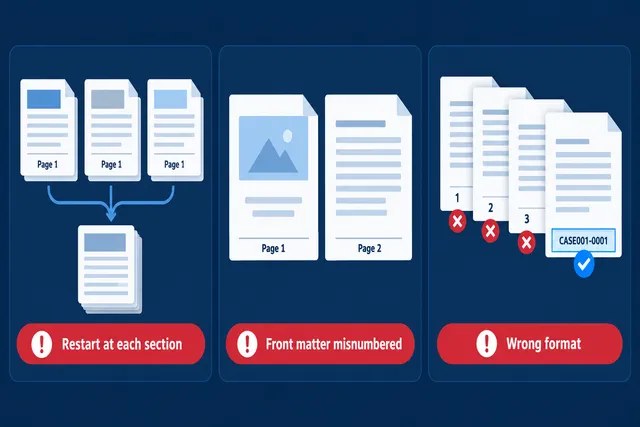
When these components are merged into a final PDF, three problems typically emerge.
First, numbering restarts at each section. A document with five merged components ends up with five "Page 1" entries. For an auditor attempting to trace a reference through the document, this is a navigational dead end.
Second, cover pages and front matter get numbered. In professional and regulatory submissions, the cover page, table of contents, and executive summary are usually excluded from the main numbering sequence. Without the ability to skip specific pages, the entire numbering scheme is off by the front matter count.
Third, the format doesn't match the standard. Some regulatory submissions require "Page X of Y" format. Others require Roman numerals for preliminary pages and Arabic numerals for the body. Still others, particularly in legal contexts, require Bates numbering with a case prefix. A generic "add page numbers" tool that only supports "1, 2, 3" won't satisfy these requirements.