

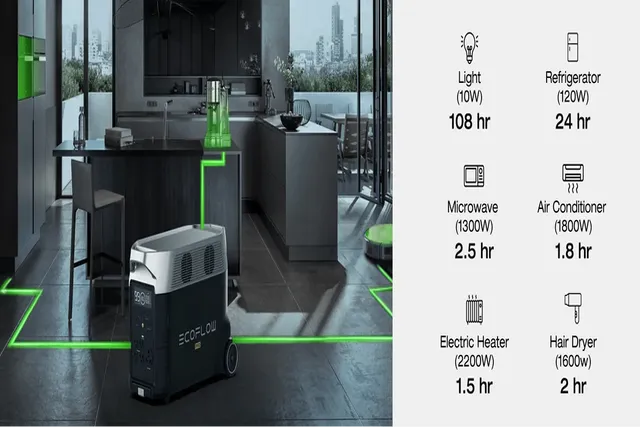
For home backup, a portable power station needs enough output to run essential devices and enough battery capacity to keep them powered throughout the planned outage. In the 12-hour examples below, internet access, phone charging, and basic lighting require roughly 400–500Wh of rated capacity. Adding a laptop, fan, and refrigerator brings the suggested capacity closer to 2,000Wh. Output power must also cover running loads and appliance startup.
These differences are becoming more relevant as households look for flexible backup power options. The portable power stations market is expanding as consumers seek reliable electricity during outages, outdoor trips, and off-grid activities. Choosing a suitable model starts with understanding power consumption, battery capacity, and the features that matter during an outage.
Three Key Trends Shaping the Portable Power Stations Market
1. Demand for Home Backup Is Driving Interest in Higher-Capacity Models
Power outages caused by severe weather, grid problems, or equipment failures can interrupt internet access, refrigeration, lighting as well as other essential household functions. Portable power stations offer a battery-based option for keeping selected devices running without relying on a fuel-powered generator.
However, backup needs vary by household. A compact unit may support communication devices and lights, while a household that wants to operate a refrigerator for several hours may need a much larger battery and a higher power output.
This is encouraging manufacturers to offer products across a wider range of capacities and output ratings. It is also making clear capacity information more important, as buyers compare how long different models can run their essential appliances.
2. Solar Charging and Expandable Batteries Are Making Backup Systems More Flexible
Portable power stations can often be recharged through a wall outlet, a vehicle connection, or compatible solar panels. Solar charging can be particularly useful during longer outages or in locations without reliable grid access, although actual charging depends on sunlight, panel placement, weather, and the station's input limits.
Some manufacturers also offer expandable battery systems. These allow compatible units to be connected to additional battery packs to increase stored energy. This can provide a more flexible option for households that need greater capacity but do not want to purchase the largest system immediately.
For the market, solar compatibility and modular designs create opportunities to serve different backup needs. They also make charging speed, expansion limits, and compatibility important factors when comparing products.
3. Battery Technology Is Influencing Product Life and Value
Battery chemistry affects the size, weight, charging performance as well as expected service life of a portable power station. Lithium-ion batteries are widely used because they can store substantial energy in a relatively compact unit. Lithium iron phosphate (LiFePO4), a type of lithium-ion battery chemistry, is also used in products designed to offer long cycle life.
These developments matter because a portable power station may remain unused for long periods before being needed during an emergency. Battery durability, maintenance requirements, charging time, and safe storage can therefore influence its long-term value.
For manufacturers, battery improvements create opportunities to develop more durable and capable products. For buyers, the main consideration is not simply the battery label but the manufacturer's specifications, warranty, expected cycle life, and guidance on safe operation.
Portable Power Stations Market Outlook
These trends form part of the wider growth in portable energy storage. According to Coherent Market Insights (CMI), the global portable power stations market is estimated to be valued at US$763.9 million in 2026 and is projected to reach USD 1,387.6 million by 2033, registering a CAGR of 8.9% during the forecast period.
Demand is supported by the need for backup electricity, growing interest in outdoor recreation, and the use of portable power in off-grid locations. At the same time, the upfront cost of larger stations and the availability of alternative power sources can limit adoption.
The CMI report divides the market by capacity, technology, and application. These segments help explain why portable power stations range from small units for charging personal devices to larger models designed for demanding backup loads.
Key Segments of the Portable Power Stations Market
The CMI report covers the following segments.
By Capacity
- Under 300 Wh
- 300–600 Wh
- Above 600 Wh
By Technology
- Lithium-ion
- Lead-acid
- Fuel Cell Vehicle (FCV)
By Application
- Emergency
- Off-grid
- Automotive
By Region
- North America
- Latin America
- Europe
- Asia Pacific
- Middle East
- Africa
Capacity and technology are especially relevant when choosing a home backup system. Capacity determines how much energy a station can store, while battery technology affects factors such as weight, charging behavior, and expected service life. The application segment also shows how the same product category can serve emergency backup, remote power needs, and selected automotive uses.
Under 300 Wh: The Leading Capacity Segment
According to Coherent Market Insights, under-300 Wh segment is expected to account for 54.7% of the portable power stations market in 2026.
Compact units in this category are popular because they are relatively light, easy to carry, and generally more affordable than larger stations. They can suit camping trips, short outings, and basic emergency needs such as phone charging, small lights, and selected communication devices.
Their main limitation is stored energy. A station with a rated capacity below 300 Wh will not normally provide enough usable energy to run a laptop, fan, and refrigerator together for a long outage. Conversion losses and the energy reserved in the battery further reduce the amount available to connected devices.
The segment's leading market share reflects the appeal of portability and affordability, rather than its suitability for every backup task. For home use, a smaller unit can still be useful when the priority is keeping essential low-power devices running. Households planning to operate larger appliances need to compare higher-capacity options instead.
Lithium-Ion Technology Leads the Market
As per CMI, lithium-ion segment is expected to hold 44.9% of the market in 2026. Lithium-ion technology is widely used in portable power stations because it offers a practical balance between energy storage, weight, and performance. These characteristics are useful for products that need to remain portable while supplying power to several types of devices.
Battery design is particularly important in larger units intended for home backup. A household may need enough stored energy for several hours of lighting, internet access as well as refrigeration, while still requiring a unit that can be moved and stored conveniently. Battery cycle life and charging performance also affect the cost of using the station over time.
LiFePO4 batteries are another option within the broader lithium-ion family. Some models use this chemistry to offer longer cycle life, although actual performance depends on the battery design and operating conditions.
For buyers, the useful comparison includes rated capacity, usable energy, continuous output, surge capability, charging time, warranty, and manufacturer guidance. Battery chemistry alone does not determine whether a station is suitable for a particular household.
How to Calculate the Right Size for Home Backup
The market offers portable power stations in several capacity ranges, but the right choice depends on the devices that must remain powered. Two checks are needed: output power, measured in watts, and battery capacity, measured in watt-hours.