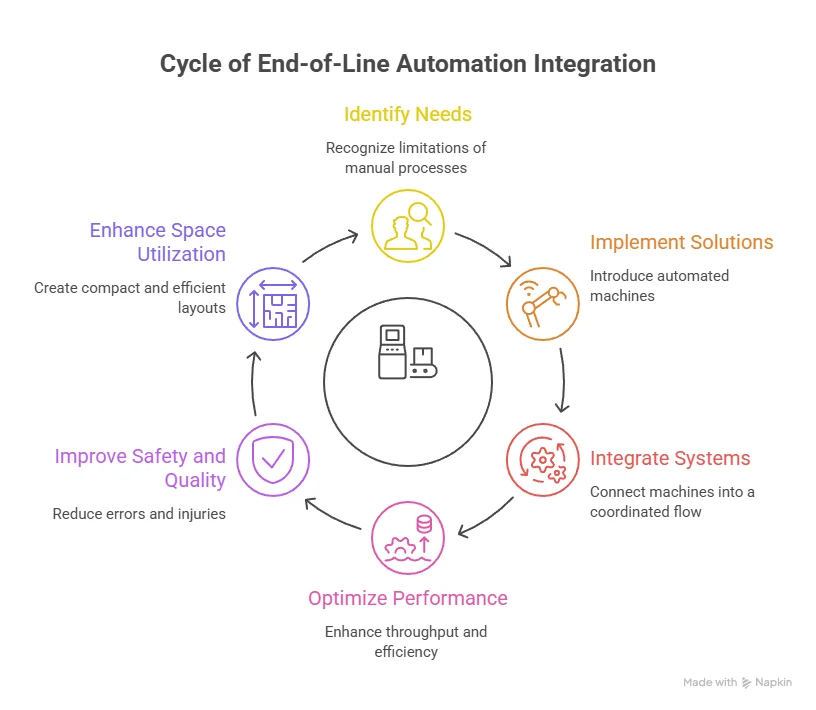
As you look at your automation lines, you are probably feeling growing pressure to move beyond manual or semi-automatic end-of-line processes and toward fully integrated, smart systems that can keep pace with your upstream investments. End-of-line packaging automation is moving from a “nice to have” to a nonnegotiable part of modern manufacturing.
You face tighter delivery schedules, more frequent changeovers, and a shrinking labor pool. At the same time, customers expect consistent quality, complete traceability, and competitive pricing.
This article looks at how smart, connected lines are redefining end-of-line efficiency, why integration with Industry 4.0 architectures matters, and where you see the strongest growth opportunities across regions and sectors.
From Semi-Automatic to Fully Integrated
If your end-of-line areastill depends heavily on manual labor, you are not alone. Many plants evolved gradually, adding stand-alone machines as needed. That approach solved immediate problems, but it also created islands of automation that do not work together smoothly.
Today you see a different pattern. Manufacturers are shifting toward fully integrated end-of-line packaging automation that links case forming and packing, sealing, labeling, inspection, and palletizing into a coordinated flow. Each machine is chosen with systemwide performance in mind, not as an isolated purchase.
The drivers are clear
Higher throughput requirements that push manual processes beyond their physical limits.
Fewer skilled operators available for repetitive, physically demanding tasks.
Greater product variety that demands frequent, fast changeovers.
Stricter safety and quality standards that leave little room for error.
In many projects, palletizing becomes the anchor point for an upgrade. Automated palletizers reduce strain injuries, bring consistency to stacking patterns, and create a predictable interface with downstream logistics. Around that anchor, you then build or modernize upstream functions such as case packing and stretch wrapping to achieve a balanced flow.
When you design the line as a whole, you also gain better use of space. Instead of scattered machines and ad hoc conveyors, you can create compact layouts with clear material and operator flows, which support both safety and productivity.
Turning the Line Into a Data Source
You know that Industry 4.0 is no longer just a buzzword at the corporate level. It shows up every time you install new equipment, review your SCADA setup, or ask for more visibilityinto what is happening on the floor.
End-of-line packaging automation plays a key part in that story because it sits at the point where finished product leaves the production area and enters warehousing and distribution. That position makes it an ideal place to capture data about
Actual production volumes versus plan
Changeover times
Downtime patterns and root causes
Quality issues such as incorrect labels or damaged packs
Modern machines come withbuilt-in connectivityand richer diagnostics than older equipment. When you connect these systems into your plant network, you can collect detailed performance data in real time. You no longer rely solely on handwritten logbooks or rough estimates from the shift.
With that data at hand, you can move from reactive firefighting to more proactive decisions.
Vision systems also play a growing role in this transformation. Camera-based inspection at the end of the line can check for correct barcodes, date codes, label placement, or case integrity.
The Human Side of Automation
Any discussion of automation raises questions about the workforce. On your floor, you probably hear concerns about job security, workload, and retraining. Those concerns are understandable, and how you manage them has a direct impact on project success.
In many plants, end-of-line packaging automation does not eliminate all roles; instead, it changes them. Operatorsshift from repetitive manual lifting and stacking to tasks such as:
Monitoring machine status and performance
Performing changeovers and basic adjustments
Handling first-level troubleshooting
Coordinating material flow to and from the line
These changes can improve safety and job satisfaction if you support them with proper training and clear communication. You reduce exposure to repetitive motion injuries and heavy lifting while creating opportunities for operators to build technical skills.
Flexibility for Shorter Product Cycles
You probably see your product portfolio changing faster than it did five or 10 years ago. Marketing introduces new formats and promotions, customers demand customization, and retailers want private-label variations. For your packaging line, that means more SKUs and more frequent changeovers.
Traditional equipmentdesigned around lengthy runs and infrequent adjustments struggles under that pattern. You lose valuable time on each changeover, and those minutes add up quickly over the course of a week.
New generations of end-of-line packaging automation take flexibility seriously. They offer
Tool-less or low-tool changeoverswherever possible
Recipe-based settings that operators can select on a touchscreen
Guiding systems that show the correct steps and confirm completion
Servo-driven adjustments that reduce trial-and-error
Collaborative robots, or cobots, are another option for flexible tasks such as mixed-case palletizing or handling seasonal products. You can reprogram them for new configurations without major engineering changes.
Regional and Sector Hot Spots
Globally, you see different levels of maturity and different adoption drivers for end-of-line packaging automation.
Across all regions, the food and beverage industry stands out. You know how strongly this sector feels pressure from both regulators and consumers. Strict hygiene rules, tight shelf-life windows, and the dominance of large retailers leave little room for error.
Automated, consistent end-of-line processes provide an important layer of assurance that finished product reaches customers in the right condition, with complete and correct information on the label.
Pharmaceutical and personal care manufacturers show a similar pattern, with serialization, tamper evidence, and regulatory inspections all pushing toward more controlled, automated end-of-line operations.
Building a Roadmap That Fits Your Plant
A practical roadmap helps you move from today’s reality to the level of automation that fits your products, volumes, and budget.
Vendor selection matters here. You benefit from partners who understand your industry, offer a clear lifecycle support plan, and can integrate their equipment into your existing environment. References from plants similar to yours are particularly helpful, because they show how systems perform under real conditions.
Product portfolios will keep evolving, customer expectations will climb, and regulations will tighten. When you design your end-of-line packaging automation with modularity and connectivity in mind, you give yourself options for the next round of improvements.
Disclaimer: This post was provided by a guest contributor. Coherent Market Insights does not endorse any products or services mentioned unless explicitly stated.
Share this story
M
About Author
Milan Tančik
Milan Tančik- Experienced Content Writer with a Bachelors degree in English Language and Literature from the Faculty of Philosophy in Novi Sad, as well as a demonstrated history of working in the SEO space.