

Short answer: Forrester's Q1 2025 Wave evaluated the ten most significant MDR vendors across 21 criteria and named CrowdStrike, Expel and Red Canary as Leaders, with eSentire and Binary Defense as Strong Performers. For ecommerce specifically, the shortlist should weight identity monitoring and third-party visibility over endpoint coverage alone.
That weighting comes from the data rather than preference, and it is the opposite of how most MDR comparisons are structured.
Check who a vendor actually serves before a shortlist is prepared
MDR vendor rankings are frequently published by MDR vendors, and the author usually appears at the top. Segment fit is not always visible from a feature table.
G2 review data shows Huntress is heavily focused on small businesses, while Expel has a stronger enterprise presence. Both are good products, but they are not interchangeable.
The wider point is that the MDR category is still consolidating. Independent ICT market research shows security services among the faster-growing enterprise software segments, attracting more entrants than can meaningfully differentiate.
Managed Detection and Response (MDR) services rely on Endpoint Detection and Response (EDR) technologies as a core foundation. While EDR provides endpoint monitoring, threat detection, and automated response capabilities, MDR adds human expertise, continuous monitoring, and incident investigation to improve overall cybersecurity effectiveness.
This increasing adoption of MDR services is also propelling the demand for Endpoint Detection and Response (EDR) solutions. This is because the organizations seek stronger endpoint visibility, behavioural threat detection, and faster incident response capabilities across distributed IT environments.
The global Endpoint Detection and Response (EDR) Market is estimated to reach USD 6,892.8 Mn in 2026 and is projected to grow to USD 35,375.2 Mn by 2033, registering a CAGR of 26.3% during 2026–2033, driven by rising cyberattack complexity, expanding enterprise mobility, remote work adoption, and the growing need for proactive endpoint protection.
The market remains segmented across multiple deployment and adoption models. By Component, the market is divided into Solutions and Services, with solutions accounting for the core demand base. By Deployment Type, the adoption is split between Cloud-based and On-premise deployments, while on the basis of Solution Type includes Workstations, Mobile Devices, Servers, and Point-of-Sale Terminals. By Organization Size, demand is distributed across Small and Medium Enterprises (SMEs) and Large Enterprises.
The vendors differentiate through detection accuracy, automation capabilities, integration with broader security ecosystems, and managed security support rather than the endpoint protection alone.
The EDR industry is also evolving around three shifts that are changing the way the enterprises approach endpoint security. AI-led detection and response is becoming a key focus as the security teams look to reduce investigation time and improve threat identification. The greater integration with XDR and broader security ecosystems is gaining momentum and thus allow the endpoint intelligence to be combined with identity, cloud, and network signals rather than evaluated in isolation. At the same time, cloud-based EDR adoption is accelerating as organizations increasingly shift toward scalable and flexible security architectures. Cloud-based deployments accounted for 59.0% share in 2026, supported by the growing need to secure remote teams, hybrid infrastructures, and expanding digital ecosystems. The preference for cloud-based models is driven by their ability to provide centralized monitoring, simplified security management, and faster threat response across distributed environments.
Together, these trends are moving EDR from a standalone endpoint tool toward a more connected security operations layer.
What the breach data actually says
Verizon's 2025 Data Breach Investigations Report analyzed more than 22,000 security incidents including 12,195 confirmed breaches. Three findings should shape an ecommerce shortlist.
Credentials are the leading way in, not code. Stolen credentials accounted for 22 percent of breaches, ahead of vulnerability exploitation at 20 percent and phishing at 15 percent. For a store, that means the admin login rather than the theme file.
Web application attacks run on stolen credentials. 88 percent of basic web application attacks involved stolen credentials, which is the single most relevant figure in the report for anyone running a storefront.
Third-party involvement doubled. Breaches involving a third party went from 15 percent to 30 percent in a year. For ecommerce that means agencies, installed apps, contractors and every integration holding an API key.
Comparison at a glance
|
Vendor |
Best for |
Segment weight |
Published pricing |
|
CrowdStrike Falcon Complete |
Hands-off full remediation |
Enterprise |
From $184.99 per device/year in Falcon Enterprise |
|
Expel |
Enterprise buyers with mixed tooling |
50.7% enterprise on G2 |
Not published |
|
Red Canary |
Detection engineering depth |
Mid-market to enterprise |
Not published |
|
ESET |
Response speed and research depth |
Enterprise tier available |
Not published |
|
eSentire |
Mid-market to enterprise coverage |
Mid-market to enterprise |
Not published |
|
Sophos MDR |
Existing Sophos estates |
Mid-market |
Not published |
|
Huntress |
Small business and MSP-managed stores |
80.8% small business |
Not published |
|
Proficio |
Agentic AI triage at scale |
Mid-market to enterprise |
Not published |
Pricing and positioning details for vendors other than ESET are drawn from publicly published comparisons rather than each vendor's own documentation, so confirm them directly before shortlisting. ESET figures come from its own service pages.
1. ESET
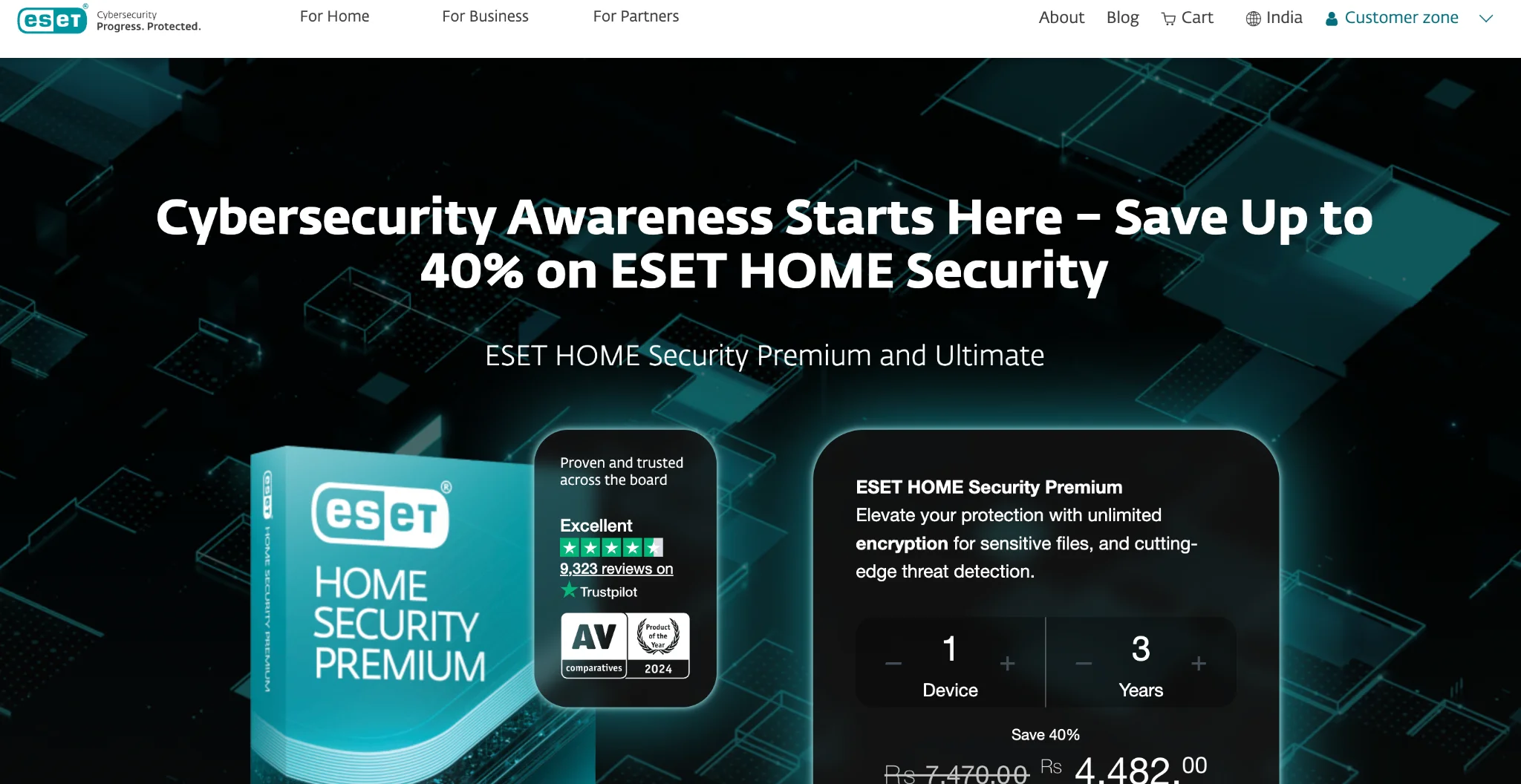
Best for: enterprises where response speed and forensic support matter more than platform breadth.
The managed detection and response service from ESET publishes a mean time to respond of six minutes, against an average of 22 minutes across sampled MDR providers on their own published figures as of July 2025. It defines that as the average time between initial detection of an incident and the first action taken, which is the definition worth applying to every vendor here.
The research base is unusual. Global telemetry across more than 100 million sensors and 11 R&D centers, 35 years of operation, and membership of the Joint Cyber Defense Collaborative led by CISA. It is a Market Leader specifically in MDR in the KuppingerCole Leadership Compass 2026 and a Leader in the 2024 IDC MarketScape for Modern Endpoint Security, with more than 1,100 Gartner Peer Insights reviews.
Watch for: ESET is not in the Forrester Wave, so the buyer is weighing published response times and analyst recognition rather than that specific evaluation.
2. CrowdStrike Falcon Complete
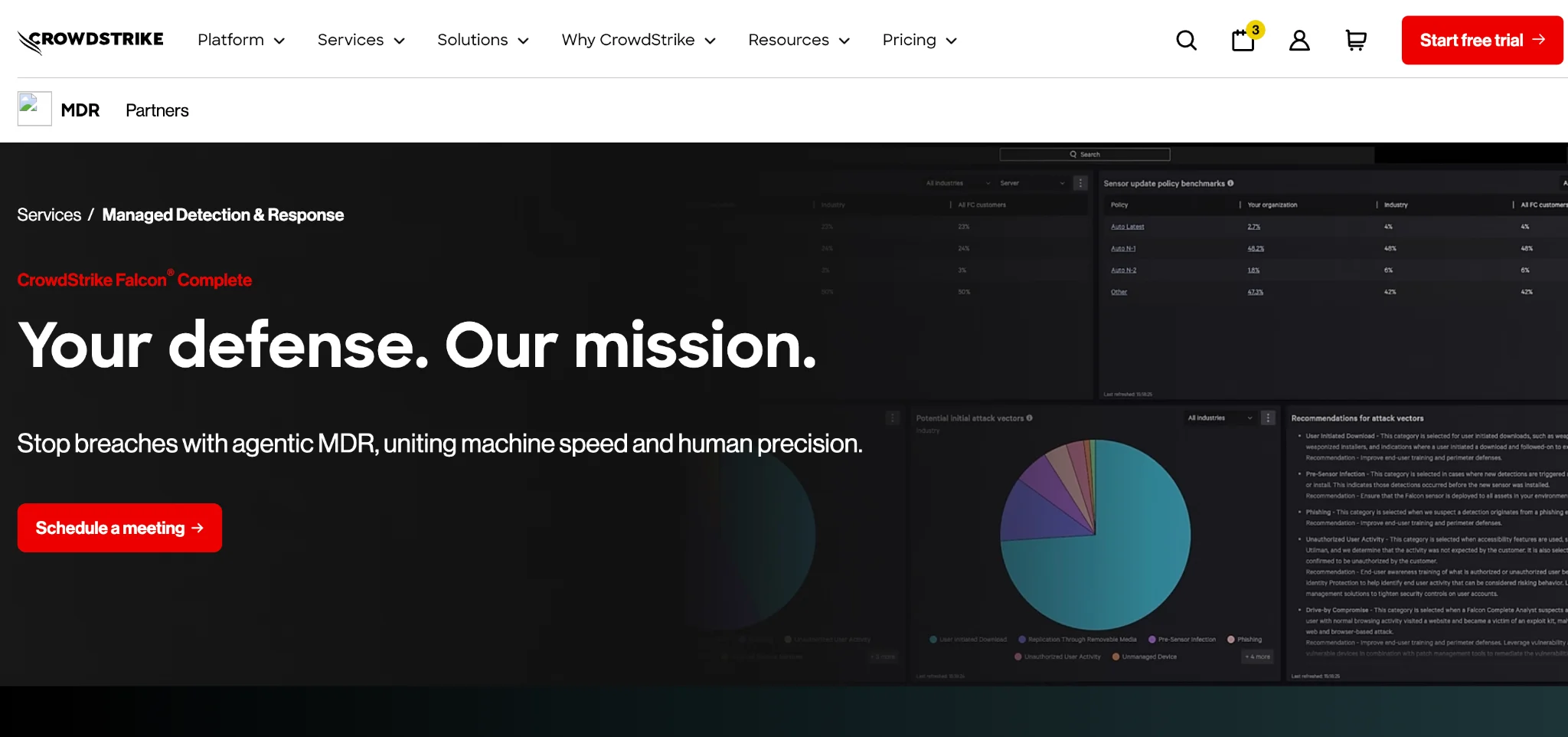
Best for: enterprises wanting the provider to remediate rather than advise.
A Forrester Wave Leader, with the service performing full remediation through the remediation process rather than handing a recommendation. It carries a $1 million breach warranty, which is a rare commercial commitment in this category.
Watch for: it is the priciest entry here at $184.99 per device per year within Falcon Enterprise, and the value case weakens if an organization is not already committed to the Falcon platform.
3. Expel

Best for: enterprise ecommerce with tooling accumulated through acquisition.
A Forrester Wave Leader, and the most enterprise-weighted vendor in this comparison by review segment. Forrester specifically credited its balance of human-led investigation against software-enabled platforms, which matters when the organization's stack was assembled rather than chosen.
Watch for: results depend on the quality of telemetry the organization feeds to it, so the integration work is real.
4. Red Canary
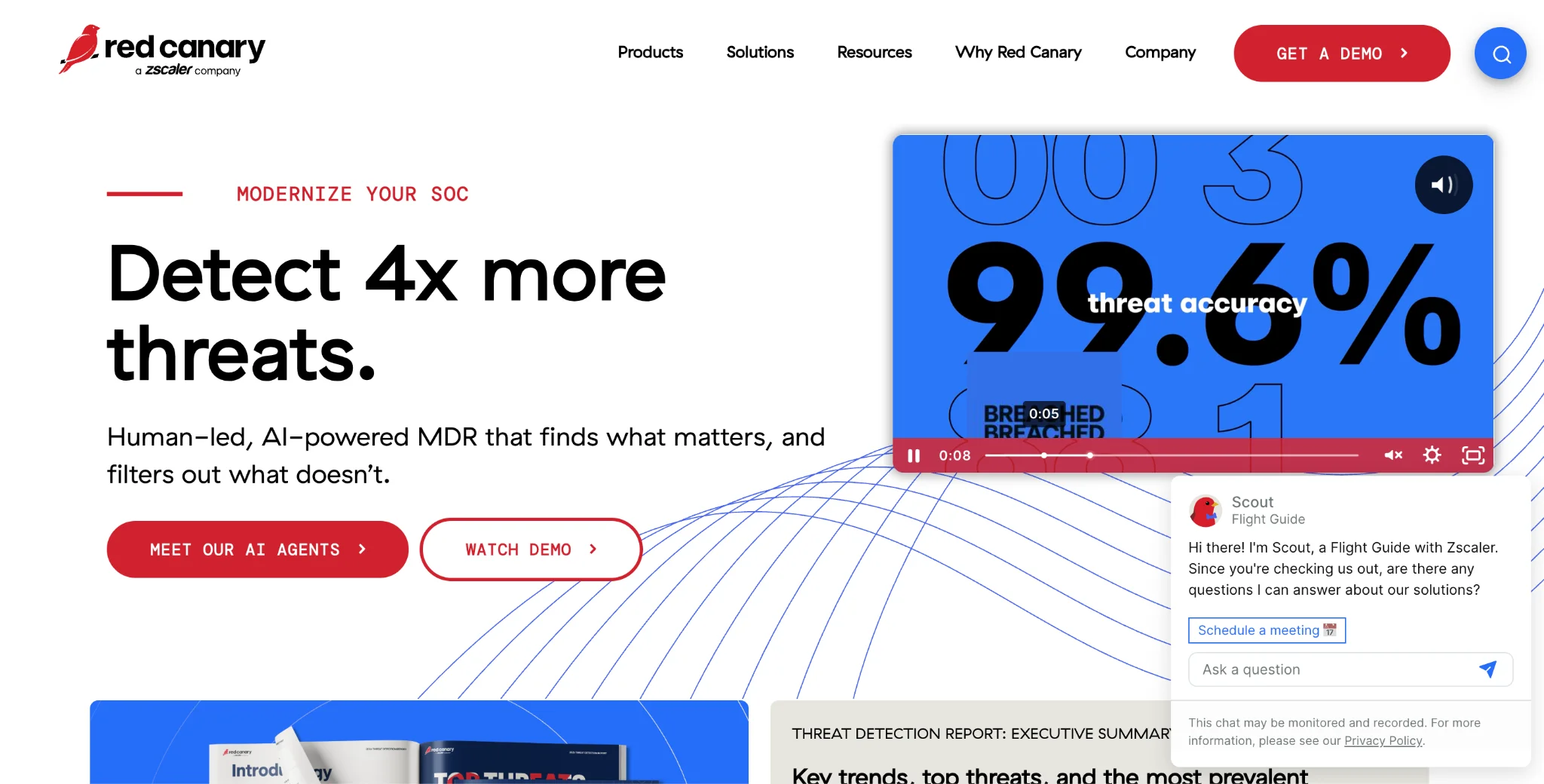
Best for: organizations that want detection engineering rather than alert forwarding.
The third Forrester Wave Leader, recognized for threat intelligence pedigree and awarded the highest possible scores in ten criteria including detection engineering and threat hunting.
Watch for: strongest on detection, so confirm what response actions are included versus recommended.
5. eSentire
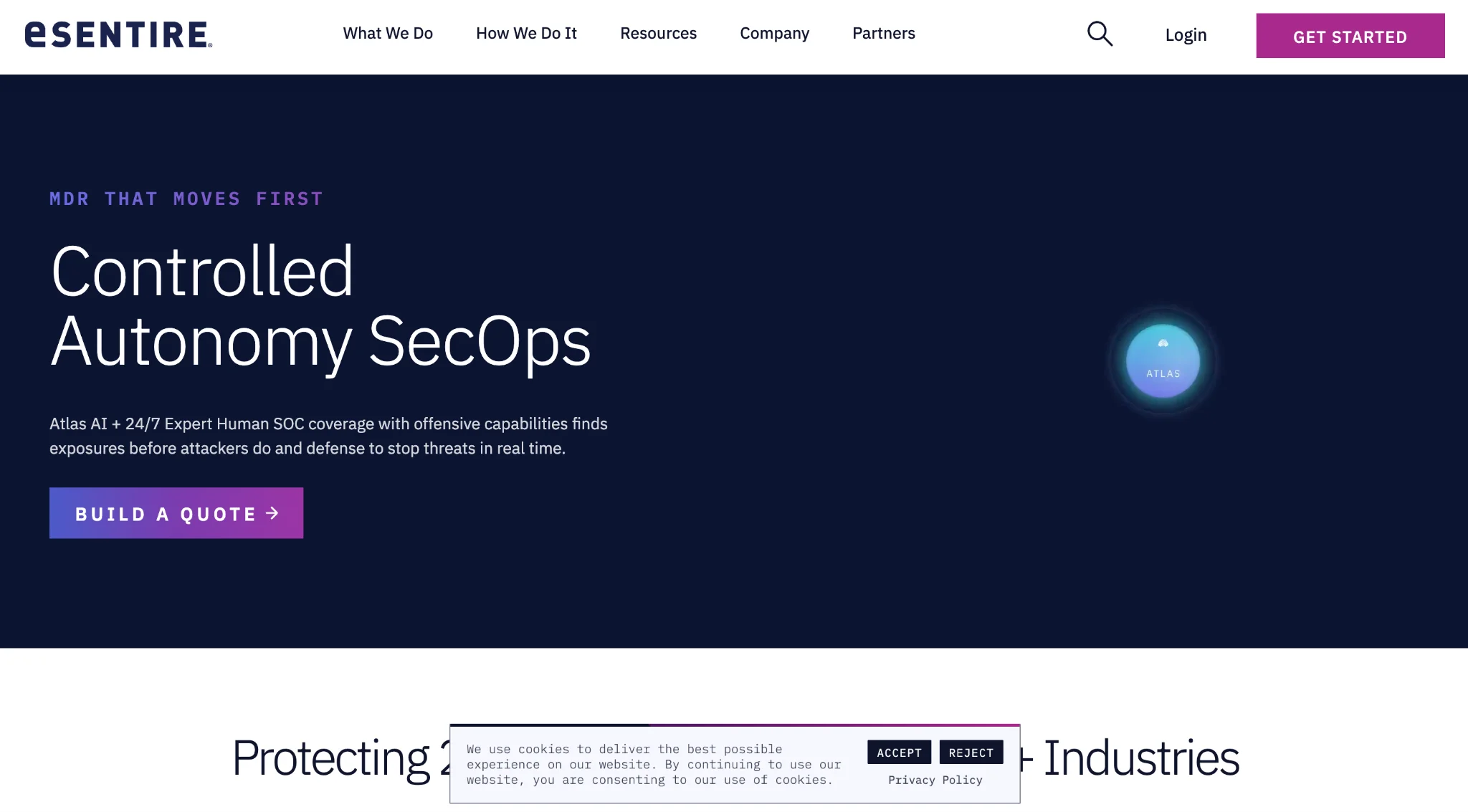
Best for: mid-market to enterprise buyers wanting a named Wave placement below Leader tier.
A Forrester Wave Strong Performer with broad coverage across endpoints, identity, cloud and log sources.
Watch for: pricing is not published, so budget for a scoped proposal.
6. Sophos MDR

Best for: organizations already running Sophos firewalls, email gateways or endpoints.
The integration argument is the whole argument If an organization's estate is already Sophos, the operational overhead of adding MDR is lower than switching.
Watch for: weaker case if the organization is not already part of that ecosystem.
7. Huntress
Best for: smaller stores, or stores managed through an MSP.
Strong reviews and a lightweight agent, with G2 scores among the highest in the category.
Watch for: 80.8 percent of its reviews come from small business and 2.2 percent from enterprise. That is a positioning fact rather than a criticism, and it should decide whether it belongs on an enterprise shortlist.
8. Proficio
Best for: buyers interested in agentic AI handling first-pass triage.
For 2026 it introduced autonomous agents combing unstructured telemetry so human analysts focus on complex investigations.
Watch for: ask what the agents can act on independently versus what they only surface.
Where platform responsibility ends
Hosted commerce platforms typically hold PCI DSS Level 1 certification, and merchants inherit compliant hosting and payment infrastructure. Shopify is the largest example, though the boundary works the same way across Adobe Commerce, BigCommerce and Salesforce Commerce Cloud. That covers the platform, not the merchant operation.
Staff accounts, API keys, installed apps, custom scripts, business email and employee laptops all remain under merchant control. Order-level fraud tooling manages transaction risk and does not monitor administrator logins or employee devices, which is the gap MDR fills when identity, endpoint and application data is connected.
Given that credentials are the leading breach vector, Shopify admin security practices are the foundation MDR sits on rather than a substitute for it. No monitoring service compensates for shared admin accounts.
More apps, more integrations, more team members and more external services each add an access point to the admin dashboard, which is precisely why third-party involvement now sits at 30 percent of breaches.
Staff accounts, API keys, installed apps, custom scripts, business email and employee laptops all
PCI DSS v4.0.1 and checkout integrity
Two requirements became mandatory on 31 March 2025, and both target client-side script attacks that earlier versions did not cover.
Requirement 6.4.3 governs script management. Every script loaded on a payment page must be authorized, have its integrity verified and appear in an inventory with written business justification. That includes third-party scripts, and it extends to the pages leading up to checkout.
Requirement 11.6.1 governs detection. A mechanism is required that alerts on unauthorized changes to payment page content and security-impacting HTTP headers, evaluated at least weekly, though assessors increasingly expect continuous monitoring.
The phrase that decides the selected tooling is as received by the consumer browser. A skimmer injected through a compromised CDN or a tampered third-party tag never touches the merchant server, so file integrity monitoring alone does not satisfy 11.6.1, and neither does MDR.
Be clear on the boundary. MDR does not make the merchant compliant and does not watch the consumer's browser. What it does, once change-detection alerts are connected as a data source, is compress the time between an unauthorized script firing an alert and somebody investigating it.
The increasing complexity of digital environments has also changed how enterprises evaluate endpoint security capabilities. While compliance requirements and platform-level controls address specific security obligations, organizations continue to require broader visibility across devices, applications, and infrastructure. This has strengthened demand for EDR solutions, which represent the leading component segment of the market, accounting for 67.0% share in 2026.
Within the Managed Detection and Response (MDR) ecosystem, EDR solutions serve as a foundational technology layer by providing continuous endpoint monitoring, behavioural analytics, threat intelligence, and automated response capabilities that enable MDR providers to deliver faster detection, investigation, and remediation of security incidents.
The solutions segment remains central to enterprise adoption as it enables real-time endpoint visibility, behavioural threat detection, investigation, and response across critical environments. These capabilities extend across workstations, mobile devices, servers, and point-of-sale terminals, reflecting the growing need to secure diverse endpoint ecosystems rather than relying only on traditional perimeter protection.
How to evaluate
Response authority. Document which actions the provider takes without approval. Can analysts disable a staff account or end a session at 2am during a sale?
Identity first. Given the 22 percent credential figure, identity and email coverage matters more than endpoint count for ecommerce.
Third-party visibility. With third-party involvement at 30 percent of breaches, ask how the provider monitors agency access, contractor accounts and app-level API keys.
Ecommerce playbooks. Account takeover, card testing, checkout script tampering and ransomware should each have a documented process. Ask to see them.
Least privilege. The provider should hold only the store administration, identity and single sign-on permissions the agreed service requires.
Published response times, and whether they are contractual. An average on a marketing page and an SLA with remedies attached are different things.
The U.S. is the most developed and influential market for Endpoint Detection and Response solutions where enterprise buyers are evaluating platforms based on more than endpoint coverage alone. The combination of rising ransomware activity, increasing regulatory scrutiny, cloud migration, and expanding hybrid work environments has made continual endpoint visibility and rapid response capabilities a core security requirement.
The organizations across financial services, healthcare, government, retail, and technology sectors are adopting AI-driven EDR platforms to reduce investigation time, improve threat detection accuracy, as well as strengthen the security operations.
The market is also highly competitive, with vendors differentiating through platform depth rather than endpoint protection alone. CrowdStrike, Microsoft, Palo Alto Networks, SentinelOne, Broadcom (Symantec), Trellix, Sophos, Trend Micro, Cisco, and ESET are among the key participants shaping the category.
CrowdStrike and SentinelOne have built their positioning around cloud-native detection and automated response. Microsoft, Cisco, and Palo Alto Networks benefit from broader security ecosystems connecting endpoint, identity, network, and cloud signals.
FAQ
What are the best MDR services for enterprise ecommerce?
Forrester's Q1 2025 Wave named CrowdStrike, Expel and Red Canary as Leaders among ten vendors evaluated, with eSentire and Binary Defense as Strong Performers. For ecommerce specifically, weight identity and third-party coverage heavily, and check the reviewer segment mix before assuming a highly rated vendor serves the organization's size.
Does platform PCI compliance mean I do not need MDR?
No. Platform certification covers the hosted payment environment. Merchant-controlled accounts, apps, scripts and devices remain merchant responsibility and the remaining monitoring gap.
What is the leading cause of ecommerce breaches?
Stolen credentials, at 22 percent of breaches in Verizon's 2025 report, ahead of vulnerability exploitation at 20 percent. Notably, 88 percent of basic web application attacks involved stolen credentials.
How much does enterprise MDR cost?
Almost nobody publishes. CrowdStrike lists Falcon Enterprise from $184.99 per device per year, and the rest of this list quotes on request. Expect per-endpoint or per-user pricing with annual commitments at enterprise tier.
How is MDR different from EDR or XDR?
EDR and XDR are technologies somebody has to configure and operate. MDR adds the analysts who monitor them, investigate alerts and carry out agreed response actions.
Will MDR make an ecommerce store PCI compliant?
No. It can support monitoring and incident response, but scope determination, control implementation and evidence retention stay with the merchant organization.