CRM integration also makes mail easier to trigger, coordinate with digital channels and measure against customer responses. For broadband providers, the value lies in making those connections work around service availability, installation milestones and subscriber needs.
Choosing a platform therefore comes down to how it connects customer data, campaign timing and physical delivery. The seven platforms below approach that differently.
Key Takeaways
- A serviceability change, an upgrade window or a completed install can each trigger a mailpiece without a manual list export.
- The USPS Intelligent Mail barcode gives piece-level scan visibility, but a scan is not proof a piece reached a specific mailbox.
- Response attribution comes from personalized URLs, QR codes and matchback against the converted-customer file.
- Platforms differ less on printing than on CRM depth, trigger flexibility, multi-touch sequencing and production coverage across regions.
Why Broadband Fits Address-Based Marketing
Most of an ISP's important marketing moments are tied to a specific household. Announcing availability in a newly built area, promoting an upgrade when a faster tier becomes available, welcoming a new install, prompting a renewal, or winning back a former subscriber all happen at an address.
Direct mail campaigns turn those moments into repeatable outreach and represent an estimated 39.2% of the market by marketing strategy in 2026. The providers can reuse campaign templates as construction progresses, changing the offer and mailing audience for each neighborhood. Automation makes that repetition easier, while address-based targeting keeps the message tied to households that can actually receive the service.
Digital channels struggle with that precision. A postcard does not, and demand for connectivity keeps rising as high-speed broadband benefits extend further into everyday work, education and entertainment.
Once a household subscribes, the communication needs change. Installation messages give way to upgrade offers, renewal reminders and occasional win-back campaigns. These recurring uses help explain the relevance of IT and telecom, which represents an estimated share of 18.7% of the market by end user in 2026.
Broadband providers within this segment need both serviceability and subscriber information to decide what to send. Connecting those records helps avoid acquisition offers reaching existing customers or upgrade messages reaching ineligible addresses.
The practical shift is treating mail as one step in a shared sequence rather than a separate campaign. Same trigger, same audience definition, same system of record, with email or SMS timed around expected arrival rather than a broad mailing window.
This move toward event-triggered outreach connects the market’s other marketing-strategy categories: lead generation, follow-up automation and customer retention programs. A prospect’s enquiry can prompt a follow-up, while a completed installation can move that household into a welcome sequence. The workflow changes with the customer’s situation, reducing the need to rebuild mailing lists between stages.
How These Platforms Were Compared
Each platform was checked against its own product pages and documentation rather than directory summaries. Where sources disagreed on a detail, it was left out.
That matters because these tools serve different buying needs. Beyond IT and telecom, the market covers BFSI, retail and e-commerce, government, healthcare, education, travel and hospitality, and others. A workflow designed around retail purchases may require adjustment for broadband subscriptions. The comparison therefore looks at how each platform would fit an ISP’s day-to-day campaign work.
Four criteria were weighed. Whether mail can be triggered from CRM, marketing automation or serviceability data. Whether the platform surfaces IMb scan activity alongside pURL and QR response data. Whether multi-touch sequences run as one automated flow rather than repeated manual uploads. And whether production coverage suits campaigns spanning several service regions.
The emphasis on response data reflects a closer connection between physical mail and digital campaign measurement. Teams can use recorded enquiries and conversions to adjust later sends, rather than judging a campaign only by how many pieces went out. That makes feedback into the customer record useful when deciding which capabilities justify the expense.
Per-piece pricing was deliberately excluded. Vendors quote on different bases, some all-in and some separating postage, production and software, so a figure here would mislead more than it helped.
Broadband Direct Mail Platforms at a Glance
|
Platform
|
Best suited to
|
Notable for broadband teams
|
|
Postalytics
|
ISP marketing teams running triggered mail from a CRM
|
Multi-touch Flows, postal retargeting, Calix integration
|
|
Lob
|
Enterprise teams with high volume and compliance needs
|
Postal routing, nationwide print network, address verification
|
|
PostGrid
|
Developer-led teams embedding mail in their own systems
|
REST API, CASS and SERP certified verification, 2-day SLA
|
|
Poplar
|
Growth teams running prospecting and retargeting mail
|
Lookalike modeling, address validation API
|
|
PostPilot
|
Ecommerce and DTC brands on Shopify
|
Full-service execution, own print facilities
|
|
Click2Mail
|
Teams sending on demand without a subscription
|
CRM Connect integrations, no subscription fees
|
|
PCM Integrations
|
Teams wanting per-piece pricing with no contract
|
Native HighLevel and Salesforce connections
|
The Platforms
1. Postalytics
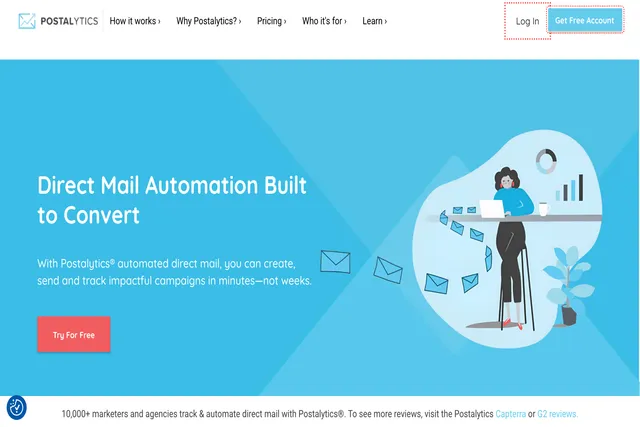
Having created the direct mail automation category in 2017, Postalytics is built to run mail inside existing CRM and marketing automation workflows. Sends trigger from CRM, marketing automation or API events, with native connections to HubSpot, Salesforce, HighLevel, ActiveCampaign, Klaviyo, Zoho and Marketo, plus Zapier for everything else, plus an integration with Calix Engagement Cloud that lets providers build audiences from subscriber and service data.
Flows handles multi-touch journeys as one automated workflow, with scheduled delays, branching logic and suppression rules. MailBack adds postal retargeting, identifying eligible anonymous US website visitors and triggering mail to qualifying households. IMb tracking, personalized URLs and QR codes feed delivery and response data back to the originating record, production runs across the US and Canada, and accounts start free with no mailing caps, with Salesforce and the full integration set on paid plans.
2. Lob
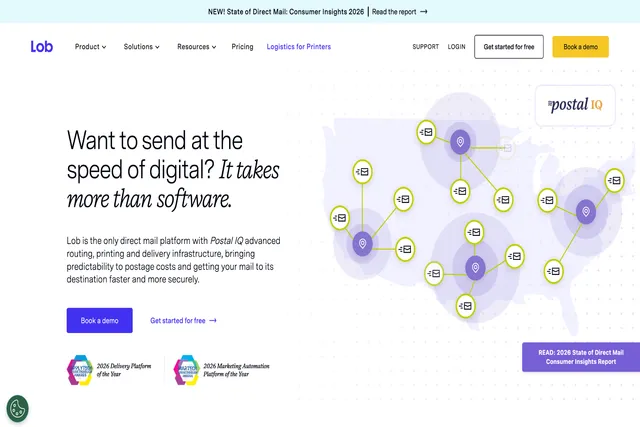
Lob positions itself around delivery infrastructure as much as software. Its postal routing selects an entry point for each piece, and its nationwide print network produces mail near the destination to cut transit time and stabilize cost on high volume.
Address verification, documented APIs and integrations sit alongside campaign tooling, and the platform publishes security practices supporting HIPAA, GDPR and CCPA. Its named verticals are financial services, healthcare, insurance, retail and ecommerce, plus SaaS, so broadband teams would be applying a general-purpose enterprise platform rather than a sector-specific one.
3. PostGrid
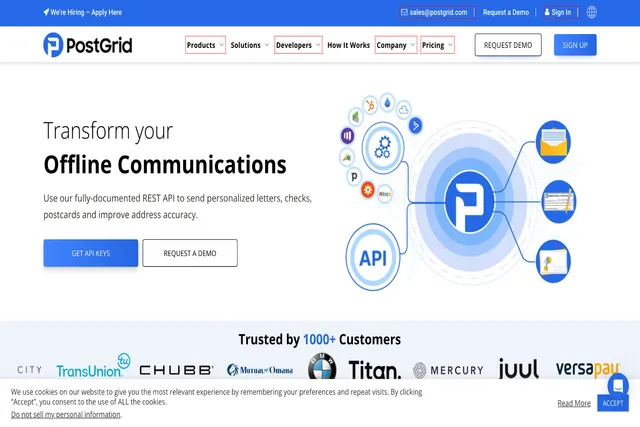
PostGrid leads with a documented REST API for sending personalized letters, postcards and checks, which suits an in-house team that wants mail embedded in its own software rather than run from a marketing dashboard. Address verification is also sold as a separate product.
Its address APIs are CASS and SERP certified, with autocomplete, bulk verification and international coverage, and the platform commits to processing mail within two business days. Integrations include Salesforce, HubSpot, Marketo, Microsoft Dynamics, ActiveCampaign, Klaviyo and Zapier, with operations across the US, Canada, UK and Australia.
4. Poplar
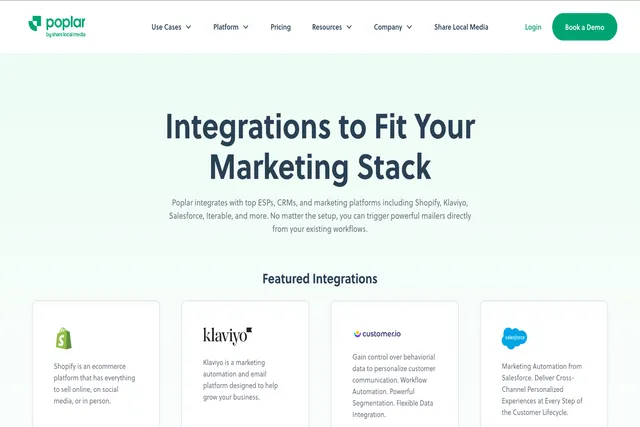
Poplar, a product of Share Local Media, structures its platform around prospecting, retargeting and retention rather than transactional mail. Prospecting uses advanced targeting and lookalike modeling, while retargeting aims at email leads and site visitors.
It offers an address validation API and API mailing alongside the dashboard, and integrates with Customer.io, Iterable, Optimizely, Mailchimp, Klaviyo, Emarsys, Shopify and Zapier. It holds SOC 2, though its published case studies skew toward consumer brands rather than service providers.
5. PostPilot
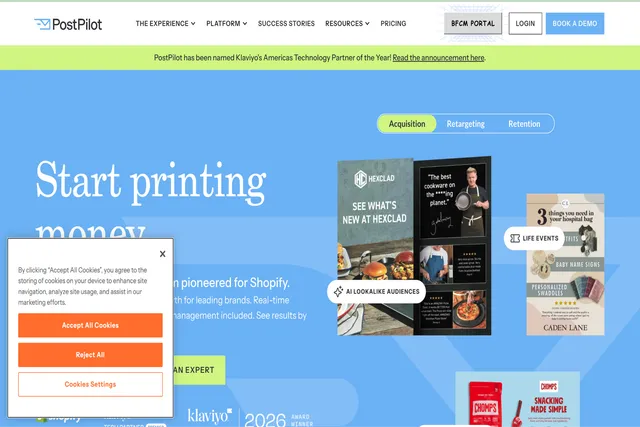
PostPilot is built for Shopify and ecommerce, and is worth including mainly so broadband teams can rule it in or out quickly. Its acquisition, retargeting and retention tooling is strong, including a lookalike engine and site and cart retargeting, and it runs its own print facilities in South Carolina, Arizona and London.
The model is full service, with strategy, creative and campaign management included rather than self serve, and there are no contracts or minimums. Native integrations center on Shopify and Klaviyo, so the fit depends on whether your stack looks like an ecommerce stack.
6. Click2Mail
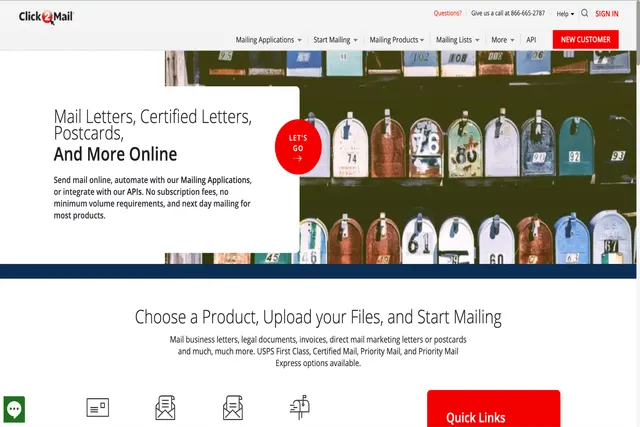
Click2Mail has been running online mailing since 2003 and suits teams that want to send on demand without committing to a subscription. There are no registration or subscription fees, and pricing works on a per-piece basis.
Its Connect product maps CRM fields to mail templates and triggers pieces on CRM events, supporting Salesforce, Podio, Follow-Up Boss, Google Sheets, HighLevel and Clio, plus Zapier and open APIs. It sits closer to a mailing service with automation attached than a marketing automation platform, which matters depending on how much sequencing a campaign needs.
7. PCM Integrations
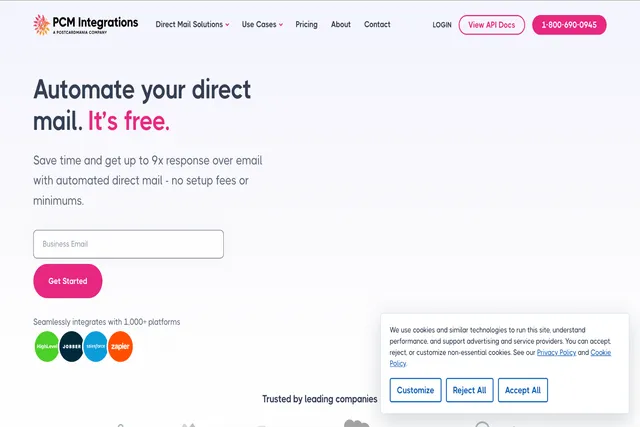
PCM Integrations sells direct mail automation on a no-contract, no-monthly-fee basis with per-piece pricing, which suits providers whose volume is uneven across a build schedule. Its API lets any software trigger physical mail.
CRM connections run through Zapier for no-code setups, with native HighLevel and Salesforce integrations available. Print production is handled in house at a facility in Clearwater, Florida, and the company also offers private-label mailing sites for multi-location groups.
Budget and Timing Considerations
Postage is the cost most likely to move during a planning cycle. Review current USPS rates before approving volume, particularly if the budget was prepared months earlier, and compare vendors on the same basis rather than on advertised price per piece. Check whether a quote covers printing, paper, postage, tracking, integrations, minimum volumes and support.
Timing deserves the same caution. USPS does not guarantee delivery dates for common marketing mail classes, so sequence follow-up around an expected delivery window rather than a fixed date. Scan events include assumed handling and logical delivery events derived from business rules rather than a physical scan of that individual piece, which makes them a useful operational signal and a poor proof of receipt.
These dependencies make the U.S. a practical setting for closer coordination between campaign software and mail production. Postal infrastructure and connected customer systems allow broadband providers, financial services firms and retailers to combine physical outreach with digital follow-up. The demand for targeted household campaigns and measurable results is supporting the growth in the U.S. direct mail automation software market. Also, the broadband expansion adds opportunities to automate outreach as more addresses become serviceable. For buyers, the adoption depends on reducing manual handoffs without losing the control of timing or customer data.
Key participants serving these needs include PFL Tactile Marketing Automation, Lob, Sendoso, PostcardMania, Postalytics, and PostGrid. Their approaches differ: Postalytics emphasizes integration with existing marketing systems, Lob focuses on production and delivery infrastructure, and PostGrid supports teams building mail into their own applications. Choosing between them means considering how much work stays with the provider’s team, how much the supplier handles, and whether that arrangement can support a wider mailing footprint.
Production coverage matters once campaigns span several service regions, and it will matter more as networks expand. Forecasts for broadband technology trends point to continued fiber and fixed wireless buildout, which means more addresses moving from planned to serviceable each quarter.
As those addresses change, closer links between customer records, campaign decisions and production should make automation more useful. For ISPs, the longer-term value is a mailing process that can follow the network’s expansion and the subscriber’s next need without being rebuilt for every campaign.
FAQ
What triggers a broadband direct mail campaign?
Common triggers include an address becoming serviceable, construction reaching a new area, a completed installation, upgrade eligibility, an approaching renewal, and a former subscriber meeting win-back criteria.
How is mail delivery tracked and timed alongside other channels?
The Intelligent Mail barcode generates scan events as a piece moves through the USPS network, and platforms use those events to schedule email or SMS around expected arrival. A scan should not be treated as confirmation that a piece reached a specific mailbox.
What is matchback analysis, and when should we use it?
Matchback compares converted customers against the mailed file to find recipients who converted without scanning a code or visiting a personalized URL. It is useful when responses arrive through search, phone or retail instead.

