People looking for local service websites are skimming through your pages. They’re just looking for what they need. Studies even suggest that most site visitors only read 20% of the text on a page. The question isn't how to get them to read more. It's what that 20% needs to be doing.
In most cases, it’s decided by two things: structure and intent.
- Structure puts parts that matter where eyes land. Think headlines, bullets, or proof.
- Intent makes those parts worth stopping for, because they solve a problem.
And there’s a bigger shift happening behind the scenes. The global digital marketing services market is expected to grow from USD 750 billion in 2026 to USD 1,300 billion by 2033, registering a compound annual growth rate (CAGR) of 9% from 2026 to 2033. That growth is being shaped by the same thing that makes a service website successful: getting the right message in front of the right person at exactly the right moment.
So, how does that look in practice? Below, we’ll break down the anatomy of a high-converting service business website.
Start With a Hero That Answers These 3 Questions
Every visitor lands with the same three questions: What do you do? Do you do it for people like me? And why you, instead of the other guy?
Your hero either answers all three at a glance or it doesn't. Nobody's timing you with a stopwatch. A scanner's eyes hit the top of the page, pull out the headline, a few bullets, maybe a number, and their gut renders a verdict: right place, or back button.
Here's a hero that answers all three, from a cleaning company in New York.
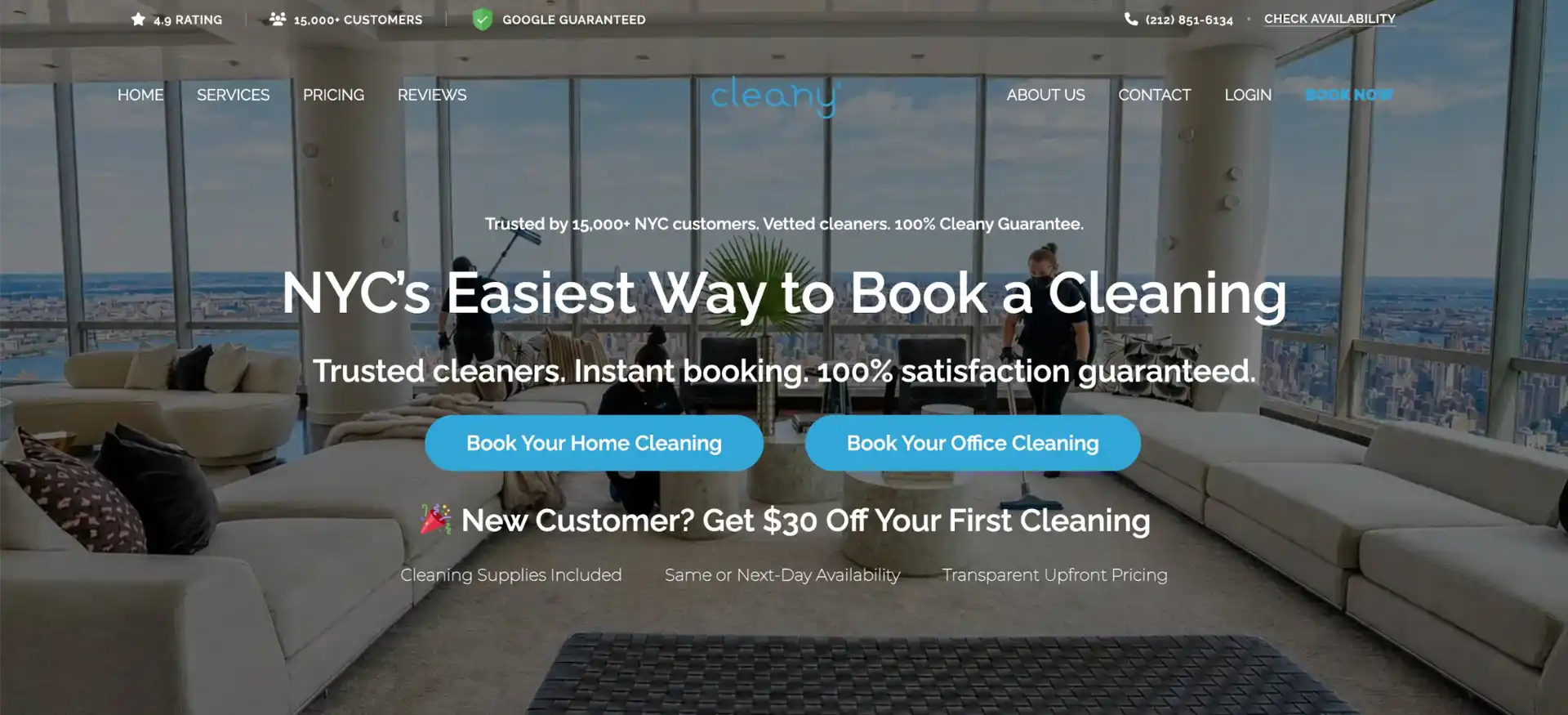
What do you do? "NYC's Easiest Way to Book a Cleaning." Service and city in seven words, with the promise baked in. No cleverness, no "we bring sparkle back to your life."
Do you do it for people like me? Book Your Home Cleaning or Book Your Office Cleaning lets visitors sort themselves in one click, and both end at a booking. Two CTAs usually split attention. These don't, because they're the same CTA asking a qualifying question.
Why you? A 4.9 rating, 15,000+ customers, and Google Guaranteed sit in the top bar. Vetted cleaners and a 100% Cleany Guarantee run above the headline. Supplies included, same or next-day availability, transparent pricing, and discounts.
There’s another reason this structure works: search remains a major gateway between intent and action. The Search Engine Optimization segment is expected to account for 35.0% of the global digital marketing services market share in 2026, making SEO one of the most prominent service types in the market. The broader service-type landscape includes Search Engine Optimization, Social Media Marketing, Content Marketing, Email Marketing, Search Engine Marketing, and Others. For a local service business, that means winning the click is only half the job. The page still has to earn the conversion.
Match the Page to the Promise That Brought The
If you’re running PPC campaigns, the ad and the landing page should have the same intent. The ad makes a promise, and the page should deliver on it. As a rule of thumb, stick with a strict message match. The headline should mirror the ad that sent them there.
It's also one of the cheapest fixes you can get. New creative costs money. A bigger budget costs more. Rewriting a headline to match the ad costs an afternoon. Which is why the ad and the page shouldn't be assigned to two different people.
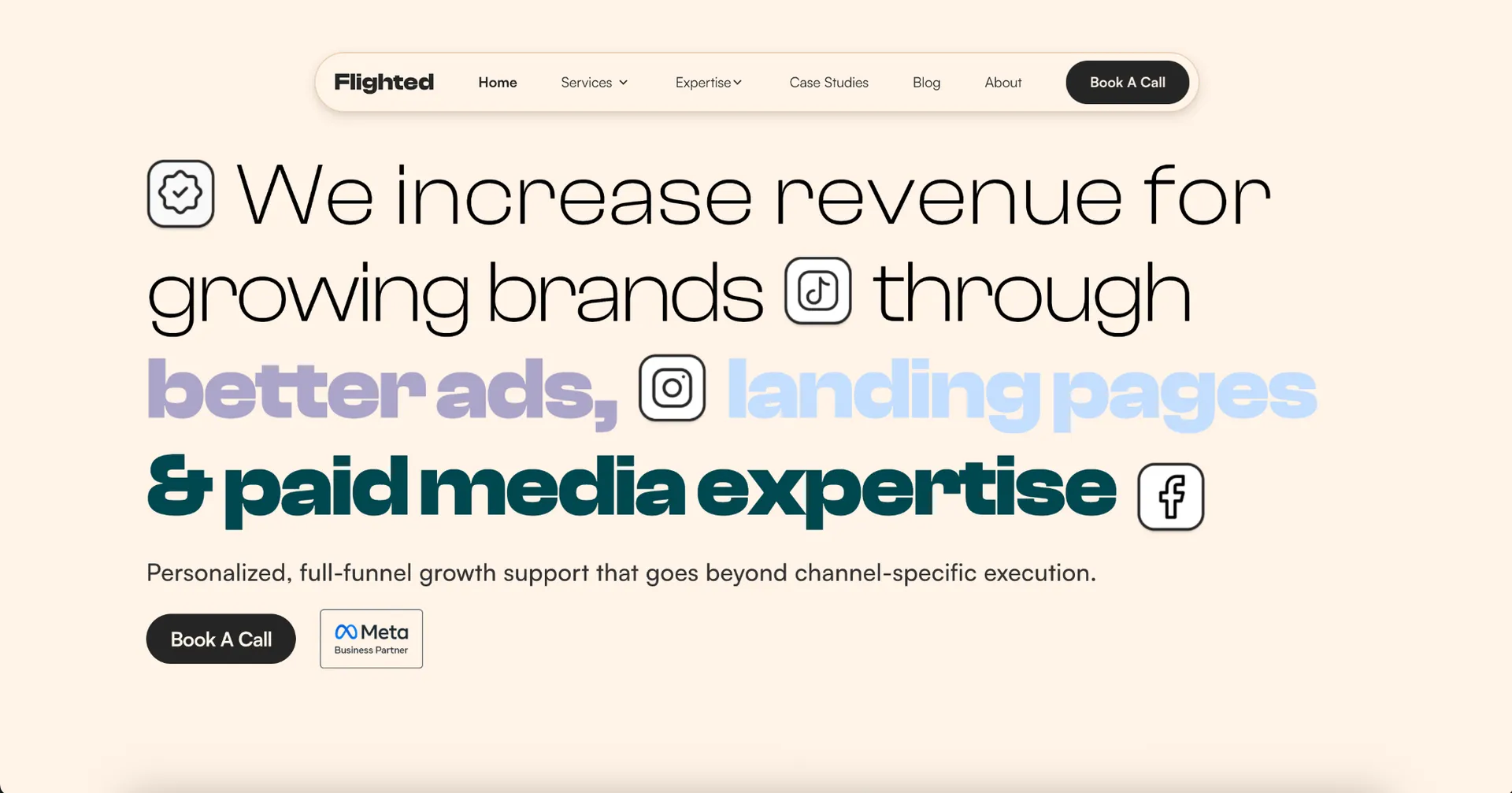
For example, Flighted, a performance marketing agency, runs paid media, creative, and landing pages as three parts of one system. This resulted in Halfday Travel having a 39% increase in conversion rates and 69% revenue growth within 30 days.
The same principle scales beyond individual campaigns. Large Enterprises are estimated to capture 59.0% of the global digital marketing services market share in 2026, highlighting how heavily established organizations continue to invest in structured digital acquisition. The enterprise-size landscape spans Large Enterprises and Small and Medium Enterprises, but regardless of company size, the winning principle remains the same: don't make visitors work to connect your marketing promise to the page they reach.
Answer Every Question Before They Think to Ask It
Landing pages should sell themselves. The highest-converting pages feel like you're getting all the answers to your questions before you even think about them. That comes from knowing your ICP well enough to predict what they worry about and in what order.
So don't sequence the page around what you want to say. Sequence it around what they're about to ask:
- Is this for someone like me?: Case studies, testimonials, and reviews
- Can they actually do it?: Real work, real numbers, real names. Not stock photos
- What does it cost?: A range is better than nothing.
- What happens if I reach out?: Tell them exactly what to expect and your process.
This is where the third major trend comes into play: first-party data and privacy-conscious marketing are becoming increasingly important. As browsers, platforms, and regulations continue to restrict easy access to third-party tracking signals, service businesses need stronger direct relationships with visitors. Clear forms, useful resources, reviews, calculators, and transparent offers do more than improve conversions; they give customers a reason to engage directly with the brand.
For local businesses, the opportunity is especially significant in the U.S. digital marketing services market, where search, paid media, social platforms, reviews, and localized landing pages increasingly work together to influence purchase decisions. A visitor searching for a service in a specific city doesn't need another generic sales pitch. They need evidence that the business understands their location, their problem, and what happens next.
Remove the Friction Between Interest and Contact
HubSpot analyzed 40,000+ landing pages and found that 3-field forms have a 25% conversion rate. Forms with 10+ fields drop to 7%. Ask for a name, a way to reach them, and the problem. Qualify on the call, not on the form.
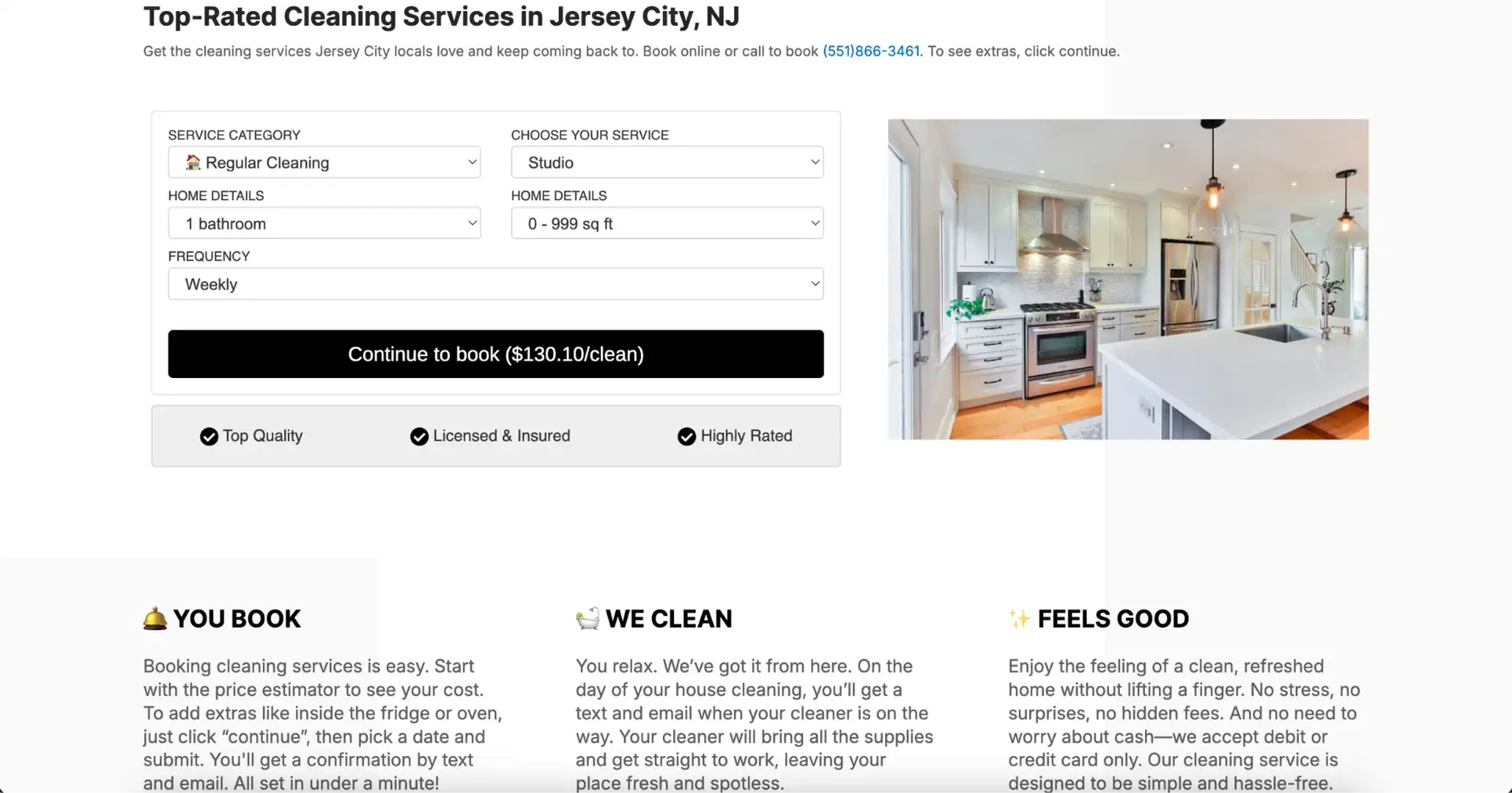
The exception is a form that gives something back. The Jersey City estimator uses five dropdowns, which the data says should hurt, and it works because each one buys the visitor a real price.
Then fix the button. "Submit" sells nothing. Name the result instead: "Get your quote in 24 hours" or "Talk to a specialist now."
Finally, speed. Conversion rates drop to 4.42% for every extra second of load time between 0 and 5 seconds, and 53% of mobile users leave after 3 seconds. Aim for under 2, and test on a phone over cell data, because that's how most visitors use to look for a service company.
At scale, this focus on performance is exactly why digital marketing has become a major strategic function rather than a standalone promotional activity. The competitive landscape includes major players such as Publicis Groupe, WPP plc, Omnicom Group, Dentsu Group, Interpublic Group, Accenture Interactive, Deloitte Digital, IBM iX, PwC Digital Services, Havas Group, S4 Capital, BlueFocus Communication Group, Cheil Worldwide, Hakuhodo DY Holdings, and Cognizant Interactive. Their presence reflects how broad the digital marketing ecosystem has become, spanning strategy, search, creative, technology, media, data, and customer experience.
But you don't need an enterprise-sized marketing department to apply the same principles. A service business website has one job: turn existing attention into action. Every headline, testimonial, form, CTA, and page-speed improvement should make that job easier.
Key Takeaways
A service business website isn't a brochure with a contact form stapled to the end. It's the part of your sales process that runs without you, on traffic you've usually already paid for.
Here's the quick recap

