For an agency buyer, the report provides a useful way to organize the decision. Start with the service required, then consider who will deliver it, how the engagement will be priced, and which industry needs it must address.
Those decisions also depend on how search is changing. Businesses still need the foundations of SEO, but they increasingly expect support with AI visibility, efficient delivery, and reporting connected to results. Three trends explain what this means when choosing an agency.
Three Trends Changing What Businesses Need From SEO
1. SEO and AI Search Are Coming Together
Business content now has more than one opportunity to get discovered. It can appear in conventional search results and potentially support an AI-generated answer.
The foundations still matter. Google says established SEO practices remain relevant to AI Overviews and AI Mode, without special technical requirements beyond eligibility in Search. Accessible pages and useful content remain central.
For businesses, this means looking for an agency that connects existing SEO work with AI visibility assessment. For the market, it expands demand for content improvements, technical implementation, and monitoring across different search experiences.
2. AI Is Speeding Up the Work, but Expertise Still Counts
AI can help agencies organize research, identify gaps, and develop drafts. SmartSites describes AI-assisted research and writing followed by human editing. Stellar also combines AI systems with human strategists.
The benefit is greater efficiency. The real value comes from applying that efficiency to business needs: accurate information, relevant recommendations, and work that gets implemented properly.
This is changing how agencies compete. Buyers can look beyond content volume and assess the quality of review, industry understanding, and execution.
3. Reporting Is Moving Closer to Revenue
Traffic shows that people arrived. It does not indicate whether they became customers.
An online store needs to understand organic sales. An industrial supplier needs qualified quote requests. A local service business needs relevant calls and enquiries.
SmartSites describes reporting on calls, leads, sales, and AI assistant visits. AlchemyLeads includes performance tracking and attribution among its services.
This emphasis supports demand for ongoing analysis. Businesses need agencies that can explain what changed, why it matters, and what to improve next.
WebFX, Hawke Media, SmartSites, AlchemyLeads, Stellar, and ABM Agency address these expectations in different ways. To compare them meaningfully, a business first needs to identify which services will help its website and customers—and how that work should be delivered.
Start With the Service a Business Needs
A clear service requirement makes it easier to assess what each agency offers. The CMI report breaks services down into on-page SEO, off-page SEO, technical SEO, local SEO, enterprise SEO, and other services. It also looks at who delivers that work: SEO agencies, freelance consultants, full-service digital marketing agencies, and in-house SEO teams.
Then comes the payment model. The report covers monthly retainers, project-based, hourly-based, performance-based, and subscription-based arrangements. The right fit depends on whether a specific project or ongoing support is needed.
Industry matters, too. The report covers retail and e-commerce, IT and telecom, BFSI, healthcare, travel and hospitality, media and entertainment, education, real estate, automotive, and professional services. An online store needs a different approach from a healthcare provider or an industrial supplier.
These distinctions help businesses build a useful shortlist. Product-page improvements, a website migration, and local visibility each call for different skills. On-page SEO and SEO agencies show how the selected service connects with the team delivering it.
On-Page SEO: Making Pages More Useful
A website needs more than good rankings. Its pages should help visitors find relevant information and decide what to do next. That is why on-page SEO remains an important part of search marketing, accounting for an estimated 32.0% of the global SEO services market in 2026.
For an online retailer, this could mean clearer product descriptions and better category pages. For a service business, it may involve improving service information, page titles, and internal links. These changes help search engines understand the content while making the website more useful for potential customers.
SEO Agencies: Bringing the Skills Together
Improving a website is rarely a one-time task. Businesses need to maintain their content, resolve technical issues, and understand how search performance contributes to enquiries and sales. This helps explain why SEO agencies are expected to hold 41.0% of the global SEO services market in 2026.
An agency can bring technical specialists, content teams, and analysts into one programme. For businesses without these resources internally, that can make ongoing SEO work easier to manage. The important question is whether the agency can turn its recommendations into completed improvements and demonstrate how those changes support business goals.
Why the U.S. Matters to This Shift
The U.S. presents an important opportunity for SEO and GEO services because businesses compete across national, local, and online purchasing journeys. Retailers need product discovery, professional service firms rely on qualified enquiries, and B2B companies use content to support longer buying cycles. Those needs create opportunities for agencies that understand both search execution and the customer’s decision process.
In May 2025, Google announced the U.S. rollout of AI Mode beyond its experimental environment. Conversational search and complex comparisons gave the businesses another reason to review how clearly their content answers customer questions.
The practical response is to integrate AI visibility assessment into existing SEO programmes. The businesses still need accessible websites, useful content, and accurate local information. They also need reporting that distinguishes mentions and referrals from measurable customer actions. For agencies, relevant industry experience and reliable implementation can make a meaningful difference in winning and retaining clients.
What to Look for Before Comparing Agencies
These market changes give buyers a clearer set of questions to ask. An “AI-powered” label reveals little about how the work will be delivered.
- Technical work that gets done: Can the agency identify website problems and take responsibility for resolving them?
- Content that understands customers: Can it explain products and expertise in language the target audience uses?
- Reporting connected to business goals: Will reports show relevant enquiries, purchases, and sales opportunities alongside traffic?
- Clear working arrangements: Are the inclusions, work ownership, and agreement modification terms clear?
With those questions in mind, the differences between providers become easier to assess.
Agency Comparison at a Glance
|
Factor
|
WebFX
|
Hawke Media
|
SmartSites
|
AlchemyLeads
|
Stellar
|
ABM Agency
|
|
Main approach
|
Revenue-focused search marketing
|
Full-service marketing support
|
Comprehensive SEO delivery
|
Search for specialist buyer journeys
|
AI-supported marketing delivery
|
Enterprise account-based marketing
|
|
Relevant capabilities
|
Conventional and AI search marketing
|
Coordinated digital marketing programmes
|
Technical, local, national, e-commerce, and AI search optimization
|
AI search, SEO, digital PR, technical work, and attribution
|
AI systems with human strategists
|
Account-focused enterprise campaigns
|
|
Buyer priority
|
Connected execution and reporting
|
Wider marketing coordination
|
Several practical search requirements
|
Qualified enquiries
|
Automation and strategic support
|
Defined high-value accounts
|
These are summaries of published positioning and services. Use them to guide a shortlist, then assess the actual proposal.
WebFX: Enterprise-Scale AI Marketing Powerhouse
- Best for: Mid-to-large companies that want a full-service agency with enterprise systems and custom technology.
- The main difference: WebFX built their own marketing technology platform. Most agencies use off-the-shelf tools. WebFX created MarketingCloudFX from scratch. That's a meaningful distinction if you care about integrated reporting and ROI tracking.
What They Do Well
MarketingCloudFX is their crown jewel. ROI tracking, competitive intelligence, AI-powered recommendations—all in one dashboard. If you're the type who wants to trace every marketing dollar to revenue, this tooling delivers.
Here's something worth noting about their AI approach. They use AI for insights and optimization. But content creation stays human-driven. Why does that matter? E-E-A-T signals. Brand voice consistency. Google still rewards content with genuine expertise behind it.
The numbers back up their reputation. 93% client satisfaction rate. Over 1,100 testimonials. That's not luck. Clients mention the same things repeatedly: deep reporting, professional account teams, actual results.
Considerations
Six months minimum. That's the commitment. Their pricing starts higher than boutique agencies, too. You're paying for the systems and the 750-person team behind them.
If you're a smaller company wanting maximum flexibility? This structure might feel heavy. And here's something else to consider: WebFX shines at managing complex, multi-channel campaigns. If you only need SEO (nothing else), you might be paying for firepower you won't use.
HawkeMedia: The Outsourced CMO Model
- Best for: Brands wanting strategic marketing leadership with month-to-month flexibility and pick-and-choose services.
- The main difference: HawkeMedia lets you cancel anytime. In an industry addicted to 6 and 12-month contracts, that's rare. They're betting their retention comes from results, not legal agreements.
- What is an "outsourced CMO" anyway? HawkeMedia positions themselves as an extension of your marketing team. Not a vendor you hand tasks to. A strategic partner who thinks about your business goals first.
- Founded in 2013, they've worked with over 4,700 brands. Company valuation now exceeds $150 million. They're doing something right.
What They Do Well
Month-to-month contracts. That's their biggest selling point. Need to scale up for a product launch? Done. Want to pull back during a slow quarter? No problem. Try getting that flexibility from most agencies.
Their Hawke AI platform pulls data from over 7,000 brands and $500 million in media spend. What does that mean for you? Benchmarking insights most agencies simply don't have. They can tell you how your metrics compare to similar companies because they have the data to back it up.
Considerations
Their client list includes Red Bull, Eddie Bauer, and Crocs. They work with companies of all sizes, yes. But their pricing and approach feel built for established brands with real marketing budgets.
SmartSites: Hands-On Digital Marketing for SMBs
- Best for: Small to mid-sized businesses wanting responsive service, strong communication, and a partner that treats them like their biggest client.
- The main difference: SmartSites obsesses over client communication. Read their 1,000+ reviews. The same words keep appearing: "responsive," "proactive," "they actually call back." For SMBs burned by agencies that ghost after signing, this matters.
- Brothers Alex and Michael Melen founded SmartSites in 2011. Since then? "America's #1 rated digital marketing agency" based on reviews. Nine consecutive years on the Inc. 5000. Not a fluke.
What They Do Well
Here's what clients keep saying: "They respond fast." "They keep us updated." "They care about our results." Sounds basic, right? But how many agencies actually deliver that consistently? Based on 1,000+ reviews, SmartSites does.
They use established AI SEO tools—Surfer SEO, MarketMuse, and Semrush. No custom platforms. That keeps costs lower while still delivering data-driven optimization.
Google Premier Partner. Facebook Marketing Partner. They bring platform expertise across search and social. And their web design team can handle site improvements in-house. Other SEO-focused agencies would outsource that work.
AlchemyLeads: Agile, Revenue-Focused SEO for B2B and eCom
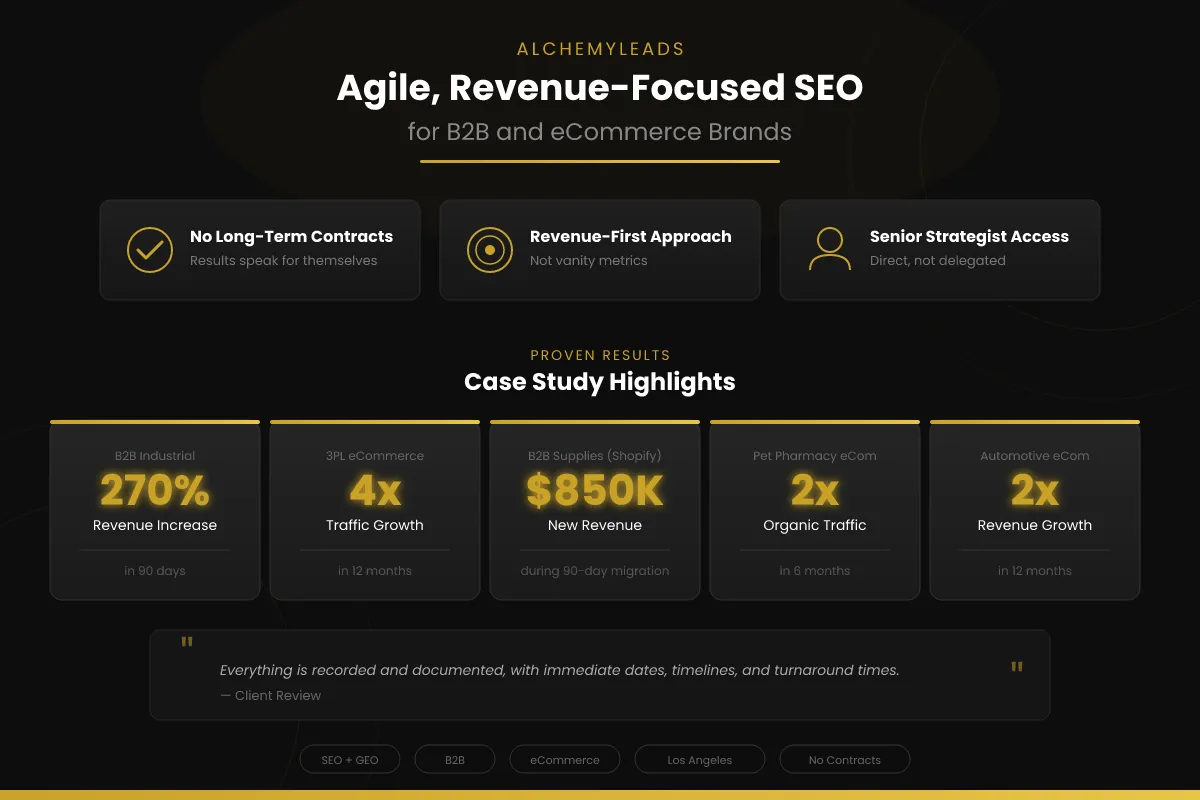
- Best for: B2B industrial companies and eCommerce brands that want a strategic partner focused on revenue outcomes, not vanity metrics.
- The main difference: No contracts. That's a bold move in an industry that loves locking clients into 6 or 12-month agreements. Why would an agency do that? Because they're betting on results keeping you around. That confidence says something.
- AlchemyLeads is a boutique agency based in Los Angeles. Small team. Focused client roster. They work primarily with B2B industrial manufacturers, eCommerce brands, and professional services firms. The core philosophy? Marketing should generate measurable business results.
What They Do Well
No contracts mean accountability. If they're not delivering, you leave. That pressure keeps everyone focused on what actually matters: revenue.
Here's where they stand out on AI search. AlchemyLeads runs a hybrid strategy—traditional SEO plus explicit GEO optimization. They're positioning clients for where search is heading, not just where it is today. Google's traditional results matter. But so does visibility in ChatGPT, Perplexity, and AI Overviews. They optimize for both.
Stellar: AI-Native Performance & SEO Agency
- Best for: High-growth B2B and e-commerce brands that want to scale using AI-native marketing and technical SEO, rather than the traditional agency playbook.
- Main difference: Stellar built its own AI platform, Prism, which handles real-time spend reallocation and predictive outcome modeling across every digital channel — so budget decisions aren't made on gut feel or monthly reporting lag.
What They Do Well
Pairs experienced human strategists with in-house "Agentic Engineers" who build custom AI tools for keyword clustering and automated bid management
Takes an outcome-first approach, pulling data from paid search, social, and programmatic together to cut down on wasted ad spend
Puts AI-assisted content through a senior editor review process to keep it aligned with Google's E-E-A-T standards
Key Capabilities
- AI-driven SEO and dynamic content strategy
- Real-time paid media optimization across search, social, and Amazon
- Full-funnel lifecycle marketing and conversion rate optimization (CRO)
ABM Agency: Precision Enterprise Account-Based Marketing
- Best for: Global enterprises in complex B2B spaces — manufacturing, SaaS, cybersecurity — that need account-specific strategy, not a numbers game.
- The main difference: Most agencies chase traffic and hope some of it converts. ABM Agency skips that entirely. They run 1:1 and 1:few campaigns targeting specific accounts a company wants to close, with marketing built around sales goals from day one. The pitch is simple: every dollar spent should be traceable to a revenue outcome.
What they do well
They're good at working inside a client's sales process instead of next to it. Using ABM-specific tools and custom account data, they help identify who actually matters inside a target org and build outreach around those people. The result: bigger contracts on average, and ROI that's easier to predict than what most broad SEO campaigns deliver.
Considerations
This isn't the agency for a broad B2C play or cheap volume lead-gen — that level of precision would just be wasted effort there. But if your team is judged on revenue, not clicks, it's probably the piece you've been missing.
How to Choose the Right Agency
Start with the outcome the business needs, then compare the proposed work.
- For coordinated search marketing: Assess WebFX’s execution plan and commercial reporting.
- For broader marketing support: Examine how Hawke Media connects search with the wider programme.
- For local, national, or e-commerce requirements: Review SmartSites’ relevant implementation experience.
- For industrial or technical enquiries: Assess AlchemyLeads’ understanding of target buyers and the sales process.
- For automation with strategic involvement: Compare Stellar’s delivery options and human oversight.
- For targeting specific enterprise accounts: Examine ABM Agency’s approach and the contribution of organic search.
Before committing, confirm scope, content ownership, reporting access, pricing, and cancellation terms. Case studies help establish experience. The proposal should explain how that experience applies to the business.
The Outlook for SEO and GEO Services
Search is giving businesses more ways to be discovered—and more work to connect that discovery with customers. Technical optimization, useful content, and reliable measurement remain central as AI-generated answers become part of the journey.
For agencies, the opportunity lies in combining efficient delivery with industry understanding and accountable implementation. For buyers, it comes down to choosing the capabilities that match their website, audience, and commercial goals.

