

Omnichannel Retailing Market Analysis & Forecast - 2026 to 2033
Omnichannel Retailing Market is estimated to be valued at USD 11.57 Bn in 2026 and is expected to reach USD 29.30 Bn in 2033, exhibiting a compound annual growth rate (CAGR) of 14.2% from 2026 to 2033.
Key Takeaways
- By Retail Format, E-commerce platforms dominate the global omnichannel retailing market with a commanding 69.7% share during the forecast period.
- By Region, North America dominates the global omnichannel retailing market, capturing a substantial 37% share during the forecast period.
Market Overview
The global Omnichannel Retailing Market is witnessing robust growth, fueled by rising consumer demand for seamless, integrated shopping experiences across physical and digital platforms. Retailers are increasingly investing in advanced technologies to unify in-store, mobile, and online operations. Brick-and-mortar stores continue to play a pivotal role, while e-commerce accelerates growth.
Current Events and its Impacts on the Omnichannel Retailing Market
Current Event | Description and its impact |
Technological Integration Across Retail Channels |
|
Changing Consumer Behaviour and Expectations |
|
Evolving Regulatory Landscape and Market Competition |
|
Omnichannel Retailing Market Trends
- Rise of Mobile Commerce
Mobile commerce (m-commerce) continues to grow as consumers increasingly rely on their smartphones and mobile devices for shopping. Retailers are optimizing their online platforms and mobile apps to provide seamless and intuitive mobile shopping experiences. Mobile payment options, such as mobile wallets and contactless payments, are becoming more prevalent, enabling convenient and secure transactions on mobile devices.
- Unified Commerce
The concept of unified commerce is gaining traction in the omnichannel retailing market. Unified commerce focuses on creating a single, integrated platform that connects all retail channels, both online and offline. This approach eliminates data silos and enables real-time inventory visibility, centralized customer data, and seamless transactions across channels.
Retailers are adopting unified commerce solutions to deliver consistent experiences and streamline operations. For instance, in 2020, Salesforce cloud-based software company announced its acquisition of Slack, a popular collaboration and messaging platform. This acquisition aimed to provide Salesforce customers with enhanced communication and collaboration capabilities, enabling seamless interactions across all channels and improving team collaboration in the omnichannel retailing space.
Opportunities in the Omnichannel Retailing Market
- Seamless Integration of Online and Offline Channels
Retailers have the opportunity to create a seamless integration between their online and offline channels. This includes enabling features such as buy online, pick up in-store (BOPIS), click-and-collect, and returns/exchanges across channels. By providing customers with the flexibility to choose their preferred shopping and fulfillment methods, retailers can increase convenience and customer satisfaction.
- Personalization and Targeted Marketing
Omnichannel retailing allows retailers to gather data and insights from multiple touchpoints, enabling them to deliver personalized and targeted marketing campaigns. By leveraging customer preferences, purchase history, and behavior across channels, retailers can provide relevant product recommendations, personalized promotions, and customized offers.
This personalized approach enhances customer engagement and increases the likelihood of conversion. For instance, in April 2023, Reliance Retail Indian retail Company launched an omni channel beauty retail platform, Tira, that would provide beauty enthusiasts in India with a seamless and personalized shopping experience.
- Current Industry Events of 2026
- Market Size Estimation
- Regional Breakdown
- Competitive Landscape
- Customer Intelligence
- Segmental Analysis
- Pricing Analysis
- Key Market Drivers, Challenges & Future Trends
- Customized Insights Section
Segmental Insights
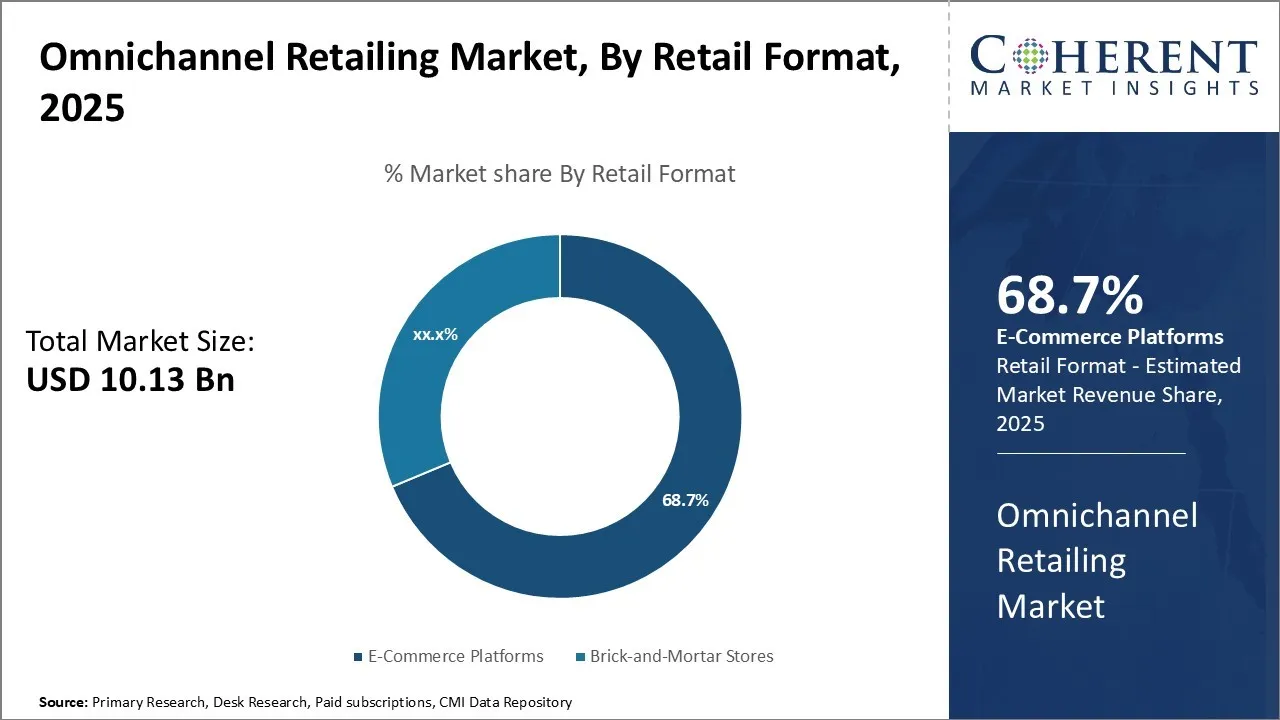
Omnichannel Retailing Market Insights, By Retail Format
E-commerce platforms are projected to lead the global omnichannel retailing market, capturing a substantial 69.7% share. This dominance is driven by the accelerating demand for convenience, 24/7 access, rapid product search, and tailored online experiences. Consumers are increasingly embracing mobile-first shopping, AI-powered recommendations, and seamless digital payment solutions, making e-commerce the cornerstone of omnichannel strategies.
Retailers are leveraging these platforms not only for direct sales but also to collect actionable customer insights, manage real-time inventory, and personalize engagements at scale.
Despite the stronghold of digital commerce, brick-and-mortar stores continue to hold a notable 31.3% market share. Their importance lies in providing immersive, tactile brand experiences, immediate product access, and face-to-face customer service. As physical retail evolves, it is being reimagined with digital integrations like self-service kiosks, mobile checkouts, and in-store app experiences. This synergistic use of both digital and physical formats reflects a strategic approach where retailers aim to meet customer needs across every touch point reinforcing brand loyalty and optimizing operational efficiency across channels.
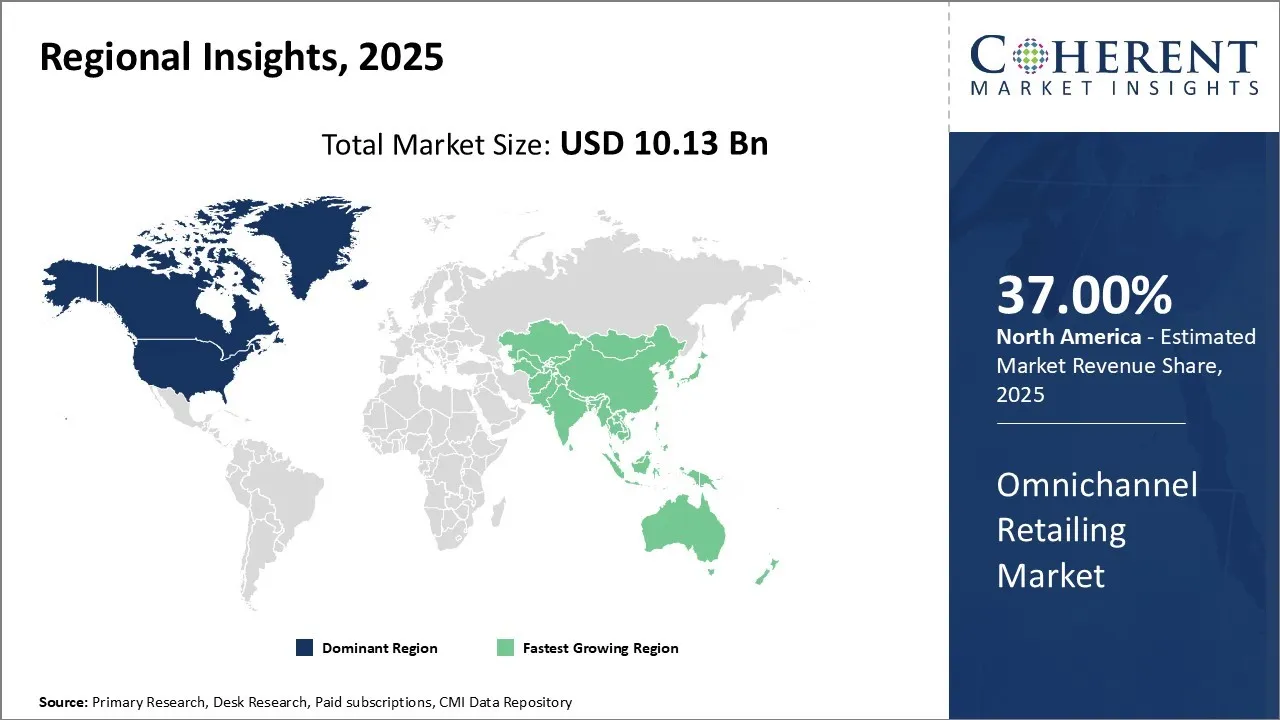
Regional Insights
North America Omnichannel Retailing Market Trends and Analysis
North America leads the global omnichannel retailing market, capturing a substantial 37.00% share. This dominance is driven by the region’s highly advanced digital infrastructure, widespread smartphone adoption, and the presence of prominent retail giants such as Walmart, Amazon, and Target. These companies are at the forefront of integrating real-time data analytics, AI-driven personalization, and seamless transitions between online and offline experiences.
Popular services like curbside pickup, same-day delivery, and mobile loyalty programs have become standard offerings, reflecting a sophisticated and mature omnichannel ecosystem. The region's continuous investment in retail innovation and its deep understanding of evolving consumer behaviours keep it at the cutting edge of global omnichannel retail transformation.
Asia Pacific Omnichannel Retailing Market Trends and Analysis
Asia Pacific is emerging as the fastest-growing region in the omnichannel retailing market. This surge is powered by rapid digital transformation, rising internet penetration, and a young, tech-savvy consumer base across major economies like China, India, Japan, and South Korea. Governments and private players are heavily investing in logistics, digital payments, and mobile commerce platforms to support hybrid shopping experiences.
The growing popularity of live commerce, app-based loyalty programs, and integrated online-to-offline (O2O) retail formats is accelerating regional growth. Asia Pacific’s dynamic retail landscape, driven by mobile-first consumers and innovative start-ups, positions it as a key growth engine for global omnichannel strategies.
Omnichannel Retailing Market Dominating Countries
United States and Canada
The United States stands at the forefront of the global omnichannel retailing market, anchoring North America’s dominant 37% share. This leadership is driven by the integration of advanced technologies by major retailers such as Amazon, Walmart, and Target. These companies are pioneers in offering seamless transitions between online and offline retail, with services like curbside pickup, same-day delivery, and personalized loyalty programs.
The U.S. market benefits from high consumer digital adoption, real-time data analytics, and a mature logistics infrastructure, enabling a highly responsive and personalized retail ecosystem. As a result, the country continues to define global standards for omnichannel experiences.
Canada also plays a significant role in the North American omnichannel retail landscape. Canadian retailers are rapidly adopting e-commerce and integrating it with physical store offerings to create unified customer journeys. Popular features such as “click-and-collect,” mobile checkout, and app-based loyalty rewards are increasingly common. The country’s diverse consumer base, strong digital infrastructure, and focus on customer-centric retail innovations support its growing position in the omnichannel market.
Market Report Scope
Omnichannel Retailing Market Report Coverage
| Report Coverage | Details | ||
|---|---|---|---|
| Base Year: | 2025 | Market Size in 2026: | USD 11.57 Bn |
| Historical Data for: | 2020 To 2024 | Forecast Period: | 2026 To 2033 |
| Forecast Period 2026 to 2033 CAGR: | 14.2% | 2033 Value Projection: | USD 29.30 Bn |
| Geographies covered: |
| ||
| Segments covered: |
| ||
| Companies covered: | Amazon, Walmart, Alibaba Group, Target Corporation, com, eBay Inc., Best Buy Co. Inc., Zara (Inditex Group), The Home Depot Inc., Nordstrom Inc., Macy's Inc., Costco Wholesale Corporation, Apple Inc., Tesco PLC, ASOS PLC | ||
| Growth Drivers: |
| ||
| Restraints & Challenges: |
| ||
Analyst Viewpoint – Omnichannel Retailing Market
- Analysts sees that consumer expectations for seamless, personalized, and flexible interactions are pushing retailers to accelerate digital transformation and redefine customer engagement across all touchpoints.
- Experts identify technological integration as a major catalyst for growth. The adoption of Artificial Intelligence (AI), big data analytics, and cloud-based platforms is allowing retailers to offer real-time personalization, improve supply chain agility, and automate customer service. These technologies enable precise targeting, dynamic pricing, and efficient inventory management key components of a successful omnichannel strategy.
- Regionally, North America is seen as the innovation hub, led by retail giants like Walmart, Amazon, and Target, who are pioneering next-gen fulfillment models like curbside pickup and real-time inventory tracking. Asia Pacific is recognized as the fastest-growing market, with rapid mobile commerce adoption, live shopping trends, and digitally native consumers in countries like China and India.
- Analysts conclude that sustained success in the omnichannel retailing market will depend on continuous innovation, investment in logistics infrastructure, and the ability to create a consistent and engaging brand experience across all channels.
Omnichannel Retailing Market: Key Development
- In January 2025, Riskified and Appriss announced formed a partnership agreement to transform the retail landscape. This collaboration will lead to growing challenges of omnichannel frauds and abuse by integrating comprehensive data on consumers shopping patterns throughout the entire journey.
- In April 2025, Meta unveiled omnichannel ads as a part of its offering for advertisement. This enables them to showcase ads that highlights product location for people most likely to shop in-store.
- In May 2024, Domo launched new suite of Domo features and tools in the Shopify app store that is designed to revolutionize the way in which retailers run their business.
Market Segmentation
- By Retail Format (Revenue, USD Bn, 2021 - 2033)
- Brick-and-Mortar Stores
- E-commerce Platforms
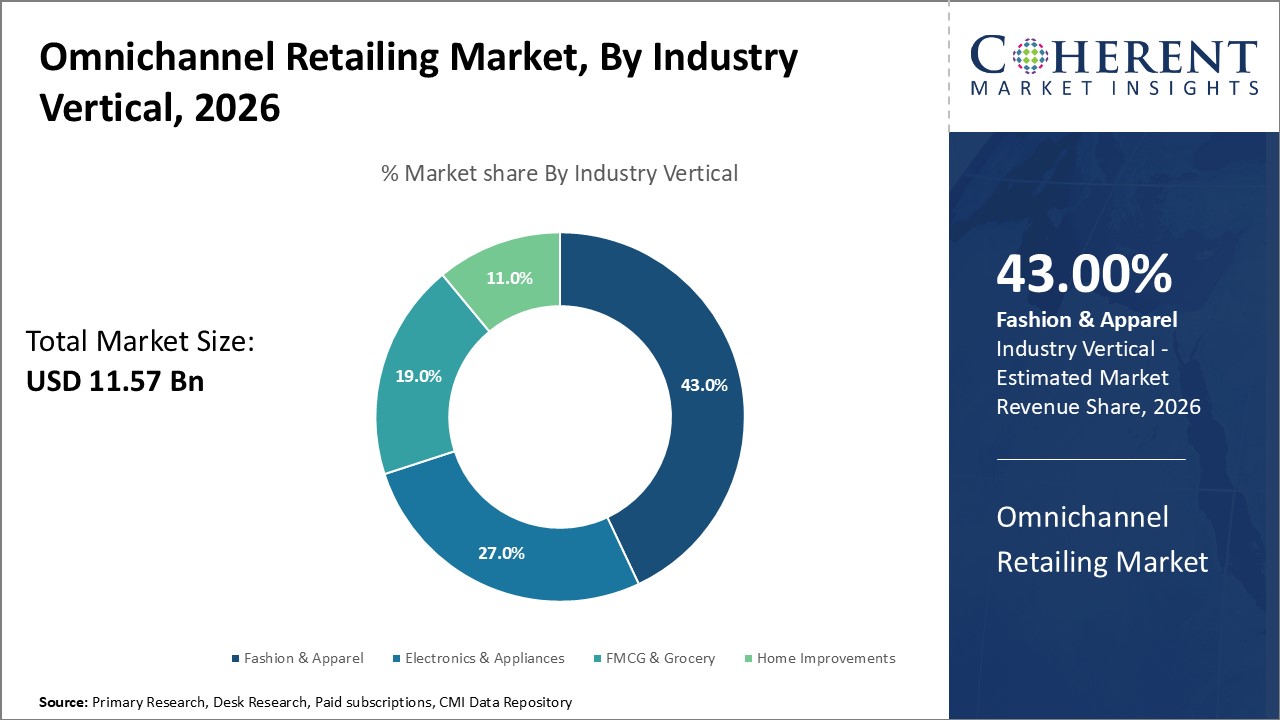
- By Industry Vertical (Revenue, USD Bn, 2021 - 2033)
- Fashion & Apparel
- Electronics & Appliances
- FMCG & Grocery
- Home Improvements
- By Region (Revenue, USD Bn, 2021 - 2033)
- North America
- U.S.
- Canada
- Latin America
- Brazil
- Argentina
- Mexico
- Rest of Latin America
- Europe
- Germany
- U.K.
- Spain
- France
- Italy
- Russia
- Rest of Europe
- Asia Pacific
- China
- India
- Japan
- Australia
- South Korea
- ASEAN
- Rest of Asia Pacific
- Middle East
- GCC Countries
- Israel
- Rest of Middle East
- Africa
- South Africa
- North Africa
- Central Africa
- North America
- Top companies in Omnichannel Retailing Market
- Amazon
- Walmart
- Alibaba Group
- Target Corporation
- JD.com
- eBay Inc.
- Best Buy Co., Inc.
- Zara (Inditex Group)
- The Home Depot, Inc.
- Nordstrom, Inc.
- Macy's, Inc.
- Costco Wholesale Corporation
- Apple Inc.
- Tesco PLC
- ASOS PLC
Sources
The Stakeholders Consulted
- Retail operations managers and store format strategists
- E-commerce and digital transformation heads
- Supply chain and logistics managers
- Retail technology and omnichannel platform providers
- UX designers and customer engagement consultants
- Payment systems and fintech solution developers
- Regulatory advisors on data privacy and consumer protection
- Industry associations promoting digital commerce and retail innovation
- End-users across sectors such as apparel, electronics, grocery, personal care, and home décor
Databases Opened
- U.S. Census Bureau – Retail Trade Reports
- World Bank – Consumer and Digital Economy Indicators
- OECD – Retail and E-commerce Statistics
- Ministry of Commerce & Industry (India) – Retail Trade Policy and Sector Data
Magazines & Trade Publications
- Retail Dive
- Chain Store Age
- Stores Magazine (NRF)
- RIS News
- Internet Retailer
- Forbes Retail Section
- Economic Times Retail and E-commerce News
Scientific and Industry Journals
- Journal of Retailing and Consumer Services
- International Journal of Retail & Distribution Management
- Journal of Business Research – Retail Strategy
- Computers in Human Behavior – E-commerce and UX
- International Journal of Information Management
Newspapers & Media Outlets
- The Wall Street Journal – Retail and Consumer Markets
- Bloomberg – Retail Innovation & E-commerce News
- Reuters – Global Consumer Trends
- The Economic Times – Retail & Omnichannel Developments
- Business Standard – Digital Economy & Retail Technology
Associations and Regulatory Bodies
- National Retail Federation (NRF)
- Retailers Association of India (RAI)
- U.S. Federal Trade Commission (FTC) – Consumer Protection and E-commerce Regulations
- International Organization for Standardization (ISO) – Retail and Payment Technology Standards
- European Commission – E-commerce and Digital Services Regulation
Public Domain Sources
- U.S. Bureau of Labor Statistics (BLS) – Retail Employment and Wages
- European Commission – Digital Economy and Society Index (DESI)
- World Bank – Retail Logistics and Infrastructure Reports
- UNCTAD – E-commerce and Omnichannel Trends in Emerging Markets
- Internet World Stats – Global Internet Usage and E-commerce Penetration
Proprietary Research Elements
- CMI Data Analytics Tool
- Proprietary CMI Repository of Retail and E-commerce Market Data (covering past 8 years)
- CMI Expert Interviews and Transcripts (focused on omnichannel strategy, consumer behavior, and retail technology adoption)
Get access to 250+ pages report
Every segment, forecast, competitor profile and data table behind the analysis above — available for instant download.
- ESOMAR Member
- ISO 9001:2015 Certified
- D-U-N-S Registered
- GDPR & CCPA Compliant
Missing comfort of reading report in your local language? Find your preferred language:
Transform your Strategy with Exclusive Trending Reports
Frequently Asked Questions
The Omnichannel Retailing Market size is estimated to be valued at USD 11.57 Bn in 2026, and is expected to reach USD 29.30 Bn by 2033.
Technological complexity and integration challenges, data management and privacy concerns, and channel conflict and competition are the factors hampering the growth of the global market.
Changing consumer behavior and expectations, growing importance of e-commerce, increasing mobile adoption, and focus on personalization and customer experience are the major factors driving the market growth.
The E-Commerce Platform is the leading Retail format segment in the market.
Major players operating in the market include Amazon, Walmart, Alibaba Group, Target Corporation, JD.com, eBay Inc., Best Buy Co., Zara (Inditex Group), The Home Depot, Nordstrom, Macy's, Costco Wholesale, Apple Inc., Tesco PLC, and ASOS PLC.
The leading region in the market may vary based on market dynamics and regional trends. However, regions such as North America, Europe, and the Asia Pacific are expected to have a significant influence on the market.
The CAGR of the Omnichannel Retailing Industry is projected to be 14.2% from 2026 to 2033.