

Vacuum Pump Market Analysis & Forecast: 2026-2033
Vacuum Pump Market is estimated to be valued at USD 8.0 Mn in 2026 and is expected to reach USD 13.2 Mn in 2033, exhibiting a compound annual growth rate (CAGR) of 7.5% from 2026 to 2033.
Key Takeaways
- Based on Type, Rotary Vacuum Pumps is projected to hold around 36% shares in the global market in 2026.
- By Region, North America is expected to dominate the global market with 54.00% shares during the forecast period.
Market Overview
The vacuum pumps market is expected to grow at a significant rate during the forecast period due to the increasing need for efficient equipment, growing oil and gas production, and rising government investments in research and development. Moreover, the rise in electrification of mechanical components and the rise in e-mobility will drive the demand for vacuum pumps across the globe.
Current Events and Its Impact on the Global Vacuum Pump Market
Event | Description and Impact |
Global Semiconductor Supply Chain Disruptions and Recovery |
|
Green Energy Transition and Industrial Decarbonization |
|
Advanced Manufacturing and Industry 4.0 Adoption |
|
Pricing Analysis: Vacuum Pump Market
The vacuum pump market spans a broad pricing spectrum, influenced by application, technology, and end-user demand. Prices range from under $500 for basic lab pumps to over $100,000 for advanced scientific systems.
Rotary Plunger Vacuum Pumps, typically used in rugged industrial environments, are priced between $5,000 and $30,000, depending on capacity and application intensity. These pumps are valued for their durability in high-load operations.
In the Vacuum Pump Market for Scientific Research, pricing is highly variable. Academic institutions often select cost-effective solutions such as Welch rotary vane pumps ($800–$2,500) or KNF diaphragm pumps ($400–$1,200). In contrast, research-grade systems from Leybold or Pfeiffer Vacuum for advanced applications, including particle physics and materials science, range from $20,000 to $150,000.
Cryogenic Vacuum Pumps, vital for ultra-high vacuum and particle accelerator applications, command premium prices—from $25,000 to over $100,000, depending on cooling capacity and integration level.
Manufacturers like Edwards Vacuum and Pfeiffer Vacuum dominate the premium segment, while Busch and Welch offer mid-tier and budget options. Scientific and R&D applications often benefit from institutional discounts and bundled procurement programs.
- Current Industry Events of 2026
- Market Size Estimation
- Regional Breakdown
- Competitive Landscape
- Customer Intelligence
- Segmental Analysis
- Pricing Analysis
- Key Market Drivers, Challenges & Future Trends
- Customized Insights Section
Role of Emerging Technologies in the Vacuum Pump Market
The vacuum pump industry is being positively influenced by newer innovations technologies the same way other industries are being bolstered by IoT and fossil fuel integration. Smart monitoring systems for IoT vacuum brakes allow for energy use tracking of major indexes like pressure and temperature. These apps are capable of running predictive maintenance, troubleshooting during downtime, and aiding remote diagnostics. Pumps are also capable of dynamically adjusting motor RPM to meet demand. This not only saves energy in semiconductor industries that use these pumps but also ensures accurate pressure control. Moving to screw and scroll type pumps is much easier because these pumps are dry in nature requiring no oil and minimal servicing.
Parts that require extreme precision such as those used in semiconductor labs also have parts coated with DLC which enhance their resiliency. Pumps that are integrated with magnetic bearings also improve frictionless movement allowing much greater operable life to the equipment. More modern and eco-friendly designs are becoming popular due to advancements in energy recovery systems and materials, and implementing them leads to utilizing these pumps in more extreme environments.
Segmental Insights
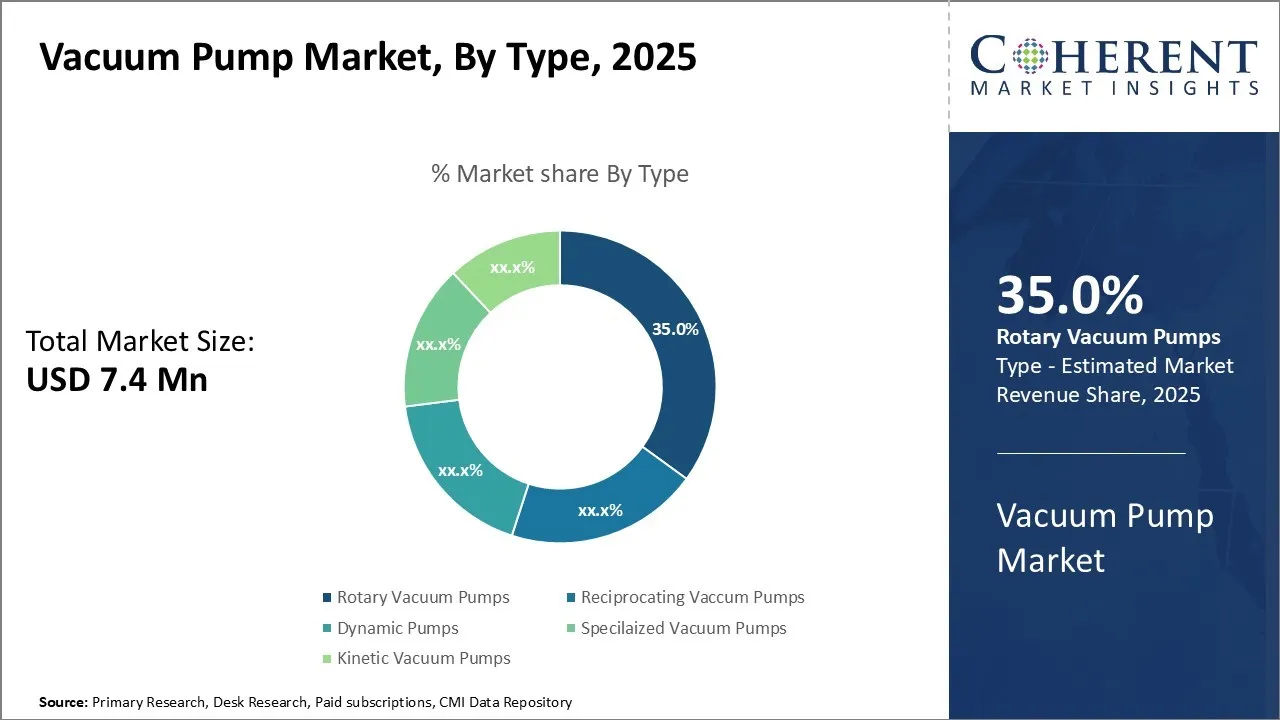
Vacuum Pump Market Insights, By Type
The rotary vacuum pump segment leads the global vacuum pump market, accounting for the largest share of 36.0% among all pump types. This dominance is primarily due to the versatility and efficiency of rotary pumps across diverse industrial applications. Rotary vane pumps, a key sub-type, are widely favored for their ability to deliver a uniform discharge with minimal pulsations, ensuring steady operation across various pressure conditions.
These pumps find applications, for example, in precision sectors such as aerospace, laboratories, and also in manufacturing and packaging systems. They are further distinguished in the market due to their strong structure and minimal maintenance needs. In parallel, there are also some segments of reciprocating vacuum pumps which are expected to grow significantly in the coming years. These pumps are very suitable for high pressure use due to a number of significant advantages like high compression ratio. The semiconductor and electronic equipment manufacturing industries, especially in Asia Pacific and North America, are rapidly growing and need dependable and effective vacuum solutions, leading to an increase in demand. Their use in reciprocating pumps in the creation and maintenance of controlled environments places them at the backbone of next generation electronics fabrication.
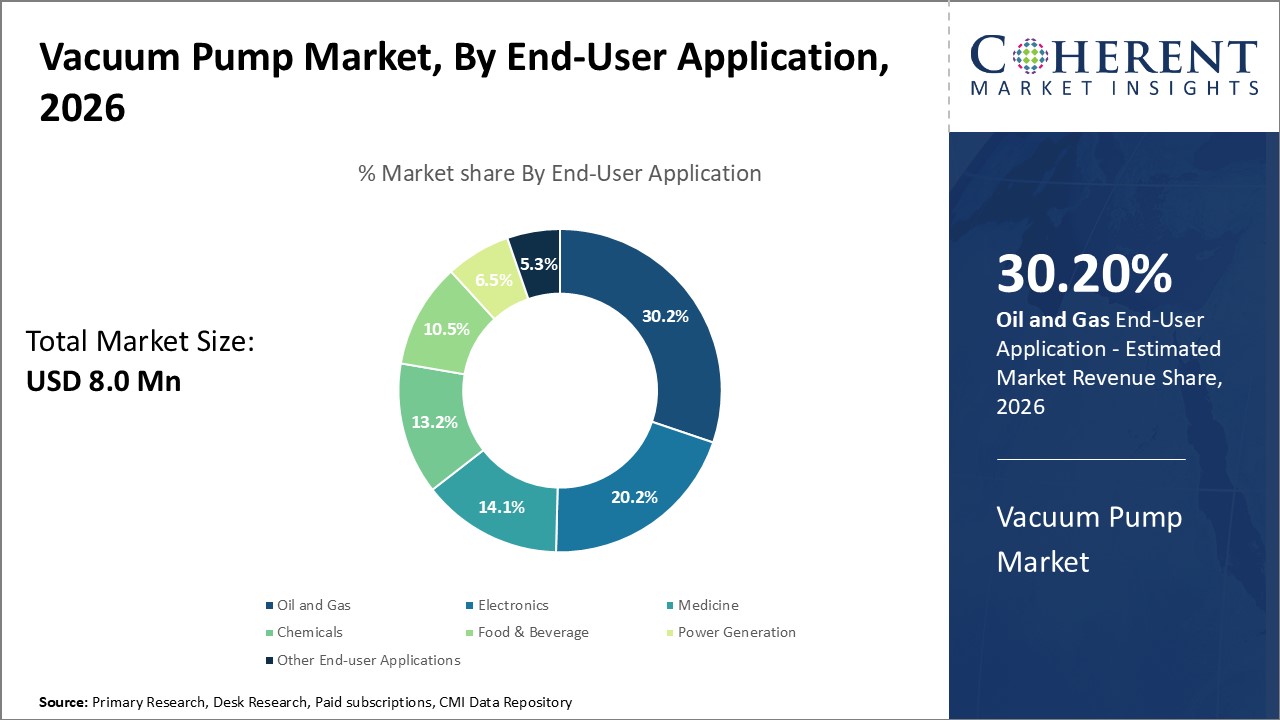
Vacuum Pump Market Insights, By End-User Application
The oil and gas industry continues to dominate the worldwide vacuum pump market due to its vast use in upstream and downstream activities. In this industry, vacuum pumps are required for exploration, refining, gas recovery, distillation, and vapor extraction. There is investment in oil and gas infrastructure, especially in the Middle East, North America, and certain parts of Asia due to increased global energy demand and the stabilization of oil prices. With increased complexity and scale of operations, growth in these areas further drives demand. The continuous development of shale gas projects and expansions of petrochemicals also drive demand in this segment. There is also emerging demand for vacuum pumps in the electronics segment. Manufacturing output is quickly rising in the consumer electronics sector, which includes smartphones, computers, tablets, and smart wearables owing to technological advancements.
Precision vacuum systems are vital for semiconductor wafer handling, thin film deposition, and component assembly, thus, China, South Korea, and Japan which are major hubs for electronics manufacture also drive the demand for vacuum pumps. Emerging economies, alongside the surge in consumer demand and increasing disposable incomes, are driving the growth in electronics manufacturing, which is further accelerating the demand for vacuum pumps within the sector.
Global Vacuum Pump Market – Regional Insights
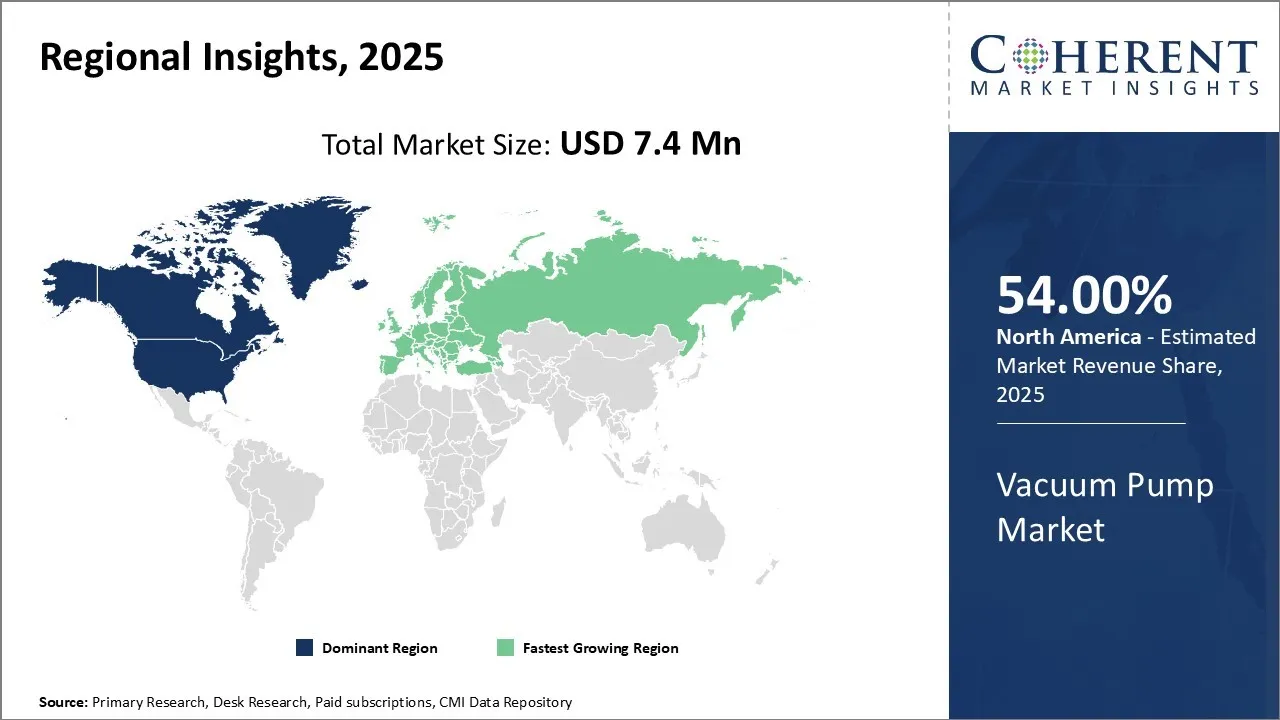
North America Vacuum Pump Market Analysis and Trends
North America is projected to showcase robust growth in the global vacuum pump market over the forecast period, driven by accelerating investments in energy, chemicals, and oil & gas sectors. The ongoing expansion of shale gas extraction and increased production of natural gas are pushing the demand for high-performance vacuum systems across upstream and downstream applications.
Additionally, a well-established industrial infrastructure, combined with a focus on energy efficiency and automation, is fostering the adoption of innovative vacuum technologies. The market also benefits from the presence of leading vacuum pump manufacturers and advanced research ecosystems that support ongoing innovation and product development. This makes North America a key region in shaping the global vacuum pump landscape.
Europe Vacuum Pump Market Analysis and Trends
Europe is expected to register significant growth in the global vacuum pump market, bolstered by rising environmental regulations, a shift toward clean energy, and expanding semiconductor and pharmaceutical industries. As energy storage and renewable power technologies gain momentum, vacuum pumps are becoming integral to advanced manufacturing and chemical processing across the region.
Furthermore, European nations are actively investing in sustainable production methods, driving demand for low-emission and energy-efficient vacuum solutions. Europe’s commitment to innovation, coupled with strong government backing for green technologies, positions the region as a strategic player in global market expansion.
Dominating Countries in the Vacuum Pump Market
United States Vacuum Pump Market Analysis and Trends
The United States leads the North American vacuum pump market, supported by rapid shale gas production and a resurgence in industrial manufacturing. The U.S. energy sector’s emphasis on efficient processing and environmental compliance has significantly increased the deployment of vacuum systems in oil refineries, power plants, and chemical facilities. In addition, the country’s strong R&D infrastructure drives continuous innovation in vacuum technologies, particularly in high-growth fields such as semiconductors and pharmaceuticals.
Canada Vacuum Pump Market Analysis and Trends
Canada is experiencing steady growth in its vacuum pump market due to investments in power generation, chemical processing, and mining. The country’s focus on clean energy and sustainable industrial operations has led to increased demand for energy-efficient vacuum solutions. Canadian manufacturers are also adopting advanced vacuum systems to improve process efficiency and reduce operational costs across various industrial applications.
Germany Vacuum Pump Market Analysis and Trends
Germany holds a dominant position in the European vacuum pump market, driven by its strong industrial base and leadership in automation, automotive manufacturing, and clean technologies. The country’s active implementation of Industry 4.0 strategies promotes the use of intelligent vacuum solutions in production lines. Germany’s emphasis on environmental sustainability and precision engineering further fuels demand for high-performance vacuum systems.
Market Report Scope
Vacuum Pump Market Report Coverage
| Report Coverage | Details | ||
|---|---|---|---|
| Base Year: | 2025 | Market Size in 2026: | USD 8.0 Mn |
| Historical Data for: | 2020 To 2024 | Forecast Period: | 2026 To 2033 |
| Forecast Period 2026 to 2033 CAGR: | 7.5% | 2033 Value Projection: | USD 13.2 Mn |
| Geographies covered: |
| ||
| Segments covered: |
| ||
| Companies covered: | Tsurumi Manufacturing Co. Ltd., Ingersoll Rand Inc., Wintek Corporation, Atlas Copco AB, Ebara Corporation, Flowserve Corporation, Becker Pumps Corporation, Busch Vacuum Solutions (Busch group), Global Vac, Pfeiffer Vacuum GmbH (Pfeiffer Vacuum Technology AG), Graham Corporation, and ULVAC Inc. | ||
| Growth Drivers: |
| ||
| Restraints & Challenges: |
| ||
Global Vacuum Pump Market Drivers
- Growing popularity of MEMS technology to propel the market growth
MEMS is microscopic device structure combining optical, mechanical, and fluidic elements with electronics. This granular device consists various moving structures that are integrated with microelectronics. Over the past few years, the MEMS technology has advanced further and is increasingly being adopted for commercial use in medical and automotive industries. They are utilized in automobile applications as pressure transducers primarily in manifold air-pressure sensing.
Thus, due to various benefits of this technology, its popularity is increasing among several industries, this in turn is expected to fuel growth of the global vacuum pump market over the forecast period.
- Growing demand for dry vacuum pumps to fuel the market pace
There are various benefits of using dry vacuum pump technology. It offers measurable, clear advantages in variety of important applications. Use of a dry screw vacuum pump with a proper design can ensure the processing requirements are completed with reliable, safe, and cost-effective solution.
Moreover, these pumps need no oil or water for lubrication or sealing during the vacuum stages. These systems consequently eliminate effluent generation, high treatment costs, and pollution. Thus, demand for dry vacuum pumps is increasing, which is likely to support growth of the global vacuum pump market over the forecast period.
Global Vacuum Pump Market Opportunities
Increasing number of governments focusing on promoting use of electric and hybrid vehicles running on biofuels is expected to create growth opportunities in the global vacuum pump market over the forecast period. Due to increasing greenhouse emissions, governments around the world are introducing EVs and vehicles running on biofuels.
For instance, as per the Energy Information Administration, in 2020, there was an increase in the production volume of biodiesel. It increased to 1,807 million gallons from 1,735 million gallons in 2019. This in turn is creating the need for vacuum pumps, which creates various opportunities for growth in the market.
Moreover, rapid growth of beverage industry worldwide, especially in alcoholic sector is also anticipate to provide business opportunities in the global vacuum pump market over the forecast period. The need for vacuum pumps is increasing in beverage industry, specifically in alcoholic sector for drying and extracting water in different processes.
For instance, as per the International Organization of Vine and Wine, the wine production increased in Europe during the pandemic. The production of wine in Italy was 49.1 million hectoliters, followed by France with 46.6 million hectoliters and Spain with 40.7 million hectoliters. Thus, these factors are creating lucrative environment for growth opportunities in the global vacuum pump market.
Global Vacuum Pump Market Trends
- Growing adoption of consumer electronics is a major trend
Electronics such as smartphones, laptops, and other gadgets is increasing around the world along with the digitization across several industries. As a result, demand for semiconductor manufacturing has increased significantly.
This is further creating demand for vacuum pumps, as vacuum in the chip manufacturing facilities has an important role, as they are manufactured carefully under low pulsation, vibration, and dustproof environment. This trend is expected to continue in the global vacuum pump market in the coming future.
- Launch of advanced pumps by vendors is gaining traction in the market
In order to cater the industrial needs, vendors are increasing launching advanced vacuum pumps. For instance, in June 2021, Leybold introduced a novel dry screw vacuum pump. The high-energy efficient DRYVAC DC 500 and the more powerful DV 800 feature a screw design. It requires no operating lubricant. Thus, launch of such advanced pumps by vendors is a growing trend in the global vacuum pump market, which is expected to fuel growth of the market over the forecast period.
Analyst Viewpoint
- The vacuum pump market continues to show strong momentum, driven by increasing demand across semiconductor fabrication, pharmaceutical manufacturing, and industrial automation sectors.
- High-purity and contamination-free environments in electronics and biotech applications are key growth drivers, pushing manufacturers toward more advanced vacuum solutions.
- The transition to electric vehicles is accelerating demand for vacuum pumps in EV battery production, thermal management systems, and advanced material coating processes.
- Despite the growth potential, high upfront investment costs and complex maintenance requirements of high-performance vacuum systems remain key barriers to adoption.
- Energy efficiency pressures and evolving environmental regulations are prompting manufacturers to innovate sustainable, oil-free, and low-emission vacuum technologies.
- The adoption of Industry 4.0 is a major enabler, with IoT-integrated vacuum systems offering predictive maintenance, performance analytics, and real-time system optimization.
- Renewable energy infrastructure—especially solar panel production—presents a fast-growing application area for specialized vacuum processes.
- Asia-Pacific leads the global market, bolstered by China's semiconductor expansion and India's pharmaceutical investments, alongside proactive industrial policy support.
- North America is emerging as a strategic market for biotech, aerospace, and medical vacuum applications, while Europe prioritizes energy-efficient and eco-compliant systems.
- Industry consolidation is ongoing, as major players pursue acquisitions to expand product portfolios, integrate emerging technologies, and strengthen their position in next-gen manufacturing sectors.
Global Vacuum Pump Market: Key Developments
- In March 2025, Edwards Vacuum, part of the Atlas Copco Group, launched its new dry screw vacuum pump series, equipped with advanced digital monitoring and predictive maintenance features, targeting semiconductor and pharmaceutical applications.
- In February 2025, Busch Vacuum Solutions announced the expansion of its production facility in Maulburg, Germany, aimed at increasing capacity and meeting growing demand for high-efficiency vacuum systems in European markets.
- In January 2025, ULVAC Inc. entered into a strategic partnership with Samsung Electronics to co-develop vacuum technologies for advanced semiconductor fabrication processes, enhancing next-gen chip production capabilities.
- In December 2024, Gardner Denver Industrial Group introduced its AI-powered vacuum pump monitoring platform, designed to optimize energy consumption and provide real-time diagnostics across industrial applications.
- In November 2024, Pfeiffer Vacuum opened a new innovation and manufacturing center in Nashua, USA, to strengthen its footprint in North America and support R&D for ultra-high vacuum solutions used in aerospace and scientific research sectors.
Market Segmentation
- Global Vacuum Pump Market, By Type (Revenue, USD Mn, 2021 - 2033)
- Rotary Vacuum Pumps
- Reciprocating Vacuum Pumps
- Kinetic Vacuum Pumps
- Dynamic Pumps
- Specialized Vacuum Pumps
- Global Vacuum Pump Market, By End-User Application (Revenue, USD Mn, 2021 - 2033)
- Oil and Gas
- Electronics
- Medicine
- Chemicals
- Food and Beverage
- Power Generation
- Other End-user Applications
- Global Vacuum Pump Market, By Geography (Revenue, USD Mn, 2021 - 2033)
- North America
- U.S.
- Canada
- Latin America
- Brazil
- Argentina
- Mexico
- Rest of Latin America
- Europe
- Germany
- U.K.
- Spain
- France
- Italy
- Russia
- Rest of Europe
- Asia Pacific
- China
- India
- Japan
- Australia
- South Korea
- ASEAN
- Rest of Asia Pacific
- Middle East
- GCC Countries
- Israel
- Rest of Middle East
- Africa
- South Africa
- North Africa
- Central Africa
- North America
- Company Profiles
- Ingersoll Rand Inc.
- Atlas Copco AB
- Flowserve Corporation
- Busch Vacuum Solutions (Busch group)
- Pfeiffer Vacuum GmbH (Pfeiffer Vacuum Technology AG)
- ULVAC Inc.
- Graham Corporation
- Global Vac
- Becker Pumps Corporation
- Ebara Corporation
- Wintek Corporation
- Tsurumi Manufacturing Co. Ltd.
Sources
Primary Research Interviews
- Vacuum pump manufacturers and suppliers
- Industrial equipment distributors and dealers
- End-user industry representatives (semiconductor, pharmaceutical, chemical processing)
- Technical specialists and engineers
- Others
Databases
- IBISWorld Industry Research Database
- Euromonitor International Database
- Statista Industrial Equipment Database
- Global Trade Information Services (GTIS)
- Others
Magazines
- Pumps & Systems Magazine
- Processing Magazine
- Industrial Equipment News
- Plant Engineering Magazine
- Others
Journals
- Journal of Vacuum Science & Technology
- Vacuum Technology & Applications
- Industrial Equipment Engineering Journal
- Others
Newspapers
- Financial Times
- The Wall Street Journal
- Reuters Business News
- Industrial Distribution Magazine
- Others
Associations
- American Vacuum Society (AVS)
- European Vacuum Society (EVS)
- International Association of Vacuum Equipment Manufacturers
- Fluid Power Society
- Others
Public Domain Sources
- U.S. Census Bureau Manufacturing Statistics
- European Commission Industrial Reports
- International Trade Administration Data
- National Institute of Standards and Technology (NIST)
- Others
Proprietary Elements
- CMI Data Analytics Tool
- Proprietary CMI Existing Repository of information for last 8 years
*Definition: Vacuum pumps are the devices that remove air and gas molecules from a sealed volume to create a vacuum. They can be used to generate rough vacuums, intermediate vacuums or ultra-high vacuums in different applications.
Get access to 250+ pages report
Every segment, forecast, competitor profile and data table behind the analysis above — available for instant download.
- ESOMAR Member
- ISO 9001:2015 Certified
- D-U-N-S Registered
- GDPR & CCPA Compliant
Missing comfort of reading report in your local language? Find your preferred language:
Transform your Strategy with Exclusive Trending Reports
Frequently Asked Questions
The Vacuum Pump Market is estimated to be valued at USD 8.0 Mn in 2026, and is expected to reach USD 13.2 Mn by 2033.
The CAGR of the Vacuum Pump Market is projected to be 7.5% from 2026 to 2033.
Growing popularity of MEMS technology and growing demand for dry vacuum pumps are fuelling the growth of market.
The electronics segment is the leading component segment in the market.
High cost vacuum pump and issues related compatibility of vacuum pumps are the major factors restraining growth of the market.
Tsurumi Manufacturing Co. Ltd., Ingersoll Rand Inc., Wintek Corporation, Atlas Copco AB, Ebara Corporation, Flowserve Corporation, Becker Pumps Corporation, Busch Vacuum Solutions (Busch group), Global Vac, Pfeiffer Vacuum GmbH (Pfeiffer Vacuum Technology AG), Graham Corporation, and ULVAC Inc.
Regulatory standards for noise and emissions are pushing manufacturers to develop quieter, cleaner, and more energy-efficient vacuum pumps, influencing product design and driving technological advancements to meet compliance.