

3D Printing Market Size and Forecast – 2026 to 2033
The Global 3D Printing Market is estimated to be valued at USD 27.68 Bn in 2026 and is expected to reach USD 102.70 Bn by 2033, exhibiting a compound annual growth rate (CAGR) of 20.6% from 2026 to 2033.
Key Takeaways
- By Technology, Fused Deposition Modeling (FDM) hold the largest market share of 36.7% in 2026 owing to the increasing demand for rapid prototyping.
- By Application, Automotive expected to hold largest market share of 30.6% in 2026 owing to the rapid prototyping & development speed.
- By End User, Manufacturers acquired the prominent market share of 38% in 2026 owing to the rapid prototyping & faster product development.
- By Region, North America dominates the overall market with an estimated share of 41.1% in 2026 owing to the strong industrial adoption across key sectors.
Market Overview
Industries are steadily expanding the 3D printing market by adopting additive manufacturing to achieve faster design cycles, lower costs, and greater production flexibility. Companies across automotive, aerospace, healthcare, consumer goods, and manufacturing actively use the technology for prototyping, tooling, and producing end-use parts. Ongoing advancements in printing technologies, software, and materials enhance performance and reliability. Increasing demand for customization, lightweight components, on-demand production, and sustainable manufacturing practices further drives global market growth.
Current Events and Its Impact on the 3D Printing Market
Current Events | Description and its impact |
Geopolitical and Regulatory Developments |
|
Technological Innovations and Industry Collaborations |
|
Environmental and Sustainability Trends |
|
Segmental Insights
- Current Industry Events of 2026
- Market Size Estimation
- Regional Breakdown
- Competitive Landscape
- Customer Intelligence
- Segmental Analysis
- Pricing Analysis
- Key Market Drivers, Challenges & Future Trends
- Customized Insights Section
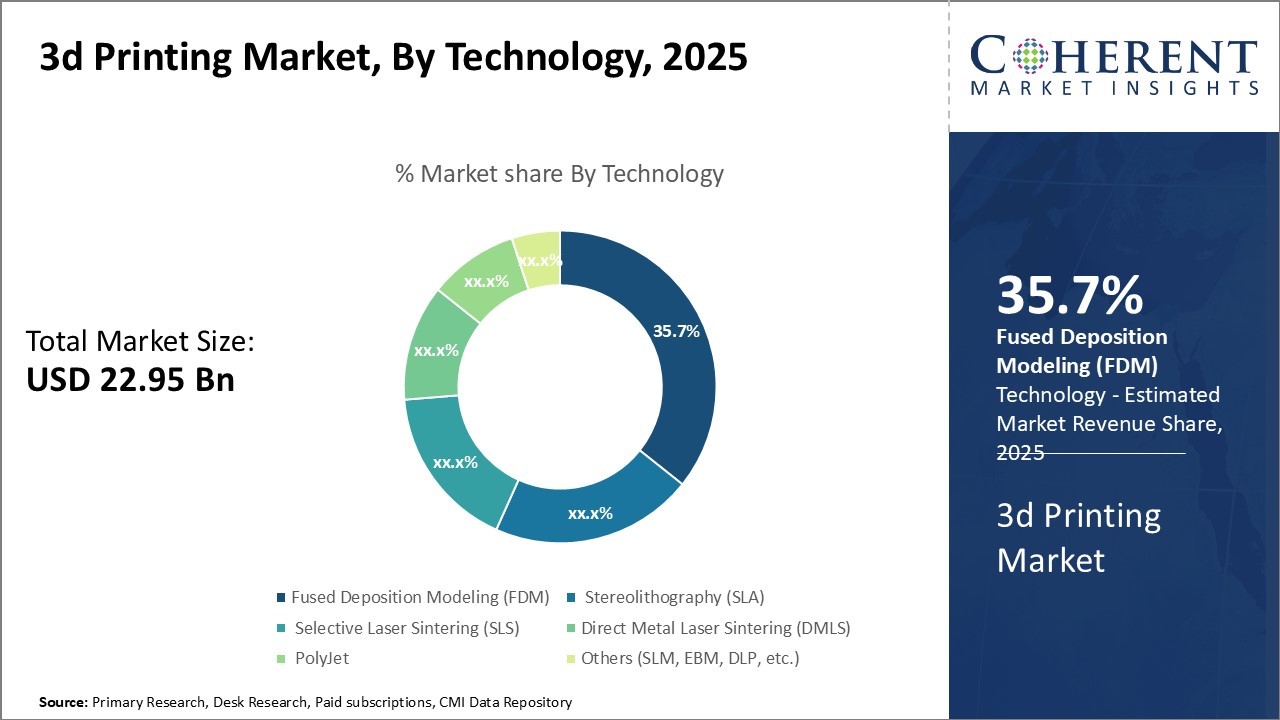
3D Printing Market Insights, By Technology - Fused Deposition Modeling (FDM) contribute the highest share of the market owing to its expansion of material options
Fused Deposition Modeling (FDM) hold the largest market share of 36.7% in 2026. Affordability, user-friendly operation, and versatility are driving the growth of the Fused Deposition Modeling (FDM) segment in the 3D printing market. Industries actively adopt FDM for rapid prototyping, functional testing, and low-volume production because it requires minimal setup and uses materials efficiently. Ongoing enhancements in printer accuracy, printing speed, and filament options, including engineering-grade thermoplastics, are broadening FDM adoption across manufacturing, education, automotive, and product development applications. For instance, in February 2025, Shapeways expanded its 3D printing capabilities by launching Fused Deposition Modeling (FDM), a durable and versatile solution for low-volume production, prototypes, and end-use parts.
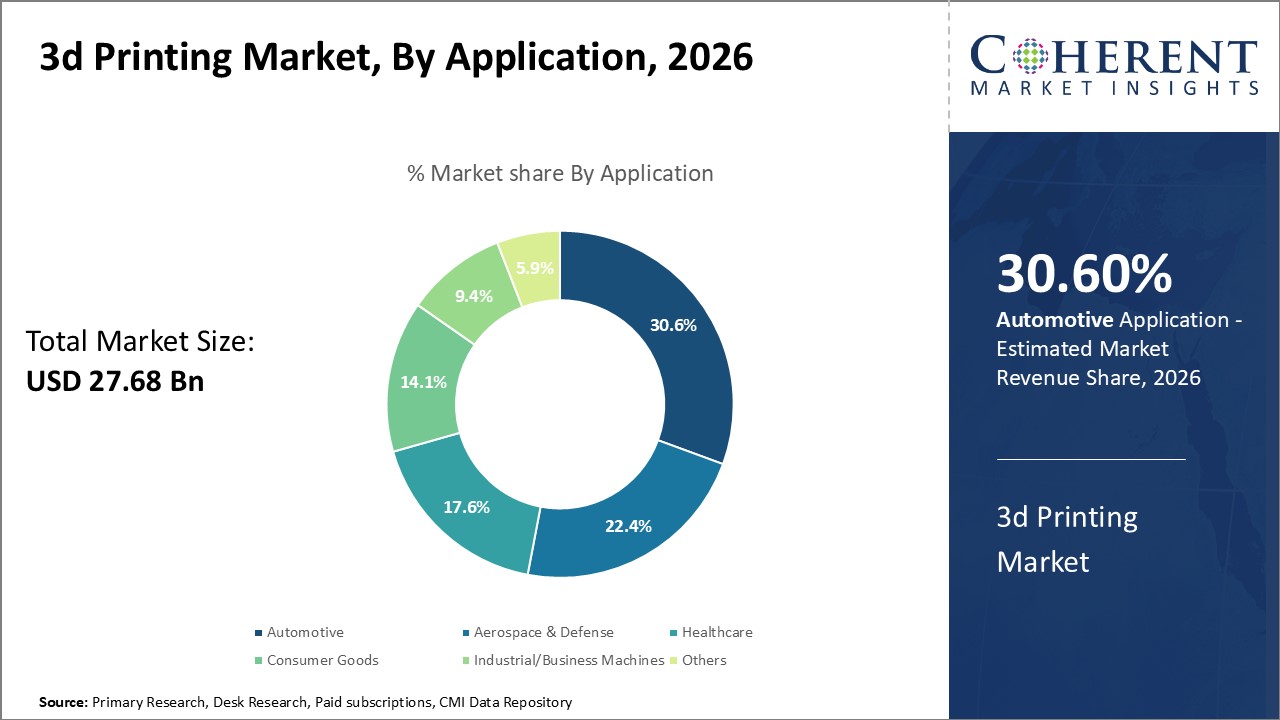
3D Printing Market Insights, By Application - Automotive contribute the highest share of the market owing to its sustainability & regulatory pressure
Automotive expected to hold largest market share of 30.6% in 2026. Automakers are driving the growth of 3D printing in the automotive sector by seeking faster vehicle development, greater design flexibility, and more cost-effective production processes. They actively use 3D printing to produce prototypes, tooling, and customized components, which shortens development timelines and reduces reliance on traditional tooling. The technology enables lightweight designs and complex geometries that improve vehicle performance and efficiency. Increasing use in electric vehicles, interior customization, and local spare-part manufacturing further fuels industry demand. For instance, in June 2025, Lyten launched Lyten Motorsports, a new venture aimed at applying its 3D Graphene material innovations to motorsports parts.
3D Printing Market Insights, By End User - Manufacturers contribute the highest share of the market owing to its expansion in healthcare & medical applications
Manufacturers acquired the prominent market share of 38% in 2026. Manufacturers are actively leveraging 3D printing to streamline production, lower costs, and speed up product development. They use the technology to quickly produce prototypes, tooling, and end-use parts while reducing material waste and inventory requirements. Its capability to create complex geometries and customized products drives innovation across industries, including automotive and healthcare. Continuous improvements in printing materials, software, and machine reliability boost efficiency, flexibility, and scalability, establishing 3D printing as a key component of modern manufacturing strategies. For instance, in October 2025, WOL3D launched BRAHMA, a consumer 3D printing farm designed to support smart manufacturing with scalable, efficient, and sustainable printing solutions for creators, businesses, and industries.
Role of AI (Artificial Intelligence) in the 3D Printing Market
Artificial Intelligence (AI) is actively transforming the 3D printing market by improving design, production, and quality control processes. AI-driven software optimizes modeling, reduces material waste, and speeds up prototyping. Machine learning algorithms enhance print precision and anticipate potential failures, boosting efficiency and reliability. AI also enables real-time monitoring and adaptive adjustments during printing, allowing for complex geometries and customized products. By leveraging data analytics and automation, AI drives faster innovation, cuts costs, and expands applications across industries like healthcare, aerospace, and automotive. For instance, in August 2025, Rapid Fusion launched an AI-powered print assistant to optimize 3D printing for complex components across automotive, aerospace, construction, medical, and defense sectors.
Regional Insights
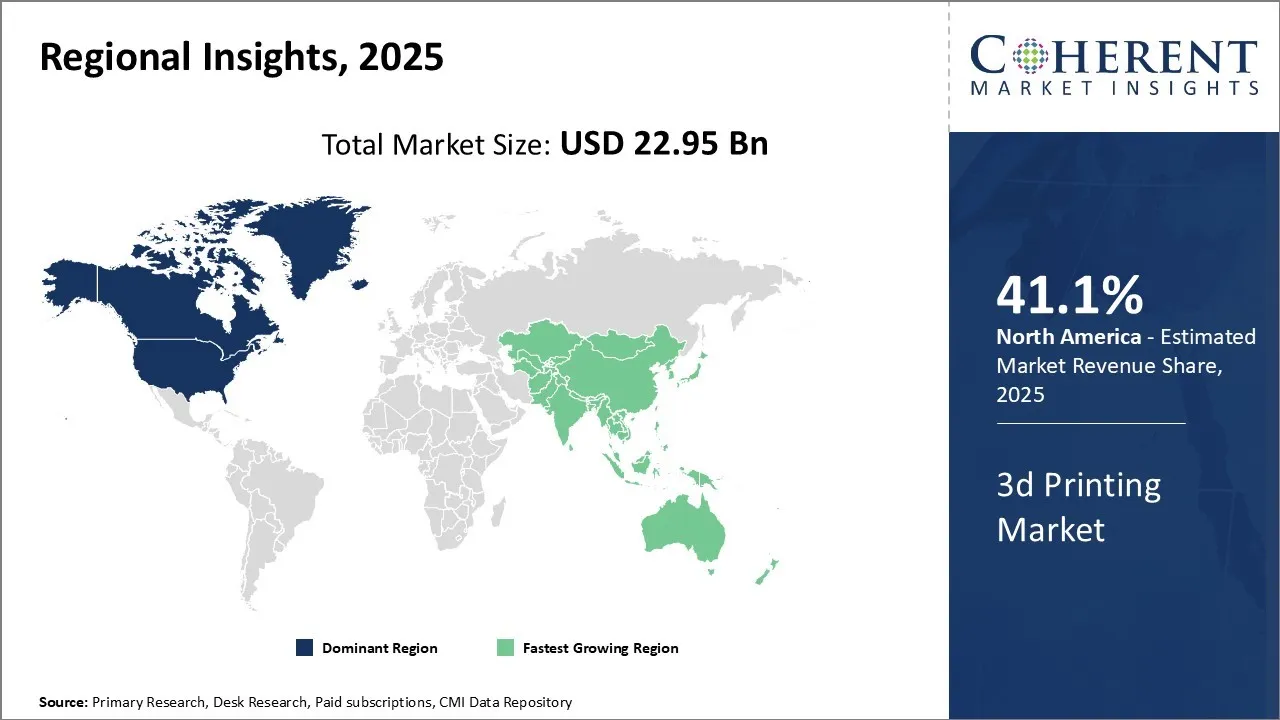
North America 3D Printing Market Trends
North America dominates the overall market with an estimated share of 41.1% in 2026. North America’s 3D printing market is gaining momentum as companies across aerospace, automotive, healthcare, and industrial sectors adopt the technology, supported by advanced R&D and government-industry collaboration. Manufacturers are increasingly producing end-use parts and localizing production with 3D printing, while demand grows for production-grade metal and polymer additive manufacturing. Companies are also expanding services and deploying advanced software tools. Continuous material innovation and new applications in construction and customized products actively shape trends across the region. For instance, in September 2026, U.S.-based startup Thrōn launched a Kickstarter crowdfunding campaign for its collection of 3D-printed sculptural furniture focused on sustainable, eco-friendly solutions.
Asia Pacific 3D Printing Market Trends
Asia Pacific’s 3D printing market is rapidly expanding as manufacturers actively adopt the technology across diverse industries. Companies in China, Japan, India, and Southeast Asia are applying 3D printing in automotive, electronics, healthcare, and industrial production, driving localized innovation and cost-efficient prototyping. Advances in materials and technologies, including metals, polymers, and ceramics, are broadening applications, while governments and research institutions actively support and collaborate on implementation. The region continues to shape market dynamics by focusing on customized solutions and scalable production. For instance, in July 2026, Chinese 3D printing firm HeyGears unveiled one-piece multi-material 3D-printed dentures made using its Multi-Material Fusion DLP technology.
United States 3D Printing Market Trends
The United States leads the 3D printing market, with companies driving strong innovation and widespread industry adoption. U.S. firms are applying 3D printing to advanced areas such as aerospace, healthcare, automotive, and defense, while rising demand for customization and rapid prototyping fuels growth. Robust R&D, venture capital investment, and domestic technology firms advancing materials, hardware, and software further support the market. Companies also prioritize supply chain resilience and on‑shoring, expanding 3D printing from prototypes to functional end‑use parts.
In July 2026, Health Canada has approved U.S. medical device startup Nanochon’s clinical trial design, authorizing a first-in-human study of its 3D-printed Chondrograft knee implant. Such advancements in healthcare is accelerating the 3D printing market share.
India 3D Printing Market Trends
India’s 3D printing market is rapidly evolving, driven by growing adoption in healthcare, automotive, and education sectors. Companies are leveraging additive manufacturing for cost-effective prototyping, skill development, and localized production. Startups and research institutions are innovating with low-cost materials and metal 3D printing solutions tailored to local needs. The market benefits from government initiatives promoting advanced manufacturing and digital technologies, while expanding applications in customized consumer products and industrial tooling, reflecting India’s focus on accessible, scalable, and flexible 3D printing solutions. For instance, in December 2026, Amandeep Hospitals, in partnership with Ujala Cygnus, inaugurated North India’s first hospital-based 3D printing and virtual reality facility, advancing patient-centric medical technology integration.
End-user Feedback and Unmet Needs in the 3D Printing Market
- Material Limitations: Users often highlight restrictions in material variety, durability, and performance, which limit applications for functional end-use parts. Many industries require advanced composites, metals, or bio-compatible materials that are still costly or underdeveloped. Expanding material options and improving reliability remain critical for broader adoption.
- Cost and Accessibility: High equipment and maintenance costs restrict adoption among small businesses and educational institutions. Users report challenges in accessing affordable, high-quality printers and materials. Developing cost-effective solutions and simplified workflows could enhance market penetration and support wider experimentation and prototyping.
- Technical Complexity: Many end-users struggle with software interfaces, design optimization, and machine calibration. Complexity in 3D modeling and post-processing slows adoption, particularly in non-engineering sectors. Streamlined software, intuitive design tools, and better training resources are needed to make 3D printing more user-friendly.
3D Printing Market Trend
Shift to Industrial Adoption
The 3D printing market is moving from prototyping to full‑scale manufacturing. Industries such as aerospace, automotive, and healthcare are integrating additive manufacturing into production lines due to enhanced design flexibility and reduced waste. Manufacturers are using advanced materials to replace traditional parts, accelerating supply chains and enabling customized solutions. Focus on end‑use parts is driving collaborations between OEMs and 3D printer producers, expanding application boundaries and reshaping conventional industrial workflows.
Material Innovation and Diversification
Material development remains a key trend as demand grows for stronger, lighter, and more versatile printing options. Beyond classic plastics, engineers are exploring advanced polymers, metal alloys, ceramics, and bio‑based compounds. These materials enable complex functional parts in high‑stress environments and support sustainable practices. The trend pushes research into recyclable and eco‑friendly materials, broadening industrial use cases. Material suppliers and machine makers are partnering to ensure compatibility and performance for diverse applications.
3D Printing Market Opportunity
On‑Demand Spare Parts Production
3D printing creates opportunities to produce spare parts on demand, reducing the need for large inventories and long supply chains. Manufacturers can produce components only when required, lowering warehousing costs and minimizing delays. This capability is especially valuable for industries with aging equipment where parts are scarce. Localized production hubs can support rapid fulfillment near customers’ locations. The flexibility to print complex geometries also enables redesigning parts for better performance without traditional tooling.
Market Report Scope
3D Printing Market Report Coverage
| Report Coverage | Details | ||
|---|---|---|---|
| Base Year: | 2025 | Market Size in 2026: | USD 27.68 Bn |
| Historical Data for: | 2020 To 2024 | Forecast Period: | 2026 To 2033 |
| Forecast Period 2026 to 2033 CAGR: | 20.6% | 2033 Value Projection: | USD 102.70 Bn |
| Geographies covered: |
| ||
| Segments covered: |
| ||
| Companies covered: | 3D Systems Corporation, Arkema, EOS GmbH, ExOne Company, General Electric Company (GE Additive), Hewlett Packard Inc., Markforged Holding Corporation, Materialise NV, Renishaw plc, SLM Solutions Group AG, Stratasys Ltd, Sisma SPA, Ultimaker BV, voxeljet AG, and Xometry Inc. | ||
| Growth Drivers: |
| ||
| Restraints & Challenges: |
| ||
3D Printing Market News
- In December 2025, Chennai-based deep-tech startup Tvasta Manufacturing Solutions partnered with CEPT University to build a national platform for 3D construction printing, integrating research, education, and real-world testing.
- In December 2025, the Faculty of Engineering at the University of Porto has signed a strategic agreement with NTU’s Singapore Centre for 3D Printing to strengthen long-term collaboration in additive manufacturing research, mobility, and doctoral training.
- In December 2025, Creative3DP has launched a Kickstarter crowdfunding campaign for ExtrudeX, a desktop machine that recycles 3D print waste and filament scraps into new filament.
Analyst Opinion (Expert Opinion)
- The trajectory of 3D printing is no longer defined by novelty but by industrial criticality. Adoption data indicates that a significant majority of manufacturing firms now integrate additive processes beyond prototyping, with over half producing functional end‑use parts and nearly all practitioners regarding these capabilities as a strategic advantage. This shift marks a structural transformation: 3D printing has graduated from experimental to core manufacturing infrastructure, particularly where complex geometries and customization deliver quantifiable operational leverage.
- In aerospace and defense, the penetration of additive technologies into structural components demonstrates a hard‑earned trust in part performance. Aerospace OEM usage statistics show that a sizable share of industry 3D printers are dedicated to lightweight components and tooling, driven by the imperative of weight reduction and efficiency. Instances like Airbus consolidating multiple traditional fuel system parts into a single printed component underscore the metric‑driven impact on fuel consumption and assembly simplification, reinforcing additive’s role in high‑stakes manufacturing.
- Healthcare serves as a clear exemplar of targeted value creation in 3D printing. The preponderance of patient‑specific medical devices, from dental crowns to surgical guides, reflects how additive processes deliver tailored clinical solutions with measurable procedural benefits such as reduced operation time and enhanced surgical precision. The widespread use of 3D printing in hearing aid fabrication and anatomical models demonstrates a mature adoption curve where customization directly correlates with clinical outcomes.
- On the digital‑industrial frontier, the integration of 3D printing with advanced design and production ecosystems signifies a foundational evolution. Increasing uptake of cloud‑based management, digital twins, and automation platforms indicates that additive manufacturing is no longer a stand‑alone tool but a digitally orchestrated production asset that enhances throughput and responsiveness across global supply networks. This digital synthesis is rapidly becoming the baseline expectation for advanced manufacturers.
Speak to the analyst
Want personalized insights?
Take the findings above to one of our principal consultants, or have the report rebuilt around the segments, geographies and competitors you actually track.
Market Segmentation
- Technology Insights (Revenue, USD Bn, 2021 - 2033)
- Fused Deposition Modeling (FDM)
- Stereolithography (SLA)
- Selective Laser Sintering (SLS)
- Direct Metal Laser Sintering (DMLS)
- PolyJet
- Others (SLM, EBM, DLP, etc.)
- Application Insights (Revenue, USD Bn, 2021 - 2033)
- Automotive
- Aerospace and Defense
- Healthcare
- Consumer Goods
- Industrial/Business Machines
- Others
- End User Insights (Revenue, USD Bn, 2021 - 2033)
- Manufacturers
- Service Bureaus
- Designers and Engineers
- Hobbyists and Consumers
- Others
- By Regional Insights (Revenue, USD Bn 2021 - 2033)
- North America
- U.S.
- Canada
- Latin America
- Brazil
- Argentina
- Mexico
- Rest of Latin America
- Europe
- Germany
- U.K.
- Spain
- France
- Italy
- Russia
- Rest of Europe
- Asia Pacific
- China
- India
- Japan
- Australia
- South Korea
- ASEAN
- Rest of Asia Pacific
- Middle East
- GCC Countries
- Israel
- Rest of Middle East
- Africa
- South Africa
- North Africa
- Central Africa
- Key Players Insights
- 3D Systems Corporation
- Arkema
- EOS GmbH
- ExOne Company
- General Electric Company (GE Additive)
- Hewlett Packard Inc.
- Markforged Holding Corporation
- Materialise NV
- Renishaw plc
- SLM Solutions Group AG
- Stratasys Ltd
- Sisma SPA
- Ultimaker BV
- voxeljet AG
- Xometry Inc.
Sources
Primary Research interviews
- Manufacturing engineers and plant managers from aerospace, automotive, and healthcare sectors
- 3D printing equipment designers and R&D heads
- Material scientists and polymer/metal specialists
- Hospital and clinic administrators using 3D-printed medical devices
Databases
- PubMed for biomedical applications
- IEEE Xplore for engineering and additive manufacturing research
- Scopus for cross-disciplinary 3D printing studies
- ScienceDirect for materials and industrial case studies
Magazines
- Additive Manufacturing Magazine
- 3D Printing Industry Magazine
- TCT Magazine
- Engineering Design & Automation Magazine
Journals
- Journal of Additive Manufacturing
- Rapid Prototyping Journal
- Advanced Materials Research
- Materials & Design Journal
Newspapers
- The New York Times (Technology & Industry sections)
- The Guardian (Science & Innovation)
- The Wall Street Journal (Manufacturing & Technology)
- Financial Times (Industrial Technology coverage)
Associations
- ASTM International (Additive Manufacturing Committee)
- SME (Society of Manufacturing Engineers)
- America Makes
- Wohlers Associates (non-consulting reports and resources)
Public Domain sources
- NASA technical reports on additive manufacturing
- FDA guidelines on medical device printing
- European Union Horizon 2020 research publications
- U.S. Patent Office filings on 3D printing technologies
Proprietary Elements
- CMI Data Analytics Tool
- Proprietary CMI Existing Repository of information for last 8 years
Get access to 250+ pages report
Every segment, forecast, competitor profile and data table behind the analysis above — available for instant download.
- ESOMAR Member
- ISO 9001:2015 Certified
- D-U-N-S Registered
- GDPR & CCPA Compliant
Missing comfort of reading report in your local language? Find your preferred language:
Transform your Strategy with Exclusive Trending Reports
Frequently Asked Questions
The 3d Printing Market is estimated to be valued at USD 27.68 Bn in 2026, and is expected to reach USD 102.70 Bn by 2033.
The CAGR of the 3d Printing Market is projected to be 20.6% from 2026 to 2033.
Increasing adoption in various industries such as healthcare, automotive, and aerospace and reduction in 3D printing costs due to advancements in technology are the major factors driving the growth of the global 3D printing market.
Limited material options and their high costs and intellectual property issues and piracy concerns are the major factors hampering the growth of the global 3D printing market.
In terms of Technology, the Fused Deposition Modeling (FDM) segment is estimated to dominate the market revenue share in 2026.
3D Systems Corporation, Arkema, EOS GmbH, ExOne Company, General Electric Company (GE Additive), Hewlett Packard Inc., Markforged Holding Corporation, Materialise NV, Renishaw plc, SLM Solutions Group AG, Stratasys Ltd, Sisma SPA, Ultimaker BV, voxeljet AG, and Xometry Inc. are the major players.
North America is expected to lead the global 3D printing market.