

Additive Manufacturing Market Size and Forecast — 2026-2033
The Global Additive Manufacturing Market is expected to be valued at USD 31.48 billion in 2026 and reach USD 114.45 billion by 2033, exhibiting a compound annual growth rate (CAGR) of 24.0% from 2026 to 2033.
Key Takeaways of the Global Additive Manufacturing Market:
- The hardware segment is expected to lead the market with a share of 59.3% in 2026.
- The industrial 3D printer segment is projected to dominate, holding 69.6% of the market share in 2026.
- The Fused Deposition Modeling (FDM) segment is projected to dominate, holding 26.6% of the market share in 2026.
- North America is expected to lead the market, holding a share of 34. 7% in 2026. Asia Pacific is anticipated to be the fastest-growing region, with a market share of 27.8% in 2026.
Market Overview:
Increased adoption of 3D printing across industries, such as automotive, aerospace, medical, and consumer products, is driving the demand for additive manufacturing. Additionally, ongoing development and innovations in materials, software, and technology are expanding the application areas of 3D printing. Wide availability of affordable desktop 3D printers and the development of new applications are further propelling the growth of the global additive manufacturing market during the forecast period.
Component Insights
Component Insights – Emphasis on Advancements and Customization Drives Hardware Growth
The hardware segment is expected to dominate the market, holding a share of 59.3% in 2026. Hardware machines have evolved significantly over the past decade with enhanced functionality, precision, and processing power. Machines are now equipped with state-of-the-art technologies, such as multiple laser sources, 5-axis movements, and closed-loop sensors, for monitoring quality parameters. This has enabled the development of more complex geometries and finer product details. The integration of artificial intelligence and internet of things capabilities has also made machines more intelligent by allowing remote monitoring and predictive maintenance.
The hardware segment is also gaining from increasing customization requirements across industries. Additive manufacturing provides the flexibility to produce application-specific components on-demand without the need for extensive tooling charges. This has spurred the use of machines for prototype development as well as manufacturing of unique, patient-specific medical devices. It is also driving demand from industries such as aerospace & defense, automotive, and consumer products which require customized, low volume production. Hardware manufacturers have responded by introducing tailored machines for diverse materials like metals, polymers, concrete, and living cells. The availability of different build envelope sizes further supports varied customer needs.
Going forward, nanotechnology is expected to influence hardware innovation. The development of high-resolution metal 3D printers capable of depositing materials at nano-scale is gaining focus. Adoption of integrated quality control systems using AI and virtual commissioning capabilities is also on the rise. While hardware will continue facing price challenges vis-a-vis conventional techniques, ongoing product, and process improvements are likely to enhance adoption rates across both developed and developing regions.
Printer Type Insights
Printer Type Insights – Wide Range of Applications Spurs Industrial 3D Printer Usage
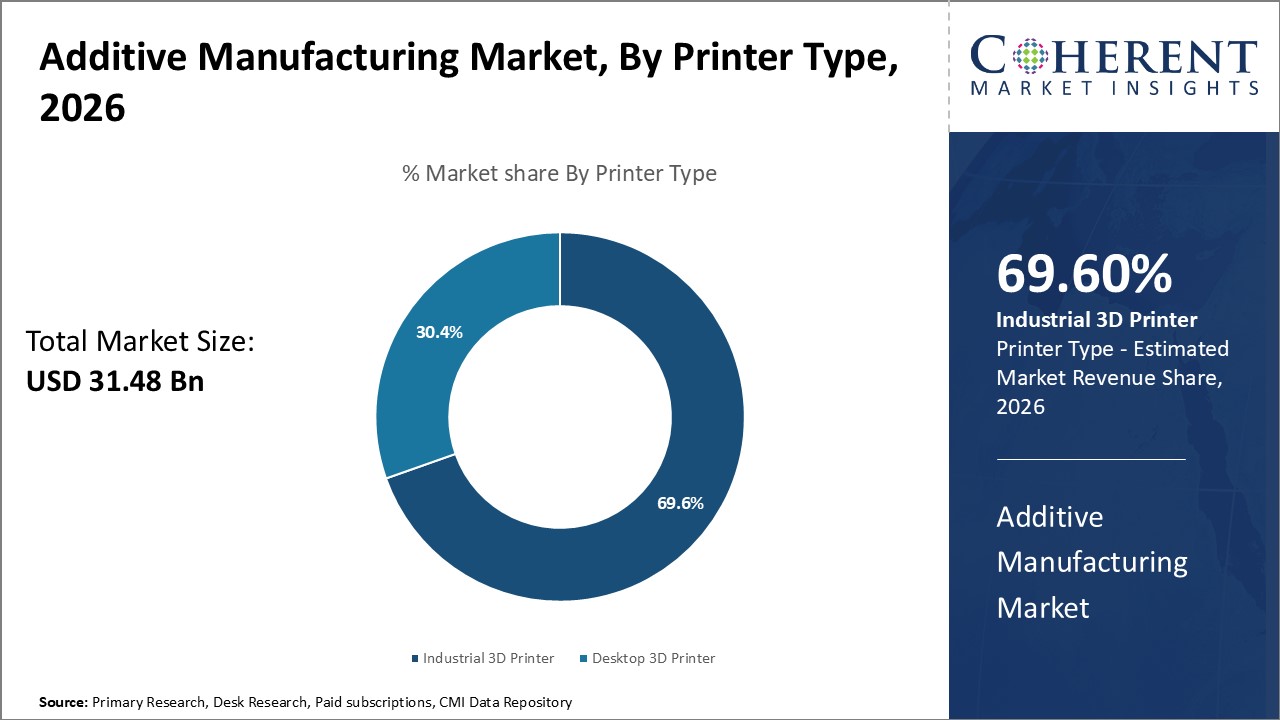
The industrial 3D printer segment is expected to dominate the additive manufacturing market, holding a share of 69.6% in 2026. These machines are capable of printing at larger scales and higher speeds compared to desktop variants. Hence, they find widespread use from prototyping to actual manufacturing in sectors such as aerospace, automotive, healthcare, and consumer goods.
Within aerospace, industrial 3D printers are used to produce functional concept models, test parts, maintenance tools, and spare components on-demand. Their benefits of design flexibility and complex geometry printing have resulted in various critical aircraft and spacecraft parts now being additively manufactured. In automotive, they are employed for applications like jigs and fixtures, injected molding tools as well as low volume, geometric parts. Their ability to print multiple materials including metals and elastomers expand in-house prototyping capacities.
In the medical field, these printers construct custom surgical guides, dental models and U.S. Food and Drug Administration (FDA)-approved final implants with precision. Their use alleviates inventory issues and procedural costs for one-off devices. Industrial 3D printers also enable 'desktop manufacturing' through centralized production of customized consumer products like hearing aids, eyewear, and sports gear.
Technology Insights
Technology Insights – Superior Material Properties Fuel FDM Technology Adoption
The Fused Deposition Modeling (FDM) segment is expected to dominate the additive manufacturing market, holding a share of 26.6% in 2026. FDM deposits thermoplastics layer-by-layer through an extrusion nozzle to build objects. It offers cost-effective construction of conceptual models, prototypes, patterns, and final parts without tooling in thermoplastics such as ABS, PLA, nylon, and flexible filaments. The availability of a wide variety of engineering-grade thermoplastics expands the technology's appeal across manufacturing. ABS is cost-effective and chemically resistant while nylon has high strength-to-weight ratios. Semicrystalline thermoplastics like polypropylene and polycarbonate possess temperature tolerances extending their utility. Thermoplastic polyurethane elastomer and thermoplastic vulcanizates provide flexible parts for applications involving movement.
Additionally, multi-material printing using FDM broadens functional capabilities. The option to combine rigid and flexible materials or deposit soluble supports with builds eases part removal. Recent advancements integrating carbon fiber and metal filling have also enhanced mechanical properties. This has spurred adoption in prototyping, tooling, casting patterns, and full production of items with minimal post-processing needs.
Regional Insights
North America Additive Manufacturing Market Trends
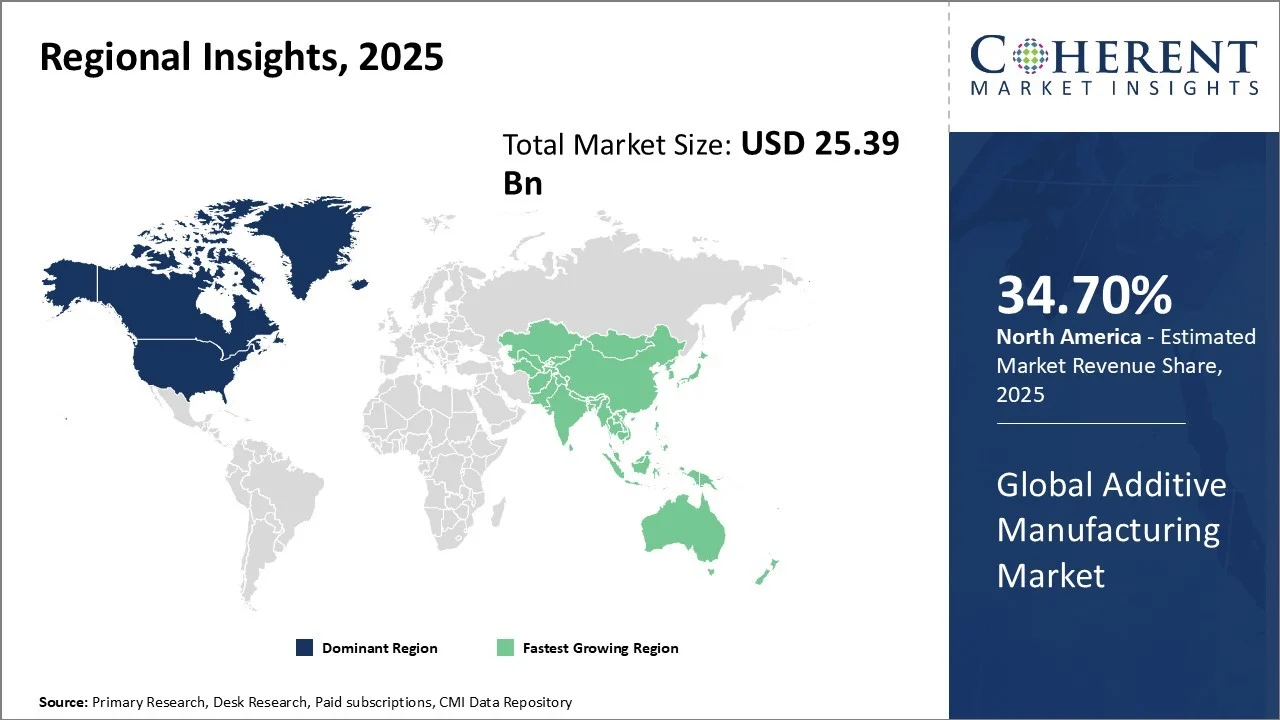
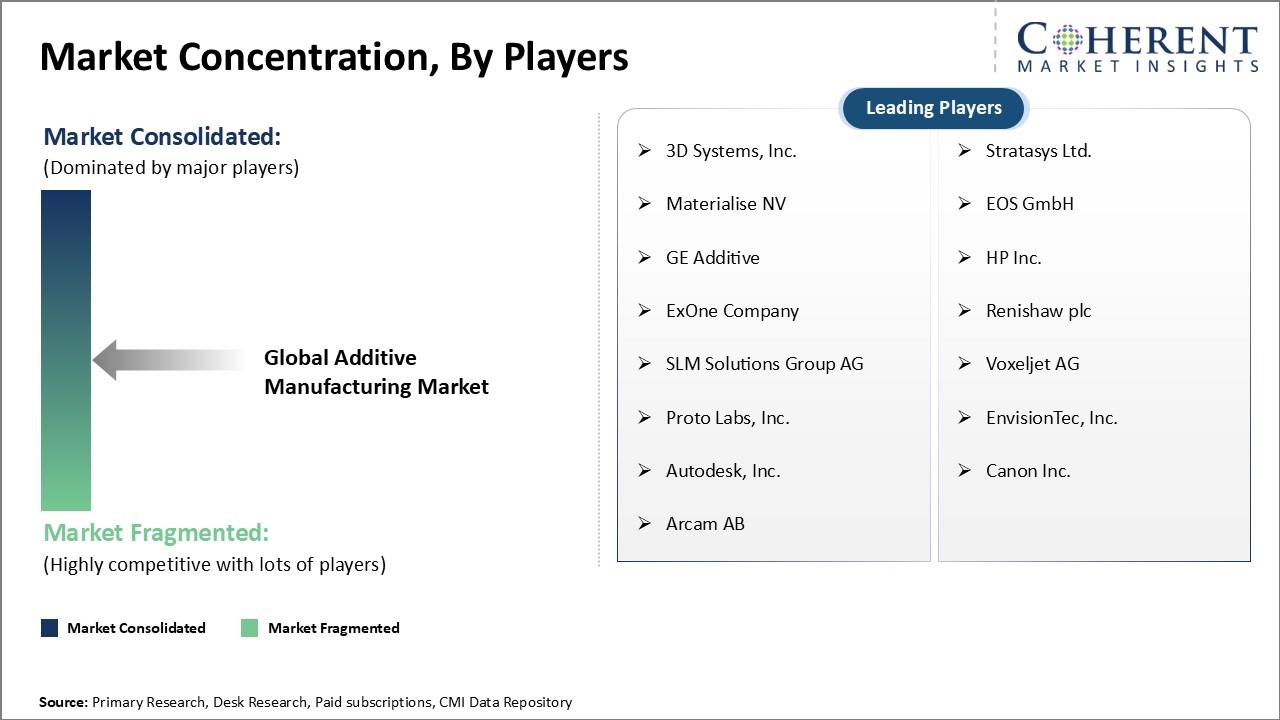
North America is expected to dominate the global additive manufacturing market, holding a market share of approximately 34.7% in 2026. The dominance stems from early adoption of the technology across various industries such as aerospace, automotive, and healthcare. The strong presence of leading additive manufacturing equipment and material manufacturers, such as 3D Systems, Stratasys, GE Additive, and HP in the region, has accelerated technology development and applications. Moreover, sizable investments by government organizations such as the National Aeronautics and Space Administration (NASA) and the Defense Advanced Research Projects Agency (DARPA) to support additive manufacturing research have created a robust ecosystem for innovations.
Asia Pacific Additive Manufacturing Market Trends
The Asia Pacific region, accounting for approximately 27.8% of the market in 2026, is projected to be the fastest-growing region. Countries like China, Japan, and South Korea are rapidly industrializing and recognize the benefits of additive manufacturing in reducing costs and shortening product development cycles. The governments of these countries provide subsidies and relaxed regulations to promote localized additive manufacturing industries. For example, Made in China 2026 aims to make China a leader in advanced manufacturing through initiatives that support the adoption of additive technologies.
Additive Manufacturing Market Outlook for Key Countries
U.S. Additive Manufacturing Market Trends
The U.S. additive manufacturing market continues to benefit from close collaboration between private companies, research institutes, and defense organizations to develop new applications. Companies like 3D Systems, Stratasys, and GE Additive have major production and R&D centers in the country, continuing to drive innovation. States like Michigan and Ohio are emerging as hubs for additive manufacturing due to the presence of automotive and aerospace corporations adopting the technology.
Germany Additive Manufacturing Market Trends
Germany additive manufacturing market growth is primarily driven by its strong machine tools and automotive industries. Companies, such as EOS, SLM Solutions, and Renishaw, have gained global prominence through their metal 3D printing solutions used extensively in the automotive sector for prototyping and low-volume production. The German government is actively working to position the county as a leader in industrial 3D printing through initiatives supporting research and skills training.
China Additive Manufacturing Market Trends
China continues to lead the Asia Pacific region in additive manufacturing adoption. The government's Made in China 2026 policy aims to replace 10-30% of traditional manufacturing with 3D printing and sees it as a critical part of its plans to move up the value chain. Major local players, such as Zhuhai CTC Electronic and Xi'an Bright Laser, have emerged to cater to the domestic demand, while international firms are also increasingly setting up larger production facilities in the country.
Japan Additive Manufacturing Market Trends
Japan additive manufacturing market growth is driven by demands from major industries such as automotive, electronics, and healthcare. Companies like Canon, Nikon, and Stratasys have established strong product portfolios catering to precision prototyping needs of these sectors. The government is focused on cultivating skills and startup culture around 3D printing to foster innovation. Leading academic institutions are actively involved in researching new applications of additive technology.
Market Players, Key Development, and Competitive Intelligence
Key Developments:
- In March 2025, Alloyed, an advanced metals company, raised USD 48.43 million (£37 million) to enhance its digital design software and expand additive manufacturing capabilities in the U.K. and the U.S.
- In February 2025, Firestorm Labs, a manufacturer of Unmanned Aerial Systems (UAS), showcased its innovative approach to 3D printing drones, which allows drones to be printed and assembled in the field—wherever and whenever needed
Top Strategies Followed by Global Additive Manufacturing Market Players
- Established Players: Leading companies focus on strategic acquisitions, large-scale investments, and technological advancements to maintain and strengthen their market dominance.
- Stratasys acquired Origin to enhance its presence in the mass production 3D printing segment, focusing on photopolymer-based additive manufacturing.
- EOS introduced its EOS M 300 Series, an advanced metal 3D printing solution, providing improved scalability, precision, and efficiency for industries such as aerospace and automotive.
- Mid-Level Players: Mid-sized companies adopt regional expansion, strategic partnerships, and cost-effective solutions to increase market share.
- Alloyed, a company founded by University of Oxford aerospace materials engineers, has secured USD 48.43 (£37 million) in investment to expand its digital design software and additive manufacturing capabilities in the U.K. and the U.S. The company’s advanced digital platform and 3D printers produce high-performance metal components for aerospace, automotive, defense, data centers, and wearable electronics.
- Small-Scale Players: Smaller companies differentiate by targeting niche markets, focusing on customer-centric innovations, and offering specialized integrations.
- Zellerfeld is producing and shipping 3D-printed footwear worldwide, offering customized, locally produced shoes that challenge traditional manufacturing methods.
- Syntilay, in partnership with Reebok co-founder Joe Foster, launched AI-designed, 3D-printed shoes customized to each customer's foot using phone camera scans.
Emerging Startups – Additive Manufacturing Industry Ecosystem
- Innovative Technologies: Startups are pioneering advanced manufacturing techniques to enhance production efficiency and product quality.
- Freemelt develops open-source electron beam powder bed fusion systems, enabling collaborative research and development in metal additive manufacturing.
- Rapidia offers a water-based metal 3D printing process that eliminates the traditional debinding step, significantly reducing production time and resource consumption.
- Sustainable Solutions: Companies are focusing on eco-friendly manufacturing processes to minimize environmental impact.
- Alloyed utilizes advanced digital design software and additive manufacturing to produce high-performance metal components, aiming to improve efficiency and reduce material waste.
- Additec specializes in wire-directed energy deposition, offering large-scale metal additive manufacturing with reduced waste and smart process controls for flaw detection.
- Hybrid Manufacturing Approaches: Startups are integrating additive and subtractive manufacturing techniques to enhance production capabilities.
- Fabrisonic combines ultrasonic additive manufacturing with traditional CNC milling, creating a hybrid process that leverages the benefits of both methods.
- Ethereal Machines focuses on hybrid manufacturing solutions that integrate additive and subtractive processes in a single platform, catering to industries like aerospace and tooling.
- Industry-Specific Solutions: Companies are developing specialized additive manufacturing applications tailored to particular sectors.
- Dynatomics, backed by Larry Page, is utilizing AI and 3D printing to build affordable electric vertical take-off and landing (eVTOL) aircraft, aiming to revolutionize air travel
- Intech Additive Solutions offers end-to-end metal additive manufacturing solutions for aerospace and automotive industries, focusing on sustainability and cost-efficiency
- Current Industry Events of 2026
- Market Size Estimation
- Regional Breakdown
- Competitive Landscape
- Customer Intelligence
- Segmental Analysis
- Pricing Analysis
- Key Market Drivers, Challenges & Future Trends
- Customized Insights Section
Market Report Scope
Additive Manufacturing Market Report Coverage
| Report Coverage | Details | ||
|---|---|---|---|
| Base Year: | 2025 | Market Size in 2026: | USD 31.48 Bn |
| Historical Data for: | 2020 To 2024 | Forecast Period: | 2026 To 2033 |
| Forecast Period 2026 to 2033 CAGR: | 24.0% | 2033 Value Projection: | USD 114.45 Bn |
| Geographies covered: |
| ||
| Segments covered: |
| ||
| Companies covered: | 3D Systems, Inc., Stratasys Ltd., Materialise NV, EOS GmbH, GE Additive, HP Inc., ExOne Company, Renishaw plc, SLM Solutions Group AG, Voxeljet AG, Proto Labs, Inc., EnvisionTec, Inc., Autodesk, Inc., Canon Inc., and Arcam AB | ||
| Growth Drivers: |
| ||
| Restraints & Challenges: |
| ||
Market Dynamics
Global Additive Manufacturing Market Driver – Advancements in 3D printing technologies
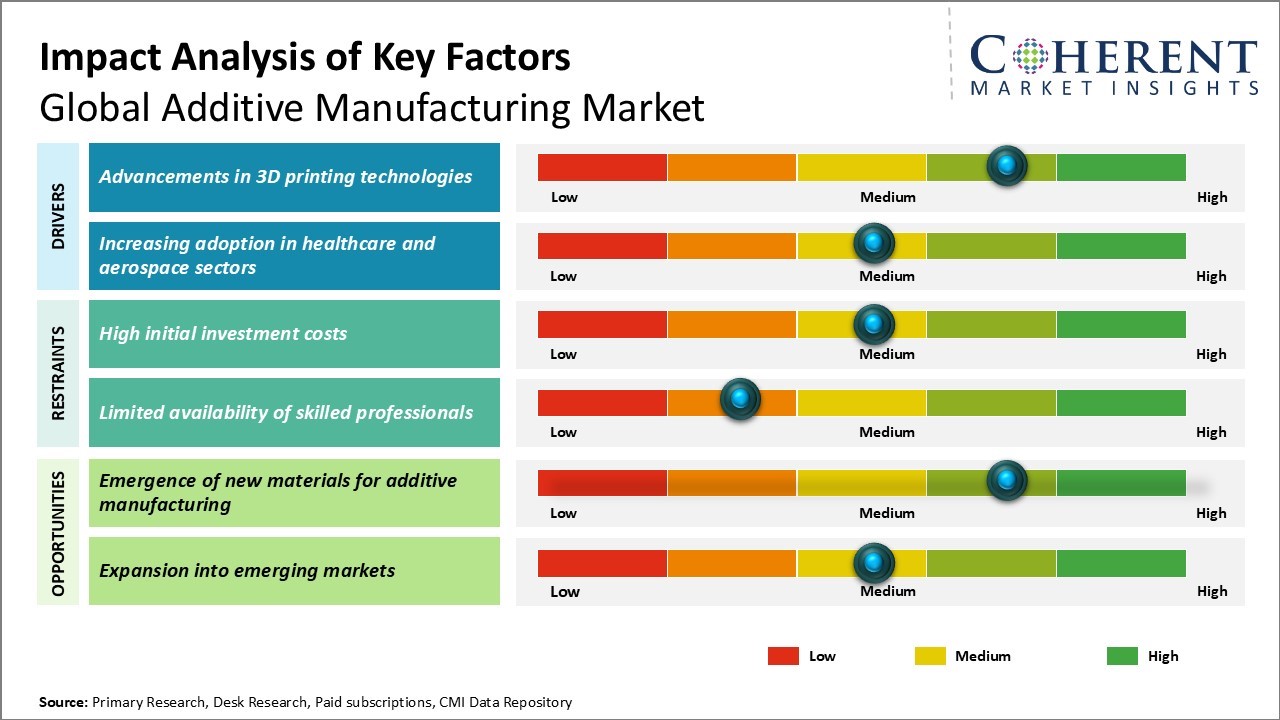
The additive manufacturing market has witnessed significant advancements in 3D printing technologies over the past decade. Rapid advancements in areas such as materials, multi-material printing, and speed have increased the applications of 3D printing across industries. Manufacturers are increasingly adopting 3D printing due to advantages such as reduced waste, customization capabilities, and complex part production using advanced metal and polymer materials. Many industries such as automotive, aerospace, and medical are leveraging 3D printing for prototyping as well as direct manufacturing of complex components. Furthermore, the development of multi-material 3D printers allows the mixing of different materials in a single part, enabling novel applications. Fused deposition modeling (FDM) printers offering high-speed printing while maintaining print quality are also gaining traction. Continued improvements in areas, such as speed, resolution, and reliability, would further increase the adoption of 3D printing technologies by industrial users.
Global Additive Manufacturing Market Challenge - High initial investment costs
The high initial costs associated with additive manufacturing equipment pose a significant challenge for widespread adoption of the technology. 3D printers can range in price from tens of thousands to over a million dollars for professional-grade machines. In addition to the hardware costs, companies need to invest in design software, specialized training for technicians, and post-processing equipment. The high costs limit additive manufacturing primarily to industrial applications where the benefits outweigh the investment. For smaller companies and individual users, the barriers to entry remain quite high. Achieving greater economies of scale through increased production volumes could help drive costs down over time. However, the high prices currently restrict additive manufacturing mainly to prototyping and low-volume production.
Global Additive Manufacturing Market Opportunity - Emergence of new materials for additive manufacturing
The variety of materials now available for additive manufacturing is creating promising new opportunities. Traditionally, 3D printing was mainly used for plastics and resins but innovations have expanded the range of possible raw materials. Metals like titanium and nickel alloys can now be deposited layer by layer, opening up applications in industries like aerospace and medical devices. Biocompatible materials allow for custom implants and prosthetics to be created using the patient's medical scans. New composites blend materials like carbon fiber for strong yet lightweight parts. Continuous fiber printing embeds long filaments for extreme strength. The widening selection of materials addresses more complex engineering needs while boosting the functionality of parts made through additive methods. As material innovation progresses further, it has the potential to drive both new applications and wider adoption of 3D printing across more industries.
Analyst Opinion (Expert Opinion)
- The additive manufacturing market is poised for substantial growth over the forecast period, driven by technological advancements and increasing adoption across various industries. The ability to produce complex, customized components efficiently positions additive manufacturing as a transformative force in sectors such as aerospace, healthcare, and automotive.
- A significant challenge to market expansion is the high initial investment required for advanced 3D printing equipment and the ongoing costs associated with materials and maintenance. Additionally, intellectual property concerns and the need for skilled labor may hinder widespread adoption.
- The North America region is expected to maintain its dominance in the market, driven by innovation, research and development activities, and the presence of key industry players. Meanwhile, Asia Pacific is anticipated to experience the fastest growth, supported by strong manufacturing infrastructures and government initiatives promoting advanced manufacturing technologies.
Speak to the analyst
Want personalized insights?
Take the findings above to one of our principal consultants, or have the report rebuilt around the segments, geographies and competitors you actually track.
Market Segmentation
- Component Insights (Revenue, USD Bn, 2021 - 2033)
- Hardware
- Software
- Services
- Printer Type Insights (Revenue, USD Bn, 2021 - 2033)
- Industrial 3D Printer
- Desktop 3D Printer
- Technology Insights (Revenue, USD Bn, 2021 - 2033)
- Fused Deposition Modeling (FDM)
- Stereolithography (SLA)
- Selective Laser Sintering (SLS)
- Direct Metal Laser Sintering (DMLS)
- PolyJet Printing
- Binder Jetting Printing
- Electron Beam Melting (EBM)
- Laminated Object Manufacturing (LOM)
- Material Insights (Revenue, USD Bn, 2021 - 2033)
- Plastic
- Metal
- Ceramics
- Alloys
- Regional Insights (Revenue, USD Bn, 2021 - 2033)
- North America
- U.S.
- Canada
- Latin America
- Brazil
- Argentina
- Mexico
- Rest of Latin America
- Europe
- Germany
- U.K.
- Spain
- France
- Italy
- Russia
- Rest of Europe
- Asia Pacific
- China
- India
- Japan
- Australia
- South Korea
- ASEAN
- Rest of Asia Pacific
- Middle East
- GCC Countries
- Israel
- Rest of Middle East
- Africa
- South Africa
- North Africa
- Central Africa
- North America
- Key Players Insights
- 3D Systems, Inc.
- Stratasys Ltd.
- Materialise NV
- EOS GmbH
- GE Additive
- HP Inc.
- ExOne Company
- Renishaw plc
- SLM Solutions Group AG
- Voxeljet AG
- Proto Labs, Inc.
- EnvisionTec, Inc.
- Autodesk, Inc.
- Canon Inc.
- Arcam AB
Get access to 250+ pages report
Every segment, forecast, competitor profile and data table behind the analysis above — available for instant download.
- ESOMAR Member
- ISO 9001:2015 Certified
- D-U-N-S Registered
- GDPR & CCPA Compliant
Missing comfort of reading report in your local language? Find your preferred language:
Transform your Strategy with Exclusive Trending Reports
Frequently Asked Questions
The global additive manufacturing market is expected to be valued at USD 31.48 Billion in 2026 and reach USD 114.45 Billion by 2033.
The CAGR of the global additive manufacturing market is projected to be 24.0% from 2026 to 2033.
Advancements in 3D printing technologies and increasing adoption in healthcare and aerospace sectors are the major factors driving the growth of the global additive manufacturing market.
High initial investment costs and limited availability of skilled professionals are hampering the growth of the global additive manufacturing market.
In terms of component, the hardware segment is estimated to dominate the market revenue share in 2026.
3D Systems, Inc., Stratasys Ltd., Materialise NV, EOS GmbH, GE Additive, HP Inc., ExOne Company, Renishaw plc, SLM Solutions Group AG, Voxeljet AG, Proto Labs, Inc., EnvisionTec, Inc., Autodesk, Inc., Canon Inc., and Arcam AB are the major players.
North America is expected to lead the global additive manufacturing market in 2026, holding a share of 34.7%.