

Next Generation Data Storage Market Size and Forecast – 2026 to 2033
The Next Generation Data Storage Market is anticipated to grow at a CAGR of 8.3% with USD 16.7 Bn share in 2026 and is expected to reach USD 22.8 Bn in 2033. Cloud computing, AI, IoT, and big data analytics are generating massive data volumes, driving the growth of the Next Generation Data Storage market. According to industry estimates, global data creation is expected to exceed 180 zettabytes by 2025, compared to around 64 zettabytes in 2020, highlighting the increasing need for scalable and high-performance storage infrastructure.
Key Takeaways
- Direct Attached Storage (DAS) holds the largest market share of 43.4% in 2026 owing to its low latency and high performance. The increasing use of high-speed enterprise applications and AI workloads has accelerated DAS adoption, with enterprise data processing speeds improving by nearly 35% compared to traditional network-based storage systems.
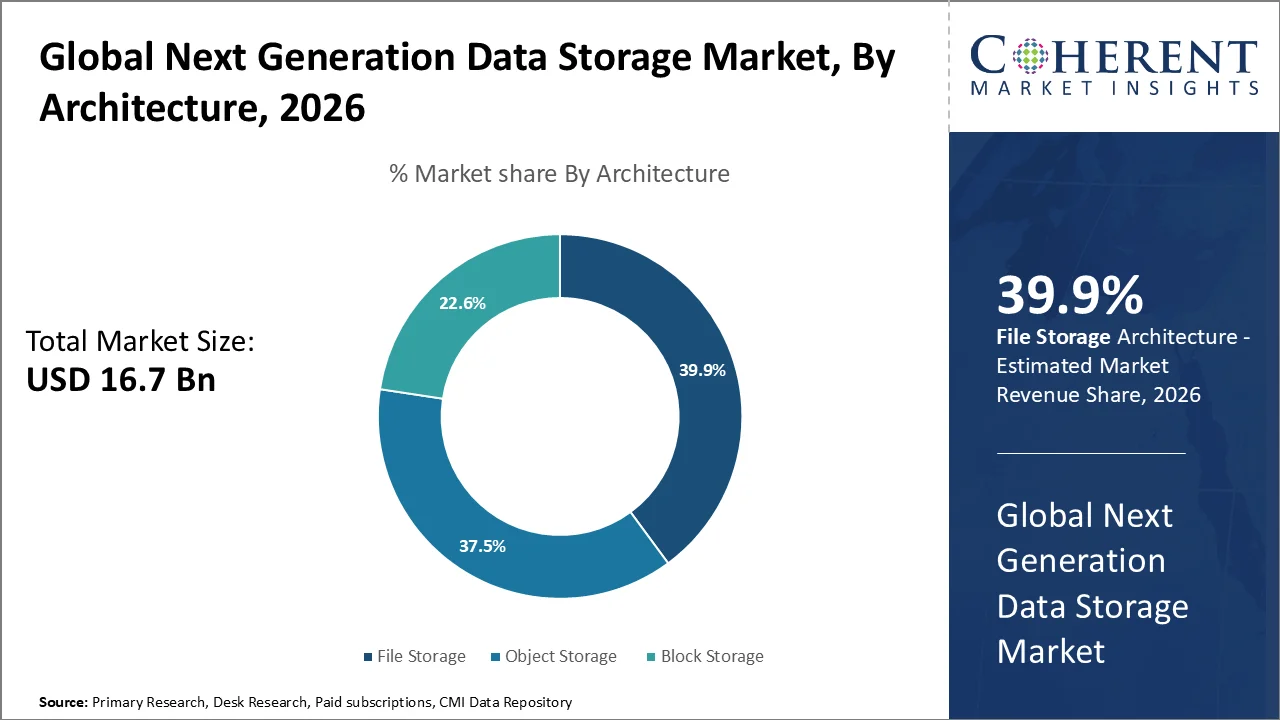
- File Storage is expected to hold the largest market share of 39.9% in 2026 owing to the explosion of unstructured data. Industry reports indicate that over 80% of global enterprise data is unstructured, including videos, images, emails, and social media content, significantly increasing demand for scalable file storage solutions.
- Hard Disk Drive (HDD) acquired the prominent market share of 46.3% in 2026 owing to its cost advantage over SSDs. HDDs continue to offer nearly 80% lower cost per terabyte compared to SSDs, making them the preferred choice for large-scale archival and backup storage applications.
- Cloud captures the largest market share of 52.2% in 2026 owing to the expansion of AI, machine learning, and big data analytics.
- Healthcare holds the largest market share of 37.8% in 2026 owing to the adoption of electronic health records (EHRs).
- By Region, North America is expected to acquire the dominant share of 39.20% in 2026 owing to the rapid adoption of artificial intelligence and big data.
Current Events and Their Impact on the Next Generation Data Storage Market
Current Event | Description and its Impact |
U.S.-China Semiconductor Export Restrictions |
|
India’s Digital Personal Data Protection Act (DPDP Act) |
|
Segmental Insights
- Current Industry Events of 2026
- Market Size Estimation
- Regional Breakdown
- Competitive Landscape
- Customer Intelligence
- Segmental Analysis
- Pricing Analysis
- Key Market Drivers, Challenges & Future Trends
- Customized Insights Section
File Storage holds the Largest Market Share
File Storage is expected to hold the largest market share of 39.9% in 2026 owing to the rising demand for collaboration and remote work. Businesses are steadily increasing their use of file storage in the next generation data storage market as unstructured data continues to expand and requires better organization. Industry estimates indicate that nearly 80–90% of enterprise data is unstructured, including documents, videos, emails, multimedia files, and collaboration content, significantly increasing the need for scalable file storage systems. Organizations depend on file storage to improve teamwork, enable remote working models, and ensure smooth file sharing across geographically dispersed teams. Additionally, more than 70% of enterprises globally have adopted hybrid or remote work strategies, accelerating demand for centralized and cloud-integrated file storage platforms. The shift toward cloud-based platforms and hybrid IT environments strengthens adoption by offering greater scalability and operational flexibility, with global cloud storage traffic projected to exceed 20 zettabytes annually by 2026.
Why is Direct Attached Storage (DAS) Acquiring the Largest Market Share?
Direct Attached Storage (DAS) hold the largest market share of 43.4% in 2026. Organizations are increasingly adopting Direct Attached Storage (DAS) in the next generation data storage market because it delivers high performance, low latency, and cost-effective storage solutions. Enterprises use DAS for AI workloads, big data analytics, media production, and high-performance computing applications that require fast data access. The adoption of NVMe SSDs and all-flash storage architectures continues to improve DAS efficiency and speed. Growing demand for edge computing, localized data processing, and simplified storage management is also driving enterprises and small businesses to implement DAS for reliable and scalable storage operations. For instance, Data Direct Networks (DDN), a clustered NAS and HPC storage provider, introduced a Hadoop-ready converged compute and storage cluster for enterprise customers. Hadoop was originally developed for hyperscale environments at companies like Google, Yahoo, and IBM using commodity servers with direct-attached storage (DAS).
Hard Disk Drive (HDD) holds the Largest Market Share
Hard Disk Drive (HDD) acquired the prominent market share of 46.3% in 2026. Rising data from cloud computing, artificial intelligence, and video streaming drives the adoption of Hard Disk Drives (HDDs) in next-generation data storage markets. Organizations prefer HDDs for cost-effective bulk storage, growing archival needs, and expanding hyperscale data centers. Industry studies show that HDDs provide nearly 70–80% lower cost per terabyte compared to SSDs, making them highly suitable for large-scale bulk storage environments. In addition, hyperscale data centers are expected to account for more than 60% of enterprise storage capacity globally, significantly increasing demand for high-capacity HDDs exceeding 20TB. Manufacturers enhance HDDs with better energy efficiency, reliability, and higher capacity to meet enterprise demands. For instance, in January 2026, Seagate Technology Holdings launched new 32TB HDD edge-to-cloud storage solutions across its Exos, SkyHawk AI, and IronWolf Pro portfolios, supporting AI-powered video analytics and data-intensive applications.
Cloud holds the Largest Market Share
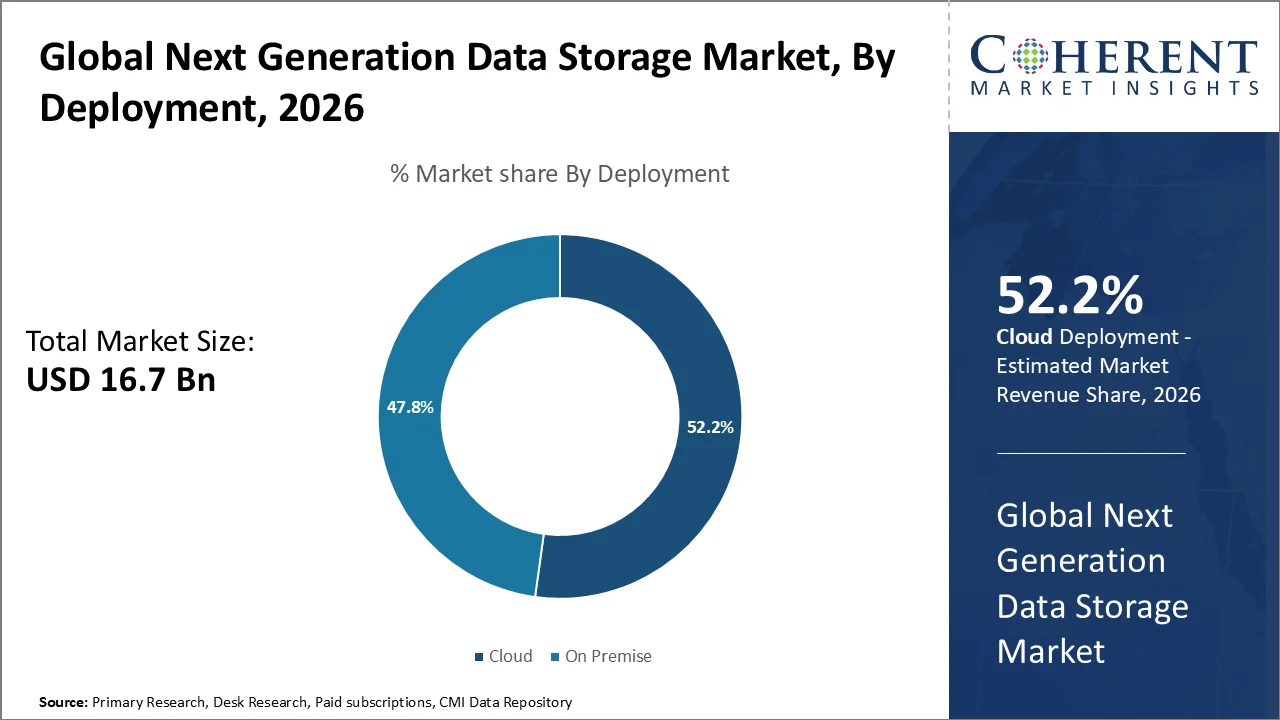
Cloud captures the largest market share of 52.2% in 2026 owing to the cost efficiency and pay-as-you-go models. Enterprises actively adopt cloud computing and drive growth in the next-generation data storage market by shifting workloads to scalable and flexible infrastructure. Artificial intelligence, Internet of Things, and digital services generate increasing data volumes and push demand for cloud storage. Organizations choose cloud platforms for cost efficiency, remote access, and reliable disaster recovery. They also expand hybrid and multi-cloud strategies to strengthen adoption. Ongoing digital transformation across industries continues to fuel cloud-based storage solutions for secure, on-demand, high-performance data management worldwide. For instance, in March 2026, NVIDIA introduced NVIDIA BlueField-4 STX, a modular reference architecture that helps enterprises, cloud providers, and AI companies deploy accelerated storage infrastructure for long-context reasoning in agentic AI.
Healthcare holds the Largest Market Share
Healthcare holds the largest market share of 37.8% in 2026. Healthcare digitization actively drives the next-generation data storage market as hospitals and providers generate vast volumes of electronic health records, medical imaging, and genomic data. Telemedicine and AI-based diagnostics increase storage requirements as they gain wider adoption. Healthcare organizations implement secure, compliant, and interoperable storage systems to safeguard sensitive patient information. Cloud-based healthcare platforms enhance accessibility and scalability. Ongoing demand for real-time data access and advanced analytics continues to push healthcare systems toward modern storage solutions across global markets.
Next Generation Data Storage Market Trends
- Shift toward high-density flash storage and NVMe-based architectures is accelerating as enterprises demand ultra-low latency, higher throughput, and improved energy efficiency for modern AI and cloud workloads.
- Rapid adoption of cloud-native and hybrid storage models is reshaping enterprise infrastructure strategies, enabling scalable, on-demand capacity while reducing dependence on traditional on-premise hardware-heavy storage systems.
- Explosive growth of AI and machine learning workloads is driving demand for high-performance storage solutions optimized for parallel processing, large dataset handling, and real-time analytics requirements.
- Increasing focus on energy-efficient and sustainable storage technologies is pushing innovations in low-power SSDs, advanced cooling systems, and carbon-aware data center storage architectures worldwide.
- Rising cybersecurity concerns are influencing storage design, with stronger encryption, immutable backups, and zero-trust architectures becoming standard features in modern next-generation storage systems.
Regional Insights
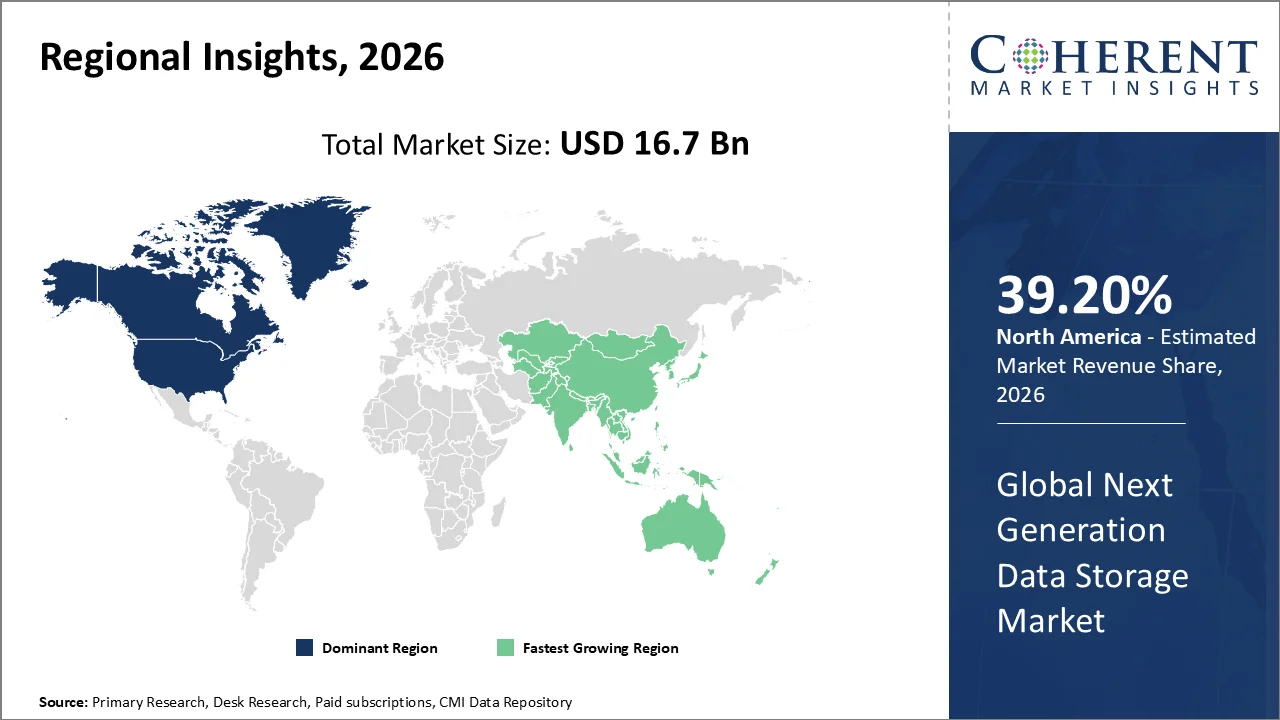
North America dominates owing to High demand for data security
North America is expected to acquire the dominant share of 39.20% in 2026. Enterprises in North America actively drive the next-generation data storage market by adopting cloud computing, artificial intelligence, and big data analytics at a large scale. Major hyperscale data center operators and leading technology companies in the region invest continuously in advanced storage infrastructure. Organizations increase demand for secure, compliant, and real-time data processing solutions, which further accelerates adoption. Rapid digital transformation across healthcare, BFSI, and IT sectors strengthens the need for scalable, high-performance, and cost-efficient storage systems. For instance, in April 2025, TerraMaster launched the D9-320 9-bay USB 3.2 Gen2 DAS storage expansion enclosure with 9 individual power switches and a master control switch, helping users reduce power consumption by up to 70% by turning off idle drives.
Asia Pacific Next Generation Data Storage Market Trends
Rapid digital transformation drives the Asia Pacific next generation data storage market, while businesses increasingly adopt cloud platforms and rely on big data analytics. Growing internet access and widespread smartphone usage generate large volumes of data from e-commerce and social media, increasing storage demand. Governments support digital infrastructure and smart city development, further boosting growth. The adoption of AI, IoT, and edge computing also accelerates the need for advanced, scalable, and efficient storage solutions across industries. For instance, in May 2026, Pixxel partnered with Sarvam AI to develop India’s first orbital data center satellite, The Pathfinder, which will use onboard GPUs for AI model training and inference.
United States Next Generation Data Storage Market Trends
Rapid adoption of cloud computing, artificial intelligence, and big data analytics drives the United States next generation data storage market across multiple industries. Technology companies and large enterprises actively demand and deploy advanced storage systems. Digital services, streaming platforms, and e-commerce continuously generate vast amounts of data, increasing storage requirements. Leading tech firms innovate consistently, while widespread use of IoT and edge computing further pushes the need for scalable and high-performance storage solutions to handle complex and expanding data workloads efficiently. For instance, in April 2026, Kingston Digital launched the Kingston DC3000ME Gen5 U.2 NVMe SSD with a new 30.72TB option to meet rising storage density and performance demands in modern data centers.
China Next Generation Data Storage Market Trends
China’s next generation data storage market is driven by rapid digital transformation across industries, which generates vast amounts of data from both enterprises and consumers. Enterprises increasingly adopt cloud computing, big data analytics, artificial intelligence, IoT, and 5G networks, boosting demand for advanced storage systems. Government programs that support digital infrastructure, smart cities, and local technology innovation also speed up adoption. Moreover, growing enterprise demand for scalable, secure, and efficient storage, along with expanding hyperscale data centers and hybrid cloud setups, continues to drive market momentum in China.
Who are the Major Companies in Next Generation Data Storage Industry
Some of the major key players in Next Generation Data Storage are Avago Technologies, Dell, IBM Corporation, EMC Corporation, Hitachi Data Systems, Micron Technology, Hewlett-Packard Development Company, Nutanix, Toshiba Corporation, Drobo, Quantum Corporation, and SimpliVity Corporation.
Key News
- In March 2026, E-Power Inc. partnered with Raytel Electronics to launch 800G and 1.6T high-speed optical modules for the North American AI infrastructure market.
Market Report Scope
Next Generation Data Storage Market Report Coverage
| Report Coverage | Details | ||
|---|---|---|---|
| Base Year: | 2025 | Market Size in 2026: | USD 16.7 Bn |
| Historical Data for: | 2020 To 2024 | Forecast Period: | 2026 To 2033 |
| Forecast Period 2026 to 2033 CAGR: | 8.3% | 2033 Value Projection: | USD 22.8 Bn |
| Geographies covered: |
| ||
| Segments covered: |
| ||
| Companies covered: | Avago Technologies, Dell, IBM Corporation, EMC Corporation, Hitachi Data Systems, Micron Technology, Hewlett-Packard Development Company, Nutanix, Toshiba Corporation, Drobo, Quantum Corporation, and SimpliVity Corporation. | ||
Analyst Opinion
- Next generation data storage is being structurally forced upward by an explosion in global data creation rather than incremental IT upgrades. The world is generating over 100 zettabytes of data annually, with projections widely cited by IDC suggesting this figure will surge beyond 170 zettabytes within a few years. In my view, this isn’t “growth” in the traditional sense—it is a systems overload problem. Enterprises are no longer optimizing storage; they are struggling to simply contain data from AI models, digital transactions, video streaming, and industrial IoT.
- Hyperscale infrastructure expansion is now the most decisive demand engine. There are well over 1,000 hyperscale data centers globally, and each new facility is designed around dense, high-speed storage architectures rather than legacy hard-disk centric models. Industry deployment patterns show solid-state storage increasingly dominating new builds, with SSDs already accounting for a majority share of performance-critical workloads in modern data centers. In practice, this shift is not optional—it is dictated by AI training clusters where a single model can require petabytes of fast-access storage and sustained high I/O throughput that HDD systems simply cannot support.
- Artificial intelligence has become the most disruptive force reshaping storage architecture decisions. Large-scale AI training pipelines generate and repeatedly process massive datasets, often requiring ultra-low latency storage layers and tiered hybrid architectures. For example, leading AI models are trained on datasets spanning hundreds of billions to trillions of parameters, forcing enterprises to redesign storage around parallel data access rather than capacity alone.
Speak to the analyst
Want personalized insights?
Take the findings above to one of our principal consultants, or have the report rebuilt around the segments, geographies and competitors you actually track.
Market Segmentation
- By Type (Revenue, USD Bn, 2021-2033)
- Direct Attached Storage (DAS)
- Network Attached Storage (NAS)
- Storage Area Network (SAN)
- By Architecture (Revenue, USD Bn, 2021-2033)
- File Storage
- Object Storage
- Block Storage
- By Storage Medium (Revenue, USD Bn, 2021-2033)
- Tape
- Hard Disk Drive (HDD)
- Solid-State Drive (SSD)
- By Deployment (Revenue, USD Bn, 2021-2033)
- On Premise
- Cloud
- By Industry Vertical (Revenue, USD Bn, 2021-2033)
- BFSI, Government
- Retail
- IT and Telecommunication
- Manufacturing
- Healthcare
- Education and Media
- Entertainment
- By Region (Revenue, USD Bn, 2021-2033)
- North America
- U.S.
- Canada
- Latin America
- Brazil
- Mexico
- Argentina
- Rest of Latin America
- Europe
- Germany
- U.K.
- France
- Italy
- Spain
- Russia
- Rest of Europe
- Asia Pacific
- China
- India
- Japan
- Australia
- South Korea
- ASEAN
- Rest of Asia Pacific
- Middle East
- GCC
- Israel
- Rest of Middle East
- Africa
- South Africa
- Central Africa
- North Africa
- North America
Sources
Primary Research interviews
- Industry experts from data infrastructure and cloud storage teams
- IT architects and enterprise storage decision-makers
- Data center operators and system integrators
- Technology procurement managers across end-use industries
- Storage hardware and software product engineers
Databases
- U.S. National Institute of Standards and Technology (NIST) publications and datasets
- IEEE Xplore digital library
- ACM Digital Library
- World Bank data repository (ICT infrastructure indicators)
- Government open data portals (India, EU, US)
Magazines
- Technology and enterprise IT-focused trade publications
- Cloud computing and data infrastructure magazines
- Data engineering and DevOps practitioner magazines
- Storage hardware and semiconductor industry magazines
Journals
- IEEE Transactions on Cloud Computing
- Journal of Big Data
- ACM Computing Surveys
- International Journal of Information Management
- Data Science and Engineering journals
Newspapers
- Financial newspapers covering technology markets
- Business-focused daily newspapers with tech sections
- National newspapers reporting on digital infrastructure developments
- Global newspapers with enterprise technology coverage
Associations
- Storage and data infrastructure industry associations
- Cloud computing and data center industry bodies
- IT standards and interoperability organizations
- Semiconductor and hardware ecosystem associations
- Enterprise technology user groups and forums
Public Domain sources
- Government technology and digital economy reports
- Open-source project documentation and repositories
- Company investor presentations and annual reports
- Regulatory filings and policy documents
- Conference proceedings and publicly available whitepapers
Proprietary Elements
- CMI Data Analytics Tool
- Proprietary CMI Existing Repository of information for last 10 years
Get access to 250+ pages report
Every segment, forecast, competitor profile and data table behind the analysis above — available for instant download.
- ESOMAR Member
- ISO 9001:2015 Certified
- D-U-N-S Registered
- GDPR & CCPA Compliant
Missing comfort of reading report in your local language? Find your preferred language:
Transform your Strategy with Exclusive Trending Reports
Frequently Asked Questions
Next generation data storage refers to advanced storage technologies designed for high-speed, high-capacity, and intelligent data management.
Demand is rising due to explosive global data generation, especially from AI applications, video streaming, connected devices, and enterprise digitization.
Key technologies include NVMe (Non-Volatile Memory Express), solid-state drives (SSDs), cloud-native storage systems, object storage, software-defined storage (SDS), and AI-driven data management platforms.
Cloud computing and hyperscale data centers are major drivers, as they require highly scalable and efficient storage systems.
Key challenges include high infrastructure costs, data security risks, complexity in managing hybrid environments, and energy consumption concerns associated with large-scale data centers.