

Storage in Big Data Market Size and Share Analysis: 2026 - 2033
The storage in big data market is anticipated to grow at a CAGR of 18.5% with USD 77.73 Bn in 2026 and is expected to reach USD 241.9 Bn in 2033. Growing data from enterprises, IoT, and cloud services (USD119 billion) is driving strong demand for scalable big data storage solutions.
Key Takeaways
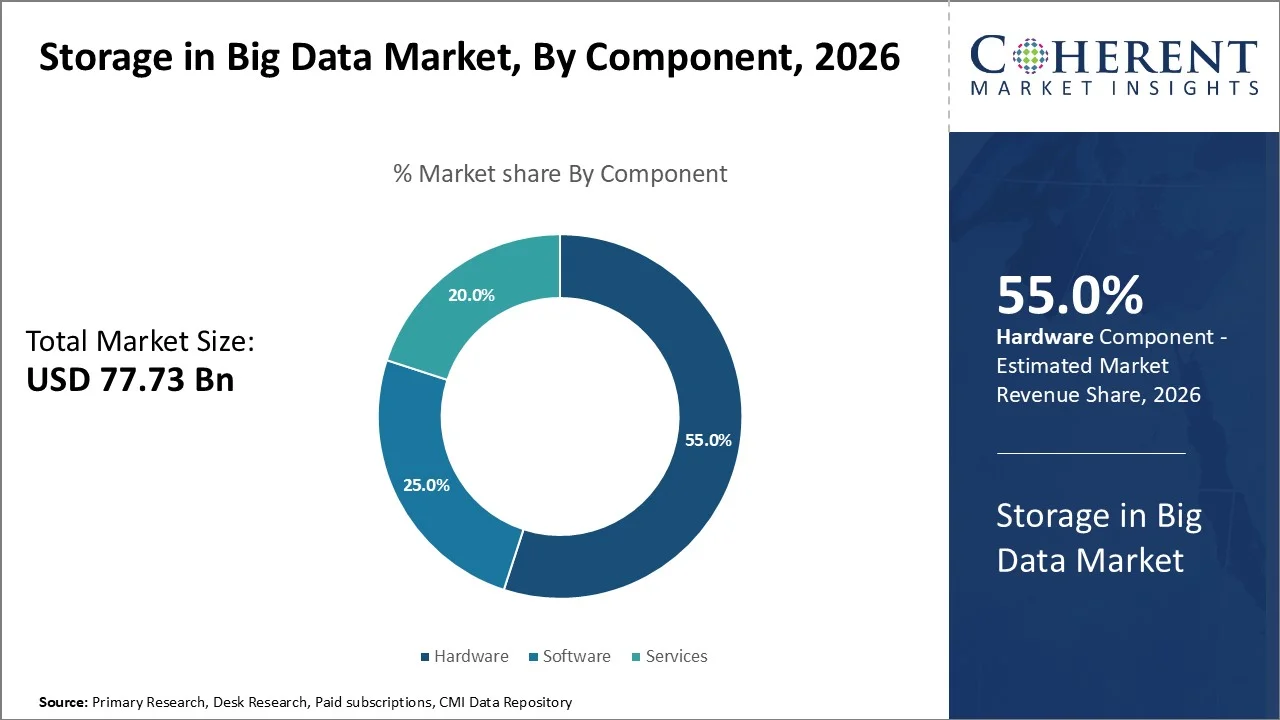
- Hardware is expected to account for the largest share of 55% in 2026, as enterprises invest heavily in storage infrastructure (servers, storage arrays, and networking equipment). As of June 30, 2025, a total of 49,796 storage infrastructure projects has been sanctioned across 27 states in India.
- Based on industry vertical, IT & Telecommunication will dominate with 40% in 2026, by 2025, over 60% of IT spending in large enterprises will be directed toward cloud and digital transformation projects, including AI, analytics, and enterprise applications, all of which generate massive amounts of storage data.
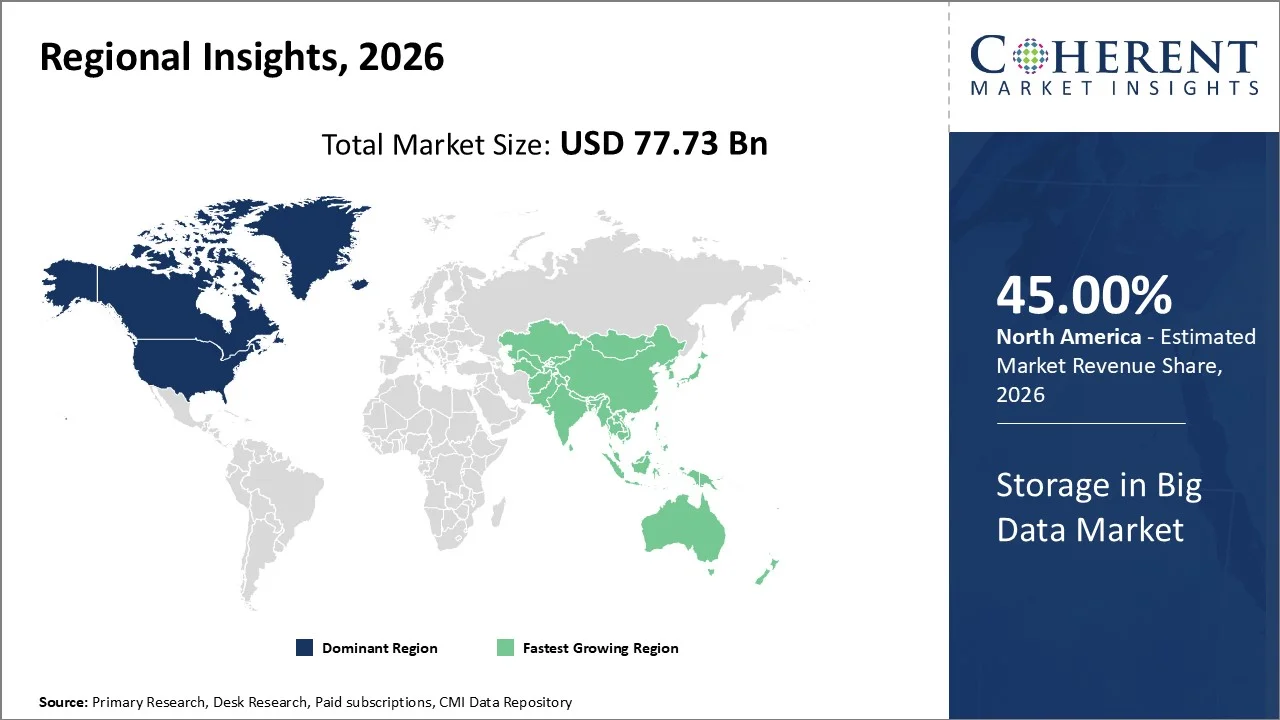
- North America is expected to acquire the dominant share of 45% in 2026, advanced technological infrastructure, high digital penetration, and robust investments in data-driven innovation. As of January 2026, US spending on data center construction was over USD2.4 billion per month, roughly 16 times the level in early 2014.
Segmental Insights
Why is Hardware Segment Acquiring the Largest Market Share?
Hardware is projected to account for the largest share of component in 2026, representing approximately 55% of the total volume. The hardware component forms the backbone of data storage infrastructures, providing the physical media and computational resources essential for storing as well as rapidly accessing numerous volumes of data generated daily. A study conducted by Cast AI has found that companies only use around 13% of the CPUs they provision, and 20% memory, on average.
The persistent expansion of data-intensive applications, such as IoT sensor networks as well as high-definition video streaming, demands low-latency and high-throughput storage hardware, making it an indispensable element of big data storage architectures. For instance, government-funded research initiatives in countries like the United States and Germany usually emphasize developing high-performance hardware storage infrastructures to ensure data sovereignty, cybersecurity, as well as compliance with regulatory regimes, thereby reinforcing hardware’s dominance in the market.
- Current Industry Events of 2026
- Market Size Estimation
- Regional Breakdown
- Competitive Landscape
- Customer Intelligence
- Segmental Analysis
- Pricing Analysis
- Key Market Drivers, Challenges & Future Trends
- Customized Insights Section
IT & Telecommunication holds the Largest Market Share
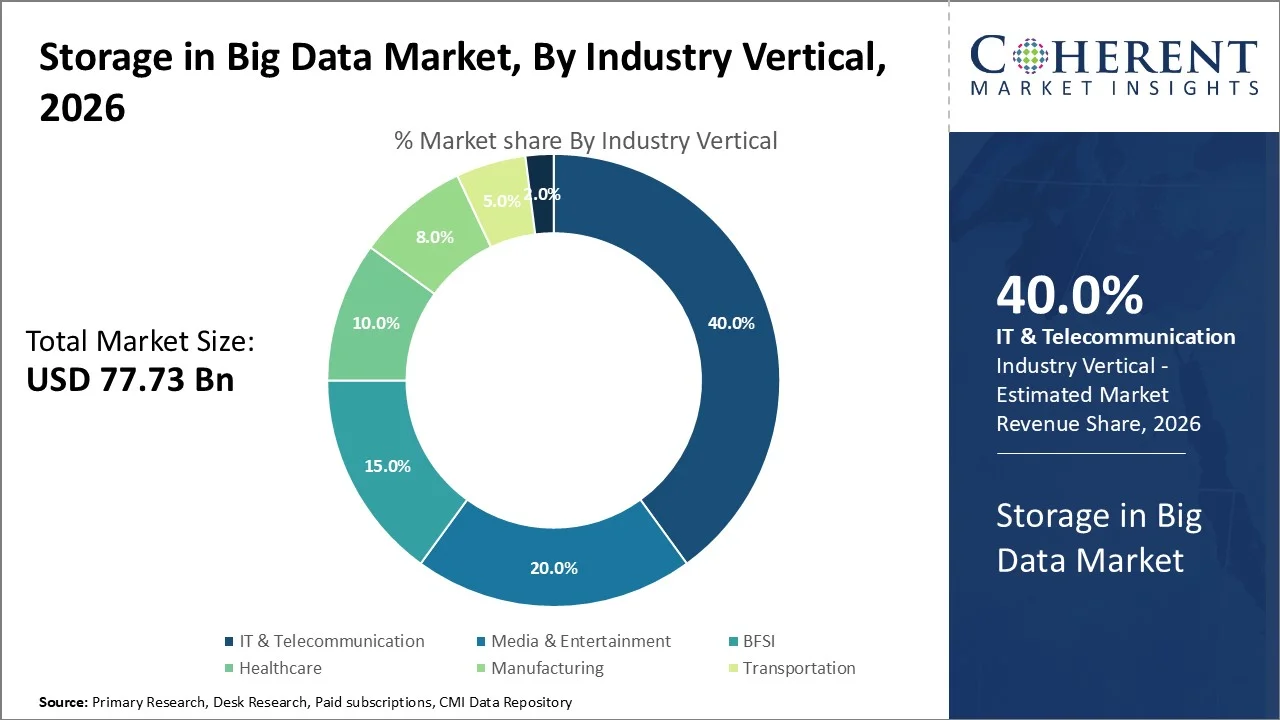
Based on industry vertical, IT & telecommunication dominates the market, accounting for a significant 40% share in 2026, owing to their large-scale data generation, expansive infrastructure, as well as continuous innovation in storage technologies. This sector inherently produces high amounts of data through a variety of channels including network traffic logs, customer usage patterns, application data, as well as communication exchanges, all of which require robust big data storage solutions to manage, analyze, and retrieve information efficiently.
For example, global telecom companies consistently handle petabytes of call records, network performance data, as well as customer behavior analytics daily. They leverage big data storage platforms such as distributed file systems, object storage, as well as cloud-based databases to store and process this data which is crucial for real-time decision making, fault diagnosis, as well as personalized service offerings.
According to reports published by the International Telecommunication Union (ITU), the rapid adoption of 5G technologies has further bolstered data generation in this segment, urging service providers to invest heavily in scalable as well as secure data storage solutions.
NoSQL Databases: A major breakthrough in Storage in Big Data
NoSQL Databases come in various types, such as Key-Value Stores, Document Stores, Column-Family Stores, Graph Databases, etc. Examples include Apache Cassandra, MongoDB, Amazon DynamoDB, and HBase. These databases do not need a fixed schema, which makes them flexible as well as able to handle structured, semi-structured, along with unstructured data.
They can easily grow by adding more servers (horizontal scalability) and are made to stay available even if some servers fail. Each type is good for specific tasks, for example, Cassandra is great for many writes and high availability, while MongoDB operates well with JSON or document data. MongoDB is used by over 60 million developers worldwide and powers many large-scale enterprise applications.
Current Events and Their Impact on the Storage in Big Data Market
Current Event | Description and its Impact |
U.S. and EU Data Privacy Regulations (2025) |
|
Incentives for AI and GenAI Adoption (U.S., GCC, 2025) |
|
Storage in Big Data Market Trends
- Inclination towards Cloud and Hybrid Storage Solutions, as enterprises are progressively adopting cloud-based and hybrid storage systems to handle vast data volumes with greater flexibility as well as cost efficiency. For instance, December 2025, Hitachi Vantara's Virtual Storage Platform One Wins CRN 2025 Products of the Year Award for Excellence in Hybrid Cloud Storage.
- Growth of Edge Computing, with the surge of IoT and edge devices necessitates decentralized storage closer to data sources, advancing real-time data processing capabilities.
- Integration of AI & Analytics for Storage Optimization with advanced AI-driven storage management tools improve data lifecycle management, predictive maintenance, as well as cost control.
- Focus on Data Security and Compliance, along with strict regulations around data privacy is supporting the development and adoption of secure storage architectures with encryption as well as access controls.
Regional Insights
North America dominates owing to its highly developed technological infrastructure
North America account 45% market share in 2026, owing to its highly developed technological infrastructure, widespread adoption of cloud computing, and the presence of major data-intensive industries such as healthcare, finance, and retail. AI funding has risen drastically over time, reaching USD 202 billion in 2025. The United States dominated AI funding, with USD159 billion, or 79%, of investment going to U.S.-based companies.
North America has strong rules for data privacy, like the California Consumer Privacy Act (CCPA). These rules encourage companies to use advanced storage systems that follow strict data management standards, helping the market for high-tech storage grow. These combined factors thus amplify North America’s leadership in big data storage, positioning it as the most significant sub-region within the North American market.
Asia Pacific Storage in Big Data Market Trends
The Asia-Pacific region is poised to be as the fastest-growing region through 2026-2033, expanding at a CAGR of approximately 18.5%. Owing to multiple dynamic factors intrinsic to the region’s socio-economic as well as technological landscape. The proliferation of internet connectivity, smartphone penetration, as well as digital transformation initiatives across vibrant markets such as China, India, Indonesia, Vietnam, etc., fuel unprecedented volumes of data generation having advanced storage infrastructure. In 2024 fully 5.5 billion people are online. The number of internet users in China hit 1.1 billion by December 2024, up 16 million from the previous year, according to an industrial report on the country's internet development.
For instance, Singapore’s Smart Nation initiative extensively leverages big data analytics for urban planning, transportation, healthcare, etc., necessitating cutting-edge storage technologies that ensure high availability, low latency, and enhanced security.
Widespread adoption of cloud computing is accelerating the Storage in Big Data Market Demand in United States
The U.S. has long been a global leader in digital innovation, hosting the headquarters of major technology giants like Amazon, Google, Microsoft, IBM, etc., all of which invest heavily in developing as well as deploying cutting-edge storage solutions made for big data applications. A clear example is Amazon Web Services (AWS), which runs the biggest cloud storage network in the U.S., helping all kinds of companies, from small startups to large Fortune 500 firms.
The proliferation of IoT devices, the surge in the digitalization of healthcare data, expansive e-commerce activities, as well as the extensive use of AI analytics across various sectors have collectively driven massive demand for scalable, resilient, as well as low-latency storage infrastructures.
China Storage in Big Data Market Trends
China contributes the highest share in the big data storage market in the region owing to its extensive investment in digital infrastructure and massive data generation from various sectors. The Chinese government is pushing for more digital development with its "New Infrastructure" plan. This plan focuses on building data centers, 5G networks, and AI systems, which has made the demand for better storage solutions much higher.
The China Academy of Information and Communications. Technology (CAICT) estimates that the AI industry surpassed RMB 900bn in scale in 2024. The “Eastern Data, Western Computing” initiative, launched during the 14th Five-Year Plan, drove over RMB 1 trillion in investment and now supplies about 80% of the national intelligent computing capacity.
Who are the Major Companies in Storage in Big Data Industry
Some of the major key players in storage in big data are MemSQL Inc., Google Inc., Hitachi Data Systems Corporation, Microsoft Corporation, Hewlett Packard Enterprise, Amazon Web Services, Inc., Teradata Corporation, VMware, Inc., SAP SE, IBM Corporation, Oracle Corporation, Dell EMC, and SAS Institute Inc.
Key News
- In January 2026, Google Cloud launched a preview of Dataplex Universal Catalog, a solution that unifies data management, governance, and AI-ready storage. A data product in Dataplex is a curated package of data, documentation, and controls designed to solve specific business problems. Companies like Virgin Media O2 are using these data products to deploy reliable data and scalable AI solutions, highlighting growing demand for advanced storage and data management in the enterprise market.
- In April 2026, Hitachi Vantara, a part of Hitachi Ltd., was named a Leader and Fast Mover in the 2026 GigaOm Radar for Object Storage. Their Virtual Storage Platform One Object (VSP One Object) is a flexible, software-based storage system that saves space and uses capacity efficiently, designed for large businesses.
Market Report Scope
Storage in Big Data Market Report Coverage
| Report Coverage | Details | ||
|---|---|---|---|
| Base Year: | 2025 | Market Size in 2026: | USD 77.73 Bn |
| Historical Data for: | 2020 To 2024 | Forecast Period: | 2026 To 2033 |
| Forecast Period 2026 to 2033 CAGR: | 18.5% | 2033 Value Projection: | USD 241.9 Bn |
| Geographies covered: |
| ||
| Segments covered: |
| ||
| Companies covered: | MemSQL Inc., Google Inc., Hitachi Data Systems Corporation, Microsoft Corporation, Hewlett Packard Enterprise, Amazon Web Services, Inc., Teradata Corporation, VMware, Inc., SAP SE, IBM Corporation, Oracle Corporation, Dell EMC, and SAS Institute Inc. | ||
| Growth Drivers: |
| ||
| Restraints & Challenges: |
| ||
Analyst Opinion
- The Storage in Big Data market is fundamentally fueled by sheer data creation, not just technology hype. According to IDC (2025), the global data sphere reached 114 zettabytes in 2025, driven by IoT devices, AI workloads, and enterprise digital transformation, meaning the market isn’t “growing” because of trends, it’s growing because the world is producing more data than ever before.
- Hyperscale cloud providers are highly expanding infrastructure, with Amazon Web Services, Microsoft Azure, Google Cloud, etc., collectively adding over 300 new data centers globally in 2025 (Synergy Research Group, 2025). This expansion is not speculative, it shows urgent demand for storage capacity capable of supporting AI, analytics, as well as high-throughput applications.
- AI and machine learning adoption is intensifying storage requirements. NVIDIA’s 2025 AI Enterprise report highlights that over 70% of enterprises running AI workloads now require more than 10 PB of storage per deployment, focusing that storage is no longer peripheral, it is mission-critical for performance as well as business competitiveness.
- Enterprises cannot scale AI, IoT, or big data analytics without storage systems that are high-capacity, flexible, as well as optimized for cost and speed. This positions storage providers at the core of the modern data economy.
Speak to the analyst
Want personalized insights?
Take the findings above to one of our principal consultants, or have the report rebuilt around the segments, geographies and competitors you actually track.
Storage in Big Data Market Segmentation
- By Component
- Hardware
- Software
- Services
- By Industry Vertical
- BFSI
- IT & Telecommunication
- Healthcare
- Manufacturing
- Transportation
- Media & Entertainment
- Others
- Global Storage in Big Data Market, By Region
- North America
- U.S.
- Canada
- Latin America
- Brazil
- Mexico
- Argentina
- Rest of Latin America
- Europe
- Germany
- U.K.
- France
- Italy
- Spain
- Russia
- Rest of Europe
- Asia Pacific
- China
- India
- Japan
- Australia
- South Korea
- ASEAN
- Rest of Asia Pacific
- Middle East
- GCC
- Israel
- Rest of Middle East
- Africa
- South Africa
- Central Africa
- North Africa
- North America
Sources
Primary Research Interviews
- Cloud Storage Solution Providers
- Big Data Analytics Companies
- Enterprise IT Decision Makers
- Data Center Infrastructure Managers
- Others
Databases
- IDC Worldwide Storage Database
- Forbes Global Technology Database
- Others
Magazines
- Big Data Quarterly
- Cloud Computing Magazine
- Data Storage Magazine
- Enterprise Storage Forum
- Others
Journals
- Journal of Big Data
- IEEE Transactions on Cloud Computing
- International Journal of Data Science and Analytics
- Others
Newspapers
- The Wall Street Journal
- Financial Times
- Reuters
- TechCrunch
- Others
Associations
- Storage Networking Industry Association (SNIA)
- Big Data Analytics Association (BDAA)
- Cloud Security Alliance (CSA)
- International Association for Cloud Computing (IACC)
- Others
Public Domain Sources
- U.S. Government Accountability Office Reports
- European Commission Digital Strategy Documents
- OECD Digital Economy Outlook
- World Bank Digital Development Reports
- Others
Proprietary Elements
- CMI Data Analytics Tool
- Proprietary CMI Existing Repository of information for last 10 years
Get access to 250+ pages report
Every segment, forecast, competitor profile and data table behind the analysis above — available for instant download.
- ESOMAR Member
- ISO 9001:2015 Certified
- D-U-N-S Registered
- GDPR & CCPA Compliant
Missing comfort of reading report in your local language? Find your preferred language:
Transform your Strategy with Exclusive Trending Reports
Frequently Asked Questions
The Storage in big data market is expected to reach USD 241.9 Billion in 2033.
Major players operating in the global Storage in big data market include MemSQL Inc., Google Inc., Hitachi Data Systems Corporation, Microsoft Corporation, Hewlett Packard Enterprise, Amazon Web Services, Inc., Teradata Corporation, VMware, Inc., SAP SE, IBM Corporation, Oracle Corporation, Dell EMC, and SAS Institute Inc.
Reduced budget for data storage is expected to hinder the global storage in big data market growth over the forecast period
Increasing adoption of software-based storage options is expected to drive growth of the global storage in big data market during the forecast period
The storage in big data market is anticipated to grow at a CAGR of 18.5% between 2026 and 2033.
Among regions, North America is expected to account for a largest market share in the global storage in big data market over the forecast period.