

Global Cloud Database Market Size and Forecast – 2026-2033
The Global Cloud Database Market is estimated to be valued at USD 26.00 Bn in 2026 and is expected to reach USD 73.03 Bn by 2033, exhibiting a compound annual growth rate (CAGR) of 15.9% from 2026 to 2033.
Key Takeaways of the Global Cloud Database Market:
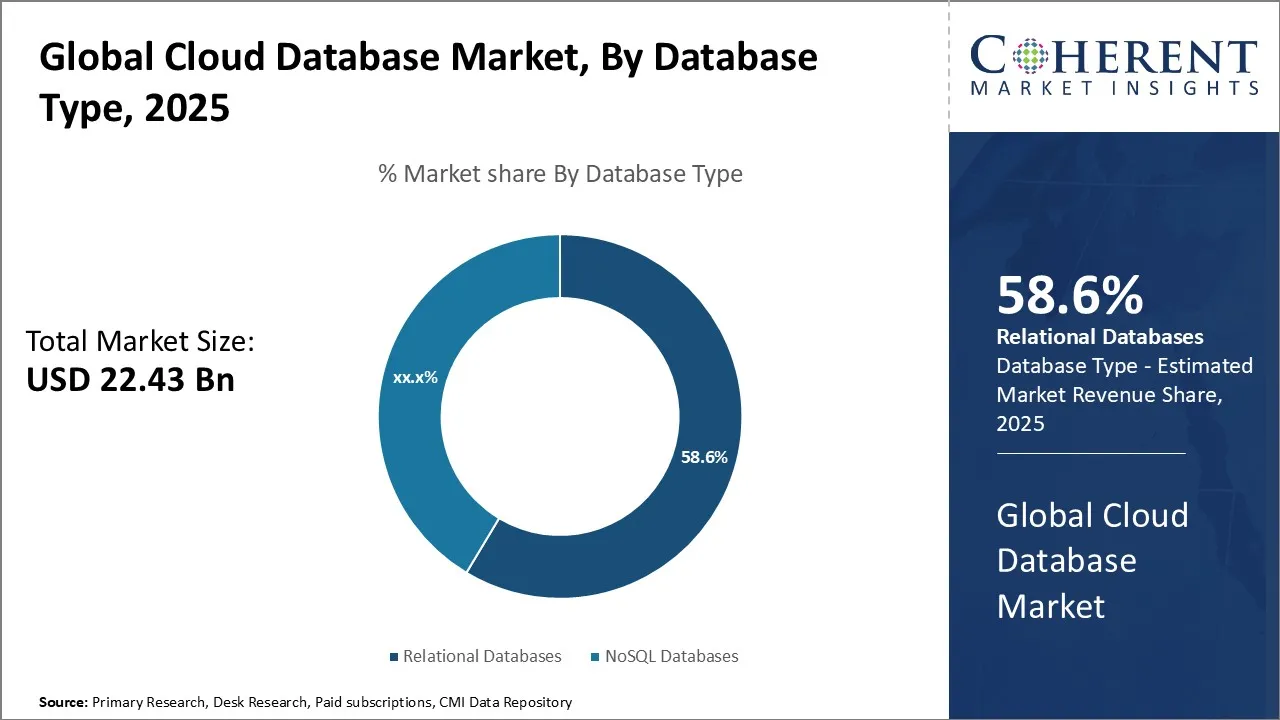
- The relational databases segment leads the market holding an estimated share of 59.6% in 2026.
- The public cloud segment is projected to dominate with a share of 57.2% in 2026.
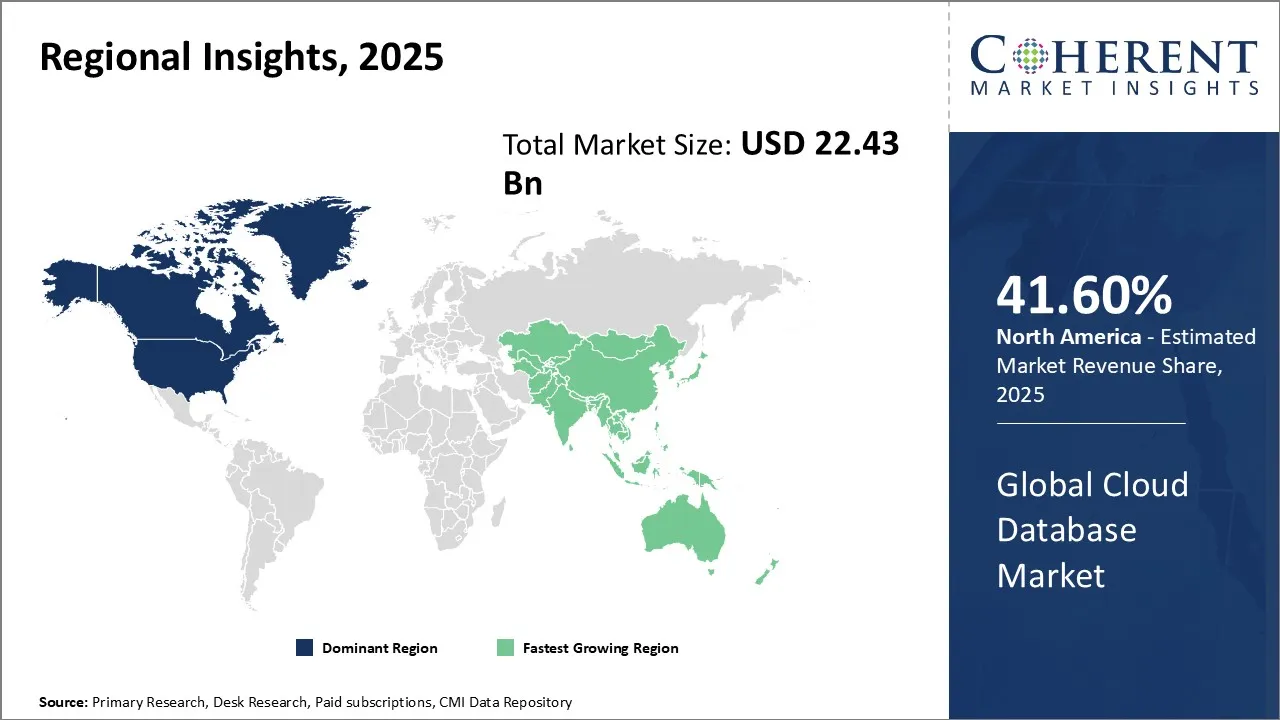
- North America is estimated to lead the market with a share of 41.6 % in 2026.
- Asia Pacific, holding a share of 22.4 % in 2026, is projected to be the fastest growing region.
Market Overview:
The market is seeing the fast adoption of cloud-based solutions, driven by their cost-effectiveness and scalability. Organizations are moving their database workloads to the cloud to reduce their infrastructure costs and improve their disaster recovery capabilities. To add, digital transformation initiatives are being implemented worldwide, adding to the market growth. The need for agile data management solutions are further fueling the demand for cloud databases.
Current Events and their Impact
Current Events | Description and its impact |
Heightened Global Data Sovereignty and Privacy Regulations |
|
Intensified Geo-Political Tensions Affecting Cloud Infrastructure |
|
Segmental Insights
- Current Industry Events of 2026
- Market Size Estimation
- Regional Breakdown
- Competitive Landscape
- Customer Intelligence
- Segmental Analysis
- Pricing Analysis
- Key Market Drivers, Challenges & Future Trends
- Customized Insights Section
Global Cloud Database Market Insights, by Database Type - Relational Databases Lead due to its Robust Data Consistency and Reliability
Relational databases have been the backbone of enterprise applications for decades, holding a share of 59.6% in 2026. Relational databases adhere to the Atomicity, Consistency, Isolation, Durability (ACID) properties, which guarantee the integrity and reliability of data transactions. This is crucial for businesses that handle critical data, such as financial institutions, healthcare organizations, and e-commerce platforms, where data accuracy and consistency are paramount. Also, relational databases have been around for a long time, and as a result, there is a vast array of tools, frameworks, and skilled professionals available to support their implementation and management.
Moreover, relational databases are suitable for structured data and complex queries, making them ideal for applications such as enterprise resource planning (ERP), customer relationship management (CRM), and transactional systems.
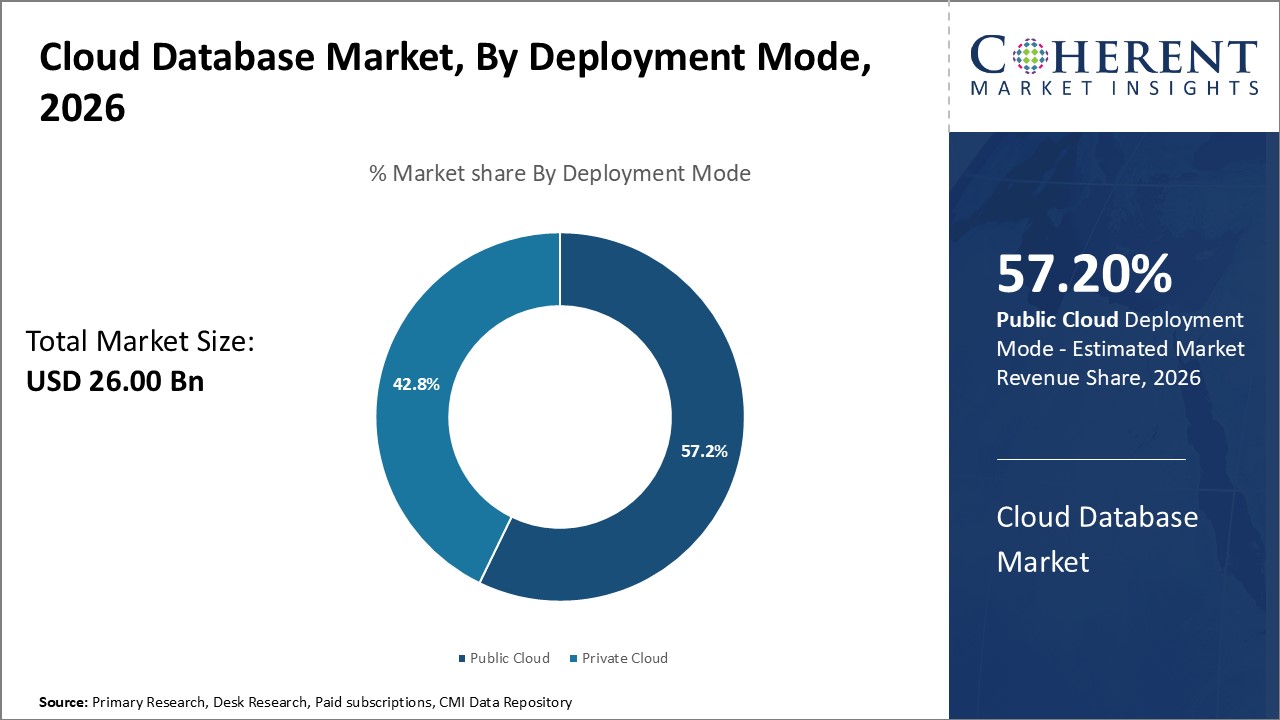
Global Cloud Database Market Insights, by Deployment Mode - Public Cloud Leads due to its Cost-effectiveness and Scalability
The public cloud deployment mode, holding a share of 57.2% in 2026, has emerged as the dominant segment in the cloud database market. Public cloud providers offer a shared infrastructure where multiple tenants can access computing resources on a pay-per-use basis. This model eliminates the need for organizations to invest in expensive hardware, software licenses, and maintenance costs associated with on-premises databases. Also, public cloud platforms offer virtually unlimited scalability, allowing organizations to easily scale their database resources up or down based on their changing requirements. The ease of deployment and management is another advantage of public cloud databases. Public cloud providers offer a wide range of complementary services, such as data integration, analytics, machine learning, and serverless computing, which can be easily integrated with cloud databases.
Role of Artificial Intelligence (AI) in the Market
Artificial Intelligence (AI) is playing a transformative role in the global cloud database market by enhancing the efficiency, intelligence, and adaptability of data management systems. As organizations increasingly rely on data-driven decision-making, the integration of AI into cloud databases allows for advanced analytics, predictive insights, and automation of routine tasks. AI-powered algorithms can streamline complex queries, detect anomalies in real time, and automate functions such as indexing and resource provisioning, significantly reducing the operational burden on database administrators.
Google Cloud’s BigQuery ML allows users to create and execute machine learning models directly within the BigQuery platform using SQL. Companies like Spotify leverage BigQuery ML to enhance user experiences through personalized music recommendations based on behavioral data. By running ML models within the same environment where their data resides, Spotify reduces latency and complexity while gaining faster, more actionable insights.
Regional Insights
North America Cloud Database Market Analysis and Trends
North America, holding a share of 41.6% in 2026, is expected to dominate the global cloud database market. The region boasts a robust market ecosystem, with a high concentration of technology giants and innovative startups driving the adoption of cloud database solutions. The presence of well-established cloud infrastructure providers, such as Amazon Web Services (AWS), Microsoft Azure, and Google Cloud Platform, has further fueled the growth of the market in North America. Additionally, the region's strong emphasis on data security and privacy regulations, such as the California Consumer Privacy Act (CCPA), has prompted organizations to shift towards cloud-based database solutions that offer enhanced security features and compliance capabilities.
Asia Pacific Cloud Database Market Analysis and Trends
The Asia Pacific region, holding a share of 22.4% in 2026, is expected to exhibit the fastest growth in the global cloud database market. The rapid digitalization of businesses, coupled with the increasing adoption of cloud computing services, has been a key driver for the market's growth in this region. Governments in countries like China, India, and Singapore have implemented favorable policies and initiatives to promote the adoption of cloud technologies, including cloud databases. Moreover, the expanding e-commerce sector and the proliferation of mobile devices have generated massive amounts of data, necessitating the use of scalable and flexible cloud database solutions. The region's growing pool of skilled IT professionals and the presence of major cloud service providers have also contributed to the market's growth.
Global Cloud Database Market Outlook for Key Countries:
U.S. Cloud Database Market Analysis and Trends
The U.S. cloud database market is highly competitive, with major players such as AWS, Microsoft, and Google dominating the landscape. These companies have made significant investments in research and development to enhance their cloud database offerings, focusing on aspects such as performance, scalability, and security. The market growth in the U.S. is driven by the increasing adoption of cloud computing across various industries, including healthcare, finance, and e-commerce. The country's stringent data protection regulations, such as HIPAA and SOC, have also influenced the demand for compliant cloud database solutions.
China Cloud Database Market Analysis and Trends
China cloud database market is rapidly expanding, fueled by the government's "Internet Plus" strategy and the increasing digitalization of businesses. The country's tech giants, such as Alibaba Cloud and Tencent Cloud, have been instrumental in driving the adoption of cloud database solutions. These companies have developed localized offerings that cater to the specific needs of China cloud database market, including support for local regulations and data sovereignty requirements.
India Cloud Database Market Analysis and Trends
India continues to be a key player in the global cloud database market, with a rapidly growing IT industry and a large pool of skilled professionals. The country's government has launched initiatives such as "Digital India" to promote the adoption of cloud computing and other digital technologies. The market growth in India is also driven by the expanding startup ecosystem, which relies heavily on cloud-based services for their operations.
Japan Cloud Database Market Analysis and Trends
Japan cloud database market is driven by the country's advanced technological infrastructure and the increasing adoption of digital transformation initiatives. The market growth is fueled by the demand for scalable and reliable cloud database solutions across various industries, including e-commerce, manufacturing, and finance. Japanese companies are increasingly leveraging cloud databases to handle large volumes of data and support their global expansion efforts. Major cloud service providers, such as AWS and Google Cloud Platform, have established a strong presence in Japan, offering localized services and support to cater to the unique requirements of the Japan cloud database market.
Market Players, Key Development, and Competitive Intelligence
Key Developments:
- On May 29, 2025, Microsoft’s first cloud region in Malaysia, known as Malaysia West, was officially opened. Located in Greater Kuala Lumpur, the new region includes three availability zones and provides cloud services to meet local data storage needs.
- In April 2025, Toshiba Digital Solutions Corporation announced the global launch of GridDB Cloud, its cloud-based service for managing IoT and the high frequency generation of large volumes of big data
- In December 2024, SurrealDB, the ultimate multi-model database, announced the launch of Surreal Cloud, a Database-as-a-Service (DBaaS) offering
- In November 2023, IBM announced at AWS re:Invent 2023 that it has been working with Amazon Web Services (AWS) on the general availability of Amazon Relational Database Service (Amazon RDS) for Db2, a fully managed cloud offering designed to make it easier for database customers to manage data for artificial intelligence (AI) workloads across hybrid cloud environments.
Top Strategies Followed by Global Cloud Database Market Players
- Established players are investing heavily in R&D to develop cutting-edge technologies that can meet the evolving needs of their customers.
- For instance, Amazon Web Services (AWS) has been continuously investing in R&D to enhance its cloud database offerings, such as Amazon Aurora and Amazon DynamoDB, to provide better performance, scalability, and reliability to its customers.
- Mid-level players are focusing on delivering cost-effective solutions to target price-sensitive consumers.
- For instance, DigitalOcean provides affordable cloud database solutions, such as MySQL and PostgreSQL, to SMEs, enabling them to store and manage their data efficiently without breaking the bank.
- Small-scale players are specializing in specific areas, such as healthcare or finance, and developing tailored solutions to meet the specific needs of these industries.
- For example, Couchbase provides a NoSQL cloud database that is designed for high-performance applications, such as real-time analytics and user profile management, which are critical for industries like healthcare and e-commerce
Market Report Scope
Cloud Database Market Report Coverage
| Report Coverage | Details | ||
|---|---|---|---|
| Base Year: | 2025 | Market Size in 2026: | USD 26.00 Bn |
| Historical Data for: | 2020 To 2024 | Forecast Period: | 2026 To 2033 |
| Forecast Period 2026 to 2033 CAGR: | 15.9% | 2033 Value Projection: | USD 73.03 Bn |
| Geographies covered: |
| ||
| Segments covered: |
| ||
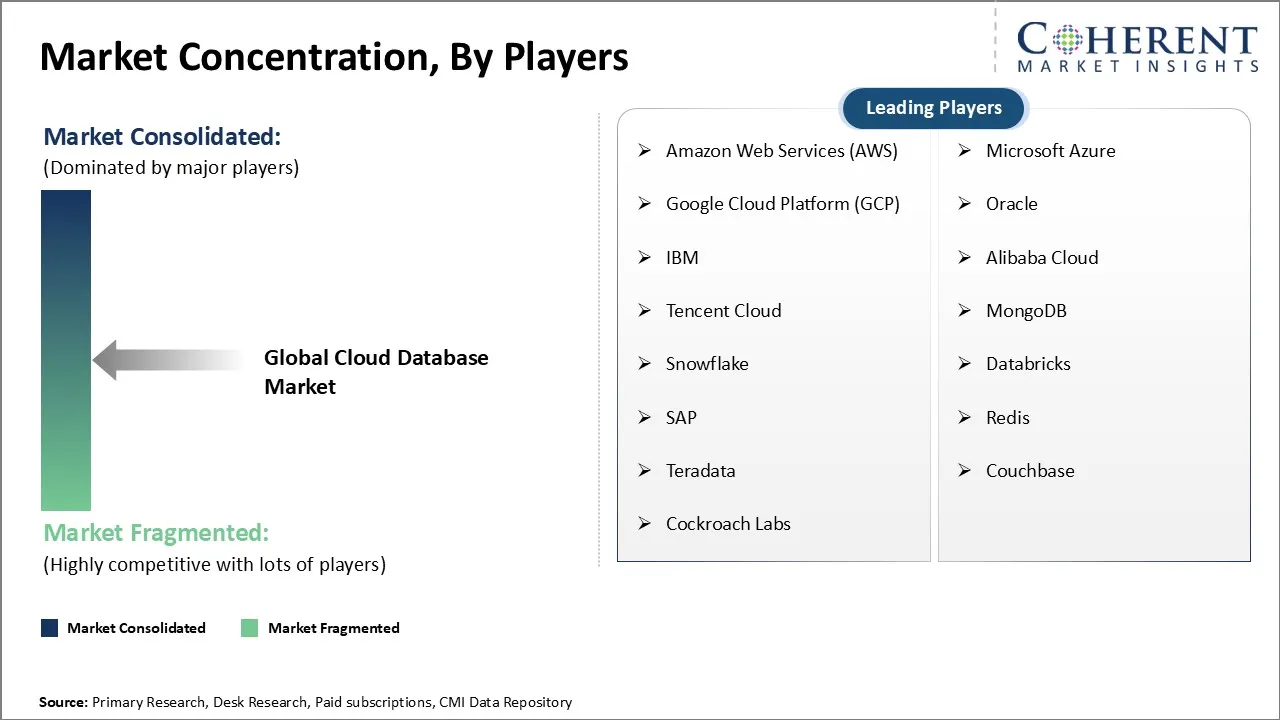
| Companies covered: | Amazon Web Services (AWS), Microsoft Azure, Google Cloud Platform (GCP), Oracle, IBM, Alibaba Cloud, Tencent Cloud, MongoDB, Snowflake, Databricks, SAP, Redis, Teradata, Couchbase, and Cockroach Labs | ||
| Growth Drivers: |
| ||
| Restraints & Challenges: |
| ||
Market Dynamics
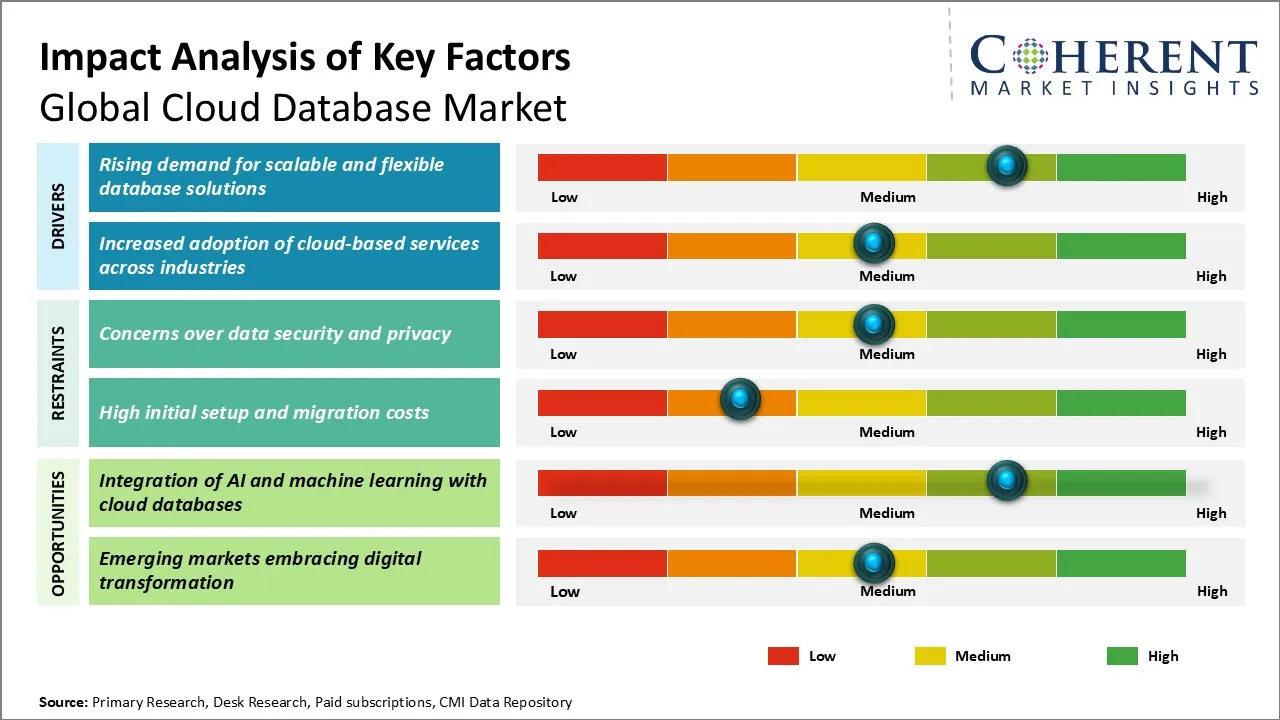
Global Cloud Database Market Driver - Rising demand for scalable and flexible database solutions
In today's fast-paced business environment, organizations are facing an ever-increasing volume of data that needs to be efficiently managed and analyzed. As a result, there is a growing demand for database solutions that offer scalability and flexibility to accommodate the dynamic needs of modern enterprises. Cloud databases have emerged as a popular choice due to their ability to seamlessly scale up or down based on the changing requirements of businesses. Moreover, cloud databases provide the flexibility to access and manage data from anywhere, at any time, enabling teams to collaborate effectively across geographies.
For instance, Netflix uses Amazon DynamoDB and Amazon Aurora, which allows the company to scale resources up during high-demand periods (e.g., new show releases) and scale down afterward, optimizing both performance and cost.
Global Cloud Database Market Opportunity - Integration of AI and machine learning with cloud databases
By leveraging the power of AI and ML, cloud database providers can offer advanced analytics capabilities, enabling organizations to derive valuable insights from their data. AI-powered algorithms can automatically analyze vast amounts of structured and unstructured data, identifying patterns, trends, and anomalies that would be difficult to detect manually. Furthermore, AI and ML can enhance the performance and efficiency of cloud databases by automating tasks such as indexing, query optimization, and resource allocation. This can lead to faster query processing, improved scalability, and reduced operational costs.
For instance, Google Cloud’s BigQuery ML allows data analysts to build and train machine learning models directly within BigQuery using standard SQL queries.
Analyst Opinion (Expert Opinion)
- Cloud databases are revolutionizing healthcare by enabling real-time data access and analysis from wearables, electronic health records, and remote monitoring tools. Hospitals now leverage cloud platforms to aggregate patient data securely, enabling faster diagnostics and personalized treatment plans powered by AI and machine learning.
- Financial institutions are adopting cloud databases to streamline large-scale, high-frequency transaction monitoring. Real-time data processing combined with AI allows for early detection of fraudulent activities and dynamic risk scoring, supporting more responsive and data-driven decision-making across operations.
- Retailers are utilizing cloud databases to consolidate customer data from multiple touchpoints and apply machine learning models to deliver hyper-personalized product recommendations. Simultaneously, predictive analytics help optimize inventory levels in real time, reducing overstock and improving supply chain agility.
Speak to the analyst
Want personalized insights?
Take the findings above to one of our principal consultants, or have the report rebuilt around the segments, geographies and competitors you actually track.
Market Segmentation
- Database Type Insights (Revenue, USD Bn, 2021 - 2033)
- Relational Databases
- NoSQL Databases
- Deployment Mode Insights (Revenue, USD Bn, 2021 - 2033)
- Public Cloud
- Private Cloud
- Regional Insights (Revenue, USD Bn, 2021 - 2033)
- North America
- U.S.
- Canada
- Latin America
- Brazil
- Argentina
- Mexico
- Rest of Latin America
- Europe
- Germany
- U.K.
- Spain
- France
- Italy
- Russia
- Rest of Europe
- Asia Pacific
- China
- India
- Japan
- Australia
- South Korea
- ASEAN
- Rest of Asia Pacific
- Middle East
- GCC Countries
- Israel
- Rest of Middle East
- Africa
- South Africa
- North Africa
- Central Africa
- North America
- Key Players Insights
- Amazon Web Services (AWS)
- Microsoft Azure
- Google Cloud Platform (GCP)
- Oracle
- IBM
- Alibaba Cloud
- Tencent Cloud
- MongoDB
- Snowflake
- Databricks
- SAP
- Redis
- Teradata
- Couchbase
- Cockroach Labs
Sources
Primary Research Interviews
Stakeholders
- Cloud Service Providers (e.g., AWS, Microsoft Azure, Google Cloud engineers)
- Database Architects and Administrators from Fortune 500 companies
- CTOs and CIOs from AI/ML-driven tech startups
- IT Consultants specializing in digital transformation and data architecture
- SaaS Platform Providers integrating cloud-native databases
- Compliance Officers and Cybersecurity Experts managing cloud data governance
Databases
- Global Tech Census
- World Digital Infrastructure Index
- Asia Cloud Consortium Archives
- OECD Digital Economy Data
- National Data Grid Reports (U.S., India, EU)
Magazines
- Cloud Technology Monthly
- Digital Infrastructure Review
- Database Engineering Digest
- CloudOps & Dev Weekly
- AI-Driven Business Magazine
Journals
- Journal of Cloud Systems and Virtualization
- International Journal of Data Architecture
- AI & Database Management Journal
- Cloud Native Software Systems Review
- Applied Database Intelligence Journal
Newspapers
- The Global Tech Tribune
- Cloud Economy Daily
- The Data Times (US)
- Asia-Pacific Digital News
- Tech Policy Observer
Associations
- International Association for Cloud Architecture (IACA)
- Global Alliance for Database Standards (GADS)
- Cloud Computing Professionals Guild (CCPG)
- Data Infrastructure Association of America (DIAA)
- Asia-Pacific Cloud Innovation Network (APCIN)
Public Domain Sources
- U.S. Census Bureau
- EUROSTAT
- United Nations Economic Commission for Europe (UNECE)
- World Bank
- ResearchGate
Proprietary Elements
- CMI Data Analytics Tool, Proprietary CMI Existing Repository of Information for Last 8 Years
Get access to 250+ pages report
Every segment, forecast, competitor profile and data table behind the analysis above — available for instant download.
- ESOMAR Member
- ISO 9001:2015 Certified
- D-U-N-S Registered
- GDPR & CCPA Compliant
Missing comfort of reading report in your local language? Find your preferred language:
Transform your Strategy with Exclusive Trending Reports
Frequently Asked Questions
The global cloud database market is estimated to be valued at USD 22.43 billion in 2025 and is expected to reach USD 62.25 billion by 2032.
The CAGR of the global cloud database market is projected to be 15.7% from 2025 to 2032.
Rising demand for scalable and flexible database solutions and increased adoption of cloud-based services across industries are the major factors driving the growth of the global cloud database market.
Concerns over data security and privacy and high initial setup and migration costs are the major factors hampering the growth of the global cloud database market.
In terms of database type, relational databases is estimated to dominate the market revenue share in 2025.
Amazon Web Services (AWS), Microsoft Azure, Google Cloud Platform (GCP), Oracle, IBM, Alibaba Cloud, Tencent Cloud, MongoDB, Snowflake, Databricks, SAP, Redis, Teradata, Couchbase, and Cockroach Labs are the major players.
North America is expected to lead the global cloud database market in 2025.