

Security As A Service Market Size Analysis and Forecast 2026-2033
The global security as a service market size is estimated to reach USD 16,920 Mn in 2026 and is expected to grow at a compound annual growth rate (CAGR) of 17% during the forecast period (2026-2033), exceeding USD 50,750 Mn by 2033. This growth is mostly due to increasing frequency and sophistication of cyber threats, coupled with rising adoption of cloud-based solutions across enterprises.
Key Takeaways from the Security As A Service Market Report
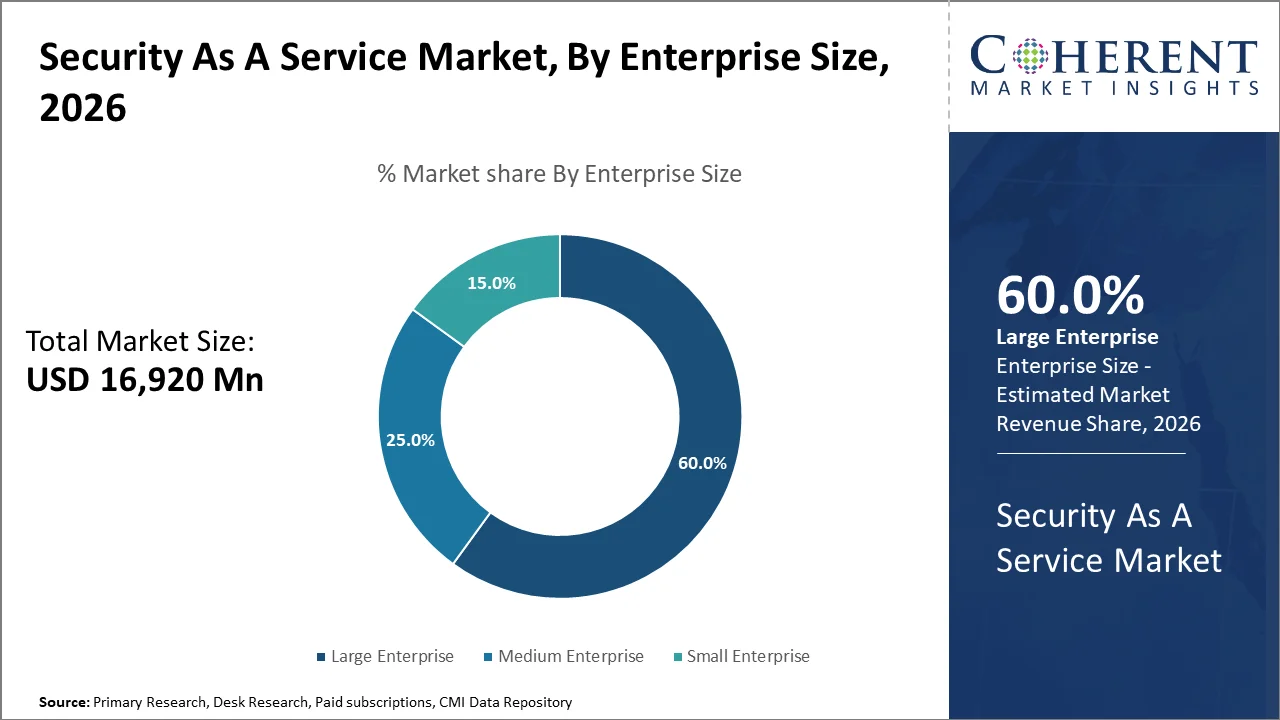
- Large enterprise segment is expected to lead the market with a share of 60% in 2026 as a result of complex IT infrastructure, higher cyber risk exposure, and larger budgets. According to the National Institute of Standards and Technology (NIST), large organizations have very complex and connected IT systems, so they need organized cybersecurity to manage risks effectively.
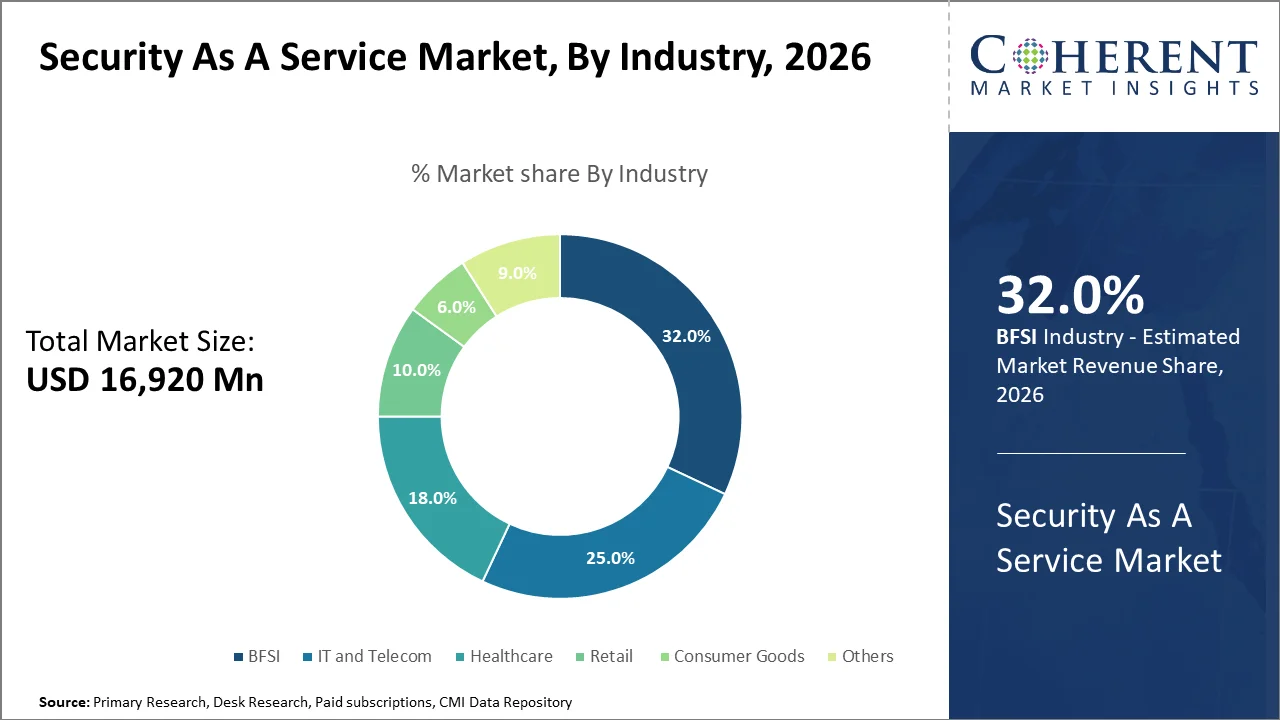
- BFSI is likely to remain the leading end-use industry for security-as-a-service, accounting for a market share of over 32% in 2026 on account of strict compliance requirements and high-value data protection needs. According to International Business Machines Corporation, the financial sector experiences one of the highest data breach costs across industries, averaging approximately $6.08 Mn in 2024. This highlights the significant financial risks, thereby driving greater investment in advanced security solutions.
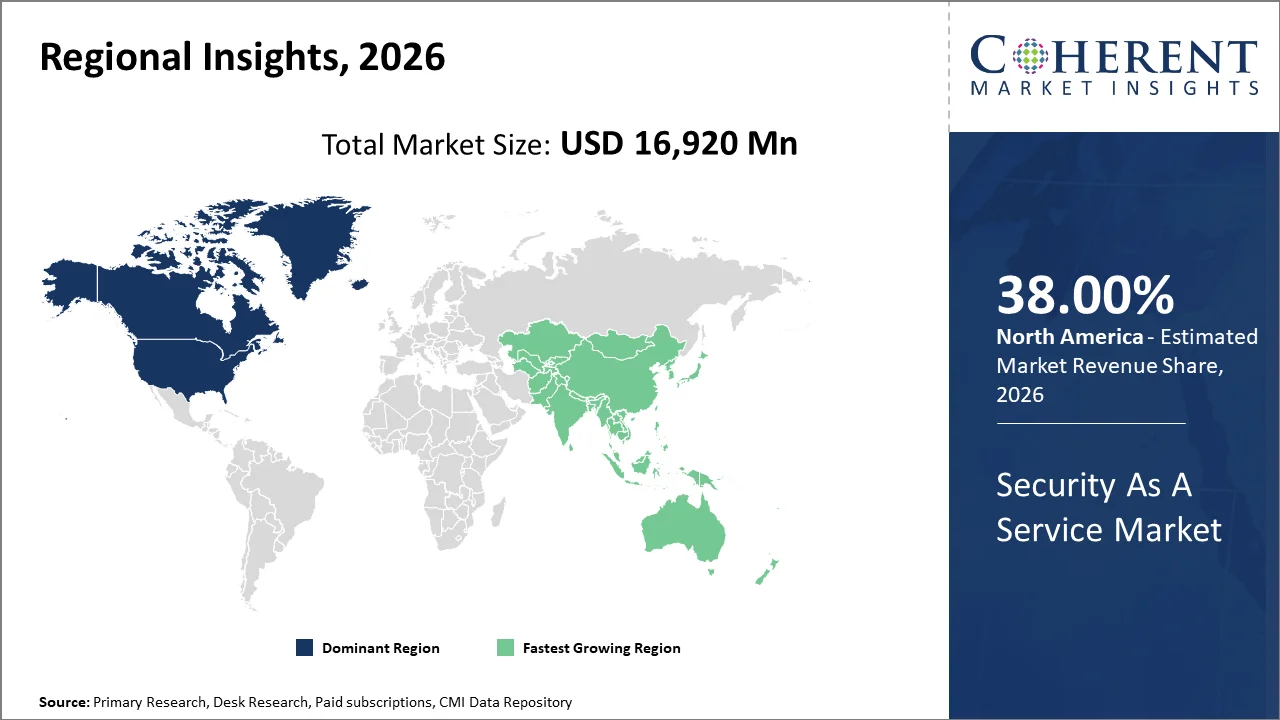
- North America is slated to dominate the global security as a service industry with a share of 38% in 2026, mostly due to strict regulations, increasing adoption of cloud solutions, and strong presence of cybersecurity vendors. Recent data shows that more than 94% of enterprises worldwide are using cloud services, especially in developed areas like North America, which drives demand for cloud-based security solutions.
- Asia Pacific, holding a share of 25% in 2026, is poised to emerge as the most lucrative market for service-as-a-service providers during the forecast period, thanks to digital transformation and rising cyber threats. More than 50% of organizations in the region consider cloud-related threats as a top concern, leading to higher investment in cybersecurity solutions.
Segmental Insights
Which Enterprise Size Leads the Security-as-a-Service Market?
Security-as-a-Service Usage Remains High in Large Enterprises
As per Coherent Market Insights’ latest security as a service market analysis, large enterprise segment is slated to dominate the market, accounting for a share of 60% in 2026. This is due to the increasing complexity of IT infrastructures in large organizations, higher volume of sensitive data they manage, and the need for advanced cybersecurity solutions to prevent data breaches and ensure regulatory compliance.
Large enterprises also have greater financial resources to invest in subscription-based security services. This enables them to adopt comprehensive Security-as-a-Service (SECaaS) solutions that cover threat detection, identity and access management, and cloud security, ensuring continuous protection across all digital assets.
- Current Industry Events of 2026
- Market Size Estimation
- Regional Breakdown
- Competitive Landscape
- Customer Intelligence
- Segmental Analysis
- Pricing Analysis
- Key Market Drivers, Challenges & Future Trends
- Customized Insights Section
Which Industry is the Leading Adopter of Security-as-a-Service Solutions
BFSI Emerges as the Front-Runner in Security-as-a-Service Adoption
Based on industry, BFSI segment is expected to remain the leading user of security-as-a-service solutions, holding a market share of more than 32% in 2026. This is mostly due to the sector’s increasing reliance on digital banking, online transactions, and cloud-based financial platforms, which heighten the need for robust cybersecurity measures.
This dominance is reinforced by broader industry trends. As per the Cloud Security Alliance, nearly 98% of financial services firms are using some form of cloud computing, creating a large base that requires ongoing security services. Likewise, 58% of banking customers report concerns about data safety, pressuring institutions to invest in advanced security capabilities.
Strict regulatory compliance requirements and the increasing frequency of cyber threats in the financial ecosystem are also pushing BFSI institutions to adopt advanced security-as-a-service solutions to protect sensitive customer data as well as ensure operational resilience. As a result, the target segment is likely to retain its dominant position during the assessment period.
Overview of Cybersecurity Service Costs and Pricing Models
Service Category | Description | Pricing / Cost Details | Example Providers |
Managed Security Service Provider (MSSP) | Comprehensive security packages, often including 24/7 monitoring and response | - Per User: $50–$200+ / user/month | Meriplex |
Managed SOC as a Service | Outsourced SOC services focusing on detection and response | - Basic Monitoring: $10,000–$15,000/month | Total Assure |
vCISO as a Service | Fractional leadership for security strategy | - Micro-business: ~$2,000/month | IronOrbit |
Specific Security Product Licensing (SaaS) | Individual security tools and suites | - Endpoint Security (CrowdStrike): ~$60/endpoint/year | Microsoft |
Security As A Service Market Growth Drivers
Digital Transformation and Cloud Adoption: Organizations in the contemporary world are increasingly shifting from traditional on-premises security solutions to cloud-delivered, subscription-based security services. These solutions are scalable, flexible, and easier to manage, supporting remote work, hybrid infrastructure, and distributed IT environments. This cloud-first approach is providing a strong impetus for the growth of security-as-a-service market.
Escalating Cyber Threat Landscape: The growing sophistication and volume of cyberattacks, including ransomware, phishing, and automated threats, are increasing rapidly. For instance, cyberattacks increased by 47% in the first quarter of 2025, as per Digital Watch Observatory. This rise is pushing governments and businesses to adopt advanced threat detection and response services offered via SECaaS.
Security As A Service Market Innovations
The Rise of AI-Based SECassS Platforms
Artificial intelligence-powered analytics and automated incident response are becoming core features of SECaaS platforms. Leading players are introducing AI-based security solutions that improve real-time threat detection as well as reduce response times across distributed networks. For instance,
- In March 2026, Proofpoint, Inc. introduced Proofpoint AI Security. It is the company’s latest intent-based AI security solution designed to protect enterprise AI agents.
- In August 2025, CrowdStrike launched new AI security services to help organizations secure AI systems as well as operationalize AI within the SOC.
- In October 2024, Kudelski Security launched a new AI Security service portfolio. The services are designed to help businesses prepare for and reduce the risks from AI-powered systems and applications.
Shift Towards Zero Trust and Identity Centric Security Models
The adoption of Zero Trust frameworks and identity-focused security is increasing, with SECaaS providers adding these approaches to their core offerings. These solutions focus on continuous verification of user identities, device posture, and access privileges to reduce risks from insider threats as well as lateral attacks. For example, in early 2026, Okta expanded its identity security offerings with new capabilities to govern both human and non‑human identities under a broader Zero Trust‑aligned strategy.
Current Events and Their Impact on the Security As A Service Market
Current Event | Description and its Impact |
Expanded Cybersecurity Regulatory Frameworks (e.g., UK Cyber Security & Resilience Bill and global compliance mandates) |
|
AI‑Driven Security Innovation & Ecosystem Shifts (Anthropic Project Glasswing) |
|
Regional Insights
North America Leading the Security-as-a-Service Market with Cloud Security Adoption
North America is expected to account for 38% of the global security as a service (SECaaS) market share in 2026. This is due to widespread enterprise adoption of cloud computing, growing cybersecurity awareness, and stringent regulatory frameworks such as HIPAA and NIST guidelines.
Organizations across nations like the U.S, and Canada are increasingly outsourcing security functions, including threat detection, identity management, and data protection, to specialized SECaaS providers to reduce operational costs and improve resilience against evolving cyber threats.
The rapid expansion of remote work and hybrid work models has heightened demand for secure access solutions, including zero-trust architectures and cloud-based endpoint protection. Major enterprises are integrating SECaaS platforms with existing IT infrastructure, enabling real-time monitoring, automated threat response, and compliance management. For example, Microsoft acquired RiskIQ, a digital threat intelligence platform, to enhance its SECaaS capabilities for hybrid work and digital transformation initiatives.
Asia Pacific Emerging as the Fastest Growing Security As A Service Market
Asia Pacific is anticipated to emerge as a hotbed for security-as-a-service vendors, accounting for a global market share of 25% in 2026. This growth is mostly due to rapid digital transformation across industries, increased adoption of cloud-based services by SMEs, and the rise of smart cities and IoT deployments. Organizations are prioritizing managed detection and response (MDR) and identity-as-a-service (IDaaS) solutions to secure distributed IT environments while addressing limited in-house cybersecurity expertise.
Governments in countries like India, Japan, and Singapore are also implementing cybersecurity frameworks and incentives to promote cloud adoption securely. This, in turn, is driving demand for third-party security services. Rising cyber threats, including ransomware attacks targeting critical infrastructure, have accelerated investment in SECaaS platforms that offer continuous monitoring and rapid incident response.
Recent developments in the region further highlight this trend. For instance, Accenture’s acquisition of CyberCX in August 2025 represents a strategic effort to expand cybersecurity and managed security capabilities across Asia Pacific. This shift shows increasing demand for complete third-party security services and encourages wider use of cloud and managed security solutions.
In addition, many Asian enterprises are shifting toward managed network services and SASE (Secure Access Service Edge) architectures to modernize their IT infrastructure and improve security. These changes are helping organizations adopt SECaaS solutions like MDR and IDaaS more effectively.
Security As A Service Market Outlook – Country-wise
U.S. Security As A Service Market Trends
The U.S. SECaaS market is poised to exhibit strong growth during the forecast period, thanks to increasing adoption of cloud solutions, stringent cybersecurity regulations, and the need for advanced threat protection across industries. A 2025 cloud security report found that 99% of organizations experienced at least one attack on their cloud or AI systems in the past year. This shows why many U.S. companies are investing in cloud‑based security services.
Adoption of zero-trust architectures, identity-as-a-service (IDaaS), and managed detection and response (MDR) platforms is especially strong in sectors like finance, healthcare, and technology. Large-scale remote and hybrid work adoption is further increasing demand for subscription-based security services that offer scalable protection and real-time threat intelligence.
China Security As A Service Market Forecast
The security-as-a-service market in China is expected to grow rapidly during the forecast period, attributed to government initiatives like the Cybersecurity Law and smart city projects that demand robust cloud and IoT security. High enterprise cloud adoption in China is creating strong demand for SECaaS solutions, including managed threat detection, cloud security, and compliance services.
Cost-effectiveness and scalability of security-as-a-service solutions are also encouraging their adoption in China. SECaaS enables organizations, especially SMEs, to access enterprise‑grade security without high upfront capital expenditure on infrastructure and staffing. Pay‑as‑you‑go pricing and scalability align security costs to business needs.
Leading technology companies such as Alibaba Cloud Security and Tencent Cloud Security are expanding their SECaaS offerings, providing integrated security platforms for businesses across urban and rural regions. Regulatory push for standardized cybersecurity practices and growing awareness of ransomware and cyber threats among Chinese enterprises are also key growth drivers.
Who are the Key Players in Security As A Service Market?
Some of the major players in the global security-as-a-service market are Proofpoint Inc., Okta, Inc., Gemalto NV, Qualys, Inc., Intel Security, Zscaler, Inc., Cisco Systems Inc., Alert Logic, Inc., Oracle Corporation, and Trend Micro Inc.
Recent Developments in Security-as-a-Service Market
- In April 2026, Perpetuals launched Quantum-Resilient-as-a-Service (QRaaS) to help organizations enhance encryption standards. The service is designed to protect financial markets from emerging risks posed by quantum computing.
- In January 2026, Telefonica Tech UK&I launched a managed service based on Netskope’s Security Service Edge technology in Ireland and the UK. The new Telefonica Tech Security Edge service enables enterprise employees to securely access applications and data from anywhere, reducing risk, cost, and complexity.
- In August 2025, CrowdStrike launched new services to secure AI systems and operationalize AI within the SOC. These services help security teams safely use AI and reduce risks in their operations.
- In June 2025, Oracle launched Oracle Compute Cloud@Customer Isolated, a new secure, sovereign, air-gapped cloud offering. This solution is designed to provide governments and regulated industries the required level of security and control for confidential data
Market Report Scope
Security As A Service Market Report Coverage
| Report Coverage | Details | ||
|---|---|---|---|
| Base Year: | 2025 | Market Size in 2026: | USD 16,920 Mn |
| Historical Data for: | 2020 To 2024 | Forecast Period: | 2026 To 2033 |
| Forecast Period 2026 to 2033 CAGR: | 17% | 2033 Value Projection: | USD 50,750 Mn |
| Geographies covered: |
| ||
| Segments covered: |
| ||
| Companies covered: | Proofpoint Inc., Okta, Inc., Gemalto NV, Qualys, Inc., Intel Security, Zscaler, Inc., Cisco Systems Inc., Alert Logic, Inc., Oracle Corporation, and Trend Micro Inc. | ||
| Growth Drivers: |
| ||
| Restraints & Challenges: |
| ||
Analyst Opinion (Expert Opinion)
- Cyberattacks are increasing rapidly, forcing adoption. Reports indicate that nearly 60% of organizations experienced a cyberattack in the past year, showing that SECaaS adoption is driven by urgent security needs rather than trendiness.
- Cloud migration fuels demand for outsourced security. As enterprises move workloads to the cloud, about 64% of organizations report difficulty securing all environments internally, making cloud-based SECaaS a practical solution.
- Slow breach detection highlights the value of SECaaS. Studies show that nearly two-thirds of cloud breaches are detected after days or weeks, emphasizing the need for continuous monitoring and integrated security platforms rather than fragmented tools.
Speak to the analyst
Want personalized insights?
Take the findings above to one of our principal consultants, or have the report rebuilt around the segments, geographies and competitors you actually track.
Market Segmentation
- By Enterprise Size Insights
- Small Enterprise
- Medium Enterprise
- Large Enterprise
- By Industry Insights
- BFSI
- IT and Telecom
- Healthcare
- Retail and Consumer Goods
- Others
- By Region Insights
- North America
- U.S.
- Canada
- Latin America
- Brazil
- Argentina
- Mexico
- Rest of Latin America
- Europe
- Germany
- U.K.
- Spain
- France
- Italy
- Russia
- Rest of Europe
- Asia Pacific
- China
- India
- Japan
- Australia
- South Korea
- ASEAN
- Rest of Asia Pacific
- Middle East & Africa
- GCC Countries
- Israel
- Rest of Middle East & Africa
- North America
Sources
Primary Research interviews
- CIOs, CISOs, and Security Heads of enterprises across Banking, IT & Telecom, Retail, Healthcare, Government, and Manufacturing sectors
- Security as a Service solution providers (product, sales & operations teams)
- IT security integrators and managed security service administrators
- Channel partners and VARs engaged in Security as a Service implementations
- Enterprise users of cloud-based security solutions (SMBs to large enterprises)
Databases
- UN Comtrade Database
- World Bank DataBank
- IMF Data & Financial Statistics
- International Telecommunication Union (ITU) statistics
- GSMA Intelligence (industry telecom data)
- IDC Worldwide IT Spending Tracker databases
- Statista (industry statistics on cloud security adoption)
- Government IT procurement portals and tender databases
Magazines
- SC Magazine
- Infosecurity Magazine
- Cybersecurity Dive
- Network World
- Cloud Computing Magazine
- Security Boulevard
Journals
- IEEE Transactions on Information Forensics & Security
- Journal of Cybersecurity (Oxford Academic)
- Computers & Security (Elsevier)
- Journal of Information Privacy and Security
- International Journal of Cloud Computing and Services Science
- ACM Transactions on Privacy and Security
Newspapers
- The New York Times – Technology Section
- The Guardian – Technology & Security
- The Wall Street Journal – Cybersecurity Coverage
- The Economic Times – Tech & IT Sector
- The Times of India – Tech & Security Special Reports
- The Hindu – Tech Trends
Associations
- Information Systems Audit and Control Association (ISACA)
- Cloud Security Alliance (CSA)
- International Information System Security Certification Consortium (ISC)²
- (ISC)2 Security Congress reports
- OWASP (Open Web Application Security Project)
- National Institute of Standards and Technology (NIST) cyber frameworks & publications
- IEEE Computer Society
Public Domain sources
- Government cybersecurity publications and whitepapers
- National cybersecurity strategy documents (US, EU, UK, India, Australia)
- Official cloud security guidelines from NIST, ENISA, and CERTs
- Regulatory frameworks (GDPR, HIPAA, PCI DSS cybersecurity guidance)
- Technical blogs from major cloud platform providers (AWS, Azure, Google Cloud security blogs)
- Public cybersecurity breach reports and analytics
Proprietary Elements
- CMI Data Analytics Tool
- Proprietary CMI Existing Repository of information for last 8 years
Get access to 250+ pages report
Every segment, forecast, competitor profile and data table behind the analysis above — available for instant download.
- ESOMAR Member
- ISO 9001:2015 Certified
- D-U-N-S Registered
- GDPR & CCPA Compliant
Missing comfort of reading report in your local language? Find your preferred language:
Transform your Strategy with Exclusive Trending Reports
Frequently Asked Questions
The global security-as-a-service market is estimated to be valued at USD 16,920 Mn in 2026.
The global Security As A Service Market value is expected to reach USD 50,750 Mn by 2033.
The global market is poised to exhibit a CAGR of 17% from 2026 to 2033.
Major growth factors include rapid digitalization, adoption of cloud technologies, and rising cybersecurity threats.
Large enterprise segment, with about 60% share in 2026, dominates the market.
Some major companies in the Security As A Service Market include Proofpoint Inc., Okta, Inc., Gemalto NV, Qualys, Inc., Intel Security, Zscaler, Inc., Cisco Systems Inc., Alert Logic, Inc., Oracle Corporation, and Trend Micro Inc.
North America, with 38% share in 2026, is set to lead the market during the forecast period.