

Continuous Testing Market Size and Share Analysis - Growth Trends and Forecasts (2026 - 2033)
The Continuous Testing market is anticipated to grow at a CAGR of 4.05% with USD 3.58 Bn in 2026 and is expected to reach USD 3.35 Bn in 2033. High demand for continuous and instant content delivery is major factor driving market growth, owing to increasing inclination of consumers towards interacting with peers through real-time communication and rising use of social media (As of 2025, 65.7% of the global population are active social media users).
Key Takeaways
- Professional services segment is expected to account the largest share of 60% in 2026, due to high demand for consulting, implementation, and training services when organizations adopt continuous testing. Enterprises spend 1.5x more on professional services than on managed services in the first 12–18 months of continuous testing adoption.
- Cloud will dominate with 65% in 2026, organizations highly prefer SaaS solutions due to its lower upfront costs, faster deployment, as well as flexibility. The global SaaS industry is worth more than USD237 Bn.
- Large enterprises will dominate with 67% in 2026, large enterprises drive demand for continuous testing due to complex application portfolios along with the need for faster release cycles. Large enterprises typically manage 50,000+ automated test cases as well as execute 10,000–100,000 automated tests daily, increasing the need for continuous testing platforms.
- North America is expected to acquire the dominant share of 47% in 2026, advancement in internet infrastructure, high use of mobile and web applications, and rising number of social media users. In 2025, the Federal Communications Commission (FCC) defines broadband speed as 100 MBps download and 20 MBps uploads for fixed broadband connections.
Core Testing Frameworks and Tools is transforming the Continuous Testing Industry
Companies use different testing tools to check software quality as well as find problems early. Popular tools include JUnit and TestNG for Java, NUnit for .NET, Jest, and Mocha for JavaScript, pytest for Python, as well as RSpec for Ruby. Prominent companies like Netflix, Spotify, Airbnb, etc., use these tools to test their apps as well as services regularly.
These testing frameworks aid developers find bugs faster as well as improve software quality. They can lessen down bug detection time by 60%, give developers feedback 70% faster, as well as aid companies handle high code quality with over 80% code coverage.
Current Events and Their Impact on the Continuous Testing Market
Current Event | Description and its Impact |
EU AI Act & ETSI Continuous Compliance Standards (2026) |
|
Rising Cybersecurity Regulations (NIS2, DORA & Cyber Resilience Act) |
|
- Current Industry Events of 2026
- Market Size Estimation
- Regional Breakdown
- Competitive Landscape
- Customer Intelligence
- Segmental Analysis
- Pricing Analysis
- Key Market Drivers, Challenges & Future Trends
- Customized Insights Section
Segmental Insights
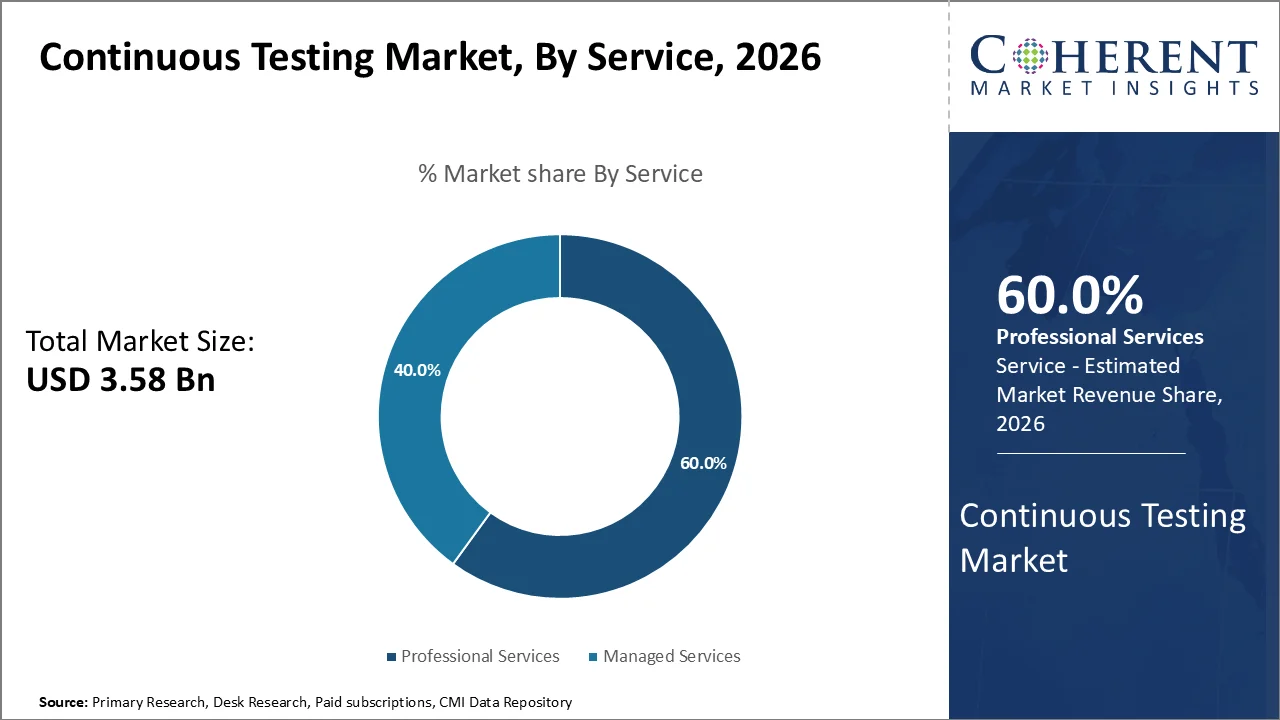
Why is Professional Services Segment Acquiring the Largest Market Share?
Professional services segment is projected to account for the largest share of service in 2026, representing approximately 60% of the total volume. The critical need for specialized expertise along with strategic guidance during the initial phases of continuous testing implementation is fueling the market growth.
Organizations across industries are recognizing that successful continuous testing adoption requires cohort technical knowledge, methodology design, as well as cultural transformation.
For example, some big financial companies like JPMorgan Chase spend a lot on expert service partners to make as well as improve their software delivery systems. They usually need help with test automation, DevOps setup, and managing changes in how teams work.
Cloud Continuous Testing holds the Largest Market Share
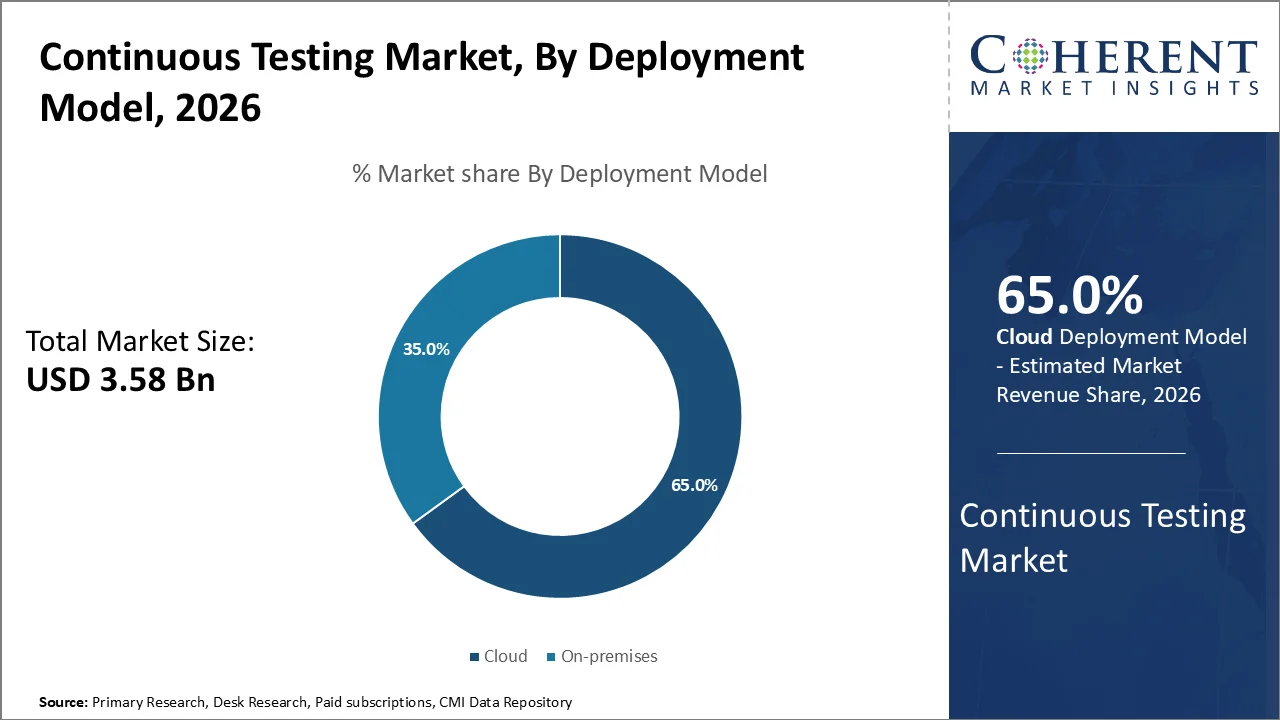
Based on deployment model, cloud dominates the market, accounting for a significant 65% share in 2026, its inherent scalability, cost-effectiveness, along with rapid deployment capabilities is propelling the growth of the segment.
Major technology companies like Microsoft, Amazon, Google, etc., have highly invested in cloud-based testing platforms, with Azure DevOps platform by Microsoft as well as CodeBuild services by Amazon demonstrating how cloud infrastructure can seamlessly integrate continuous testing into development workflows.
For instance, in April 2026, TestGrid is a cloud-based testing platform that provide real device testing, codeless automation, as well as integration with popular CI/CD pipelines.
Large Enterprises holds the Largest Market Share
Large enterprises dominate the market, accounting for a significant 67% share in 2026, their substantial technology budgets, complex IT infrastructures, as well as stringent regulatory compliance requirements that necessitate robust testing frameworks are the factors propelling the segmental growth.
In 2025, 17% of small enterprises, 30.36% of medium enterprises and 55.03% of large enterprises used AI. Large enterprises typically operate multiple interconnected systems across various business units, geographic locations, as well as customer touchpoints, making an intricate web of applications that require continuous validation as well as testing.
For example, multinational financial institutions like JPMorgan Chase have invested heavily in continuous testing platforms to make sure their digital banking services, trading platforms, as well as risk management systems operate easily across different time zones along with regulatory environments.
Continuous Testing Market Trends
- Organizations are adopting testing earlier in the development lifecycle, lower costs as well as improving quality.
- Intelligent test automation, predictive analytics, as well as self-healing test scripts are becoming mainstream. Projections suggest that 60% of firms will prioritize predictive analytics by 2025, making it one of the hot topics in tech innovation as well as business strategy.
- High emphasis on containerized testing environments as well as serverless testing frameworks
- Escalated focus on API testing as microservices architectures proliferate. In 2024, 74% of respondents are API-first, up from 66% in 2023, with an average application running between 26 and 50 APIs actively.
- Rising demand for citizen developer-friendly testing platforms.
Regional Insights
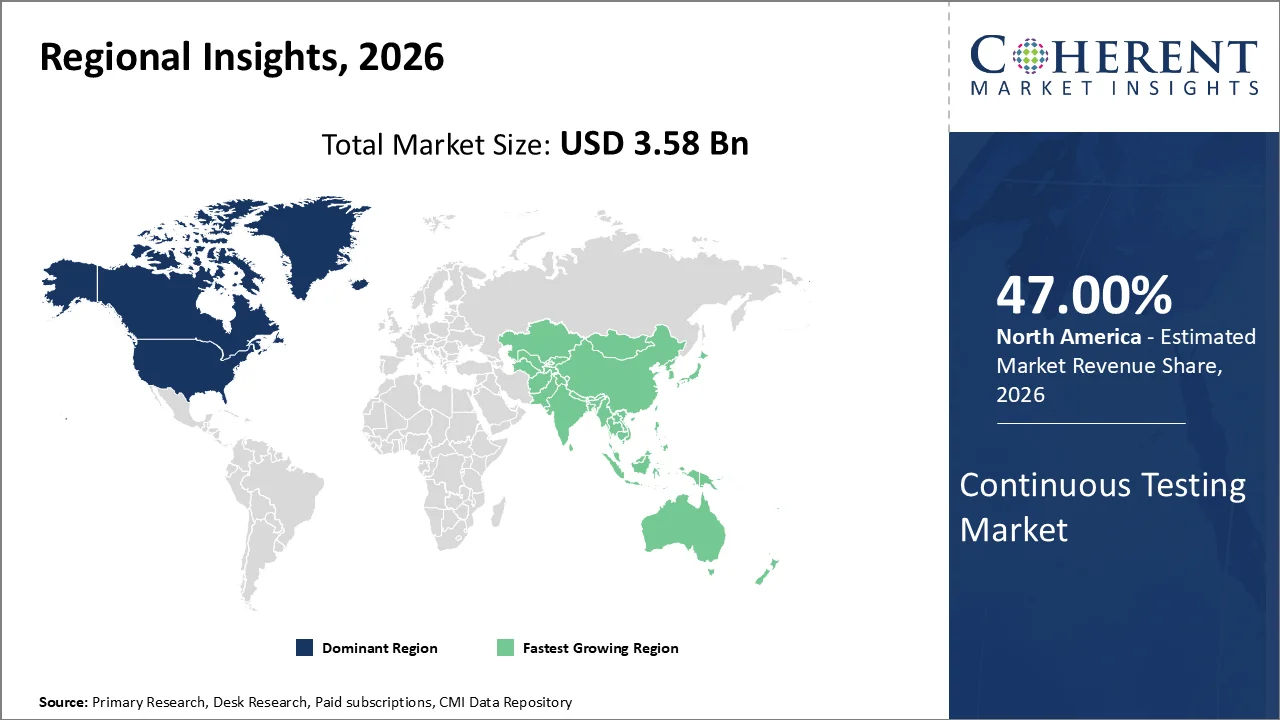
North America dominates owing to its robust nuclear infrastructure
North America account 47% market share in 2026, owing to its advanced technological infrastructure, high enterprise cloud adoption, and strong digital transformation investments. According to the OECD, 56% of large enterprises in OECD economies adopted cloud computing services, reflecting the cloud maturity and DevOps readiness that support continuous testing implementation across large enterprises.
The concentration of Fortune 500 companies across Silicon Valley, Seattle, as well as other major technology hubs is the growth inducing factor that have adopted continuous testing as a core component of their software development lifecycle.
Companies like Microsoft, Amazon, Google, etc., have implemented sophisticated continuous testing environments that connect seamlessly with their cloud platforms.
Asia Pacific Continuous Testing Market Trends
The Asia Pacific region is poised to be the fastest-growing region through 2026-2033, expanding at a CAGR of approximately 6.2%. The rapid digital transformation initiatives across emerging economies as well as the increasing sophistication of local technology ecosystems are the factors propelling the market growth. The Association of Southeast Asian Nations (ASEAN)1 is projected to contribute USD360 billion to global digital trade by 2025 and grow to USD1 trillion or about 10% of global digital trade by 2030 (Statista, 2022b). ASEAN has an immense opportunity to grow its digital landscape further and develop its leading role in digital transformation.
This is clearly seen in countries like India, where the government’s Digital India program has helped both government and private companies use automated testing more widely.
The successful deployment of continuous testing methodologies by the Indian Space Research Organization for satellite software systems exemplifies this regional capability advancement. In line with this, China's technology sector has experienced tremendous growth in continuous testing adoption, with companies like Alibaba, Tencent, etc., developing proprietary testing platforms that rival Western solutions.
Its Robust Technology Infrastructure is Accelerating the Continuous Testing Market Demand in U.S.
The U.S. contributes the highest share in the continuous testing market in North America due to its technology infrastructure, presence of Fortune 500 companies, as well as comprehensive digital transformation initiatives.
The concentration of major technology hubs including Silicon Valley, Seattle, Austin, Boston, etc., where leading software companies have continuous deployment (CI/CD) pipelines is augmenting the growth.
For example, Azure DevOps platform by the Microsoft has seen substantial adoption across U.S. enterprises, with companies like Starbucks implementing continuous testing frameworks to support their mobile application ecosystem that processes millions of daily transactions.
China Continuous Testing Market Trends
China contributes the highest share in the Continuous Testing Market in the region due to its extensive digital transformation initiatives, strong support by the government authorities, as well as the presence of a number of large-scale technology enterprises. China’s rapid advancement in AI integration, cloud computing, and telecommunications infrastructure has created a thriving ecosystem for continuous testing practices to flourish.
For example, the Ministry of Industry and Information Technology in China has promoted policies aimed at accelerating software development efficiency through automation as well as DevOps practices, which inherently mandate continuous testing to ensure faster release cycles and higher software quality.
Additionally, China’s leading domestic technology companies such as Alibaba, Tencent, and Huawei have been early adopters of continuous testing to support their massive-scale platforms from e-commerce to fintech and telecommunications facilitating rapid iterations of applications without compromising user experience or security.
Who are the Major Companies in Continuous Testing Industry
Some of the major key players in Continuous Testing market include, EPAM Systems, Mindtree, HCL Technologies, ATOS, Tech Mahindra, Hexaware, Tricentis, Cigniti, Larsen & Toubro Infotech, and NIIT Technologies
Key News
- In March 2026, Inflectra, a leader in software lifecycle management, announced the launch of its Early Access Program for SureWire. As AI agents move from research to production, SureWire provides the first dedicated quality assurance environment designed to handle the non-deterministic nature of systems that reason and improvise.
- In May 2026, Tata Elxsi, a global leader in design and technology services, announced the launch of AnaTel, an AI-native software development platform for healthcare and medical technology companies, co-developed with OpenAna, a provider of autonomous AI engineering platforms. AnaTel™ makes its debut at DeviceTalks Boston 2026, where Tata Elxsi is presenting its latest advances in AI-powered MedTech engineering and compliance.
Market Report Scope
Continuous Testing Market Report Coverage
| Report Coverage | Details | ||
|---|---|---|---|
| Base Year: | 2025 | Market Size in 2026: | USD 3.58 Bn |
| Historical Data for: | 2020 To 2024 | Forecast Period: | 2026 To 2033 |
| Forecast Period 2026 to 2033 CAGR: | 4.05% | 2033 Value Projection: | USD 3.35 Bn |
| Geographies covered: |
| ||
| Segments covered: |
| ||
| Companies covered: | EPAM Systems, Mindtree, HCL Technologies, ATOS, Tech Mahindra, Hexaware, Tricentis, Cigniti, Larsen & Toubro Infotech, and NIIT Technologies | ||
| Growth Drivers: |
| ||
| Restraints & Challenges: |
| ||
Analyst Opinion
- The Continuous Testing market is witnessing significant momentum as organizations increasingly prioritize agility and quality in software development. A 2023 World Quality Report by Capgemini reported that over 60% of organizations are highly investment in test automation, including continuous testing tools, to improve software quality as well as lower release cycles.
- The rapid adoption of DevOps methodologies as well as the rising demand for faster release cycles, continuous testing has become a vital component in ensuring easy integration as well as deployment. 70% of organizations indicate that DevOps maturity meaningfully influences their AI success.
- One of the primary drivers is the escalating complexity of applications coupled with the need to detect defects early in the development lifecycle, thereby reducing time-to-market and improving product reliability.
- On the opportunity front, advancements in AI and machine learning are enhancing test automation capabilities, enabling smarter test case generation and efficient defect prediction. This technological evolution opens avenues for vendors to introduce innovative solutions catering to diverse industry verticals, including BFSI, healthcare, and retail.
Speak to the analyst
Want personalized insights?
Take the findings above to one of our principal consultants, or have the report rebuilt around the segments, geographies and competitors you actually track.
Market Segmentation
- By Service (Revenue, USD Bn, 2021-2033)
- Managed Services
- Professional Services
- By Deployment Model (Revenue, USD Bn, 2021-2033)
- On-premises
- Cloud
- By Organization Size (Revenue, USD Bn, 2021-2033)
- Small & Medium Enterprises
- Large Enterprises
- By Region (Revenue, USD Bn, 2021-2033)
- North America
- U.S.
- Canada
- Latin America
- Brazil
- Mexico
- Argentina
- Rest of Latin America
- Europe
- Germany
- U.K.
- France
- Italy
- Spain
- Russia
- Rest of Europe
- Asia Pacific
- China
- India
- Japan
- Australia
- South Korea
- ASEAN
- Rest of Asia Pacific
- Middle East
- GCC
- Israel
- Rest of Middle East
- Africa
- South Africa
- Central Africa
- North Africa
- North America
Sources
Primary Research Interviews
- QA Managers from software development firms
- DevOps Engineers from IT service providers
- Product Managers of testing tools companies
- CIOs of enterprises implementing continuous testing
- Others
Databases
- Gartner
- IDC (International Data Corporation)
- Others
Magazines
- Software Testing Magazine
- SD Times
- TechBeacon
- Continuous Delivery & DevOps Magazine
- Others
Journals
- Journal of Systems and Software
- IEEE Transactions on Software Engineering
- ACM Transactions on Software Engineering and Methodology
- Others
Newspapers
- The Economic Times (Tech Section)
- The Wall Street Journal (Technology)
- Financial Times (Tech Industry Coverage)
- TechCrunch
- Others
Associations
- International Software Testing Qualifications Board (ISTQB)
- Agile Alliance
- DevOps Institute
- Association for Software Testing (AST)
- Others
Public Domain Sources
- Company websites and annual reports of leading continuous testing tool providers
- Press releases from market leaders
- Government publications on IT and software testing trends
- Reports and whitepapers from technology consulting firms (e.g., Accenture, Deloitte)
- Others
Proprietary Elements
- CMI Data Analytics Tool
- Proprietary CMI Existing Repository of information for last 10 years
Get access to 250+ pages report
Every segment, forecast, competitor profile and data table behind the analysis above — available for instant download.
- ESOMAR Member
- ISO 9001:2015 Certified
- D-U-N-S Registered
- GDPR & CCPA Compliant
Missing comfort of reading report in your local language? Find your preferred language:
Transform your Strategy with Exclusive Trending Reports
Frequently Asked Questions
The Continuous Testing market is expected to reach USD 3.35 Bn in 2033.
Major players operating in the global continuous testing market include EPAM Systems, Mindtree, HCL Technologies, ATOS, Tech Mahindra, Hexaware, Tricentis, Cigniti, Larsen & Toubro Infotech, and NIIT Technologies
Integration challenges with legacy systems is one of the major factors that is expected to hamper growth of the market over the forecast period.
High demand for continuous and instant content delivery, owing to increasing inclination of consumers towards interacting with peers through real-time communication is one of the major factors that is expected to propel growth of the market over the forecast period.
The continuous testing market is anticipated to grow at a CAGR of 4.05% between 2026 and 2033.
Among regions, North America is expected to account for a largest market share in the global continuous testing market over the forecast period.
Early Defect Detection: Continuous testing helps identify and fix defects early in the development cycle, reducing the cost and effort required for late-stage bug fixes.