

Customer Experience Management Market Analysis & Forecast: 2026-2033
Customer Experience Management Market is estimated to be valued at USD 15.94 Bn in 2026 and is expected to reach USD 39.05 Bn in 2033, exhibiting a compound annual growth rate (CAGR) of 13.7% from 2026 to 2033.
Key Takeaways
- In terms of components, The Solutions Segment is estimated to lead the Customer Experience Management market outlook with about 61.0% market share in 2026, as a result of the growing need for full-fledged software systems that facilitate integrated customer interactions.
- In terms of region, the North America region is expected to dominate the global Customer Experience Management market with 44.00% share in 2026. This is due to the adoption of new technologies, high spending on customer experience management technologies, and high concentrations of industry stakeholders.
Market Overview
The Global Customer Experience Management market has multiple drivers, including increased sophisticated customer retention and engagement techniques, advanced demand for tailored interactions, and growing attention to technological solutions powered by AI. Furthermore, the increasing use of big data and IoT technologies helps companies acquire better insights about the customers, allowing for more targeted servicing. For instance, Starbucks uses artificial intelligence and IoT through its mobile application and loyalty systems to offer tailored deals along with effortless ordering which boosts loyalty and engagement.
Current Events and Its Impact on the Global Customer Experience Management Market
Event | Description and Impact |
AI and Machine Learning Technology Revolution |
|
Post-Pandemic Digital Transformation Acceleration |
|
Global Economic Uncertainty and Inflation Pressures |
|
Pricing Analysis
The global Customer Experience Management (CEM) market features diverse pricing models tailored to various customer loyalty management, voice of customer programs, and digital customer experience needs. Pricing ranges from affordable basic plans starting around $10 per user per month to enterprise-level packages exceeding $500,000 annually.
While per-user or per-seat priced subscriptions is a common practice for SaaS-based CEM solutions, specialized feedback and survey tools opt for transaction-based pricing. There is also tiered subscription models that are built with scaled features for different user needs. Salesforce is one of the top CEM vendors with a wide-ranging plan starting from $25 to $300 per user per month with advanced customer loyalty management powered by AI insights at the higher tier.
Adobe Experience Cloud sustains its position as a market leader with a starting price of $24,000 for basic components and $500,000 for full enterprise suites which prioritizes digital customer experience features. Oracle and Microsoft have competing offers with these other vendors and provide similar enterprise-level suites with variable pricing depending on the modules and customization.
Mid-market providers such as Zendesk and Freshworks offer competitive, transparent tiered pricing suited for growing businesses implementing voice of customer programs. Qualtrics and Medallia specialize in experience management platforms with premium pricing aligned to advanced analytics and customer journey measurement. Overall, pricing flexibility supports organizations of all sizes in deploying tailored CEM solutions that enhance customer engagement and loyalty.
- Current Industry Events of 2026
- Market Size Estimation
- Regional Breakdown
- Competitive Landscape
- Customer Intelligence
- Segmental Analysis
- Pricing Analysis
- Key Market Drivers, Challenges & Future Trends
- Customized Insights Section
Role of Emerging Technologies
The latest innovations and emerging technologies are transforming the CEM market by allowing for real-time, hyper-personalized, and omnichannel engagement strategies. The transformation is spearheaded by Artificial Intelligence (AI) and Machine Learning (ML) technologies which power sentiment analysis automation, predictive analytics, and automation itself. Customer loyalty management is enhanced with consistent omni-channel support. AI chatbots and virtual assistants enhance complex query resolution with context-based reasoning. Through automatic real-time data flow synchronization, cross-departmental silos are eliminated between marketing, sales, and service teams resulting in a single, unified view of the customer.
Actionable insights for advanced customer intelligence tools are powered with large datasets from social media, the internet of things, and customer relationship management systems (CRMs) creating adaptive and targeted dynamic segmentation. Social media, IoT, CRM data streams, and advanced analytics transform vast datasets into actionable insights, agile targeting brand VoC programs.
Fast global real-time interactions are made possible with Edge computing cloud-native architectures. Additionally, utterance analytics coupled with AR/VR enhance intuitive and immersive interfaces improving digital customer experiences. Customer interaction is elevated through adaptive content where recommendations are made based on behavioral, contextual, and psychological signals in real-time, setting forth a new standard for responsive and meaningful customer engagement.
Segmental Insights
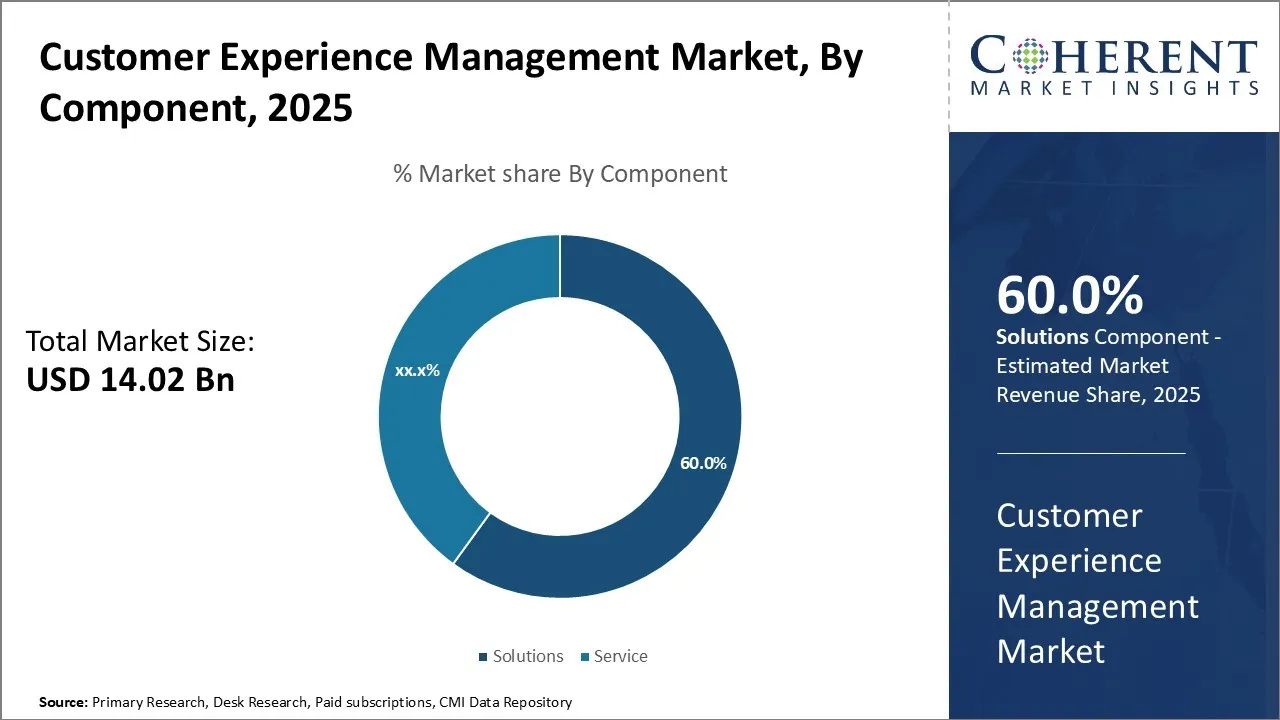
Customer Experience Management Market Insights, By Component
The solutions segment dominates the customer experience management market, holding a substantial 61.0% market share in 2026. This leadership is driven by increased competition among vendors and the relatively easy market entry facilitated by digital platforms.
By improving customer satisfaction and retention, businesses can gain a major competitive edge. Meeting comprehensive customer needs is likely to drive ongoing growth within the segment. In comparison, the services segment holds a smaller share but is anticipated to grow steadily. It includes professional services like training, integration, deployment, ongoing vendor support, and managed services offered by vendors. The demand is especially fueled by the need to strategically optimize technological investments.
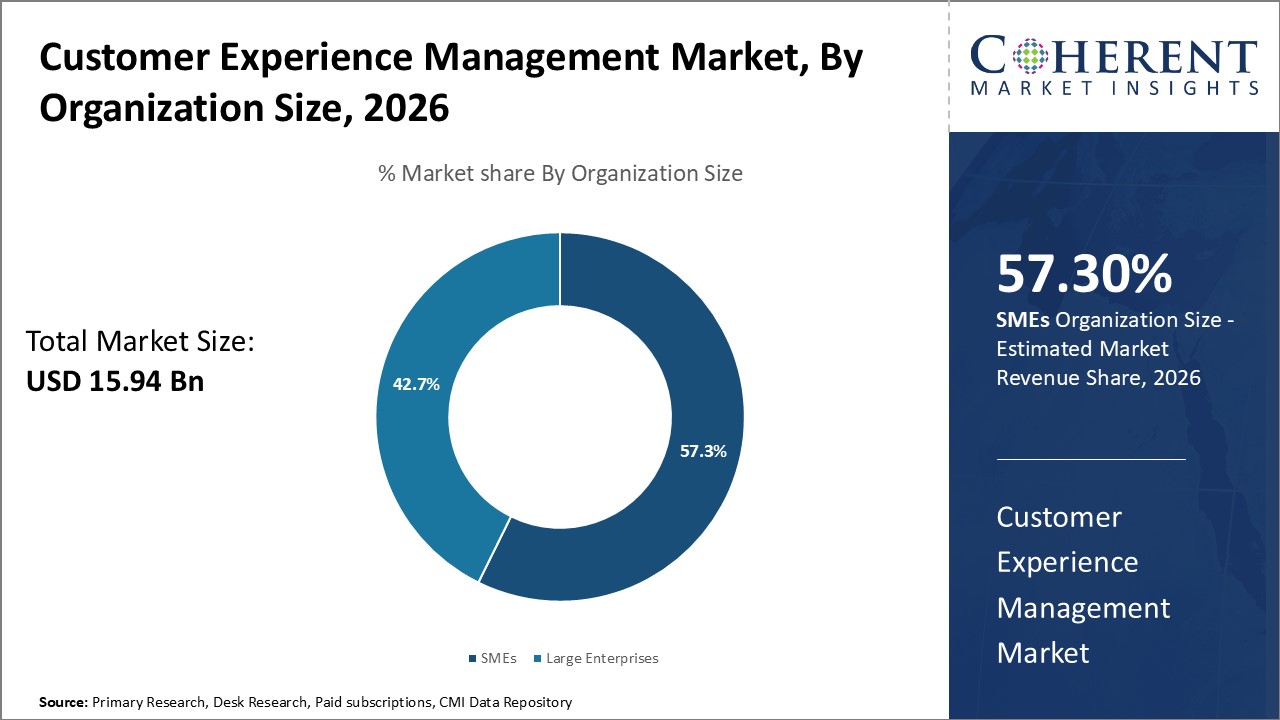
Customer Experience Management Market Insights, By Organization Size
The SMEs segment commands a significant share of the market, fueled by the rising adoption of customer experience solutions among small and medium-sized enterprises worldwide. Increased awareness of the link between superior customer experience and profitability is motivating SMEs to invest in management tools tailored to their scale and budgets. This trend, combined with the availability of cost-effective, easy-to-implement solutions, drives strong segment growth.
Conversely, large enterprises are also rapidly increasing their use of customer experience management platforms. With larger budgets and economies of scale, these organizations can deploy advanced, integrated solutions to manage vast and diverse customer bases. The ongoing digital transformation and investment in customer engagement technologies are expected to accelerate growth in this segment.
Customer Experience Management Market Insights, By Touch Point
The telephone segment continues to dominate customer interaction channels, largely due to the rise of VoIP phone systems. These systems provide enhanced analytics on call metrics—such as missed calls, abandoned calls, and queue statistics—making telephone a preferred and reliable communication channel. Its simplicity and directness keep it at the forefront of customer support strategies globally.
The email segment is also growing rapidly, reflecting email’s widespread use for business-to-customer communication. Automated emails—welcome messages, notifications, and follow-ups—help businesses nurture relationships and build brand experiences. With its broad applicability across industries, email remains a critical touchpoint in customer experience management, driving continued adoption.
Customer Experience Management Market Insights, By Application
The BFSI (Banking, Financial Services, and Insurance) sector dominates the market, propelled by the increased use of smartphones for digital banking and financial transactions. Personalized mobile engagement tools enhance customer convenience and satisfaction, solidifying BFSI’s leadership. The sector’s focus on seamless, secure digital experiences continues to drive demand for advanced customer experience management solutions.
Meanwhile, the retail segment is experiencing rapid growth as companies shift toward omnichannel customer service models. Rising competition, product commoditization, and the need for differentiated customer engagement push retailers to optimize customer experience strategies. Investments in integrated service platforms and analytics help retailers deliver.
Regional Insights
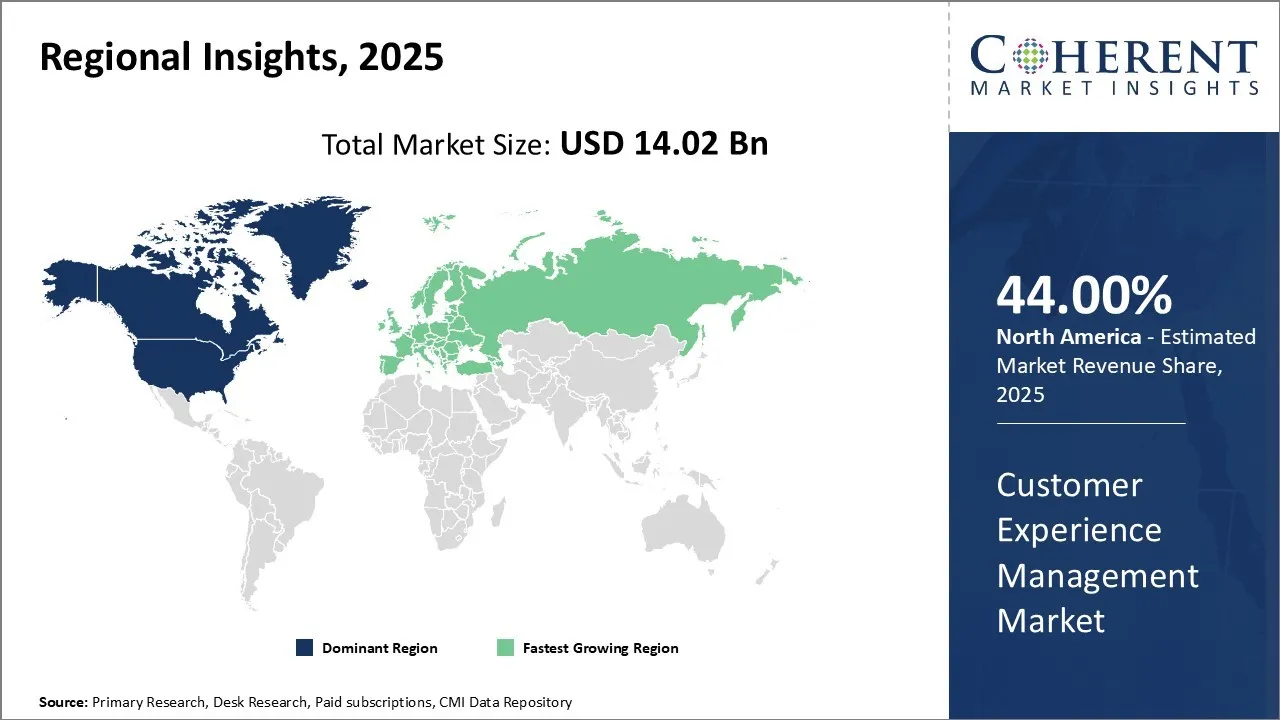
North America Customer Experience Management Market Analysis and Trends
North America is poised to lead the global customer experience management (CXM) market, holding an estimated 44.00% share in 2026. The region benefits from a strong presence of medium and large-sized enterprises prioritizing multichannel service delivery to ensure seamless customer experiences across all touchpoints.
The United States, in particular, leads this trend by adopting advanced business analytics tools such as speech analytics, sentiment analytics, and text analytics. These technologies enable organizations to extract valuable insights from unstructured data generated by customer interactions, thereby enhancing digital service offerings. The well-established technology ecosystem and increasing demand for personalized customer engagement are expected to drive robust market expansion across North America.
Asia Pacific Customer Experience Management Market Analysis and Trends
Asia Pacific is emerging as a major growth hub for the customer experience management market, propelled by countries including Japan, Singapore, China, and Australia—pioneers in omnichannel strategies. The region is witnessing a rising adoption of ‘phygital’ experiences, blending digital enhancements with offline customer interactions to allow seamless movement across devices and platforms.
This integrated approach is fueling customer engagement and loyalty, contributing to market growth. Supported by rapid digital transformation and expanding consumer bases, Asia Pacific is set to capture a significant share of the global CXM market in the coming years.
Dominating Countries in the Customer Experience Management Market
United States Customer Experience Management Market Analysis and Trends
The U.S. leads the North America CXM market, driven by its concentration of enterprises investing heavily in customer analytics and multichannel engagement. Advanced analytics platforms and AI-powered tools are increasingly integrated to deliver personalized customer journeys, strengthening brand loyalty. The demand for superior digital experiences is pushing companies to innovate in areas such as real-time interaction monitoring and predictive analytics, cementing the U.S. as a key player in global CXM advancements.
China Customer Experience Management Market Analysis and Trends
China is a pivotal market within the Asia Pacific region, showing rapid CXM adoption due to its booming digital economy and tech-savvy consumers. Government initiatives supporting digital infrastructure and smart city projects accelerate omnichannel deployments. Local CXM providers are enhancing capabilities in AI-driven sentiment analysis and customer data platforms, positioning China as a competitive force in the global CXM landscape.
India Customer Experience Management Market Analysis and Trends
India’s CXM market is growing swiftly, fueled by expanding internet penetration, rising smartphone use, and increased focus on customer-centric business models. Policies encouraging digital innovation and investments in analytics infrastructure support this growth. With a large and diverse consumer base, Indian enterprises are increasingly leveraging CXM solutions to provide personalized, seamless customer experiences across channels, making India a vital contributor to Asia Pacific’s market momentum.
Market Report Scope
Customer Experience Management Market Report Coverage
| Report Coverage | Details | ||
|---|---|---|---|
| Base Year: | 2025 | Market Size in 2026: | USD 15.94 Bn |
| Historical Data for: | 2020 To 2024 | Forecast Period: | 2026 To 2033 |
| Forecast Period 2026 to 2033 CAGR: | 13.7% | 2033 Value Projection: | USD 39.05 Bn |
| Geographies covered: |
| ||
| Segments covered: |
| ||
| Companies covered: | MaritzCX Research LLC (Inmoment LLC), Adobe Inc., Medallia Inc., Oracle Corporation, Clarabridge, SAP SE, Sitecore, IBM Corporation, Zendesk, Avaya Inc., Open Text Corporation, Verint Systems Inc., and Tech Mahindra | ||
| Growth Drivers: |
| ||
| Restraints & Challenges: |
| ||
Global Customer Experience Management Market Drivers
- Increasing adoption of automation, cloud-based technology, and advanced analytics to boost the market pace
Data integrity is known to be a major factor driving the customer experience, and now it is leading to growing shift among enterprises toward automation, cloud-based technology, and advanced analytics. With these tools, access of companies to data remains up to date. The use of cloud-based technology offers provision of data consistency, which further drives the demand for these tools.
Due to the management of data feeds in cloud-based repository, achieving consistent distribution and management of data in the internal system of an organization becomes possible. This further ensures that customers get real-time update, which is an important factor of enhanced customer experience. Thus, increasing adoption of these tools is expected to drive growth of the global customer experience management market during the forecast period.
- Rising demand for personalized customer experience to propel the market growth
Personalized, enhanced customer service along with the quality of the service/solution is required for development of a business. Customer retention and customer satisfaction are the most important aspects of enhanced customer service. Enterprises across various industries are finding ways to leverage the advantage, which is hard to imitate for competitors through offering highly personalized customer experiences.
These experiences use proprietary data in order to provide a better experience to several customers. The end results however are dependent on the execution, which can allow businesses to differentiate themselves and also achieve customer loyalty as well as sustainable competitive benefit. Thus, these factors in turn are expected to fuel growth of the global customer experience management market during the forecast period.
Global Customer Experience Management Market Opportunities
Growing adoption of AI is expected to bring multiple growth opportunities in the global customer experience management market during the forecast period. AI is expected to drive success of customer experience through AI-driven data collection and measurement, enhanced chatbots, and actionable intelligence to predict modeling. The Ai interactions in customer experience space enabled by natural language communication are continuously increasing.
Conversational communication with Chabot with the use of natural language in chat and voice, especially in support channel is likely to make AI chat vague from human agents of customer service. Thus, adoption of AI in customer experience field is likely to offer various growth opportunities in the coming future.
Growing demand from telecom sector is anticipated to create major opportunities in the global customer experience management market over the forecast period. This in turn increased telecom spending. Moreover, the existing increasing demand for cloud infrastructure services and a strong increase in specialized software is likely to drive the growth of customer experience management solutions.
As several academic institutions began online classes, the demand for telecom services and communications tools increased all over the world. This is further expected to offer several lucrative opportunities in the global customer experience management market over the forecast period.
Global Customer Experience Management Market Trends
- Growth of hospitality industry is a growing trend in the market
Hospitality industry is one of the end-user industries of customer experience management solutions, which increasingly growing in terms of customer experience. The market is thus, expected to show strong growth with increasing growth of this industry and continuously changing customer expectations.
The hospitality industry is majorly impacted by AI, as hotel owners are using AI to keep a check on the messages being exchanged by customers about their amenities, property, stays, and services. Thus, increasing growth of hospitality industry is expected to drive demand for customer experience management solutions. This trend is likely to continue in the market over the forecast period.
- Growing investment in CX solutions is a recent trend in the market
In the coming future, the demand for an Omni channel service experience is likely to grow among customers. Along with this, real-time messaging is likely to outgrow email, and as the adoption of remote work is increasing with customer success, it will be a key competitive differentiator.
These changes are taking place at a highly rapid pace, due to which competition in the market is growing immensely. This in turn is driving the investments in the customer experience management market, which is likely to continue in the market over the coming years.
- Increasing regulatory compliance to hamper the market pace
Government of countries across the globe are implementing new regulations in response to increasing data breaches. These regulations enable data security and protection. For instance, in May 2018, the European Union introduced General Data Protection Regulation, which provides data protection regulations as well as monitors behavior of a person in the European Union.
These regulations have to be followed by CEM solution providers, while leveraging data of their customers. Such regulations by governments around the world are expected to hinder growth of the global customer experience management market during the forecast period.
Analyst Viewpoint
- The Customer Experience Management (CEM) market is witnessing robust growth as organizations increasingly recognize that delivering superior customer experiences drives competitive advantage and brand loyalty.
- Digital transformation initiatives are reshaping customer interactions, creating strong demand for comprehensive CEM solutions that enable seamless omnichannel experiences across multiple touchpoints.
- The surge in customer data from sources such as social media, mobile apps, and IoT devices offers businesses unprecedented opportunities to gain deeper insights and deliver personalized interactions at scale.
- Cloud-based CEM platforms are gaining significant traction due to their scalability, cost-effectiveness, and rapid deployment capabilities, appealing to organizations across various sizes and industries.
- Data privacy regulations like GDPR and CCPA present challenges, requiring organizations to carefully balance personalization with stringent compliance mandates.
- Integration complexity with existing legacy systems remains a key barrier, delaying or complicating CEM solution implementation for many enterprises.
- North America currently leads the market, driven by early technology adoption and strong investments in customer-centric strategies by major enterprises.
- The Asia-Pacific region is emerging as the fastest-growing market, fueled by rapid digitalization, expanding e-commerce ecosystems, and rising consumer expectations in emerging economies.
- Integration of artificial intelligence (AI) and machine learning (ML) within CEM platforms is a transformative trend, enabling predictive analytics, automated customer service, and real-time personalization to boost customer satisfaction and operational efficiency.
Global Customer Experience Management Market: Key Developments
- In March 2025, Salesforce announced the acquisition of AI analytics startup CustomerSense to enhance its Einstein AI capabilities within its Customer 360 platform, aiming to deliver deeper predictive insights for customer engagement.
- In January 2025, Adobe launched its new cloud-native Experience Platform, offering real-time data integration and AI-driven personalization features designed to streamline omnichannel customer journeys.
- In December 2024, Oracle partnered with telecommunications giant Verizon to integrate its CEM solutions with Verizon’s 5G network services, enhancing real-time customer interaction and service delivery for telecom customers.
- In November 2024, Zendesk introduced an advanced voice of customer (VoC) tool that incorporates sentiment analysis powered by natural language processing, aiming to provide businesses with more actionable customer feedback.
- In October 2024, Genesys announced the expansion of its AI-driven customer experience suite with new IoT integration capabilities, allowing businesses in retail and healthcare to deliver personalized, context-aware customer service.
Market Segmentation
- Global Customer Experience Management Market, By Component (Revenue, USD Bn, 2021 - 2033)
- Solutions
- Services
- Professional Services
- Managed Services
- Global Customer Experience Management Market, By Deployment (Revenue, USD Bn, 2021 - 2033)
- Cloud
- On-premise
- Global Customer Experience Management Market, By Organization Size (Revenue, USD Bn, 2021 - 2033)
- SMEs
- Large Enterprises
- Global Customer Experience Management Market, By Touchpoint (Revenue, USD Bn, 2021 - 2033)
- Telephone
- Web
- Social Media
- Other Touchpoints
- Global Customer Experience Management Market, By Application (Revenue, USD Bn, 2021 - 2033)
- BFSI
- Retail
- IT and Telecommunications
- Healthcare
- Manufacturing
- Government
- Travel and Transportation
- Other Applications
- Global Customer Experience Management Market, By Geography (Revenue, USD Bn, 2021 - 2033)
- North America
- U.S.
- Canada
- Latin America
- Brazil
- Argentina
- Mexico
- Rest of Latin America
- Europe
- Germany
- U.K.
- Spain
- France
- Italy
- Russia
- Rest of Europe
- Asia Pacific
- China
- India
- Japan
- Australia
- South Korea
- ASEAN
- Rest of Asia Pacific
- Middle East
- GCC Countries
- Israel
- Rest of Middle East
- Africa
- South Africa
- North Africa
- Central Africa
- North America
- Company Profiles
- Adobe Inc.
- Oracle Corporation
- SAP SE
- IBM Corporation
- Avaya Inc.
- Verint Systems Inc.
- Tech Mahindra
- Open Text Corporation.
- Zendesk
- Sitecore
- Clarabridge
- Medallia Inc.
- MaritzCX Research LLC (Inmoment LLC)
Sources
Primary Research Interviews
- Chief Technology Officers (CTOs) from Customer Experience Management solution providers
- Customer Experience Directors from Fortune 500 companies
- Digital Transformation Consultants specializing in CX implementations
- Customer Success Managers from leading CX platforms
- Others
Databases
- Gartner Magic Quadrant Database
- Forrester Wave Database
- IDC MarketScape Database
- Statista Business Intelligence Platform
- Others
Magazines
- Customer Experience Magazine
- CRM Magazine
- Digital Marketing Magazine
- Customer Management IQ
- Others
Journals
- Journal of Service Management
- International Journal of Information Management
- Journal of Business Research
- Others
Newspapers
- The Wall Street Journal
- Financial Times
- Business Standard
- Forbes Business
- Others
Associations
- Customer Experience Professionals Association (CXPA)
- International Customer Management Institute (ICMI)
- Digital Analytics Association (DAA)
- Customer Contact Council
- Others
Public Domain Sources
- U.S. Census Bureau Business and Industry Reports
- European Commission Digital Economy Reports
- OECD Digital Economy Statistics
- World Bank Digital Development Reports
- Others
Proprietary Elements
- CMI Data Analytics Tool
- Proprietary CMI Existing Repository of information for last 8 years
*Definition: Customer experience management (CXM) is the process of delivering a great customer experience across every touchpoint and ensuring that customers remain loyal to the brand. It is a core part of any customer-first strategy and helps to drive customer satisfaction, reduce churn and increase revenue and loyalty.
Get access to 250+ pages report
Every segment, forecast, competitor profile and data table behind the analysis above — available for instant download.
- ESOMAR Member
- ISO 9001:2015 Certified
- D-U-N-S Registered
- GDPR & CCPA Compliant
Missing comfort of reading report in your local language? Find your preferred language:
Transform your Strategy with Exclusive Trending Reports
Frequently Asked Questions
The Customer Experience Management Market size is estimated to be valued at USD 15.94 Bn in 2026, and is expected to reach USD 39.05 Bn by 2033.
The CAGR of the global Market is projected to be 13.7% from 2026 to 2033.
Increasing adoption of automation, cloud-based technology, and advanced analytics and rising demand for personalized customer are fuelling the market.
The Solution segment is the leading component segment in the market.
Issues regarding data privacy and security and increasing regulatory compliance are the major factors restraining growth of the market.
MaritzCX Research LLC (Inmoment LLC), Adobe Inc., Medallia Inc., Oracle Corporation, Clarabridge, SAP SE, Sitecore, IBM Corporation, Zendesk, Avaya Inc., Open Text Corporation, Verint Systems Inc., and Tech Mahindra.
Data analytics plays a critical role in the Customer Experience Management (CXM) Market by enabling businesses to gain actionable insights from customer interactions, optimize touchpoints, and deliver more personalized and effective customer experiences.