

Chatbot Market Size and Forecast – 2026 to 2033
The global chatbot market size is expected to reach USD 12.01 Bn in 2026 and exhibit a compound annual growth rate (CAGR) of 25.9% during the assessment period, totalling USD 60.22 Bn by 2033.
Key Takeaways from the Chatbot Market Report
- Demand is expected to remain high for online chatbots, with the target segment accounting for 49% of the market share in 2026.
- Large enterprises segment currently accounts for a prominent share in the chatbot market.
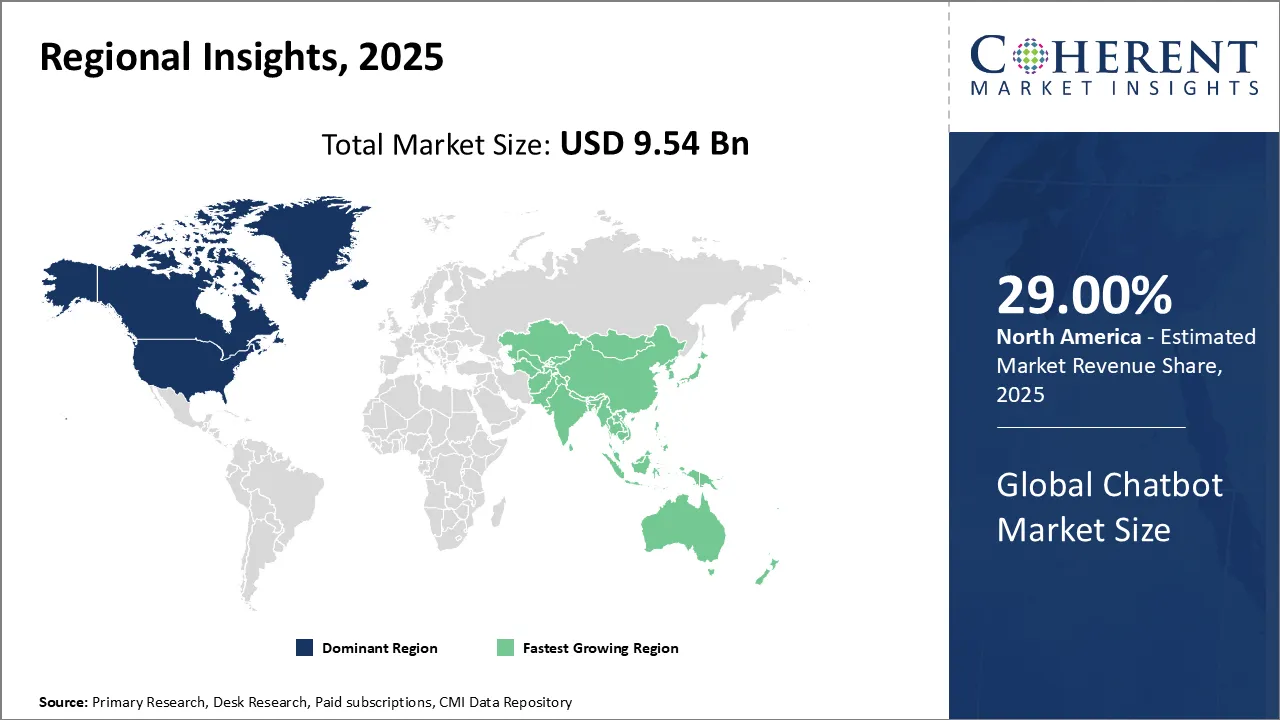
- North America is slated to account for 29% of the global chatbot market share by 2026. This is mostly due to rapid adoption of advanced technologies like AI, NLP, machine learning, and cloud computing across various sectors.
- Asia Pacific is poised to emerge as the fastest-growing chatbot market during the forecast period. This can be attributed to rapid digitalization and favourable government support.
Chatbot Market Overview
The global chatbot market is expected to register strong growth during the forecast period. This is mostly due to rapid digital transformation, escalating demand for improved customer engagement, and increasing use of AI-powered chatbots across sectors like retail, BFSI, healthcare, and e-commerce.
Chatbots are sophisticated software applications designed to enable seamless interaction between humans and machines, typically through text or voice conversations over the Internet. This implementation relies on artificial intelligence to enable natural and meaningful interactions with users.
Chatbots help businesses communicate easily with their customers using different methods like text, voice, video, images, and file sharing. They can be used on digital platforms such as websites, mobile apps, and other devices, making them simple and convenient for users.
Additionally, Over-the-top (OTT) messaging apps are pioneering new ways for businesses to engage with their audiences. This provides both businesses and consumers with great opportunities for optimized and efficient communication.
In the ever-evolving landscape of business communications, organizations are increasingly adopting platform-based approaches. For example, Lyft partnered with Anthropic to deploy the AI assistant Claude as a chatbot for handling customer & driver support requests.
By integrating their chatbot services and offers into communication apps, businesses can enable many features such as games, payment processing, advertising, and others. Thus, rising adoption will play a key role in stimulating growth of the chat market during the forecast period.
Current Events and Their Impact on the Chatbot Market
Current Event | Description and its Impact |
Generative AI Technology Breakthroughs |
|
Competitive Landscape Consolidation |
|
Segmental Insights
- Current Industry Events of 2026
- Market Size Estimation
- Regional Breakdown
- Competitive Landscape
- Customer Intelligence
- Segmental Analysis
- Pricing Analysis
- Key Market Drivers, Challenges & Future Trends
- Customized Insights Section
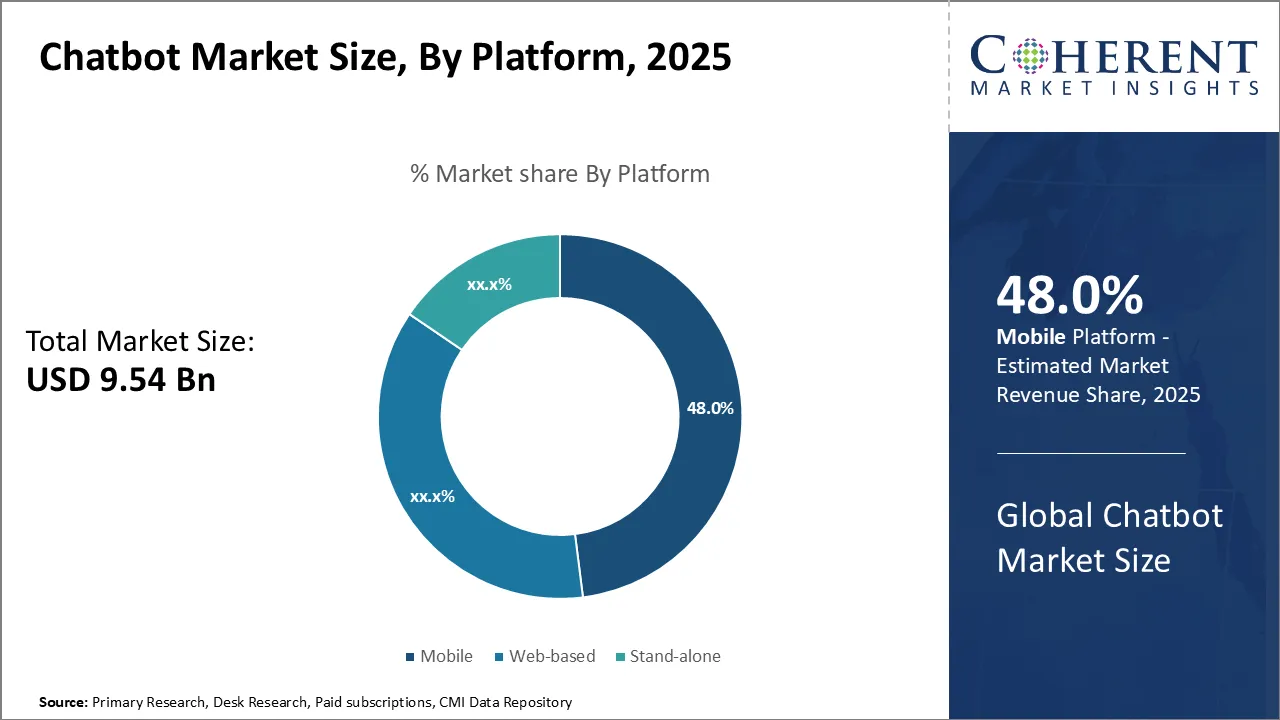
Chatbot Market Insights, By Platform: Mobile Chatbots Remain Growth Engine for the Market
As per Coherent Market Insights’ latest analysis, mobile chatbot segment is expected to dominate the market, holding a share of 49% in 2026. This can be attributed to rising adoption of online chatbots by businesses.
There is a boom in online businesses that are looking for cost-effective ways to improve customer engagement and automate customer service. This is putting online chatbots into the spotlight.
Chatbots built for mobile apps improve user engagement as well as provide personalized recommendations. The popularization of smartphones and increasing demand for real-time support on the go are expected to further boost the mobile chatbots segment in the coming years.
Regional Insights
North America Remains Market Leader in Chatbot Adoption
North America, with an estimated share of 29% in 2026, is expected to dominate the global chatbot market during the forecast period. The market growth in this region is primarily driven by the significant increase in the use of chatbots across multiple business verticals.
There is a rising adoption of AI chatbots across the U.S. industries. For instance, the U.S. General Services Administration (GSA) made a deal with Elon Musk’s company xAI under its OneGov program in September 2026. The agreement allows federal agencies to use xAI’s Grok chatbot models (Grok 4 and Grok 4 Fast).
Technological innovations, such as Internet of Things, Application Programming Interface, and artificial intelligence, are also evolving rapidly. Sophisticated chatbots are integrated with these technologies, enabling operational improvements and increasing market demand.
Asia Pacific Becoming a Hotbed for Chatbot Market Companies
Asia Pacific chatbot market is expected to experience remarkable growth during the forecast period. This is mostly due to rapid digital transformation, increasing government support, and high smartphone adoption.
Advances in artificial intelligence (AI) are also helping businesses adopt chatbots for customer support, sales, and other services. For instance, in October 2026, Alibaba Group launched a new AI chatbot assistant integrated into its Quark app.
Chatbot demand in the region is also increasing due to improvements in digital and communication infrastructure. More reliable internet, better ICT systems, and expanding technology access are making it easier for companies to implement chatbots and reach more users across different industries.
For example, the state‑run SSG Hospital in Vadodara, Gujarat, recently launched an AI‑powered oncology chatbot. The new chatbot is designed to assist cancer patients and their families with treatment guidance, post-care, and follow-up support.
Chatbot Market Outlook – Country-wise
AI Adoption Boosting Chatbot Market Growth in the U.S.
The U.S. chatbot industry is expected to grow rapidly during the projection period. This is mostly due to high adoption of artificial intelligence and advanced technologies across industries like retail, banking, and healthcare.
Businesses in the nation are increasingly using chatbots for customer support, lead generation, and personalized marketing. This is driving strong demand for chatbots. Moreover, widespread smartphone and internet penetration make it easier for companies to implement as well as scale chatbot solutions.
E-Commerce Driving Chatbot Sales in China
China is poised to emerge as a highly lucrative market for chatbots during the forthcoming period. This is mostly due to robust growth of e-commerce, social media platforms, and digital payment systems.
Companies in China are using chatbots for online shopping assistance, customer service, and interactive marketing campaigns. Government initiatives promoting AI adoption and increasing tech-savvy consumers are also slated to boost market growth in China during the forecast period.
Market Concentration and Competitive Landscape
Leading chatbot developers are introducing novel solutions to meet the evolving needs of the end-use industries. For instance, French startup Mistral launched its Le Chat chatbot for corporate use.
Many companies are forming partnerships and alliance to boost their sales as well as stay ahead of the competition. Similarly, strategies like mergers, collaborations, and acquisitions are becoming popular in the market.
Chatbot Industry News
- In October 2025, Microsoft launched the Copilot Fall Release. This new assistant is designed to make AI more personal, useful, and human centered.
- In October 2025, OpenAI launched ChatGPT Atlas, a new chatbot-powered browser. It lets users browse the web and get answers from the chatbot at the same time.
- In April 2025, Meta Platforms (Meta) launched a stand‑alone version of its Meta AI app. The app is powered by Llama 4, Meta Platform’s latest large‑language model.
- In March 2024, VOXI by Vodafone, in collaboration with Accenture, launched a new generative AI chatbot to improve customer experience. The new chatbot is designed to engage in human-like conversations with customers as well as handle more sophisticated customer request.
Market Report Scope
Chatbot Market Report Coverage
| Report Coverage | Details | ||
|---|---|---|---|
| Base Year: | 2025 | Market Size in 2026: | USD 12.01 Bn |
| Historical Data for: | 2020 To 2024 | Forecast Period: | 2026 To 2033 |
| Forecast Period 2026 to 2033 CAGR: | 25.9% | 2033 Value Projection: | USD 60.22 Bn |
| Geographies covered: |
| ||
| Segments covered: |
| ||
| Companies covered: | Facebook, Inc., Kiwi, Inc., Astute Solutions, Google, Inc., Pandorabots, Inc., Haptik, Inc., Yahoo Inc., Helpshift, ToyTalk (PullString Inc.), Imperson Ltd., Slack Technologies, Inc., Kasisto Inc., and Microsoft Corporation | ||
| Growth Drivers: |
| ||
| Restraints & Challenges: |
| ||
Chatbot Market Drivers
Growing Need for Effective and Immediate Customer Support
Chatbots have emerged as ideal solutions to meet the growing demand for immediate and effective customer support regardless of geographic restrictions. By offering 24/7 support, businesses can ensure uninterrupted service and give consumers access to world-class support to get their queries answered quickly.
The tendency of chatbots to simulate human-like conversations has become a key factor in increasing their value and improving the live chat customer service experience. Due to these benefits, companies in various industries are adopting chatbot technology to meet customer expectations and streamline customer support processes.
For instance, in July 2023, the CEO of Dukaan, an e-commerce company, has been reported to have laid off 90% of customer support staff and replaced them with artificial intelligence chatbot. The response time has gone down from 2 hours 13 minutes to 3 min 12 seconds and customer support costs have gone down by ~85%.
Increased Use of Generative Models in Chatbots
Rising use of generative models in chatbots has become a major growth driver for the global chatbot market. By leveraging advanced language models, such as GPT-3, the chatbot's Natural Language Processing (NLP) capabilities have been enhanced to enable more sophisticated and contextual conversations with users. This improves the user experience by allowing chatbots to provide personalized, human-like responses.
Additionally, the flexibility and adaptability of generative models allow chatbots to be tailored to specific industries and use cases. This is making them a very popular solution across multiple industries.
As businesses increasingly realize the value of efficient and interactive customer interactions, the demand for chatbots based on generative models is expected to continue growing. This will likely boost growth of the chatbot market during the forthcoming period.
For instance, Swiggy recently started using generative AI to improve its services. In July 2023, the company announced a pilot of its “neural search” feature, which uses a Large Language Model to answer users’ open-ended queries and provide personalized food and grocery recommendations.
The system is trained on Swiggy’s food catalog of over 50 million items. Swiggy is also working with a third party to develop a GPT-4-powered chatbot for customer support. These developments are expected to support expansion of the chatbot industry in the coming years.
Chatbot Market Opportunity
Development of Self-Learning Chatbots for Human-Like Conversations
The global chatbot industry presents great opportunities through efforts aimed at developing self-learning chatbots that can provide a human-like conversational experience. As companies strive to improve customer retention and satisfaction, it is becoming increasingly important to focus on developing self-learning chatbots.
Using artificial intelligence and machine learning technology, these chatbots can continuously analyze and adapt user interactions to better understand customer intent and context. This evolution to self-learning chatbots can provide more personalized and contextual responses, similar to human conversations, ultimately leading to increased customer satisfaction and loyalty.
Additionally, self-learning chatbots reduce the need for manual intervention and constant program updates, improving operational efficiency. By capitalizing on this market opportunity, businesses can remain competitive, provide superior customer experience, and drive the growth of the global chatbot market.
Chatbot Market Challenges
Inability to Recognize and Effectively Respond to Customer Intent
The global chatbot market outlook appears bright, owing to rising adoption of chatbots across various industries. However, the inability to recognize and effectively respond to customer intent might slow down market growth to some extent during the forecast period.
Although chatbots have made great strides in natural language processing, they still face challenges in accurately deciphering complex user intent and providing appropriate responses. This limitation often leads to a frustrating customer experience and can hinder the smooth flow of conversations between users and chatbots.
Customers expect personalized and contextual interactions. Thus, the inability of chatbots to capture customer intent and effectively respond to their queries can lead to reduced customer satisfaction and loss of trust.
Overcoming this limitation will require further advances in machine learning and AI technology to improve the understanding capabilities of chatbots. Moreover, combining chatbot functionality with human assistance when needed is proving to be beneficial in providing a more satisfying customer experience and driving the growth of the global chatbot market.
According to a study by Aivo, over 30% of customers are willing to abandon a brand if their customer service experience is unsatisfactory. It also mentions that bad experiences are usually caused by a lack of empathy on the part of the customer-facing side, auto auto-responder with no solution.
Analyst Opinion (Expert Opinion)
- AI-driven chatbots are evolving beyond simple Q&A. Modern chatbots use advanced natural language processing to understand context, sentiment, and complex queries. For example, OpenAI’s ChatGPT handles nuanced customer interactions, enabling businesses to resolve queries without human intervention.
- Customer support automation is now table-stakes, not optional. Companies deploying chatbots report up to 30% reduction in support costs and faster response times. Telecom companies, for instance, have chatbots handling over 55% of routine inquiries, freeing human agents for more complex tasks.
- Sector-specific adoption varies widely. Banking uses chatbots for customer onboarding (~41% of institutions), while education platforms have seen 62% increase in chatbot engagement in 2025. Healthcare adoption lags due to regulatory and accuracy concerns, highlighting that one solution doesn’t fit all industries.
- Data privacy and trust are critical constraints. Studies show that nearly 69% of chatbot cookies track user behavior, raising privacy concerns. Enterprises now focus on governance frameworks to ensure secure and ethical chatbot deployment.
Speak to the analyst
Want personalized insights?
Take the findings above to one of our principal consultants, or have the report rebuilt around the segments, geographies and competitors you actually track.
Market Segmentation
- By Platform Insights (Revenue, USD Bn, 2021 - 2033)
- Web-based
- Mobile
- Stand-alone
- By Enterprise Size Insights (Revenue, USD Bn, 2021 - 2033)
- Large Enterprises
- Small and Medium Enterprises
- By Region (Revenue, USD Bn, 2021 - 2033)
- North America
- U.S.
- Canada
- Latin America
- Brazil
- Mexico
- Argentina
- Rest of Latin America
- Europe
- Germany
- U.K.
- France
- Italy
- Spain
- Russia
- Rest of Europe
- Asia Pacific
- China
- India
- Japan
- Australia
- South Korea
- ASEAN
- Rest of Asia Pacific
- Middle East
- GCC
- Israel
- Rest of Middle East
- Africa
- South Africa
- Central Africa
- North Africa
- North America
- Key Players Insights (Revenue, USD Bn, 2021 - 2033)
- Facebook, Inc.
- Kiwi, Inc.
- Astute Solutions
- Google, Inc.
- Pandorabots, Inc.
- Haptik, Inc.
- Yahoo Inc.
- Helpshift
- ToyTalk (PullString Inc.)
- Imperson Ltd.
- Slack Technologies, Inc.
- Kasisto Inc.
- Microsoft Corporation.
Sources
Primary Research interviews
- CIOs, CTOs, and IT managers of enterprises implementing chatbots
- AI and machine learning specialists in customer service automation
- Product managers of leading chatbot platforms
- Industry experts in NLP and conversational AI
Databases
- Statista
- Crunchbase
- CB Insights (for company funding & innovation data)
- GitHub repositories (for open-source chatbot projects and trends)
- World Bank & IMF datasets (for regional technology adoption statistics)
Magazines
- Wired
- MIT Technology Review
- Fast Company
- TechCrunch
Journals
- Journal of Artificial Intelligence Research
- International Journal of Human-Computer Studies
- IEEE Access (AI & Robotics sections)
- ACM Transactions on Interactive Intelligent Systems
Newspapers
- The New York Times – Technology Section
- The Guardian – Technology & AI Section
- The Washington Post – Tech & Innovation
- Financial Times – Technology Coverage
Associations
- Association for Computing Machinery (ACM)
- IEEE Computer Society
- AI & Robotics Association (AIARA)
- International Association for Pattern Recognition (IAPR)
Public Domain sources
- U.S. Patent and Trademark Office (for chatbot patents)
- European Patent Office
- GitHub open-source repositories
- Government AI policy documents (e.g., U.S. National AI Initiative)
Proprietary Elements
- CMI Data Analytics Tool
- Proprietary CMI Existing Repository of information for last 8 years
Get access to 250+ pages report
Every segment, forecast, competitor profile and data table behind the analysis above — available for instant download.
- ESOMAR Member
- ISO 9001:2015 Certified
- D-U-N-S Registered
- GDPR & CCPA Compliant
Missing comfort of reading report in your local language? Find your preferred language:
Transform your Strategy with Exclusive Trending Reports
Frequently Asked Questions
The global market is estimated to be valued at USD 12.01 Bn in 2026.
The global chatbot market value is expected to total USD 60.22 Bn by 2033.
The global chatbot industry is projected to exhibit a CAGR of 25.9% from 2026 to 2033.
Major players operating in the chatbot market include Facebook, Inc., Kiwi, Inc., Astute Solutions, Google, Inc., Pandorabots, Inc., Haptik, Inc., Yahoo Inc., Helpshift, ToyTalk (PullString Inc.), Imperson Ltd. Slack Technologies, Inc., Kasisto Inc., and Microsoft Corporation.
Mobile segment dominates the market with a share of 48% in 2026.
Major growth factors include growing need for effective and immediate customer support and increased use of generative models in chatbots.
North America acquires the largest market share.