

Industrial Internet of Things Market Size and Share Analysis- 2026 To 2033
The Industrial Internet of Things Market size is anticipated to grow at a CAGR of 24.2%, with USD 191.44 Bn in 2026, and is expected to reach approximately USD 872.25 Bn in 2033. The primary drivers are largely defined by the increasing adoption of connected industrial equipment, rising deployment of smart manufacturing technologies, growing demand for predictive maintenance and real-time asset monitoring, and wider integration of artificial intelligence, cloud computing, edge computing, and advanced analytics across industrial operations. In May 2026, Rockwell Automation reported that 95% of Asia-Pacific manufacturers view digital transformation as essential to their competitiveness and 71% plan to grow their use of machine learning and artificial intelligence over the next 12 months.
Key Takeaways
- The managed services segment is estimated to dominate the market with 58.0% in 2026. The segment’s growth is owing to the increasing complexity of IIoT infrastructure, continuous IT/OT monitoring requirements, cybersecurity management, device maintenance, and demand for specialized technical support. In May 2025, Cisco reported that 86% of organizations had experienced AI-related security incidents during the previous year, while 86% identified cybersecurity talent shortages as a challenge, supporting increasing reliance on external and managed technology services.
- The remote monitoring segment is estimated to lead the solution category with 26.0% in 2026. The segment’s growth is owing to increasing adoption of real-time equipment monitoring, predictive maintenance, asset-condition analytics, early fault detection, and remote industrial operations. In September 2025, Siemens reported that BlueScope had avoided approximately 2,000 hours of unplanned downtime and prevented 53 complete process interruptions through AI-enabled predictive maintenance using real-time machine data.
- The device management segment is estimated to dominate the platform type category with 39.0% in 2026. The segment’s growth is owing to the rapidly expanding installed base of connected industrial sensors, gateways, machinery, controllers, and other endpoints requiring provisioning, configuration, monitoring, security, and lifecycle management. According to Ericsson’s June 2026 Mobility Report update, global cellular IoT connections reached approximately 4.5 Bn at the end of 2025 and are expected to reach 7.8 Bn by 2031, strengthening the requirement for scalable device-management platforms.
- The manufacturing segment is estimated to lead the industry vertical category with 27.0% in 2026. The segment’s growth is owing to increasing deployment of connected production equipment, smart factories, industrial automation, predictive maintenance, AI-enabled quality control, and real-time production analytics. In January 2026, the World Economic Forum reported that ACG Packaging Materials’ manufacturing facility in India deployed more than 30 digital use cases using IIoT, generative AI, machine learning, and digital twins.
- North America is estimated to dominate the Industrial Internet of Things Market with 36.5% in 2026. The regional growth is owing to the high adoption of industrial automation, connected manufacturing systems, predictive maintenance, smart factory technologies, and increasing integration of AI, robotics, edge computing, and real-time industrial data platforms across the U.S. and Canada. In June 2026, the International Federation of Robotics reported that industrial robot installations in the U.S. increased by 11% year-on-year to 38,000 units in 2025.
Market Drivers
Rising Industrial Automation and Digitalization Investments are Accelerating the Industrial Internet of Things Market
The Industrial Internet of Things Market is witnessing a robust momentum as the manufacturers, utilities, energy companies, and the process industries are ramping up their investments in connected automation, digital control systems, smart sensors, and software-driven industrial infrastructure. IIoT empowers enterprises to link operational technology with real-time data platforms to improve production visibility, equipment utilization, and process efficiency.
In March 2025, Schneider Electric announced plans to invest over USD 700 million in its U.S. operations over the next three years, including a focus on increasing demand for digitalization, industrial automation, manufacturing, and energy infrastructure. The company said it already has more than 20 smart factories and distribution centers in its U.S. operations.
Predictive Maintenance and Real-Time Asset Intelligence are Driving IIoT Deployment
Another major driver for the Industrial Internet of Things Market is the increasing need to reduce equipment downtime and enhance asset utilization. Sensors are always connected and constantly measure equipment parameters like temperature, vibration, pressure, acoustics and operating conditions. By combining these data streams with AI and analytics, IIoT platforms can detect abnormalities and enable condition-based and predictive maintenance.
According to Honeywell’s 2025 AI in the Energy Industry survey of 300 U.S. energy and energy-adjacent industry decision-makers and influencers, 85% of U.S. energy leaders said their companies were actively using or piloting AI. 52% of the respondents said that the biggest impact area of AI was predictive maintenance and 44% said it was operational efficiency.
Current Events and Their Impact on the Industrial Internet of Things Market
Current Event | Description and its Impact |
EU Data Act Strengthens Industrial IoT Data Access and Sharing Requirements (2025–2026) |
|
EU Cyber Resilience Act Moves Toward Mandatory Vulnerability Reporting for Connected Industrial Products (2026) |
|
- Current Industry Events of 2026
- Market Size Estimation
- Regional Breakdown
- Competitive Landscape
- Customer Intelligence
- Segmental Analysis
- Pricing Analysis
- Key Market Drivers, Challenges & Future Trends
- Customized Insights Section
Segmental Insights
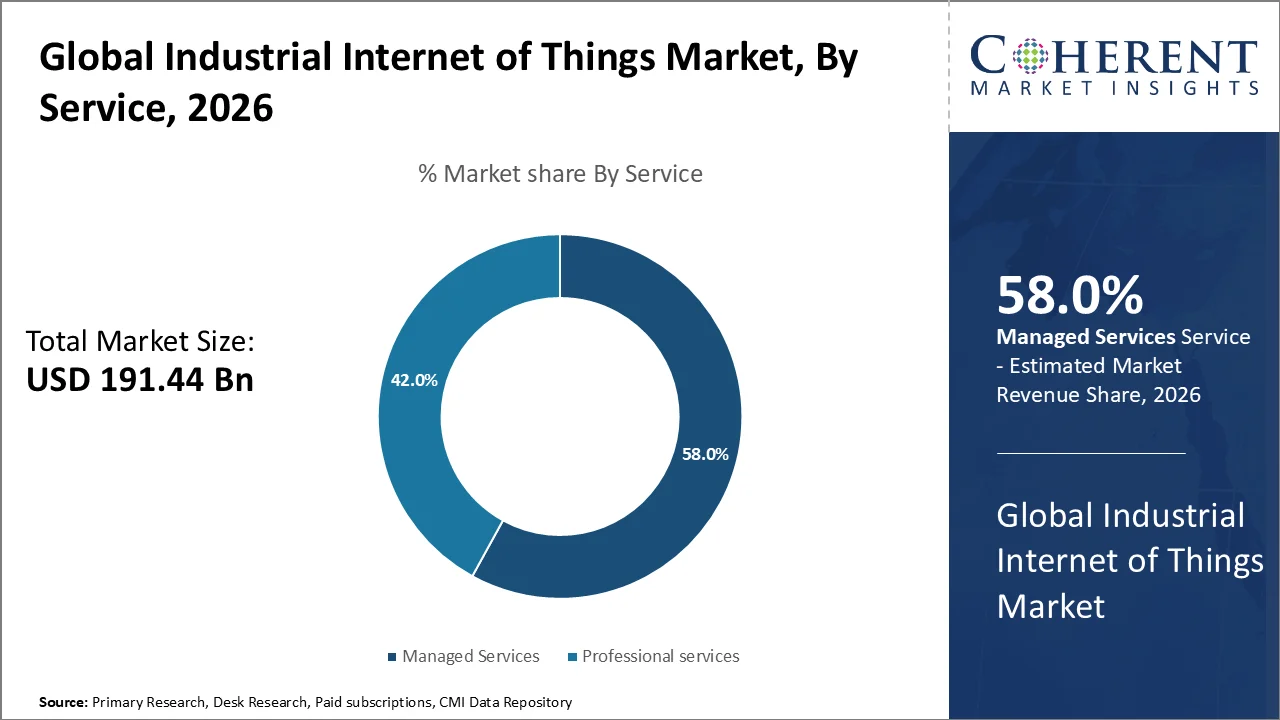
Why are Managed Services Acquiring the Largest Share?
On the basis of service, the managed services segment is estimated to account for the largest Industrial Internet of Things Market share of 58.0% in 2026. The segment’s growth is owing to the increasing complexity of connected industrial environments, shortage of specialized OT cybersecurity expertise, continuous device and network monitoring requirements, and growing need for remotely managed infrastructure across manufacturing and critical industries.
Cisco’s 2026 State of Industrial AI Report, based on more than 1,000 industrial professionals across 19 countries and 21 industrial sectors, found that 40% of organizations consider cybersecurity the biggest obstacle to scaling industrial AI, while 51% require more reliable connectivity, 44% greater edge-compute capacity, and 42% greater bandwidth capacity. These infrastructure and security challenges are strengthening demand for externally managed IIoT and OT services.
In June 2026, Rockwell Automation expanded its SecureOT portfolio with SecureOT Platform Managed Services and Managed Secure Remote Access, providing continuous asset discovery, inventory management, risk prioritization, platform updates, and remotely managed OT access.
Why is Remote Monitoring Leading the Solution Category?
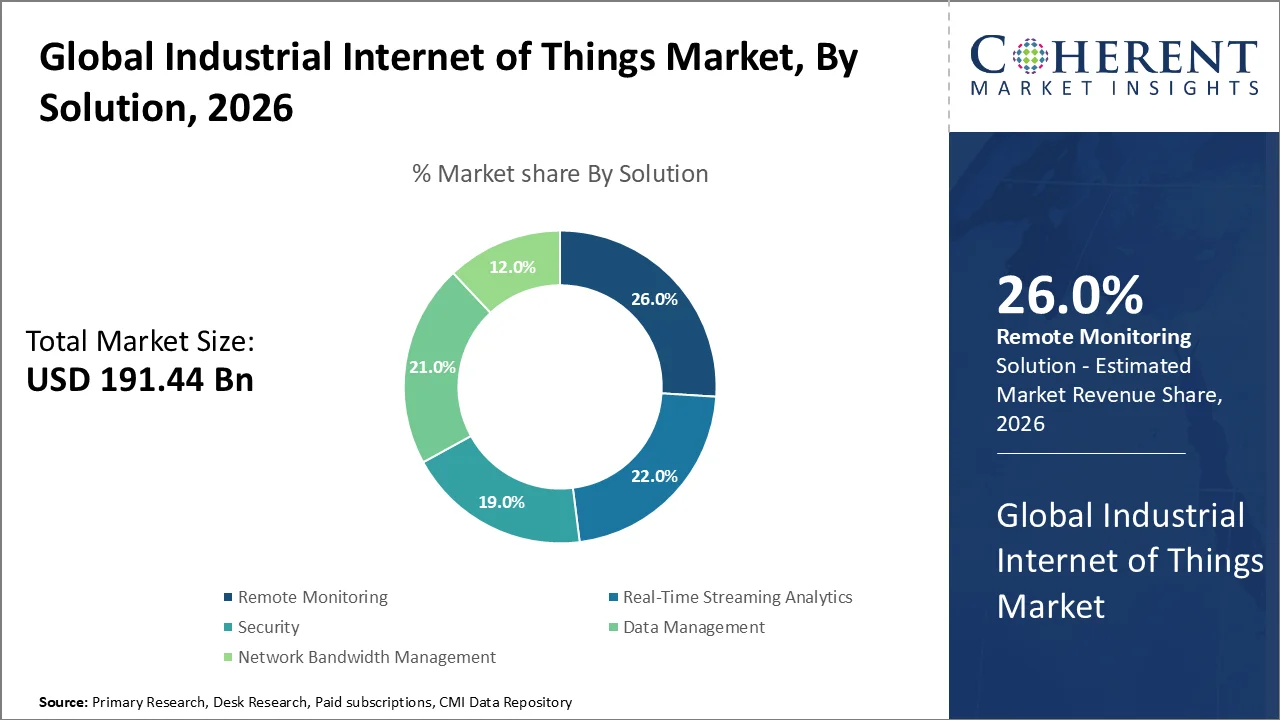
On the basis of solution, the remote monitoring segment is estimated to lead with 26.0% share in 2026. The segment’s growth is owing to the increasing requirement for real-time visibility into machinery health, production performance, energy consumption, equipment faults, and operating conditions across geographically distributed industrial facilities.
In July 2025, AWS reported that a global automotive manufacturer deployed connected industrial data and analytics technologies across 15 manufacturing plants, using AWS IoT SiteWise and machine-learning capabilities to analyze historical and real-time equipment data. The implementation reduced equipment downtime by 40% and generated approximately USD 2.8 million in annual savings. This demonstrates the measurable operational benefits that are accelerating adoption of remote equipment monitoring and predictive-maintenance solutions.
Why is Device Management Acquiring the Largest Platform Share?
On the basis of platform type, the device management segment is estimated to account for the largest share of 39.0% in 2026. The segment’s growth is owing to the rapidly expanding number of industrial sensors, gateways, smart meters, controllers, connected machinery, and embedded devices that require provisioning, authentication, configuration, firmware updates, diagnostics, security, and lifecycle management.
In February 2025, Cisco reported that its IoT Control Center had connected more than 270 million devices across 50+ service providers, 120 countries, and over 30,000 enterprises. The platform supports automated provisioning, lifecycle-aware configuration, real-time diagnostics, network visibility, and device security, highlighting the scale of device-management requirements associated with large IoT deployments.
Why is Manufacturing Holding the Largest Market Share?
On the basis of industry vertical, the manufacturing segment is estimated to lead the Industrial Internet of Things Market with 27.0% share in 2026. The segment’s growth is owing to extensive deployment of smart sensors, connected machinery, machine vision, digital production systems, predictive maintenance, automated material handling, and real-time factory analytics.
In June 2026, the World Economic Forum reported that Hitachi Vantara’s manufacturing facility in Norman, U.S., integrated inventory visibility and operational decision-making into a global digital platform and implemented AI-enabled configuration automation. The transformation reduced inventory by 50% and shortened order-to-ship lead times by 77%.
Industrial Internet of Things Market Trends
- The convergence of AI, IoT, cloud computing and digital twins is transforming IIoT platforms from simple connectivity solutions to intelligent industrial decision systems. According to the World Economic Forum, published in October 2025, 94% of industrial transformations leverage at least two technology domains. For instance, 55% of industrial AI deployments leverage IoT, 50% leverage cloud technologies, and 44% leverage digital twins.
- Increasing use of AI-enabled digital twins linked to real-time IIoT data is improving virtual factory design, simulation, production optimization and asset monitoring. In January 2026, Siemens reported that PepsiCo’s use of Digital Twin Composer helped identify up to 90% of possible problems prior to physical modifications, increased throughput by 20%, and supported 10-15% reductions in capital expenditure.
- The growing integration of agentic AI and physical AI with IIoT infrastructure is moving industrial operations toward increasingly autonomous production environments. In June 2026, AWS demonstrated an autonomous manufacturing environment connecting robots, AMRs, machine-vision systems, industrial sensors, edge devices, and AI agents.
Regional Insights
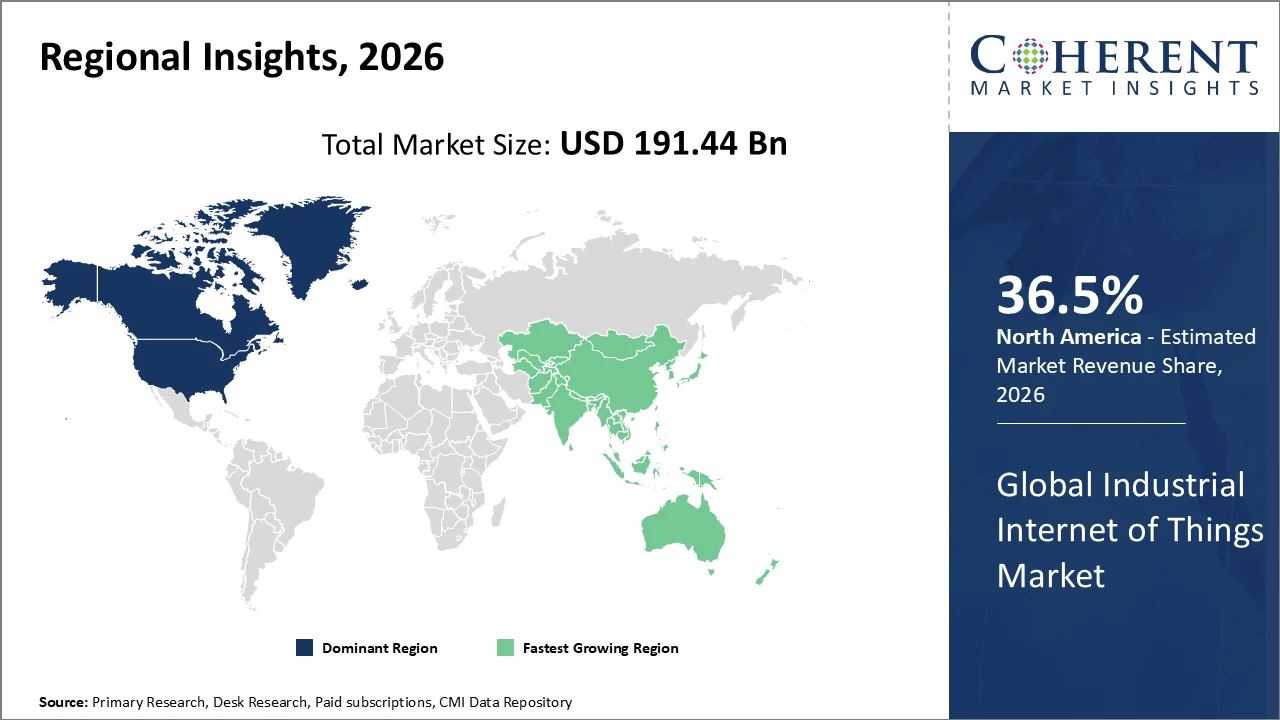
North America Dominates Owing to Advanced Digital Manufacturing and Connected Industrial Infrastructure
North America is estimated to account for the largest Industrial Internet of Things Market share of 36.5% in 2026. The region’s dominance is owing to the early adoption of connected manufacturing equipment, industrial sensors, private 5G, predictive maintenance, digital twins, advanced robotics, and OT cybersecurity across manufacturing, aerospace, defense, energy, and other critical industries.
In August 2026, MxD announced that it had received USD 67 million from the U.S. Department of War for nine advanced manufacturing modernization projects. These projects include real-time machine monitoring, AI-enabled digital twins, private 5G networks, connected manufacturing systems, AI-enabled robotics, and real-time quality inspection.
Asia Pacific Industrial Internet of Things Market Trends
Asia Pacific is estimated to account for approximately 28.0% of the Industrial Internet of Things Market in 2026 and is expected to be the fastest-growing region over 2026–2033. The regional growth is owing to rapid manufacturing digitalization, expanding 5G infrastructure, industrial automation investments, smart-factory programs, and increasing deployment of AI-connected industrial systems, particularly across China, India, Japan, South Korea, and Southeast Asia.
In July 2026, official Chinese government information citing MIIT statistics reported that China’s core industrial Internet sector had exceeded RMB 1.6 trillion, while more than 25,000 “5G + Industrial Internet” projects had already been launched nationwide.
China’s government reported that the country had reached 4.958 million 5G base stations, with 5G-Advanced coverage across 330 cities and 2.948 billion IoT terminal users by the end of March 2026. The same update reported that output of industrial robots increased 33.2% year-on-year in Q1 2026, demonstrating the rapid expansion of the digital and automation infrastructure supporting IIoT adoption across Asia Pacific.
Strong Smart Manufacturing Adoption and Industrial Interoperability are Accelerating the Industrial Internet of Things Market in the United States
The U.S. Industrial Internet of Things Market is experiencing strong growth, driven by the fast uptake of connected factory systems, industrial AI, predictive analytics, digital twins, and real-time production monitoring. The country also has an existing smart-manufacturing ecosystem and growing efforts to improve interoperability of industrial equipment, software and data platforms.
In May 2026, NIST reported that 46% of U.S. manufacturers are already using AI tools in manufacturing operations, while more than 80% expect to increase AI use over the next two years. NIST also reported that 54% of manufacturers are using AI for preventive or predictive maintenance, while 32% are using it for plant-floor IoT analysis. These applications directly strengthen demand for connected sensors, machine data acquisition, edge computing, and IIoT analytics platforms.
China Industrial Internet of Things Market Trends
China is expected to witness strong growth in the Industrial Internet of Things Market over the forecast period. The growth is owing to large-scale industrial digitalization, rapid smart-factory development, integration of AI with industrial networks, and government-led expansion of next-generation manufacturing infrastructure.
In January 2026, China’s Ministry of Industry and Information Technology introduced a plan to deepen integration between industrial internet and artificial intelligence. By 2028, the government aims to upgrade new-type industrial networks at no fewer than 50,000 enterprises and develop high-quality industrial datasets across 20 key industries. This is creating a strong policy base for expansion of industrial connectivity, machine-data platforms, edge intelligence, and AI-enabled IIoT solutions.
Who are the Major Companies in Industrial Internet of Things Industry
Some of the major key players in Industrial Internet of Things Market are ABB, ARM Ltd., Cisco Systems, Inc., Dassault Systèmes, General Electric, Honeywell International Inc., Huawei Technology Co., Ltd., Intel Corporation, Rockwell Automation, Inc., and Texas Instruments Inc.
Key News
- In June 2026, ABB launched Grinding Connect, a cloud-based digital service suite for gearless mill drive systems in mining. The solution combines remote diagnostics, analytics, and AI-enabled technical support to improve equipment monitoring, maintenance planning, and reliability, strengthening ABB’s industrial remote-monitoring and connected-services portfolio.
- In February 2025, Arm introduced the Armv9 Edge AI Platform, combining the Cortex-A320 CPU and Ethos-U85 NPU for IoT and edge-AI applications. The platform supports AI models containing more than one billion parameters on-device and targets industrial automation, smart cameras, autonomous factory equipment, and other intelligent IoT endpoints.
Market Report Scope
Industrial Internet of Things Market Report Coverage
| Report Coverage | Details | ||
|---|---|---|---|
| Base Year: | 2025 | Market Size in 2026: | USD 191.44 Bn |
| Historical Data for: | 2020 To 2024 | Forecast Period: | 2026 To 2033 |
| Forecast Period 2026 to 2033 CAGR: | 24.2% | 2033 Value Projection: | USD 872.25 Bn |
| Geographies covered: |
| ||
| Segments covered: |
| ||
| Companies covered: | ABB, ARM Ltd., Cisco Systems, Inc., Dassault Systèmes, General Electric, Honeywell International Inc., Huawei Technology Co., Ltd., Intel Corporation, Rockwell Automation, Inc., and Texas Instruments Inc. | ||
| Growth Drivers: |
| ||
| Restraints & Challenges: |
| ||
Analyst Opinion
- The Industrial Internet of Things Market is moving from isolated proof-of-concept projects toward enterprise-wide industrial data architectures. According to HiveMQ’s 2025 Industrial IoT survey, 70% of organizations were actively developing or deploying IIoT strategies, while 61% identified predictive maintenance as a leading AI use case. This indicates that IIoT is increasingly becoming a core operational layer for asset intelligence, maintenance optimization, and industrial AI rather than a standalone connectivity solution.
- Private 5G and advanced industrial wireless connectivity are expected to become increasingly important for scaling IIoT deployments. In April 2026, the Alliance for Private Networks and 5G-ACIA announced plans to consolidate their Industrial 5G initiatives to accelerate IIoT and private-network adoption. 5G-ACIA currently represents more than 80 member organizations and contributes directly to 3GPP standardization, indicating increasing ecosystem maturity around secure and scalable industrial connectivity.
- IIoT is increasingly becoming the data foundation for industrial AI, digital twins, and autonomous manufacturing systems. Siemens Energy’s Industrial IoT deployment on AWS has been expanded across 18 global factories and 30 custom use cases, resulting in 50% less time spent on data collection, 25% lower asset-maintenance costs, and a 15% increase in machine availability. These measurable operational gains indicate that future IIoT spending will increasingly be justified by productivity, uptime, and asset-performance improvements rather than connectivity alone.
Speak to the analyst
Want personalized insights?
Take the findings above to one of our principal consultants, or have the report rebuilt around the segments, geographies and competitors you actually track.
Market Segmentation
- By Service (Revenue, USD Bn, 2021-2033)
- Professional services
- Managed Services
- By Solution (Revenue, USD Bn, 2021-2033)
- Real-Time Streaming Analytics
- Security
- Data Management
- Remote Monitoring
- Network Bandwidth Management
- By Platform Type (Revenue, USD Bn, 2021-2033)
- Device Management
- Application Management
- Network Management
- By Verticals (Revenue, USD Bn, 2021-2033)
- Agriculture
- Manufacturing
- Automotive & machinery
- Food and Beverage
- Chemicals and Materials
- Electronics and Utilities
- Healthcare and Pharmaceuticals
- Metals and Mining
- Oil and Gas
- Retail
- Transportation
- Others
- By Region (Revenue, USD Bn, 2021-2033)
- North America
- U.S.
- Canada
- Latin America
- Brazil
- Mexico
- Argentina
- Rest of Latin America
- Europe
- Germany
- U.K.
- France
- Italy
- Spain
- Russia
- Rest of Europe
- Asia Pacific
- China
- India
- Japan
- Australia
- South Korea
- ASEAN
- Rest of Asia Pacific
- Middle East
- GCC
- Israel
- Rest of Middle East
- Africa
- South Africa
- Central Africa
- North Africa
- North America
Sources
Primary Research Interviews
- Industrial IoT solution providers and platform developers
- Industrial automation and control system manufacturers
- OT/IT integration specialists and industrial network engineers
- Plant managers and manufacturing operations heads
- Predictive maintenance and asset-performance management experts
- Industrial cybersecurity and OT security professionals
- Procurement managers from manufacturing, oil & gas, utilities, transportation, and mining companies
- Key opinion leaders (KOLs) in smart manufacturing, industrial AI, and IIoT
Databases
- World Bank
- Organisation for Economic Co-operation and Development (OECD)
- U.S. Census Bureau
- Eurostat
- National Institute of Standards and Technology (NIST)
- U.S. Department of Energy (DOE)
- International Telecommunication Union (ITU)
- UN Industrial Development Organization (UNIDO)
Magazines
- Control Engineering
- Automation World
- IndustryWeek
- Manufacturing Today
- Plant Engineering
- IoT For All
Journals
- IEEE Internet of Things Journal
- IEEE Transactions on Industrial Informatics
- Journal of Industrial Information Integration
- Computers in Industry
- Journal of Manufacturing Systems
- International Journal of Advanced Manufacturing Technology
Newspapers
- The Wall Street Journal
- Financial Times
- Reuters
- The Economic Times
- Nikkei Asia
- South China Morning Post
Associations
- Industrial Internet Consortium / Industry IoT Consortium
- OPC Foundation
- International Society of Automation (ISA)
- ODVA
- 5G Alliance for Connected Industries and Automation (5G-ACIA)
- GSM
- Manufacturing Enterprise Solutions Association (MESA International)
- International Federation of Robotics (IFR)
Public Domain Sources
- Company Annual Reports and Investor Presentations
- Government Smart Manufacturing and Industrial Digitalization Programs
- Industrial Automation and IIoT Product Launch Announcements
- Government Cybersecurity and OT Security Guidelines
- Patent Databases such as WIPO, USPTO, and Google Patents
- University and National Laboratory Research Publications
- Publicly Available Industrial IoT Deployment Case Studies
- Regulatory and Standards Publications Related to Industrial Connectivity, Cybersecurity, Data Governance, and Interoperability
Proprietary Elements
- CMI Data Analytics Tool
- Proprietary CMI Existing Repository of Information for the Last 10 Years
Get access to 250+ pages report
Every segment, forecast, competitor profile and data table behind the analysis above — available for instant download.
- ESOMAR Member
- ISO 9001:2015 Certified
- D-U-N-S Registered
- GDPR & CCPA Compliant
Missing comfort of reading report in your local language? Find your preferred language:
Transform your Strategy with Exclusive Trending Reports
Frequently Asked Questions
The Industrial Internet of Things Market is expected to reach approximately USD 872.25 Bn in 2033, compared to USD 191.44 Bn in 2026.
Major players operating in the global Industrial Internet of Things Market include ABB, ARM Ltd., Cisco Systems, Inc., Dassault Systemes, General Electric, Honeywell International Inc., Huawei Technology Co., Ltd., Intel Corporation, Rockwell Automation, Inc., and Texas Instruments Inc.
The high initial investment cost, cybersecurity risks, and data privacy concerns are the key factors hampering growth of the Industrial Internet of Things Market.
The increasing adoption of smart manufacturing and industrial automation, rising deployment of connected sensors and industrial equipment, growing demand for predictive maintenance, and wider integration of AI, cloud computing, edge computing, and advanced analytics are driving market growth.
The Industrial Internet of Things Market is anticipated to grow at a CAGR of 24.2% between 2026 and 2033.
Among regions, North America is expected to account for the largest market share, estimated at 36.5% in 2026, supported by the early adoption of connected manufacturing equipment, industrial sensors, private 5G, predictive maintenance, digital twins, advanced robotics, and OT cybersecurity.
Asia Pacific is expected to be the fastest-growing region during 2026–2033, supported by manufacturing digitalization, expanding 5G infrastructure, industrial automation investments, smart-factory programs, and adoption of AI-connected industrial systems.