

Digital Twin Market Size and Forecast – 2026 to 2033
The Digital Twin Market is anticipated to grow at a CAGR of 31.4% with USD 49.5 Bn share in 2026 and is expected to reach USD 331.8 Bn in 2033. The increasing adoption of Industry 4.0, expanding deployment of IoT-connected devices, growing demand for predictive maintenance, advancements in AI and cloud computing, and rising need for real-time asset monitoring drive the Digital Twin market. The global number of IoT devices is projected to increase from 19.8 Bn in 2025 to more than 40.6 Bn by 2034, with China expected to lead the market with approximately 7.51 Bn consumer IoT devices by 2034.
Key Takeaways
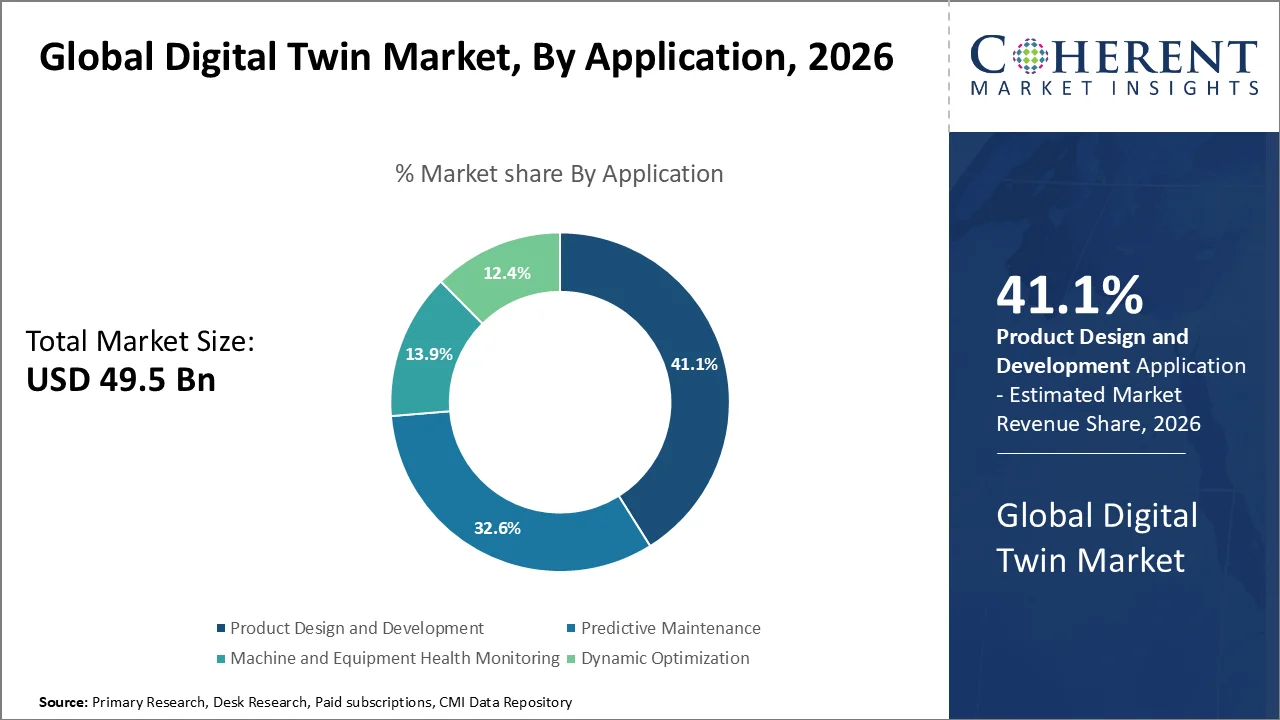
- Product Design and Development hold the largest market share of 41.1% in 2026 owing to its growing demand for faster product innovation. Digital twins shorten time to market by minimizing product iteration and testing cycles.
- Healthcare expected to hold largest market share of 38.6% in 2026 owing to the growing demand for personalized medicine. Digital twin technology enables doctors to simulate patient responses and evaluate treatments using virtual models, reducing risks to humans and animals while enabling personalized care.
- North America is expected to acquire the dominant share of 39.2% in 2026 owing to its early adoption of industry 4.0 and smart manufacturing. 78% of surveyed leaders allocate over 20% of their improvement budgets to smart manufacturing initiatives.
Current Events and Their Impact on the Digital Twin Market
Current Event | Description and its Impact |
EU Data Act Becomes Applicable (September 2025) |
|
India's DoT Advances the 'Sangam: Digital Twin' Initiative |
|
Segmental Insights
- Current Industry Events of 2026
- Market Size Estimation
- Regional Breakdown
- Competitive Landscape
- Customer Intelligence
- Segmental Analysis
- Pricing Analysis
- Key Market Drivers, Challenges & Future Trends
- Customized Insights Section
Why is Product Design and Development Acquiring the Largest Market Share?
Product Design and Development hold the largest market share of 41.1% in 2026. Organizations are driving the Product Design and Development segment of the Digital Twin market by accelerating innovation, enhancing product quality, and shortening development cycles. They use digital twins to create virtual prototypes, validate product designs, and detect performance issues before physical manufacturing, helping reduce costs and mitigate risks. Companies integrate AI, IoT, cloud computing, and advanced simulation tools to improve design accuracy and strengthen collaboration among engineering teams. They also adopt digital twins to manage increasing product complexity and support sustainable, data-driven product development across diverse industries. For instance, in March 2026, Synopsys, Inc. introduced the Synopsys Electronics Digital Twin (eDT) Platform, an open solution designed to accelerate the creation, management, deployment, and utilization of electronics digital twins (eDTs). The platform supports software-defined product development and helps enable the next generation of physical AI systems.
Which End User segment dominates the market?
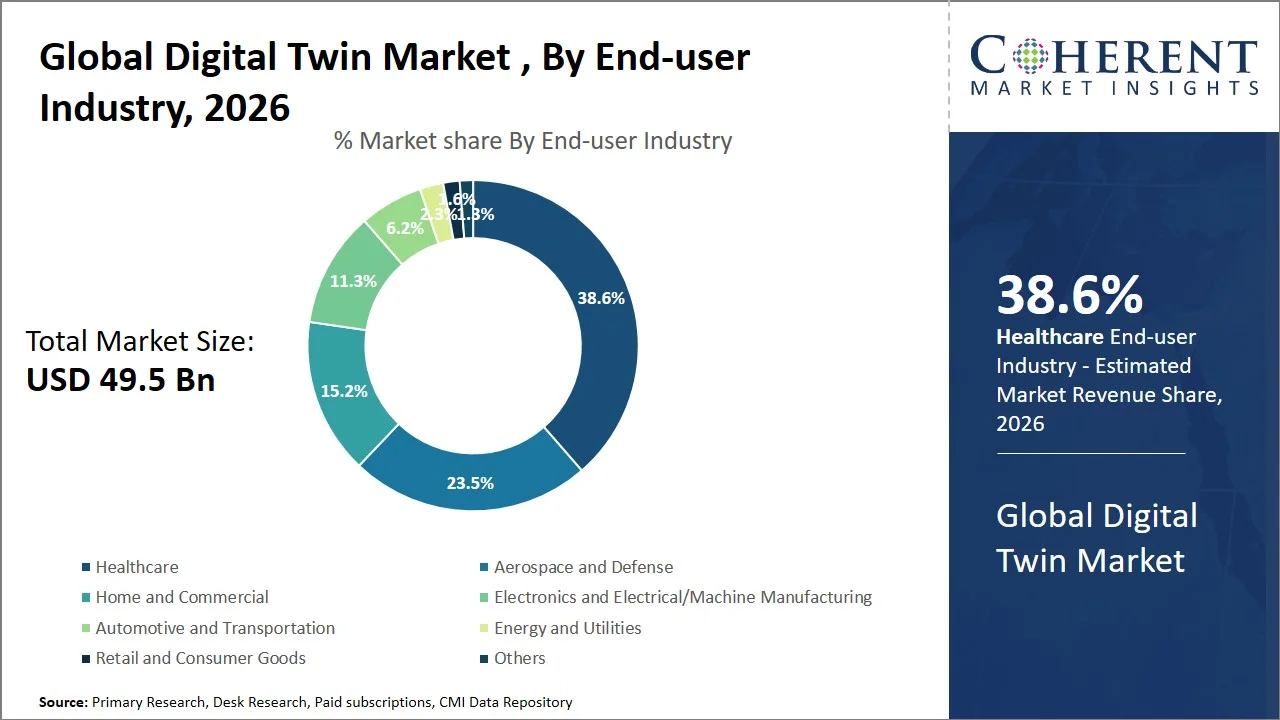
Healthcare expected to hold largest market share of 38.6% in 2026. Healthcare providers are driving the healthcare segment of the Digital Twin market by adopting advanced technologies to improve patient care, operational efficiency, and clinical outcomes. Hospitals and research organizations use digital twins to deliver personalized medicine, simulate treatment plans, and monitor patients in real time through connected devices. In December 2025, GE HealthCare and Mayo Clinic launched a digital twin project to personalize radiation therapy for cancer patients. They integrate AI, IoT, cloud computing, and electronic health records to strengthen predictive analytics and support clinical decision-making. Rising demand for chronic disease management, precision healthcare, and cost-effective medical services continues to accelerate digital twin adoption across the healthcare sector.
Digital Twin Market Trends
- Rising adoption of AI-powered digital twins enhances predictive analytics, automates decision-making, and improves operational efficiency across manufacturing, healthcare, energy, and smart infrastructure. According to the World Economic Forum, the convergence of AI with digital twins is enabling organizations to improve asset performance, optimize operations, and support autonomous decision-making in industrial environments.
- Growing integration of IoT devices and edge computing enables real-time data collection and continuous synchronization between physical assets and their digital counterparts, improving monitoring and asset performance. The International Data Corporation (IDC) estimates that the number of connected IoT devices will exceed 40 billion by 2030, providing the real-time data foundation required for digital twin applications.
- Expanding adoption of digital twins in healthcare supports personalized medicine, surgical planning, remote patient monitoring, and hospital optimization. The U.S. National Institute of Standards and Technology (NIST) has identified healthcare as a key sector where digital twins can improve patient-specific modeling, medical device performance, and clinical decision support through secure and interoperable digital twin frameworks.
Regional Insights
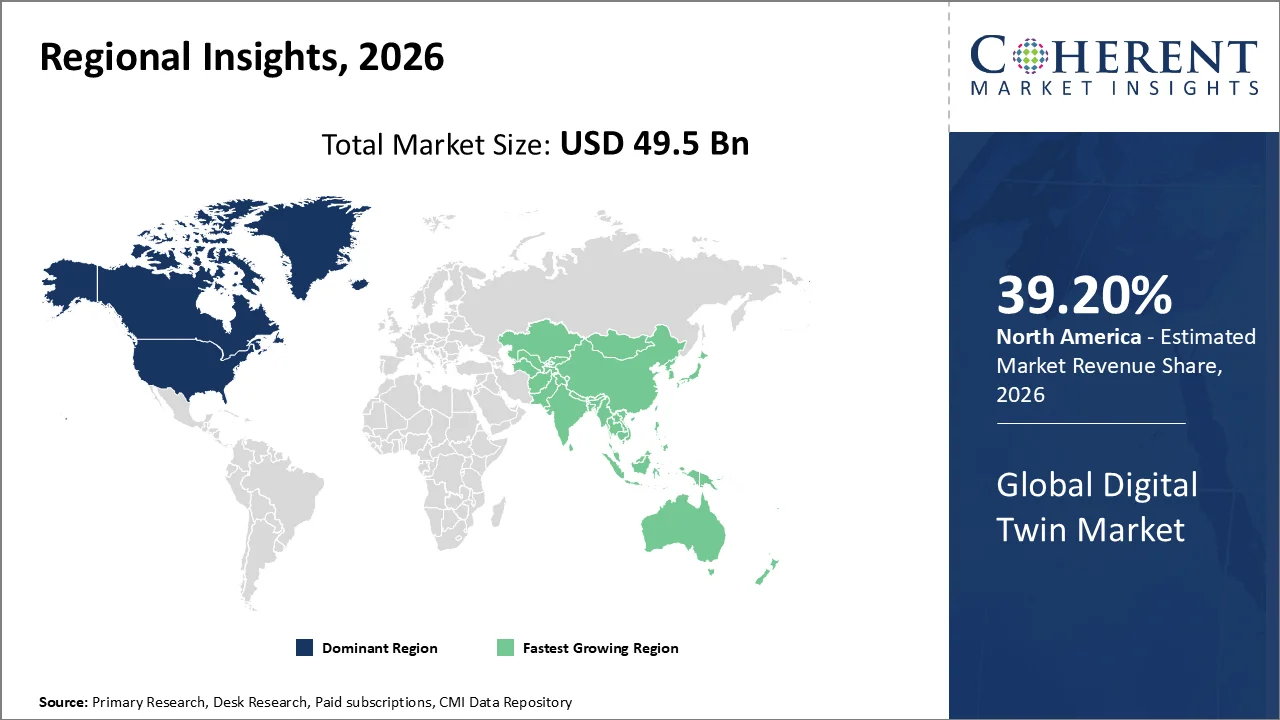
North America dominates owing to increasing demand for predictive maintenance
North America is expected to acquire the dominant share of 39.20% in 2026. Organizations in North America are accelerating the Digital Twin market by investing in digital transformation, advanced technologies, and industrial innovation. Companies across manufacturing, healthcare, aerospace, energy, and infrastructure sectors are adopting digital twins to enhance operational efficiency, enable predictive maintenance, and improve decision-making. The region’s strong adoption of AI, IoT, cloud computing, and advanced analytics supports the development of innovative digital twin solutions. Government initiatives, a robust technology ecosystem, and growing demand for smart manufacturing and sustainable practices continue to encourage market expansion. For instance, in April 2026, Kyndryl, a provider of mission-critical enterprise technology services, introduced Kyndryl Digital Twin for the Workplace, an AI-powered capability that helps organizations minimize workflow disruptions by predicting and resolving technology issues before they impact operations.
Asia Pacific Digital Twin Market Trends
Rapid industrial automation, smart manufacturing initiatives, and the adoption of advanced technologies across various sectors are driving the Asia Pacific digital twin market. Investments in smart cities, infrastructure development, and IoT integration are increasing the demand for real-time monitoring and simulation solutions. Healthcare, automotive, energy, and aerospace industries are adopting digital twin technologies to enhance operational efficiency, optimize resource utilization, and support informed decision-making. Government initiatives promoting digital transformation, along with advancements in cloud computing and artificial intelligence, are further strengthening market expansion. For instance, in March 2026, L&T Technology Services Limited, a global provider of AI, digital, and R&D consulting services, has launched its next-generation AI-powered digital twin platform to support lung navigation, surgical planning, and respiratory diagnostics.
United States Digital Twin Market Trends
The United States digital twin market grows as industries such as manufacturing, healthcare, aerospace, automotive, and smart infrastructure increasingly adopt advanced technologies. Organizations use digital twin solutions to enable real-time monitoring, perform predictive maintenance, optimize operations, and improve decision-making processes. Companies invest in artificial intelligence, the Internet of Things, cloud computing, and data analytics to enhance digital twin capabilities and drive market development. Government programs and industrial modernization initiatives further promote the adoption of digital twin technologies across multiple sectors. For instance, in June 2025, Factorial Inc. launched Gammatron, an AI-driven digital twin platform that accelerates next-generation battery development by improving performance prediction, validation, and optimization.
China Digital Twin Market Trends
China’s digital twin market gains momentum as industries rapidly modernize, cities adopt smart technologies, and organizations integrate advanced solutions such as artificial intelligence, IoT, cloud computing, and big data analytics. As of December 2025, generative AI adoption reached 42.8%, up 25.2 percentage points year over year. The government promotes digital transformation, intelligent manufacturing, and infrastructure development, which increases the adoption of digital twin technologies. Companies across automotive, healthcare, energy, and urban planning sectors invest in these solutions to enable real-time simulation, enhance monitoring capabilities, optimize operations, and support better decision-making.
Who are the Major Companies in Digital Twin Industry
Some of the major key players in Digital Twin are General Electric, IBM Corporation, PTC, Inc., Siemens AG, SAP SE, Microsoft Corporation, Alphabet Inc., Dell, Oracle Corporation, Robert Bosch GmbH, and AT&T.
Key News
- In January 2026, Louisiana State University (LSU) launched the first Digital Twin Design and Production Certificate, an online program developed with industry partners to address the growing demand for digital twin skills in infrastructure design, construction, and operations.
Market Report Scope
Digital Twin Market Report Coverage
| Report Coverage | Details | ||
|---|---|---|---|
| Base Year: | 2025 | Market Size in 2026: | USD 49.5 Bn |
| Historical Data for: | 2020 To 2024 | Forecast Period: | 2026 To 2033 |
| Forecast Period 2026 to 2033 CAGR: | 31.4% | 2033 Value Projection: | USD 331.8 Bn |
| Geographies covered: |
| ||
| Segments covered: |
| ||
| Companies covered: | General Electric, IBM Corporation, PTC, Inc., Siemens AG, SAP SE, Microsoft Corporation, Alphabet Inc., Dell, Oracle Corporation, Robert Bosch GmbH, and AT&T. | ||
Analyst Opinion
- Digital twins are shifting from experimental technology to operational necessity, especially in asset-heavy industries. The market is no longer being driven by technology curiosity but by the need to reduce downtime, improve asset performance, and make faster decisions using real-time data. Industry studies indicate that unplanned downtime costs industrial companies billions annually, pushing manufacturers, energy firms, and infrastructure operators to adopt predictive digital models.
- Manufacturing is emerging as the strongest adoption engine for digital twins as companies move toward autonomous and data-driven production. Smart manufacturing initiatives are expanding rapidly across automotive, aerospace, and electronics sectors, where even minor efficiency improvements can create significant cost advantages. Automotive manufacturers are using digital twins to simulate vehicle performance, optimize production lines, and identify design issues before physical testing.
- Infrastructure and smart city development will remain major growth catalysts as governments seek better management of complex urban systems. Digital twins allow authorities to simulate traffic flows, monitor energy consumption, and improve infrastructure planning before making large-scale investments. Cities such as Singapore have implemented nationwide digital twin initiatives through virtual models of urban environments to support planning, sustainability efforts, and disaster management. This demonstrates that digital twins are becoming strategic decision-making platforms rather than standalone visualization tools.
- The integration of artificial intelligence, IoT, and cloud computing will determine the next phase of digital twin adoption. Digital twins are becoming more valuable as organizations combine real-time sensor data with AI-driven analytics to predict failures and automate responses. Research indicates that industrial IoT deployments continue to expand as companies prioritize predictive maintenance and operational optimization. Sectors such as energy, aerospace, and healthcare are increasingly adopting AI-enabled digital twins to improve system accuracy, enhance safety, and support complex decision-making processes.
Speak to the analyst
Want personalized insights?
Take the findings above to one of our principal consultants, or have the report rebuilt around the segments, geographies and competitors you actually track.
Market Segmentation
- By Application (Revenue, USD Bn, 2021-2033)
- Product Design and Development
- Predictive Maintenance
- Machine and Equipment Health Monitoring
- Dynamic Optimization
- By End-User Industry (Revenue, USD Bn, 2021-2033)
- Aerospace and Defense
- Healthcare
- Home and Commercial
- Electronics and Electrical/Machine Manufacturing
- Automotive and Transportation
- Energy and Utilities
- Retail and Consumer Goods
- Others (Agriculture and Chemical)
- By Region (Revenue, USD Bn, 2021-2033)
- North America
- U.S.
- Canada
- Latin America
- Brazil
- Mexico
- Argentina
- Rest of Latin America
- Europe
- Germany
- U.K.
- France
- Italy
- Spain
- Russia
- Rest of Europe
- Asia Pacific
- China
- India
- Japan
- Australia
- South Korea
- ASEAN
- Rest of Asia Pacific
- Middle East
- GCC
- Israel
- Rest of Middle East
- Africa
- South Africa
- Central Africa
- North Africa
- North America
Sources
Primary Research Interviews
- Industry professionals, technology experts, digital transformation leaders, IoT specialists, cloud computing professionals, and end-user organizations across key industries
- Interviews with solution providers, technology architects, and enterprise users involved in digital twin adoption
Databases
- Government technology and innovation databases
- Industrial IoT and smart manufacturing databases
- Open technology adoption databases
- Company filings, product documentation, and publicly available technical resources
- Standards and regulatory databases related to IoT, AI, simulation, and digital engineering
Magazines
- Technology and innovation magazines
- Manufacturing and industrial automation publications
- Engineering and infrastructure technology magazines
- Digital transformation and enterprise technology publications
Journals
- Peer-reviewed journals covering digital twins, IoT, artificial intelligence, machine learning, simulation technologies, and Industry 4.0
- Academic research papers on smart manufacturing, predictive maintenance, virtual modeling, and connected systems
Newspapers
- Business and technology news publications
- Industry news platforms covering digital transformation, AI adoption, cloud technologies, and industrial innovation
- Economic and policy-related news sources
Associations
- Technology and engineering associations
- Manufacturing and industrial automation associations
- IoT and smart infrastructure organizations
- Standards development organizations related to digital engineering and connected technologies
Public Domain Sources
- Government publications and statistical databases
- Open-access research papers and technical reports
- Industry standards and framework documents
- Regulatory publications and policy documents
- Open-source technology communities and documentation resources
Proprietary Elements
- CMI Data Analytics Tool
- Proprietary CMI Existing Repository of information for last 10 years
Get access to 250+ pages report
Every segment, forecast, competitor profile and data table behind the analysis above — available for instant download.
- ESOMAR Member
- ISO 9001:2015 Certified
- D-U-N-S Registered
- GDPR & CCPA Compliant
Missing comfort of reading report in your local language? Find your preferred language:
Transform your Strategy with Exclusive Trending Reports
Frequently Asked Questions
The Digital Twin Market is anticipated to grow at a CAGR of 31.4% with USD 49.5 Bn share in 2026 and is expected to reach USD 331.8 Bn in 2033.
A digital twin is a virtual representation of a physical object, process, system, or environment that uses real-time data, sensors, and advanced analytics to simulate, monitor, and optimize performance.
The digital twin market is driven by increasing adoption of IoT, artificial intelligence, cloud computing, and data analytics, along with the growing need for predictive maintenance, automotive, and smart infrastructure.
Industries such as manufacturing, automotive, aerospace, energy, healthcare, construction, and urban planning are among the leading adopters of digital twin technology.
Digital twins enable manufacturers to simulate production processes, identify inefficiencies, reduce equipment downtime, and optimize workflows before implementing physical changes.
Artificial intelligence enhances digital twins by analyzing large volumes of real-time data, identifying patterns, predicting failures, and recommending operational improvements.