

Predictive Maintenance Market Size and Trends
The global predictive maintenance market is estimated to be valued at USD 13.36 Bn in 2026 and is expected to reach USD 54.35 Bn by 2033, exhibiting a compound annual growth rate (CAGR) of 22.2% from 2026 to 2033.
Key Takeaways
- Based on Component, the Solutions segment is expected to lead the market with 73.9% share in 2026, driven by AI-powered analytics, real-time monitoring, and scalable cloud/on-premise deployments across industries.
- Based on Technique, the Vibrating Monitoring segment is expected to hold 40.7% share on 2026, due to its non-intrusive, real-time fault detection and wireless sensor technologies.
- Based on End-Use Industry, the Manufacturing segment is projected to account for 33.2% share in 2026, as factories adopt predictive maintenance to minimize downtime, optimize resources, and advance industry 4.0 goals.
- Based on Region, North America is set to lead the global predictive maintenance market with 36.2% share in 2026. While, Asia Pacific is anticipated to be the fastest growing region.
Market Overview
The predictive maintenance market growth can be attributed to factors such as rising adoption of IoT and automation technologies across industries. Predictive maintenance helps companies to optimize production planning and reduce unexpected downtime. It analyzes the condition of equipment in industrial units to predict faults and recommend scheduling of maintenance tasks. This helps companies improve operational efficiency and reduce maintenance costs. The growing need to cut capital expenses is also expected to drive greater adoption of predictive maintenance solutions in the coming years. With rise in complexities in industrial operations, predictive maintenance is anticipated to emerge as a vital tool for businesses to monitor assets health and performance continuously.
Current Events and their Impacts on the Predictive Maintenance Market
Current Event | Description and its Impact |
Energy Transition and Infrastructure Modernization
|
|
Cybersecurity Threats and Industrial IoT Vulnerabilities |
|
Role of Artificial Intelligence (AI) in Predictive Maintenance Market
Artificial Intelligence (AI) plays a transformative role in the predictive maintenance market by enabling real-time monitoring, advanced analytics, and intelligent decision-making. AI algorithms analyze vast amounts of sensor data to detect patterns, forecast equipment failures, and recommend timely interventions—reducing unplanned downtime and maintenance costs. Machine learning models continuously improve accuracy by learning from historical performance and anomalies, while generative AI tools assist technicians with diagnostics and repair strategies. This shift from reactive to proactive maintenance enhances asset reliability, extends equipment life, and supports operational efficiency across industries such as manufacturing, energy, transportation, and aerospace.
For instance, in January 2025, Novelis adopted SymphonyAI’s Predictive Asset Intelligence platform to transition from preventive to AI-powered predictive maintenance across its 32 global plants. The solution enables real-time equipment monitoring, early fault detection, and reduced downtime. By integrating rule-based and machine learning alerts, Novelis enhances collaboration and operational efficiency, advancing its vision of the “plant of the future.”
- Current Industry Events of 2026
- Market Size Estimation
- Regional Breakdown
- Competitive Landscape
- Customer Intelligence
- Segmental Analysis
- Pricing Analysis
- Key Market Drivers, Challenges & Future Trends
- Customized Insights Section
Segmental Insights
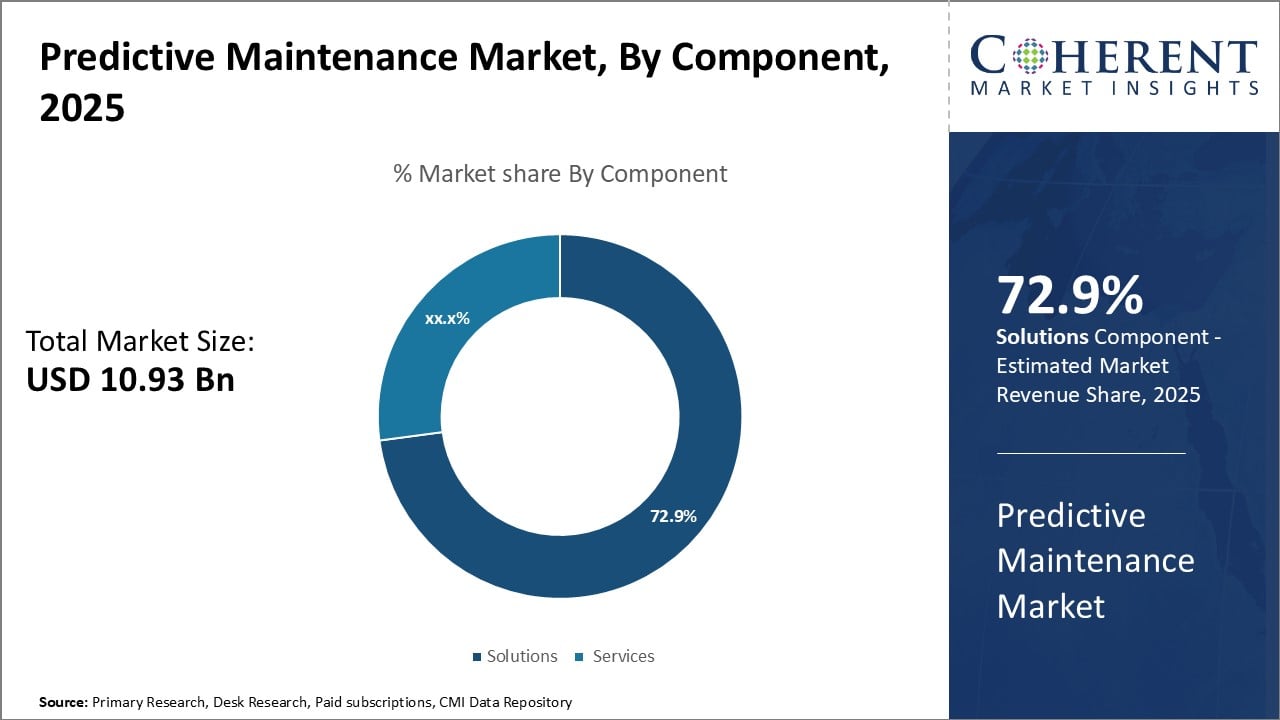
Predictive Maintenance Market Insights, By Component - Solutions Dominance Is Driven By AI-Powered Analytics, Real-Time Monitoring, And Scalable Cloud/On-Premise Deployments Across Industries
In terms of component, solutions segment is expected to contribute 73.9% share of the market in 2026 owing to the elevated embracement of sophisticated predictive analytical solutions across industries. Monitoring emerging technological and malfunction patterns helps in optimizing asset performance and reducing maintenance costs. Various enterprises are increasingly shifting from conventional preventive to predictive maintenance using cutting-edge digital applications and services. This offers real-time equipment condition monitoring, automated failure detection, and prescriptive recommendations to avert downtime. Furthermore, the integration of innovative technologies like AI, IoT, and cloud computing within solution suites multiplies their scope and appeal. The openness to deploy on-prem and cloud platforms additionally raises the flexibility and scalability for businesses of all scales.
For instance, in January 2025, Megger launched its world-class predictive maintenance solutions across the UK and Ireland, aiming to revolutionize asset reliability and operational efficiency. These advanced tools offer real-time condition monitoring, early fault detection, and data-driven diagnostics, helping industries reduce downtime and optimize performance. The rollout reflects growing demand for intelligent maintenance technologies across critical infrastructure sectors.
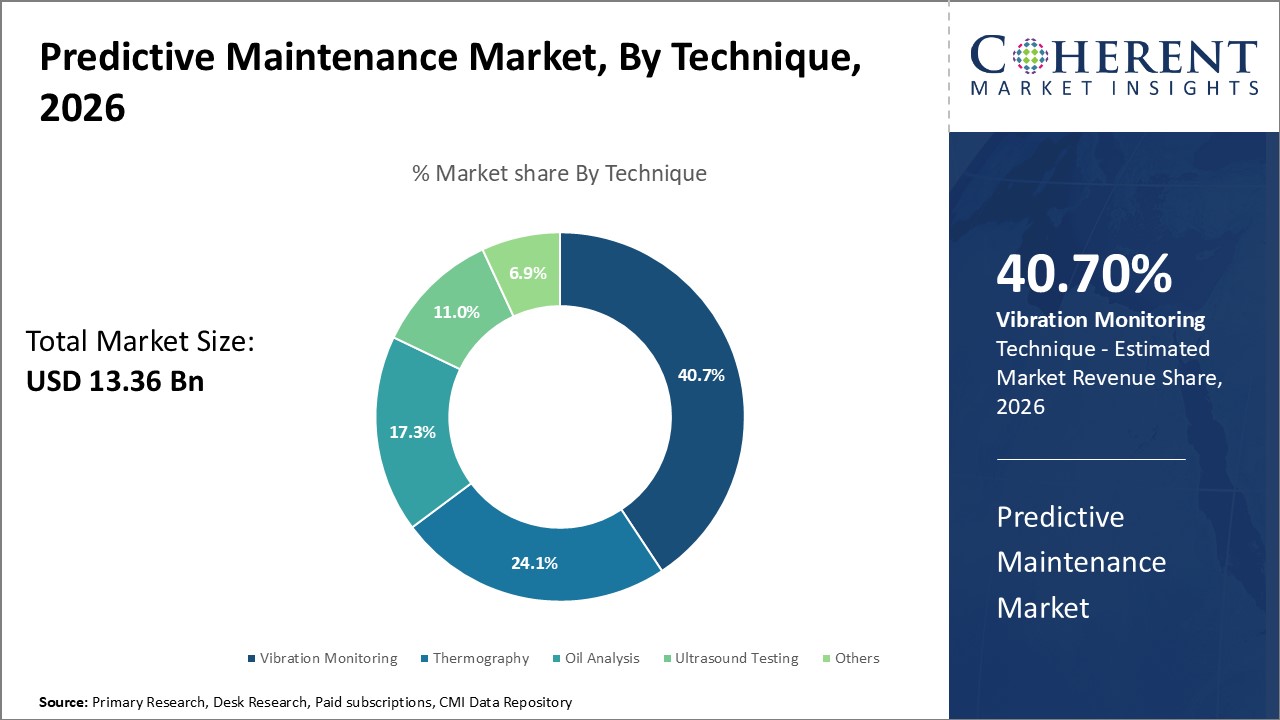
Predictive Maintenance Market Insights, By Technique - Vibration Monitoring Leads to Its Non-Intrusive, Real-Time Fault Detection and Wireless Sensor Technologies
In terms of technique, the vibration monitoring segment is expected to contribute 40.7% share of the market in 2026 owing to its non-intrusive fault diagnosis capabilities. As vibration signals carry unique signatures of mechanical and operational issues, the technique allows proactive equipment health tracking without disrupting regular processes. It detects anomalies by continuously measuring vibration levels and comparing real-time readings against historical benchmarks. This helps identify developing faults at nascent stages for swift intervention. Moreover, advancements like portable wireless sensors and condition-based parameter setting have augmented the application of vibration monitoring across industries and asset types.
For instance, in May 2025, Banner Engineering introduced the QM30VT3, a compact three-axis vibration and temperature sensor tailored for predictive maintenance. Designed for industrial environments, the sensor enables real-time monitoring of machine health, helping detect faults early and reduce downtime. Its advanced data capabilities support seamless integration into IoT systems, enhancing reliability and operational efficiency across sectors.
Predictive Maintenance Market Insights, By End-Use Industry - Manufacturing Leads with as Factories Adopt Predictive Maintenance to Minimize Downtime, Optimize Resources, And Advance Industry 4.0 Goals
In terms of end-use industry, manufacturing is expected to contribute 33.2% share of the market in 2026 due to the massive need to optimize resource utilization. Unplanned downtime in production lines causes significant losses, forcing manufacturers to shift from routine-based to condition-based maintenance. Predictive solutions aid real-time performance oversight, spare parts deployment based on actual wear, and production planning as per demand fluctuations. This raises equipment effectiveness, throughput, quality control, and sustainability targets. Further, factories are increasingly leveraging predictive maintenance to achieve Industry 4.0 goals like predictive quality, dynamic scheduling, and remote problem-solving for enhanced output.
For instance, in June 2025, Alfa Laval unveiled Clariot™, its next-generation AI-powered condition monitoring solution for hygienic manufacturing. Designed to deliver 24/7 equipment diagnostics and real-time alerts, Clariot™ enables predictive maintenance for pumps and rotating machinery. The system helps manufacturers reduce downtime, optimize performance, and achieve Industry 4.0 goals through smarter, data-driven asset management.
Regional Insights
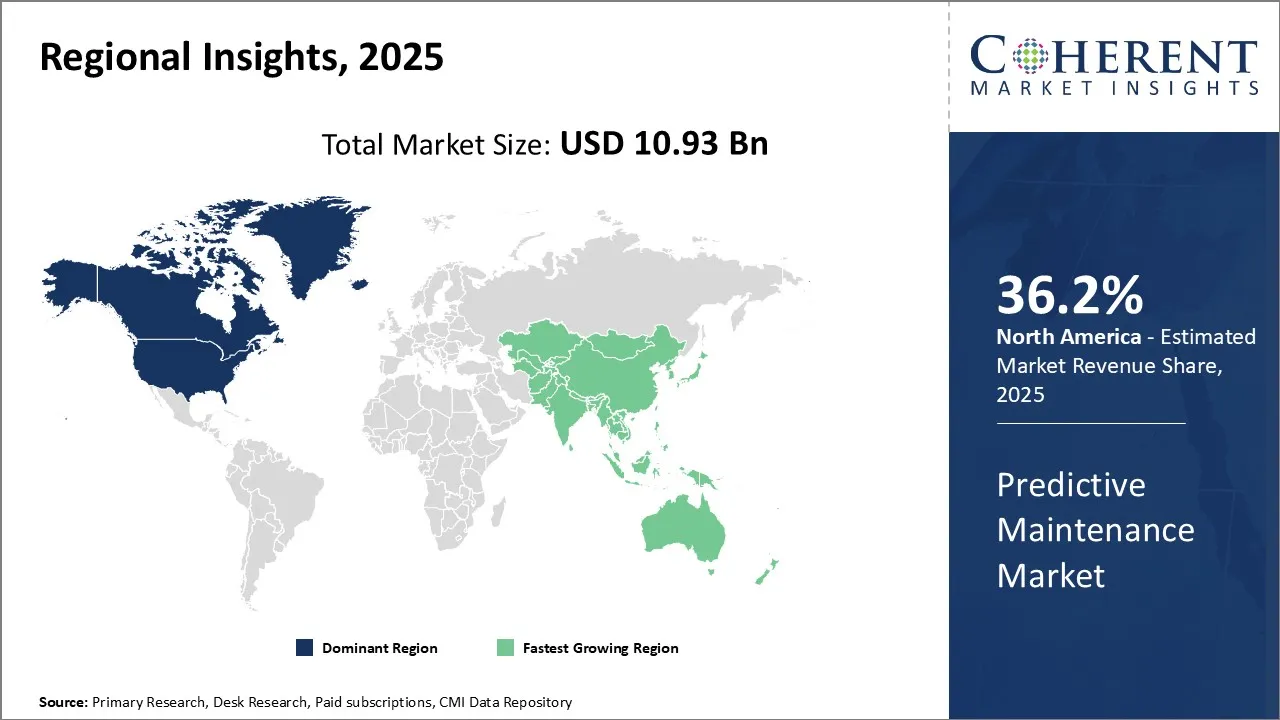
North America Predictive Maintenance Market Analysis & Trends
North America has established itself as the dominant regional market for predictive maintenance globally. The region is expected to hold 36.2% of the market share in 2026. The region is home to some of the largest manufacturing and industrial companies who have aggressively adopted predictive maintenance solutions to optimize productivity and minimize downtimes. With many Fortune 500 companies based in the U.S. and Canada focusing on Industry 4.0 technologies, predictive analytics finds wide acceptance to drive efficient maintenance practices. Further, the presence of major predictive maintenance vendors in the region has ensured easy access to cutting-edge solutions and expertise.
For instance, in April 2026, MaintainX received Frost & Sullivan’s 2026 North American Technology Innovation Leadership Award for its AI-powered maintenance and asset optimization platform. The solution enables predictive maintenance through real-time equipment monitoring, intelligent diagnostics, and streamlined workflows. This recognition highlights MaintainX’s role in transforming industrial operations with data-driven strategies that reduce downtime and boost performance.
Asia Pacific Predictive Maintenance Market Analysis & Trends
Asia Pacific has emerged as the fastest growing regional market for predictive maintenance. Several factors are contributing to the rapid growth, key among them being the massive industrialization and infrastructure development programs underway in countries like China, India, Indonesia, and Vietnam. The Make in India and Made in China 2026 initiatives lay strong emphasis on the digital transformation of manufacturing processes using technologies like IoT, AI, and predictive analytics. The growth in the number of industrial units has spurred the demand for predictive maintenance solutions from sectors like automotive, electronics, energy, and chemicals. At the same time, availability of low-cost skilled resources is enabling Asian companies to develop cost-competitive predictive maintenance offerings.
For instance, in October 2026, Schaeffler launched its Asia Pacific Remote Monitoring Center to deliver expert predictive maintenance services across the region. Supporting over 8,000 sensors for 77 customers, the center uses AI and machine learning to detect faults early, reduce downtime, and optimize asset performance. Staffed by certified vibration analysts, it marks a major step in industrial reliability.
Predictive Maintenance Market Outlook Country-Wise
The U.S. Predictive Maintenance Market Trends
The U.S. predictive maintenance market is booming due to aging infrastructure, rising operational costs, and the push for efficiency across industries. Companies are adopting AI-driven solutions to monitor equipment health, prevent failures, and reduce downtime. Integration with digital twins and IoT further enhances real-time diagnostics, making predictive maintenance vital for manufacturing, energy, and transportation sectors.
For instance, in November 2024, VoyageX AI launched a free three-month trial of its advanced Ship Maintenance Software for the North American maritime industry. Powered by AI, the platform enables predictive maintenance through real-time equipment monitoring, fault forecasting, and compliance tracking. The solution aims to reduce operational costs, minimize downtime, and enhance fleet performance with intelligent diagnostics and scheduling.
Japan Predictive Maintenance Market Trends
Japan’s predictive maintenance market is surging due to its advanced manufacturing sector, aging infrastructure, and push for Industry 4.0 integration. The adoption of AI, IoT, and robotics enables real-time equipment monitoring and fault prediction, helping reduce downtime and optimize operations. These technologies support Japan’s goal of maintaining global competitiveness and operational efficiency.
For instance, in October 2026, TDK's press release highlights its participation at CEATEC 2026, where it showcased several AI-driven innovations, including the edge RX solution, a predictive maintenance system for industrial machines. This solution uses sensors to collect and analyze vibration and temperature data in real time, enabling early anomaly detection and improved operational efficiency through cloud integration.
Market Report Scope
Predictive Maintenance Market Report Coverage
| Report Coverage | Details | ||
|---|---|---|---|
| Base Year: | 2025 | Market Size in 2026: | USD 13.36 Bn |
| Historical Data for: | 2020 To 2024 | Forecast Period: | 2026 To 2033 |
| Forecast Period 2026 to 2033 CAGR: | 22.2% | 2033 Value Projection: | USD 54.35 Bn |
| Geographies covered: |
| ||
| Segments covered: |
| ||
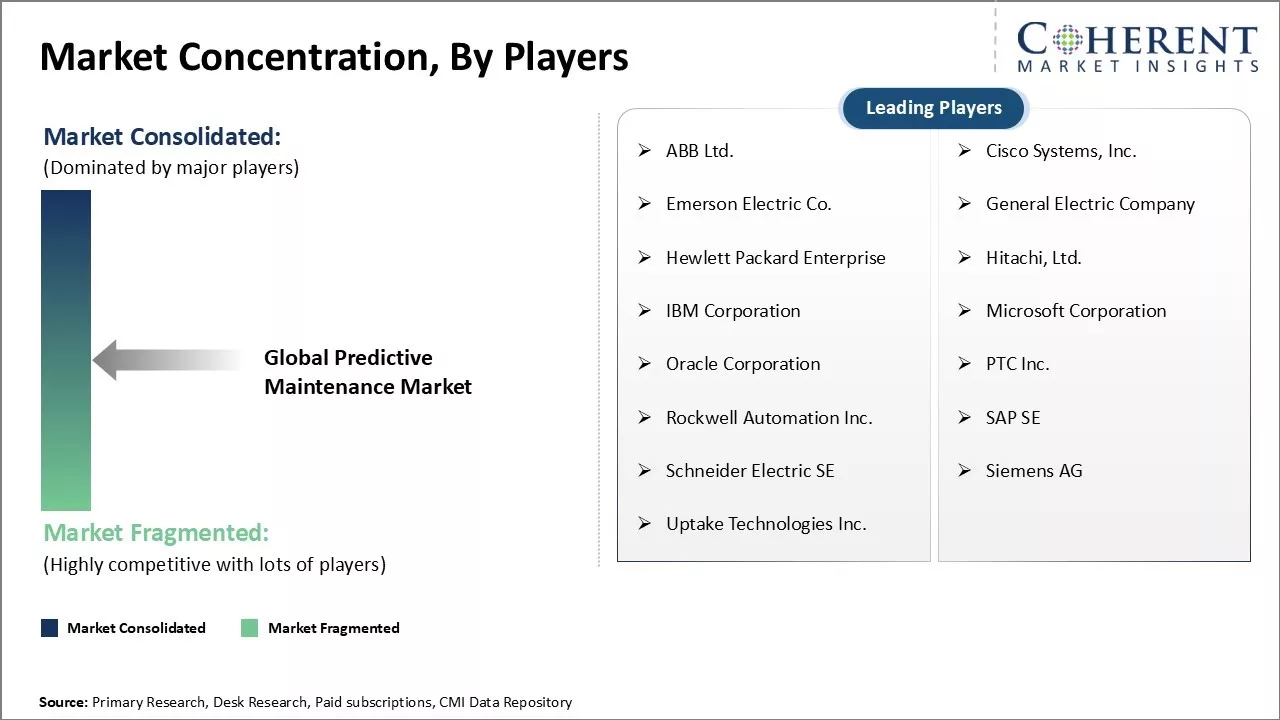
| Companies covered: | ABB Ltd., Cisco Systems, Inc., Emerson Electric Co., General Electric Company, Hewlett Packard Enterprise, Hitachi, Ltd., IBM Corporation, Microsoft Corporation, Oracle Corporation, PTC Inc., Rockwell Automation Inc., SAP SE, Schneider Electric SE, Siemens AG, and Uptake Technologies Inc. | ||
| Growth Drivers: |
| ||
| Restraints & Challenges: |
| ||
Predictive Maintenance Market Driver
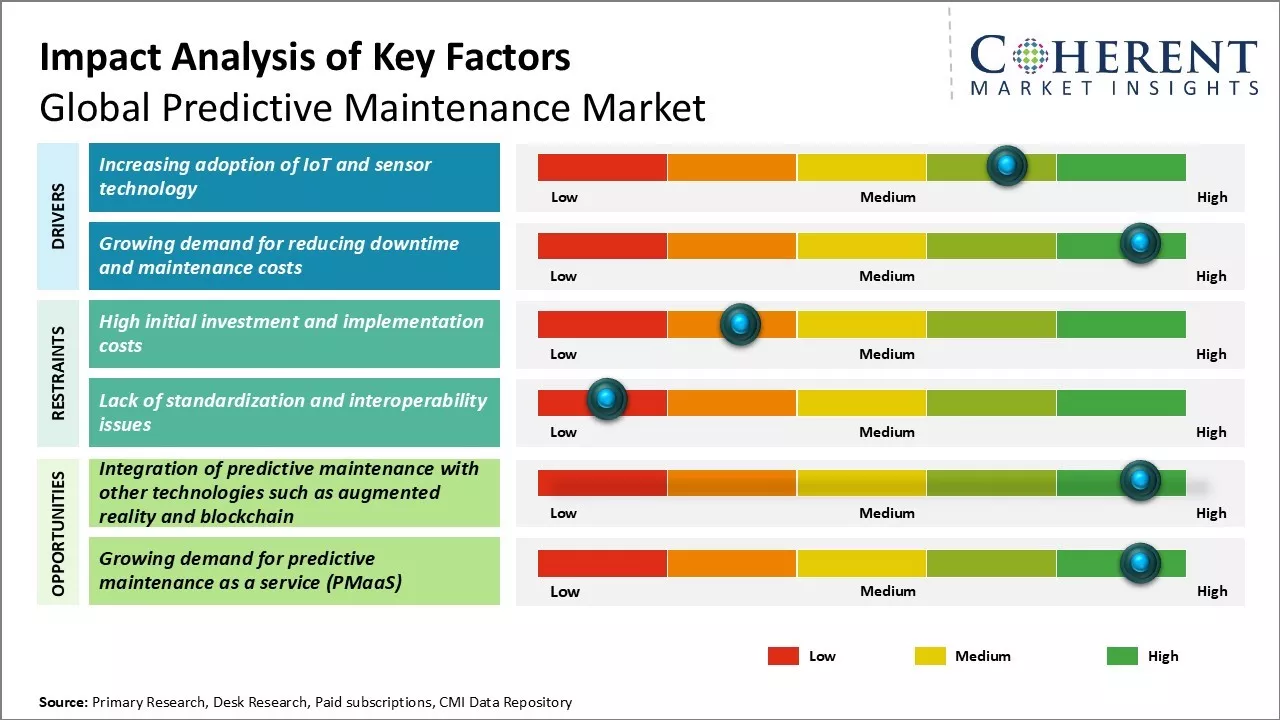
Increasing adoption of IoT and sensor technology
The rapid advancement of Internet of Things (IoT) technologies and proliferation of sensors have enabled industries to collect and analyze data from their assets and machines in real-time. IoT offers the ability to monitor individual parts and performance of critical systems continuously. This real-time monitoring generates vast amounts of useful condition monitoring data which can help predict failures or downtimes before they actually occur. With IoT, variables like vibration, temperature, pressure, and noise can be tracked remotely and alerts can be triggered when anomalous behaviors are detected. This helps maintenance teams to address issues proactively rather than waiting for failures to happen. Many industries that rely heavily on plant uptime such as manufacturing, transportation, energy, and utilities are actively deploying IoT sensors into their operations. As sensor technology becomes cheaper and more robust, more equipment and machinery across industries can be outfitted with smart sensors. This will drive greater predictive capabilities as maintenance teams are empowered with continuous health monitoring data. The widespread use of industrial IoT is set to profoundly change maintenance operations from reactive to proactive in the coming years.
Market Concentration and Competitive Landscape
Growing demand for reducing downtime and maintenance costs
Industries are under intense pressure to maximize equipment uptime while keeping maintenance costs low. Unplanned downtimes result in lost production time and can significantly hurt business productivity and profitability. At the same time, costs associated with maintenance and repair works need to be optimized. This is prompting many organizations to adopt predictive maintenance strategies to move from time-based and break-fix maintenance to condition-based maintenance. Predictive maintenance uses data analytics tools to monitor equipment health and detect early signs of wear and tear. This helps predict failures in advance and schedule maintenance work during planned downtimes rather than emergency breakdowns. It allows critical assets to run for longer without disrupting operations. With such substantial advantages, the demand for predictive maintenance solutions from industries is growing steadily to maximize asset performance and lower long-term maintenance expenditure. This growing demand opens up significant market opportunities for predictive maintenance vendors and technology providers.
Predictive Maintenance Market Opportunity
Integration of predictive maintenance with other technologies
The integration of predictive maintenance solutions with complementary technologies provides a major growth opportunity. Combining predictive maintenance with augmented reality enhances remote diagnosis and repair capabilities. Workers can access holograms and visual inspection aids using smart glasses. Similarly, deploying predictive maintenance on Blockchain networks offers the benefits of decentralization, transparency, and security of maintenance records. This allows asset owners to monitor equipment health from any location. By leveraging technologies like AI, IoT, cloud computing, and digital twins, predictive systems can glean richer insights from diverse data sources. Such integrations empower predictive maintenance with functionalities like autonomous condition monitoring and self-directed repairs. This drives higher equipment uptime and process efficiency. Global leaders are well-positioned to capitalize on this opportunity through strategic partnerships that deliver integrated digital solutions.
Analyst Opinion (Expert Opinion)
The global predictive maintenance (PdM) market has matured into a discipline where success depends less on algorithms and more on data quality, integration, and operational execution. When implemented effectively, PdM reduces unplanned downtime by 30–50% and extends asset life by up to 40%, as demonstrated in industrial deployments by Siemens and IBM. However, many pilots fail to scale because predictive insights are not embedded into maintenance workflows or inventory systems.
The economic rationale remains compelling: unplanned downtime can cost manufacturers over US$100,000 per hour, making predictive analytics a direct lever for risk reduction. Edge computing now plays a critical role by enabling real-time analysis closer to machines, while AI-driven models increasingly blend sensor data with physics-based insights. Yet, technology alone is insufficient, organizations must redesign processes, train cross-functional teams, and align incentives with reliability outcomes.
Industry consolidation is favoring vendors offering integrated hardware and software ecosystems, while specialist analytics firms succeed through partnerships. Beyond cost savings, PdM supports sustainability by extending equipment life and reducing waste. The verdict is clear: predictive maintenance is transformative only when embedded into daily operations. Firms that combine analytics with disciplined execution will achieve measurable reliability gains; others will see limited returns despite technological investments.
Speak to the analyst
Want personalized insights?
Take the findings above to one of our principal consultants, or have the report rebuilt around the segments, geographies and competitors you actually track.
Predictive Maintenance Industry News
- In March 2025, Siemens expanded its Industrial Copilot platform with a generative AI-powered maintenance solution aimed at enhancing predictive maintenance. The new offering analyzes machine data to deliver real-time diagnostics and actionable insights, helping technicians prevent failures and reduce downtime. This innovation supports smarter industrial operations and aligns with Siemens’ vision for AI-driven manufacturing efficiency
- In February 2025, GE Aerospace and SAS partnered to launch a predictive maintenance initiative focused on aircraft landing gear systems (ATA Chapter 32). Using advanced analytics and AI, the collaboration aims to detect early signs of wear, enhance safety, and reduce operational disruptions. This marks a strategic move toward smarter, data-driven aviation maintenance practices.
- In December 2024, Quant Gulf partnered with Emicool to launch an AI-driven predictive maintenance initiative aimed at boosting cooling efficiency. The system uses real-time analytics to monitor equipment health, detect anomalies early, and reduce downtime. This collaboration marks a significant step in advancing smart maintenance practices across the UAE’s district cooling and energy management sectors.
- In December 2023, ABB, a global leader in electrification and automation with over 140 years of excellence and a commitment to driving industrial transformation, enhanced its ABB Ability Field Information Manager (FIM 3.0) to provide system engineers and maintenance teams with enhanced connectivity and expanded reach across the latest communication protocols. This upgrade aims to boost operational efficiency by enabling faster, more intuitive configuration, commissioning, diagnostics, and maintenance of devices, while supporting smarter maintenance and improved engineering efficiency.
- In June 2023, Qatar Airways, one of the world's top airlines known for its commitment to excellence and customer service, partnered with Google Cloud, a leading provider of cloud computing and artificial intelligence solutions, to develop innovative data and AI solutions specifically tailored for the airline industry. This collaboration will focus on enhancing areas, such as predictive maintenance, passenger experience, and cargo operations, with the goal of elevating efficiency and customer satisfaction within the airline sector. By leveraging Google Cloud's advanced data analytics, AI, and machine learning capabilities, Qatar Airways aims to optimize its operations and deliver a more personalized and streamlined experience for its passengers.
Market Segmentation
- Component Insights (Revenue, USD Bn, 2026 - 2033)
- Solutions
- Services
- Technique Insights (Revenue, USD Bn, 2026 - 2033)
- Vibration Monitoring
- Thermography
- Oil Analysis
- Ultrasound Testing
- Others (Wear Debris Analysis, Acoustic Emission, etc.)
- End-use Industry Insights (Revenue, USD Bn, 2026 - 2033)
- Manufacturing
- Energy and Utilities
- Transportation and Logistics
- Aviation
- Others (Healthcare, Process Industries, etc.)
- By Regional Insights (Revenue, USD Bn 2026 - 2033)
- North America
- U.S.
- Canada
- Latin America
- Brazil
- Argentina
- Mexico
- Rest of Latin America
- Europe
- Germany
- U.K.
- Spain
- France
- Italy
- Russia
- Rest of Europe
- Asia Pacific
- China
- India
- Japan
- Australia
- South Korea
- ASEAN
- Rest of Asia Pacific
- Middle East
- GCC Countries
- Israel
- Rest of Middle East
- Africa
- South Africa
- North Africa
- Central Africa
- Key Players Insights (Revenue, USD Bn, 2021 - 2033)
- ABB Ltd.
- Cisco Systems, Inc.
- Emerson Electric Co.
- General Electric Company
- Hewlett Packard Enterprise
- Hitachi, Ltd.
- IBM Corporation
- Microsoft Corporation
- Oracle Corporation
- PTC Inc.
- Rockwell Automation Inc.
- SAP SE
- Schneider Electric SE
- Siemens AG
- Uptake Technologies Inc.
Sources
Primary Research Interviews from the following stakeholders
Stakeholders
- Interviews with reliability engineers, maintenance managers, condition monitoring specialists, plant managers, asset managers, operations heads, IIoT platform leads, data scientists (predictive analytics), system integrators, sensor & transducer suppliers, and procurement heads across leading global markets.
Specific stakeholders
- Reliability / maintenance leads at heavy manufacturing and process plants
- Plant operations and maintenance managers at discrete manufacturers
- Asset management and reliability engineers at utilities and energy firms
- Maintenance and engineering heads at oil & gas and petrochemical operators
- Fleet & depot maintenance managers at logistics and transportation companies
- MRO and engineering leads at airlines and aviation MROs
- Facility and operations managers at large infrastructure
- Data centre operations and reliability heads
- Product managers and R&D lead at predictive-maintenance software & IIoT platform vendors
- Sensor, vibration, and condition-monitoring component OEMs
- Systems integrators and automation contractors in manufacturing, utilities, and transportation sectors
- Heads of digital transformation / Industry 4.0 at large industrial groups
- Third-party maintenance service providers and OEM service divisions
- Cybersecurity leads responsible for OT/IIoT security in industrial environments
Databases
- UN Comtrade Database
- World Trade Organization (WTO) Trade Statistics
- Eurostat (industry & manufacturing datasets)
- Bureau of Economic Analysis (U.S.) / U.S. Census manufacturing statistics
- China Customs Statistics
- Korea Customs Service Data Portal
- Japan External Trade Organization (JETRO) statistics
- Directorate General of Commercial Intelligence and Statistics (DGCIS), India
- International Energy Agency (IEA) equipment & energy consumption statistics
- International Labour Organization (ILO) — sector employment & productivity data
Magazines / Trade Press
- Maintenance Technology
- Plant Engineering
- Control Engineering
- Reliabilityweb (Uptime)/Uptime Magazine
- IndustryWeek
- Machine Design
- Plant Services
- Sensors Online / Sensors Magazine
- IoT Agenda / IoT World Today (predictive maintenance coverage)
Journals / Academic Publications
- IEEE Transactions on Industrial Informatics
- IEEE Transactions on Automation Science and Engineering
- Mechanical Systems and Signal Processing (MSSP)
- Reliability Engineering & System Safety
- Journal of Sound and Vibration
- Measurement (Elsevier)
- Journal of Quality in Maintenance Engineering
- Journal of Intelligent Manufacturing
Newspapers & Business Press
- The Wall Street Journal – Industry & Technology sections
- Financial Times – Industry & Technology coverage
- The Economic Times – Industry & Technology (India)
- The Hindu Business Line – Industry and Energy
- Nikkei Asia – Manufacturing & Supply Chain
- South China Morning Post – Technology & Industry
Associations & Standards Bodies
- IEEE (Industrial Electronics, Predictive Maintenance working groups)
- International Society of Automation (ISA)
- MESA International (Manufacturing Execution & Asset Management)
- Society for Maintenance & Reliability Professionals (SMRP)
- API (American Petroleum Institute) – relevant maintenance standards
- ISO / IEC (standards for condition monitoring, IoT interoperability)
- CIGRÉ / IEEE Power & Energy (for utilities)
- SAE International (transportation equipment maintenance practices)
- Asset Management Council (ISO 55000 practitioner community)
Public Domain / Government Sources
- National Institute of Standards and Technology (NIST), U.S. — industrial cybersecurity & sensor standards guidance
- U.S. Department of Energy (DOE) — industrial efficiency & predictive maintenance case studies
- Ministry of Heavy Industries / Ministry of Power (India) — manufacturing & power plant reports
- NITI Aayog (India) — industrial transformation and Industry 4.0 policy notes
- European Commission — Industry 4.0 and digitalisation reports
- U.S. Occupational Safety and Health Administration (OSHA) — equipment safety guidance (maintenance-related)
- National regulators’ asset management / grid reliability reports (e.g., Ofgem, CEA India)
Proprietary Elements
- CMI Data Analytics Tool
- Proprietary CMI Existing Repository of information for last 8 years
Get access to 250+ pages report
Every segment, forecast, competitor profile and data table behind the analysis above — available for instant download.
- ESOMAR Member
- ISO 9001:2015 Certified
- D-U-N-S Registered
- GDPR & CCPA Compliant
Missing comfort of reading report in your local language? Find your preferred language:
Transform your Strategy with Exclusive Trending Reports
Frequently Asked Questions
The Predictive Maintenance Market is estimated to be valued at USD 13.36 Bn in 2026, and is expected to reach USD 54.35 Bn by 2033.
The CAGR of the Predictive Maintenance Market is projected to be 22.2% from 2026 to 2033.
Increasing adoption of IoT and sensor technology and growing demand for reducing downtime and maintenance costs are the major factors driving the growth of the global predictive maintenance market.
High initial investment and implementation costs and lack of standardization and interoperability issues are the major factors hampering the growth of the global predictive maintenance market.
In terms of component, solutions segment is estimated to dominate the market revenue share in 2026.
ABB Ltd., Cisco Systems, Inc., Emerson Electric Co., General Electric Company, Hewlett Packard Enterprise, Hitachi, Ltd., IBM Corporation, Microsoft Corporation, Oracle Corporation, PTC Inc., Rockwell Automation Inc., SAP SE, Schneider Electric SE, Siemens AG, and Uptake Technologies Inc. are the major players.
North America is expected to lead the global predictive maintenance market.