

Fleet Management Market Size and Forecast – 2026 to 2033
Fleet Management Market is estimated to be valued at USD 16.93 Bn in 2026 and is expected to reach USD 58.93 Bn in 2033, exhibiting a compound annual growth rate (CAGR) of 19.5% from 2026 to 2033.
Key Takeaways
- By Application, Real-Time Location Monitoring hold the largest market share of 42% in 2026 owing to its operational efficiency & cost savings.
- By Commercial Vehicle Type, Light Commercial Vehicle is expected to dominate the largest market share in 2026 owing to the growth of e-commerce, last-mile & urban delivery.
- By Component, Hardware acquired the prominent market share in 2026 owing to its growing demand for real-time tracking, monitoring & data capture.
- By Deployment, On-premises is expected to hold largest market share in 2026 owing to its data control, security & privacy.
- By Region, North America dominates the overall market with an estimated share of 46% in 2026 owing to the strong demand for operational efficiency and cost reduction.
Market Overview
The fleet management market is growing rapidly as companies adopt real-time vehicle tracking to enhance efficiency and driver safety. Telematics, IoT, and data analytics empower fleet operators to monitor and maintain vehicles more intelligently across logistics, transportation, and delivery operations. Businesses are increasingly implementing integrated fleet management solutions to meet regulatory requirements, support electric vehicle adoption, and handle the rising demands of e-commerce and last-mile delivery, strengthening their performance across commercial and industrial sectors worldwide.
Current Events and Its Impact on the Fleet Management Market
Current Events | Description and its impact |
Geopolitical and Regulatory Developments |
|
Technological Advancements and Digital Transformation |
|
Economic Factors and Supply Chain Dynamics |
|
Segmental Insights
- Current Industry Events of 2026
- Market Size Estimation
- Regional Breakdown
- Competitive Landscape
- Customer Intelligence
- Segmental Analysis
- Pricing Analysis
- Key Market Drivers, Challenges & Future Trends
- Customized Insights Section
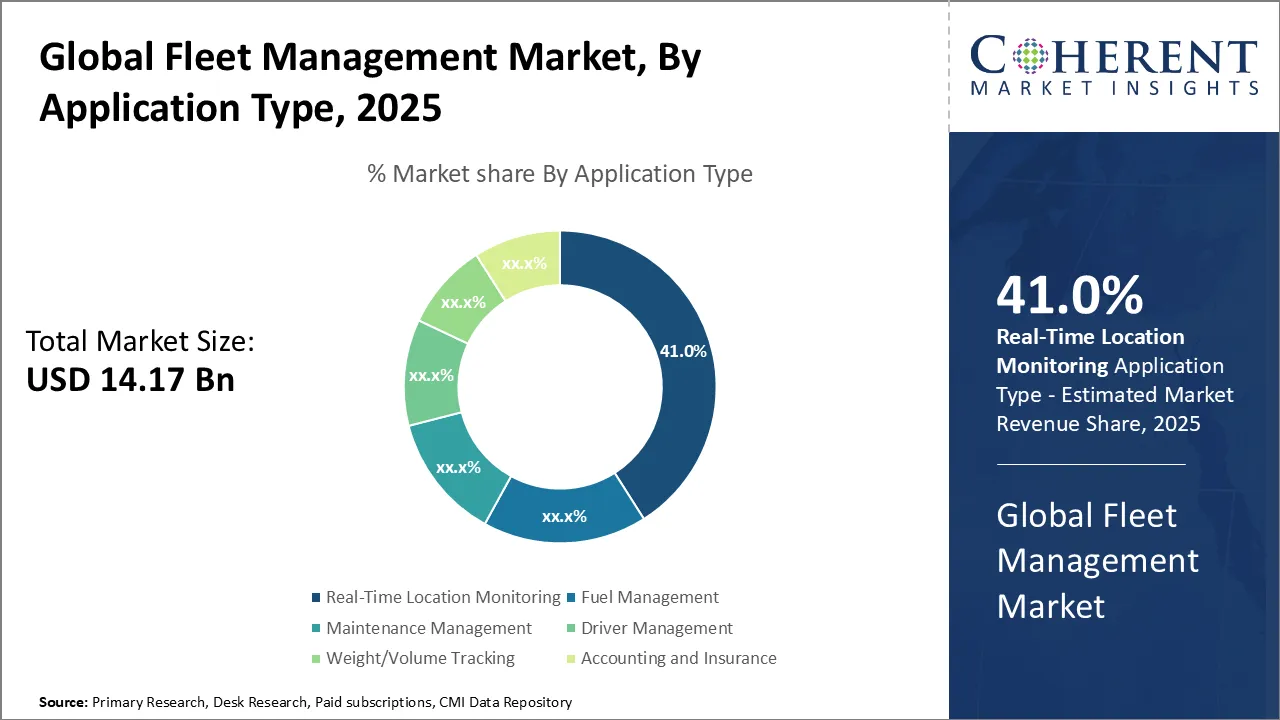
Fleet Management Market Insights, By Application Type: Real-Time Location Monitoring contribute the highest share of the market owing to its regulatory & compliance pressures.
Real-Time Location Monitoring hold the largest market share of 42% in 2026. Fleet operators are driving the demand for real-time location monitoring to enhance visibility, safety, and productivity in transportation operations. They use live tracking to optimize routes, cut fuel usage, and respond swiftly to delays or emergencies. Evolving GPS, IoT, and 5G technologies improve data precision and communication efficiency. Growing focus on driver behavior, asset protection, and regulatory compliance is prompting more organizations to implement real-time tracking solutions across a wide range of fleet management applications. For instance, in September 2025, Etihad Cargo, the logistics arm of Etihad Airways, has launched SmartTrack, a real-time shipment monitoring service that provides live updates on location and cargo conditions, advancing its digital transformation and transparency in air freight.
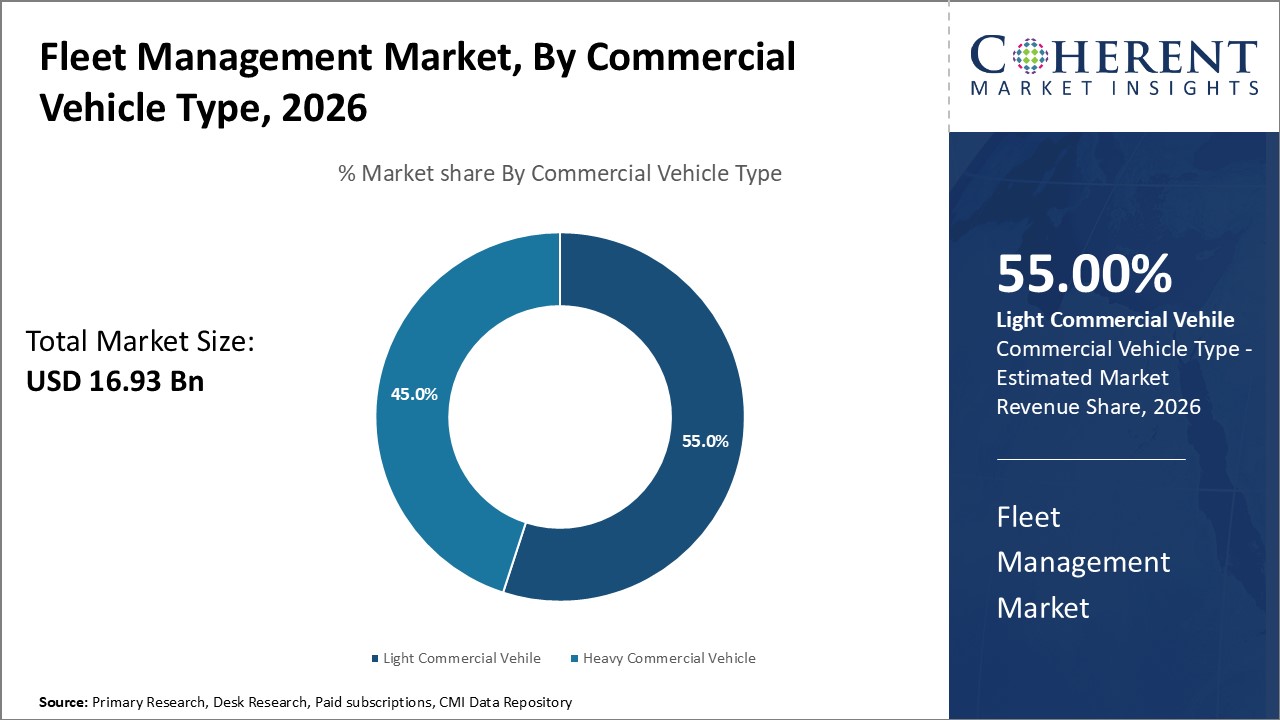
Fleet Management Market Insights, By Commercial Vehicle Type: Light Commercial Vehicle contribute the highest share of the market owing to its urbanization & infrastructure development.
Businesses are driving the demand for light commercial vehicles in the fleet management market as e-commerce, last-mile delivery, and urban logistics expand rapidly. They deploy smaller, more agile vehicles to navigate congested city routes efficiently. Telematics and IoT advancements allow operators to track, maintain, and utilize these fleets more effectively. Small and medium enterprises increasingly adopt these solutions, while a strong focus on cost efficiency, sustainability, and regulatory compliance further accelerates the use of light commercial vehicle management systems. For instance, in September 2025, Tata Motors, India’s largest commercial vehicle maker, has launched the Tata LPT 812, a new ILMCV designed for higher payload capacity, improved efficiency, and greater profitability for fleet owners.
Fleet Management Market Insights, By Component: Hardware contributes the highest share of the market owing to its technological advances & connectivity infrastructure.
Businesses are driving the growing demand for hardware solutions in the fleet management market to achieve reliable, real-time vehicle monitoring and control. They deploy GPS devices, sensors, dashcams, and onboard diagnostic tools to track vehicles accurately, analyze driver behavior, and perform predictive maintenance. Fleet operators increasingly invest in advanced, durable hardware to boost operational efficiency, safety, and compliance. The rising adoption of connected technologies, telematics integration, and the need for strong on-site infrastructure are accelerating hardware deployment across commercial and industrial fleets.
Fleet Management Market Insights, By Deployment: On-premises contribute the highest share of the market owing to its predictable cost structure / upfront investment.
Businesses are increasingly adopting on-premises fleet management solutions to retain full control over data security, privacy, and system customizations. They host software locally to integrate fleet management with legacy systems and customize workflows according to operational needs. By choosing on-premises deployments, companies ensure offline functionality, meet regulatory requirements, and manage costs through upfront investments. Seeking higher performance, reliability, and direct oversight of their infrastructure, organizations are actively implementing on-premises solutions to efficiently manage commercial and industrial fleets. For instance, in June 2025, Broadcom has launched VMware Cloud Foundation 9.0, a private cloud platform that enhances management for traditional, AI, and cloud-native applications. VCF 9.0 delivers public-cloud agility with on-premises security, improved compliance, cyber resilience, and fleet-level patch and security management.
Regional Insights
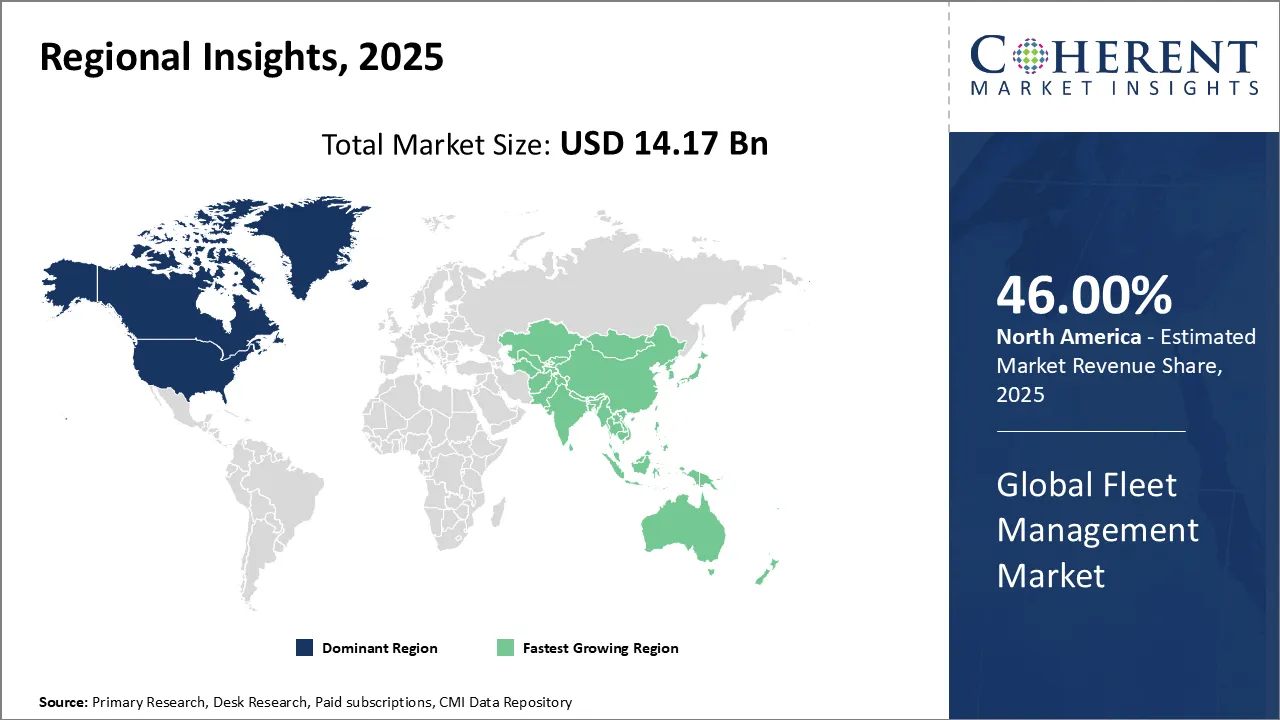
North America Fleet Management Market Trends
North America dominates the overall market with an estimated share of 46% in 2026. North American companies are driving key trends in the fleet management market by rapidly integrating telematics and cloud-based platforms to connect vehicles, drivers, and back-office systems for improved operational oversight. They are adopting electric and hybrid vehicles to meet sustainability goals, while using advanced analytics and AI to predict maintenance needs and guide driver behavior. Stricter safety and emissions regulations are prompting investments in video monitoring and compliance tools, and consolidation among major platform providers is enhancing system interoperability. For instance, in October 2026, Nomad Fuel, a growing player in Canada’s freight tech industry, has launched a modernized fuel management platform that helps trucking fleets buy, manage, and optimize their fuel spend.
Asia Pacific Fleet Management Market Trends
Companies in the Asia‑Pacific region are rapidly shaping the fleet management market demand by embracing digital transformation and smart logistics solutions. Urbanization and industrial growth are driving their need for fleet visibility, while the rise of e-commerce is increasing last‑mile and regional delivery operations. Businesses are actively using IoT, telematics, and AI to optimize routes, predict maintenance needs, and monitor driver behavior. Governments are encouraging sustainable fleets and infrastructure development, prompting operators to adopt advanced fleet management technologies to remain competitive. For instance, in January 2026, CASE India has introduced seven new construction equipment models and launched myCASE Construction, a telematics app that enables real-time machine tracking, fuel efficiency monitoring, and remote troubleshooting for fleet management.
United States Fleet Management Market Trends
U.S. companies are driving growth in the fleet management market by adopting cloud-based telematics, AI-powered analytics, and mobile connectivity to streamline operations and minimize downtime. Fleet operators actively implement real-time tracking, geofencing, and preventive maintenance to improve safety, compliance, and efficiency. The increasing integration of electric vehicles and stricter federal regulations on driver hours and emissions are prompting technology upgrades. Logistics firms are expanding last-mile services and leveraging data platforms to manage complex delivery networks more effectively. For instance, in June 2026, Samsara Inc. and Element Fleet Management have launched a joint fleet and operations management solution that streamlines procurement and onboarding, enhancing safety and efficiency beyond traditional telematics.
China Fleet Management Market Trends
Chinese companies are actively transforming the fleet‑management market by deploying advanced telematics, AI-powered analytics, and cloud-based platforms to boost efficiency and competitiveness. Growing e-commerce volumes and expanding urban logistics networks are driving their demand for agile, connected fleet solutions. Government initiatives promoting intelligent transportation and emissions control are accelerating the adoption of digital fleet-monitoring and driver-management systems. At the same time, businesses are integrating electric vehicles and shared-mobility models into their fleets, creating new opportunities for technology-driven fleet services.
End-user Feedback and Unmet Needs in the Fleet Management Market
- Integration & interoperability challenges: End‑users often struggle to integrate fleet‑management solutions with diverse vehicle systems and legacy software. The lack of unified standards for telematics hardware and data exchange increases complexity.
- Skills & resource gaps: Companies report a shortage of trained personnel able to maximise advanced features like AI‑based analytics, predictive maintenance and driver behaviour modules. This limits ROI and slows scaling.
- Data visibility and real‑time responsiveness: Users demand accurate, real‑time insights into vehicle status, route deviations and driver behaviour, but connectivity issues, latency, and data silos hamper full visibility.
Fleet Management Market Trend
Connected vehicle ecosystems & IoT integration
Fleet management is increasingly evolving into a connected ecosystem where vehicles, drivers, sensors, and back‑office systems all tap into real‑time data flows. Advanced IoT sensors capture vehicle health, location, cargo conditions and driver behaviour. Fleet platforms ingest and analyse this data to inform decisions—from route changes to maintenance scheduling. As vehicles become more instrumented and digitally linked, operators gain deeper visibility and responsiveness, transforming fleets into dynamic, data‑driven assets for logistics, service and industrial operations.
Electrification, sustainability and regulatory compliance
The drive toward zero‑emission vehicles, tighter emissions rules and greener logistics is altering fleet management strategy. Operators are not only buying electric or hybrid vehicles, but also deploying systems to monitor battery health, optimize charging schedules, integrate charging‑infrastructure data and align with environmental reporting. Governments and corporate sustainability agendas are pushing fleets to re‑engineer operations and adopt fleet‑management tools capable of supporting these new requirements, ultimately redefining what “fleet management” means in a sustainable world.
Fleet Management Market Opportunity
Electric and hybrid fleet transition
Fleet operators have a significant opportunity to adopt electric and hybrid vehicles as regulatory pressures and sustainability targets increase. Fleet‑management providers can develop tools to monitor battery health, optimise charging schedules, integrate EVs into existing fleets and manage total cost of ownership. This shift creates a demand for solutions that support EV workflows, grid‑connectivity, charging‑station integration and dynamic routing for range‑limited vehicles—opening new service‑led business models around green fleets.
Market Report Scope
Fleet Management Report Coverage
| Report Coverage | Details | ||
|---|---|---|---|
| Base Year: | 2025 | Market Size in 2026: | USD 16.93 Bn |
| Historical Data for: | 2020 To 2024 | Forecast Period: | 2026 To 2033 |
| Forecast Period 2026 to 2033 CAGR: | 19.5% | 2033 Value Projection: | USD 58.93 Bn |
| Geographies covered: |
| ||
| Segments covered: |
| ||
| Companies covered: | AT&T Inc., Verizon, Zebra Technologies Corp., Trimble Inc., Teletrac Navman US Ltd., TomTom International BV, and Others | ||
| Growth Drivers: |
| ||
| Restraints & Challenges: |
| ||
Fleet Management Market News
- In October 2025, Kooner Fleet Management Solutions has launched FleetIQ, a platform that improves fleet health and maintenance by streamlining service, reducing downtime, and providing predictive insights and real-time visibility.
- In October 2025, Aion-Tech Solutions has commercially launched ROQIT, a zero-emission fleet management SaaS platform by its subsidiary ROQIT Greenfleet, supporting intelligent operations for cars, buses, trucks, and rail assets.
- In October 2025, Vinli has launched Velona™, its new Agentic Fleet Management product that helps fleet operators identify hidden cost savings and address operational risks before they cause downtime or liability.
Analyst Opinion (Expert Opinion)
- The fleet management market is becoming a strategic lever for operational transformation. With over 65 % of fleet managers already using telematics solutions and 80 % employing GPS tracking systems, the shift from “just monitor” to “actively optimize” is well underway. In my view, the firms that treat fleet management as a core capability (rather than a compliance item) will pull well ahead of the pack.
- What stands out is that the value is migrating from hardware to intelligence. Real‑time tracking was yesterday’s headline—but now we’re seeing fleets using IoT sensors and AI‑driven analytics to reduce maintenance downtime by up to 30 % and cut fuel waste by 15‑20 %.
To me, this implies that vendors who push simple GPS boxes are entering commodity territory—winner‐takes‐most will apply analytics and contextualized insights. - Another striking trend: regulatory and sustainability pressures are forcing fleet operators to invest in technology early, not just when they’re ready. For instance, the U.S. market reports that fleets with 50+ vehicles have telematics penetration near 93 %.
My opinion is that this means laggards will face ‘technology debt’—not only in cost but in the ability to compete on agility and compliance. - However, the amount of money spent isn’t the bottleneck—it’s the organizational readiness. As noted by McKinsey & Company, it’s not just the tech that matters, but whether companies can interpret and act on data: “The right skills. Telematics data tells you what your vehicles—and drivers—are doing, not how to optimize your business.”
My belief is that half of the current fleet analytics projects will under‑deliver simply because leadership overlooked the change management and process side.
Speak to the analyst
Want personalized insights?
Take the findings above to one of our principal consultants, or have the report rebuilt around the segments, geographies and competitors you actually track.
Market Segmentation
- Global Fleet Management Market, By Application Type
- Real-Time Location Monitoring
- Weight/Volume Tracking
- Fuel Management
- Driver Management
- Maintenance Management
- Accounting and Insurance
- Global Fleet Management Market, By Commercial Vehicle Type
- Light Commercial Vehicles
- Heavy Commercial Vehicles
- Global Fleet Management Market, By Component
- Hardware
- Software
- Service
- Global Fleet Management Market, By Deployment
- Cloud
- On-Premises
- Regional Insights (Revenue, USD Bn, 2021 - 2033)
- North America
- U.S.
- Canada
- Latin America
- Brazil
- Argentina
- Mexico
- Rest of Latin America
- Europe
- Germany
- U.K.
- Spain
- France
- Italy
- Russia
- Rest of Europe
- Asia Pacific
- China
- India
- Japan
- Australia
- South Korea
- ASEAN
- Rest of Asia Pacific
- Middle East
- GCC Countries
- Israel
- Rest of Middle East
- Africa
- South Africa
- North Africa
- Central Africa
- North America
- Company Profiles
- AT&T Inc.
- Verizon
- Zebra Technologies Corp.
- Trimble Inc.
- Teletrac Navman US Ltd.
- TomTom International BV
Sources
Primary Research interviews
- Fleet operators and logistics managers from commercial and industrial sectors
- Vehicle telematics solution providers and hardware vendors
- Transportation and delivery service companies
- Government transportation and regulatory authorities
- Electric and hybrid fleet operators
Databases
- U.S. Department of Transportation vehicle and fleet databases
- European Environment Agency (EEA) transport statistics
- National Highway Traffic Safety Administration (NHTSA) datasets
- International Transport Forum (OECD) statistics
- World Bank transport and urban mobility data
Magazines
- Fleet Owner
- Transport Topics
- Automotive Fleet
- Trucking Info
- Logistics Management
Journals
- Journal of Transportation Management
- International Journal of Logistics Management
- Journal of Intelligent Transportation Systems
- Transportation Research Part C: Emerging Technologies
- International Journal of Vehicle Design
Newspapers
- The Wall Street Journal – Transport & Logistics section
- Financial Times – Mobility and Transport coverage
- The New York Times – Automotive & Fleet articles
- The Guardian – Transport & Environment
- South China Morning Post – Logistics and Urban Mobility
Associations
- American Trucking Associations (ATA)
- International Road Transport Union (IRU)
- National Association of Fleet Administrators (NAFA)
- Society of Automotive Engineers (SAE)
- European Automobile Manufacturers Association (ACEA)
Public Domain sources
- Government reports on urban transport and fleet regulations
- UN Environment Programme – Sustainable Transport publications
- Open-access academic research on telematics and IoT in fleets
- Publicly available industry whitepapers from OEMs and software vendors
- Transportation safety and emissions reports from national agencies
Proprietary Elements
- CMI Data Analytics Tool
- Proprietary CMI Existing Repository of information for last 8 years
Get access to 250+ pages report
Every segment, forecast, competitor profile and data table behind the analysis above — available for instant download.
- ESOMAR Member
- ISO 9001:2015 Certified
- D-U-N-S Registered
- GDPR & CCPA Compliant
Missing comfort of reading report in your local language? Find your preferred language:
Transform your Strategy with Exclusive Trending Reports
Frequently Asked Questions
The Fleet Management Market is estimated to be valued at USD 16.93 Bn in 2026, and is expected to reach USD 58.93 Bn by 2033.
The CAGR of the Fleet Management Market is projected to be 19.5% from 2026 to 2033.
Rise in number of asset and vehicle thefts and increasing cases of road accidents are fuelling the growth of market.
The Real-Time Location Monitoring segment is the leading segment in the market.
Need to connect information together through various sources and risk of cyber-attacks are the major factors restraining growth of the market.
AT&T Inc., Verizon, Zebra Technologies Corp., Trimble Inc., Teletrac Navman US Ltd., TomTom International BV, and Others