

Healthcare Cyber Security Market Size and Share Analysis – Growth Trends and Forecasts (2026-2033)
The Healthcare Cyber Security Market size is estimated to expand at a CAGR of 14.2% from USD 17.98 Bn in 2026 to USD 45.51 Bn by 2033. The growth of the market is primarily attributed to the increasing number of cyberattacks on healthcare organizations, increasing adoption of electronic health records (EHRs), increasing digitalization of the healthcare infrastructure, growing telehealth and connected medical devices, and stringent regulatory requirements for patient data protection. According to the healthcare cybersecurity findings reveal that healthcare organizations experienced a record 275 million healthcare records exposed or compromised in 2024, with ransomware attacks against healthcare organizations rising exponentially, underscoring the increased demand for sophisticated cybersecurity solutions across hospitals, clinics and healthcare networks.
Key Takeaways
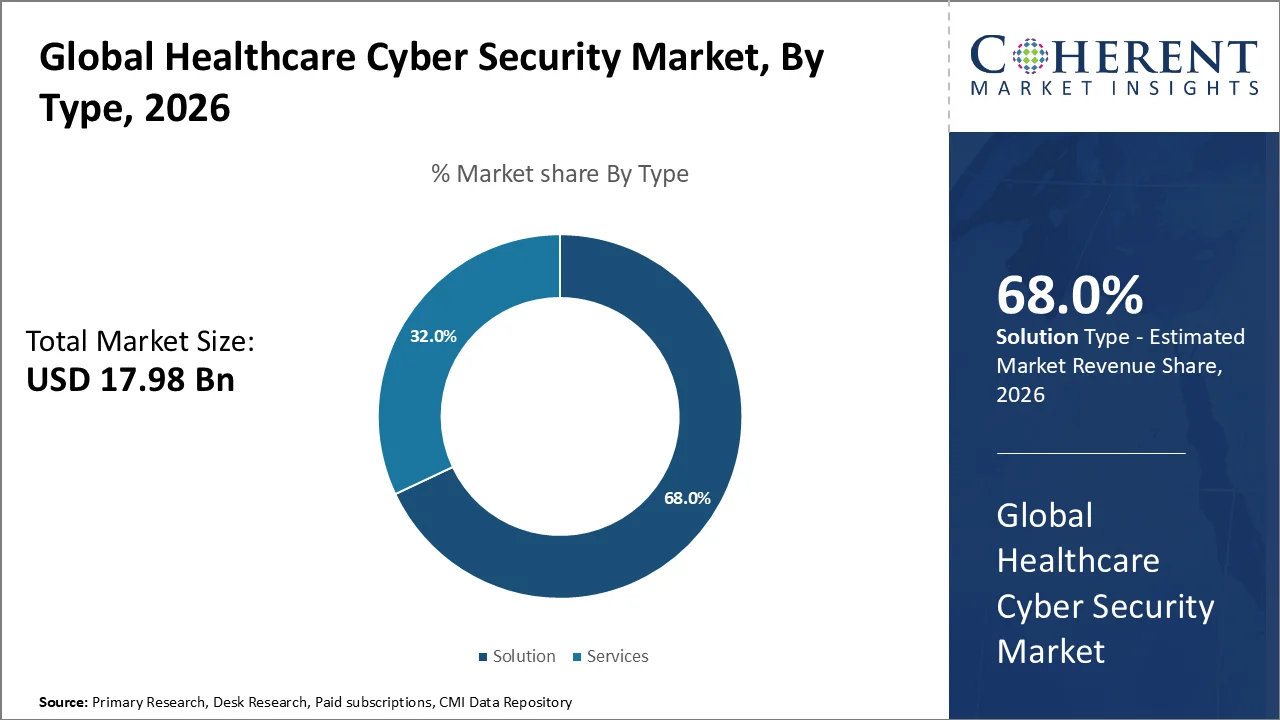
- Solution segment is projected to lead the market with 68.0% in 2026. This industry is currently witnessing growth because of the widespread use of cybersecurity technology in the detection of threats, risk management, identity management, data protection, and compliance with regulatory standards by various health care firms. According to the HIMSS Healthcare Cybersecurity Survey of 2024, about 55% of health care firms are planning to raise their spending on cybersecurity in 2025.
- Network Security category will be the leading segment with 31.0% in 2026. The segment is increasing because of the rising requirement of protecting hospitals' networks, connected medical equipment, cloud-based systems, and telemedicine infrastructure from ransomware attacks and advanced persistent threats. The healthcare organizations are increasingly deploying advanced network monitoring, firewalls, IDS/IPS solutions, and network segmentation technologies to mitigate cybersecurity threats. Some recent health care cyber threat analyses have revealed that ransomware remains one of the leading causes of major healthcare cybersecurity incidents globally.
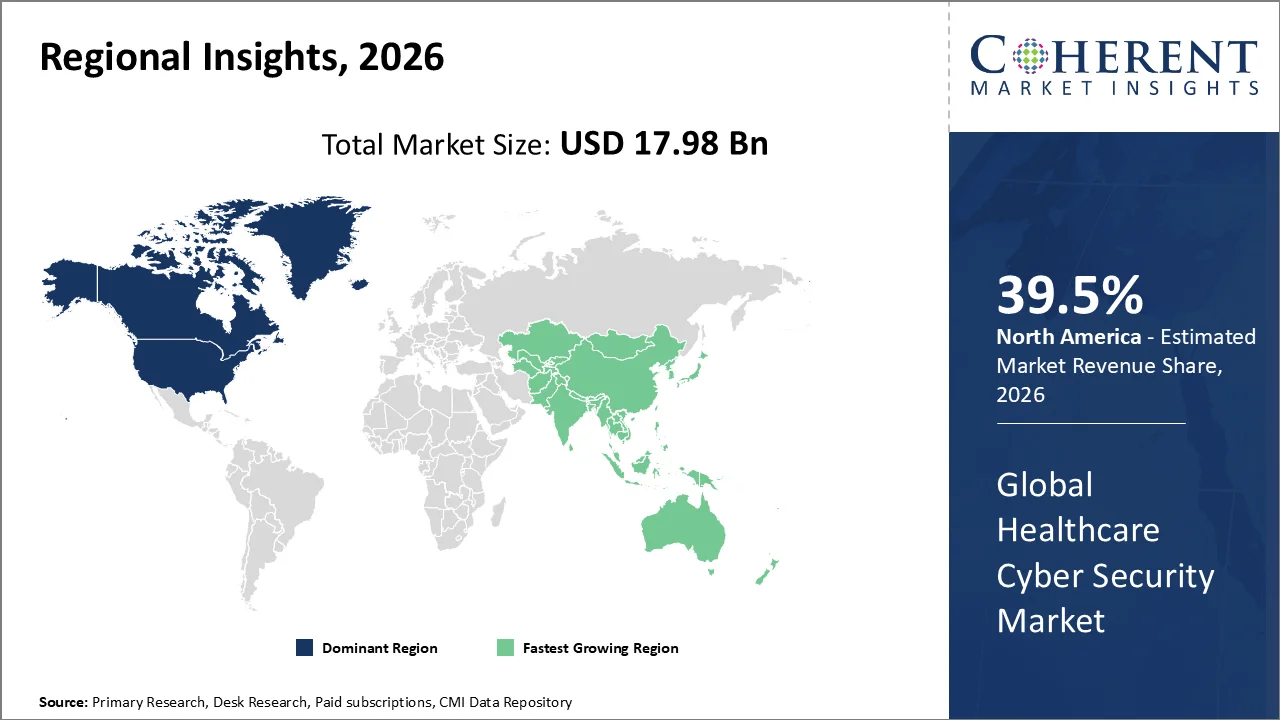
- North America is forecast to capture an estimated 39.5% share of the Healthcare Cyber Security Market in 2026. The dominance of the region in the market can be attributed to digitization in healthcare sector, usage of electronic health records (EHRs), higher spending on cybersecurity by healthcare institutions, and stringent regulatory measures for patient data privacy. As per the statistics from American Hospital Association (AHA), till October 2025, there were reports of 364 reported healthcare hacking incidents affecting more than 33 million individuals.
Market Drivers
Rising Healthcare Data Breaches and Cyberattacks are Accelerating Healthcare Cyber Security Market Growth
The Healthcare Cyber Security Market is significantly driven by the rising frequency and scale of cyberattacks on healthcare institutions. As healthcare becomes more digital, and as the value of patient information increases, healthcare providers and insurers, as well as life science companies, are becoming increasingly appealing targets for ransomware, phishing, supply chain attacks, and cyber theft. As more organizations adopt EHRs, telemedicine systems, connected medical devices, and healthcare software applications in the cloud, the attack surface expands, necessitating that healthcare companies spend a lot on cybersecurity technologies.
According to the Federal Bureau of Investigation (FBI) Internet Crime Complaint Center (IC3) report of 2024, healthcare has been identified as one of the most affected sectors of the critical infrastructure due to ransomware attacks, which emphasizes the importance of improving the cybersecurity measures in healthcare facilities.
In July 2025, Clearwater rolled out their new solution for ECRM to allow healthcare companies develop cyber resiliency, regulatory compliance, and enhanced visibility of cyber risks within the entire enterprise.
Growing Adoption of Connected Medical Devices and Digital Health Platforms is Driving Market Expansion
The expanding growth in connected medical devices, telehealth solutions, remote patient monitoring solutions, and cloud-enabled healthcare applications creates huge opportunities for the Healthcare Cyber Security Market. With more and more healthcare organizations implementing technologies on their networks to improve patient care and make processes efficient, cyber security has become an important concern for the healthcare industry.
Moreover, the Health Sector Coordinating Council (HSCC) Cybersecurity Working Group also approximates that there are tens of thousands of devices connected to each hospital within the United States, resulting in a more complicated network security situation.
In October 2025, Axonius introduced Axonius for Healthcare, a healthcare-tailored cybersecurity platform that delivers complete visibility and security management for linked medical devices, clinical systems, IoT assets and healthcare IT environments.
Current Events and Their Impact
Current Event | Description and its Impact |
U.S. HHS Proposed HIPAA Security Rule Update Strengthens Healthcare Cybersecurity Requirements (January 2025) |
|
American Hospital Association (AHA) Warns of Escalating Third-Party Healthcare Cyber Risks (October 2025) |
|
- Current Industry Events of 2026
- Market Size Estimation
- Regional Breakdown
- Competitive Landscape
- Customer Intelligence
- Segmental Analysis
- Pricing Analysis
- Key Market Drivers, Challenges & Future Trends
- Customized Insights Section
Segmental Insights
Why is Solution Acquiring the Largest Share?
Based on type, the Solution segment is anticipated to hold the highest share of the Healthcare Cyber Security Market, 68.0% in 2026. The growth of the segment is attributed to the increasing adoption of cybersecurity solutions for threat detection, risk management, identity governance, data protection, and regulatory compliance across healthcare organizations.
In April 2025, Palo Alto Networks unveiled healthcare-specific AI-enabled security operations offerings in Cortex XSIAM, allowing healthcare organizations to automate threat detection, incident response and security analytics. This release reflects the increasing adoption of cyber security offerings in healthcare operations in the industry.
Why does Network Security hold the Largest Market Share?
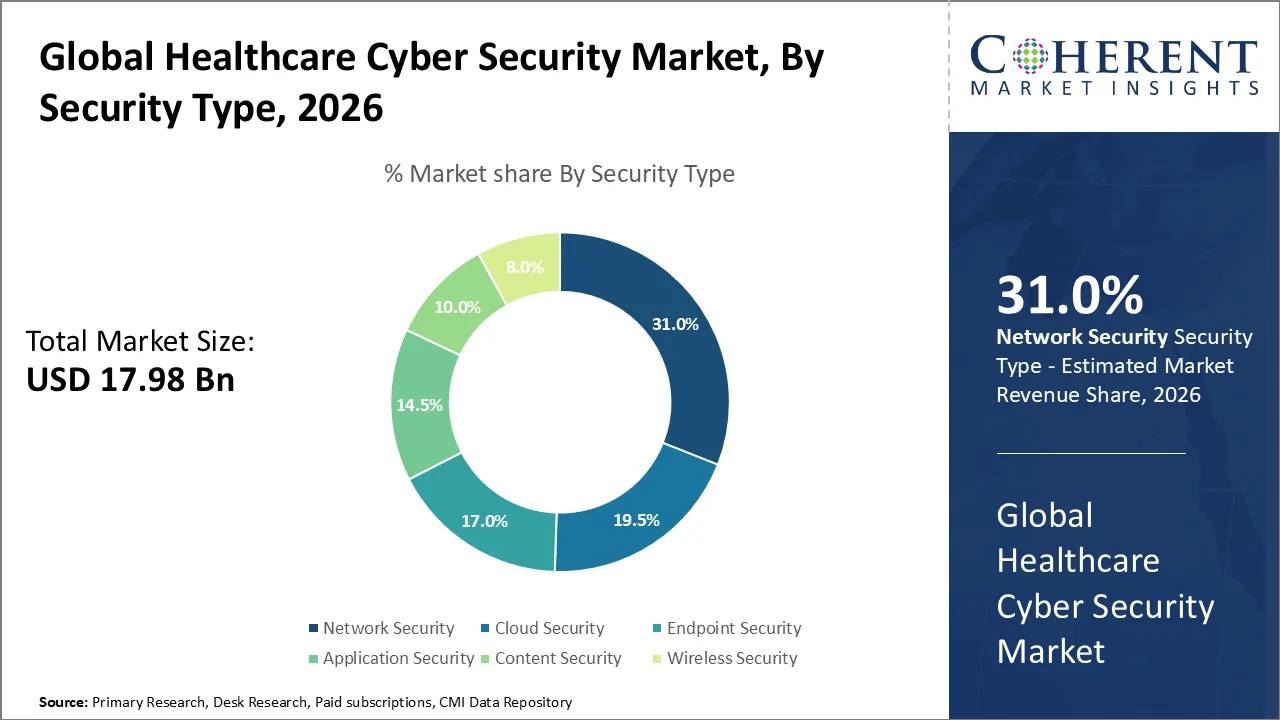
Based on Security Type Network Security segment is expected to hold the largest Healthcare Cyber Security Market share of 31.0% by 2026. The segment is growing due to the increasing need to protect hospital networks, connected medical devices, telehealth platforms, and cloud-based healthcare systems from evolving cyber threats. The rapid use of Internet of Medical Things (IoMT) devices has dramatically enlarged the healthcare attack surface, and with it the requirement for sophisticated network monitoring, segmentation and intrusion prevention tools.
According to the U.S. Food and Drug Administration (FDA) Cybersecurity Program for Medical Devices has noted, healthcare providers are working within a dynamic ecosystem of network-connected medical devices that need continual cybersecurity management.
Healthcare Cyber Security Market Trends
- The increasing usage of Zero Trust Architecture (ZTA) is changing the approach to cybersecurity in the healthcare industry. Healthcare institutions have been shifting toward an identity-based security framework to secure their data, cloud applications, remote access, and IoT devices. In addition, the Zero Trust Maturity Model of the United States’ Cybersecurity and Infrastructure Security Agency (CISA) are still fueling the implementation of zero trust architecture in healthcare institutions.
- AI-based threat detection and SOCs is a big area of investment. Healthcare firms are using artificial intelligence and machine learning to detect unusual behavior, automate incident response and decrease the burden on security analysts. The IBM Cost of a Data Breach Report 2024 revealed that organizations that had deployed AI and automation extensively in security operations experienced significantly lower costs of a breach than those that had not deployed these technologies, spurring wider adoption across healthcare institutions.
- Third-party and supply chain risk management is becoming a primary cybersecurity priority. As cyber events involving third-party companies continue to escalate, healthcare providers are taking a closer look at vendor security evaluations, software supply-chain visibility and business partner risk management. The American Hospital Association (AHA) Cybersecurity Advisory has revealed that a considerable number of recent healthcare data exposures happened in third-party environments, which has been a driving factor for vendor risk management platforms and security governance solutions.
Regional Insights
North America Dominates Owing to Advanced Healthcare Digital Infrastructure and Regulatory Cybersecurity Initiatives
North America is expected to account for approximately 39.5% of the global Healthcare Cyber Security Market in 2026. The expansion of the region is linked to the rapid digitization of healthcare, high adoption of electronic health records (EHRs), increased investments in cybersecurity, and rigorous patient data protection rules. Healthcare businesses in the U.S. and Canada are looking to zero-trust architectures, cloud security platforms, identity and access management (IAM) and medical device security solutions to secure increasingly digital healthcare ecosystems.
According to the American Hospital Association’s (AHA) 2025 Cybersecurity Year in Review found that more than 80% of stolen protected health information data were breached via third-party vendors, software providers, business associates and non-hospital entities rather than hospitals themselves.
In July 2025, Microsoft Corporation announced improved AI-driven security operations capabilities via Microsoft Security Copilot, empowering enterprises to automate threat investigations, faster incident response, and boost cybersecurity operations at scale.
Asia Pacific Healthcare Cyber Security Market Trends
Asia Pacific region will see the fastest growth for the healthcare cyber security market during the forecast period due to various factors like digital transformation in the healthcare sector, increasing telemedicine, adoption of cloud-based healthcare systems, adoption of connected medical devices, and increased government spending for ensuring cybersecurity in their critical infrastructures. Some of the countries from the region include China, India, Japan, South Korea, Singapore, and Australia, among others.
According to the Singapore Cyber Security Agency (CSA) Healthcare Cybersecurity Initiatives, healthcare is one of the key industries to be protected under national critical information infrastructure protection initiatives.
In August 2025, Trend Micro Incorporated announced an expansion of healthcare cybersecurity capabilities across the Asia-Pacific region, helping hospitals and health care providers improve cloud security, threat intelligence and connected medical device protection in an era of increasing cyber risks and healthcare digital transformation initiatives.
Growing Federal Cybersecurity Initiatives and Healthcare Infrastructure Protection are Accelerating the Market in the United States
The U.S. healthcare cyber security market is expanding at a significant rate, driven by increased digitization in healthcare, stringent cybersecurity laws, and government initiatives to improve cyber resilience in healthcare infrastructure. To address the rising cyber dangers, hospitals, health systems, insurers and healthcare technology providers are investing more in identity security, network protection, cloud security and threat detection technologies.
According to the Office of the National Coordinator for Health Information Technology (ONC), 78% of U.S. hospitals are actively participating in all four domains of interoperable electronic health information exchange: sending, receiving, discovering, and integrating patient data. As healthcare interoperability grows, enterprises are investing in cybersecurity solutions to safeguard data sharing networks, cloud platforms and linked healthcare ecosystems.
In May 2026, CrowdStrike Holdings, Inc. announced new healthcare-focused updates to its Falcon cybersecurity platform, further extending AI-powered threat hunting, identity protection and medical device visibility features.
Rapid Digital Health Expansion and National Data Security Regulations are Driving Market Growth in China
Chinese Healthcare Cyber Security Market is witnessing fast growth owing to digitalization of the healthcare sector, deployment of smart hospitals, application of AI-based healthcare solutions, and cyber security laws in the country. The growing adoption of cloud computing, telemedicine platforms, EMR systems, and connected healthcare technologies is increasing demand for cybersecurity solutions.
Furthermore, China has over 3,000 internet hospitals as of 2024, reflecting the rapid expansion of telemedicine, online healthcare services, and digital patient engagement platforms.
In September 2025, during HUAWEI CONNECT 2025 in Shanghai, Huawei Technologies Co., Ltd. and Zhongshan Hospital launched the Global Showcase for Intelligent Healthcare.
Who are the Major Companies in Healthcare Cyber Security Industry
Some of the major key players in Healthcare Cyber Security Market are IBM Corporation, Lockheed Martin Corporation, Cisco Systems, Inc., Northrop Grumman Corporation, Intel Security Group (McAfee), CA, Inc., Booz Allen Hamilton Inc., Computer Sciences Corporation, Symantec Corporation, and Trend Micro Incorporated.
Key News
- In June 2025, Cisco announced new AI-driven security innovations across its Security Cloud platform, including enhancements to Cisco XDR and Splunk integration capabilities.
- In April 2025, IBM Corporation announced autonomous security operations capabilities powered by Agentic AI through enhancements to its IBM QRadar Suite. The new AI-driven security agents are designed to autonomously investigate alerts, execute threat-hunting activities, prioritize vulnerabilities, and accelerate incident response workflows.
Market Report Scope
Healthcare Cyber Security Market Report Coverage
| Report Coverage | Details | ||
|---|---|---|---|
| Base Year: | 2025 | Market Size in 2026: | USD 17.98 Bn |
| Historical Data for: | 2020 To 2024 | Forecast Period: | 2026 To 2033 |
| Forecast Period 2026 to 2033 CAGR: | 14.2% | 2033 Value Projection: | USD 45.51 Bn |
| Geographies covered: |
| ||
| Segments covered: |
| ||
| Companies covered: | IBM Corporation, Lockheed Martin Corporation, Cisco Systems, Inc., Northrop Grumman Corporation, Intel Security Group (McAfee), CA, Inc., Booz Allen Hamilton Inc., Computer Sciences Corporation, Symantec Corporation, and Trend Micro Incorporated | ||
| Growth Drivers: |
| ||
| Restraints & Challenges: |
| ||
Analyst Opinion
- The Healthcare Cyber Security Market is experiencing continuous expansion as healthcare businesses are putting more emphasis on cyber resilience in the context of increased digitization and changing threat landscapes. According to the American Hospital Association (AHA) Cybersecurity Survey, cybersecurity has become a board-level concern for hospitals as risks to healthcare infrastructure, patient data and linked medical equipment continue to increase. This trend is spurring investments in threat detection, identity security and cyber risk management technologies.
- Healthcare cybersecurity is shifting from a compliance role to a strategic operational need. The IBM Cost of a Data Breach Report 2024 revealed that the healthcare industry had the highest average cost of a data breach across all industries, with an average cost of USD 9.77 million per incident, marking the 14th consecutive year the sector has placed highest. Increasing financial impact of cyber events is forcing healthcare organizations to increase cyber security efforts and deploy proactive security technologies.
- The increasing growth of healthcare ecosystems that are connected is driving demand for cybersecurity solutions that are more advanced in the long term. As per the Journal of Medical Internet Research (JMIR), there were over 3,000 internet hospitals in China by the year 2024.
Speak to the analyst
Want personalized insights?
Take the findings above to one of our principal consultants, or have the report rebuilt around the segments, geographies and competitors you actually track.
Market Segmentation
- By Type (Revenue, USD Bn, 2021-2033)
- Solution
- Risk and Compliance Management
- Identity and Access Management
- Data Loss Protection
- Intrusion Detection System (IDS)/Intrusion Prevention System (IPS)
- Security Information and Event Management (SIEM)
- Unified Threat Management
- Others
- Services
- Managed Security Services
- Deployment & Integration
- Support & Maintenance
- Solution
- By Security Type (Revenue, USD Bn, 2021-2033)
- Network Security
- Application Security
- Endpoint Security
- Cloud Security
- Content Security
- Wireless Security
- Global Healthcare Cyber Security Market , By Region (Revenue, USD Bn, 2021-2033)
- North America
- U.S.
- Canada
- Latin America
- Brazil
- Mexico
- Argentina
- Rest of Latin America
- Europe
- Germany
- U.K.
- France
- Italy
- Spain
- Russia
- Rest of Europe
- Asia Pacific
- China
- India
- Japan
- Australia
- South Korea
- ASEAN
- Rest of Asia Pacific
- Middle East
- GCC
- Israel
- Rest of Middle East
- Africa
- South Africa
- Central Africa
- North Africa
- North America
- Key Players
- IBM Corporation
- Lockheed Martin Corporation
- Cisco Systems, Inc.
- Northrop Grumman Corporation
- Intel Security Group (McAfee)
- CA, Inc.
- Booz Allen Hamilton Inc.
- Computer Sciences Corporation
- Symantec Corporation
- Trend Micro Incorporated
Sources
Primary Research Interviews
- Healthcare Cybersecurity Solution Providers
- Healthcare IT Security Vendors
- Hospital CIOs & CISOs
- Healthcare IT Directors & Security Managers
- Health Information Management Professionals
- Managed Security Service Providers (MSSPs)
- Healthcare Cloud Service Providers
- Medical Device Security Specialists
- Cybersecurity Consultants & Risk Management Experts
- Healthcare Regulatory & Compliance Professionals
- Others
Databases
- Bloomberg Terminal
- S&P Global Market Intelligence
- Gartner
- IDC
- Frost & Sullivan
- D&B Hoovers
- PitchBook
- Crunchbase
- Statists
- Others
Magazines
- Healthcare IT News
- HealthTech Magazine
- SC Media
- Cybersecurity Dive
- Information Security Magazine
- CIO Magazine
- Healthcare Innovation
- Others
Journals
- Journal of Cybersecurity
- International Journal of Medical Informatics
- Journal of Healthcare Information Management
- Journal of Medical Internet Research (JMIR)
- IEEE Security & Privacy
- Health Security Journal
- BMC Medical Informatics and Decision Making
- Others
Newspapers
- The Wall Street Journal
- Financial Times
- Reuters
- Bloomberg News
- The New York Times
- The Economic Times
- Business Standard
- Others
Associations
- Health Information Sharing and Analysis Center (Health-ISAC)
- Healthcare Information and Management Systems Society (HIMSS)
- American Hospital Association (AHA)
- Health Sector Coordinating Council (HSCC)
- Information Systems Security Association (ISSA)
- ISACA
- Others
Public Domain Sources
- U.S. Department of Health and Human Services (HHS)
- Cybersecurity and Infrastructure Security Agency (CISA)
- Federal Bureau of Investigation (FBI) Internet Crime Complaint Center (IC3)
- Office of the National Coordinator for Health Information Technology (ONC)
- U.S. Food and Drug Administration (FDA)
- National Health Commission of China (NHC)
- Cyber Security Agency of Singapore (CSA)
- World Health Organization (WHO)
- OECD Health Statistics
- World Bank Open Data
- Others
Proprietary Elements
- CMI Data Analytics Tool, Proprietary CMI Existing Repository of Information for the Last 10 Years
Get access to 250+ pages report
Every segment, forecast, competitor profile and data table behind the analysis above — available for instant download.
- ESOMAR Member
- ISO 9001:2015 Certified
- D-U-N-S Registered
- GDPR & CCPA Compliant
Missing comfort of reading report in your local language? Find your preferred language:
Transform your Strategy with Exclusive Trending Reports
Frequently Asked Questions
The Healthcare Cyber Security Market is expected to reach USD 45.51 Billion by 2033, growing from USD 17.98 Billion in 2026.
Major players operating in the global Healthcare Cyber Security Market include IBM Corporation, Lockheed Martin Corporation, Cisco Systems, Inc., Northrop Grumman Corporation, McAfee, CA Technologies, Booz Allen Hamilton Inc., Computer Sciences Corporation, Symantec Corporation, and Trend Micro Incorporated.
The increasing sophistication of ransomware and cyberattacks, shortage of skilled cybersecurity professionals in healthcare, legacy healthcare IT systems, high implementation costs, and growing third-party cybersecurity risks are the key factors hampering market growth.
The rising healthcare data breaches and ransomware attacks, increasing adoption of electronic health records (EHRs), expansion of telehealth services, growth in connected medical devices (IoMT), healthcare digital transformation initiatives, and stringent data privacy regulations are driving market growth.
The Healthcare Cyber Security Market is anticipated to grow at a CAGR of 14.2% between 2026 and 2033.
Healthcare organizations are investing in cybersecurity solutions to protect sensitive patient data, secure connected medical devices, prevent ransomware attacks, ensure regulatory compliance, safeguard telehealth platforms, and maintain operational continuity across healthcare networks.
The market outlook remains highly positive as healthcare providers continue to adopt cloud technologies, telemedicine platforms, AI-powered healthcare applications, connected medical devices, and zero-trust security frameworks, thereby increasing demand for advanced cybersecurity solutions.