

Robotics Ethics Market Size and Forecast — 2026-2033
The Global Robotics Ethics Market is estimated to be valued at US$ 3.66 Bn in 2026 and is expected to reach US$ 7.86 Bn by 2033, exhibiting a compound annual growth rate (CAGR) of 13.6% from 2026 to 2033.
Key Takeaways of the Global Robotics Ethics Market:
- The healthcare & medical robotics segment is expected to lead the market holding a share of 31.6% in 2026, due to rapid innovation and adoption in this sector.
- The data privacy & consent segment is projected to dominate with a share of 35.3% in 2026 as robots, AI systems, and smart devices collect increasingly personal information.
- North America is estimated to lead the market with a share of 34.8% in 2026, due to strong government funding.
- Asia Pacific, holding a share of 26.3% in 2026, is projected to be the fastest growing region, driven by rapid industrial automation adoption.
Market Overview:
With the increasing adoption of robots across industry verticals, concerns around the ethical use and development of AI and robotics technologies have also risen. Various guidelines and regulations are being introduced around the world such as the European Union AI Act, a landmark regulation establishing a comprehensive framework for artificial intelligence, to ensure responsible development and use of emerging technologies.
Current Events and Their Impact
Current Events | Description and its impact |
Increased Regulatory Focus on AI and Robotics Ethics in Europe (Regional policy event) |
|
Continued Development of Autonomous Weapon Systems (Geopolitical/Macro-level) |
|
by Application
Global Robotics Ethics Market, by Application – Healthcare & Medical Robotics Drives Significant Growth
The healthcare & medical robotics segment is expected to contribute the highest share of 31.6% in the global robotics ethics market in 2026 due to rapid innovation and adoption in this sector. Robotic technologies are transforming patient care by improving surgical accuracy, assisting in rehabilitation, and helping provide independent living for elderly and disabled populations. Surgical robots allow for minimally invasive procedures and greater control and precision than open or laparoscopic surgery. This results in less pain and scarring for patients while also reducing recovery time. Rehabilitation robots actively participate in physical therapy by assisting with exercises and building strength.
by Ethical Concern
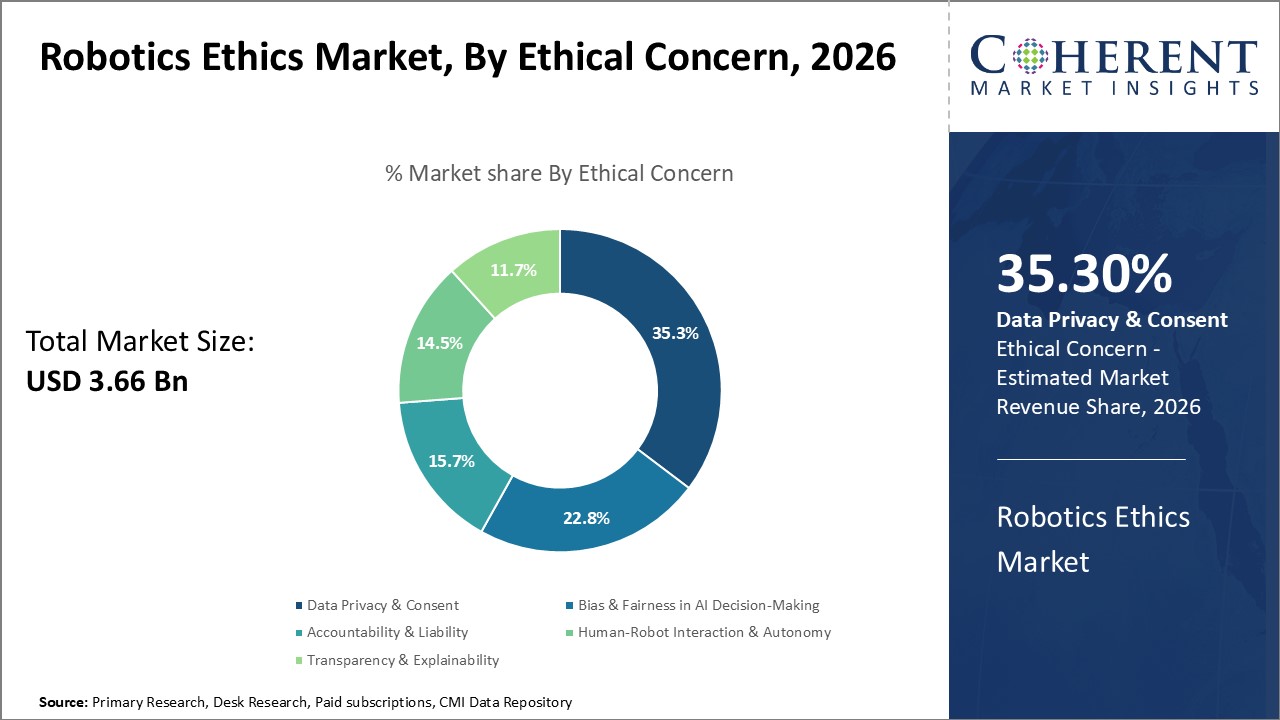
Global Robotics Ethics Market, by Ethical Concern – Data Privacy & Consent Fuels Concerns in Global Robotics Ethics Market
The data privacy & consent segment is expected to play a major role in driving the global robotics ethics market, holding a share of 35.3% in 2026. As robots, AI systems, and smart devices collect increasingly personal information, ensuring secure data handling and meaningful consent becomes paramount. Biometric scans, location tracking, health records, household habits, and others end up residing in electronic databases. However, privacy regulations and security protocols have struggled to keep pace with advancing technologies. High-profile data breaches continue eroding public trust.
Meanwhile, complex data usages and opaque algorithms make “consent” vague. People may agree to vague terms without understanding eventual data applications and implications. These privacy and consent challenges could stall robotic adoption if left unaddressed. To promote continued innovation, companies face pressures to implement “Privacy by Design” measures, bolster cybersecurity safeguards, provide robust transparency about information use, and devise innovative solutions for flexible, granular consent models. Addressing data ethics proactively helps reassure people and maintains responsible development and use of transformative robotic technologies.
Role of Artificial Intelligence (AI) in the Robotics Ethics Market
Artificial Intelligence (AI) is not just a core component of modern robotics—it is also a key catalyst in shaping the ethical frameworks that govern the industry. As robots become more autonomous and integrated into daily life, AI is playing a critical role in ensuring their behavior aligns with human values, safety standards, and regulatory expectations.
One of the most pivotal applications of AI in the robotics ethics space is in ethical decision-making algorithms. These systems enable robots to assess complex scenarios—particularly in healthcare, defense, and autonomous mobility—and make choices that reflect ethical principles such as fairness, harm prevention, and informed consent. For instance, Intuitive Surgical’s da Vinci robotic system, used in minimally invasive surgeries, employs AI-driven learning modules to assist surgeons while adhering to strict operational and ethical guidelines, reducing the likelihood of human error and increasing patient safety.
Regional Insights
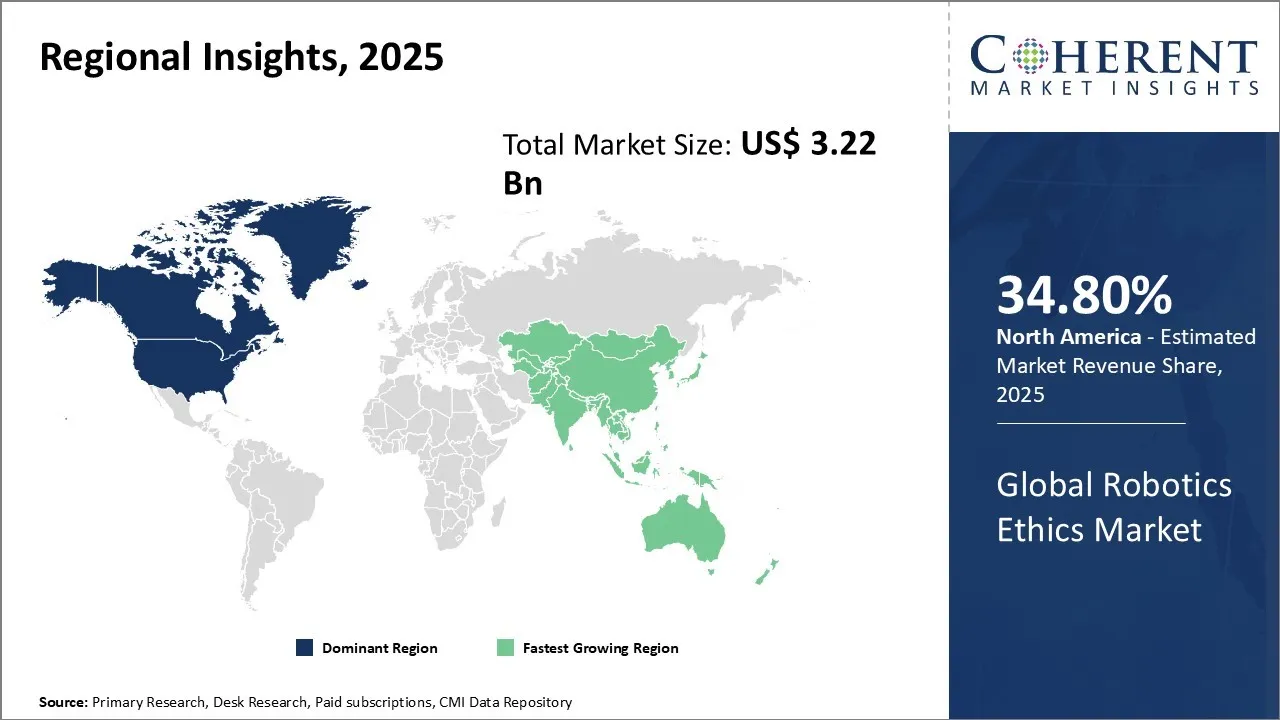
North America Robotics Ethics Market Analysis and Trends
North America, holding a share of 34.8% in 2026, is expected to dominate the robotics ethics market, which can be attributed to strong government funding and support for R&D activities. Countries like the U.S. have declared their plans to embrace and leverage new technologies like artificial intelligence and robotics through initiatives such as National Robotics Initiative 2.0. This has encouraged local companies as well as global players to invest heavily in this region. Some of the notable companies in the North America robotics ethics market include Anthropic, OpenAI and Albert Technologies.
Asia Pacific Robotics Ethics Market Analysis and Trends
The Asia Pacific region, holding a share of 26.3% in 2026, is expected to exhibit the fastest growth in the robotics ethics market, driven by rapid industrial automation, especially across industries like automotive, electronics and healthcare. Countries like China, Japan and South Korea are major manufacturing hubs with a large industrial base. Furthermore, improving connectivity infrastructure and declining hardware costs have made industrial robots an attractive option for small and medium enterprises in the region. Governments are also promoting robotics through initiatives supporting Science, Technology, Engineering, and Mathematics (STEM) education and innovation. Major market players from Asia Pacific include TECHMAN Robots, Exscientia and Eight360.
Robotics Ethics Market Outlook for Key Countries
U.S. Robotics Ethics Market Analysis and Trends
The U.S. robotics ethics market is at the forefront of developing robust policies and frameworks around emerging technologies. Technological advancements are supporting increased deployment of collaborative robots across sectors. Main players like OpenAI are working with policymakers to ensure legal and ethical compliance of AI systems.
China Robotics Ethics Market Analysis and Trends
China robotics ethics market continues to see exponential rise in industrial automation due to low labor costs and growing domestic demand. Chinese tech giants including Baidu, Alibaba and Tencent are investing in AI safety research. However, ensuring data privacy remains a challenge due to regulatory differences compared to Western nations.
Japan Robotics Ethics Market Analysis and Trends
Japan continues to lead with collaborative and service robots adoption in industries like healthcare, agriculture and logistics. The government is strongly focused on innovation-led growth through initiatives like Society 5.0. Major stakeholders include SoftBank, Toyota, and Panasonic that are advancing robotics R&D activities.
Germany Robotics Ethics Market Analysis and Trends
Germany robotics ethics market is characterized by strong manufacturing capabilities in industrial machinery and automotive domains. Key participants include Deutsche Telekom, Robert Bosch, and Siemens that are promoting responsible and trustworthy AI product development. Researchers are addressing societal aspects around human-robot interaction.
Market Players, Key Development, and Competitive Intelligence
Key Developments:
- On March 2025, Hexagon, a player engaged in precision technologies, launched a new Robotics division, leveraging its industry-leading expertise in measurement technologies, AI, and autonomous systems to advance humanoid robotics.
- In September 2023, The Robotics and AI Institute, an organization that aims to solve the most important and fundamental problems in robotics and AI, hired Dr. Kate Darling to lead its study of ethics and societal impact. In this role, Darling led a team of researchers to explore key societal questions related to the development of intelligent machines.
- In October 2022, six robotics companies, Boston Dynamics, Agility Robotics, ANYbotics, Clearpath Robotics, Open Robotics, and Unitree, published an open letter to the robotics industry, in which they recognized that ‘adding weapons to robots that are remotely or autonomously operated, widely available to the public, and capable of navigating to previously inaccessible locations where people live and work, raises ‘new risks of harm and serious ethical issues.’ In the letter, they pledged that they ‘will not weaponize our advanced-mobility general-purpose robots or the software we develop that enables advanced robotics and we will not support others to do so.’
- In September 2021, the University of Texas at Austin launched a program called CREATE (Convergent, Responsible, and Ethical AI Training Experience for Roboticists). It offers graduate coursework and professional development in responsible design and implementation.
Top Strategies Followed by Global Robotics Ethics Market Players
- Established Players: Established players focus heavily on research and development to continuously innovate and stay ahead of the competition. Companies like Robotics Tech invest over 15% of their annual revenues into R&D. Strategic partnerships are also crucial.
- Robotica, a global leader, partners with IBM to develop AI-powered inspection robots. They also collaborate with local startups to customize products for regional needs.
- Mid-level Players: Mid-level players often pursue cost-effective strategies to attract price-sensitive customers. PBC Robotics keeps costs low through efficient manufacturing processes and uses competitive sourcing for key components. Roboizen partners with other mid-sized firms to gain bulk production and purchasing benefits. Their alliance with Mech Tech has allowed shared R&D efforts, reducing individual costs.
- Small-scale Players: Small players focus on niche areas. Neuretics Robotics has found success in medical robotics using patented haptic technology for minimal invasive surgeries. BugBotic specializes in precision farming robots targeted at small landholdings.
- Current Industry Events of 2026
- Market Size Estimation
- Regional Breakdown
- Competitive Landscape
- Customer Intelligence
- Segmental Analysis
- Pricing Analysis
- Key Market Drivers, Challenges & Future Trends
- Customized Insights Section
Market Report Scope
Robotics Ethics Market Report Coverage
| Report Coverage | Details | ||
|---|---|---|---|
| Base Year: | 2025 | Market Size in 2026: | USD 3.66 Bn |
| Historical Data for: | 2020 To 2024 | Forecast Period: | 2026 To 2033 |
| Forecast Period 2026 to 2033 CAGR: | 13.6% | 2033 Value Projection: | USD 7.86 Bn |
| Geographies covered: |
| ||
| Segments covered: |
| ||
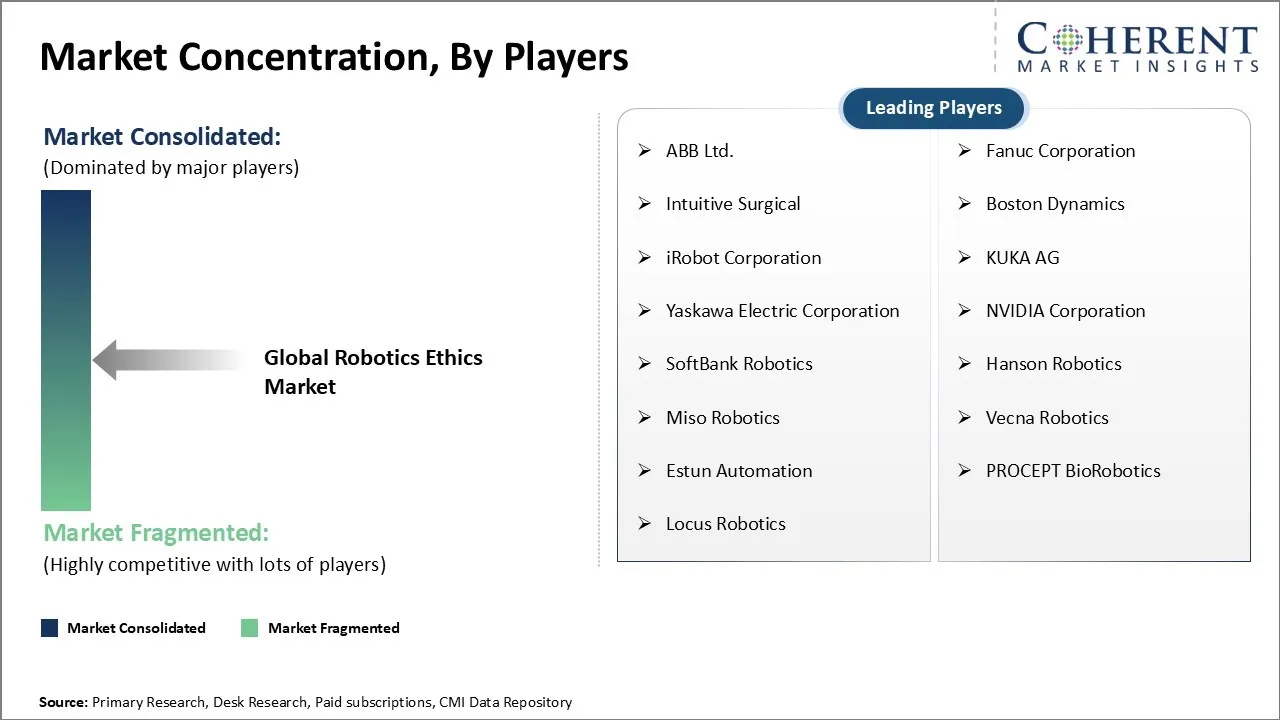
| Companies covered: | ABB Ltd., Fanuc Corporation, Intuitive Surgical, Boston Dynamics, iRobot Corporation, KUKA AG, Yaskawa Electric Corporation, NVIDIA Corporation, SoftBank Robotics, Hanson Robotics, Miso Robotics, Vecna Robotics, Estun Automation, PROCEPT BioRobotics, and Locus Robotics | ||
| Growth Drivers: |
| ||
| Restraints & Challenges: |
| ||
Market Dynamics
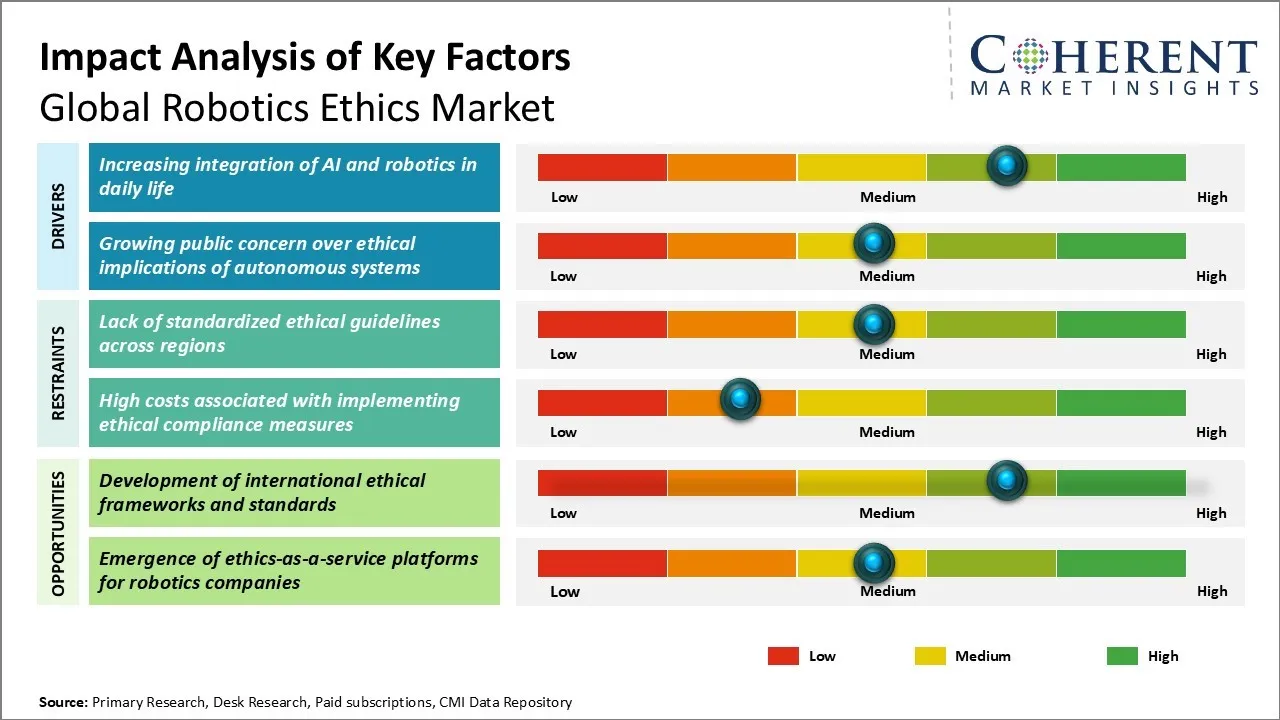
Global Robotics Ethics Market Driver - Increasing integration of AI and robotics in daily life
The advancement of artificial intelligence and robotics technologies is rapidly increasing the integration of robotic systems into various aspects of daily life. Robots are being developed to assist humans in many tasks across industries like healthcare, agriculture, manufacturing, logistics, and others. As robots are deployed more widely to interact and work alongside humans, it is raising issues regarding their ethical and social impacts. As the interaction between humans and robots becomes more direct and frequent, there is a need to establish principles and guidelines to address these ethical concerns and build public trust in the emerging technologies. The growing integration of AI-enabled robotics in day-to-day lives is therefore expected to drive greater attention to and demand for defining ethical standards for responsible robotics development and use.
Global Robotics Ethics Market Opportunity - Development of international ethical frameworks and standards for market
One of the key opportunities for the global robotics ethics market is the development of common international ethical frameworks and standards. If various stakeholders including governments, academic institutes, private organizations, and technology developers are able to come together and formulate harmonized ethical guidelines addressing technologies' societal and human impacts, it can help streamline research and innovation on a global scale. Agreement on universal ethical principles around issues such as data governance, responsible innovation, environmental stewardship and inclusiveness can provide much-needed direction to businesses operating in different cultural contexts. This can further boost cross-border partnerships, pooling of resources and sharing of best practices. Ultimately, synchronized ethical standards upholding guidelines like transparency, safety, and accountability can help build necessary public trust for technologies to be accepted and contribute broadly to improving lives worldwide.
Analyst Opinion (Expert Opinion)
- The global robotics ethics market is not just expanding—it is evolving, and quickly. This is the result of the tidal wave of AI integration across industries—from healthcare to defense. But what makes the ethics layer especially crucial is its direct impact on public trust and regulatory compliance. Without it, innovation in robotics could hit a wall of societal resistance.
- Around 70% of industrial robotics companies in Europe are either developing or actively implementing AI ethics guidelines, according to recent Eurostat data. One particularly noteworthy shift is in funding. Venture capital is being directed toward “ethics-first” robotics companies with companies like Agility Robotics and Replikant Systems receiving large rounds specifically tied to their commitment to ethical AI development.
- Asia Pacific, while still building regulatory cohesion, is catching up at lightning speed. For example, Japan’s Ministry of Economy, Trade and Industry (METI) launched a new certification program in 2024 for ethical robotics design—a bold move that could push the region’s growth beyond the currently projected 20% market share.
Speak to the analyst
Want personalized insights?
Take the findings above to one of our principal consultants, or have the report rebuilt around the segments, geographies and competitors you actually track.
Market Segmentation
- Application Insights (Revenue, US$ Bn, 2021 - 2033)
- Healthcare & Medical Robotics
- Autonomous Vehicles (AVs)
- Industrial & Collaborative Robots
- Defense & Security Robotics
- Consumer & Service Robots
- Ethical Concern Insights (Revenue, US$ Bn, 2021 - 2033)
- Data Privacy & Consent
- Bias & Fairness in AI Decision-Making
- Accountability & Liability
- Human-Robot Interaction & Autonomy
- Transparency & Explainability
- Regional Insights (Revenue, US$ Bn, 2021 - 2033)
- North America
- U.S.
- Canada
- Latin America
- Brazil
- Argentina
- Mexico
- Rest of Latin America
- Europe
- Germany
- U.K.
- Spain
- France
- Italy
- Russia
- Rest of Europe
- Asia Pacific
- China
- India
- Japan
- Australia
- South Korea
- ASEAN
- Rest of Asia Pacific
- Middle East
- GCC Countries
- Israel
- Rest of Middle East
- Africa
- South Africa
- North Africa
- Central Africa
- North America
- Key Players Insights
- ABB Ltd.
- Fanuc Corporation
- Intuitive Surgical
- Boston Dynamics
- iRobot Corporation
- KUKA AG
- Yaskawa Electric Corporation
- NVIDIA Corporation
- SoftBank Robotics
- Hanson Robotics
- Miso Robotics
- Vecna Robotics
- Estun Automation
- PROCEPT BioRobotics
- Locus Robotics
Sources
Primary Research Interviews:
Stakeholders:
- AI and Robotics Companies (e.g., Ethics Officers, CTOs, Heads of AI Compliance)
- Robotics Hardware and Software Manufacturers (e.g., NeuralCore, BioSync, etc.)
- Ethicists and Philosophers from Technology Think Tanks
- Autonomous Vehicle & Drone Manufacturers
- Tech Policy Advisors and Government Regulators
- Professors and Researchers in AI, Robotics, and Ethics from Global Universities
Databases:
- Global Robotics Consortium Database
- United Nations Centre for Robotics and AI (UNCRA)
- OpenRobotics Knowledge Base
- Ministry of Digital Affairs (Japan)
- Robotics and AI Development Registry (RAIDR)
Magazines:
- Future Robotics Review
- Autonomous Intelligence Magazine
- Ethics in Tech Weekly
- Global Robotic Times
- The AI & Automation Gazette
Journals:
- Journal of Ethical AI Systems
- Robotics Policy and Compliance Quarterly
- Journal of Machine Learning & Autonomous Behavior
- AI & Human Values Journal
- Journal of Emerging Robotics Regulation
Newspapers:
- The Tech Daily Chronicle
- Robotics Business News International
- AI Watch Global
- The Innovator’s Tribune
- The Asia Robotics Bulletin
Associations:
- Global Council for Ethical Robotics (GCER)
- International Federation of Robotics (IFR)
- The Society for the Ethical Advancement of AI (SEAAI)
- North American Robotics Association (NARA)
- AI Ethics and Safety Initiative (AESI)
Public Domain Sources:
- World Economic Forum (Robotics and AI Reports)
- United Nations Commission on Science & Technology for Development (UNCSTD)
- Global AI Observatory (UNESCO)
- Robotics Regulation Library (RobRegLib)
- ResearchGate
Proprietary Elements:
- CMI Data Analytics Tool, Proprietary CMI Existing Repository of Information for Last 8 Years
Get access to 250+ pages report
Every segment, forecast, competitor profile and data table behind the analysis above — available for instant download.
- ESOMAR Member
- ISO 9001:2015 Certified
- D-U-N-S Registered
- GDPR & CCPA Compliant
Missing comfort of reading report in your local language? Find your preferred language:
Transform your Strategy with Exclusive Trending Reports
Frequently Asked Questions
The global robotics ethics market is estimated to be valued at US$ 3.66 Bn in 2026 and is expected to reach US$ 7.86 Bn by 2033.
The CAGR of the global robotics ethics market is projected to be 13.6% from 2026 to 2033.
Increasing integration of AI and robotics in daily life and growing public concerns over ethical implications of autonomous systems are the major factors driving the growth of the global robotics ethics market.
Lack of standardized ethical guidelines across regions and high costs associated with implementing ethical compliance measures are the major factors hampering the growth of the global robotics ethics market.
In terms of application, the healthcare & medical robotics segment is estimated to dominate the market revenue share in 2026.
ABB Ltd., Fanuc Corporation, Intuitive Surgical, Boston Dynamics, iRobot Corporation, KUKA AG, Yaskawa Electric Corporation, NVIDIA Corporation, SoftBank Robotics, Hanson Robotics, Miso Robotics, Vecna Robotics, Estun Automation, PROCEPT BioRobotics, and Locus Robotics are the major players.
North America is expected to lead the global robotics ethics market in 2026.