

Fiber Laser Market Size and Share Analysis - Growth Trends and Forecasts (2026–2033)
The Fiber Laser Market size is anticipated to grow at a CAGR of 10.8%, from USD 9.45 Bn in 2026 to approximately USD 19.37 Bn in 2033. The market’s growth is primarily driven by the increasing adoption of fiber lasers in metal cutting, welding, marking, engraving, and precision material-processing applications, along with rising demand from the automotive, aerospace, electronics, semiconductor, and industrial manufacturing sectors. Fiber lasers have an advantage in terms of high-quality beams, energy efficiency, less maintenance needs, compactness, and higher speeds than some conventional types of lasers. IPG Photonics stated that material processing products made up 85% of the company's fourth-quarter 2025 sales. Material-processing sales grew by 17% year over year.
Key Takeaways
- The infrared fiber laser segment is likely to dominate the market with approximately 72.0% share in 2026. The segment’s growth is owing to its extensive use in high-power cutting, welding, drilling, marking, engraving, and precision metal-processing applications. A 2024 Fraunhofer study reported coupling efficiencies of approximately 80% when 1,070 nm solid-state laser radiation was applied to grain-oriented electrical steel.
- The material-processing segment is set to lead the market with approximately 84.0% share in 2026. The segment’s growth is owing to the rising adoption of fiber lasers for cutting, welding, additive manufacturing, surface cleaning, marking, and micromachining across automotive, battery, electronics, and general manufacturing facilities. As a company-level demand indicator, material-processing products accounted for 88% of IPG Photonics’ total revenue in Q3 2025, while segment sales increased 6% year over year, driven by welding, additive manufacturing, cleaning, and micromachining applications.
- The Asia Pacific region is likely to dominate the Fiber Laser Market with approximately 48.0% share in 2026. The region’s dominance is owing to its large metal-fabrication base, extensive electronics and machinery production, expanding automotive manufacturing capacity, and rising deployment of automated laser-cutting and welding systems across China, Japan, South Korea, India, and Southeast Asia. According to UNIDO’s International Yearbook of Industrial Statistics 2025, Asia and Oceania accounted for 57.2% of global manufacturing value added in 2024 and 47.2% of global manufactured-goods exports.
Market Drivers
Expansion of Electric-Vehicle Battery Manufacturing Is Accelerating Fiber Laser Demand
The rapid expansion of electric-vehicle battery manufacturing is increasing demand for fiber lasers across electrode processing, cell-tab welding, busbar joining, battery-module assembly, enclosure welding, surface cleaning, and quality-control applications. Fiber lasers enable precise, high-speed, and low-distortion processing of aluminum, copper, steel, and other materials used in modern battery systems.
In June 2025, Fraunhofer ILT introduced laser processes for battery production that included the high-quality joining of copper busbars to steel cell terminals by means of a fiber laser process. Additionally, it also showcased a hybrid laser–convection electrode-drying process that reduced drying time by more than 60% without compromising product quality.
Semiconductor Capacity Expansion Is Strengthening Precision Fiber Laser Applications
Increasing investment in semiconductor fabrication, advanced packaging, power electronics, sensors, and high-performance computing is supporting demand for ultrafast and precision fiber lasers. These lasers are increasingly used for wafer marking, micromachining, drilling, trimming, selective material removal, thin-film processing, annealing, and failure-analysis sample preparation.
In July 2026, SEMI predicted that the global expenditure on wafer fabrication equipment sales would climb to 23.1%, reaching a figure of USD 143.9 billion in 2026. The spending on semiconductor testing equipment is predicted to reach USD 15.3 billion, growing 31.0%, whereas the assembly and packaging equipment is predicted to grow to USD 6.7 billion in 2026. These investments will be triggered by AI accelerators, high bandwidth memory, logic devices, packaging technology, and increased semiconductor capacity production.
Current Events and Their Impact on the Fiber Laser Market
Current Event | Description and its Impact |
EU Carbon Border Adjustment Mechanism Enters Definitive Phase (2026) |
|
U.S. Introduces Semiconductor Import Measures to Strengthen Domestic Manufacturing (2026) |
|
- Current Industry Events of 2026
- Market Size Estimation
- Regional Breakdown
- Competitive Landscape
- Customer Intelligence
- Segmental Analysis
- Pricing Analysis
- Key Market Drivers, Challenges & Future Trends
- Customized Insights Section
Segmental Insights
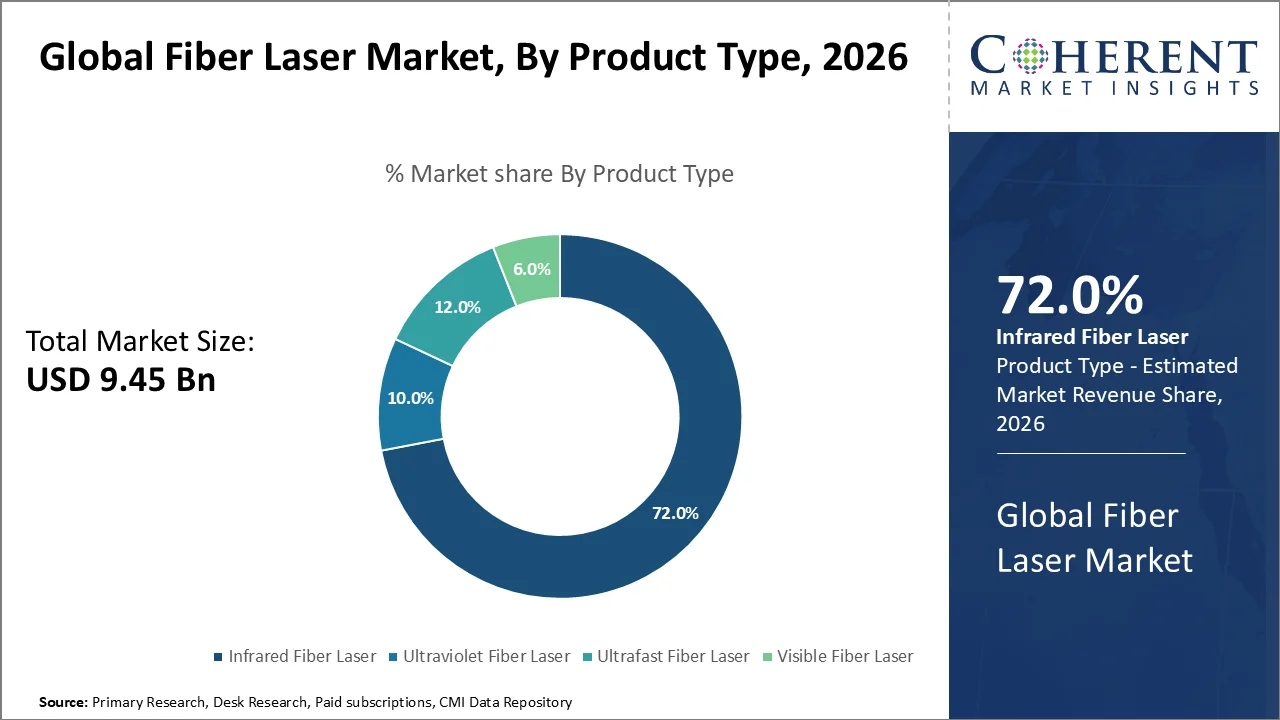
Why Is the Infrared Fiber Laser Segment Acquiring the Largest Share?
On the basis of product type, the infrared fiber laser segment is projected to account for the largest Fiber Laser Market share of approximately 72.0% in 2026. The segment’s dominance is owing to its scalability to high-power outputs, superior beam focusability, compatibility with metals and polymers, and extensive use in cutting, welding, marking, engraving, additive manufacturing, medical procedures, and precision processing.
Fraunhofer identified material processing, polymer processing, medical procedures, and optical communication as potential applications for the technology. The ability to extend infrared fiber lasers from established near-infrared industrial systems to high-performance 2 µm platforms is strengthening their technological and application leadership over visible and ultraviolet fiber lasers.
In April 2025, Fraunhofer IOF developed a thulium-based infrared fiber-laser system operating between 2,030 nm and 2,050 nm with an output power of 1.91 kW, almost twice the approximately 1.1 kW output of conventional systems. The system’s optical grating achieved efficiency exceeding 95%, while overall beam-combination efficiency surpassed 90%. These improvements demonstrate the ability of infrared fiber lasers to achieve higher power without sacrificing beam quality or focusing performance.
Material Processing Holds the Largest Market Share
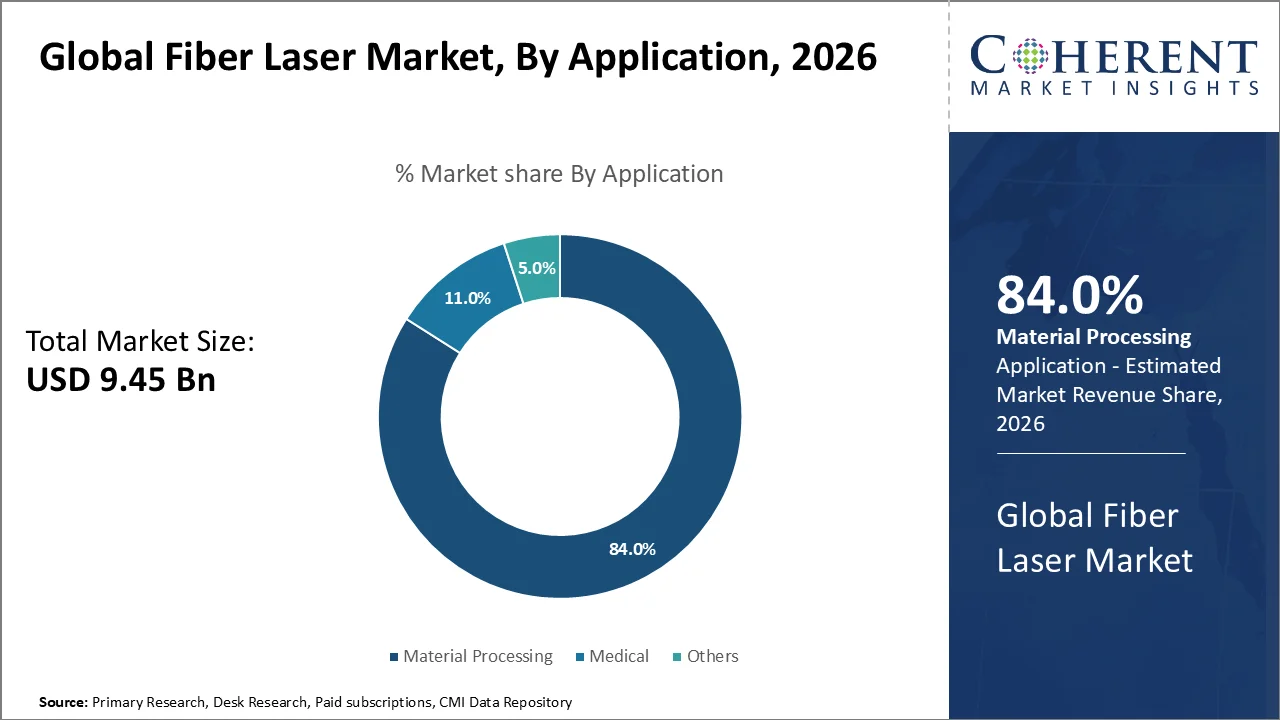
On the basis of application, the material-processing segment is projected to lead the Fiber Laser Market with approximately 84.0% share in 2026. The segment’s dominance is owing to the extensive use of fiber lasers in sheet-metal cutting, welding, drilling, marking, engraving, surface cleaning, additive manufacturing, micromachining, and component production across automotive, electronics, semiconductor, aerospace, machinery, and general manufacturing industries.
According to the World Steel Association’s April 2026 outlook, global steel demand is forecast to reach approximately 1,724 million tonnes in 2026 and increase to 1,762 million tonnes in 2027. This large volume of steel consumption creates a substantial processing base for high-speed fiber-laser cutting, welding, marking, and component-fabrication systems.
In April 2026, TRUMPF introduced an automated laser-welding solution for electric-vehicle power electronics in collaboration with Yazaki. The solution uses a 9 kW fiber laser to weld copper conductors directly onto copper busbars, replacing conventional screw connections.
Fiber Laser Market Trends
- The growing adoption of dynamic beam-shaping technology is expanding fiber-laser use in metal additive manufacturing. Modern laser powder-bed fusion systems generally use ytterbium-doped fiber lasers operating near 1,070 nm. nLIGHT’s 2 kW Corona AFX beam-shaping fiber laser enables ring-shaped and adjustable beam profiles for higher-power processing.
- The shift toward intelligent, high-power fiber-laser systems is accelerating sheet-metal processing and automated fabrication. In November 2025, Coherent introduced the EDGE CUT20 solution, combining a fiber laser with a cutting head rated for power levels of up to 20 kW. The system provides real-time focus and beam-diameter adjustment, while its integrated SmartQD monitoring technology detects piercing, loss-of-cut, and burn conditions without requiring separate external sensors.
- The increasing use of ultrafast fiber lasers is enabling precision processing of ceramics, tungsten carbide, medical tools, and other difficult-to-machine materials. In October 2025, Fraunhofer ILT introduced an ultrashort-pulse laser process that performs structuring and polishing within a single clamping operation. The process uses picosecond pulses to remove material and subsequently melts only the upper 0.2–2 micrometers of the surface for polishing, achieving processing rates of approximately 10–100 square centimeters per minute.
Regional Insights
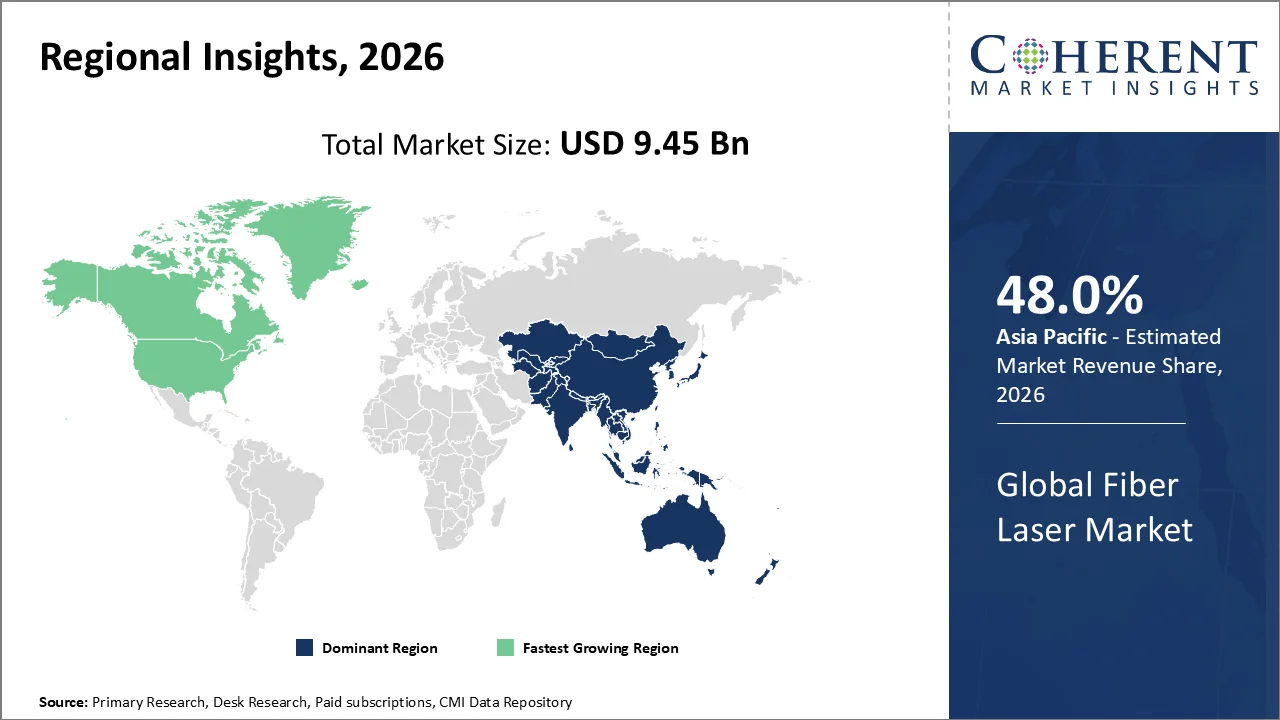
Asia Pacific Dominates Owing to Its Large Automotive and Advanced-Manufacturing Base
The Asia Pacific region is projected to account for the largest Fiber Laser Market share of approximately 48.0% in 2026. The region’s dominance is owing to its large automotive and electronics production base, expanding electric-vehicle and battery manufacturing capacity, strong semiconductor ecosystem, and increasing use of automated laser cutting, welding, marking, and micromachining systems across China, Japan, South Korea, India, and Southeast Asia.
The semiconductor manufacturing ecosystem is also strengthening regional fiber-laser demand. SEMI’s Q2 2026 World Fab Forecast identifies China as the world’s largest semiconductor fabrication-equipment spending market in 2026 and projects the country to maintain the largest installed fabrication capacity in both 2026 and 2027.
In July 2026, the Intelligent Manufacturing Expo Southeast Asia 2026 was held in Bangkok, featuring nearly 150 exhibitors across industrial automation, metal processing, robotics, semiconductor equipment, and laser technologies.
North America Is Expected to Register the Fastest Market Growth
North America is expected to register the fastest growth in the Fiber Laser Market during 2026–2033. Regional growth is owing to rapid investment in semiconductor fabrication, electric-vehicle components, aerospace and defense manufacturing, medical-device production, automated metal fabrication, and advanced manufacturing infrastructure across the United States, Canada, and Mexico.
According to the U.S. Bureau of Economic Analysis, the foreign direct investment position in the United States increased by USD 266.0 billion to USD 5.86 trillion in 2025. Manufacturing accounted for 42.8% of the total investment position, equivalent to approximately USD 2.51 trillion.
In July 2026, AMADA America opened a dedicated Welding Technology Zone at its Solution Center in Schaumburg, Illinois, to demonstrate automated fiber-laser welding, laser marking, micro-welding, resistance welding, and process-monitoring technologies to North American metal fabricators.
Industrial Automation Recovery and Domestic High-Power Laser Manufacturing are Accelerating the Fiber Laser Market in the United States
The U.S. Fiber Laser Market is gaining momentum owing to the recovery in industrial equipment demand, rising automation of cutting and welding operations, and increasing adoption across battery manufacturing, additive manufacturing, aerospace, defense, and semiconductor applications. IPG Photonics reported that its first-quarter 2026 revenue increased by 17% year over year to USD 265.5 million. Industrial Solutions accounted for 86% of total revenue and grew by 21%, supported by increased demand for fiber lasers used in welding, cutting, marking, and surface-cleaning applications. The company also recorded a 27% increase in North American sales, indicating strengthening regional demand for industrial laser technologies.
In April 2026, Aurelius Systems announced the establishment of a new U.S. manufacturing division for domestically produced high-power fiber laser source modules. Its first product will be a compact, rack-integrated, multi-kilowatt fiber laser source designed for industrial material processing and directed-energy applications.
High-End Equipment Manufacturing and Ultra-High-Power Laser Innovation are Strengthening the Fiber Laser Market in China
China is expected to maintain strong growth in the Fiber Laser Market owing to its large metal-processing base, expanding industrial automation ecosystem, and increasing use of high-power lasers in automotive, electronics, shipbuilding, aerospace, renewable energy, and heavy machinery manufacturing.
According to China’s National Bureau of Statistics, value added by the country’s equipment-manufacturing industry increased by 9.2% in 2025 and accounted for 36.8% of total value added by industrial enterprises above the designated size.
Who are the Major Companies in Fiber Laser Industry
Some of the major key players in Fiber Laser Market are TRUMPF, ROFIN-SINAR Technologies Inc., Newport Corporation., IPG Photonics Corporation, Coherent Inc., Calmar Laser Inc., AdValue Photonics, Lumentum Operations LLC, Epilog Lasers Corporation, Fujikura Ltd., Maxphotonics Co. Ltd., and Raycus Fiber Laser Technologies Co. Ltd.
Key News
- In June 2025, IPG Photonics introduced the LDD-1000-DS optical coherence tomography system for real-time monitoring of deep laser welds. The system can inspect weld keyholes at depths of up to 50 mm and supports closed-loop autofocus control.
- In April 2024, Coherent announced the continued integration of ROFIN-SINAR’s industrial laser technologies into its portfolio of marking, cutting, drilling, and welding systems.
Market Report Scope
Fiber Laser Market Report Coverage
| Report Coverage | Details | ||
|---|---|---|---|
| Base Year: | 2025 | Market Size in 2026: | USD 9.45 Bn |
| Historical Data for: | 2020 To 2024 | Forecast Period: | 2026 To 2033 |
| Forecast Period 2026 to 2033 CAGR: | 10.8% | 2033 Value Projection: | USD 19.37 Bn |
| Geographies covered: |
| ||
| Segments covered: |
| ||
| Companies covered: | TRUMPF, ROFIN-SINAR Technologies Inc., Newport Corporation., IPG Photonics Corporation, Coherent Inc., Calmar Laser Inc., AdValue Photonics, Lumentum Operations LLC, Epilog Lasers Corporation, Fujikura Ltd., Maxphotonics Co. Ltd., and Raycus Fiber Laser Technologies Co. Ltd. | ||
| Growth Drivers: |
| ||
| Restraints & Challenges: |
| ||
Analyst Opinion
- The Fiber Laser Market is entering a stronger industrial-capital-investment cycle, with demand increasingly centered on automated and high-value material-processing systems. U.S. metalworking-machinery orders reached USD 2.77 billion during January–May 2026, increasing 31.9% year over year. This indicates rising manufacturer investment in advanced cutting, welding, automation, and precision-fabrication equipment, supporting the adoption of integrated fiber-laser systems.
- Aerospace and defense are expected to remain premium growth applications because they require specialized processing of high-strength alloys and complex components. AMT reported that manufacturing-technology orders from aerospace manufacturers increased 233% in value and 125% in units during the first two months of 2026 compared with the same period in 2025. This investment trend supports demand for high-power cutting, precision welding, drilling, and laser-based additive-manufacturing systems.
- Laser-based additive manufacturing is expanding the Fiber Laser Market beyond conventional cutting and welding into mission-critical component production. NASA reported that additive manufacturing of an RS-25 engine component resulted in a 78% reduction in welds, 35% lower costs, and 80% production-time savings. NASA subsequently applied additive manufacturing to more than 30 additional engine components, demonstrating the commercial and operational value of laser powder-bed fusion and directed-energy-deposition technologies.
Speak to the analyst
Want personalized insights?
Take the findings above to one of our principal consultants, or have the report rebuilt around the segments, geographies and competitors you actually track.
Market Segmentation
- By Product Type (Revenue, USD Bn, 2021-2033)
- Ultraviolet Fiber Laser
- Infrared Fiber Laser
- Ultrafast Fiber Laser
- Visible Fiber Laser
- By Application (Revenue, USD Bn, 2021-2033)
- Material processing
- Medical
- Others
- By Region (Revenue, USD Bn, 2021-2033)
- North America
- U.S.
- Canada
- Latin America
- Brazil
- Mexico
- Argentina
- Rest of Latin America
- Europe
- Germany
- U.K.
- France
- Italy
- Spain
- Russia
- Rest of Europe
- Asia Pacific
- China
- India
- Japan
- Australia
- South Korea
- ASEAN
- Rest of Asia Pacific
- Middle East
- GCC
- Israel
- Rest of Middle East
- Africa
- South Africa
- Central Africa
- North Africa
- North America
Sources
Primary Research Interviews
- Fiber laser manufacturers and technology developers
- Laser-system integrators and automation providers
- Industrial laser cutting and welding specialists
- Photonics engineers and optical-system designers
- Metal fabrication and precision-machining companies
- Automotive and electric-vehicle component manufacturers
- Battery-cell and battery-pack production specialists
- Semiconductor and electronics manufacturing experts
- Aerospace and defense manufacturing professionals
- Medical-device manufacturing and laser-processing specialists
- Distributors and suppliers of laser sources, optics, and components
- Procurement heads from automotive, electronics, aerospace, and industrial manufacturing companies
- Key opinion leaders in photonics, laser engineering, and advanced manufacturing
Databases
- World Bank
- Organisation for Economic Co-operation and Development (OECD)
- United Nations Industrial Development Organization (UNIDO)
- UN Comtrade Database
- International Trade Centre Trade Map
- Eurostat
- U.S. International Trade Commission DataWeb
- U.S. Bureau of Economic Analysis
- U.S. Census Bureau
- European Patent Office Espacenet
- World Intellectual Property Organization PATENTSCOPE
- Google Patents
- Panjiva
- S&P Capital IQ
- D&B Hoovers
- Orbis
- EMIS
- Factiva
- PitchBook
Magazines
- The Fabricator
- Industrial Laser Solutions
- Laser Focus World
- Photonics Spectra
- PhotonicsViews
- TCT Magazine
- Additive Manufacturing Media
- Modern Machine Shop
- Metalworking World Magazine
- Manufacturing Today
Journals
- Optics & Laser Technology
- Journal of Laser Applications
- Applied Optics
- Optics Express
- Photonics Research
- Journal of Manufacturing Processes
- International Journal of Advanced Manufacturing Technology
- Lasers in Manufacturing and Materials Processing
- Precision Engineering
- Materials & Design
- Additive Manufacturing
- IEEE Photonics Technology Letters
Newspapers
- Financial Times
- The Wall Street Journal
- Reuters
- Nikkei Asia
- South China Morning Post
- The Economic Times
- The Japan Times
- The Korea Herald
- China Daily
- The Business Times Singapore
Associations
- SPIE—The International Society for Optics and Photonics
- Optica
- Laser Institute of America
- Association of Industrial Laser Users
- European Photonics Industry Consortium
- International Federation of Robotics
- SEMI
- Association for Manufacturing Technology
- German Machine Tool Builders’ Association
- World Steel Association
- International Organization of Motor Vehicle Manufacturers
- Society of Manufacturing Engineers
- America Makes
- European Association of the Machine Tool Industries
- Japan Laser Processing Society
Public Domain Sources
- Company annual reports and investor presentations
- Company product brochures and technical datasheets
- Company press releases and product-launch announcements
- Government advanced-manufacturing strategies and policy documents
- National laboratory and publicly funded research publications
- University photonics and laser-processing research reports
- Semiconductor and electronics manufacturing statistics
- Automotive and electric-vehicle production statistics
- Steel, machinery, and fabricated-metal production data
- Customs, import, and export databases for laser systems and components
- Patent databases such as WIPO, USPTO, EPO, and Google Patents
- Laser safety and machinery standards published by ISO and IEC
- Publicly available conference proceedings from SPIE and Optica
- Regulatory publications related to industrial machinery, medical lasers, and workplace laser safety
Proprietary Elements
- CMI Data Analytics Tool
- Proprietary CMI Existing Repository of Information for the Last 10 Years
Get access to 250+ pages report
Every segment, forecast, competitor profile and data table behind the analysis above — available for instant download.
- ESOMAR Member
- ISO 9001:2015 Certified
- D-U-N-S Registered
- GDPR & CCPA Compliant
Missing comfort of reading report in your local language? Find your preferred language:
Transform your Strategy with Exclusive Trending Reports
Frequently Asked Questions
The Fiber Laser Market is expected to reach approximately USD 19.37 Bn by 2033, increasing from USD 9.45 Bn in 2026.
Major players operating in the global Fiber Laser Market include TRUMPF, ROFIN-SINAR Technologies Inc., Newport Corporation., IPG Photonics Corporation, Coherent Inc., Calmar Laser Inc., AdValue Photonics, Lumentum Operations LLC, Epilog Lasers Corporation, Fujikura Ltd., Maxphotonics Co. Ltd., and Raycus Fiber Laser Technologies Co. Ltd.
High initial investment costs, expensive maintenance, specialized replacement components, complex system integration, shortages of skilled operators, and laser-safety compliance requirements are key factors hampering market growth.
Increasing adoption of fiber lasers in metal cutting and welding, rising demand from automotive and electric-vehicle manufacturing, semiconductor capacity expansion, and wider use of automated precision-processing systems are driving market growth.
The Fiber Laser Market is anticipated to grow at a CAGR of 10.8% between 2026 and 2033.
Asia Pacific is expected to dominate the global Fiber Laser Market with approximately 48.0% share in 2026, supported by its large automotive, electronics, semiconductor, machinery, and metal-fabrication industries.
North America is expected to register the fastest growth during 2026–2033, driven by investments in semiconductor fabrication, electric-vehicle components, aerospace and defense manufacturing, medical devices, and automated metal processing.