

Metrology Services Market Size and Share Analysis - Growth Trends and Forecasts (2026-2033)
The Metrology Services Market size is anticipated to grow at a CAGR of 13.8% with USD 2.01 Bn in 2026 and is expected to reach USD 4.98 Bn in 2033. The major factors are mainly determined by the rising demand for precision measuring instruments, widespread use of modern manufacturing technologies, need for quality control in the automotive industry, aerospace industry, electronics industry, and semiconductor industry, and adoption of Industry 4.0 and automation systems for inspection. According to the International Organization for Standardization (ISO), there are more than 25,000 ISO standards around the world.
Key Takeaways
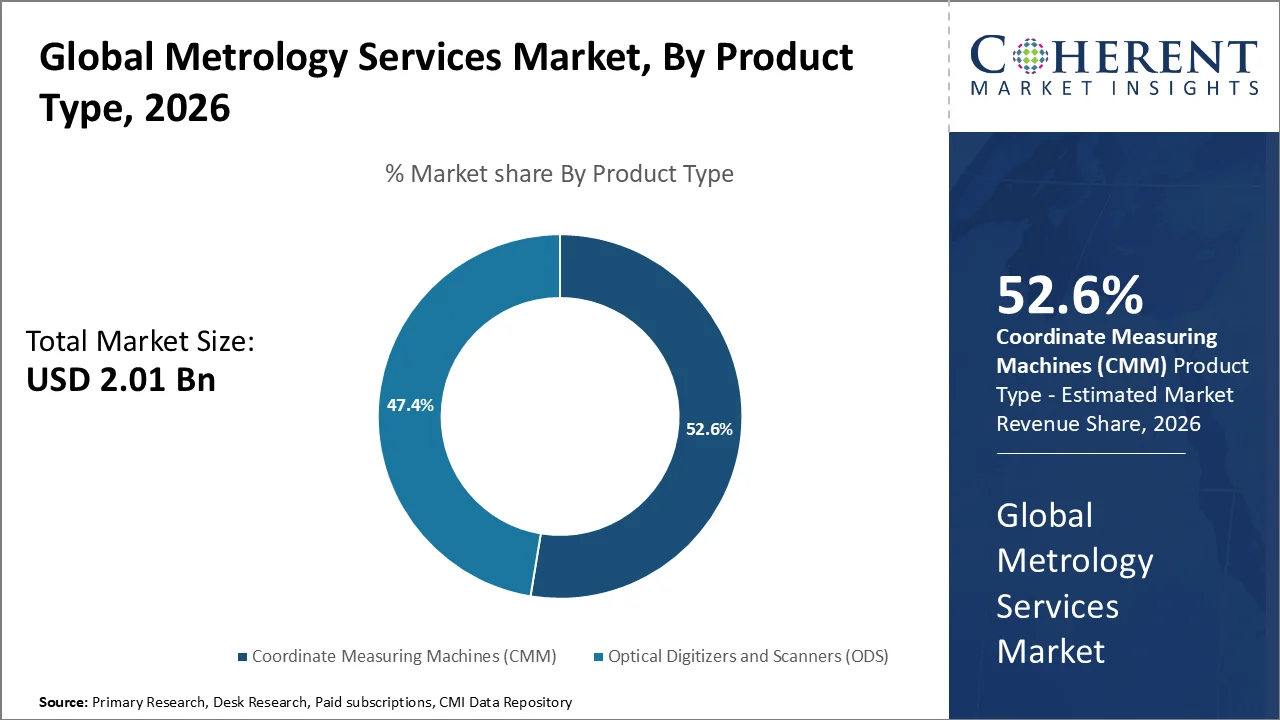
- The Coordinate Measuring Machines (CMM) market segment is expected to dominate the global market, accounting for 52.6% of the total market size in 2026. The primary driver behind the rising popularity of this market segment is its accuracy and repeatability in measuring complex geometries. Advanced measurement technologies for dimensional inspection are important for increasing manufacturing efficiency, optimizing the process, and providing dimensional data for industrial applications, as per NIST.
- The automotive segment is set to lead the Metrology Services Market by application with 32.8% share in 2026. The segment’s growth is owing to increasing vehicle electrification, rising production of precision-engineered components, and growing adoption of automated quality inspection systems. According to the International Energy Agency (IEA), global electric car sales exceeded 17 million units in 2024, increasing the need for accurate measurement and validation of batteries, electric motors, lightweight structures, and advanced vehicle components.
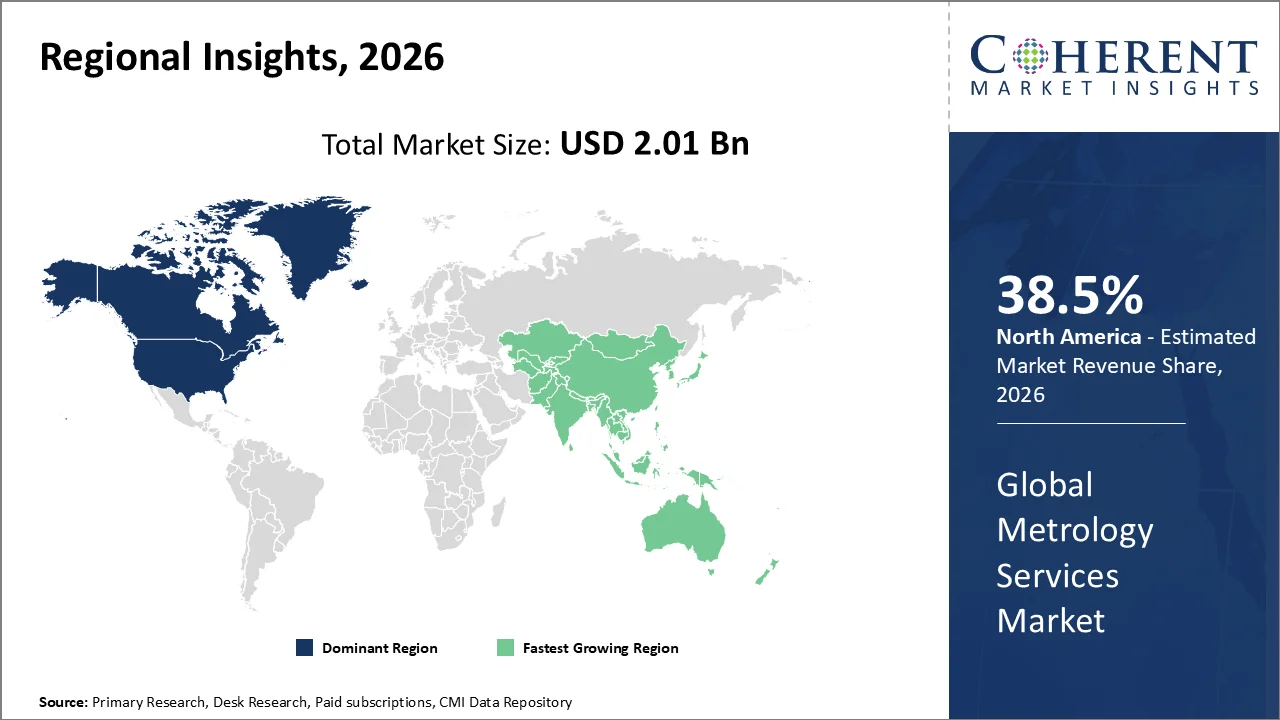
- The North America region is likely to dominate the Metrology Services Market with 38.5% share in 2026. The region’s growth is owing to the strong presence of advanced manufacturing industries, including automotive, aerospace, semiconductor, and medical device sectors, along with increasing adoption of automated inspection technologies and Industry 4.0-based quality control systems. According to the U.S. National Science and Technology Council (NSTC), the U.S. government continues to prioritize advanced manufacturing through investments in semiconductor fabrication, automation, and digital manufacturing capabilities under the National Strategy for Advanced Manufacturing.
Market Drivers
Growing Adoption of Advanced Manufacturing Technologies is Accelerating the Metrology Services Market
The Metrology Services Market is seeing high growth owing to the fast development of cutting-edge manufacturing technologies such as additive manufacturing, precision machining, semiconductor manufacturing, and production technologies using Industry 4.0. The advanced manufacturing technologies that are developed require high levels of precision in terms of measuring, inspecting, and calibrating in order to ensure dimensional accuracy, reliable products, and quality. Coordinate Measuring Machines (CMMs), optical scanners, laser trackers, and metrology automation technologies are increasingly being employed in manufacturing operations.
According to the International Federation of Robotics (IFR), the total number of industrial robots installed throughout the world stood at 542,076 units by 2024, which shows the ongoing trend of automation in manufacturing. Increased use of robotics and automated production lines is contributing to the need for metrology systems.
Semiconductor Manufacturing Expansion is Driving Demand for High-Precision Metrology Services
The rapid growth in the production of semiconductors is increasingly becoming one of the key catalysts for the Metrology Services Market owing to the growing need for nanometric measurements, wafer inspections, defect detections, and process controls. The latest generation of semiconductors requires very high levels of precision in terms of measuring capability in order to ensure that the manufacturing yields remain high.
According to the Semiconductor Industry Association (SIA), total sales in the global semiconductor industry were recorded at USD 627.6 billion in 2024, growing by 19.1% from 2023 due to the rise in demand for artificial intelligence, high-performance computing, automotive semiconductors, and more advanced chips. The growth in capacity for semiconductor fabrication facilities, especially in North America, is leading to higher demand for metrology equipment.
Current Events and Their Impact on the Metrology Services Market
Current Event | Description and its Impact |
U.S. CHIPS and Science Act Accelerates Semiconductor Manufacturing Expansion (2025–2026) |
|
Promoting Smart Factories in U.S. National Strategy for Advanced Manufacturing (2025-2026) |
|
- Current Industry Events of 2026
- Market Size Estimation
- Regional Breakdown
- Competitive Landscape
- Customer Intelligence
- Segmental Analysis
- Pricing Analysis
- Key Market Drivers, Challenges & Future Trends
- Customized Insights Section
Segmental Insights
Why are Coordinate Measuring Machines (CMM) Acquiring the Largest Share?
On the basis of product type, the Coordinate Measuring Machines (CMM) segment is projected to account for the largest Metrology Services Market share of 52.6% in 2026. The segment’s growth is owing to the high measurement accuracy, repeatability, automated inspection capabilities, and increasing adoption across automotive, aerospace, semiconductor, and industrial manufacturing applications. CMM systems are widely preferred for dimensional verification of complex components, quality assurance, reverse engineering, and compliance with strict manufacturing tolerances.
Manufacturers represented more than 62% of institute members, and 73% of those manufacturers were small and medium-sized enterprises. Many smaller manufacturers rely on external metrology laboratories because purchasing, maintaining, programming, and calibrating advanced CMM systems requires significant capital and specialized personnel.
In May 2026, Hexagon Manufacturing Intelligence introduced PC-DMIS FUSION, a real-time metrology reporting and analytics platform integrated with PC-DMIS software.
Automotive Holds the Largest Market Share
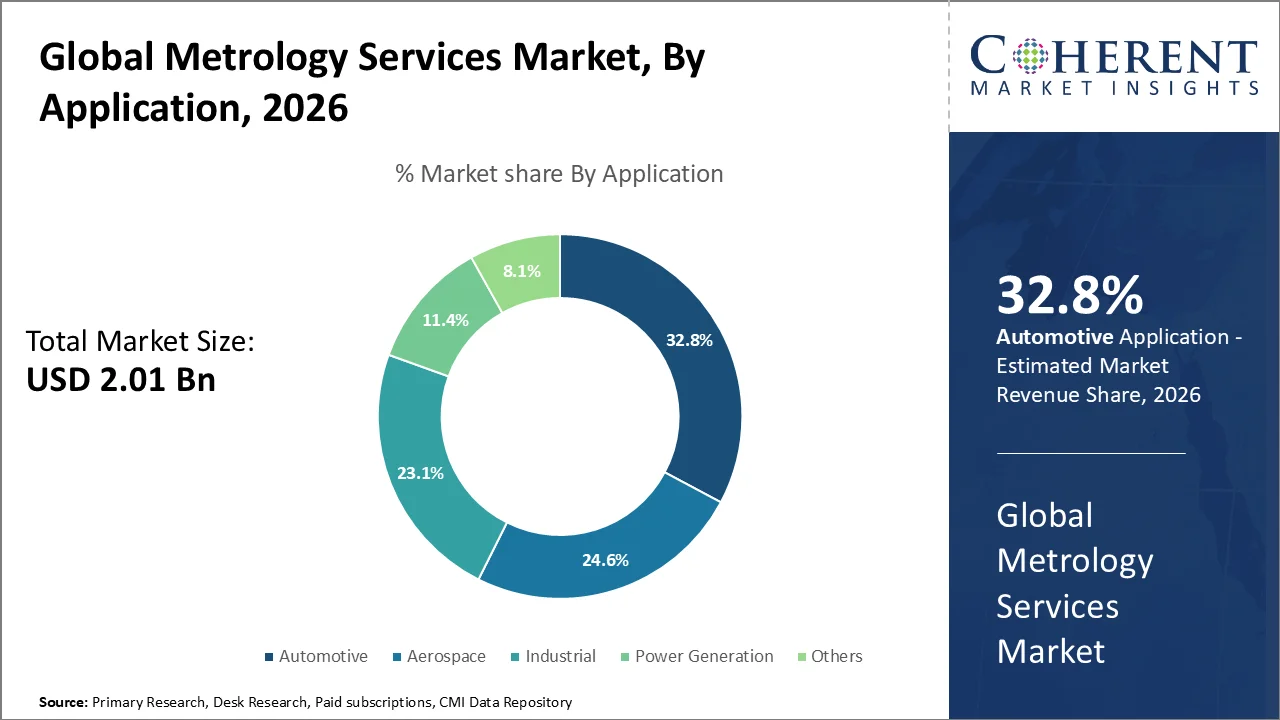
On the basis of application, the automotive segment is projected to lead the Metrology Services Market with a major 32.8% share in 2026. The segment’s growth is owing to increasing vehicle electrification, rising production of complex automotive components, strict dimensional accuracy requirements, and growing implementation of automated inspection systems in vehicle manufacturing facilities.
According to the International Organization of Motor Vehicle Manufacturers (OICA), worldwide motor-vehicle production increased from 92.7 million units in 2024 to 96.4 million units in 2025, representing growth of 3.9%. The large number of vehicles and components produced increases demand for dimensional inspection and production-line quality validation.
In June 2026, Nikon announced that its APDIS Laser Radar received global product-leadership recognition for advancing high-precision, in-line dimensional inspection in automotive production.
Metrology Services Market Trends
- The increasing adoption of automated and inline metrology is moving quality checks off of lab benches and onto factory floors. Factories are connecting CMMs, robotic inspection systems, optical scanners, and process control software to detect dimensional problems during manufacturing, not at the end of manufacturing. The International Federation of Robotics stated that in 2024, there were 542,000 robots installed around the world, while yearly installations continued to be above 500,000 for the fourth year in a row.
- The development of the production of semiconductors is resulting in greater demand for nanoscale and high-precision metrology. The latter includes the metrology demands in inspection, calibration, surface characterization, and dimension measurement in lithography, deposition, packaging, and advanced nodes. According to the Semiconductor Industry Association, total semiconductor sales globally equaled USD 791.7 billion in 2025, which marked a 25.6% increase compared to 2024. In addition, semiconductor sales rose to USD 298.5 billion in Q1 of 2026, up 25% compared to the last quarter.
- The increase in aerospace manufacturing and the order backlog is creating an increasing demand for portable and large volume metrology solutions. The aircraft manufacturer uses laser trackers, articulated arm CMM, photogrammetry, and optical scanners to measure the airframe, wing, turbine parts, tooling, and composites. Airbus manufactured 793 commercial aircraft in 2025, which was a 4% increase compared to 2024. The backlog for Airbus was 8,754 aircraft in 2025.
Regional Insights
North America Dominates Owing to its Advanced Manufacturing and Precision-Engineering Base
The North America region is projected to account for the largest Metrology Services Market share of 38.5% in 2026. The region’s dominance is supported by its extensive automotive, aerospace, semiconductor, medical-device, and advanced-machinery manufacturing base, where CMM inspection, equipment calibration, laser tracking, and dimensional verification are critical for maintaining tight production tolerances.
The U.S. semiconductor industry also directly employs more than 345,000 people and supports over 2 million additional U.S. jobs. Semiconductor fabrication and advanced packaging require highly precise measurement, surface characterization, calibration, and process-control services, strengthening North America’s metrology-services ecosystem.
In May 2026, U.S. manufacturers recorded USD 653.2 billion in shipments, increasing by 1.6% from April, while unfilled manufacturing orders reached USD 1,579.5 billion. The large volume of ongoing production and order backlogs supports recurring demand for component inspection, production-line validation, calibration, and outsourced metrology services.
Asia Pacific is Expected to be the Fastest-Growing Regional Market
The Asia Pacific Metrology Services Market is expected to register the fastest growth during 2026–2033. Growth is being driven by the region’s concentration of electronics, semiconductor, automotive, industrial-equipment, and robotics manufacturing, along with rapid adoption of automated production and in-line quality inspection.
China alone accounted for 54% of global industrial-robot installations in 2024, demonstrating the scale at which automated manufacturing and precision quality-control infrastructure are expanding within the region.
In June 2026, Cision launched PR Newswire Amplify across Asia Pacific. The AI-powered communications platform combines campaign planning, content creation, press-release distribution, amplification, and performance analysis within a unified system.
Federal Manufacturing and Semiconductor Programs are Accelerating the U.S. Metrology Services Market
The U.S. Metrology Services Market is currently experiencing robust growth due to government support towards advanced manufacturing, semiconductor manufacturing, automation, and measurement infrastructure development. There is growing demand from manufacturers for CMM inspection, calibration, surface analysis, and process control services in order to verify complex components.
In June 2025, the U.S. National Science Foundation announced a USD 25.5 million investment covering seven research grants and nine seed projects across 36 institutions and companies under its Future Manufacturing program. These projects support next-generation manufacturing technologies and workforce development, strengthening the research and industrial base for advanced measurement and automated quality-control services.
In August 2024, CHIPS for America also established the CHIPS Metrology Community of Practice to bring organizations across the semiconductor ecosystem together, advance metrology research, develop partnerships, and strengthen industry expertise.
Smart-Factory Expansion and Equipment Manufacturing Growth are Driving China’s Metrology Services Market
The China Metrology Services Market is expected to record strong growth owing to the rapid expansion of equipment manufacturing, industrial robotics, electric vehicles, electronics, and smart factories. This manufacturing scale creates substantial demand for CMM inspection, optical measurement, equipment calibration, production-line verification, and outsourced dimensional inspection.
According to China’s major machinery companies generated RMB 33.2 trillion, approximately USD 4.8 trillion, in operating revenue during 2025, representing 6.0% annual growth. Their combined profits reached RMB 1.7 trillion, increasing by 5.9%. The scale of machinery production supports recurring demand for calibration, machine-tool alignment, component verification, and CMM-based inspection services.
Who are the Major Companies in Metrology Services Industry
Some of the major key players in Metrology Services Market are Hexagon AB, Trescal SA, Optical Metrological Services, Carl Zeiss Corporation, Danish Micro Engineering A/S, Nikon Metrology Inc., FARO Technologies, Inc., Renishaw plc, and Optical Gaging Products, Inc.
Key News
- In January 2026, Trescal announced 14 acquisitions across Europe, Asia, Oceania, and the Americas, adding more than €50 million in annual sales and approximately 800 employees.
- In April 2025, FARO launched FARO Blink, a software-driven 3D reality-capture solution integrated with the FARO Sphere XG platform. The system combines automated scanning workflows, visualization, and cloud-based data processing to make 3D measurement and digital documentation more accessible.
Market Report Scope
Metrology Services Market Report Coverage
| Report Coverage | Details | ||
|---|---|---|---|
| Base Year: | 2025 | Market Size in 2026: | USD 2.01 Bn |
| Historical Data for: | 2020 To 2024 | Forecast Period: | 2026 To 2033 |
| Forecast Period 2026 to 2033 CAGR: | 13.8% | 2033 Value Projection: | USD 4.98 Bn |
| Geographies covered: |
| ||
| Segments covered: |
| ||
| Companies covered: | Hexagon AB, Trescal SA, Optical Metrological Services, Carl Zeiss Corporation, Danish Micro Engineering A/S, Nikon Metrology Inc., FARO Technologies, Inc., Renishaw plc, and Optical Gaging Products, Inc. | ||
| Growth Drivers: |
| ||
| Restraints & Challenges: |
| ||
Analyst Opinion
- Semiconductor manufacturing is expected to become one of the most technically demanding growth areas for metrology providers. The U.S. CHIPS and Science Act provided the Department of Commerce with USD 50 billion for semiconductor manufacturing and R&D programs, while NIST’s CHIPS Metrology Program is developing precise measurement capabilities for microelectronic materials, devices, circuits, and systems. This creates opportunities in nanoscale inspection, materials characterization, calibration, advanced packaging, and process-control metrology.
- The growth of smart factories will probably lead to an advantage being taken by metrology companies that integrate physical measurement along with software and remote services. Asia contributed 74% of all new industrial-robot installations in 2024, while Europe was responsible for 16%, and the Americas contributed 9%. Such concentration of automation of production facilities will result in increased needs for calibration, multi-site data management, machine alignment, and connectivity.
- Market differentiation will increasingly depend on service breadth rather than measurement hardware alone. Providers offering accredited calibration, on-site inspection, equipment maintenance, reverse engineering, CMM programming, and digital reporting under one contract are likely to gain stronger customer retention, particularly among automotive, semiconductor, aerospace, and precision-engineering manufacturers. This is an analytical inference based on the increasing automation, semiconductor investment, and aerospace production activity shown in the cited official data.
Speak to the analyst
Want personalized insights?
Take the findings above to one of our principal consultants, or have the report rebuilt around the segments, geographies and competitors you actually track.
Market Segmentation
- By Product Type (Revenue, USD Bn, 2021-2033)
- Coordinate Measuring Machines (CMM)
- Gantry machines
- Bridge machines
- Articulated arm machines
- Horizontal arm machines
- Optical Digitizers and Scanners (ODS)
- 3D laser scanners
- White light scanners
- Laser trackers
- Coordinate Measuring Machines (CMM)
- By Application (Revenue, USD Bn, 2021-2033)
- Automotive
- Aerospace
- Industrial
- Power generation
- Others
- By Region (Revenue, USD Bn, 2021-2033)
- North America
- U.S.
- Canada
- Latin America
- Brazil
- Mexico
- Argentina
- Rest of Latin America
- Europe
- Germany
- U.K.
- France
- Italy
- Spain
- Russia
- Rest of Europe
- Asia Pacific
- China
- India
- Japan
- Australia
- South Korea
- ASEAN
- Rest of Asia Pacific
- Middle East
- GCC
- Israel
- Rest of Middle East
- Africa
- South Africa
- Central Africa
- North Africa
- North America
Sources
Primary Research Interviews
- Metrology service providers and calibration laboratories
- Coordinate measuring machine manufacturers and distributors
- Dimensional inspection and quality-control specialists
- CMM programmers, operators, and application engineers
- Optical scanning, laser tracking, and 3D measurement expert
- Automotive, aerospace, semiconductor, industrial, and power-generation procurement managers
- Manufacturing quality heads and plant inspection managers
- Accreditation, certification, and measurement-traceability professionals
- Industrial automation and smart manufacturing experts
- Key opinion leaders in precision engineering and measurement science
Databases
- World Bank
- Organisation for Economic Co-operation and Development (OECD)
- United Nations Industrial Development Organization (UNIDO)
- U.S. Bureau of Economic Analysis (BEA)
- U.S. Census Bureau
- Eurostat
- National Institute of Standards and Technology (NIST)
- International Organization for Standardization (ISO)
- International Federation of Robotics (IFR)
- International Organization of Motor Vehicle Manufacturers (OICA)
Magazines
- Quality Magazine
- Manufacturing Engineering
- Metrology News
- Modern Machine Shop
- Control Engineering
- Aerospace Manufacturing and Design
- Automotive Manufacturing Solutions
- Semiconductor Engineering
- Manufacturing Today
Journals
- Measurement
- Precision Engineering
- Journal of Manufacturing Processes
- International Journal of Advanced Manufacturing Technology
- CIRP Annals – Manufacturing Technology
- Journal of Quality Technology
- Sensors
- Measurement Science and Technology
- International Journal of Metrology and Quality Engineering
Newspapers
- The Wall Street Journal
- Financial Times
- Reuters
- Bloomberg
- The Economic Times
- Nikkei Asia
- South China Morning Post
- The New York Times
Associations
- International Measurement Confederation
- Coordinate Metrology Society
- National Conference of Standards Laboratories International
- International Federation of Robotics
- International Organization of Motor Vehicle Manufacturers
- Semiconductor Industry Association
- Aerospace Industries Association
- Society of Manufacturing Engineers
- American Society for Quality
- ASTM International
- International Organization for Standardization
- Manufacturing USA
Public Domain Sources
- Company annual reports and investor presentations
- Product launch announcements and official press releases
- Government manufacturing and industrial production publications
- National metrology institute reports and calibration guidelines
- Accreditation and laboratory certification databases
- Automotive, aerospace, semiconductor, and industrial production statistics
- Patent databases such as WIPO, USPTO, and Google Patents
- Technical white papers on CMMs, laser trackers, and optical scanning
- Public procurement and manufacturing investment announcements
- Regulatory and standards publications related to calibration, traceability, and quality management
Proprietary Elements
- CMI Data Analytics Tool
- Proprietary CMI Existing Repository of Information for the Last 10 Years
Get access to 250+ pages report
Every segment, forecast, competitor profile and data table behind the analysis above — available for instant download.
- ESOMAR Member
- ISO 9001:2015 Certified
- D-U-N-S Registered
- GDPR & CCPA Compliant
Missing comfort of reading report in your local language? Find your preferred language:
Transform your Strategy with Exclusive Trending Reports
Frequently Asked Questions
The global Metrology Services Market is expected to reach USD 4.98 Bn by 2033, compared with USD 2.01 Bn in 2026.
Major players operating in the global Metrology Services Market include Hexagon AB, Trescal SA, Optical Metrological Services, Carl Zeiss Corporation, Danish Micro Engineering A/S, Nikon Metrology Inc., FARO Technologies, Inc., Renishaw plc, and Optical Gaging Products, Inc.
The high initial investment and equipment maintenance costs, shortage of skilled metrology professionals, complex calibration requirements, and challenges associated with integrating metrology systems into existing production lines are the major factors hampering market growth.
The increasing adoption of automated quality inspection, expansion of semiconductor fabrication and advanced packaging facilities, rising demand for high-precision measurement, and growing implementation of Industry 4.0 and smart factory systems are driving the Metrology Services Market.
The Metrology Services Market is anticipated to grow at a CAGR of 13.8% between 2026 and 2033.
North America is expected to dominate the global Metrology Services Market with an estimated 38.5% share in 2026, supported by its strong automotive, aerospace, semiconductor, medical-device, and advanced manufacturing base.
Asia Pacific is expected to be the fastest-growing regional market during the forecast period due to rapid industrial automation, semiconductor manufacturing expansion, automotive production, and increasing adoption of smart factories.