

Video Streaming Software Market Size and Trends - 2026 to 2033
Video Streaming Software Market is estimated to be valued at USD 17.95 Bn in 2026 and is expected to reach USD 62.46 Bn in 2033, exhibiting a compound annual growth rate (CAGR) of 19.5% from 2026 to 2033.
Key Takeaways
- Based on Component, the Solutions segment is expected to lead the market with a 65% share in 2026, driven by the growing adoption of comprehensive streaming platforms that offer advanced analytics, transcoding, and content management capabilities, meeting the increasing demand for seamless user experiences.
- Based on Streaming Type, the Video-on-Demand (VoD) segment is projected to hold a 76% share in 2026, owing to the rising popularity of subscription-based platforms, flexibility in viewing, and the growing availability of diverse on-demand content libraries.
- Based on Deployment type, the Cloud segment is anticipated to dominate the market with around a 71% share in 2026, supported by scalability, lower infrastructure costs, and enhanced accessibility, making it the preferred choice for enterprises and OTT service providers.
- Based on Vertical, the Media and Entertainment segment is set to lead the global video streaming software market with approximately a 48% share in 2026, fueled by increasing digital media consumption, expansion of OTT platforms, and rising investment in original streaming content.
- Based on Region, Asia Pacific is set to lead the global video streaming software market with 32.0% share in 2026. While, North America is anticipated to be the fastest growing region.
Market Overview
The rising adoption of video streaming software across various industries is a major factor driving market growth. Increasing consumer preference for on-demand and live digital content, combined with the expansion of high-speed internet and mobile connectivity, is significantly boosting the demand for advanced streaming platforms. Moreover, the growing popularity of subscription-based streaming services and the shift from traditional broadcasting to cloud-based delivery models are enhancing market expansion. Businesses are leveraging streaming software for communication, training, and marketing, further accelerating adoption. However, concerns related to content security, bandwidth limitations, and data privacy may hinder the growth of the video streaming software market.
Current Events and their Impact on the Video Streaming Software Market
Current Events | and its impact |
AI Revolution and Content Personalization Technologies |
|
Global Regulatory and Data Privacy Landscape Changes |
|
Economic Pressures and Market Consolidation Trends |
|
Advanced Streaming Technologies in Video Streaming Software Market
Advanced streaming technologies are transforming the video streaming software market in 2025 by enhancing accessibility, personalization, and interactivity to meet evolving consumer and industry demands.
In the video streaming sector, advanced streaming solutions incorporate features like adaptive bitrate streaming, AI-driven content recommendations, cloud-based delivery, and interactive tools to improve user experience, engagement, and operational efficiency. These technologies are increasingly used across media & entertainment, education, healthcare, and enterprise sectors to deliver high-quality, low-latency content, enable live interactions, and support analytics-driven decision-making. For instance, AI-powered recommendation engines enhance user retention, while low-latency streaming ensures seamless live broadcasts for sports, events, and virtual classrooms.
In October 2025, OpenAI unveiled a standalone app for its Sora 2 video-generating AI. The app functions like TikTok with vertical, swipeable videos—but all the content is AI-generated.
- Current Industry Events of 2026
- Market Size Estimation
- Regional Breakdown
- Competitive Landscape
- Customer Intelligence
- Segmental Analysis
- Pricing Analysis
- Key Market Drivers, Challenges & Future Trends
- Customized Insights Section
Segmental Insights
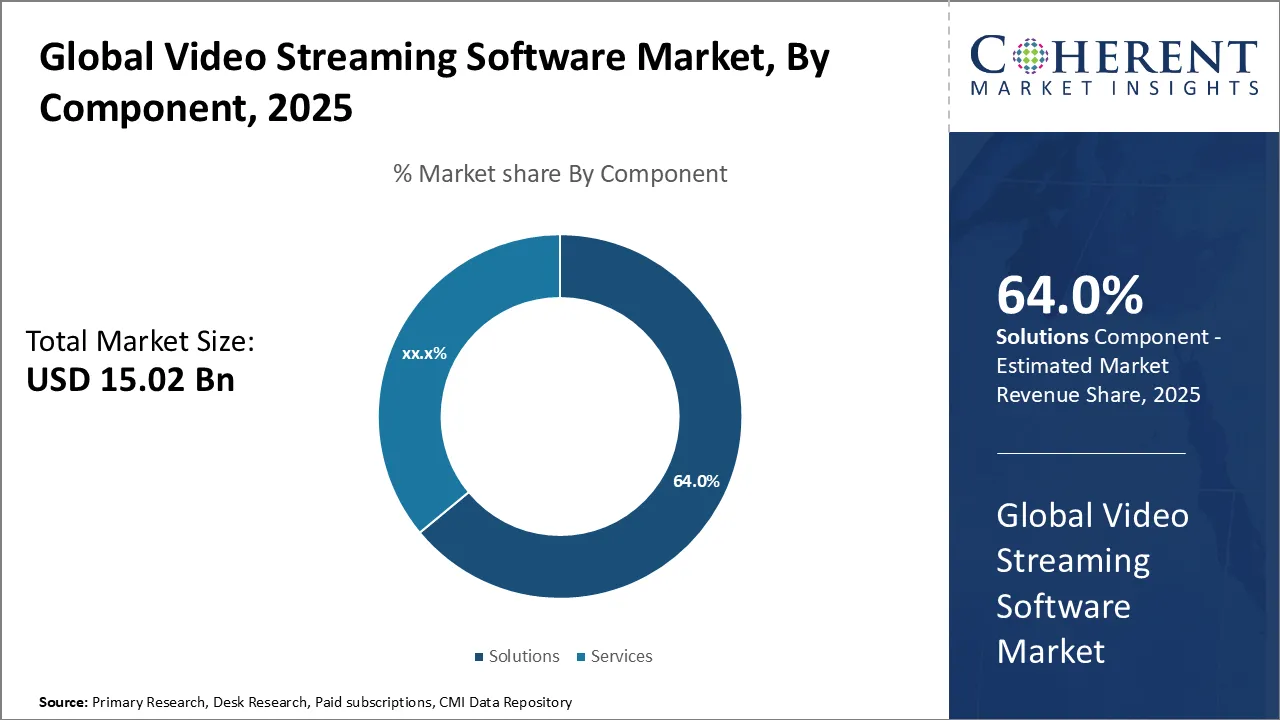
Video Streaming Software Market Insights, By Component: Solutions Lead Due to Advanced Capabilities and Growing Adoption
In terms of component, the solutions segment is expected to lead the market with a 65% share in 2026, driven by the increasing adoption of comprehensive streaming platforms that provide advanced capabilities. Solutions in this context include software for video content management, transcoding, adaptive streaming, analytics, and real-time monitoring. These features are critical for businesses and media platforms that aim to deliver seamless user experiences across devices and networks.
Enterprises, OTT service providers, and broadcasters are increasingly relying on robust solutions to streamline content delivery, manage large libraries, and monitor audience engagement. The growing complexity of content workflows, including multi-format encoding, live and on-demand distribution, and DRM protection, further reinforces the demand for solution-based offerings. Solutions also support AI-driven recommendations, automated quality of service adjustments, and integration with cloud or hybrid infrastructures.
The shift from legacy systems to scalable, flexible, and feature-rich platforms is accelerating solution adoption. Organizations benefit from lower total cost of ownership, simplified updates, and better integration capabilities. For instance, in 2025, several leading providers are expected to roll out AI-powered analytics modules, enhancing personalization and monetization opportunities for OTT platforms. As streaming consumption grows globally, solution-driven software is positioned as the backbone of the video streaming software market.
For instance, in September 2025, Dish TV India Limited, through its subsidiary Dish Infra, launched a new line of smart TVs under the brand name VZY. These smart TVs integrate DTH services with streaming capabilities, offering direct access to Dish TV's channel lineup without a set-top box, along with support for popular streaming platforms.
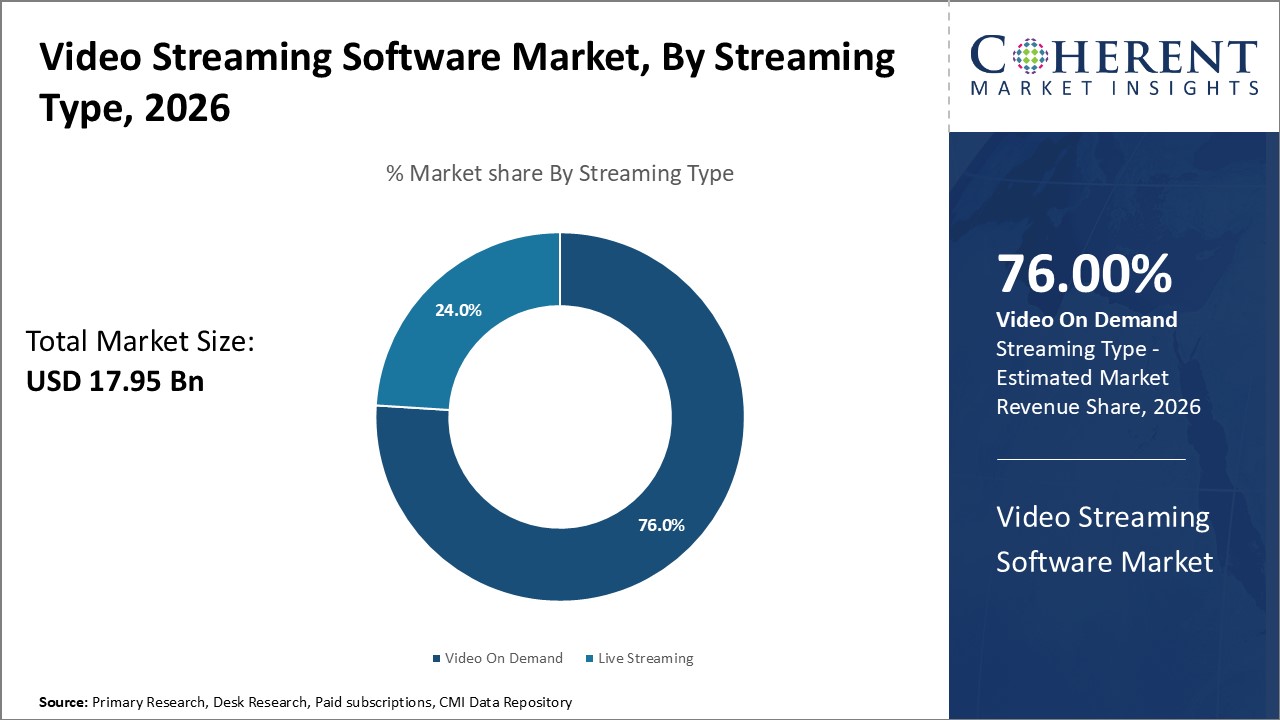
Video Streaming Software Market Insights, By Streaming Type: Video-on-Demand Leads Due to Consumer Preference and Content Flexibility
In terms of streaming type, the Video-on-Demand (VoD) segment is projected to hold a 76% share in 2026, fueled by the growing preference for subscription-based streaming platforms and the flexibility VoD offers in content consumption. VoD allows users to watch content anytime, anywhere, on a variety of devices, which aligns with modern lifestyles and on-the-go viewing habits.
The exponential growth of OTT platforms like Netflix, Disney+, and regional streaming services has further accelerated VoD adoption. These platforms provide diverse content libraries, personalized recommendations, and interactive features such as multiple language tracks, captions, and supplemental content. Consumers value the convenience of binge-watching, selective viewing, and the ability to pause, rewind, or skip content, driving engagement and subscription growth.
From an enterprise perspective, VoD platforms offer monetization models such as subscription-based (SVOD), ad-supported (AVOD), and hybrid models, making them highly attractive for both content owners and service providers. The integration of analytics tools allows providers to understand viewer behavior, optimize content strategies, and improve retention.
In August 2025, Roku—the leading TV streaming platform in the U.S., Canada, and Mexico—introduced Howdy™, a new ad-free subscription video-on-demand service offering premium entertainment for just $2.99 a month.
Video Streaming Software Market Insights, By Deployment: Cloud Leads Due to Scalability, Cost Efficiency, and Accessibility
In terms of deployment, the Cloud segment is anticipated to dominate the market with approximately a 71% share in 2026, driven by its scalability, reduced infrastructure costs, and enhanced accessibility. Cloud-based streaming solutions enable content providers to reach global audiences without investing in expensive on-premises infrastructure. This flexibility is particularly valuable for startups, mid-sized companies, and enterprises looking to scale quickly.
Cloud deployment supports elastic resource allocation, meaning streaming services can dynamically handle spikes in traffic during live events, launches, or viral content distribution. Additionally, cloud platforms simplify content storage, processing, transcoding, and delivery, while offering integrated analytics, security, and monitoring tools. The adoption of multi-cloud and hybrid cloud architectures further increases reliability, redundancy, and geographical coverage, critical for uninterrupted streaming.
Enterprises benefit from reduced operational complexity and faster time-to-market, as software updates, patches, and feature rollouts can be managed centrally.
For instance, in February 2025, Tencent Cloud announced a strategic partnership with UAE‑based SVOD platform Begin to enhance its streaming services for a global audience, focusing on scalability, flexible pricing models and cloud‑based delivery.
Video Streaming Software Market Insights, By Vertical: Media and Entertainment Leads Due to Rising Digital Media Consumption
In terms of vertical, the Media and Entertainment segment is set to lead the global video streaming software market with around a 48% share in 2026, fueled by the rapid expansion of OTT platforms and increasing digital media consumption. Streaming software is now integral to content creation, management, and distribution for broadcasters, studios, and digital media enterprises.
The surge in online video consumption, live events, and original content production has created immense demand for software capable of handling large volumes of both live and on-demand content. Media and entertainment companies rely on advanced streaming platforms for content personalization, multi-device compatibility, interactive experiences, and robust analytics. The growth of niche streaming services and regional content platforms has also increased the need for scalable, feature-rich software solutions.
For instance, in August 2025, Fox Corporation launched its new streaming service Fox One, a combined hub for news, sports and entertainment content, available across major devices at USD 19.99/month.
Regional Insights
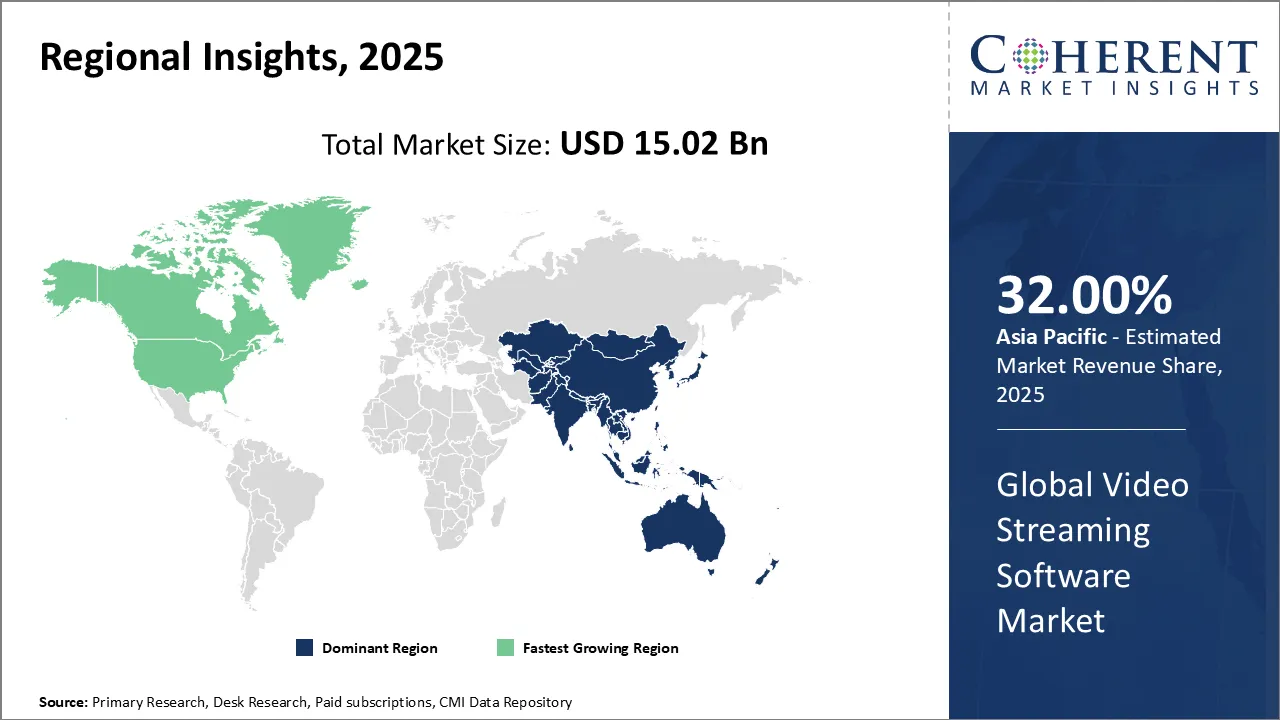
Asia Pacific Video Streaming Software Market Analysis & Trends
Asia Pacific is set to lead the global video streaming software market with 32.0% share in 2026, driven by rapid digitalization, increasing internet penetration, and widespread smartphone adoption across countries such as India, China, and Southeast Asian nations. The region has witnessed strong growth in demand for Video-on-Demand (VoD) and live streaming platforms, fueled by rising disposable incomes and a growing middle-class population seeking diverse digital content. Local streaming service providers are expanding their platforms with advanced features like cloud deployment, AI-driven recommendations, and multi-device compatibility.
Investments from OTT platforms, telecom operators, and tech startups are further strengthening the market. Emerging economies in Asia Pacific offer significant growth opportunities due to aggressive market expansion strategies, supportive government policies for digital media, and increasing cross-border content consumption.
For instance, in May 2026, Ora Streaming (by Varnish Software) launched in Asia‑Pacific as a fully‑managed private CDN‑as‑a‑service for streaming platforms, supporting hybrid cloud, edge caching and predictable OpEx pricing.
North America Video Streaming Software Market Analysis & Trends
North America remains the leading region in the global video streaming software market, holding a significant share in 2026, driven by strong demand from media, entertainment, and technology sectors. The U.S. and Canada have well-established digital infrastructure, high internet penetration, and widespread adoption of smart devices, which have accelerated the consumption of Video-on-Demand (VoD) and live streaming services. Leading streaming platforms and OTT providers continue to invest in advanced software solutions offering cloud deployment, AI-powered recommendations, and multi-device compatibility to enhance user experience. Additionally, rising content creation, digital advertising, and increasing consumer willingness to pay for premium streaming services have boosted market growth. Local players are expanding their service portfolios and adopting innovative monetization models to meet growing viewer demands.
For instance, in May 2026, Fox Corporation announced its upcoming streaming service FOX One, a unified platform combining live and on‑demand content from its broadcast and cable properties, set to launch in fall 2026.
Video Streaming Software Market Outlook Country-Wise
U.S. Video Streaming Software Market Trends
The United States is the largest market for video streaming software globally, driven by high internet penetration, widespread smartphone and smart TV adoption, and a strong presence of major OTT platforms such as Netflix, Hulu, Disney+, and Amazon Prime Video. The demand for Video-on-Demand (VoD) and live streaming services continues to grow due to increasing digital content consumption, sports broadcasting, and entertainment preferences. Advanced infrastructure, cloud-based streaming solutions, and AI-driven personalization further enhance user experience. Additionally, U.S. content creators and technology firms invest heavily in streaming software development, making the country a hub for innovation and early adoption of new streaming technologies.
For instance, in May 2026 , CNN announced its upcoming streaming product, part of its “All Access” subscription tier, set for fall 2026 in the U.S., combining live channels, on‑demand video and catch‑up programming.
India Video Streaming Software Market Trends
India is one of the fastest-growing markets for video streaming software in the Asia-Pacific region, fueled by rapid smartphone penetration, affordable data plans, and a young population with high digital engagement. Local and international OTT platforms, such as Hotstar, Zee5, and Netflix India, are driving the demand for scalable, cloud-based, and AI-enabled streaming software to deliver high-quality content to millions of viewers. Regional language content, live sports streaming, and interactive features like chat and recommendations are shaping the market. Moreover, investments from telecom operators and the government’s push for digital infrastructure further support the adoption and growth of video streaming software solutions.
For instance, in February 2026, Baidu acquired JOYY Inc.’s China live‑streaming business, YY Live, for approximately USD 2.1 billion. This move strengthens Baidu’s position in the digital video market and aligns with its cloud and AI infrastructure expansion.
Market Report Scope
Video Streaming Market Report Coverage
| Report Coverage | Details | ||
|---|---|---|---|
| Base Year: | 2025 | Market Size in 2026: | USD 17.95 Bn |
| Historical Data for: | 2020 To 2024 | Forecast Period: | 2026 To 2033 |
| Forecast Period 2026 to 2033 CAGR: | 19.5% | 2033 Value Projection: | USD 62.46 Bn |
| Geographies covered: |
| ||
| Segments covered: |
| ||
| Companies covered: | IBM Corporation, Haivision, Brightcove, Qumu, Kaltura, Sonic Foundry, Vimeo, SprountVideo, VBrick, MediaPlatform, Dacast, Agile Content, and Wowza, and Panopto. | ||
| Growth Drivers: |
| ||
| Restraints & Challenges: |
| ||
Video Streaming Software Market Driver
Expansion of Cloud-Based Streaming Solutions
The adoption of cloud-based video streaming software has accelerated in recent years, providing enterprises and OTT platforms with scalable, cost-effective, and reliable streaming capabilities. Cloud infrastructure allows content providers to manage high traffic loads, deliver low-latency streams, and offer personalized experiences without significant on-premises investments. With the rise of hybrid work, live events, and global content distribution, cloud solutions have become essential for businesses to ensure seamless delivery of video content. Leading providers such as AWS, Microsoft Azure, and Google Cloud continue to enhance streaming features, driving software adoption.
Rising Popularity of Personalized and Interactive Video Experiences
Consumers are increasingly demanding personalized and interactive video content, which drives the adoption of advanced video streaming software with AI and analytics capabilities. Platforms are integrating features such as recommendation engines, real-time analytics, chat, polls, and multi-angle streaming to engage users more effectively. The success of services like Netflix, Disney+, and Twitch demonstrates that personalized content and interactivity increase user retention and subscription growth. This trend encourages content creators and service providers to invest in sophisticated streaming software solutions that enhance viewer engagement and improve monetization opportunities.
Video Streaming Software Market Opportunities
Optimization of network bandwidth can present lucrative growth opportunities in the global video streaming software market
Network bandwidth plays a crucial role in the quality of video streaming software. Greater bandwidth of the network will provide high-quality content streaming with better speed. However, lower bandwidth will hinder the quality of content. Optimization of network bandwidth can present major opportunities for market players where they can provide high-quality content at relatively greater speed. Major companies in the market can capitalize on these opportunities by providing novel solutions and gain a significant advantage in the market.
Rising preference for online streaming service over conventional TV can provide major business opportunities in the global video streaming software market
Consumers are increasingly preferring online streaming services over conventional television. This is due to the fact that online streaming services provide better efficiency of viewing the content as compared to traditional TV. These streaming services can be accessed from anywhere over a smartphone, tablet, or laptop. As a result of this, the demand for video streaming software is rising rapidly.
Analyst Opinion (Expert Opinion)
The video streaming software market is undergoing a structural shift driven by cloud-native adoption, monetization innovation, and advanced user engagement capabilities. Platforms increasingly demand modular, microservices-based solutions that enable rapid deployment, low-latency live streaming, and seamless integration with analytics and ad-serving tools. For instance, Roku’s active accounts reached 90 million in 2024, with an 82 % year-on-year rise in streaming hours on The Roku Channel, highlighting the premium on engagement-driven software rather than content alone.
Leading OTT providers like Amazon Prime Video are expanding ad-supported models, with ad revenue projected to grow from approximately US$433 million in 2024 to US$806 million in 2025. Cloud-based deployments now account for nearly 69 % of streaming software usage, reflecting a decisive move from legacy on-premises systems toward scalable, globally accessible architectures. Platforms are embedding real-time analytics and dynamic ad insertion to efficiently monetize and enhance user experience across SVOD, AVOD, and hybrid models.
Ultimately, commercial success in video streaming software now depends on delivering performance, scalability, and monetization flexibility. Companies prioritizing cloud-native solutions, modular architecture, and integrated analytics will capture long-term competitive advantage, while those relying on legacy software risk falling behind. Software innovation has transitioned from a supporting function to a strategic driver, defining the next competitive frontier of the global video streaming software market.
Speak to the analyst
Want personalized insights?
Take the findings above to one of our principal consultants, or have the report rebuilt around the segments, geographies and competitors you actually track.
Video Streaming Software Industry News
- In March 2025, Haivision announced it would showcase its live‑video contribution ecosystem at the 2025 NAB Show.
- In April 2025 , Vimeo announced its “Vimeo Streaming” offering, enabling creators and businesses to launch branded streaming apps globally with deeper monetization, analytics and protection.
- In January 2025 , Brightcove launched its AI Content Suite, making its AI‑powered tools for content creation, metadata optimization and translation generally available.
Market Segmentation
- By Component Insights (Revenue, USD Bn & KT, 2026 - 2033)
- Solutions
- Transcoding and Processing
- Video Management Software
- Video Distribution
- Video Analytics
- Video Security
- Other Soutions
- Services
- Professional Services
- Managed Services
- Solutions
- By Streaming Type Insights (Revenue, USD Bn & KT, 2026 - 2033)
- Live Streaming
- Video on Demand
- By Deployment Insights (Revenue, USD Bn & KT, 2026 - 2033)
- On-premises
- Cloud
- By Vertical Insights (Revenue, USD Bn & KT, 2026 - 2033)
- Media and Entertainment
- Banking, Financial Services, and Insurance
- Academic and Education
- Healthcare
- Government
- Others
- Regional Insights (Revenue, USD Bn & KT, 2026 - 2033)
- North America
- U.S.
- Canada
- Latin America
- Brazil
- Argentina
- Mexico
- Rest of Latin America
- Europe
- Germany
- U.K.
- Spain
- France
- Italy
- Russia
- Rest of Europe
- Asia Pacific
- China
- India
- Japan
- Australia
- South Korea
- ASEAN
- Rest of Asia Pacific
- Middle East & Africa
- GCC Countries
- Israel
- Rest of Middle East & Africa
- North America
- Key Players Insights (Revenue, USD Bn, 2021 - 2033)
- IBM Corporation
- Haivision,
- Brightcove
- Qumu
- Kaltura
- Sonic Foundry
- Vimeo
- SprountVideo
- VBrick
- MediaPlatform
- Dacast
- Agile Content
- Wowza
Sources
Primary Research Interviews from the following stakeholders
Stakeholders
- Interviews with video streaming platform providers, OTT service operators, content creators, cloud infrastructure providers, digital media managers, and IT heads across major regional markets.
Specific stakeholders
- Product and R&D heads at leading streaming platforms
- Technology and infrastructure managers at cloud service providers and CDNs
- Operations and platform engineers at video streaming software companies
- Content acquisition and programming leads at media and entertainment companies
- Marketing and analytics officers focused on subscription growth and user engagement at OTT platforms
- Procurement and IT officers in enterprises deploying corporate video streaming solutions
- Legal and compliance teams managing copyright, DRM, and privacy regulations for digital video platforms.
Databases
- Internet Live Stats – Internet User Data
- Statista – Video Streaming Usage Statistics
- UNESCO – Digital Media and Internet Access Data
- Cisco Annual Internet Report
- Akamai State of the Internet Reports
- Digital TV Research Database
- European Audiovisual Observatory
- China Internet Network Information Center (CNNIC) Reports
- TRAI – India Telecom & Internet Statistics
- U.S. Census Bureau – Digital Media & Internet Access
Magazines
- Streaming Media Magazine
- VideoEdge Magazine
- TechCrunch – Media & Streaming Section
- Variety – Digital and OTT News
- Digital TV Europe
- FierceVideo
- Broadband TV News
- Advanced Television
- MediaPost – Video & OTT
- Videonet
Journals
- Journal of Media Economics
- International Journal on Media Management
- Journal of Broadcasting & Electronic Media
- Digital Journalism
- IEEE Transactions on Broadcasting
- Journal of Digital Media & Policy
- International Journal of Human–Computer Interaction (Streaming & UX Section)
- Journal of Interactive Media
Newspapers
- The Wall Street Journal – Technology & Media
- The New York Times – Digital Media Section
- Financial Times – Technology & Streaming
- The Guardian – Technology & Digital Media
- The Economic Times – Internet & Streaming
- South China Morning Post – Digital Media & OTT
- The Hindu Business Line – Technology & Media
- Nikkei Asia – Digital Media & Entertainment
- Business Standard – Technology & Streaming
- Los Angeles Times – Entertainment & Digital Platforms
Associations
- Interactive Advertising Bureau (IAB) – OTT & Digital Video Council
- Streaming Video Alliance
- Media & Entertainment Services Alliance (MESA)
- European Broadcasting Union (EBU) – OTT Initiatives
- Digital Entertainment Group (DEG)
- National Association of Broadcasters (NAB) – Digital Media Section
- Asia Video Industry Association (AVIA)
- Cable & Telecommunications Association for Marketing (CTAM)
- Open Web Application Security Project (OWASP) – Media & Video Section
- American Film Market (AFM) – Digital Distribution Committee
Public Domain Sources
- Federal Communications Commission (FCC), U.S. – Broadband & Streaming Reports
- Ministry of Electronics & IT (MeitY), India – Digital Media & OTT Guidelines
- European Commission – Audiovisual Media Services Directive Reports
- U.S. Department of Commerce – Digital Economy & Streaming Statistics
- Organisation for Economic Co-operation and Development (OECD) – Digital Media Reports
- United Nations Conference on Trade and Development (UNCTAD) – E-Commerce & Media
- Central Statistics Office (CSO), India – Digital Economy Reports
- China National Radio and Television Administration (NRTA) – OTT & Streaming Guidelines
- UNESCO – Global Media and Streaming Access Reports
- Reserve Bank of India (RBI) – Digital Media Monetization Insights
Proprietary Elements
- CMI Data Analytics Tool
- Proprietary CMI Existing Repository of information for last 8 years
Get access to 250+ pages report
Every segment, forecast, competitor profile and data table behind the analysis above — available for instant download.
- ESOMAR Member
- ISO 9001:2015 Certified
- D-U-N-S Registered
- GDPR & CCPA Compliant
Missing comfort of reading report in your local language? Find your preferred language:
Transform your Strategy with Exclusive Trending Reports
Frequently Asked Questions
The Video Streaming Software Market is estimated to be valued at USD 17.95 Bn in 2026, and is expected to reach USD 62.46 Bn by 2033.
The CAGR of the Video Streaming Software Market is projected to be 19.5% from 2026 to 2033.
Major factor driving the growth of global video streaming market during the forecast period is rising popularity of personalized and interactive video experiences
Major factors hampering the growth of the video streaming market during the forecast period constitutes rising threat of video content security and privacy.
Asia Pacific video streaming market is expected to generate the highest revenue during the forecast period.
Some of the key players operating in the market are IBM Corporation, Haivision, Brightcove, Qumu, Kaltura, Sonic Foundry, Vimeo, SprountVideo, VBrick, MediaPlatform, Dacast, Agile Content, and Wowza, and Panopto.