

GCC and Levant Data Storage Market Size and Share Analysis: (2026 - 2033)
The GCC and Levant data storage market is anticipated to grow at a CAGR of 14.5% with USD 5.5 Bn in 2026 and is expected to reach USD 10.98 Bn in 2033. This strong growth is because more and more data is being created in different industries. This is due to businesses going digital, the rise of IoT devices (95 billion), as well as more use of cloud computing.
Key Takeaways
- Enterprise data storage devices is expected to account the largest share of 65% in 2026, due to rapid digital transformation and cloud adoption, with data center capacity in Saudi Arabia and UAE growing significantly between 2020–2025. The United Arab Emirates (UAE) continues to lead with projects like G42's USD20bnStargate UAE initiative - a 5GW AI-focused hyperscale facility partnering with OpenAI, Nvidia, and Oracle, representing OpenAI's first international site.
- Commercial will dominate with 72% in 2026, because large enterprises in the GCC are rapidly expanding their data center and cloud infrastructure. In Saudi Arabia, adopting cloud technologies is a national priority aligned with Vision 2030, aiming to modernize government operations and increase digital agility.
- Telecom and IT hold the dominant share of 35% in 2026, Saudi Arabia and the UAE are leading the region with major investments in data centers, cloud platforms, and IoT networks to support smart cities, AI initiatives, and enterprise digital transformation. The UAE leads the GCC in data center investment, with a total pipeline of USD 46.1 billion ahead of Saudi. Arabia's USD 35.3 billion.
- GCC is expected to acquire the dominant share of 66% in 2026, Multibillion-dollar data center and cloud projects (e.g., UAE’s G42 Stargate 5GW AI facility, Saudi NEOM cloud hub) create higher storage demand.
Segmental Insights
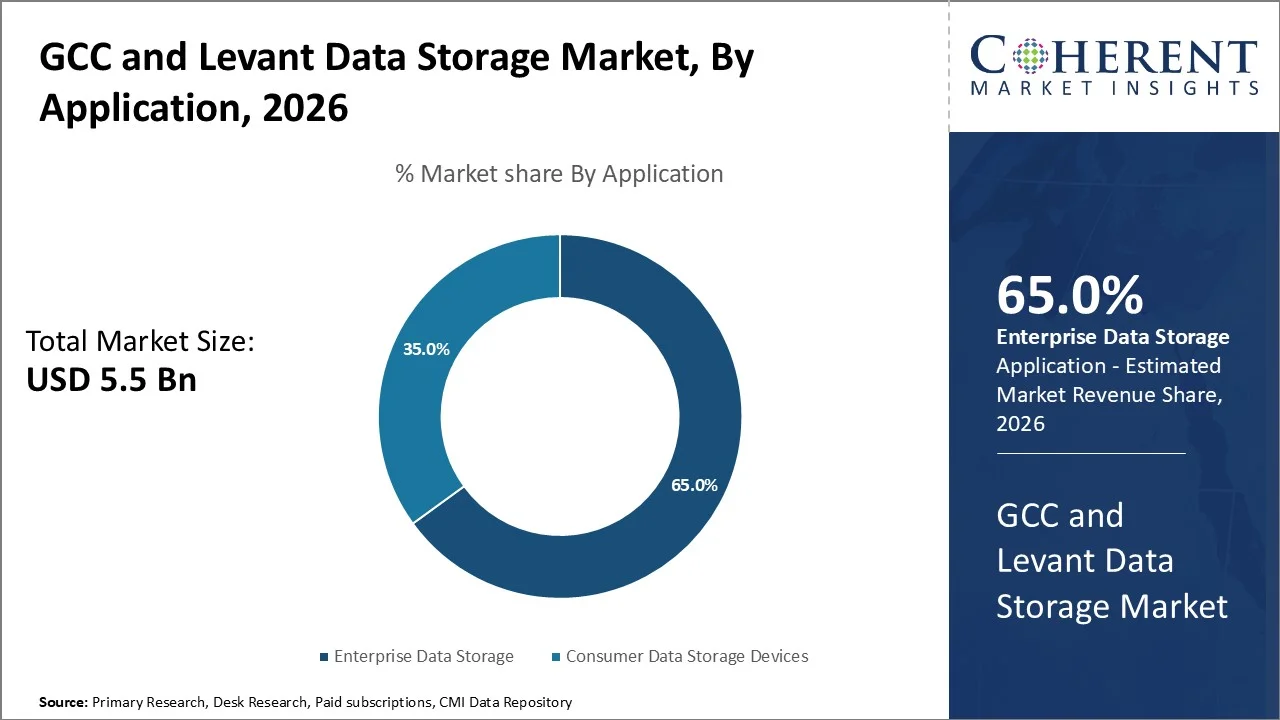
Why is Enterprise Data Storage Devices Acquiring the Largest Market Share?
Enterprise data storage devices is projected to account for the largest share of applications in 2026, representing approximately 65% of the total volume. driven by the rapidly growing business landscape in the region. The adoption of cloud-based storage solutions has particularly accelerated, propelled by the high preference for scalable, cost-efficient, as well as flexible infrastructure capable of supporting remote work, collaboration, and emerging technologies such as artificial intelligence and the Internet of Things (IoT). Saudi Arabia has seen 72% of its companies adopt a strategy to deploy emerging AI technologies, backed by cloud and high-performance computing (HPC) infrastructure.
The GCC’s substantial investments in sectors such as finance, telecommunications, healthcare, as well as oil and gas heavily depend on high-performance storage architectures. Many regional enterprises are adopting hybrid storage models combining flash storage for latency-sensitive applications like real-time analytics as well as hard disk drives for archival and large file storage.
- Current Industry Events of 2026
- Market Size Estimation
- Regional Breakdown
- Competitive Landscape
- Customer Intelligence
- Segmental Analysis
- Pricing Analysis
- Key Market Drivers, Challenges & Future Trends
- Customized Insights Section
Commercial Segment holds the Largest Market Share
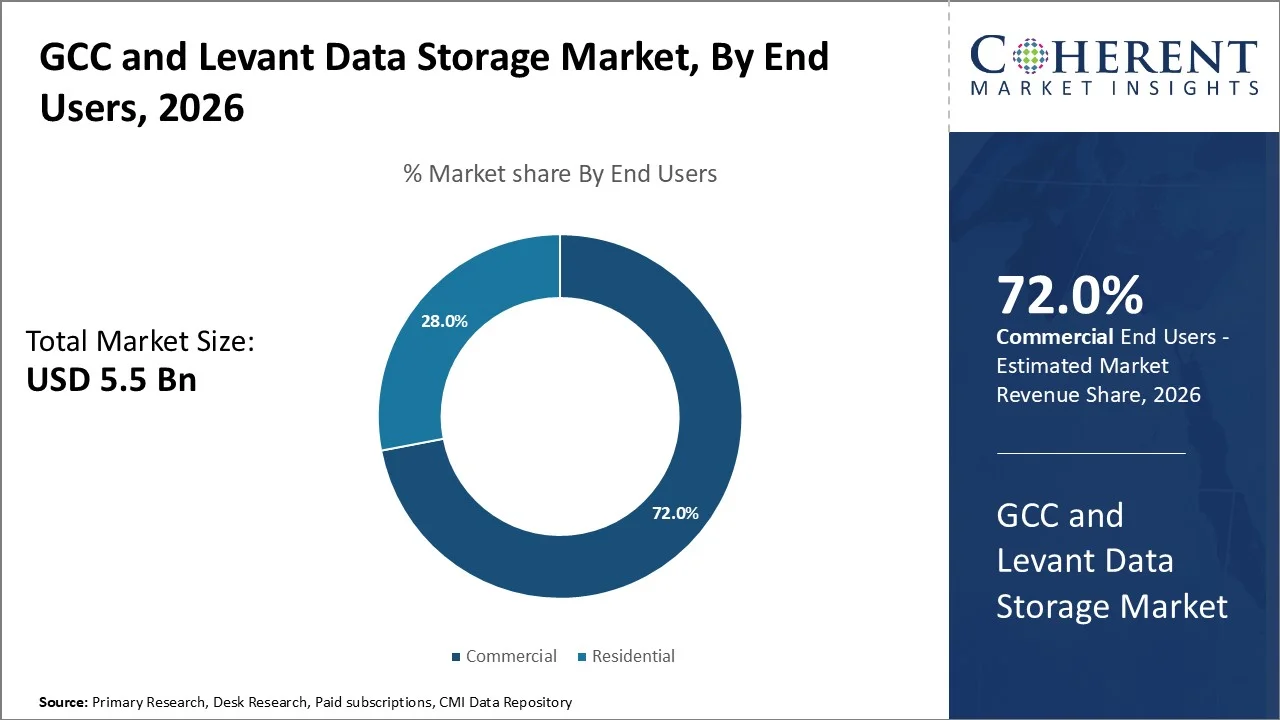
Based on end users, commercial segment dominates the market, accounting for a significant 72% share in 2026, the dominance of the Commercial segment, specifically enterprises and large organizations, is primarily because these businesses generate and consume enormous volumes of data daily, from customer data, billing records, intellectual properties to operational data essential for analytics and decision-making. Various government initiatives across the GCC and Levant countries aimed at fostering digital economies have supported enterprises to digitize their operations extensively. For instance, UAE’s Smart Dubai and Saudi Arabia’s Vision 2030 are making government services and business rules more digital. This encourages companies to spend more on advanced data storage.
Telecom and IT holds the Largest Market Share
Based on industry verticals, telecom and IT dominates the market, accounting for a significant 35% share in 2026, owning to the rapid digitization as well as expanding IT infrastructure in the region. GCC Pulse Survey 2025: The survey shows that 83% of GCCs are already using GenAI. Pilot projects grew from 37% in 2024 to 43% in 2025, showing a rising need for fast storage and cloud solutions.
The unparalleled growth of the digital economy within GCC and Levant countries has been primarily driven by major investments in telecommunications networks as well as modern IT services. For instance, leading telecom operators such as Etisalat and STC in the GCC have been aggressively expanding their 5G networks and cloud computing services, demanding immense data storage capacities to support high-speed, low-latency operations and IoT-driven applications.
On-Premises Storage Solutions is transforming the GCC and Levant Data Storage Industry
Large enterprises, government, and telecom sectors in GCC and Levant still rely heavily on on-premises storage for sensitive data and legacy applications. Emirates Telecommunications Corporation (Etisalat, UAE) uses on-prem SAN solutions for core telecom infrastructure to assure latency as well as security. On-premises storage offers high control and security but poses challenges in scalability and high capital expenditure. The GCC is rapidly becoming a data center powerhouse, with capacity in the region projected to triple, from 1 GW in 2025 to 3.3 GW over the next five years.
Multi-cloud strategy: A major breakthrough in GCC and Levant Data Storage Procedure
Using a multi-cloud strategy with AWS, Azure, and on-premises hybrid systems, Saudi Aramco migrated upstream operations data to AWS and implemented data lakes for seismic analysis. This cut data processing time by 40%, saved USD200 million a year, and improved exploration a lot.
This initiative also enhanced exploration as well as production capabilities, improved decision-making speed, and strengthened overall operational efficiency, demonstrating the impact of cloud adoption on large-scale energy enterprises in the GCC.
Current Events and Their Impact on the GCC and Levant Data Storage Market
Current Event | Description and its Impact |
Saudi Arabia Cloud-First Policy under Vision 2030 (2025) |
|
UAE Data Protection Law (DPL) Updates (2025) |
|
GCC and Levant Data Storage Market Trends
- Accelerated migration to hybrid as well as multi-cloud architectures, with 78% of enterprises planning cloud storage expansion by 2025.
- Integration of edge computing, with the high demand for edge data storage solutions to support IoT deployments and real-time processing requirements.
- Focus towards sustainability, there is an increasing emphasis on green data centers and energy-efficient storage solutions aligned with Vision 2030 and Net Zero commitments.
- High demand for data Sovereignty, escalating focus on local data residency and compliance with regional data protection regulations.
Regional Insights
GCC dominates owing to high infrastructure investments
GCC account 66% market share in 2026, driven predominantly by significant infrastructure investments, digitization efforts, and the advent of cloud technology adoption across various sectors. The GCC countries, comprising Saudi Arabia, the United Arab Emirates, Kuwait, Qatar, Bahrain, and Oman, have been aggressively pursuing national initiatives aligned with their Vision 2030-type reforms, which strongly emphasize technological modernization and data-driven economic diversification.
The United Arab Emirates reinforced its standing as a global center for artificial intelligence as well as digital infrastructure in 2025, recording a world-leading 97% utilization rate of AI tools across government authorities as well as surpassing 450,000 programmers nationwide.
Levant emerges as the fastest growing region
The levant region is poised to be the fastest-growing region through 2026-2033, expanding at a CAGR of approximately 5.74%. Mainly attributable to a surge in digital transformation projects, burgeoning startup ecosystems, and increasing government focus on modernizing IT infrastructure despite geopolitical challenges. Improvisations in internet connectivity, with increasing fiber optic rollouts and mobile broadband penetration by organizations like the Arab States Broadcasting Union and local telecom operators, have catalyzed demand for scalable data storage.
Jordan, for example, has experienced a rise in data storage requirements through its Smart Jordan initiative, which aims to digitize government services and improve e-governance to increase transparency and citizen engagement. The REACH2025 initiative has been launched to re-invigorate digital Jordan and particularly one of the growth engines of the Jordan economy.
Large-scale investments in hyperscale data centers is accelerating the demand in Saudi Arabia
Saudi Arabia contributes the highest share in the market due to its substantial investments in digital infrastructure as well as data sovereignty initiatives, which are strategic priorities outlined in the Saudi Vision 2030 plan. The focus by government authorities on supporting a digital economy has led to major expenditure on expanding data center capacities as well as cloud adoption, making Saudi Arabia the regional hub for data storage and related technologies.
For example, the Saudi Data and AI Authority (SDAIA) has been pivotal in driving large-scale data initiatives, including the establishment of hyper-scale data centers that serve both public and private sectors, thereby solidifying Saudi Arabia's leadership in this segment.
Israel Data Storage Market Trends
Israel contributes the highest share in the data storage market owing to its advanced technological infrastructure, substantial investments in digital transformation, as well as robust innovation ecosystems. Israel’s prominence in the technology sector is well-documented, with the country usually dubbed the "Start-Up Nation" due to its exceptionally high density of technology companies as well as research centers.
For instance, the Israel Innovation Authority consistently backs projects exploring next-generation storage solutions, cloud infrastructure, and data center expansions. Furthermore, Israel hosts several global data center providers who have established regional hubs, leveraging the country’s strategic location at the crossroads of Africa, Asia, and Europe.
In September 2025, SDS is building Israel’s largest sovereign AI cloud with VAST’s AI Operating System, delivering performance and scalability for the nation’s most ambitious AI workloads.
Who are the Major Companies in GCC and Levant Data Storage Industry
Some of the major key players in GCC and Levant Data Storage are Nexenta Systems, IBM Corporation, EMC Corporation (Dell Inc.), Microsoft Corporation, Hitachi Data Systems (Hitachi Ltd), VMware, Inc., Sandisk Corporation, Hewlett Packard Enterprise Co., Open Text Corp., DataDirect Networks (DDN), and NetApp Inc.
Key News
- In February 2026, IBM introduced its new FlashSystem enhanced with agentic AI, providing autonomous threat analysis, customized recovery, and automated storage management. This innovation transforms enterprise storage into an intelligent, self-managing system.
Market Report Scope
GCC and Levant Data Storage Market Report Coverage
| Report Coverage | Details | ||
|---|---|---|---|
| Base Year: | 2025 | Market Size in 2026: | USD 5.5 Bn |
| Historical Data for: | 2020 To 2024 | Forecast Period: | 2026 To 2033 |
| Forecast Period 2026 to 2033 CAGR: | 14.5% | 2033 Value Projection: | USD 10.98 Bn |
| Geographies covered: |
| ||
| Segments covered: |
| ||
| Companies covered: | Nexenta Systems, IBM Corporation, EMC Corporation (Dell Inc.), Microsoft Corporation, Hitachi Data Systems (Hitachi Ltd), VMware, Inc., Sandisk Corporation, Hewlett Packard Enterprise Co., Open Text Corp., DataDirect Networks (DDN), and NetApp Inc. | ||
| Growth Drivers: |
| ||
| Restraints & Challenges: |
| ||
Analyst Opinion
- The GCC and Levant Data Storage market is not just expanding because of trends, it is growing because enterprises, governments, and telcos in the region are facing an urgent need to modernize legacy systems. Cloud-first mandates, sovereign data policies, as well as AI-driven digital initiatives are forcing organizations to rethink storage strategies, creating demand that is fundamentally unavoidable.
- In 2025, Bahrain’s government authorities launched the “Digital Transformation 2.0” initiative, targeting the centralization of critical public sector data on high-performance, cloud-ready storage systems. This initiative alone has accelerated enterprise storage adoption as well as set a benchmark for other Levant countries, signaling that market growth is driven by strategic necessity rather than optional investment.
- Private-sector adoption is equally forceful. In late 2025, STC (Saudi Telecom Company) integrated hybrid storage solutions across multiple data centers to support 5G expansion as well as AI analytics. Analysts argue this isn’t incremental growth, it’s structural. Large-scale data creation from telecom, fintech, as well as smart city projects makes on-prem and cloud storage an essential backbone, not a luxury.
- The market’s trajectory is further supported by the rise of AI and machine learning applications that demand high-throughput, low-latency storage. Analysts from IDC Middle East indicate that GCC enterprises are actively pursuing hyper-converged infrastructure as well as software-defined storage to avoid bottlenecks, suggesting that storage modernization is no longer an alternative but a strategic imperative.
Speak to the analyst
Want personalized insights?
Take the findings above to one of our principal consultants, or have the report rebuilt around the segments, geographies and competitors you actually track.
GCC and Levant Data Storage Market Segmentation
- By Applications
- Consumer Data Storage Devices
- Hard Disk Drive (HDD)
- Solid State Devices (SSD)
- Memory Cards
- Optical Disk
- USB Flash Drives
- Enterprise Data Storage Devices
- Flash Storage and Hard Disks
- Cloud-based Storage
- Software-defined Storage
- Hyper-converged Infrastructure
- Consumer Data Storage Devices
- By End Users
- Residential
- Commercial
- SME Enterprise
- Large Enterprise
- By Industry Verticals
- BFSI
- Healthcare
- Government
- Telecom and IT
- Defense and Aerospace
- Education
- Other
- Global GCC and Levant Data Storage Market, By Region
- GCC
- UAE
- Kuwait
- Saudi Arabia
- Oman
- Qatar
- Bahrain
- Levant
- Turkey
- Israel
- Egypt
- Lebanon
- Jordan
- Cyprus
- Rest of Levant
- GCC
Sources
Primary Research Interviews
- Data Storage Solution Providers
- Cloud Infrastructure Vendors
- IT Infrastructure Managers
- System Integrators
- Others
Databases
- IDC Worldwide Storage Tracker
- Gartner IT Infrastructure Database
- Bloomberg Terminal
- Others
Magazines
- Storage Magazine
- DataCenter Knowledge
- Middle East Technology Magazine
- CIO Middle East
- Computer Weekly
- Others
Journals
- IEEE Transactions on Computers
- Journal of Computer and System Sciences
- ACM Transactions on Storage
- Others
Newspapers
- Gulf News Technology Section
- Arab News Business
- The National UAE Technology
- Al Bayan IT Section
- Khaleej Times Business
- Others
Associations
- UAE Computer Emergency Response Team (aeCERT)
- Saudi Federation for Cyber Security
- Jordan Computer Society
- Kuwait Computer Society
- Lebanese IT Association
- Others
Public Domain Sources
- UAE Ministry of Economy Reports
- Saudi Vision 2030 Digital Transformation Reports
- Jordan ICT Strategy Documents
- Kuwait National ICT Plan
- Lebanese Ministry of Telecommunications Publications
- Others
Proprietary Elements
- CMI Data Analytics Tool
- Proprietary CMI Existing Repository of information for last 10 years
Get access to 250+ pages report
Every segment, forecast, competitor profile and data table behind the analysis above — available for instant download.
- ESOMAR Member
- ISO 9001:2015 Certified
- D-U-N-S Registered
- GDPR & CCPA Compliant
Missing comfort of reading report in your local language? Find your preferred language:
Transform your Strategy with Exclusive Trending Reports
Frequently Asked Questions
The GCC and Levant data storage market is expected to reach USD 10.98 Bn in 2033.
Major players operating in the global GCC and Levant data storage market include Nexenta Systems, IBM Corporation, EMC Corporation (Dell Inc.), Microsoft Corporation, Hitachi Data Systems (Hitachi Ltd), VMware, Inc., Sandisk Corporation, Hewlett Packard Enterprise Co., Open Text Corp., DataDirect Networks (DDN), and NetApp Inc.
Slow responses offered by vendors to increasing demand is expected to hamper the GCC and Levant data storage market growth during the forecast period.
Technological advancements in information and social technology are expected to drive growth of the GCC and Levant Data storage data market during the forecast period
The GCC and Levant data storage market is anticipated to grow at a CAGR of 14.5% between 2026 and 2033.
Among regions, GCC is expected to account for a largest market share in the global GCC and Levant Data Storage market over the forecast period.