

Hyper Automation Market Size and Forecast – 2026 to 2033
The Hyper Automation Market is anticipated to grow at a CAGR of 7.1% with USD 22.9 Bn share in 2026 and is expected to reach USD 31.8 Bn in 2033. Organizations are driving the Hyper Automation market by pursuing greater operational efficiency, adopting AI and machine learning, addressing labor shortages, accelerating digital transformation, and expanding cloud adoption. 73% of IT leaders say automation saves up to 50% of their time, while 30% of business leaders report lower labor costs.
Key Takeaways
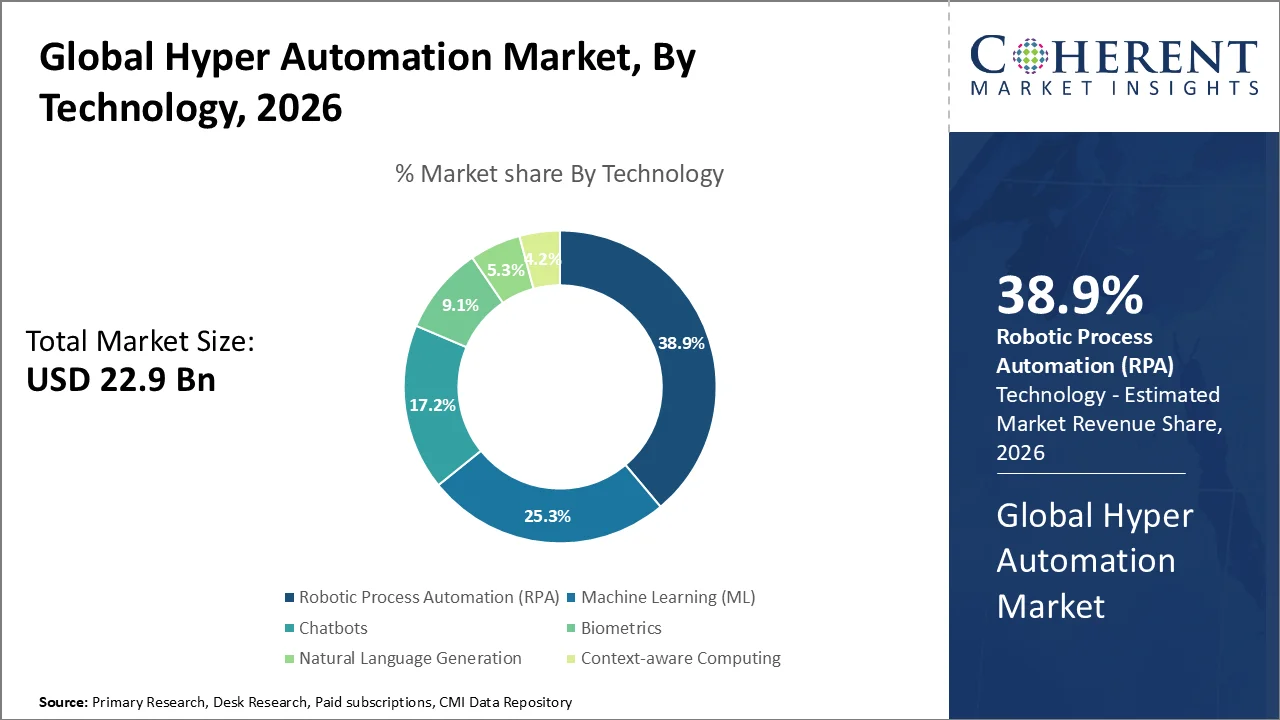
- Robotic Process Automation (RPA) hold the largest market share of 38.9% in 2026 owing to the growing demand for business process automation. The World Economic Forum projected that 42% of manufacturing tasks would be automated by 2022.
- Healthcare expected to hold largest market share of 42.2% in 2026 owing to its growing demand for improved patient experience. As of January 2026, 58% of healthcare organizations use RPA and AI-powered automation.
- North America is expected to acquire the dominant share of 41.1% in 2026 owing to its high adoption of digital transformation.
Current Events and Their Impact on the Hyper Automation Market
Current Event | Description and its Impact |
EU AI Act Implementation & Digital Omnibus (2026) |
|
EU Digital Operational Resilience Act (DORA) Enforcement |
|
Segmental Insights
- Current Industry Events of 2026
- Market Size Estimation
- Regional Breakdown
- Competitive Landscape
- Customer Intelligence
- Segmental Analysis
- Pricing Analysis
- Key Market Drivers, Challenges & Future Trends
- Customized Insights Section
Why is Robotic Process Automation (RPA) Acquiring the Largest Market Share?
Robotic Process Automation (RPA) hold the largest market share of 38.9% in 2026. Organizations are driving the hyper automation market by adopting Robotic Process Automation (RPA) to automate repetitive, rule-based tasks, improve operational efficiency, and reduce manual effort. They are combining RPA with artificial intelligence, machine learning, and intelligent document processing to streamline complex workflows across finance, healthcare, manufacturing, and retail. Businesses are also adopting RPA to accelerate process execution, improve accuracy, strengthen regulatory compliance, and optimize workforce productivity. Furthermore, organizations are leveraging cloud-based deployment and low-code platforms to implement RPA more easily, scale automation initiatives, and expand adoption across enterprise operations. For instance, UiPath, a leading AI-powered automation and robotic process automation (RPA) platform provider, launched its redesigned Global Education Academy on Adobe Learning Manager. Completed in March 2026, the implementation marked one of the most significant and complex enterprise learning deployments in Adobe Learning Manager’s history.
Healthcare expected to hold largest market share
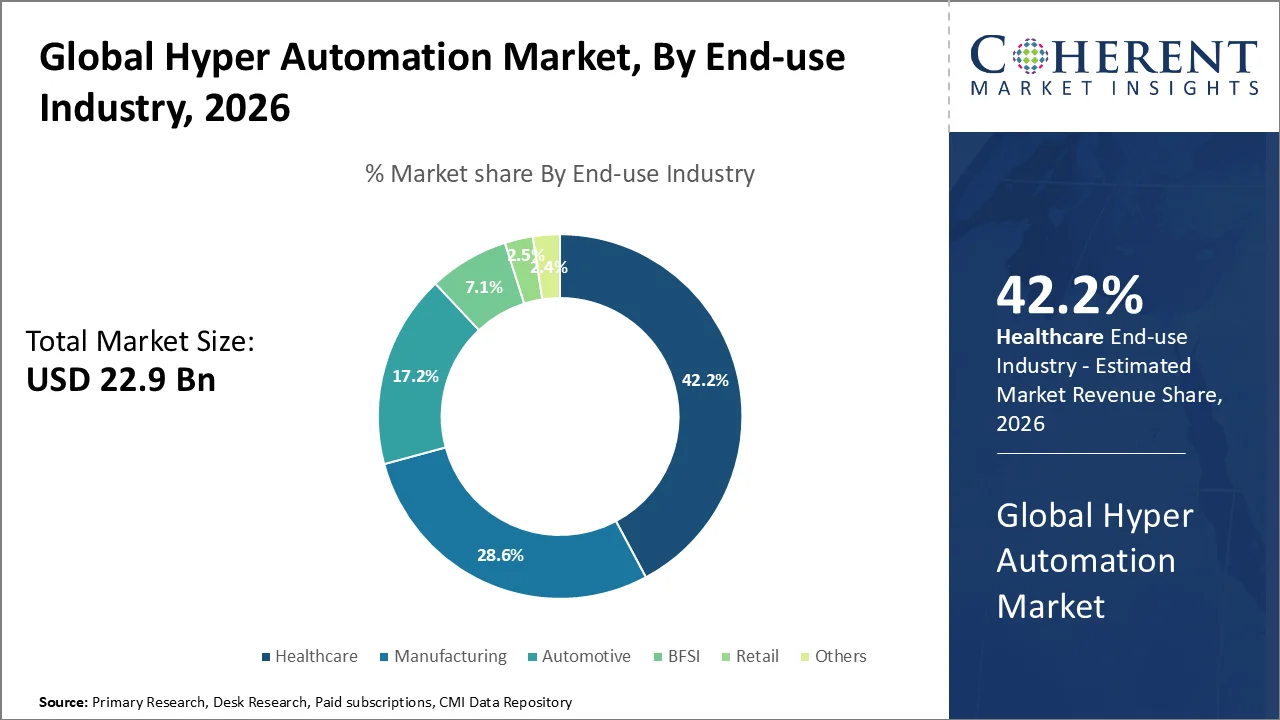
Healthcare expected to hold largest market share of 42.2% in 2026 owing to its growth of AI-powered clinical decision support. Healthcare providers are driving the hyper automation market by automating administrative, clinical, and operational workflows to improve efficiency and enhance patient care. Hospitals and healthcare organizations are adopting robotic process automation, artificial intelligence, and intelligent document processing to streamline patient registration, claims processing, medical record management, and billing. NHS hospitals use Blue Prism bots to automate patient registration and backlog scheduling, saving over 100,000 administrative hours each year. They are also implementing hyper automation to deliver faster healthcare services, optimize workforce productivity, strengthen regulatory compliance, and improve data accuracy. Furthermore, healthcare providers are expanding telehealth services, leveraging electronic health records, and advancing digital health initiatives to accelerate hyper automation adoption across their operations.
Hyper Automation Market Trends
- Organizations are increasingly combining AI, machine learning (ML), and robotic process automation (RPA) to automate complex workflows, improve decision-making, and increase operational efficiency. According to McKinsey Global Survey on AI, 78% of organizations reported using AI in at least one business function in 2024, up from 72% in 2023. The growing integration of AI capabilities into automation platforms is accelerating the shift from rule-based automation to intelligent hyper automation.
- Enterprises are moving automation workloads to cloud platforms to achieve faster deployment, scalability, and easier integration with existing enterprise systems. More than 90% of organizations worldwide are expected to adopt a hybrid cloud approach by 2027, supporting continued demand for cloud-based automation solutions. Cloud-native hyperautomation platforms help organizations reduce infrastructure costs and scale automation across departments.
- Low-code/no-code platforms are enabling non-technical users to create automation workflows with minimal programming, reducing dependency on IT teams and accelerating digital transformation. Over 70% of new applications developed by organizations will use low-code or no-code technologies by 2025, compared with less than 25% in 2020. This trend is increasing adoption of citizen-developer-driven automation initiatives.
Regional Insights
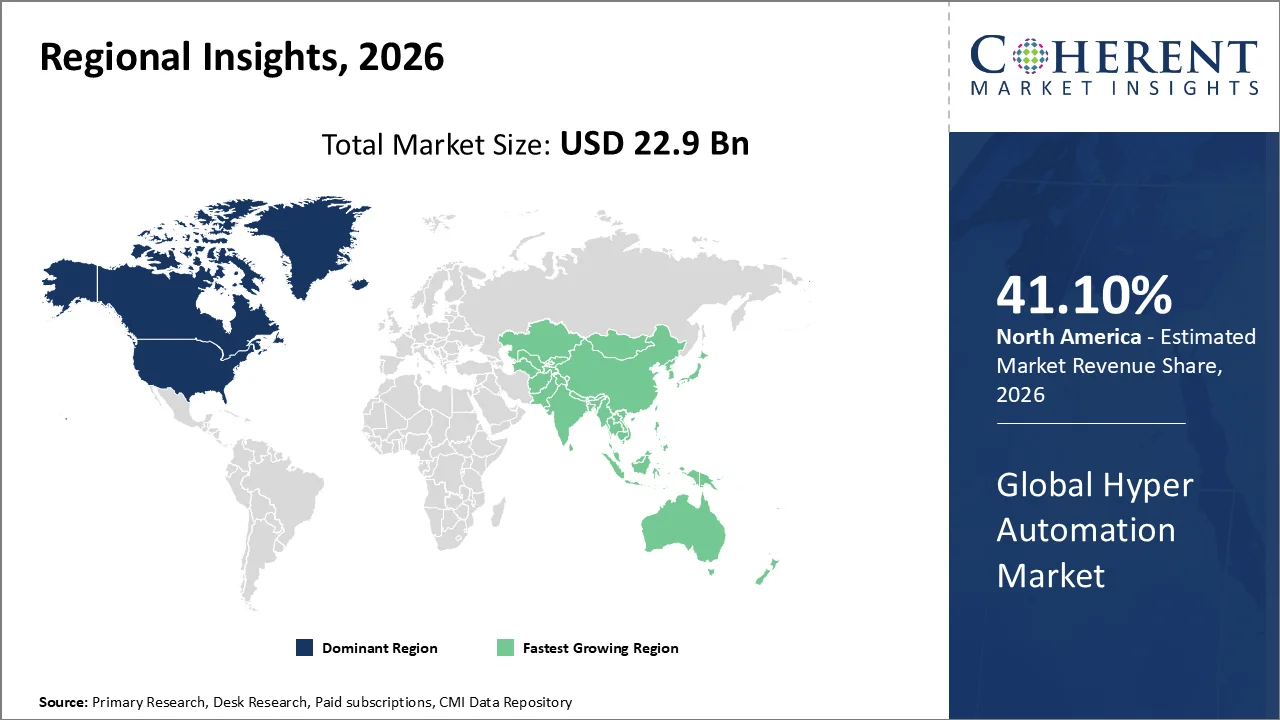
North America dominates owing to demand for operational efficiency and cost reduction
North America is expected to acquire the dominant share of 41.10% in 2026. Organizations across North America are driving the hyper automation market by accelerating digital transformation and investing in advanced automation technologies. Enterprises are adopting artificial intelligence, robotic process automation, machine learning, and cloud computing to streamline business processes and improve operational efficiency. They are leveraging the region's strong technology ecosystem, advanced IT infrastructure, and widespread cloud adoption to deploy hyperautomation solutions rapidly. Furthermore, businesses are prioritizing workforce optimization, strengthening regulatory compliance and cybersecurity, enhancing customer experiences, and investing in low-code platforms and intelligent automation to expand enterprise-wide automation initiatives. For instance, in February 2026, ABB launched the latest version of its flagship distributed control system (DCS), ABB Ability System 800xA 7.0, enabling industrial operators to modernize operations without disruption and accelerate their transition toward next-generation automation.
Asia Pacific Hyper Automation Market Trends
Organizations across the Asia Pacific region are accelerating the hyper automation market through rapid digital transformation and the adoption of artificial intelligence, machine learning, robotic process automation, and advanced analytics. Businesses are implementing automated workflows to streamline operations, minimize manual efforts, and improve productivity. Growing cloud computing adoption, increased investments in enterprise technologies, and the need for faster decision-making are driving market growth. Industries such as manufacturing, banking, healthcare, and retail are actively deploying hyper automation solutions to enhance efficiency and support digital innovation across the region.
United States Hyper Automation Market Trends
The United States hyper automation market is experiencing significant growth as businesses adopt artificial intelligence, machine learning, robotic process automation, and advanced analytics across various industries. Organizations are implementing intelligent automation solutions to streamline operations, boost productivity, and minimize manual efforts. Companies in healthcare, finance, manufacturing, and retail are increasingly investing in digital transformation strategies to improve decision-making, increase agility, and achieve greater operational efficiency.
Japan Hyper Automation Market Trends
Japan’s hyper automation market is expanding as businesses adopt advanced technologies to enhance operational efficiency and accelerate digital transformation. Companies are integrating artificial intelligence, robotic process automation, machine learning, and intelligent workflows across manufacturing, finance, healthcare, and logistics industries. Japan’s commitment to innovation, smart factory development, and workforce optimization continues to increase demand for automated solutions. Government programs that promote digitalization and emerging technology adoption are also motivating enterprises to implement hyper automation strategies, improve productivity, and strengthen their competitive position. For instance, Accenture launched Accenture Alpha Automation, a joint venture with Mujin that combines Accenture’s manufacturing expertise with Mujin’s industrial robotics and automation capabilities.
Who are the Major Companies in Hyper Automation Industry
Some of the major key players in Hyper Automation are Automation Anywhere, Inc., SolveXia, Wipro Limited, UiPath, ALLERIN TECH PVT LTD, Appian, OneGlobe LLC., Mitsubishi Electric Corporation, Catalytic Inc, Infosys Limited, and Tata Consultancy Services Limited.
Key News
- In December 2025, NTT DATA launched four AI-powered autonomous Cyber Defense Centers in Bengaluru, Hyderabad, Noida, and Mumbai, with additional centers planned in Birmingham and Dallas.
Market Report Scope
Hyper Automation Market Report Coverage
| Report Coverage | Details | ||
|---|---|---|---|
| Base Year: | 2025 | Market Size in 2026: | USD 22.9 Bn |
| Historical Data for: | 2020 To 2024 | Forecast Period: | 2026 To 2033 |
| Forecast Period 2026 to 2033 CAGR: | 7.1% | 2033 Value Projection: | USD 31.8 Bn |
| Geographies covered: |
| ||
| Segments covered: |
| ||
| Companies covered: | Automation Anywhere, Inc., SolveXia, Wipro Limited, UiPath, ALLERIN TECH PVT LTD, Appian, OneGlobe LLC., Mitsubishi Electric Corporation, Catalytic Inc, Infosys Limited, and Tata Consultancy Services Limited. | ||
Analyst Opinion
- Hyper automation is becoming a strategic priority for enterprises as organizations move beyond basic automation toward AI-driven, end-to-end process orchestration. The market is not being shaped by technology curiosity but by the need to address operational complexity, rising labor constraints, and demand for real-time decision-making. According to industry surveys, a significant share of large enterprises have already adopted or are actively scaling automation initiatives, with many combining robotic process automation (RPA), artificial intelligence, machine learning, and process mining to improve business outcomes.
- Japan, Germany, and other automation-focused economies are accelerating hyper automation adoption through smart manufacturing initiatives. For example, Japanese manufacturers are integrating AI-powered automation, digital twins, and autonomous robotics into production environments to improve precision and reduce dependency on manual processes. Companies such as Toyota and FANUC demonstrate how intelligent automation can optimize manufacturing workflows, predictive maintenance, and quality control. Industrial automation experience gives Japan a strong foundation to expand hyper automation from factory floors into enterprise functions such as finance, supply chain, and customer operations.
- The strongest growth opportunity in hyper automation lies in industries managing high-volume, rule-based, and data-intensive processes. Financial institutions, healthcare providers, and logistics companies are increasingly deploying intelligent automation to reduce processing time and improve accuracy. For instance, banks use AI-enabled automation for fraud detection, compliance monitoring, and customer service workflows, while healthcare organizations apply automation to claims processing and administrative tasks. Enterprises will prioritize hyper automation solutions that deliver measurable efficiency gains rather than standalone automation tools with limited scalability.
- The future direction of hyper automation will depend on the integration of generative AI with existing automation platforms. Industry research indicates that organizations are increasingly experimenting with AI copilots and autonomous agents to handle complex decision-making tasks that traditional RPA cannot manage. Generative AI will shift hyper automation from task execution toward intelligent process management, enabling systems to analyze data, recommend actions, and continuously optimize workflows. Companies that successfully combine AI reasoning with automation infrastructure are likely to gain a significant operational advantage.
Speak to the analyst
Want personalized insights?
Take the findings above to one of our principal consultants, or have the report rebuilt around the segments, geographies and competitors you actually track.
Market Segmentation
- By Technology (Revenue, USD Bn, 2021-2033)
- Robotic Process Automation (RPA)
- Machine Learning (ML)
- Chatbots
- Biometrics
- Natural Language Generation
- Context-aware Computing
- By End-use Industry (Revenue, USD Bn, 2021-2033)
- Manufacturing
- Automotive
- Healthcare
- BFSI
- Retail
- Others
- By Region (Revenue, USD Bn, 2021-2033)
- North America
- U.S.
- Canada
- Latin America
- Brazil
- Mexico
- Argentina
- Rest of Latin America
- Europe
- Germany
- U.K.
- France
- Italy
- Spain
- Russia
- Rest of Europe
- Asia Pacific
- China
- India
- Japan
- Australia
- South Korea
- ASEAN
- Rest of Asia Pacific
- Middle East
- GCC
- Israel
- Rest of Middle East
- Africa
- South Africa
- Central Africa
- North Africa
- North America
Sources
Primary Research Interviews
- Industry executives, technology leaders, automation specialists, AI practitioners, enterprise decision-makers, and solution providers involved in hyper automation adoption.
- Subject matter experts across industries such as banking, healthcare, manufacturing, retail, telecommunications, and IT services.
- End-user organizations implementing automation, robotic process automation (RPA), artificial intelligence (AI), machine learning (ML), process mining, and intelligent automation solutions.
Databases
- Government databases and statistical repositories.
- Corporate filings, investor presentations, and company disclosures.
- Technology adoption databases and enterprise technology usage datasets.
- Trade and industry databases covering automation, digital transformation, AI, and enterprise software trends.
Magazines
- Technology and business publications covering artificial intelligence, automation, cloud computing, enterprise software, and digital transformation.
- Industry-focused publications covering emerging technologies and enterprise innovation.
Journals
- Peer-reviewed academic journals covering artificial intelligence, machine learning, automation technologies, information systems, robotics, and digital transformation.
- Research publications from universities and academic institutions focusing on automation and enterprise technology advancements.
Newspapers
- Global and regional newspapers covering technology investments, business transformation, innovation trends, mergers, partnerships, and regulatory developments.
- Business and technology news sources tracking automation and AI industry developments.
Associations
- Technology and automation-focused industry associations.
- Artificial intelligence, robotics, software, information technology, and digital transformation associations.
- Professional organizations supporting research and knowledge exchange in automation-related fields.
Public Domain Sources
- Government publications, regulatory documents, and policy reports.
- Open-access research papers and technical publications.
- Publicly available company reports, product documentation, and technology announcements.
- Open datasets related to AI, automation, enterprise technology, and digital transformation.
Proprietary Elements
- CMI Data Analytics Tool
- Proprietary CMI Existing Repository of information for last 10 years
Get access to 250+ pages report
Every segment, forecast, competitor profile and data table behind the analysis above — available for instant download.
- ESOMAR Member
- ISO 9001:2015 Certified
- D-U-N-S Registered
- GDPR & CCPA Compliant
Missing comfort of reading report in your local language? Find your preferred language:
Transform your Strategy with Exclusive Trending Reports
Frequently Asked Questions
The Hyper Automation Market is anticipated to grow at a CAGR of 7.1% with USD 22.9 Bn in 2026 and is expected to reach USD 31.8 Bn in 2033.
Digitalization of the traditional manufacturing plants is the primary factor contributing towards the growth of global Hyper automation market during the forecast period.
Robotic Process Automation sub-segment holds the largest market share.
North America region holds the largest share in the global Hyper Automation market.
Major players operating in the global Hyper Automation market are Automation Anywhere, Inc., SolveXia, Wipro Limited, UiPath, ALLERIN TECH PVT LTD, Appian, OneGlobe LLC., Mitsubishi Electric Corporation, Catalytic Inc, Infosys Limited, and Tata Consultancy Services Limited