

High Performance Computing Market Analysis & Forecast: 2026 to 2033
High Performance Computing Market is estimated to be valued at USD 45.21 Bn in 2026 and is expected to reach USD 75.99 Bn in 2033, exhibiting a compound annual growth rate (CAGR) of 7.7% from 2026 to 2033.
Key Takeaways
- Based on Component, the Hardware segment is expected to lead the market with 70.5% share in 2026, driven by advances in integrated, energy efficient server systems.
- Based Deployment Type, the On-Premise segment is expected to hold the market with the largest share in 2026, driven by full-capacity performance and rising operational complexity.
- Based on Industrial Application, the Life Science & Healthcare segment is projected to account for the highest share of the market in 2026, fueled by genomics, drug discovery, and personalized medicine.
- Based on Region, North America is set to lead the high performance computing market with 40.2% share in 2026. While, Asia Pacific is anticipated to be the fastest growing region.
Market Overview
The major factors driving growth include increasing adoption of hybrid HPC solutions, expanding IT industry, and technological advancements in virtualization. Growing need for faster data processing with high accuracy is expected to boost revenue of the global market. This trend is fueled by government-led digitalization programs and rising acceptance of cloud technology. Moreover, rising automation in various industries is further boosting the growth of the market.
Current Events and Its Impacts on the High Performance Computing Market
Current Event | Description and its Impact |
Global AI and Machine Learning Boom |
|
European Union Digital Sovereignty Initiatives |
|
Role of AI in High Performance Computing Market
Artificial Intelligence is extremely significant to the High-Performance Computing (HPC) market as it makes complex workloads run faster, more efficiently, and on more machines. AI-powered accelerators like GPUs and TPUs make massive parallel processing possible, which speeds up simulations, predictive modeling, and real-time analytics. This integration improves how resources are managed, helps make new discoveries in scientific research, and grows the High Performance Computing Market size in fields like healthcare, finance, manufacturing, and national security.
For instance, in November 2025, ESDS introduced GPU-as-a-Service (GPUaaS) to run AI workloads on a large scale. The cloud-based service provides scalable GPU infrastructure that helps businesses and researchers speed up deep learning, natural language processing, and big data analytics. This launch makes AI-driven High Performance Computing stronger, which makes advanced computing resources more available and useful for businesses all over the world.
- Current Industry Events of 2026
- Market Size Estimation
- Regional Breakdown
- Competitive Landscape
- Customer Intelligence
- Segmental Analysis
- Pricing Analysis
- Key Market Drivers, Challenges & Future Trends
- Customized Insights Section
Segmental Insights
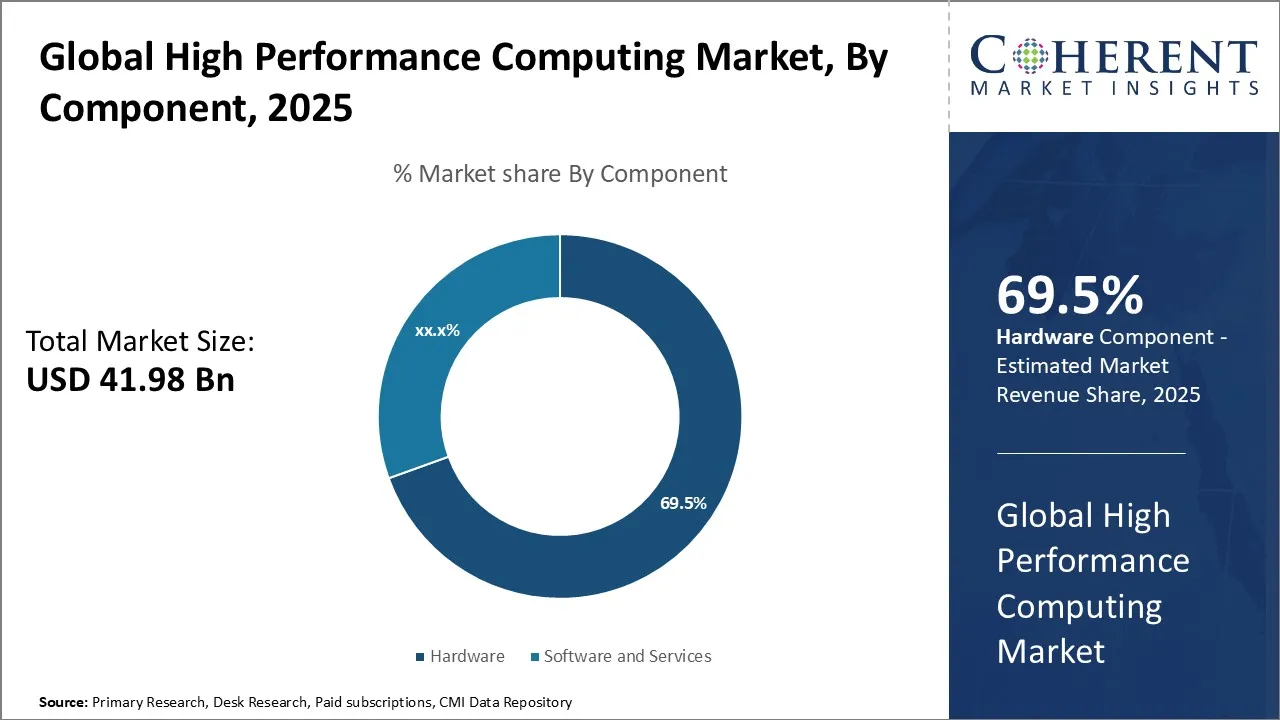
Global High Performance Computing Market Insights, By Component - Hardware Dominance Is Driven by Advances in Integrated, Energy‑Efficient Server Systems
In terms of component, the Hardware segment is expected to dominate the global market over the forecast period and this is attributed to the recent technological advancement and growing manufacturing of hardware components leading to development of integrated and energy-efficient server systems. The hardware segment mainly includes Storage, Servers, and other hardware components including networking and processors modules used heavily in the HPC clusters. The increasing development of integrated and energy-efficient server systems is expected to support growth of the segment in the coming future.
For instance, in November 2025, Ant PC launched a new website to meet India's growing need for high-performance AI workstations and servers. The move shows that the company is focused on giving professionals and businesses access to cutting-edge computer hardware. This strengthens its position in the growing high-performance computing (HPC) market and meets the needs of industries that need powerful, energy-efficient server systems.
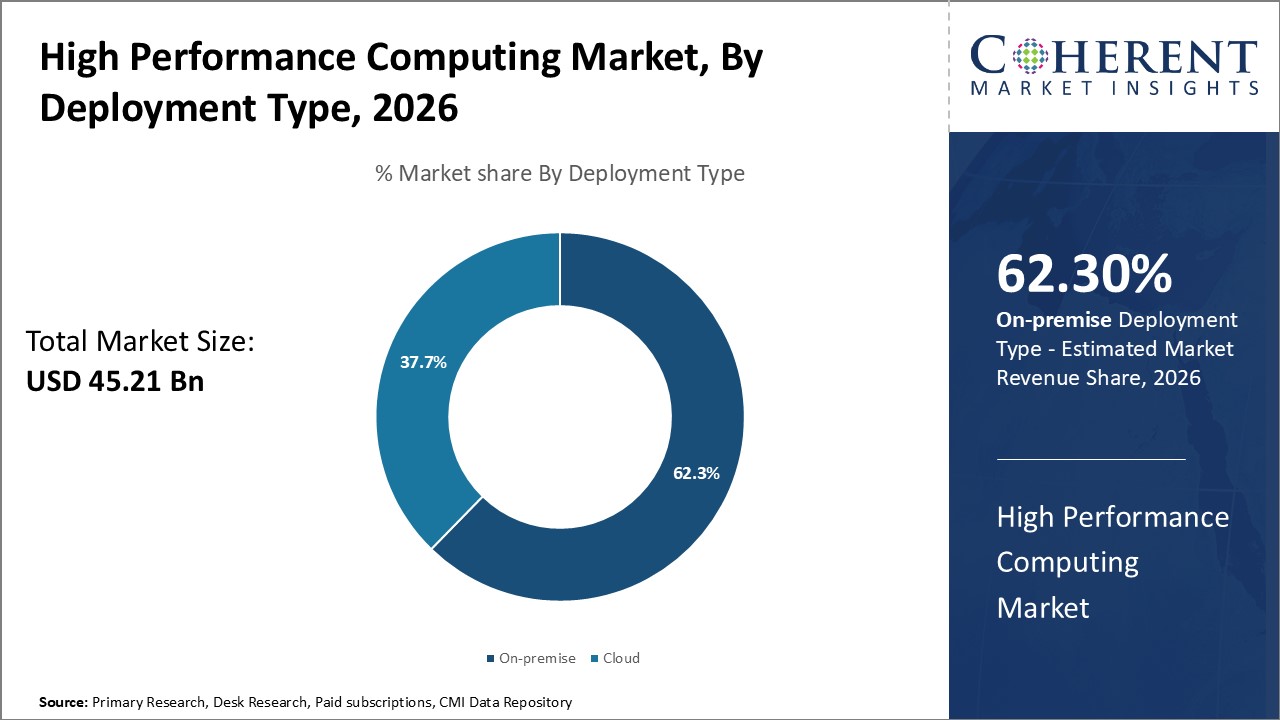
Global High Performance Computing Market Insights, By Deployment Type - On-Premise Dominance Is Driven by Full-Capacity Performance and Rising Operational Complexity
In terms of deployment type, the On-Premise segment is expected to dominate the global market over the forecast period and this is attributed to the advantages of on-premise models, such as their ability of tapping into the full capacity of HPC systems, without having to face any blockages arising from connectivity issues. Along with this, the increasing complexity of operations and rising capabilities of the systems is driving the demand for On-premise deployment of HPC systems. Thus, the segment is likely to show strong growth in coming years.
For instance, in February 2025, D-Wave announced that it will start selling its quantum systems for use on-site to speed up AI and quantum research. The new service lets businesses and research institutions use all of their HPC power on-site, getting around connectivity problems while keeping performance and security high. This move strengthens the on-premise part of the high-performance computing market, which helps drive innovation in many fields.
Global High Performance Computing Market Insights, By Industrial Application - Life Sciences & Healthcare Lead Is Fueled by Genomics, Drug Discovery, And Personalized Medicine
In terms of industrial application, the life sciences & healthcare segment is projected to account for the largest share of the market in 2026, driven by the rising demand for genomics research, drug discovery, personalized medicine, and studies related to pandemics. HPC is essential for making medical breakthroughs because it can process huge amounts of data and speed up complicated simulations.
For instance, in November 2026, Merck presented a cutting-edge, high-performance computer in Munich that it made with Lenovo and Equinix. The computer is meant to speed up innovation in the company's Life Science, Healthcare, and Electronics sectors. The system will use Lenovo ThinkSystem servers with advanced liquid cooling to help make big strides in genomics, drug discovery, and personalized medicine. It will also support high-performance computing that is environmentally friendly and energy-efficient for complex research workloads.
Regional Insights
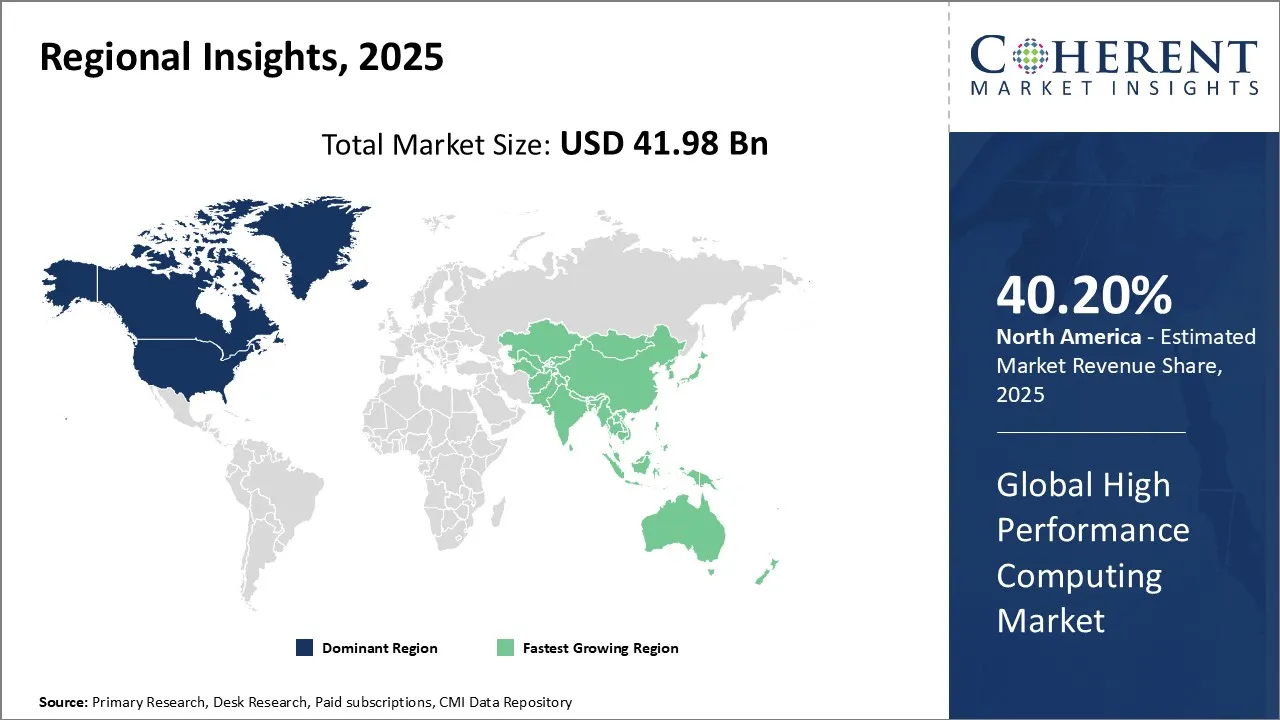
North America High Performance Computing Market Analysis & Trends
North America is anticipated to gain major share in the global high performance computing market during the forecast period. This can be attributed to increasing development and implementation of novel technologies. The growing implementation of these novel technologies is due to constantly increasing amount of data, need for security, leading to rise in use of HPC systems in the region. Moreover, increasing investments by governments at national level in research and development activities in the region is also expected to drive growth of the market in North America region.
For instance, in November 2026, the Genesis Mission started a new era in AI computing for the United States. It combines the country's best supercomputers with cutting-edge AI frameworks and quantum technologies. The initiative puts HPC at the center of America's plan to double scientific productivity over the next ten years. It is meant to speed up breakthroughs in science, energy, and national security.
Asia Pacific High Performance Computing Market Analysis & Trends
Asia Pacific is also expected to show substantial growth in the global high performance computing market during the forecast period. Countries such as Japan and China are majorly contributing to the growth of HPC systems in the region. This is due to increasing investment in HPC systems compared to other countries.
For instance, in November 2026, Microsoft announced that it will expand its AI infrastructure and cloud services in Indonesia. This will give local businesses the tools they need to come up with new ideas using advanced computing. The initiative makes it easier for businesses in healthcare, manufacturing, and other fields to access scalable, high-performance cloud resources. It also shows Microsoft's commitment to driving digital transformation and AI innovation powered by high-performance computing across the Asia-Pacific region.
High Performance Computing Market Outlook Country-Wise
The U.S. High Performance Computing Market Trends
The U.S. High Performance Computing (HPC) market will be exceptionally active in 2026 driven by defense, AI, and big data analytics. Cloud adoption, advanced processors (CPU, GPU, AI accelerators), and government-backed innovation are driving growth. HPC is necessary for national security, scientific breakthroughs, and business competitiveness.
For instance, in November 2026, Amazon Web Services (AWS) spend up to $50 billion to improve AI and supercomputing infrastructure for U.S. government agencies. Starting in 2026, the program will add almost 1.3 gigawatts of computing power to AWS Top Secret, Secret, and GovCloud regions. This will improve national security, scientific research, and innovation by providing advanced AI services and secure cloud infrastructure.
China High Performance Computing Market Trends
The High Performance Computing (HPC) market in China is growing rapidly due to is more demand for AI, big data, and scientific research. Growth is being driven by government-backed projects, the use of cloud computing, and new chip technology made in the US. HPC is very important for national security, healthcare, and advanced manufacturing. This makes China a world leader in technologies that need a lot of computing power.
For instance, in November 2026, Chinese AI chip start-up Zhonghao Xinying (CL Tech) released its TPU "Chana," which is 1.5 times faster than Nvidia's A100 and uses 30% less power. The company also released Taize, a cluster that connects 1,024 units to train trillion-parameter models. This gives China a local option because the U.S. has limited access to advanced GPUs.
Market Report Scope
High Performance Computing Market Report Coverage
| Report Coverage | Details | ||
|---|---|---|---|
| Base Year: | 2025 | Market Size in 2026: | USD 45.21 Bn |
| Historical Data for: | 2020 To 2024 | Forecast Period: | 2026 To 2033 |
| Forecast Period 2026 to 2033 CAGR: | 7.7% | 2033 Value Projection: | USD 75.99 Bn |
| Geographies covered: |
| ||
| Segments covered: |
| ||
| Companies covered: | NVIDIA Corporation, Advanced Micro Devices Inc., Amazon Web Series, NEC Corporation, Lenovo Group Ltd., Hewlett Packard Enterprise, Dassault Systemes SE, Sugon Information Industry Co. Ltd., Dell Technologies Inc., Fujistu Ltd., Microsoft Corporation, Intel Corporation, and International Business Machines Corporation. | ||
| Growth Drivers: |
| ||
| Restraints & Challenges: |
| ||
Global High Performance Computing Market Drivers
Growing need of processing large amount of data with high speed to boost the market growth
Enterprises with large amount of data required to be managed and processed are focusing on analyzing this data to support decision-making process. End-users are also looking for this in order to gain a competitive edge in the market. For instance, a pharmaceutical firm arriving early in the market will gain profits in the market. Several enterprises don’t have tools for analyzing such large amounts of data, and organization that are highly data driven are observing major improvements in decision-making compared to organization relying less on data. Thus, need for data processing with high speed is increasing among several organization, which in turn is driving the demand for HPC systems. This in turn is expected to augment growth of the global high performance computing market over the forecast period.
Growing adoption of HPC in the cloud to fuel the market pace
The use of cloud in HPC in terms of storage is increasing significantly, which is further driving research firms and enterprises to adopt a ‘cloud-first’ policy, which helps them with cost benefits with the use of cloud instead of expansion of their data centers with expenditures, such as data and cluster management, cooling, and requirements for certification. Due to this increasing use of HPC in the cloud, the number of compute infrastructure on-premise is reducing significantly. HPC is known to be one of the key expenses among businesses; however, with the cloud innovation, the cost of technology is being reduced and expansion of the technology reach is increasing due to the availability of the solution. These factors in turn are thus expected to boost growth of the global high performance computing market over the forecast period.
Global High Performance Computing Market Opportunities
Growing advancements in HPC driving the digital transformation across several sectors is likely to bring multiple growth opportunities in the global high performance computing market during the forecast period. Fields, such as climate studies and weather forecasting, precision medicine, oil and gas exploration, and manufacturing and engineering are digitally being transformed by increased scalability, productivity, ease of use, and offering support to companies in operating more cost-effectively. All this can be attributed to increasing advancements in HPC.
Increasing use of HPC systems in life science organization is anticipated to create lucrative environment for growth opportunities in the global high performance computing market during the forecast period. Several life science companies are redefining their approach to diagnosis, treatment, and care delivery for patients, owing to high-performance computing capabilities. Among these applications, HPC-driven simulations are leading to an increasing shift in precision medicine, as companies are leaving a one-size-fits-all approach to healthcare for a more effective and faster model of patient-centric research. These factors in turn are bringing several lucrative opportunities in the global high performance computing market.
Global High Performance Computing Market Trends
Growing popularity of space exploration through HPC is a growing trend in the market
Space exploration through high performance computing has become a multifaceted and exciting research field, which is currently trending. For instance, NASA partnered with Hewlett Packard Enterprise (HPE) for launching the first HPC system into space, with a mission called Spaceborne Computer. NASA makes use of leading-edge technology for collecting, analyzing, and transmitting large amount of data and derive intelligence insights rapidly. To execute these tasks, HPC capabilities are essential.
Growing smart cities development is a recent trend
The growing development of smart cities is fueling demand in the high performance computing market. Advanced urban infrastructure relies on HPC for real-time data analytics, IoT integration, and AI-driven decision-making. This trend significantly boosts High Performance Computing Market size, supporting efficient traffic systems, energy management, and public safety innovations across modern cities.
Analyst Opinion (Expert Opinion)
- The High Performance Computing market value is changing a lot because more companies want to use AI-heavy workloads and GPU-centric architectures are becoming more popular. According to industry data, global spending on high-performance computing (HPC) is now in the tens of billions of dollars, with a lot of money going toward accelerator servers, high-bandwidth memory, and advanced interconnects. Vendor disclosures from 2024 to 2025 show that there are multibillion-dollar backlogs for AI-optimized server systems. This is because hyperscalers, research centers, and big businesses have put a lot of money into them.
- As exascale systems reach peak capabilities of over 1,000 petaflops, performance benchmarks keep going up. Power use for the best installations often exceeds tens of megawatts. This shows how important it is to use hardware that uses less energy, liquid cooling, and optimized network topologies to lower the total cost of ownership. Cloud-based HPC is making access easier by providing large GPU clusters and exascale-class compute power on demand. This changes the way people buy things from capital expenditures to operational expenditures.
- Demand is quickly changing across a wide range of fields, including automotive engineering, drug discovery, weather modeling, finance, and digital twin applications. But rising system complexity, a concentration of supply chains in accelerator components, and high facility-upgrade needs are still major problems. In general, the market is moving toward bigger, more diverse computing environments because of AI workloads and next-generation scientific computing.
Speak to the analyst
Want personalized insights?
Take the findings above to one of our principal consultants, or have the report rebuilt around the segments, geographies and competitors you actually track.
Global High Performance Computing Market: Key Developments
- In November 2025, NB Hash released a new generation of AI compute infrastructure to meet the growing demand for High Performance Computing around the world. The platform is meant to provide solutions for AI, big data, and scientific workloads that can grow and use less energy.
- In October 2025, NVIDIA demonstrated NVQLink, a new way to connect GPU supercomputers with quantum processors. The technology makes hybrid quantum-classical computing possible, which speeds up research in chemistry, materials science, and AI. NVQLink works with U.S. national labs to support low-latency, high-throughput connections.
- In August 2025, IBM and AMD teamed up to work together on the future of computing. The two companies will work together to combine AMD's powerful processors with IBM's AI and hybrid cloud technologies. Their goal is to speed up progress in enterprise computing, high-performance computing (HPC), and secure AI solutions, which will make the global technology infrastructure stronger for next-generation workloads.
Market Segmentation
- By Component (Revenue, USD Bn, 2021 - 2033)
- Hardware
- Software and Services
- By Deployment Type (Revenue, USD Bn, 2021 - 2033)
- On-premise
- Cloud
- By Industrial Application (Revenue, USD Bn, 2021 - 2033)
- Aerospace and Defense
- Energy and Utilities
- BFSI
- Media and Entertainment
- Manufacturing
- Life Science and Healthcare
- Other Industrial Applications
- By Region (Revenue, USD Bn, 2021 - 2033)
- North America
- U.S.
- Canada
- Latin America
- Brazil
- Argentina
- Mexico
- Rest of Latin America
- Europe
- Germany
- U.K.
- Spain
- France
- Italy
- Russia
- Rest of Europe
- Asia Pacific
- China
- India
- Japan
- Australia
- South Korea
- ASEAN
- Rest of Asia Pacific
- Middle East & Africa
- GCC Countries
- Israel
- Rest of Middle East & Africa
- North America
- Global High Performance Computing Market: Key Companies Insights (Revenue, USD Bn, 2021 - 2033)
- NVIDIA Corporation
- Advanced Micro Devices Inc.
- Amazon Web Series
- NEC Corporation
- Lenovo Group Ltd.
- Hewlett Packard Enterprise
- Dassault Systemes SE
- Sugon Information Industry Co. Ltd.
- Dell Technologies Inc.
- Fujistu Ltd.
- Microsoft Corporation
- Intel Corporation
- International Business Machines Corporation
Sources
Primary Research Interviews
- HPC System Manufacturers
- GPU & Accelerator Vendors
- Supercomputing Center Operators
- Cloud HPC Service Providers
- HPC Software & Middleware Vendors
- Data Center / Colocation Operators
- HPC Benchmarking & Performance Engineers
- HPC Solution Integrators & Consultants
- Research Scientists / Computational Scientists (life sciences, climate, physics)
- Others
Databases
- Bloomberg Terminal
- Thomson Reuters Eikon
- Others
Magazines
- HPCwire
- The Next Platform
- Data Center Knowledge
- IEEE Spectrum
- Datacenter Dynamics
- Others
Journals
- Journal of Parallel and Distributed Computing
- IEEE Transactions on Parallel and Distributed Systems
- International Journal of High Performance Computing Applications (IJHPCA)
- ACM Transactions on Computer Systems (TOCS)
- Concurrency and Computation: Practice & Experience
- Others
Newspapers
- Financial Times
- The Wall Street Journal
- Reuters
- Bloomberg News
- The New York Times (Technology/Business sections)
- Others
Associations
- HPC Advisory Council
- SIGHPC — ACM Special Interest Group on High Performance Computing
- PRACE (Partnership for Advanced Computing in Europe)
- EuroHPC Joint Undertaking
- TOP500 Project / LINPACK community
- Others
Public Domain Sources
- TOP500.org (supercomputer rankings and reports)
- U.S. Department of Energy (DOE) — Office of Science / NERSC / Oak Ridge HPC reports
- National Science Foundation (NSF) — HPC programs and publications
- EuroHPC Joint Undertaking publications
- CERN computing / WLCG reports
- Open Science Grid / National labs technical reports
- Others
Proprietary Elements
- CMI Data Analytics Tool
- Proprietary CMI Existing Repository of Information for the Last 8 Years
Definition: High performance computing is a powerful technique that allows researchers, engineers and scientists to perform complex data-intensive tasks faster than they can with a traditional desktop computer. It enables advancements in science, engineering, business and other fields that are vital to the economy and society at large.
Get access to 250+ pages report
Every segment, forecast, competitor profile and data table behind the analysis above — available for instant download.
- ESOMAR Member
- ISO 9001:2015 Certified
- D-U-N-S Registered
- GDPR & CCPA Compliant
Missing comfort of reading report in your local language? Find your preferred language:
Transform your Strategy with Exclusive Trending Reports
Frequently Asked Questions
The High Performance Computing Market is estimated to be valued at USD 45.21 Bn in 2026, and is expected to reach USD 75.99 Bn by 2033.
The CAGR of the High Performance Computing Market is projected to be 7.7% from 2026 to 2033.
Growing need of processing large amount of data with high speed and growing adoption of HPC in the cloud are fuelling the market
The Hardware segment is the leading component segment in the market.
Security concerns of data and lack of budgets among SMEs are the major factors restraining growth of the market.
NVIDIA Corporation, Advanced Micro Devices Inc., Amazon Web Series, NEC Corporation, Lenovo Group Ltd., Hewlett Packard Enterprise, Dassault Systemes SE, Sugon Information Industry Co. Ltd., Dell Technologies Inc., Fujistu Ltd., Microsoft Corporation, Intel Corporation, and International Business Machines Corporation.