

Green Technology And Sustainability Market Size And Share Analysis - Growth Trends And Forecasts (2026-2033)
Green Technology and Sustainability Market is estimated to be valued at USD 22.51 Bn in 2026 and is expected to reach USD 50.38 Bn in 2033, exhibiting a compound annual growth rate (CAGR) of 12.2% from 2026 to 2033.
Key Takeaways
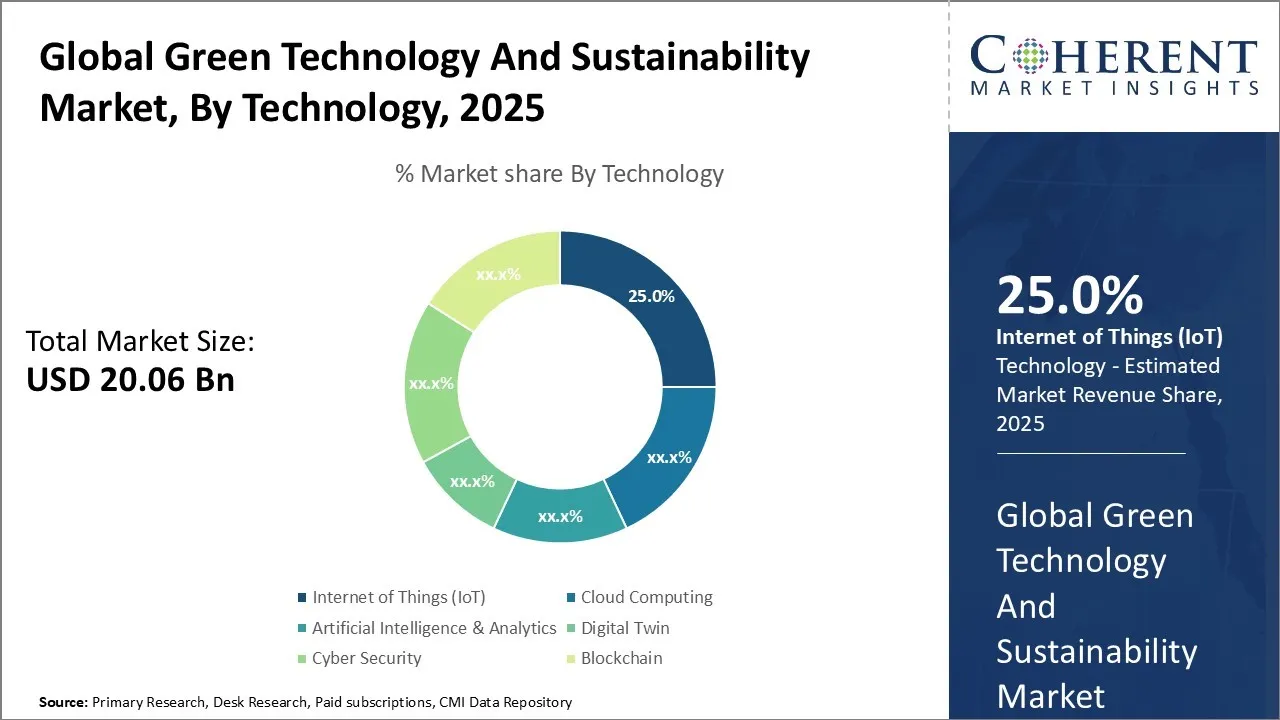
- Based on Technology, the Internet of Thigs (IoT) segment is expected to account for the 26% market share in 2026, due to its ability to enable real-time monitoring, automation, and efficient resource management.
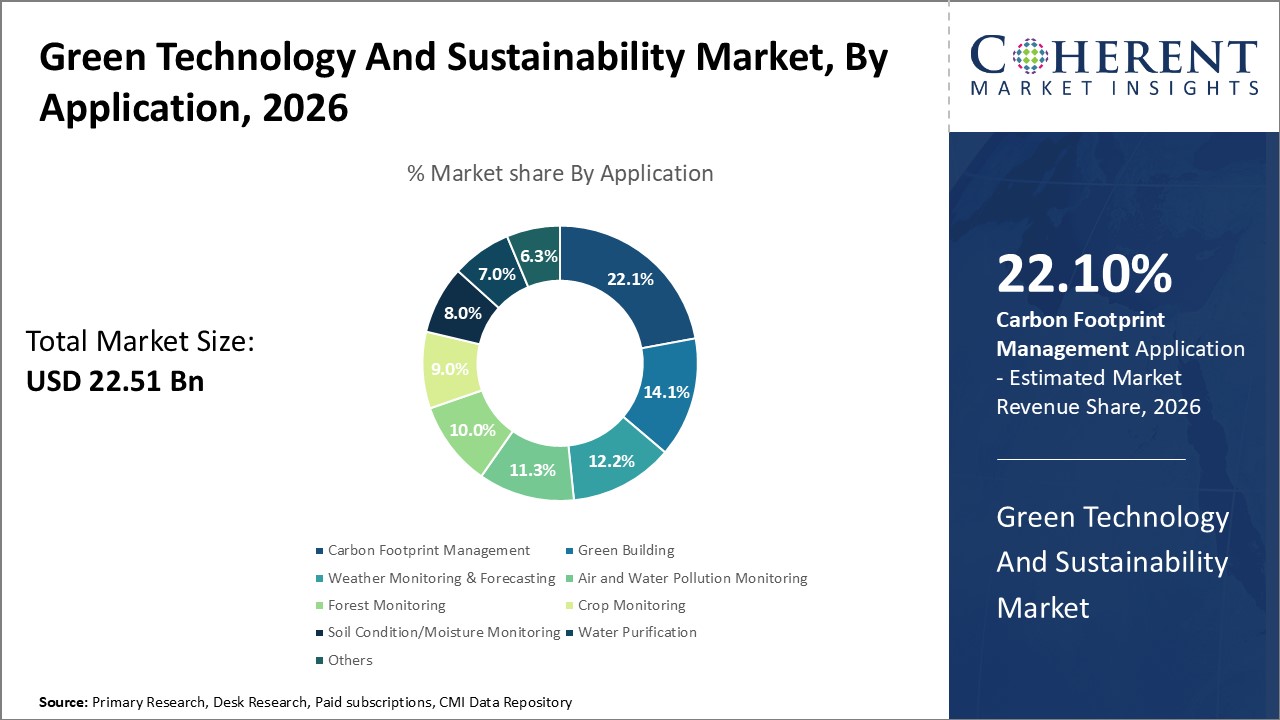
- Based on Application, the Carbon Footprint Management segment is expected to capture the largest market share in 2026, due to growing global pressure to reduce greenhouse gas emissions and meet climate targets.
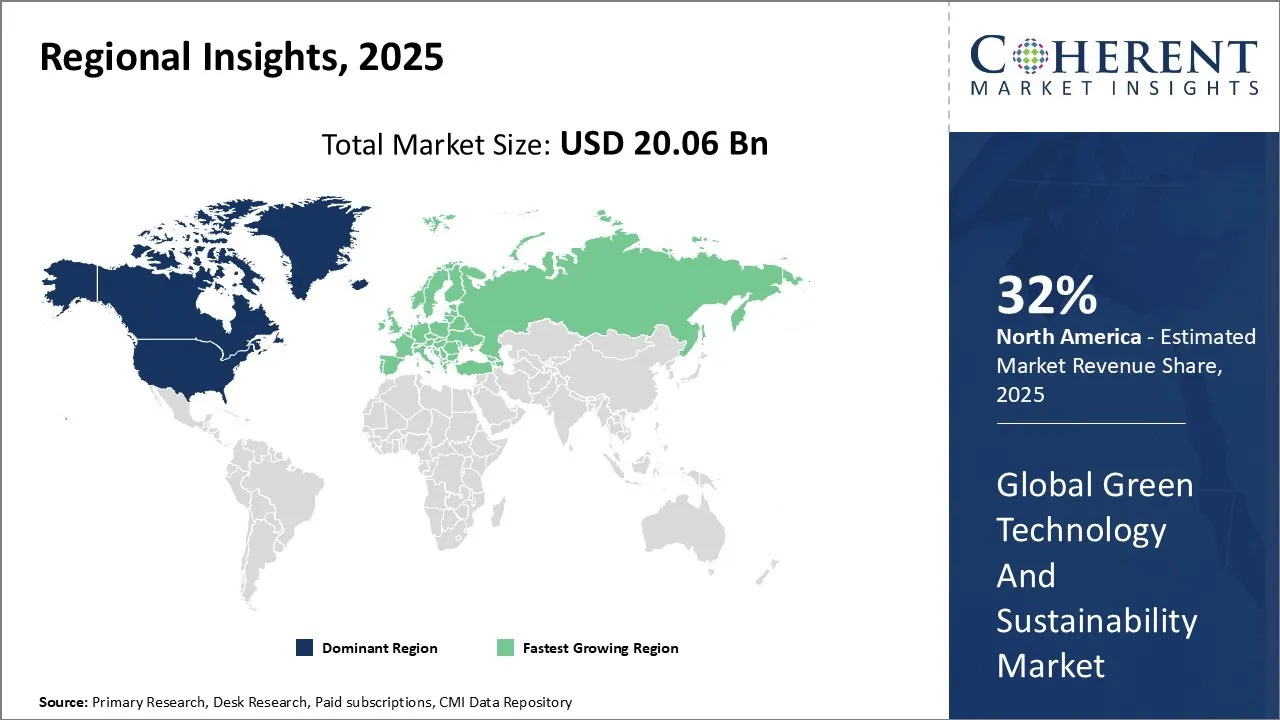
- Based on Region, North America is expected to lead the market, holding a share of 32% on account of the growing green building initiatives across the United States.
Market Overview
The global green technology and sustainability market is booming, largely due to the rising need for effective pollution monitoring and control. In addition, increasing initiatives by governments and private companies to promote environmental conservation are significantly driving green technology and sustainability market demand, making it a critical area of growth and investment in both developed and developing regions.
Current Events and Their Impact on The Green Technology and Sustainability Market
Current Event | Description and its Impact |
Geopolitical Shifts in Energy Policy |
|
Technological Innovations and Advancements |
|
Segmental Insights
- Current Industry Events of 2026
- Market Size Estimation
- Regional Breakdown
- Competitive Landscape
- Customer Intelligence
- Segmental Analysis
- Pricing Analysis
- Key Market Drivers, Challenges & Future Trends
- Customized Insights Section
Green Technology and Sustainability Market Insights, By Technology - Internet of Things (IoT) Acquires the most prominent share as it Offer Real -Time Monitoring and Automation
In terms of technology, the Internet of Things (IoT) segment is expected to contribute 26.0% of the green technology and sustainability market in 2026, due to its ability to enable real-time monitoring, automation, and efficient resource management. IoT devices help track energy consumption, air and water quality, waste levels, and emissions across various sectors, empowering organizations and governments to make data-driven decisions for sustainability. For example, IoT-enabled smart grids optimize electricity distribution and reduce wastage, while smart irrigation systems in agriculture conserve water by adjusting usage based on weather and soil data. This growing application of IoT in optimizing environmental performance is a key driver of demand in the market.
For instance, in June 2025, the Ministry of New and Renewable Energy (MNRE) unveiled an Innovative Projects Start‑Up Challenge, offering a ₹2.3 crore prize pool to foster breakthrough solutions in rooftop solar and distributed renewable energy technologies. Launched during the National Conference on Skill Development at Atal Akshay Urja Bhawan, New Delhi, the competition invites startups in sectors like green tech, IoT, AI, blockchain, energy hardware, fintech, and waste management.
Green Technology and Sustainability Market Insights, By Application - Carbon Footprint Management dominates the overall market owing to the Growing Global Pressure to Reduce Greenhouse Gas Emissions
In terms of application, the carbon footprint management segment is expected to hold the largest share of the market in 2026, due to growing global pressure to reduce greenhouse gas emissions and meet climate targets set by agreements like the Paris Accord. Governments, corporations, and investors are increasingly prioritizing ESG (Environmental, Social, and Governance) standards, pushing organizations to measure, manage, and reduce their carbon footprints. Additionally, regulatory frameworks across Europe, North America, and parts of Asia now mandate carbon disclosure, further accelerating demand. Companies also see value in carbon management tools to optimize energy use, improve sustainability credentials, and maintain competitiveness in carbon-conscious markets.
For instance, in August 2025, Global tech firm Lenovo launched TruScale Device as a Service (DaaS) for Sustainability, a new offering embedded within its TruScale device management platform. The solution spans the IT lifecycle from Advice and Implement to Support, Manage, and Retire & Refresh, to help organizations reduce emissions, extend device life, and cut e‑waste. Key features include a Carbon Impact Portal for real‑time device‑level ESG insights, Certified Refurbished Devices, CO₂ Offset Services, and Asset Recovery Services to recover value responsibly.
Regional Insights
North America Green Technology and Sustainability Market Analysis & Trends
North America is set to lead the global green technology and sustainability market with 32% share in 2026. The region is witnessing growing number of green building initiatives due to which the GHG emissions and fossil fuel demand are reducing in this region. Moreover, the markets for exquisite products, technologies, and practices in North America is seeing competitiveness. The advancements in these markets such as high efficiency appliances, advanced building materials, water-reclamation systems, and advanced insulation systems among others are further supporting growth of the global green technology and sustainability market in the region.
For instance, in February 2026, EDP Renewables North America commissioned three new utility-scale solar parks in Illinois and Texas, delivering a combined 400 MW of clean energy. Such initiatives are accelerating the green technology and sustainability market revenue.
Europe Green Technology and Sustainability Market Analysis & Trends
Europe is expected to exhibit the fastest growth in the global green technology and sustainability market over the forecast period. This is attributed to growing focus of government in the region toward improvement of the standard of living, and mobilization of massive resources across the region. Significant progress in transitioning economies is improving production efficiency and strengthening the economic reconstruction. With adaptative measures, infrastructures are becoming more climate resilience. Thus, the aforementioned factors are expected to aid in growth of the global green technology and sustainability market over the forecast period.
For instance, in July 2026, the European Union launched its Hydrogen Mechanism, an online matchmaking platform designed to spur the renewable and low‑carbon hydrogen market bloc‑wide. The initiative aims to connect hydrogen producers and buyers, covering derivatives like ammonia, methanol, and electro‑sustainable aviation fuel, while supporting infrastructure planning and financing access.
Green Technology and Sustainability Market Outlook Country-Wise
The U.S. Green Technology and Sustainability Market Trends
The United States is a key driver in the Green Technology and Sustainability Market, fueled by strong federal policies, ESG mandates, and major investments in clean energy, EV infrastructure, and climate tech. States like California lead in renewables and zero-emission goals, while corporate and startup activity in carbon capture, energy storage, and sustainable practices further accelerate market demand.
For instance, A major green hydrogen facility is moving forward in California despite federal rollbacks under the Trump administration. The Avina Clean Hydrogen Facility, under construction along the Los Angeles River, is slated to open this fall and will produce up to 4 metric tons of compressed green hydrogen daily for trucks and buses. Supported by state grants and the California Energy Commission, the project aims to cut roughly 130,000 metric tons of CO₂ annually.
Germany Green Technology and Sustainability Market Trends
Germany is a key player in the Green Technology and Sustainability Market, driven by its Energiewende policy promoting renewable energy and carbon neutrality. Strong public-private collaboration supports innovation, while circular economy practices and strict environmental regulations further boost demand for sustainable solutions.
Market Report Scope
Green Technology and Sustainability Market Report Coverage
| Report Coverage | Details | ||
|---|---|---|---|
| Base Year: | 2025 | Market Size in 2026: | USD 22.51 Bn |
| Historical Data for: | 2020 To 2024 | Forecast Period: | 2026 To 2033 |
| Forecast Period 2026 to 2033 CAGR: | 12.2% | 2033 Value Projection: | USD 50.38 Bn |
| Geographies covered: |
| ||
| Segments covered: |
| ||
| Companies covered: | CropX Inc., Enablon France SA, Enviance Inc., General Electric, Hortau Inc., IBM Corporation, LO3 Energy, Inc., Oracle Corporation, Tech Mahindra Limited, and Trace Genomics, Inc. | ||
| Growth Drivers: |
| ||
| Restraints & Challenges: |
| ||
Global Green Technology and Sustainability Market Drivers
- Rise In Environmental Concerns and Awareness to Boost the Market Growth
Environmental concerns have increased in recent years that pose threat to human existence, such as climate change, energy depletion, and global warming. As a result, several green technologies are emerging in the market. Countries around the world are now become aware of need for green technology along with technological transformation and diversification of country’s economy. Moreover, the awareness about benefits of sustainable technologies is increasing all over the world. These factors are in turn expected to support growth of the global green technology and sustainability market over the forecast period.
For instance, in February 2025, Go Waterless unveiled an innovative, eco‑friendly waterless car‑cleaning solution. Designed for high efficiency, each bottle delivers up to eight washes, a sustainable alternative to traditional car washes that consume hundreds of liters per vehicle. The formula significantly reduces water usage in vehicle cleaning, a critical concern as India grapples with looming water scarcity, with nearly 40% of the population at risk of severe shortages by 2030. With over 175 centers nationwide, Go Waterless reportedly saves 1.2 million liters of water daily.
- Growing Use of RFID Sensors To Support the Market Growth
Radio-frequency identification (RFID) sensors are increasingly being adopted across several industries along with adoption of advanced RFID tags. Along with this, emerging paper-based substrate into low-cost RFID tag designs for conductive ink is now an important factor that help reduce manufacturing cost of electronics. With minimized use of ink per antenna can save large amount of money in the mass production of electronics. Thus, growing use RFID sensors is expected to aid in the growth of the global green technology and sustainability market over the forecast period.
For instance, in April 2025, PulpaTronics, founded in 2023, is pioneering sustainable RFID technology with fully recyclable, metal‑ and chip‑free tags. Using laser‑induced carbon circuits printed directly onto paper, the startup slashes annual CO₂ emissions by 70 % and halves production costs compared to conventional silicon-and-metal RFID tags. These paper-based tags can be recycled six to seven times before composting, seamlessly integrating into existing recycling systems.
Global Green Technology and Sustainability Market Opportunities
Growing initiatives to combat air pollution and climate change are expected to create significant growth opportunities in the global green technology and sustainability market over the forecast period. Emerging economies are increasingly adopting clean energy and sustainable production practices across sectors such as transportation, agriculture, waste management, and industry to promote clean air. Additionally, a rising number of companies are investing in carbon emission-free electricity generation, further driving market expansion. The rising demand for safe, cost-effective, and carbon-neutral power is fueling innovation and investment, reinforcing the positive green technology and sustainability market forecast.
For instance, according to the International Energy Agency’s 2025 World Energy Investment report, global energy investment is set to reach a record US $3.3 trillion, a 2 % increase over 2024. Of that total, $2.2 trillion is earmarked for clean energy, including renewables, nuclear, grids, storage, efficiency, and electrification, double the $1.1 trillion slated for oil, natural gas, and coal. This marks the first time clean energy investments have outpaced fossil fuel spending.
Global Green Technology and Sustainability Market Trends
- Cloud Computing Segment Gaining Traction Among Technologies
Cloud infrastructure is developed for addressing two major elements of a sustainable IT approach; resource and energy efficiency. Due to which, virtualization is an important part of deploying cloud infrastructure for allowing a physical server to run various operating system images to improve resource efficiency. As a result, the adoption of cloud computing is increasing all over the world. This trend is expected to continue in the global green technology and sustainability market in the coming future.
Analyst Opinion (Expert Opinion)
The Green Technology and Sustainability Market value is no longer an aspirational niche, it is rapidly becoming a strategic imperative across energy, industrial, and digital sectors. However, despite the visible momentum, the market remains highly fragmented, driven more by regulatory urgency and corporate ESG commitments than by technological convergence or cost parity. In my view, the next phase of growth will depend less on policy push and more on hardwired industrial adoption and measurable ROI.
The most critical shift currently underway is the transition from point-based green innovations, like solar panels or electric vehicles, to system-level integrations, such as smart grids, net-zero buildings, and circular manufacturing ecosystems. For instance, Sweden's H2 Green Steel project is expected to begin operations by 2026, shows how green hydrogen, digital process automation, and renewable energy can be blended into a unified industrial model. This kind of orchestration, not isolated green solutions is what will define market leadership going forward.
On the digital front, artificial intelligence (AI) is playing an increasingly central role in sustainability tech. AI-enhanced building energy management systems are now capable of achieving energy savings of up to 30% in commercial buildings, as evidenced by recent implementations in Singapore’s real estate sector. However, there remains a significant disconnect between AI-enabled sustainability solutions and their practical deployment, especially among mid-sized enterprises. Lack of interoperability standards and data silos are key barriers.
Another overlooked dynamic is the critical role of traceability and lifecycle analytics in shaping green consumer and regulatory behavior. Brands like Levi Strauss & Co. and Unilever have already embedded blockchain-powered transparency tools to track environmental impact across their supply chains. Yet, this level of traceability remains rare in Asia and Latin America, which limits both consumer empowerment and ESG enforcement.
Critically, many investors underestimate the geopolitical and resource-related risks associated with green technology scale-up. Over 80% of the global supply of rare earth elements, essential for wind turbines and electric vehicle motors, is concentrated in China. Until viable recycling or substitution technologies mature, this remains a structural vulnerability.
Speak to the analyst
Want personalized insights?
Take the findings above to one of our principal consultants, or have the report rebuilt around the segments, geographies and competitors you actually track.
Key Developments
- In July 2025, the Asian Development Bank (ADB), in its first collaboration with the Green Climate Fund (GCF) in India, introduced the India Green Finance Facility (IGFF) backed by $200 million in concessional funding. The blended finance initiative aims to stimulate large-scale public and private investment in emerging clean technologies, including round-the-clock renewables, green hydrogen, compressed biogas, rural e‑mobility, and decentralized energy solutions.
- In July 2025, Global carbon capture specialist Carbon Clean launched its new Global Innovation Centre (GIC) in Navi Mumbai. Spanning 77,121 sq ft, the facility includes two carbon capture plants and advanced laboratories dedicated to solvent development, analysis, and testing.
- In June 2025, the Confederation of Indian Industry (CII) unveiled the CII‑ASCEND (Activate Startups in CleanTech to Strategize, Execute, Navigate & Deploy) initiative at the CII‑GreenCo Summit in Hyderabad. Backed by the Sustainability, Equity & Diversity (SED) Fund, the first CII‑ASCEND Innovation Challenge invites CleanTech startups, MSMEs, academic institutions, and technology providers to pilot solutions at Technology Readiness Level (TRL) 5–7.
- In January 2025, the government inaugurated the Bharat Climate Forum 2025 as a unified national platform to accelerate cleantech manufacturing by bringing together policymakers, industry leaders, financiers, and researchers. Tied to its Atmanirbhar Bharat vision, the initiative aims to drive self‑reliance in climate technologies, from solar to hydrogen.
Market Segmentation
- Global Green Technology and Sustainability Market, By Technology (Revenue, USD Bn, 2021 - 2033)
- Internet of Things (IoT)
- Cloud Computing
- Artificial Intelligence & Analytics
- Digital Twin
- Cyber Security
- Blockchain
- Global Green Technology and Sustainability Market, By Application (Revenue, USD Bn, 2021 - 2033)
- Green Building
- Carbon Footprint Management
- Weather Monitoring & Forecasting
- Air and Water Pollution Monitoring
- Forest Monitoring
- Crop Monitoring
- Soil Condition/Moisture Monitoring
- Water Purification
- Others
- Global Green Technology and Sustainability Market, By Region (Revenue, USD Bn, 2021 - 2033)
- North America
- U.S.
- Canada
- Latin America
- Brazil
- Argentina
- Mexico
- Rest of Latin America
- Europe
- Germany
- U.K.
- Spain
- France
- Italy
- Russia
- Rest of Europe
- Asia Pacific
- China
- India
- Japan
- Australia
- South Korea
- ASEAN
- Rest of Asia Pacific
- Middle East
- GCC Countries
- Israel
- Rest of Middle East
- Africa
- South Africa
- North Africa
- Central Africa
- North America
- Global Green Technology and Sustainability Market Companies Insights (Revenue, USD Bn, 2021 - 2033)
- CropX Inc.
- Enablon France SA
- Enviance Inc.
- General Electric
- Hortau Inc.
- IBM Corporation
- LO3 Energy, Inc.
- Oracle Corporation
- Tech Mahindra Limited
- Trace Genomics, Inc.
Sources
Primary Research Interviews from the following stakeholders
Stakeholders
- Interviews with sustainability officers, ESG analysts, renewable energy project developers, environmental engineers, smart grid operators, and waste management service providers across key global markets.
Specific Stakeholders
- ESG and climate strategy leads at large corporates and industrials (e.g., Tata Steel, Unilever, Apple)
- City and municipal planning authorities engaged in green infrastructure projects (e.g., New York City Mayor’s Office of Sustainability, London’s GLA Environment Team, Delhi Jal Board)
- Heads of renewable energy projects at power utilities (e.g., NTPC Renewable Energy, EDF Renewables, Enel Green Power)
- Smart city consultants and IoT integration leads in transport and utility sectors
- Supply chain and procurement heads for sustainable materials in packaging, automotive, and consumer goods sectors
- Environmental innovation leads at clean tech startups and green building system providers
Databases
- International Renewable Energy Agency (IRENA) Statistics
- United Nations Framework Convention on Climate Change (UNFCCC) Data Portal
- International Energy Agency (IEA) Green Innovation Database
- EPA Greenhouse Gas Reporting Program (U.S.)
- Eurostat – Environment and Energy Statistics
- Ministry of Environment, Forest and Climate Change (MoEFCC), India
- Global EV Outlook Database
- China National Energy Administration (NEA) Portal
- Energy Statistics India – MOSPI
Magazines
- GreenBiz
- Recharge News
- Renewable Energy World
- Smart Energy International
- Environmental Leader
- CleanTechnica
- Green Technology Magazine
- Eco-Business
Journals
- Journal of Cleaner Production (Elsevier)
- Nature Sustainability
- Renewable and Sustainable Energy Reviews
- Energy Policy (Elsevier)
- Journal of Environmental Management
- Environmental Science & Technology
- Sustainability Science
- Smart and Sustainable Built Environment
Newspapers
- The Guardian – Environment & Energy Section
- Financial Times – Climate Capital
- The Economic Times – Energy and Renewables
- Business Standard – Green Energy & ESG
- South China Morning Post – Green Tech & Policy
- New York Times – Climate and Environment Section
- Nikkei Asia – Sustainability and Energy Reports
Associations
- World Green Building Council (WGBC)
- International Renewable Energy Agency (IRENA)
- Global Alliance for Sustainable Energy
- Confederation of Indian Industry (CII) – Green Power Market Development Group
- International Electrotechnical Commission (IEC) – Smart Energy Systems Division
- Association for Renewable Energy & Clean Technology (REA), UK
- Smart Electric Power Alliance (SEPA)
- Indian Green Building Council (IGBC)
Public Domain Sources
- Ministry of New and Renewable Energy (MNRE), India
- U.S. Department of Energy (DOE) – Office of Energy Efficiency and Renewable Energy
- European Commission – Climate Action and Green Deal Reports
- India Energy Dashboard by NITI Aayog
- Climate Policy Initiative (CPI) Open Reports
- UN Environment Programme (UNEP) – Emissions Gap Reports
- Department for Business, Energy & Industrial Strategy (BEIS), UK
- Japan’s Ministry of the Environment – Renewable Energy Strategy Publications
- India Investment Grid – Renewable Energy and Green Infra
Proprietary Elements
- CMI Data Analytics Tool, and Proprietary CMI Existing Repository of information for last 8 years
*Definition: Green technology and sustainability is a wide range of technological solutions that are designed to reduce human impact on the environment. These technologies include renewable energy sources, such as solar and wind power; green materials, such as bamboo and hemp; and intelligent processes that are aimed at increasing efficiency, reducing waste, and minimizing the use of fossil fuels.
Get access to 250+ pages report
Every segment, forecast, competitor profile and data table behind the analysis above — available for instant download.
- ESOMAR Member
- ISO 9001:2015 Certified
- D-U-N-S Registered
- GDPR & CCPA Compliant
Missing comfort of reading report in your local language? Find your preferred language:
Transform your Strategy with Exclusive Trending Reports
Frequently Asked Questions
The Green Technology and Sustainability Market is estimated to be valued at USD 22.51 Bn in 2026, and is expected to reach USD 50.38 Bn by 2033.
The CAGR of the Green Technology and Sustainability Market is projected to be 12.2% from 2026 to 2033.
Rise in environmental concerns and awareness and growing use of RFID sensors are fuelling the growth of market.
The Internet of things segment is the leading segment in the market.
High cost of production and solutions of green technology and shortage of personalized solutions to address unique environment related issues are the major factors restraining growth of the market.
CropX Inc., Enablon France SA, Enviance Inc., General Electric, Hortau Inc., IBM Corporation, LO3 Energy, Inc., Oracle Corporation, Tech Mahindra Limited, and Trace Genomics, Inc.
Green technology involves eco-friendly innovations that minimize environmental impact, promoting long-term ecological balance and resource conservation.