

Global Flow Meters Market Size and Forecast – 2026 To 2033
The Global Flow Meters Market is estimated to be valued at USD 11.72 Bn in 2026 and is expected to reach USD 17.86 Bn by 2033, growing at a compound annual growth rate (CAGR) of 6.2% from 2026 to 2033. Market expansion is supported by increasing requirements for accurate and continuous flow measurement across oil and gas, water and wastewater, chemicals, power generation, food processing, and other process industries.
Industrial automation, utility digitalization, leakage management, process optimization, and tighter measurement requirements are encouraging users to replace conventional instruments with connected magnetic, ultrasonic, Coriolis, and other advanced flow-meter technologies. Smart water infrastructure is also creating new opportunities for manufacturers. In January 2026, HPL Electric & Power launched its Neeram Pulse smart water meter and opened a dedicated manufacturing facility in Gurugram for ultrasonic and multi-jet water meters, highlighting investment in digitally connected flow-measurement infrastructure.
Key Takeaways of the Global Flow Meters Market
- Differential Pressure Flow Meters are expected to hold 22.8% of the global flow meters market in 2026, supported by broad suitability across liquids, gases, and steam, mature engineering standards, and compatibility with demanding pressure and temperature conditions. In October 2025, Emerson released the Rosemount 4051S Pressure Transmitter, adding faster response, diagnostics, and flow-totalization alerts that strengthen modern differential-pressure flow applications.
- Volumetric Flow Measurement is expected to account for 71.6% of the market in 2026 because utilities and process operators frequently manage pipeline throughput, water balance, billing, dosing, and transfer in volume-based units. In November 2025, ABB launched the AquaMaster4 electromagnetic flowmeter with MQTT connectivity, enabling real-time flow anomaly detection and smarter district-metered water operations, reinforcing the commercial relevance of volumetric measurement.
- Liquid is expected to represent 64.8% of the global flow meters market in 2026, reflecting extensive measurement requirements across water treatment, chemicals, petroleum products, food processing, mining slurries, and industrial utilities. In May 2026, KROHNE introduced the IFC 400 converter for OPTIFLUX and WATERFLUX electromagnetic sensors, enhancing accuracy, diagnostics, and wireless verification for demanding liquid-process and water applications.
- Asia Pacific is expected to account for 34.7% of the global market in 2026, underpinned by large-scale industrial production, water infrastructure expansion, localized instrumentation manufacturing, and continuing investment in process automation across China, India, Japan, and Southeast Asia. In July 2025, Yokogawa India delivered its first locally produced next-generation AXG magnetic flowmeters from Pune, strengthening regional supply capability and access to advanced measurement technology.
- North America is expected to hold 27.8% of the market in 2026 while emerging as the fastest-growing region, supported by utility modernization, pipeline safety requirements, industrial automation spending, and replacement of aging metering infrastructure. In March 2025, Honeywell launched its NXU residential smart gas meter for North American utilities, using ultrasonic technology for flow measurement, remote operability, and near-real-time operational insight.
Segmental Insights
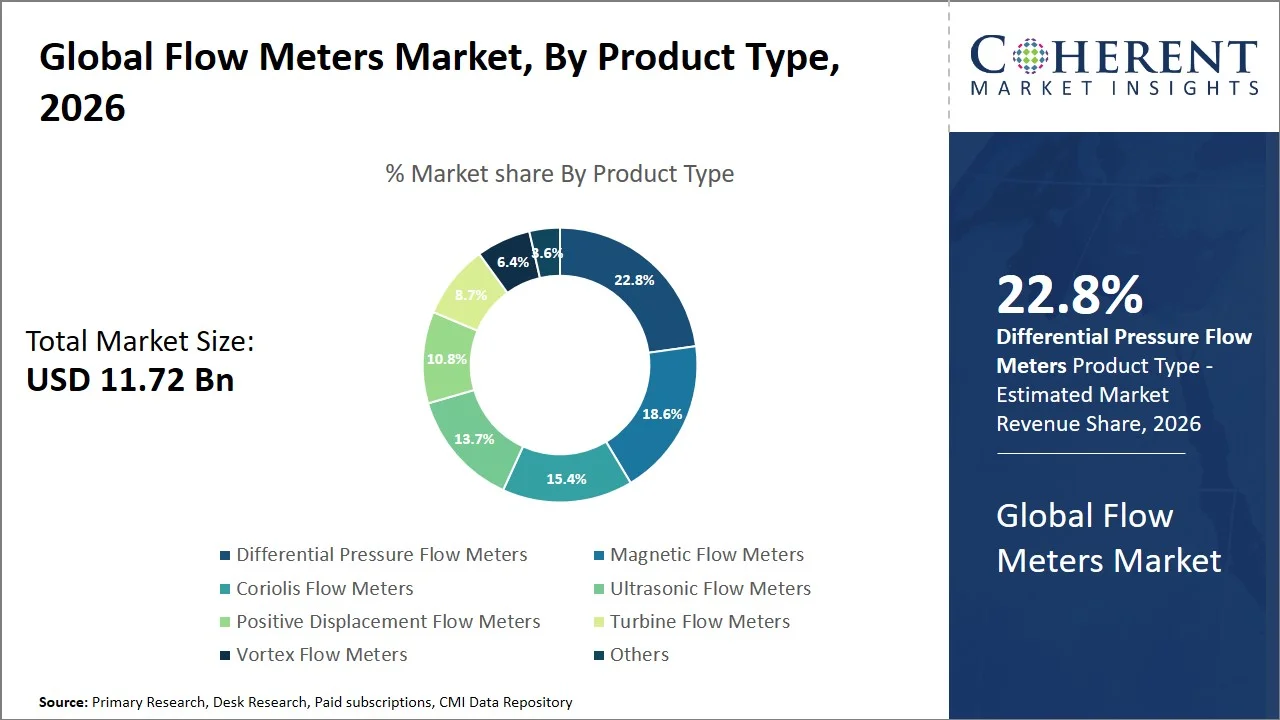
Why Do Differential Pressure Flow Meters Dominate the Global Flow Meters Market?
Differential Pressure Flow Meters are expected to hold 22.8% of the global flow meters market in 2026 because their commercial strength rests on installed-base economics and engineering familiarity rather than a single application advantage. Brownfield refineries, chemical plants, power facilities, and oil and gas systems can retain established primary elements, impulse lines, manifolds, and flow-computer architectures while replacing or upgrading transmitters. This lowers redesign risk and supports continued procurement for harsh-pressure, high-temperature, gas, liquid, and steam duties. Suppliers also benefit from recurring calibration, manifold, transmitter, and maintenance opportunities around the installed measurement loop. In January 2024, OleumTech launched its H Series Multivariable Transmitter integrating differential pressure, static pressure, and temperature inputs with third-party flow computers, including configuration for hazardous Class I, Division 1 locations, illustrating continued product investment around DP-based industrial flow measurement.
- Current Industry Events of 2026
- Market Size Estimation
- Regional Breakdown
- Competitive Landscape
- Customer Intelligence
- Segmental Analysis
- Pricing Analysis
- Key Market Drivers, Challenges & Future Trends
- Customized Insights Section
Why Does Volumetric Flow Measurement Represent the Largest Measurement Type in the Global Flow Meters Market?
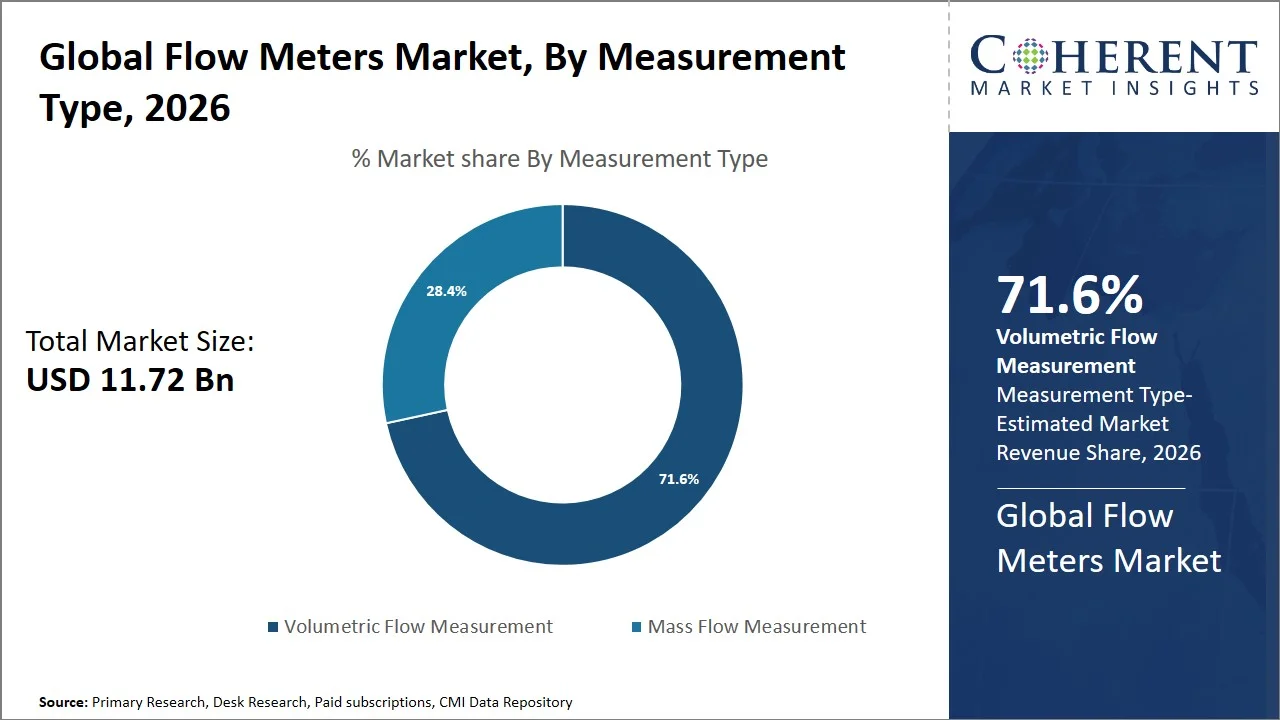
Volumetric Flow Measurement is expected to represent 71.6% of the global flow meters market in 2026 because many operating decisions are fundamentally managed in volume-per-time units, including pipeline throughput, water distribution, compressed-air use, fuel-gas supply, batching, and cooling circulation. Buyers can choose among turbine, electromagnetic, ultrasonic, differential-pressure, vortex, and positive-displacement technologies, creating a broad supplier base across price, pipe-size, accuracy, and media requirements. This flexibility makes volumetric measurement easier to specify across utilities and general industrial systems where direct mass measurement is unnecessary. The commercial result is a wider addressable installed base and more application-specific purchasing opportunities for meter manufacturers and integrators. In July 2025, AW-Lake launched its TG Series Gas Turbine Flow Meter for burners, boilers, compressed air, CNG, and test systems, with flow ranges specified in actual cubic feet per minute.
Why Does Liquid Dominate the Medium Category of the Global Flow Meters Market?
Liquid is expected to account for 64.8% of the global flow meters market in 2026 because liquid-handling infrastructure creates dense measurement requirements across transfer, dosing, treatment, cooling, blending, and process-control points. Water networks, chemical plants, refineries, food processing lines, pharmaceutical systems, mining operations, and thermal-management circuits require flow visibility to protect equipment, maintain balances, control recipes, and manage utility consumption. Manufacturers can address these needs through electromagnetic, ultrasonic; Coriolis, turbine, positive-displacement, and other designs matched to conductivity, viscosity, cleanliness, temperature, and pipe diameter. This breadth supports both replacement sales and OEM integration into skids and packaged systems. In March 2026, Endress+Hauser introduced a U.S.-market Picomag electromagnetic flowmeter variant purpose-built for liquid-cooling systems in data centers and OEM cooling equipment, supporting secure inline measurement across compact cooling loops.
Current Events and their Impact
Current Event | Description and Its Impact |
OIML R 49:2024 Water Meter Requirements – October 2024 |
|
U.S. Final Energy-Credit Measurement Rules – December 2024 |
|
EU Methane Regulation Enters into Force – August 2024 |
|
Global Flow Meters Market Dynamics
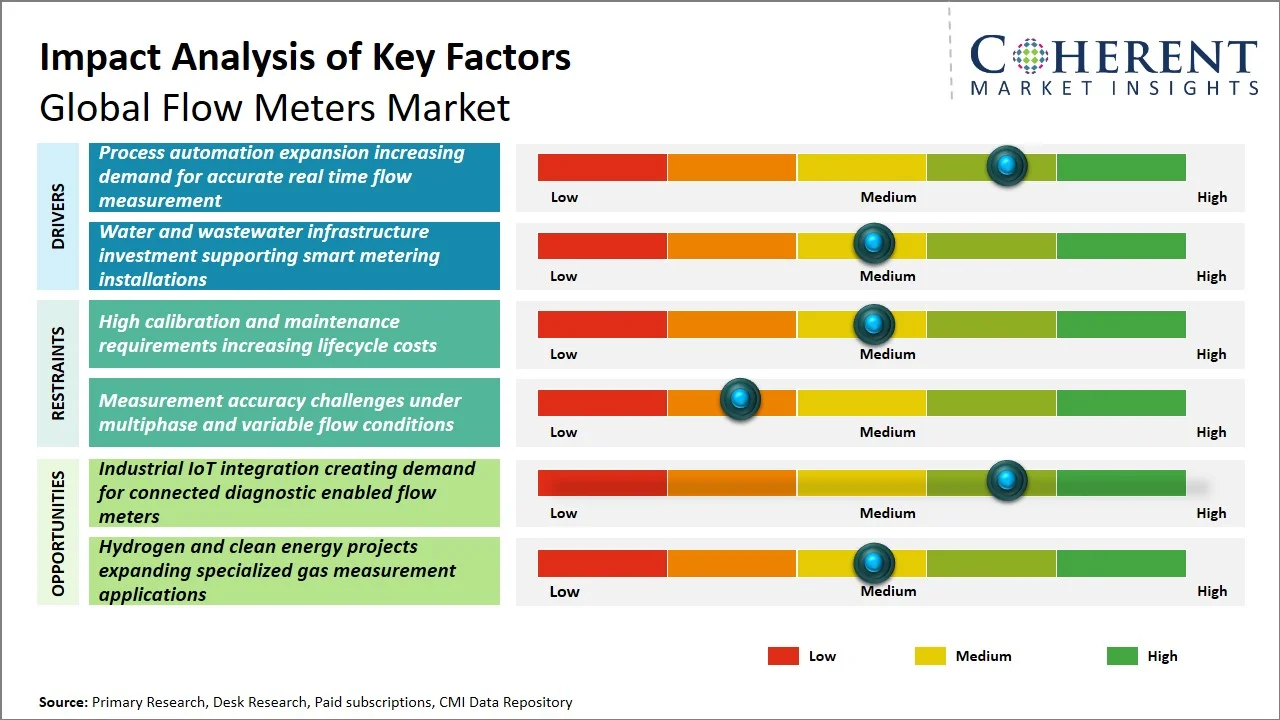
Key Market Drivers
- Process automation expansion increasing demand for accurate real time flow measurement: Process automation expansion is increasing demand for flow meters that can deliver stable measurement data directly into control, monitoring, and quality-management systems. Plants are moving beyond standalone indicators toward instruments that support continuous process adjustment, batch consistency, energy management, and deviation detection. This favors suppliers offering digital communications, low-maintenance sensing, multiparameter outputs, and hygienic or hazardous-area designs that fit automated production environments. Chemical processors, pharmaceutical manufacturers, food producers, utilities, and system integrators benefit because better flow visibility reduces manual intervention and supports tighter operating control. Commercially, the driver shifts purchasing decisions toward lifecycle performance and system compatibility rather than meter price alone. In January 2025, Bürkert detailed its Type 8098 FLOWave flowmeter for Water-for-Injection loops, using surface acoustic wave technology to provide real-time volume flow, cumulative volume, velocity, and temperature measurement without intrusive sensor elements.
- Water and wastewater infrastructure investment supporting smart metering installations: Water and wastewater infrastructure investment is supporting smart metering installations because utilities increasingly need granular consumption data, leakage visibility, network balancing, and evidence for demand-management programs. Unlike conventional replacement cycles, smart-meter projects create demand across the complete measurement architecture, including flow sensors, communications modules, data platforms, installation services, and ongoing verification. Municipal utilities, meter manufacturers, network analytics providers, and systems integrators therefore gain from multi-year capital programs that combine asset renewal with digital water management. The commercial significance is particularly strong where regulators link infrastructure spending with leakage reduction and customer-side efficiency, encouraging utilities to specify meters that can support remote reading and higher-frequency data. In September 2024, Ofwat published its Smart Metering Report examining how England and Wales’ proposed Water Efficiency Fund could improve outcomes from smart water-meter rollout and help shape the regulator’s approach to water-efficiency investment.
Emerging Market Trends
- Multi-Variable Measurement Moving Beyond Single-Output Flow Meters: Flow meters are increasingly combining flow with parameters such as temperature, pressure, density, conductivity, and diagnostics within a single device. This helps users reduce sensor requirements, simplify installation, and improve process visibility. Manufacturers that offer reliable multi-variable measurement, strong digital communication, and calibration stability can strengthen premium positioning, while basic single-output meters may face greater competition in advanced industrial applications.
- Application-Tuned Flow Meter Designs Reshaping Product Portfolios: Manufacturers are developing flow meters tailored to specific media, operating conditions, and industries rather than relying only on general-purpose designs. Material compatibility, hygiene, viscosity, corrosion resistance, installation space, and pressure conditions increasingly influence product selection. This supports demand for specialized configurations, compact designs, sanitary connections, and application-specific components, giving technically focused suppliers stronger opportunities in high-value and demanding industrial applications.
Regional Insights
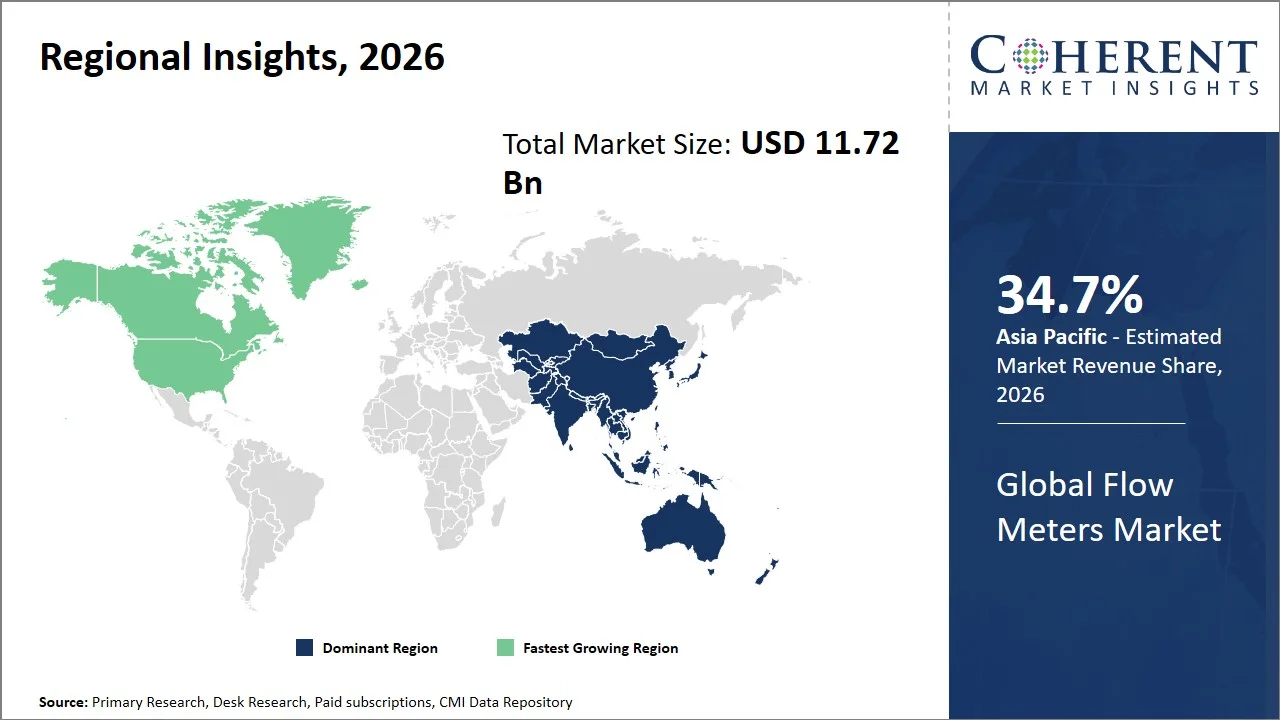
Why Does Asia Pacific Dominate the Global Flow Meters Market?
Asia Pacific is expected to hold 34.7% of the global flow meters market in 2026, supported by the region’s concentration of water infrastructure, chemicals, refining, power generation, electronics, metals, and high-volume manufacturing. China, India, South Korea, Japan, and Southeast Asia create a broad requirement for magnetic, differential-pressure, ultrasonic, Coriolis, and turbine meters across both new plants and modernization projects. Regional suppliers also benefit from localized manufacturing, competitive engineering costs, and expanding automation investment, which improves availability across standard and application-specific meters. Utility digitization adds another demand layer as cities replace manual water measurement with connected metering. In January 2026, Singapore’s national water agency PUB reported that its first Smart Water Meter Programme phase was rolling out about 300,000 meters across residential and commercial/industrial premises, reinforcing Asia Pacific’s shift toward digitally managed flow measurement.
Why Is North America Emerging as the Fastest-Growing Region in the Global Flow Meters Market?
North America is expected to account for 27.8% of the global flow meters market in 2026 and emerge as the fastest-growing region as utilities and industrial operators accelerate replacement of aging measurement assets. Growth is supported by advanced metering infrastructure, shale and LNG activity, chemicals, food processing, pharmaceuticals, semiconductor investment, and tighter expectations for traceable process data. Buyers increasingly favor meters that combine reliable sensing with remote data collection, leak identification, diagnostics, and integration into plant or utility software. This creates attractive replacement and service opportunities for suppliers with calibration, communications, and installed-base support capabilities. In September 2025, the U.S. Environmental Protection Agency updated its WaterSense guidance on Advanced Metering Infrastructure, highlighting real-time water-use data, improved billing, leak identification, and resource management as utility benefits, supporting continued North American migration toward connected water measurement.
Global Flow Meters Market Outlook for Key Countries
Why Is the U.S. a Key Market for the Global Flow Meters Market?
The U.S. is a key market for flow meters because it combines large municipal water systems with one of the world’s most instrument-intensive oil and gas, LNG, chemical, refining, pharmaceutical, food-processing, and semiconductor industries. Demand spans custody transfer, process control, cooling water, dosing, emissions-related measurement, utility management, and high-purity fluid handling. A mature calibration and automation ecosystem also supports premium adoption of Coriolis, ultrasonic, magnetic, and differential-pressure technologies where measurement uncertainty has direct operational or financial consequences. Energy infrastructure remains particularly important because new throughput capacity creates additional meter stations and process-measurement points. In March 2026, the U.S. Department of Energy authorized a 13% increase in LNG exports from the Plaquemines LNG terminal in Louisiana, raising authorized export capacity and reinforcing the continuing requirement for dependable gas-flow measurement across liquefaction, pipeline, loading, and transfer operations.
Why Is China Important in the Global Flow Meters Market?
China supports growth in the global flow meters market through its scale in chemicals, petrochemicals, power generation, municipal water, metals, batteries, electronics, food production, and industrial equipment manufacturing. Large process plants require extensive flow-control networks, while domestic automation manufacturers are increasingly supplying magnetic, vortex, ultrasonic, thermal, and Coriolis technologies tailored to local standards and price expectations. China also functions as an export manufacturing base, making international certification and calibration capability strategically important for suppliers seeking overseas customers. This combination supports both high-volume standard meters and higher-specification digital instruments. In November 2025, Hangzhou-based Supmea announced that its electromagnetic flowmeter product line had achieved NSF certification for drinking-water applications and entered the NSF certified-product database. The development illustrates how Chinese flow-meter manufacturers are strengthening compliance credentials to compete in municipal water and other quality-sensitive applications internationally.
Why Does India Support Growth in the Global Flow Meters Market?
India is important in the global flow meters market because rapid expansion of urban water systems, wastewater treatment, refining, chemicals, power, food processing, pharmaceuticals, and general manufacturing is creating more measurement points across both greenfield and retrofit projects. Cost-sensitive buyers still require reliable instrumentation, encouraging demand for locally supported magnetic, vortex, differential-pressure, turbine, and ultrasonic meters that can integrate with SCADA and plant automation systems. Domestic engineering capability and a large EPC base also help flow-meter suppliers reach municipal and industrial projects beyond major metropolitan areas. Water-system digitization is becoming especially relevant to volume measurement and network balancing. In February 2025, India’s Press Information Bureau reported that 1,482 water-supply projects and 241 sewerage projects under AMRUT 2.0 had been approved with SCADA, demonstrating how public infrastructure programs are embedding digital monitoring into future water assets.
Why Is Germany a Strategic Country in the Global Flow Meters Market?
Germany is a strategic country in the global flow meters market because its chemical, pharmaceutical, machinery, energy, food-processing, and environmental-engineering sectors place a high value on measurement accuracy, documentation, functional reliability, and lifecycle service. German industrial users often operate complex continuous processes where flow data influence material balance, energy efficiency, dosing, safety, and product quality, supporting demand for advanced Coriolis, ultrasonic, magnetic, vortex, and differential-pressure instrumentation. The country’s engineering and metrology ecosystem also favors premium solutions with digital diagnostics and strong certification support. Hydrogen infrastructure introduces an additional measurement challenge because new networks require reliable gas accounting across production, transmission, storage, and industrial consumption points. In October 2024, Germany’s Bundesnetzagentur approved a 9,040-kilometre hydrogen core network with expected investment of USD 1.16 billion, creating a long-term infrastructure pathway for specialized hydrogen flow measurement and verification.
Why Is South Korea an Important Growth Market for the Global Flow Meters Market?
South Korea is an important growth market for the global flow meters market because semiconductor fabrication, petrochemicals, refining, shipbuilding, batteries, district energy, power generation, and advanced water management all depend on precise control of liquid and gas flows. Semiconductor and battery production increase requirements for low-flow, high-purity, and gas measurement, while petrochemical and energy facilities sustain demand for larger process and utility meters. The country also has domestic flow-meter manufacturing and calibration capability, which improves technical support and reduces dependence on imported standard instruments. Export-oriented suppliers must nevertheless meet international electrical, safety, and materials requirements. In December 2025, Korea Flowmeter Co. announced that its KTR-550 turbine flowmeter had obtained CE certifications covering LVD, EMC, and RoHS requirements. The certification strengthens the ability of Korean-made flow instrumentation to address regulated overseas markets and demonstrates continued product-quality investment.
Technology Adoption Landscape in the Global Flow Meters Market
Technology | Adoption Level | Key Application Area | Business Impact |
Electromagnetic Flow Sensing | High | Water, wastewater, chemicals, conductive process liquids | Supports low-maintenance measurement without moving components and remains commercially attractive for large-pipe and utility applications. |
Differential-Pressure Multivariable Measurement | High | Oil and gas, steam systems, chemicals, power generation | Allows established primary elements to support modernized transmitters, preserving installed infrastructure while improving measurement functionality. |
Coriolis Direct Mass Flow Measurement | High | Chemical dosing, fuels, food processing, high-value fluid transfer | Provides direct mass-flow and density information, supporting tighter material balances and premium measurement applications. |
Clamp-On Transit-Time Ultrasonic Measurement | Medium | Brownfield pipelines, temporary measurement, meter verification | Reduces process interruption and enables measurement points to be added where cutting or modifying pipework is commercially undesirable. |
Vortex Measurement with Integrated Compensation | Medium | Steam, compressed gases, industrial utilities | Improves utility accounting by combining vortex measurement with temperature or pressure compensation for variable operating conditions. |
Surface Acoustic Wave Flow Measurement | Low | Pharmaceutical, biotechnology, hygienic liquid systems | Enables low-obstruction measurement in specialized hygienic processes, creating premium opportunities where contamination control is critical. |
How Are CO₂ Transport and Carbon-Management Networks Creating New Growth Opportunities in the Global Flow Meters Market?
Carbon-capture, CO₂ transport, utilization, and geological-storage networks create an underdeveloped measurement opportunity because operators need dependable flow accounting across capture plants, compression stations, pipelines, terminals, injection sites, and custody-transfer interfaces. CO₂ service is technically demanding: pressure, phase behavior, impurities, temperature changes, and dense-phase operation can complicate conventional measurement assumptions. Suppliers can capture this opportunity by developing high-pressure Coriolis, ultrasonic, and differential-pressure packages supported by application-specific calibration, materials selection, uncertainty analysis, and verification services. Target customers include cement and steel producers, carbon-network operators, pipeline companies, storage developers, engineering contractors, and industrial decarbonization projects. Winning positions will require more than a standard meter catalogue; vendors need CO₂ property expertise, high-pressure testing capability, appropriate certifications, strong EPC relationships, and service coverage near emerging infrastructure hubs. The opportunity is likely to favor established instrumentation groups with global support networks alongside specialist metrology companies that can solve difficult phase-behavior and custody-transfer problems. Early technical partnerships can also influence specifications before network designs become standardized.
Market Players, Key Development, and Competitive Landscape
Key Developments
- In July 2026, HIKMICRO announced that its Water Flow Standard Laboratory had obtained CNAS accreditation in accordance with ISO/IEC 17025 for calibration of electromagnetic and Coriolis flow meters. This is important for the global flow meters market because calibration traceability is becoming a stronger competitive requirement as manufacturers expand internationally and customers seek documented measurement confidence across industrial installations. Building accredited in-house metrology capability can also improve product validation, quality assurance, and supplier credibility.
- In February 2025, Malema, part of PSG and Dover, launched the M-2300 Series high-purity inline straight-tube ultrasonic flow meter for semiconductor manufacturing applications. Its compact architecture and high-purity configuration address fluid-control requirements where installation space, contamination management, and precise liquid measurement are critical. This is important for the global flow meters market because semiconductor equipment is creating specialized opportunities for meter suppliers able to combine miniaturization with process-fluid compatibility.
- In January 2025, Sierra Instruments launched the d·flux multiparameter mass flow meter and controller for gas applications. The device combines measurement of mass flow, volumetric flow, temperature, pressure, and density, extending the commercial role of a flow instrument beyond a single process variable. This is important for the global flow meters market because integrated measurement architectures can reduce instrumentation complexity while supporting laboratories and industrial users requiring flexible gas measurement and control.
Competitive Landscape
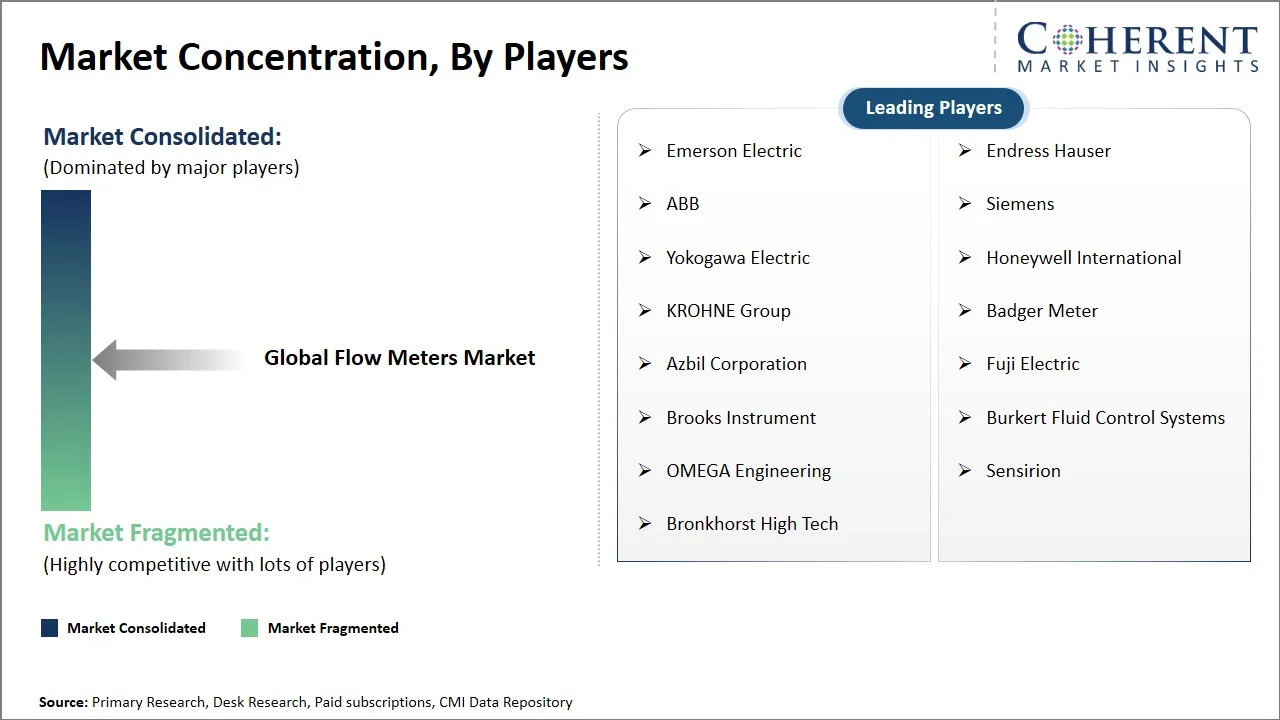
The global flow meters market is moderately consolidated at the advanced instrumentation level while remaining fragmented across regional, application-specific, and lower-cost product categories. Global automation and instrumentation vendors compete alongside specialist flow-measurement companies, regional manufacturers, calibration providers, and niche technology developers. Competition increasingly depends on measurement accuracy under real operating conditions, process compatibility, certification, installed-base support, communication capability, delivery reliability, and total lifecycle cost. Regional companies remain influential where local pricing, short lead times, customization, and service access outweigh global brand preference. Key focus areas include:
- Measurement Performance: Accuracy, repeatability, turndown, stability, and resistance to process disturbance remain central purchasing criteria.
- Application Engineering: Suppliers capable of matching meter technology to difficult fluids, piping conditions, and operating environments can protect premium margins.
- Total Cost of Ownership: Buyers increasingly evaluate installation requirements, pressure loss, calibration needs, maintenance exposure, and expected service life alongside purchase price.
- Certification and Traceability: Custody-transfer, potable-water, hazardous-area, sanitary, and legal-metrology approvals can determine supplier eligibility for regulated projects.
- Manufacturing and Supply Reliability: Short lead times, component availability, and flexible configuration are important for EPC schedules, shutdown work, and replacement demand.
- Technical Service Coverage: Local calibration, commissioning, troubleshooting, and verification capabilities strengthen customer retention and aftermarket revenue.
- Regional Localization: Local assembly, testing, inventory, and channel partnerships can improve competitiveness where imported instrumentation faces longer delivery cycles or service constraints.
Market Report Scope
Flow Meters Market Report Coverage
| Report Coverage | Details | ||
|---|---|---|---|
| Base Year: | 2025 | Market Size in 2026: | USD 11.72 Bn |
| Historical Data for: | 2020 To 2024 | Forecast Period: | 2026 To 2033 |
| Forecast Period 2026 to 2033 CAGR: | 6.2% | 2033 Value Projection: | USD 17.86 Bn |
| Geographies covered: |
| ||
| Segments covered: |
| ||
| Companies covered: | Emerson Electric, Endress Hauser, ABB, Siemens, Yokogawa Electric, Honeywell International, KROHNE Group, Badger Meter, Azbil Corporation, Fuji Electric, Brooks Instrument, Burkert Fluid Control Systems, OMEGA Engineering, Sensirion, Bronkhorst High Tech | ||
| Growth Drivers: |
| ||
| Restraints & Challenges: |
| ||
Analyst Opinion (Expert Opinion)
- The competitive center of the global flow meters market is likely to move from selling individual instruments toward providing measurement assurance throughout the asset lifecycle. Buyers will increasingly value suppliers that can specify the correct technology, configure it for the application, validate installation quality, maintain calibration confidence, and support the measurement point after commissioning. This transition should favor vendors with strong application engineering and service organizations rather than manufacturers competing primarily through catalogue breadth.
- Embedded flow measurement inside OEM machinery and packaged process equipment could materially alter traditional sales channels. As skid builders, equipment manufacturers, and system integrators design meters directly into their platforms, more purchasing decisions may occur during equipment development rather than at the end-user plant. Suppliers that can offer compact form factors, configurable interfaces, design-in engineering, consistent production quality, and dependable long-term component availability may capture recurring platform business, while traditional transaction-oriented distribution models face pressure.
- Manufacturers should prioritize difficult-measurement capabilities, accredited calibration resources, regional service capacity, cybersecurity-ready communications, and stronger relationships with EPCs and OEMs. Margin pressure will remain greatest in standardized products where low-cost suppliers can meet basic specifications, making excessive capacity investment in undifferentiated meters risky. Companies should instead allocate capital toward applications where material compatibility, measurement uncertainty, regulatory approval, local technical support, or operational consequences make supplier expertise harder to replace.
Speak to the analyst
Want personalized insights?
Take the findings above to one of our principal consultants, or have the report rebuilt around the segments, geographies and competitors you actually track.
Market Segmentation
- Product Type Insights (Revenue, USD Bn, 2021 - 2033)
- Differential Pressure Flow Meters
- Magnetic Flow Meters
- Coriolis Flow Meters
- Ultrasonic Flow Meters
- Positive Displacement Flow Meters
- Turbine Flow Meters
- Vortex Flow Meters
- Others
- Measurement Type Insights (Revenue, USD Bn, 2021 - 2033)
- Volumetric Flow Measurement
- Mass Flow Measurement
- Medium Insights (Revenue, USD Bn, 2021 - 2033)
- Liquid
- Gas
- Steam
- End Use Industry Insights (Revenue, USD Bn, 2021 - 2033)
- Oil and Gas
- Water and Wastewater
- Chemicals and Petrochemicals
- Power Generation
- Food and Beverage
- Pharmaceuticals
- Metals and Mining
- Others
- Regional Insights (Revenue, USD Bn, 2021 - 2033)
- North America
- U.S.
- Canada
- Latin America
- Brazil
- Argentina
- Mexico
- Rest of Latin America
- Europe
- Germany
- U.K.
- Spain
- France
- Italy
- Russia
- Rest of Europe
- Asia Pacific
- China
- India
- Japan
- Australia
- South Korea
- ASEAN
- Rest of Asia Pacific
- Middle East
- GCC Countries
- Israel
- Rest of Middle East
- Africa
- South Africa
- North Africa
- Central Africa
- North America
- Key Players Insights
- Emerson Electric
- Endress Hauser
- ABB
- Siemens
- Yokogawa Electric
- Honeywell International
- KROHNE Group
- Badger Meter
- Azbil Corporation
- Fuji Electric
- Brooks Instrument
- Burkert Fluid Control Systems
- OMEGA Engineering
- Sensirion
- Bronkhorst High Tech
Sources
Primary Research Interviews
- Flow meter, flow sensor, transmitter, and process instrumentation manufacturers
- Differential pressure, magnetic, Coriolis, ultrasonic, turbine, and vortex meter suppliers
- Oil and gas, water, chemicals, power, food, pharmaceutical, and mining end users
- Distributors, EPC contractors, system integrators, calibration laboratories, and industry experts
Stakeholders
- Flow meter and instrumentation manufacturers
- Sensor, transmitter, electronics, and automation-system suppliers
- EPC companies, distributors, system integrators, and calibration providers
- Utilities, oil and gas operators, chemical processors, power producers, and industrial users
End-use Sectors
- Oil and gas, refining, pipelines, and LNG
- Water and wastewater treatment
- Chemicals and petrochemicals
- Power generation and industrial utilities
- Food and beverage and pharmaceuticals
- Metals, mining, and general industrial processing
Regulatory and Government Bodies
- U.S. NIST, EPA, Department of Energy, and Census Bureau
- European Commission, EURAMET, Eurostat, and national metrology authorities
- China SAMR, National Institute of Metrology, and China Customs
- India BIS, Ministry of Jal Shakti, CPCB, and MOSPI
- Korea KATS, KRISS, Ministry of Environment, and Statistics Korea
- OIML, ISO, IEC, and accredited calibration laboratories
Databases
- UN Comtrade, ITC Trade Map, WTO, Eurostat, USITC, World Bank, and OECD
- EIA, EPA, national water, energy, industrial, and trade databases
- Pipeline, refinery, power-generation, and water-infrastructure databases
- WIPO PATENTSCOPE, Espacenet, company filings, catalogues, and pricing records
Magazines and Journals
- Flow Control, Processing, Control Engineering, and Chemical Engineering
- WaterWorld, Hydrocarbon Processing, Oil & Gas Journal, and Power Engineering
- Flow Measurement and Instrumentation, Measurement, IEEE Sensors Journal, and ISA Transactions
Associations
- International Society of Automation
- International Organization of Legal Metrology
- American Water Works Association
- American Petroleum Institute
- Measurement, Control & Automation Association
- EURAMET and national metrology associations
Public Domain Sources
- Product catalogues, specifications, datasheets, and calibration documentation
- Flow range, accuracy, pressure, temperature, conductivity, and pipe-size data
- Water, pipeline, refinery, chemical, power, and industrial production statistics
- Trade data, annual reports, patents, product launches, partnerships, and investments
Key Standards and Regulations
- OIML R 49 and ISO 4064
- ISO 5167 and ISO 10790
- API and AGA flow-measurement standards
- IEC 60079, ATEX, and IECEx
- EU Measuring Instruments Directive
- NIST Handbook 44
- ISO/IEC 17025
- Applicable CE, UKCA, UL, CSA, RoHS, and REACH requirements
Proprietary Elements
- CMI Data Analytics Tool. Proprietary CMI Existing Repository of information for the last 10 years
Get access to 250+ pages report
Every segment, forecast, competitor profile and data table behind the analysis above — available for instant download.
- ESOMAR Member
- ISO 9001:2015 Certified
- D-U-N-S Registered
- GDPR & CCPA Compliant
Missing comfort of reading report in your local language? Find your preferred language:
Transform your Strategy with Exclusive Trending Reports
Frequently Asked Questions
The CAGR of global flow meters market is projected to be 6.2% from 2026 to 2033.
The global flow meters market is estimated to be valued at USD 11.72 billion in 2026 and is expected to reach USD 17.86 billion by 2033.
Flow meters are widely used in process control, custody transfer, water management, chemical processing, energy systems, food processing, and industrial utility monitoring.
Common technologies include differential pressure, magnetic, Coriolis, ultrasonic, positive displacement, turbine, and vortex flow measurement.
Key trends include multi-variable measurement, application-specific meter designs, connected diagnostics, remote monitoring, and increasing integration with industrial automation and digital control systems.
Process automation expansion increasing demand for accurate real time flow measurement and Water and wastewater infrastructure investment supporting smart metering installations are the major factor driving the growth of global flow meters market.
High calibration and maintenance requirements increasing lifecycle costs and Measurement accuracy challenges under multiphase and variable flow conditions are the major factor hampering the growth of global flow meters market.