

In-Vehicle Payment Services Market Size & Trends
In-Vehicle Payment Services Market is estimated to be valued at USD 10.10 Bn in 2026 and is expected to reach USD 30.86 Bn in 2033, exhibiting a compound annual growth rate (CAGR) of 17.3% from 2026 to 2033.
Key Takeaways
- Basedon Mode Of Payment, the App/E-Wallet based segment holds the largest share of the global in-vehicle payment services market in 2026,
- Based on Application, Gas & Charging Stations segment dominates the market, with the highest share in 2026,
- Based on Region, North America is expected to lead the market, holding a share of 39.32% in 2026. While, Asia Pacific is anticipated to be the fastest growing region during the forecast period.
Market Overview
The in-vehicle payment services market is growing swiftly, driven by the increasing adoption of connected cars and the demand for seamless, contactless experiences. These systems allow drivers to pay for tolls, fuel, parking, or food directly through their car’s interface, reducing the need for physical cards or mobile phones.
Automakers like GM, Mercedes-Benz, and BMW are integrating payment solutions into infotainment systems through partnerships with fintech and retail firms. Advancements in IoT, 5G, and telematics are enhancing security and transaction speed, fueling further innovation.
In-vehicle payment services market demand is especially strong in North America and Asia Pacific, supported by robust digital infrastructure, EV growth, and rising mobile payment adoption. As the auto industry shifts toward smart mobility, in-vehicle payments are becoming a key differentiator in the connected car experience.
Current Events and their Impact on the In-Vehicle Payment Services Market
Current Event | Description and its Impact |
Regulatory Shifts in Payment Technologies |
|
Sustainability and EV Infrastructure Growth |
|
Role of Artificial Intelligence (AI) in the In-Vehicle Payment Services Market
The integration of Artificial Intelligence (AI) is significantly transforming the In-Vehicle Payment Services Market by enabling personalized, secure, and seamless transactions within connected cars. AI enhances user experience through voice assistants and natural language processing, allowing drivers to make payments hands-free, be it for fuel, tolls, parking, or food orders. Machine learning algorithms also analyze user preferences, driving habits, and location data to offer predictive payment suggestions and contextual services.
Furthermore, AI is improving fraud detection and payment security by monitoring real-time behavior patterns, reducing unauthorized access. Automakers are integrating AI-powered digital wallets and voice commerce systems that authenticate users through biometrics, enhancing both convenience and safety. As AI continues to mature, it will play a pivotal role in scaling autonomous commerce systems, making in-vehicle payments a core component of the smart mobility ecosystem.
In April 2024, Sheeva.AI announced the integration of its SheevaConnect™ in-car payment technology in the Citroen C3 Aircross SUV AT, India's most affordable automatic mid-sized SUV. This feature enables drivers to pay for fuel at over 32,000 fuel stations nationwide directly from the vehicle.
- Current Industry Events of 2026
- Market Size Estimation
- Regional Breakdown
- Competitive Landscape
- Customer Intelligence
- Segmental Analysis
- Pricing Analysis
- Key Market Drivers, Challenges & Future Trends
- Customized Insights Section
Emerging Technologies in the In-Vehicle Payment Services Market
- Biometric Authentication: Cars are integrating fingerprint, voice, and facial recognition to enable secure, hands-free payments.
- Voice-Based Payments: AI-powered voice assistants (e.g., Alexa, Cerence) allow drivers to make payments via simple voice commands.
- 5G Connectivity: Enables faster, real-time transactions for tolls, parking, and EV charging with low latency.
- V2X Communication: Vehicles connect with toll booths, gas stations, and parking meters to automate payments.
- Blockchain: Used for secure, tamper-proof payment records in connected vehicle ecosystems.
- AR Dashboards: Augmented reality displays guide drivers through payment options directly on windshields.
- Digital Wallet Integration: Automakers are embedding e-wallets like Apple Pay and Google Pay into infotainment systems.
Segmental Insights
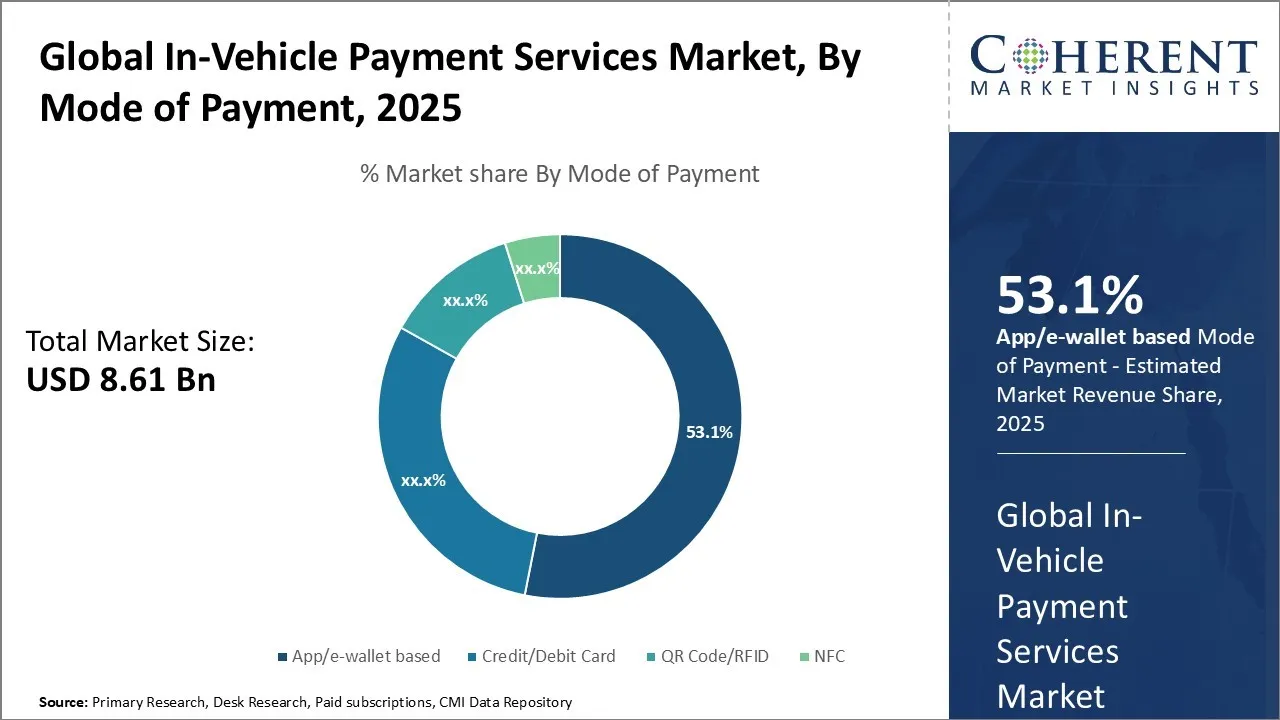
In-Vehicle Payment Services Market Insights, By Mode of Payment - App/e-Wallet Acquires the dominant share owing to its Convenience and Integration with Connected Car Ecosystem
In terms of mode of payment, the app/e-wallet segment is expected to contribute the highest share of the global in-vehicle payment services market in 2026, due to its convenience, speed, and integration with connected car ecosystems. As vehicles become more digitized, users prefer payment solutions that are already embedded in their smartphones or car infotainment systems. App-based wallets like Apple Pay, Google Pay, Samsung Pay, and OEM-specific apps allow for seamless transactions for tolls, fuel, EV charging, parking, and food services, without needing physical cards or external devices.
For example, Car IQ Inc., an automobile manufacturer, has partnered with Visa, a digital payments provider. Through this collaboration, vehicles can now connect directly with Visa’s global network of merchants and financial institutions. Additionally, Car IQ Pay’s vehicle wallet allows owners to pay for fuel, tolls, parking, insurance, maintenance, and repairs seamlessly from their car.
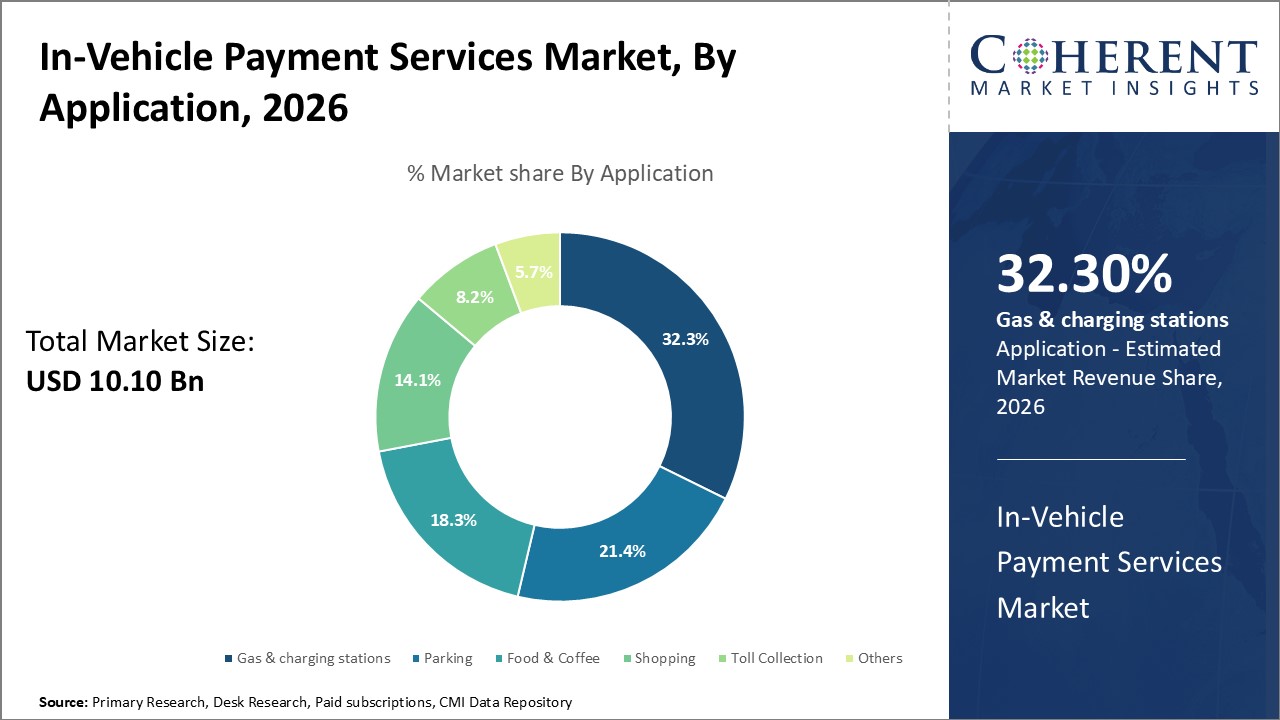
In-Vehicle Payment Services Market Insights, By Application - Gas & Charging Stations Acquires the Largest Share owing to Rising Demanding for Contactless experience in Everyday Life
In terms of application, the gas & charging stations segment represents the largest share of the market in 2026, due to the rising need for convenience, speed, and contactless experiences in everyday travel. As connected vehicles become more advanced, drivers increasingly expect seamless transactions without leaving their cars.
For gas stations, in-vehicle payments eliminate the need to swipe cards or enter PINs at pumps, reducing wait times and enhancing safety. For EV charging stations, where payment interfaces vary widely, embedded payment systems simplify the process, especially during long journeys or for fleet operators.
In July 2025, Tata Motors introduced DrivePay, a new in‑car UPI-based payment system on the Harrier.ev SUV. The feature seamlessly integrates charger discovery, navigation via MapMyIndia (Mappls), and payment—all through the 14.5" infotainment screen. Drivers can locate nearby charging stations, initiate charging sessions by entering amount or units, and pay instantly using in-car interface or iRA mobile app, with auto‑recharge and Fastag balance tracking included. Such innovations are accelerating the in-vehicle payment services market share.
Regional Insights
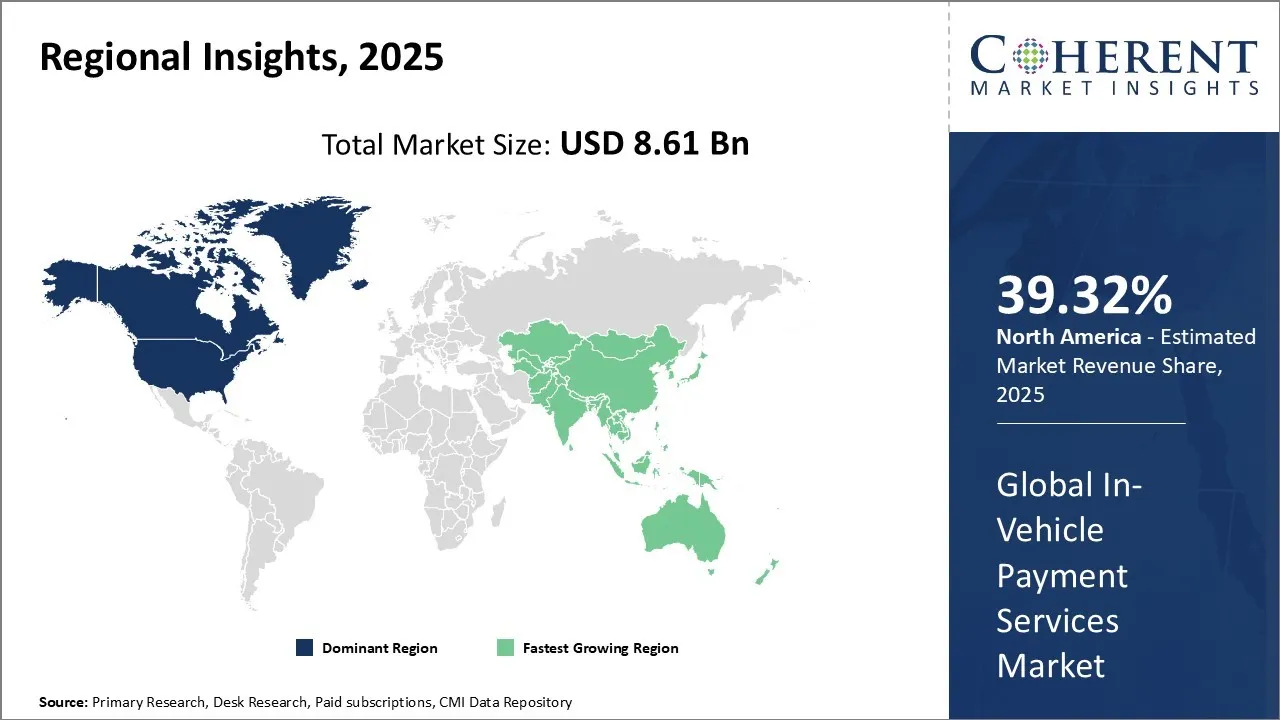
North America In-Vehicle Payment Services Market Analysis & Trends
In North America is expected to dominate in the in-vehicle payment services market with a share of 39.32% in 2026. The dominance is observed due to the region's technological maturity, high car ownership rates, and growing appetite for convenience-based services. Consumers increasingly expect connected, seamless driving experiences, including the ability to make payments for fuel, tolls, parking, and food directly from their car dashboards.
Major automotive OEMs like Ford, GM, and Tesla are integrating in-vehicle payment systems into infotainment platforms. In addition, North America's extensive highway infrastructure and rising adoption of EVs, which often rely on app-based charging networks, further drive demand for integrated payment capabilities.
For instance, in September 2023, Hyundai introduced Hyundai Pay, an innovative in‑vehicle payment service that enables U.S. drivers to locate, reserve, and pay for parking, all from within their vehicles. Initially available at 6,000 Parkopedia-supported locations. Hyundai Pay encourages effortless mobility with easy access to nearby parking, digital payments, and reservation options with no apps or wallets needed. Such innovations are proliferating the in-vehicle payment services market revenue.
Asia Pacific In-Vehicle Payment Services Market Analysis & Trends
Asia Pacific is expected to exhibit the fastest growth during forecast period driven by a combination of urban growth, digital payment maturity, and advancing automotive technology. Countries such as China, Japan, South Korea, and India are rapidly urbanizing and investing in smart city infrastructure, which has increased the need for seamless and contactless transaction systems, especially for toll booths, parking, EV charging, and drive-through services.
Additionally, the widespread use of mobile payment platforms like Alipay, WeChat Pay, and Paytm has created a digitally-savvy consumer base that readily adopts in-vehicle payment systems. The in-vehicle payment services market demand is further driven by government initiatives promoting electric vehicles and smart mobility, particularly in China and South Korea, where digital payment is becoming an integral part of transportation infrastructure.
In-Vehicle Payment Services Market Outlook Country-Wise
The U.S. In-Vehicle Payment Services Market Trends
The United States leads the in-vehicle payment services market due to its advanced connected car ecosystem and high digital wallet adoption. Fuel stations like Shell and ExxonMobil, drive-thru QSRs such as McDonald’s and Starbucks, and smart parking garages are integrating in-car payment options to streamline transactions. Additionally, toll road automation using RFID, NFC, and app-based systems is expanding across major states. These developments, combined with strong automotive tech and consumer readiness, make the U.S. a key driver of the in-car payment services market.
Germany In-Vehicle Payment Services Market Trends
Germany is a key driver of the in-vehicle payment services market due to its strong automotive base and smart mobility focus. OEMs like BMW and Mercedes-Benz are integrating in-car payment systems for EV charging, tolling, parking, and servicing. The rise of "Plug & Charge" capabilities and smart autobahn toll systems reflects growing demand for seamless, embedded payments. Backed by smart city initiatives and EV adoption, Germany is emerging as a leading market for connected vehicle transactions.
China In-Vehicle Payment Services Market Trends
China is a key driver of the In-Vehicle Payment Services Market due to its widespread use of mobile payments like WeChat Pay and Alipay. Government initiatives such as “Made in China 2026” and strong EV adoption support the shift to smart mobility. In-car payments are gaining traction in EV charging, smart parking, tolls, and car-sharing platforms, especially in major cities. The country's digital readiness and large connected vehicle ecosystem make it a leader in in-car payment adoption.
Market Report Scope
In-Vehicle Payment Services Market Report Coverage
| Report Coverage | Details | ||
|---|---|---|---|
| Base Year: | 2025 | Market Size in 2026: | USD 10.10 Bn |
| Historical Data for: | 2020 To 2024 | Forecast Period: | 2026 To 2033 |
| Forecast Period 2026 to 2033 CAGR: | 17.3% | 2033 Value Projection: | USD 30.86 Bn |
| Geographies covered: |
| ||
| Segments covered: |
| ||
| Companies covered: | BMW Group, Mastercard, Daimler Ag, Amazon, Ford Motor Company, Volkswagen Ag, Honda Motor Co., Ltd., General Motors Company, and Hyundai Motor | ||
| Growth Drivers: |
| ||
| Restraints & Challenges: |
| ||
Global In-Vehicle Payment Services Market Drivers
- Increasing adoption of mobile payments to fuel the market growth
Regular payment infrastructures are currently progressing. There is an infrastructure transformation in the payment industry, which is important for competing efficiently and to address progressing requirements of customers. Many countries are modernizing their infrastructure of payments. As the cost of infrastructure renovations can be high for both the bank and system, banks are finding ways to develop services and products on the infrastructure providing value to end users and accelerating the cash transactions in order to recover investments in infrastructure. The rapid adoption of mobile payments is a key part of this evolution and is expected to fuel the growth of the global in-vehicle payment services market price and adoption over the forecast period.
- Global In-Vehicle Payment Services Market Opportunities
The growing adoption of in-vehicle payment services is expected to generate significant opportunities in the global in-vehicle payment services market forecast period. The use of in-vehicle payment services can aid in ordering food, making payments for food and beverages, as well as purchasing gasoline and groceries, all without requiring drivers to exit the vehicle. It also helps to make payments for the parking and tolls. Thus, demand for these services is increasing rapidly, which in turn is creating growth opportunities in the global in-vehicle payment services market.
The growing need for hassle-free payment systems at toll plazas, gas stations, and parking spaces is expected to bring multiple opportunities in the global in-vehicle payment services market over the forecast period. The adoption of digital payment technology, such as debit cards, mobile payments, and credit cards, is growing rapidly all over the world. Moreover, the availability of high-speed internet at fuel stations and the use of digital payment services are increasing. This, in turn, is creating growth opportunities in the market.
Global In-Vehicle Payment Services Market Trends
- Strategic collaborations and partnerships among market players is a recent trend
Customer experience is an important part of selling process for market players. These companies are using collaborations and partnerships for improving the in-vehicle experiences for customers and offer them with services for various applications.
- Debit/Credit card payment segment gaining traction in the market
The popularity of debit/credit card and its widespread use is increasing for making contactless payments. Several automobile companies are working on development of a strong in-vehicle payment ecosystem in order to enable make hassle-free payments across restaurants, parking slots, gas stations, and toll stations, for consumers. Thus, debit/credit card payment methods are increasingly being adopted. This trend is expected to boost growth of the global in-vehicle payment services market over the forecast period.
Analyst Opinion (Expert Opinion)
The evolution of the in-vehicle payment services market represents a pivotal inflection point in the automotive and digital commerce convergence. From an analyst's perspective, this market’s trajectory is being decisively shaped by automakers’ strategic push to own the data ecosystem, the rapid onboarding of digital wallets by Tier-1 OEMs, and the emergence of fuel and EV charging partnerships as the most lucrative channel in this space.
While several sectors are experimenting with embedded payments, in-vehicle payments have become a key battleground for OEM differentiation. Companies like Hyundai, BMW, and GM have already integrated payment functionalities via voice-activated assistants and infotainment systems. For instance, Mercedes-Benz’s partnership with Mastercard to allow fingerprint-based fuel payments at German filling stations is not just a use case, it’s a signal of where the monetization is headed: frictionless, biometric-secured commerce tied directly to vehicle IDs and user profiles.
Crucially, gas stations and EV charging infrastructure remain the dominant use cases, commanding over 50% of all in-vehicle transactions as of 2024. This dominance is expected to intensify as EV adoption grows, compelling a seamless link between navigation, battery status, and payment execution. As an example, Shell’s SmartPay and ChargePoint’s in-dash integration with automakers are reducing drop-offs in EV journey planning by embedding payment natively into route management, something mobile apps could not accomplish as elegantly.
QR code and RFID-based payments are rapidly being sidelined by embedded e-wallet and app-based models. OEMs are beginning to bypass legacy methods to drive recurring revenue via app-based ecosystems. The NFC-based payment model, though secure, lacks the scalability that app-based services bring, particularly for bundling fuel, parking, toll, and drive-thru services under a unified loyalty platform.
Interestingly, the North American market is no longer the innovation leader in this space. While Tesla’s minimalistic UX has pushed digital experiences, Asia-Pacific OEMs, particularly from South Korea and China are more aggressively pursuing embedded financial features. Kia’s CarPay, launched with Parkopedia, and China's Nio integrating real-time parking payments via Alipay, are examples of how the region is leapfrogging traditional approaches.
Speak to the analyst
Want personalized insights?
Take the findings above to one of our principal consultants, or have the report rebuilt around the segments, geographies and competitors you actually track.
Key Developments
- In December 2024, Škoda and Parkopedia have enhanced the in‑car payment platform by introducing live notification prompts in Škoda infotainment systems, alerting drivers as they approach locations accepting in‑car payments for parking or fuel. Launched with fuel‑powered Škoda models produced from Q2 2024, including Fabia, Kamiq, Karoq, Kodiaq, Octavia, Scala and Superb, the feature will also debut on the all‑electric Elroq at launch, with Enyaq and other EV models gaining access by 2025.
- In April 2024, Citroën India teamed up with Sheeva.AI to introduce SheevaConnect™, an in-vehicle payment platform now available on the Citroën C3 Aircross AT. The system enables drivers to pay for fuel at over 32,000 stations across India via the MyCitroën Connect app and their preferred UPI provider, leveraging precise vehicle geolocation to authorize transactions at the point of service.
- In September 2023, Mercedes‑Benz and Mastercard introduced native in‑car payments via the Mercedes pay+ platform across over 3,600 service stations in Germany. Drivers can start refuelling from the MBUX infotainment system and complete payment using a biometric fingerprint sensor, eliminating PIN entry or mobile authentication.
Market Segmentation
- Global In-Vehicle Payment Services Market, By Mode of Payment (Revenue, USD Bn, 2021 - 2033)
- NFC
- QR Code/RFID
- App/e-wallet based
- Credit/debit card
- Global In-Vehicle Payment Services Market, By Application (Revenue, USD Bn, 2021 - 2033)
- Parking
- Gas & charging stations
- Shopping
- Food & Coffee
- Toll Collection
- Others
- Global In-Vehicle Payment Services Market, By Region (Revenue, USD Bn, 2021 - 2033)
- North America
- U.S.
- Canada
- Latin America
- Brazil
- Argentina
- Mexico
- Rest of Latin America
- Europe
- Germany
- U.K.
- Spain
- France
- Italy
- Russia
- Rest of Europe
- Asia Pacific
- China
- India
- Japan
- Australia
- South Korea
- ASEAN
- Rest of Asia Pacific
- Middle East
- GCC Countries
- Israel
- Rest of Middle East
- Africa
- South Africa
- North Africa
- Central Africa
- North America
- Key Companies Insights (Revenue, USD Bn, 2021 - 2033)
- BMW Group
- Mastercard
- Daimler Ag
- Amazon
- Ford Motor Company
- Volkswagen Ag
- Honda Motor Co., Ltd.
- General Motors Company
- Hyundai Motor
Sources
Primary Research Interviews from the following stakeholders
Stakeholders
- Interviews with OEMs, Tier-1 automotive suppliers, connected car solution providers, digital wallet platforms, fuel station operators, QSR chains, toll operators, and mobility platform managers.
Specific stakeholders
- Connected vehicle program managers at leading OEMs (e.g., Toyota, Ford, Hyundai)
- Payment integration leads at mobility-as-a-service (MaaS) platforms (e.g., Uber, Ola, Grab)
- Digital wallet product managers (e.g., Paytm, Apple Pay, Google Pay)
- Fuel retail strategy heads (e.g., Shell, BP, Indian Oil)
- Fast-food chain digital innovation leads (e.g., McDonald’s, Starbucks, Domino’s)
- Toll infrastructure operators and NHAI advisors
- Heads of telematics and infotainment at Tier-1 suppliers (e.g., Bosch, Continental, Harman)
- Smart city planners and urban mobility regulators
Databases
- World Bank Mobility Indicators
- UNCTAD Transport and Logistics Statistics
- International Energy Agency – EV & Mobility Reports
- Ministry of Road Transport and Highways (India)
- European Commission Mobility and Transport Data Hub
- U.S. Department of Transportation – Connected Vehicle Pilot Data
- National Highway Traffic Safety Administration (NHTSA) – Vehicle Tech Reports
- Transport Canada Connected Vehicle Program Data
- Statista – Vehicle Connectivity and Payment Usage Data
Magazines
- Automotive News
- Telematics Wire
- PaymentsSourceDigital
- Transactions Magazine
- Electronic Payments International
- Fleet Owner Magazine
- Autocar Professional
- Connected Car Magazine
- Fuel Marketer News
Journals
- Journal of Intelligent Transportation Systems
- IEEE Transactions on Intelligent Vehicles
- Transportation Research Part C Emerging Technologies
- International Journal of Human–Computer Interaction (Vehicle UI)
- Computer Communications (Elsevier) – Automotive Connectivity Special Issues
- Mobile Networks and Applications (MONET)
- Journal of Payment Strategy & Systems
Newspapers
- Financial Times – Connected Vehicle & Mobility Tech
- The Wall Street Journal – Auto Tech & Payments
- The Economic Times – Auto & Fintech Sections
- Nikkei Asia – Automotive and Smart Mobility Reports
- The Hindu Business Line – EV and Infrastructure
- South China Morning Post – Mobility & Consumer Tech
- Business Standard – Emerging Mobility and Tech Policies
Associations
- Intelligent Transportation Society of America (ITS America)
- European Telecommunications Standards Institute (ETSI) – ITS & V2X
- National Payments Corporation of India (NPCI)
- GlobalPlatform – Secure Digital Services
- Smart Electric Power Alliance (SEPA) – EV Integration
- Open Connectivity Foundation (OCF) – Vehicle Ecosystem
- Society of Automotive Engineers (SAE International) – Digital Vehicle Interfaces
- AutoTech Council
- International Road Federation (IRF)
Public Domain Sources
- U.S. Department of Energy – Vehicle Technology Office
- Ministry of Electronics and IT (India)
- European Automobile Manufacturers Association (ACEA)
- Ministry of Transport and Communications (Japan)
- RBI and NPCI Reports – UPI and Digital Transactions
- NITI Aayog Mobility Reports
- Smart Mobility Reports from NREL (National Renewable Energy Lab, U.S.)
- International Transport Forum – OECD Reports
- Government of Singapore Smart Mobility Taskforce Publications
Proprietary Elements
- CMI Data Analytics Tool, and Proprietary CMI Existing Repository of information for last 8 years
*Definition: In-Vehicle Payment Service is a system that allows drivers to make payment and transaction with companies or apps like toll gates, smart parking, gas stations, electric vehicle charging stations etc. In-vehicle payments are not a new concept, but they have recently seen rapid growth as they help reduce the number of people who have to leave their cars to pay for products and services.
Get access to 250+ pages report
Every segment, forecast, competitor profile and data table behind the analysis above — available for instant download.
- ESOMAR Member
- ISO 9001:2015 Certified
- D-U-N-S Registered
- GDPR & CCPA Compliant
Missing comfort of reading report in your local language? Find your preferred language:
Transform your Strategy with Exclusive Trending Reports
Frequently Asked Questions
The In-Vehicle Payment Services Market is estimated to be valued at USD 10.10 Bn in 2026, and is expected to reach USD 30.86 Bn by 2033.
The CAGR of the In-Vehicle Payment Services Market is projected to be 17.3% from 2030.86 to 2033.
Increasing adoption of mobile payments and rising technological innovation in automotive are fueling the growth of market.
The App/e-wallet based segment is the leading segment in the market.
Security of payment data as well as driver and high cost of systems are the major factors restraining growth of the market.
BMW Group, Mastercard, Daimler Ag, Amazon, Ford Motor Company, Volkswagen Ag, Honda Motor Co., Ltd., General Motors Company, and Hyundai Motor.
They offer seamless, hands-free transactions for fuel, parking, and tolls, enhancing convenience, safety, and time-efficiency while driving.