

Digital Payments Market Size and Forecast – 2026 to 2033
The global digital payments market is estimated to be valued at USD 112.15 Bn in 2026 and is expected to reach USD 453.74 Bn by 2033, exhibiting a compound annual growth rate (CAGR) of 22.1% from 2026 to 2033.
Key Takeaways
- By Mode of Payments, Point of Sales hold the largest market share of 29.7% in 2026 owing to the shift to cashless / digital transactions.
- By Enterprise Size, Large Enterprises expected to hold largest market share of 63.9% in 2026 owing to its need for scalability & high transaction volumes.
- By End User, BFSI acquired the prominent market share of 47.8% in 2026 owing to the customer expectations & digital preferences.
- By Region, North America dominates the overall market with an estimated share of 39.2% in 2026 owing to the contactless payments & digital wallet adoption.
Market Overview
The digital payments market continues to grow rapidly as rising smartphone usage, expanding e-commerce, and the move toward cashless transactions drive demand. Consumers and businesses increasingly choose digital payment methods for their convenience, speed, and improved security. Mobile wallets, contactless payments, and real-time transactions are actively reshaping the financial landscape. Governments and financial institutions are investing in digital infrastructure and encouraging innovation. These efforts position digital payments as a key element of global commerce across various industries and regions.
Current Events and their Impact on the Digital Payments Market
Current Events | Description and its impact |
Regulatory and Geopolitical Developments |
|
Technological Innovations and Adoption |
|
Competitive Landscape and Market Consolidation |
|
Role of AI (Artificial Intelligence) in Digital Payments Industry
AI plays a transformative role in digital payments by enhancing security, efficiency, and user experience. It enables real-time fraud detection through pattern analysis and anomaly tracking, reducing the risk of unauthorized transactions. AI-powered chatbots and virtual assistants streamline customer support, helping users resolve payment issues quickly. In platforms like UPI, AI assists in transaction authentication, mandate management, and dispute resolution.
In October 2025, at the Global Fintech Fest, the RBI introduced four digital payment initiatives to enhance customer convenience. These included an AI-powered UPI Help system for assistance with payments, mandates, and dispute resolution, and IoT Payments with UPI' to enable transactions directly from connected devices like cars, smart TVs, and wearables.
- Current Industry Events of 2026
- Market Size Estimation
- Regional Breakdown
- Competitive Landscape
- Customer Intelligence
- Segmental Analysis
- Pricing Analysis
- Key Market Drivers, Challenges & Future Trends
- Customized Insights Section
Segmental Insights
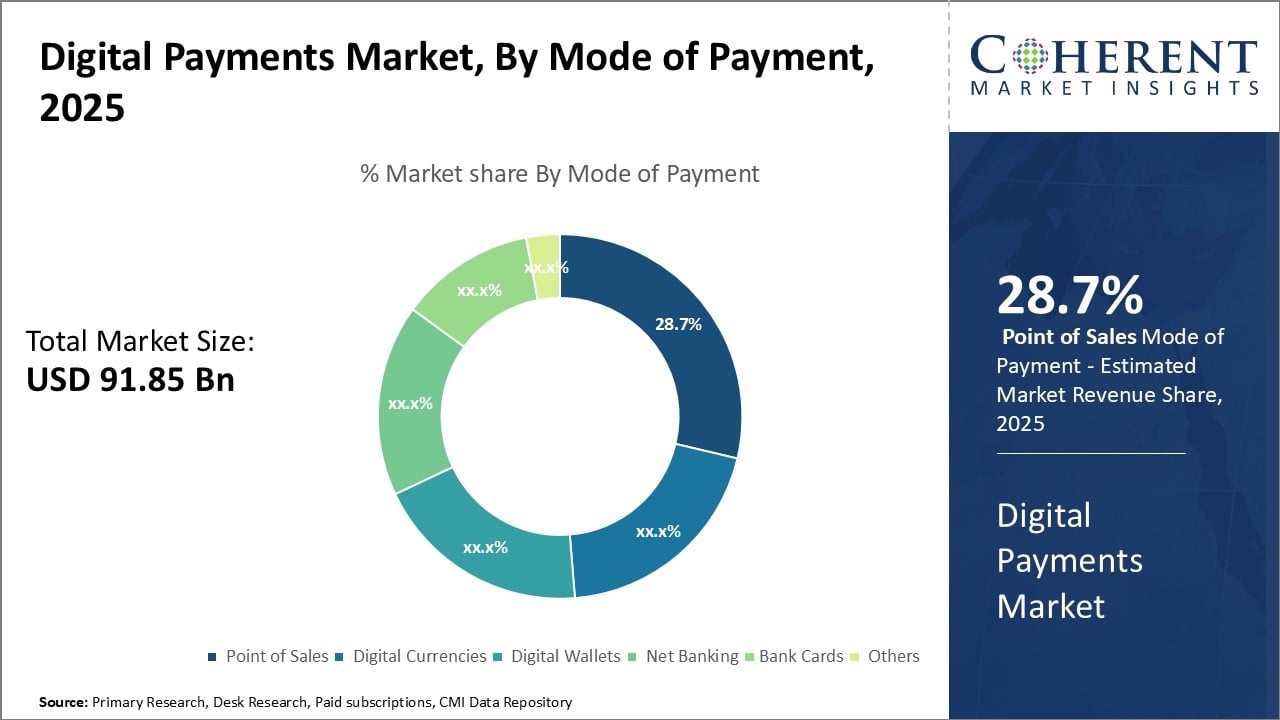
Digital Payments Market Insights, by Mode of Payments: Point of Sales contribute the highest share of the market owing to its growth of e‑commerce / omnichannel retailing.
Point of Sales hold the largest market share of 29.7% in 2026. It's easier to shop when you can buy products right at the register because you don't have to carry cash or cards. This is especially appealing to younger individuals who have fully embraced digital lifestyles and spending habits that are easy to do on the go. Payment processing is embedded straight into point-of-sale systems, so you can pay for anything in-store or online with only a few taps or clicks. Digital payments at the point of sale get rid of the time it takes to count currency, speed up transactions, and interact with inventory and accounting systems instantly.
For instance, in October 2025, Zoho launched its new line of POS devices, directly challenging established competitors like PhonePe and Paytm in the market.
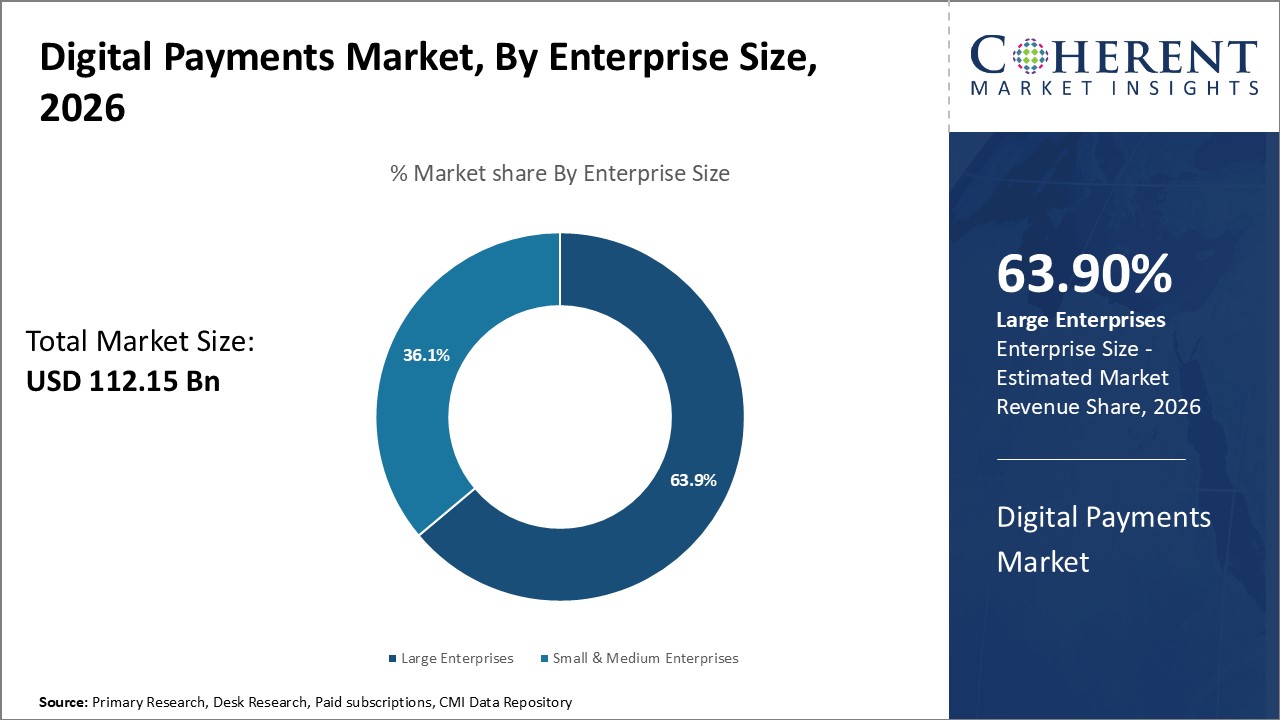
Digital Payments Market Insights, by Enterprise Size: Large Enterprises contribute the highest share of the market owing to its compliance, security, & risk management.
Large Enterprises expected to hold largest digital payments market share of 63.9% in 2026. Big organizations have different budgets, IT departments, and ways of buying things, which makes it easier for them to use new payment systems throughout their operations. For big businesses, using digital solutions instead of paper and cash has a lot of advantages. Centralized payment services give you a clear picture of your spending habits, enable you make payments in real time, and take care of your bills automatically. This is great news for worldwide companies that handle millions of payments every year.
For instance, in October 2024, Revolut, a global FinTech company known for its versatile digital banking services, has introduced a new point-of-sale (POS) terminal device targeting larger businesses in the UK and Ireland.
Digital Payments Market Insights, by End User: BFSI contribute the highest share of the market owing to its revenue generation & fee income.
BFSI acquired the prominent market share of 47.8% in 2026. Digital payments have become an important part of how modern banks and other financial institutions interact with consumers, run their businesses, find new ways to make money, and determine the future of financial services. For consumers, adding the ability to accept and process digital payments to online banking portals, mobile apps, and automated teller channels has helped build stronger relationships with customers and increase the number of transactions. The financial sector uses digital rails to upgrade old systems, bring on new partners and vendors through B2B platforms, and automate treasury and cash management processes.
For instance, in April 2025, Fintech firm Razorpay unveiled its Turbo UPI plugin on the BHIM Vega platform in collaboration with NPCI BHIM Services Limited (NBSL) and Axis Bank.
Regional Insights
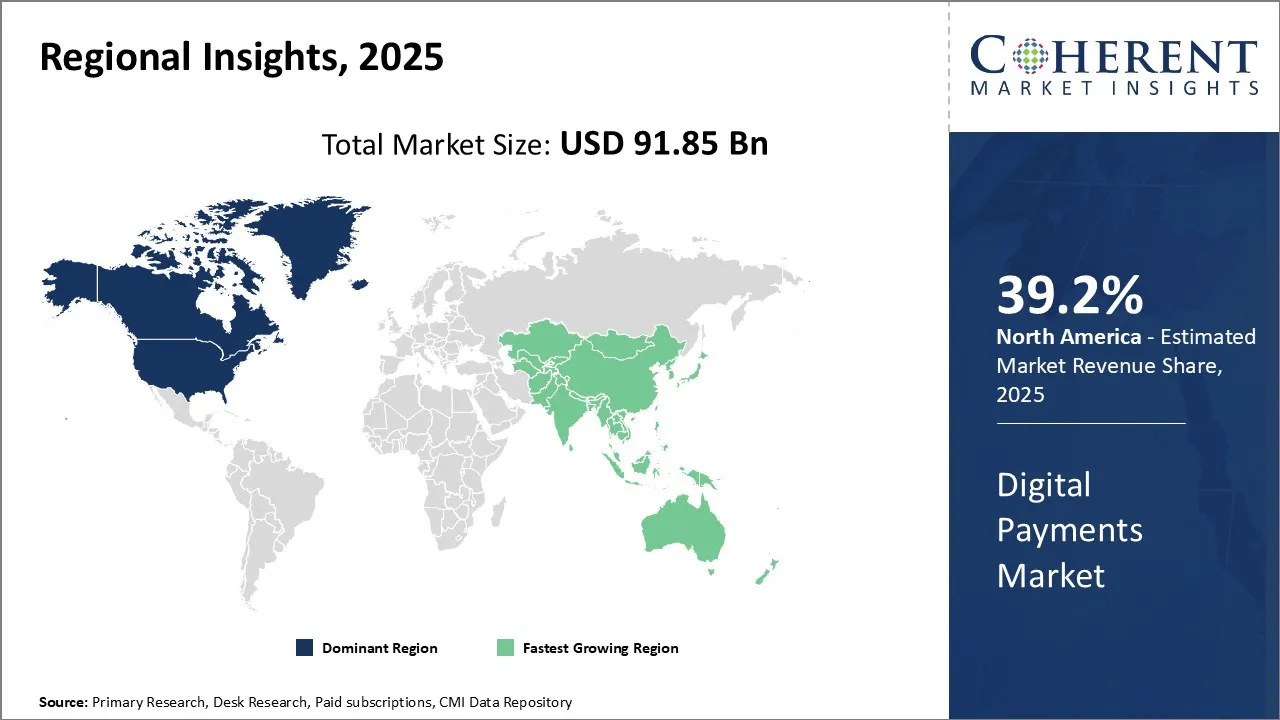
North America Digital Payments Market Trends
North America dominates the overall market with an estimated share of 39.2% in 2026. The digital payments business in North America is changing because customers want payment experiences that are more personalized and work across platforms. They actively opt to utilize digital wallets, contactless cards, and services that let them buy things now and pay for them later. To make things easier for customers, businesses use unified payment systems that connect in-store, mobile, and internet channels. The requirement for speed and security is driving the growth of real-time payments and improved fraud protection technology.
For instance, Kasheesh, a new digital payment platform, has launched in the US, enabling users to split online purchase payments across multiple debit and credit cards without incurring additional costs or interest.
Asia Pacific Digital Payments Market Trends
The digital payments business in the Asia Pacific area is growing swiftly as more people use smartphones, have access to the internet, and governments take steps to make economies less dependent on cash. People in both cities and rural places are using QR code payments, mobile wallets, and smart apps that make financial services a part of their daily lives. Fintech startups and big IT corporations from around the world are in a fierce competition, which drives innovation in payment security and user experience.
For instance, in October 2026, Singapore-based payments infrastructure platform HitPay has partnered with France-based electronic payment solutions firm Ingenico to launch an “all-in-one” system aimed at boosting digital payment adoption among small and medium-sized enterprises (SMEs) in the Philippines.
United States Digital Payments Market Trends
The digital payments sector in the United States is moving toward being safer and easier to use. People use mobile wallets, contactless payments, and voice-activated transactions to make things easier for themselves. Businesses use integrated payment systems that work with all channels of sales and make customers more interested. Buy now, pay later options and real-time payment solutions are becoming more popular as people's tastes change.
For instance, in August 2026, U.S. Citizenship and Immigration Services (USCIS) announced today that immigration applicants and petitioners can now electronically pay their fees directly from U.S. bank accounts using Form G-1650 (Authorization for ACH Transactions), effective immediately.
India Digital Payments Market Trends
The digital payments business in India is changing quickly because more people are using smartphones and the government is becoming involved. People use UPI, mobile payment wallets, and QR code payments for everyday purchases. Banks and fintech companies work together to offer new, easy-to-use payment options that make it easier for people in both cities and the countryside to get access to financial services. Digital loans, contactless payments, and real-time settlements are altering the way people and businesses handle money.
For instance, in July 2026, PayPal, a payments firm, has partnered with the operator of India’s unified payments interface and other stakeholders to launch a global platform that allows consumers to make cross-border payments to businesses.
Digital Payments Market Trend
Rise of Biometric Authentication
Fingerprint scanning, facial recognition, and voice authentication are becoming more common in the world of digital payments. Not only do these approaches make things safer, but they also make it easier for users to get in, which means they don't have to remember as many passwords or PINs. Biometric authentication speeds up transactions and makes them easier for users while also fighting fraud. This makes it a key trend that will shape payment experiences on all devices and platforms around the world in the future.
Expansion of Contactless Payments
Contactless payments are changing the way people shop by making transactions faster and easier using NFC-enabled cards and mobile wallets. Convenience, sanitary concerns, and better acceptance infrastructure are driving this movement. Contactless payments are already a common way to pay since they make shopping, traveling, and staying in hotels easier for both merchants and customers.
Digital Payments Market Opportunity
Integration with Everyday Services
Integrating digital payments into everyday tasks like paying for utilities, getting about, and shopping online makes things easier for users. This convergence opens the door to recurring payments and subscription models, which makes payments happen more often. Digital payment platforms may grow their business, keep customers coming back, and come up with new ideas for value-added services like immediate credit, loyalty rewards, and personalized offers by working with service providers.
Market Report Scope
Digital Payments Market Report Coverage
| Report Coverage | Details | ||
|---|---|---|---|
| Base Year: | 2025 | Market Size in 2026: | USD 112.15 Bn |
| Historical Data for: | 2020 To 2024 | Forecast Period: | 2026 To 2033 |
| Forecast Period 2026 to 2033 CAGR: | 22.1% | 2033 Value Projection: | USD 453.74 Bn |
| Geographies covered: |
| ||
| Segments covered: |
| ||
| Companies covered: | ACI Worldwide Inc., Adyen N.V., AliPay, Amazon Payments Inc., Apple Pay, FIS, Fiserv Inc., Global Payments Inc., Mastercard Incorporated, PayPal Holdings Inc., Paytm (One97 Communications Limited), Square, Inc., Stripe, Inc., Visa Inc., and Worldline S.A. | ||
| Growth Drivers: |
| ||
| Restraints & Challenges: |
| ||
Digital Payments Market News
- In October 2025, Reserve Bank of India unveiled three major digital payment innovations at the Global Fintech Fest 2025: ‘UPI Multi-Signatory’, ‘Small Value Transactions using Wearable Glasses via UPI Lite’, and ‘Forex on Bharat Connect.’
- In October 2025, Union Minister launched India’s UPI at Lulu Mall in Doha, strengthening digital and financial ties between India and Qatar and easing transactions for citizens and businesses.
- In October 2025, India expanded its Unified Payments Interface (UPI) services by launching them at Lulu Group’s stores in Qatar, building on the initial rollout at duty-free outlets in Hamad International Airport last month.
Analyst Opinion (Expert Opinion)
- The digital payments market is at a critical inflection point where technology convergence and consumer behavior are reshaping transactional paradigms far beyond convenience. My analysis reveals that the decisive battleground is no longer just about speed or accessibility—it’s about building unwavering trust through security and seamless integration across ecosystems.
- Moreover, the rapid embrace of contactless payments, fueled by pandemic-induced hygiene concerns, has cemented NFC technology’s role in everyday commerce. Visa reported contactless transactions accounted for nearly 70% of in-person card transactions in mature markets by early 2024. This reveals a durable behavioral change rather than a temporary spike, urging payment providers to prioritize contactless infrastructure investments, especially in developing economies where digital literacy is improving fast.
- However, the most underappreciated opportunity lies in cross-sector partnerships, which transform payment platforms into holistic financial ecosystems. Look at how Grab Financial Group evolved from a ride-hailing service into a leading super-app by integrating payments, loans, and insurance. This synergy generates higher lifetime customer value, as users find increasing utility within a single ecosystem, creating formidable barriers to entry for new competitors.
- Conversely, the market’s fragmentation—especially among digital wallets—signals an urgent need for interoperability. The Korean market’s experience shows that fragmented wallet adoption leads to consumer fatigue and slower market penetration. Those players who pioneer open APIs and cross-platform compatibility will likely dominate future market share, turning collaboration into a competitive weapon rather than a threat.
Speak to the analyst
Want personalized insights?
Take the findings above to one of our principal consultants, or have the report rebuilt around the segments, geographies and competitors you actually track.
Market Segmentation
- Mode of Payment Insights (Revenue, US$ Bn, 2021 - 2033)
- Bank Cards
- Digital Currencies
- Digital Wallets
- Net Banking
- Point of Sales
- Others
- Enterprise Size Insights (Revenue, US$ Bn, 2021 - 2033)
- Large Enterprises
- Small & Medium Enterprises
- End User Insights (Revenue, US$ Bn, 2021 - 2033)
- BFSI
- Healthcare
- IT & Telecom
- Media & Entertainment
- Retail & E-commerce
- Transportation
- Others
- Regional Insights (Revenue, US$ Bn, 2021 - 2033)
- North America
- U.S.
- Canada
- Latin America
- Brazil
- Argentina
- Mexico
- Rest of Latin America
- Europe
- Germany
- U.K.
- Spain
- France
- Italy
- Russia
- Rest of Europe
- Asia Pacific
- China
- India
- Japan
- Australia
- South Korea
- ASEAN
- Rest of Asia Pacific
- Middle East & Africa
- GCC Countries
- Israel
- South Africa
- Rest of Middle East & Africa
- Key Players Insights
Sources
- Primary Research interviews
- Industry experts from payment gateways
- Digital wallet service providers
- Bank representatives involved in digital payments
- Retailers adopting digital payment systems
- Technology solution providers for payment infrastructure
- Databases
- Government financial transaction records
- Central bank digital payment statistics
- Payment processor transaction data
- International payment network data
- Magazines
- Payments Today
- Digital Finance Monthly
- FinTech Insights
- Journals
- Journal of Electronic Commerce Research
- International Journal of Digital Banking
- Journal of Payment Systems & Strategy
- Newspapers
- The Financial Times
- The Wall Street Journal (Finance Section)
- The Economic Times
- Associations
- National Payment Council
- Electronic Transactions Association
- Digital Payment Standards Forum
- Public Domain sources
- Central bank annual reports
- Government policy documents on digital payments
- Regulatory authority publications
- Public financial market data
- Proprietary Elements
- CMI Data Analytics Tool
- Proprietary CMI Existing Repository of information for last 8 years
Get access to 250+ pages report
Every segment, forecast, competitor profile and data table behind the analysis above — available for instant download.
- ESOMAR Member
- ISO 9001:2015 Certified
- D-U-N-S Registered
- GDPR & CCPA Compliant
Missing comfort of reading report in your local language? Find your preferred language:
Transform your Strategy with Exclusive Trending Reports
Frequently Asked Questions
The Digital Payments Market is estimated to be valued at USD 112.15 Bn in 2026, and is expected to reach USD 453.74 Bn by 2033.
The CAGR of the Digital Payments Market is projected to be 22.1% from 2026 to 2033.
Growing adoption of mobile payments and remittance services for migrants are the major factors driving the growth of the global digital payments market.
Lack of internet connectivity in rural areas and security concerns related to data breaches and privacy issues are the major factors hampering the growth of the global digital payments market.
In terms of mode of payment, point of sales is estimated to dominate the market revenue share in 2026.
ACI Worldwide Inc., Adyen N.V., AliPay, Amazon Payments Inc., Apple Pay, FIS, Fiserv Inc., Global Payments Inc., Mastercard Incorporated, PayPal Holdings Inc., Paytm (One97 Communications Limited), Square, Inc., Stripe, Inc., Visa Inc., and Worldline S.A. are the major players.
North America is expected to lead the global digital payments market in 2026.