

Mobile Payment Technologies Market Size and Share Analysis- Growth Trends and Forecasts (2026-2033)
The Mobile Payment Technologies Market size is anticipated to grow at a CAGR of 30.8% with USD 184.4 Bn in 2026 and is expected to reach USD 1,205.1 Bn in 2033. The primary drivers are defined by expanding smartphone connectivity, real-time account-to-account payments, interoperable digital wallets, QR-code acceptance, and biometric transaction authentication. According to the World Bank’s Global Findex 2025, nearly 80% of adults worldwide have a financial account, while approximately 900 million unbanked adults own a mobile phone. This large digitally addressable population is strengthening demand for mobile wallets, payment applications, tokenization platforms, merchant-acquiring solutions, and instant-payment infrastructure across retail, BFSI, travel, healthcare, and entertainment applications.
Key Takeaways
- The remote payment segment is likely to dominate the market with 61.5% in 2026. The segment’s growth is owing to the rising smartphone penetration and increasing use of app-based, in-app, and online transactions. Globally, 86% of adults owned a mobile phone in 2024, including 68% with smartphones.
- The money transfers & payments segment is set to lead with 43.6% in 2026. The segment’s growth is owing to the expansion of instant P2P transfers, remittances, bill payments, and mobile money services.
- The BFSI segment is set to lead with 21.1% in 2026. The segment’s growth is owing to the banks’ rapid integration of digital wallets, instant payments, QR payments, and mobile banking. Worldwide, 79% of adults now hold a financial institution or mobile money account.
- Asia Pacific is expected to acquire the prominent share of 36.2% in 2026. The region’s growth is owing to the mature banking infrastructure, high smartphone usage, and early adoption of digital wallets and contactless payments.
Segmental Insights
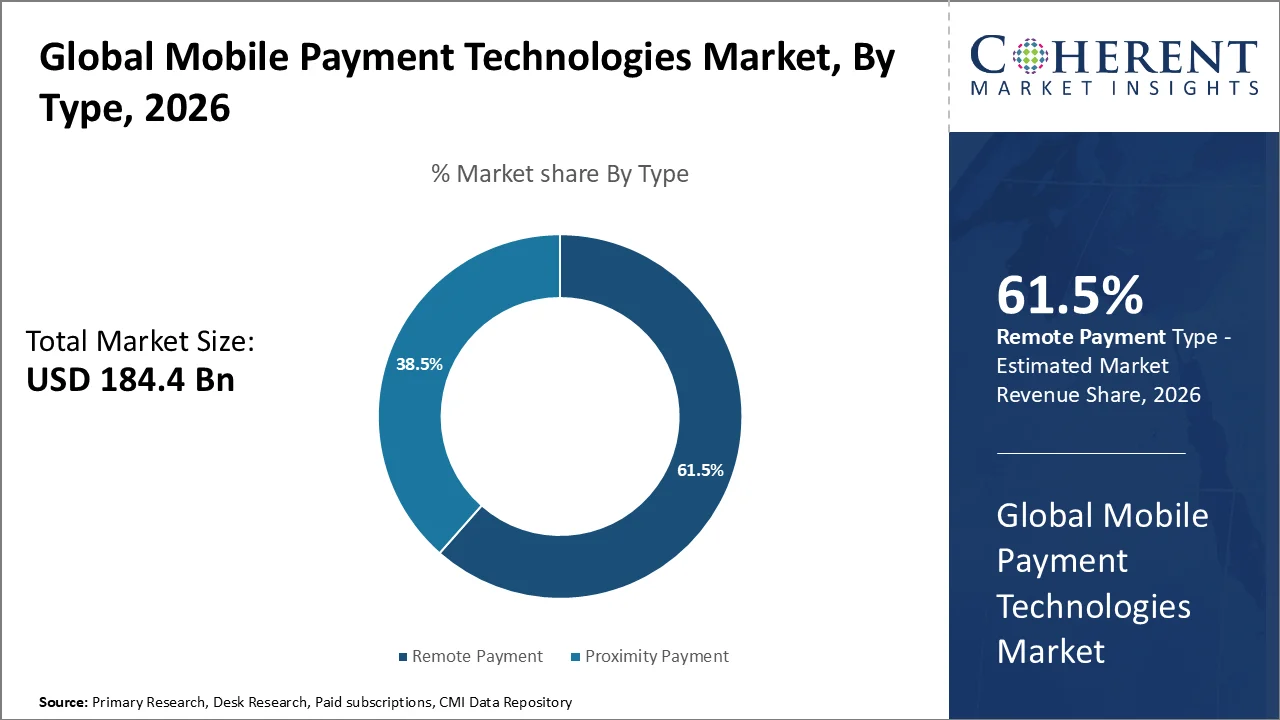
Why is Remote Payment Segment Acquiring the Largest Share?
On the basis of type, the remote payment segment is projected to account for the largest Mobile Payment Technologies Market share of 61.5% in 2026. The segment’s growth is owing to the convenience of app-based account transfers, online merchant payments, recurring bill settlement, and cross-border transactions without requiring physical contact or terminals.
NPCI reported that UPI processed nearly 22,716.07 million transactions in June 2026, thereby demonstrating the high usage frequency of mobile-led remote payments. The same transactions were valued at INR 28,92,138.67 crore, thereby indicating that consumers and businesses increasingly rely on mobile interfaces for both everyday and high-value transfers.
In February 2026, NPCI extended its UPI One World wallet service to international delegates from more than 40 countries at the India AI Impact Summit. The service enabled foreign visitors to make real-time merchant payments without an Indian bank account or mobile number, strengthening interoperability, accessibility, and the global expansion potential of remote payment technologies.
- Current Industry Events of 2026
- Market Size Estimation
- Regional Breakdown
- Competitive Landscape
- Customer Intelligence
- Segmental Analysis
- Pricing Analysis
- Key Market Drivers, Challenges & Future Trends
- Customized Insights Section
Money Transfers & Payments hold the Largest Market Share
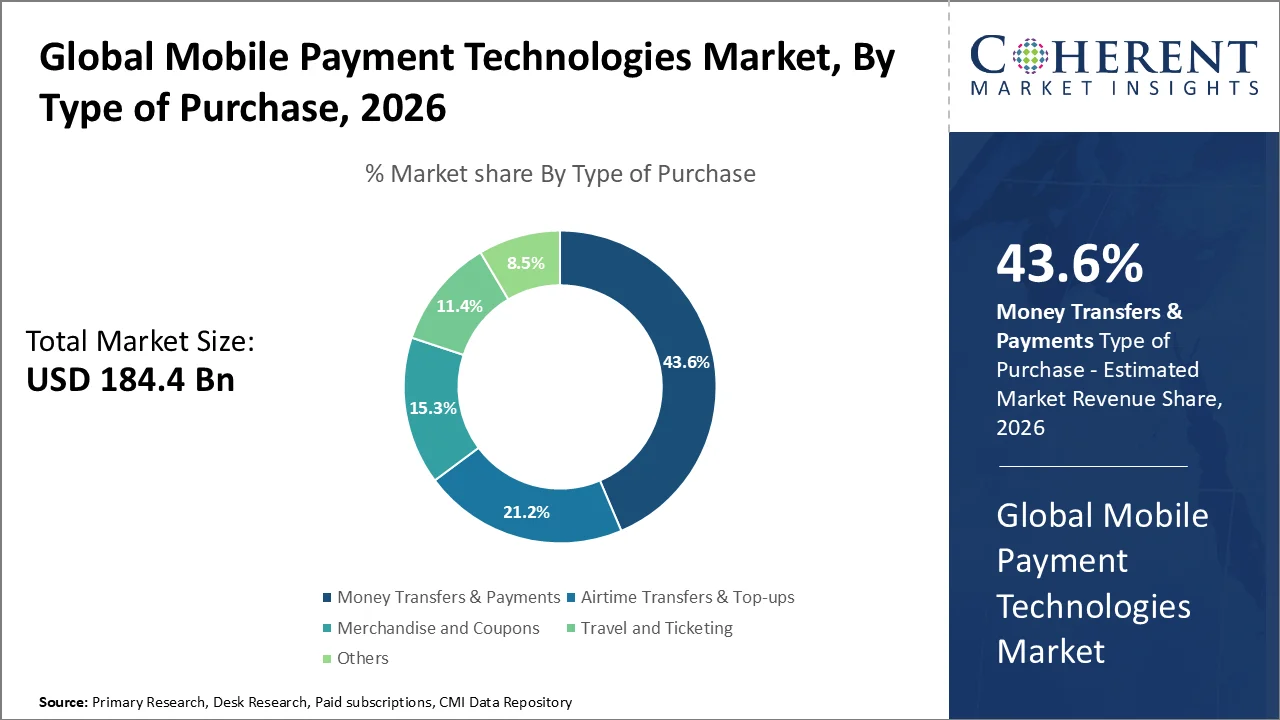
On the type of purchase, the money transfers & payments segment lead with a major 43.6% share in 2026. The growth is owing to the high frequency of peer-to-peer transfers, merchant payments, domestic remittances, utility payments, salary disbursements and government-to-person transfers.
According to GSMA, mobile-money platforms processed approximately 108 billion transactions valued at more than USD 1.68 trillion in 2024. In 2025, transaction value exceeded USD 2 trillion, representing growth of approximately 23% from the preceding year. The number of registered accounts reached around 2.3 billion, indicating that mobile money has developed from a basic cash-transfer service into a broader financial-services channel.
In July 2025, PayPal announced PayPal World, an interoperability platform intended to connect PayPal and Venmo with participating payment systems and wallets, including Mercado Pago, NPCI International Payments’ UPI and Tenpay Global.
Market Drivers
Rising Innovations in UPI and Biometric Authentication are Transforming the Mobile Payment Technologies Market in India
India has emerged as one of the most important innovation centres for real-time mobile payments. The Unified Payments Interface provides interoperable account-to-account payments through bank and third-party applications, enabling consumers and businesses to transfer funds through mobile numbers, virtual payment addresses, QR codes, and linked bank accounts.
NPCI reported that UPI processed 22.72 billion transactions valued at approximately INR 28.92 trillion in June 2026, compared with 16.7 billion transactions in December 2024. The number of banks live on UPI reached 731 in June 2026, thereby demonstrating the broad institutional participation. Biometric authorization is reducing dependence on manually entered personal identification numbers and one-time passwords. In June 2026, NPCI announced that biometric-authentication-based UPI transactions including RuPay credit-card payments on UPI, had crossed 600 million transactions.
In February 2026, Mastercard demonstrated its first fully authenticated agentic-commerce transaction in India at the India AI Impact Summit in New Delhi. The transaction was tokenized and authenticated through Mastercard’s Agent Pay framework, allowing an artificial-intelligence agent to initiate a payment within predefined consumer permissions.
Agentic Payments and Payment Passkeys: A Major Breakthrough in the Mobile Payment Technologies Market
Agentic payments allow artificial-intelligence systems to identify products, compare options, initiate purchases and complete transactions on behalf of users within predetermined limits and permissions. Agentic payments require mechanisms that demonstrate consumer consent, authenticate the agent, tokenize the payment credential, communicate transaction context, and provide users with control over transaction limits. Payment passkeys are also becoming an important supporting technology. They replace passwords and SMS-based one-time codes with device-bound authentication using a fingerprint, facial scan, or device PIN.
Visa reported in July 2025 that nearly half of its digital transactions were tokenized and that approximately one billion tokens had been added during the preceding quarter. This indicates that the underlying infrastructure required for secure mobile and agentic commerce is moving into large-scale deployment.
In March 2026, Santander and Mastercard completed Europe’s first live, end-to-end payment executed by an AI agent within a regulated banking environment. Mastercard Agent Pay allowed the agent to initiate and complete the transaction using Santander’s live payment infrastructure while operating under predefined permissions and control mechanisms.
Current Events and Their Impact
Current Event | Description and its Impact |
EU Instant Payments Regulation Implementation in 2025 |
|
EU Digital Operational Resilience Act Enforcement |
|
Mobile Payment Technologies Market Trends
- Rising adoption of QR-code and contactless payments allows for faster checkout, reduces cash handling, and expands acceptance among small merchants worldwide.
- Integration of biometric authentication, tokenization, and device-based security improves transaction protection and strengthens consumer confidence across mobile wallets without exposing payment credentials during merchant transactions and online purchases.
- Real-time account-to-account payments are expanding, thus allowing consumers and businesses to transfer funds instantly through interoperable mobile banking applications.
- Wider use of digital merchant payments is accelerating mobile payment adoption across developing economies. According to the World Bank, 42% of adults in low- and middle-income economies made an in-store or online digital merchant payment in 2024, increasing from 35% in 2021. This expansion supports the mobile wallets, QR payments, merchant applications, embedded finance, and digital commerce platforms.
- Contactless payment usage continues to strengthen across mature markets. The European Central Bank reported 29.5 billion contactless card payments at physical terminals in the second half of 2024, representing 81% of non-remote card transactions. Rising transaction volumes are increasing demand for NFC-enabled mobile wallets, secure authentication, tokenized credentials, fraud monitoring, and highly scalable payment-processing infrastructure.
Regional Insights
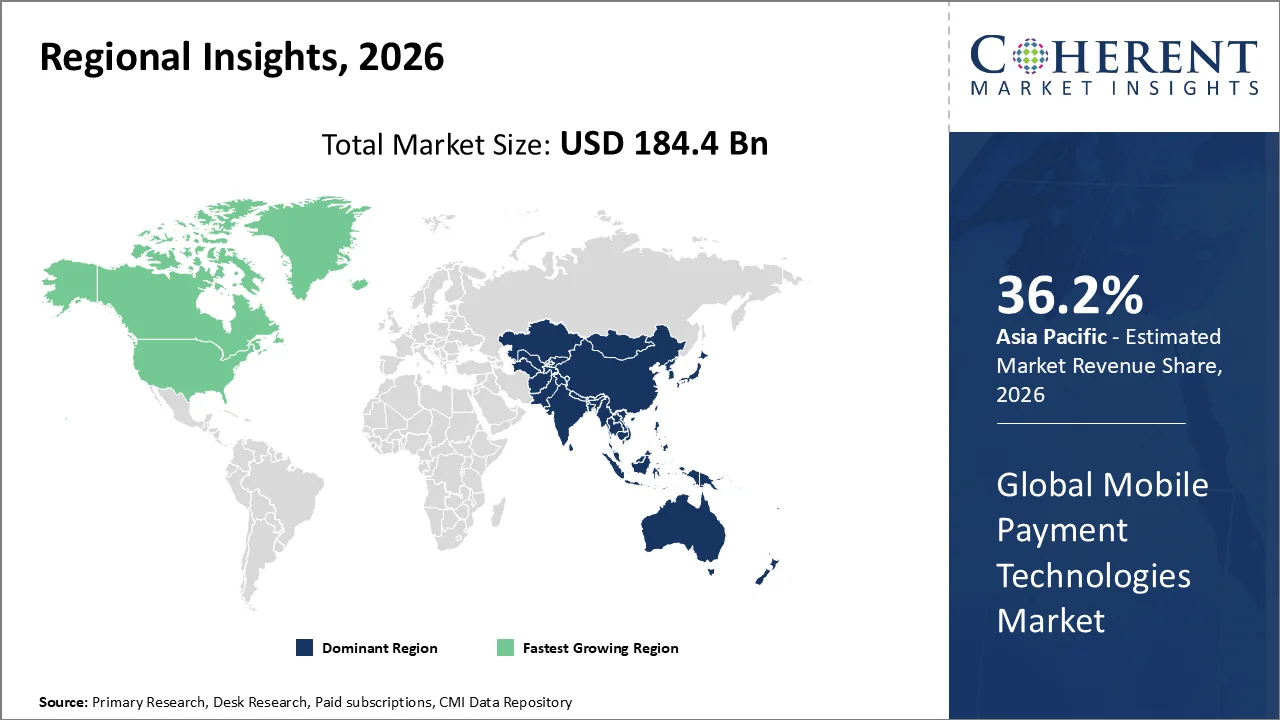
Asia Pacific Dominates Owing to the Large-Scale Instant-Payment and Mobile-Wallet Ecosystems
The Asia Pacific region accounts for 36.2% of the market share in 2026. The region’s growth is owing to the high smartphone usage, extensive QR-code acceptance, large digital-commerce markets, government-supported payment infrastructure, super-app adoption, and rapidly expanding cross-border interoperability.
Regional growth is further supported by QR interoperability and cross-border initiatives in Southeast Asia, as well as advanced contactless ecosystems in Australia, Japan, Singapore and South Korea. GSMA projects that 5G will account for approximately 50% of Asia Pacific mobile connections by 2030, supporting faster and more reliable mobile-commerce experiences.
In February 2026, Mastercard completed a fully authenticated agentic-commerce transaction in India. During March 2026, the company announced live authenticated agentic-payment pilots in Singapore, Malaysia, South Korea and Hong Kong.
North America Mobile Payment Technologies Market Trends
North America is expected to witness strong growth in market over the forecast period. The region’s growth is owing to the rising wallet usage, broader merchant acceptance, and faster-payment infrastructure.
In Canada, the Bank of Canada’s latest Merchant Acceptance Survey found that 49% of small and medium-sized merchants accepted mobile payment applications, indicating expanding point-of-sale readiness.
In April 2025, Smooth Commerce launched Interac Debit for in-app and browser-based payments across its restaurant and hospitality platform in Canada. The integration allows the customers to pay through Apple Pay and Google Pay, while giving participating businesses real-time settlement and lower transaction costs than credit cards.
Extensive QR-code Acceptance Are Accelerating the Mobile Payment Technologies Market in China
In China, the Mobile Payment Technologies Market is influenced by the widespread digital adoption, extensive QR-code acceptance, and stronger access for international users. According to the State Council, China had more than 1 billion online-payment users by the end of 2024, thereby creating a large consumer base for mobile wallets and app-based transactions.
In November 2025, UnionPay International partnered with Korean fintech company GLN to enable Korean travelers to make QR-code payments through participating mobile apps at UnionPay merchants across mainland China. This cross-border integration improves payment convenience, expands merchant transaction volumes, and supports continued investment in interoperable mobile-payment infrastructure and services.
United States Mobile Payment Technologies Market Trends
United States is emerging as a major growth market for Mobile Payment Technologies. The growth is owing to the increasing use of smartphones for transactions, bill payments, and peer-to-peer transfers. The Federal Reserve Bank of Atlanta’s 2024 Survey and Diary of Consumer Payment Choice reported that mobile-phone-enabled payments represented 32% of all consumer payments, demonstrating adoption across payment scenarios.
In October 2024, Apple expanded Apple Pay in the U.S. by enabling eligible users to access Affirm installment loans and Klarna flexible payment options during online and in-app checkout. This integration strengthens digital wallet functionality, improves payment flexibility, and supports wider use of mobile payment platforms among consumers and merchants.
Who are the Major Companies in Mobile Payment Technologies Industry
Some of the major key players in Mobile Payment Technologies Market are PayPal, Inc., Microsoft Corporation, MasterCard International Inc., Apple, Inc., American Express, Co., Google, Inc., Boku, Inc., AT & T, Inc., Visa, Inc., Vodafone Ltd., State Bank of India (SBI), Fortumo, and Bharti Airtel Ltd.
Key News
- In June 2026, HSBC and Mastercard launched a mobile virtual card solution in the UAE. The solution allows corporate customers to add tokenized virtual cards directly to digital wallets and use them for contactless, online, and in-app payments.
- In June 2026, Visa introduced enhanced Visa Pay, Visa Accept, and Visa Direct capabilities for small businesses in emerging markets. These tools let merchants use smartphones to securely accept payments, receive near-real-time funds, and send payouts without additional payment hardware.
Market Report Scope
Mobile Payment Technologies Market Report Coverage
| Report Coverage | Details | ||
|---|---|---|---|
| Base Year: | 2025 | Market Size in 2026: | USD 184.4 Bn |
| Historical Data for: | 2020 To 2024 | Forecast Period: | 2026 To 2033 |
| Forecast Period 2026 to 2033 CAGR: | 30.8% | 2033 Value Projection: | USD 1,205.1 Bn |
| Geographies covered: |
| ||
| Segments covered: |
| ||
| Companies covered: | PayPal, Inc., Microsoft Corporation, MasterCard International Inc., Apple, Inc., American Express, Co., Google, Inc., Boku, Inc., AT & T, Inc., Visa, Inc., Vodafone Ltd., State Bank of India (SBI), Fortumo, and Bharti Airtel Ltd. | ||
| Growth Drivers: |
| ||
| Restraints & Challenges: |
| ||
Analyst Opinion
- Mobile payment technologies are driven by transaction needs rather than temporary consumer trends. Around two-thirds of adults worldwide now make or receive digital payments, showing that mobile-enabled payments have become mainstream in financial activity and inclusion.
- Merchant payments are becoming a major mobile money use case. Their transaction value increased by almost 50% to USD 155 billion in 2025, thereby reflecting stronger acceptance among retailers, small businesses, online sellers, as well as service providers.
- Digital payments are also expanding financial participation among previously underserved consumers. In 2024, around 58% of women made or received a digital payment, nearly double the proportion recorded ten years earlier. This widening user base will encourage banks, fintech firms, retailers, and telecom operators to develop accessible mobile wallets, secure authentication tools, and interoperable payment platforms.
Speak to the analyst
Want personalized insights?
Take the findings above to one of our principal consultants, or have the report rebuilt around the segments, geographies and competitors you actually track.
Market Segmentation
- By Type (Revenue, USD Bn, 2021-2033)
- Proximity Payment
- Near field Communication (NFC)
- QR Code Payment
- Remote Payment
- SMS-based
- USSD/STK
- Direct operator billing (Credit/debit card-based)
- Digital wallet
- Proximity Payment
- By Type Purchase (Revenue, USD Bn, 2021-2033)
- Airtime Transfers & Top-ups
- Money Transfers & Payments
- Merchandise and Coupons
- Travel and Ticketing
- Others
- By End-use Application (Revenue, USD Bn, 2021-2033)
- Hospitality & Tourism Sector
- BFSI
- Media & Entertainment
- Retail Sector
- Health Care
- Education
- Others
- Global Mobile Payment Technologies Market, By Region (Revenue, USD Bn, 2021-2033)
- North America
- U.S.
- Canada
- Latin America
- Brazil
- Mexico
- Argentina
- Rest of Latin America
- Europe
- Germany
- U.K.
- France
- Italy
- Spain
- Russia
- Rest of Europe
- Asia Pacific
- China
- India
- Japan
- Australia
- South Korea
- ASEAN
- Rest of Asia Pacific
- Middle East
- GCC
- Israel
- Rest of Middle East
- Africa
- South Africa
- Central Africa
- North Africa
- North America
- Key Players
- PayPal, Inc.
- Microsoft Corporation
- MasterCard International Inc.
- Apple, Inc.
- American Express, Co.
- Google, Inc.
- Boku, Inc.
- AT & T, Inc.
- Visa, Inc.
- Vodafone Ltd.
- State Bank of India (SBI)
- Fortumo
- Bharti Airtel Ltd.
Sources
Primary Research Interviews
- Mobile payment technology providers
- Fintech company executives
- Banks and financial institution representatives
- Digital wallet and payment gateway operators
- Telecom and mobile network operators
- Merchant acquirers and payment processors
- Retailers and e-commerce platform managers
- Cybersecurity and payment authentication experts
- Regulatory and compliance professionals
- Key opinion leaders (KOLs) in digital payments and financial technology
Databases
- World Bank
- International Monetary Fund (IMF)
- Bank for International Settlements (BIS)
- Organisation for Economic Co-operation and Development (OECD)
- GSMA Intelligence
- Federal Reserve Economic Data (FRED)
- European Central Bank Statistical Data Warehouse
Magazines
- The Paypers
- Payments Dive
- FinTech Magazine
- Mobile Payments Today
Journals
- Electronic Commerce Research and Applications
- Journal of Payments Strategy & Systems
- International Journal of Bank Marketing
- Journal of Financial Services Research
- Journal of Banking and Finance
Newspapers
- The Wall Street Journal
- Financial Times
- The New York Times
- The Guardian
Associations
- GSM Association (GSMA)
- Electronic Transactions Association (ETA)
- PCI Security Standards Council
- EMVCo
- FIDO Alliance
- Mobile Ecosystem Forum
- European Payments Council
Public Domain Sources
- Company annual reports and investor presentations
- Central bank payment statistics and publications
- Government financial regulatory authority publications
- Digital payment regulations and policy documents
- Securities exchange filings
- Payment network and fintech company press releases
- National financial inclusion and digital transaction surveys
Proprietary Elements
- CMI Data Analytics Tool, Proprietary CMI Existing Repository of Information for Last 10 Years
Get access to 250+ pages report
Every segment, forecast, competitor profile and data table behind the analysis above — available for instant download.
- ESOMAR Member
- ISO 9001:2015 Certified
- D-U-N-S Registered
- GDPR & CCPA Compliant
Missing comfort of reading report in your local language? Find your preferred language:
Transform your Strategy with Exclusive Trending Reports
Frequently Asked Questions
The Mobile Payment Technologies Market is expected to reach USD 1,205.1 billion in 2033.
The cybersecurity risks, infrastructure limitations in developing regions, interoperability issues across fragmented platforms, and a general reluctance among consumers to abandon traditional cash are the key factors hampering growth of the market.
The escalating smartphone penetration, a global shift toward cashless transactions, and a surging e-commerce sector is boosting the demand for Mobile Payment Technologies.
The Mobile Payment Technologies Market is anticipated to grow at a CAGR of 30.8% between 2026 and 2033.
The market outlook remains positive due to the rising smartphone penetration, government-backed cashless initiatives, and surging e-commerce.
The mobile payment technologies market encompasses the infrastructure, software, and hardware that allow consumers and businesses to execute financial transactions using mobile devices (smartphones, tablets, or wearables).
Among regions, Asia Pacific is expected to account for a largest market share in the global Mobile Payment Technologies Market over the forecast period.