

IoT in Manufacturing Market Size and Forecast – 2026 to 2033
IoT in Manufacturing Market is estimated to be valued at USD 330.53 Bn in 2026 and is expected to reach USD 1,090.94 Bn in 2033, exhibiting a compound annual growth rate (CAGR) of 18.6% from 2026 to 2033.
Key Takeaways
- By Software, Application Security Software hold the largest market share in 2026 owing to the rapid proliferation of IOT/IIOT devices & growing connectivity.
- By Connectivity, Satellite Network expected to hold largest market share in 2026 owing to its need for ubiquitous and global connectivity.
- By Service, Professional Service acquired the prominent market share in 2026 owing to the increasing complexity of IIoT ecosystems.
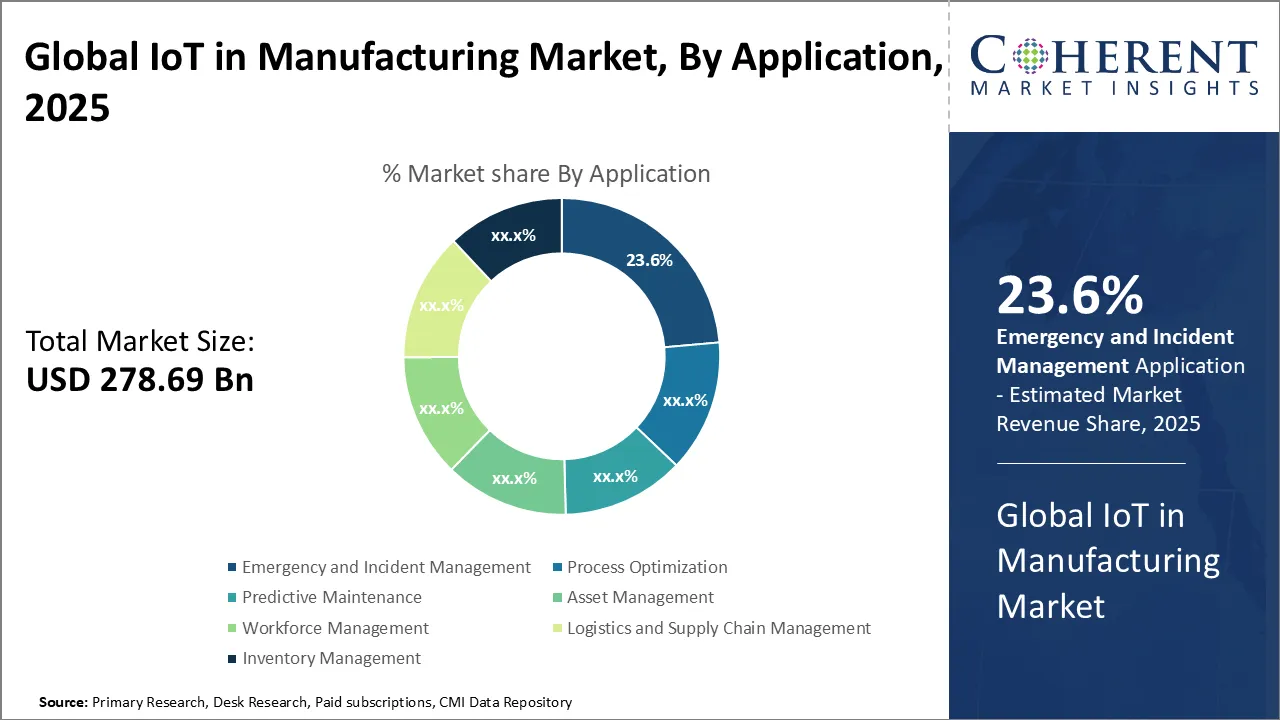
- By Application, Emergency and Incident Management hold the largest market share of 24.6% in 2026 owing to the rising workplace safety requirements & compliance regulations.
- By End User, Automotive Manufacturing dominates the overall market share in 2026 owing to the need for advanced automation & smart factory transformation.
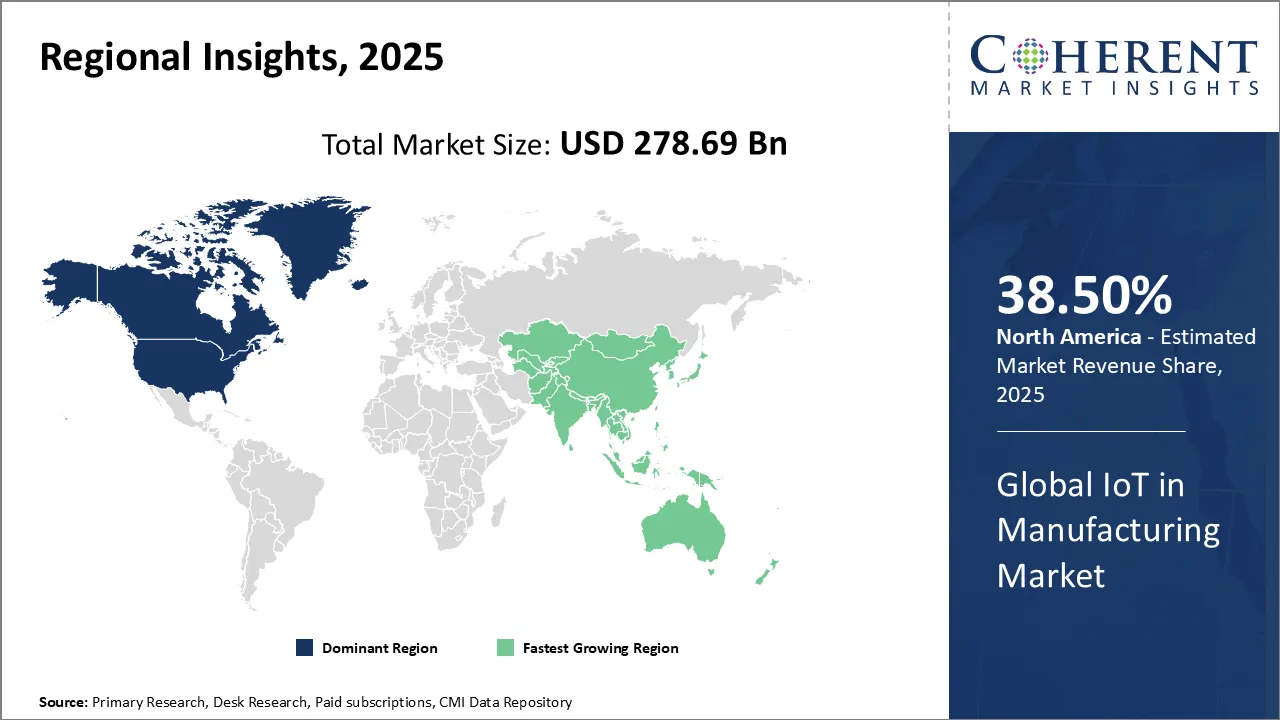
- By Region, North America dominates the overall market with an estimated share of 38.5% in 2026 owing to the strong presence of advanced manufacturing industries.
Market Overview
The IoT in manufacturing market continues to grow as factories implement connected sensors, automation, and data-driven systems to boost efficiency, productivity, and safety. Manufacturers actively integrate IoT with robotics, cloud platforms, and analytics to achieve real-time monitoring, predictive maintenance, and smarter decision-making across production lines. Ongoing digital transformation, rising industrial automation needs, and the pursuit of better-quality control and operational visibility further accelerate IoT adoption, solidifying its role as a core component of modern smart manufacturing.
Current Events and Its Impact on the IoT in Manufacturing Market
Current Events | Description and its impact |
Geopolitical and Trade Dynamics |
|
Technological Advancements and Standards |
|
Economic and Investment Trends |
|
Segmental Insights
- Current Industry Events of 2026
- Market Size Estimation
- Regional Breakdown
- Competitive Landscape
- Customer Intelligence
- Segmental Analysis
- Pricing Analysis
- Key Market Drivers, Challenges & Future Trends
- Customized Insights Section
IoT in Manufacturing Market Insights, By Application: Emergency and Incident Management contribute the highest share of the market owing to its increasing industrial accidents & risk of operational disruptions.
Emergency and Incident Management hold the largest market share of 24.6% in 2026. Manufacturers are driving the adoption of emergency and incident management solutions in the IoT manufacturing market to improve workplace safety and respond swiftly to operational hazards. They deploy IoT-enabled sensors, wearable devices, and connected machinery to monitor equipment and personnel in real time, quickly detecting accidents, malfunctions, or environmental risks. Rising automation, strict safety regulations, and the need to maintain continuous operations prompt manufacturers to implement systems that minimize downtime, safeguard workers, and deliver actionable insights for effective incident response. For instance, in May 2025, Arctic Wolf has launched Incident360 Retainer, a solution that combines incident readiness and response, enabling organizations to handle major security incidents with SLAs as fast as one hour.
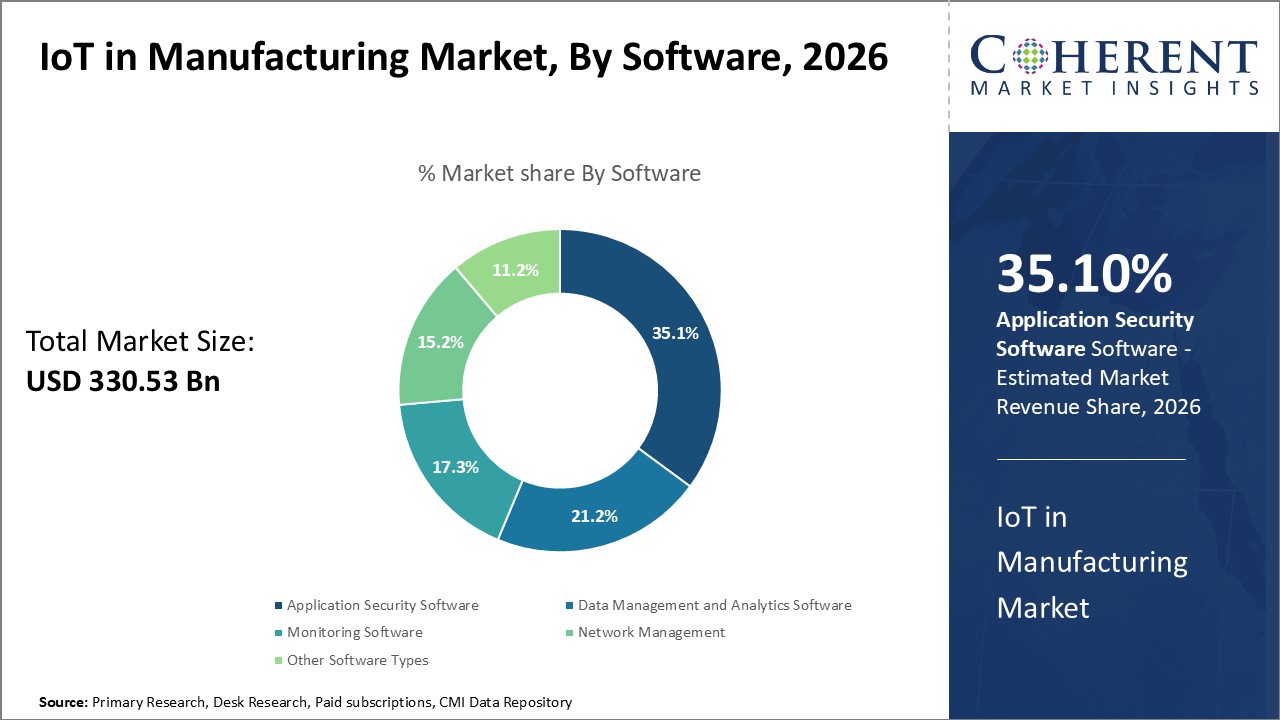
IoT in Manufacturing Market Insights, By Software: Application Security Software contribute the highest share of the market owing to its regulatory, compliance & data-protection requirements.
The demand for application security software in the IoT manufacturing market grows as manufacturers work to protect connected machines, sensors, and industrial systems from rising cyber threats. As factories digitalize, companies deploy secure applications to safeguard data, prevent unauthorized access, and maintain uninterrupted operations. The integration of cloud platforms, remote monitoring, and complex IIoT systems exposes vulnerabilities, prompting manufacturers to strengthen security frameworks. Compliance requirements, intellectual property protection, and the need for reliable production environments further drive adoption of application-level security solutions. For instance, in July 2025, Black Duck® Software, Inc., a global leader in application security, is strengthening its presence in Saudi Arabia by launching the Black Duck Polaris® Platform—the Kingdom’s first locally hosted application security SaaS.
IoT in Manufacturing Market Insights, By Connectivity: Network Satellite contribute the highest share of the market owing to its emergence of hybrid connectivity models.
Manufacturers are increasingly adopting satellite networks in the IoT manufacturing market to ensure reliable connectivity across remote and distributed industrial sites. They use satellite IoT to enable real-time monitoring, asset tracking, and seamless communication where terrestrial networks fail or are unstable. Advances in low-earth orbit satellites, hybrid connectivity solutions, and low-power devices improve accessibility and reduce latency. Growing demand for continuous data flow, operational resilience, and integrated global supply chains further drives manufacturers to implement satellite-based IoT solutions.
IoT in Manufacturing Market Insights, By Service: Professional Service contribute the highest share of the market owing to its cybersecurity requirements for connected manufacturing.
Manufacturers are driving the growth of professional services in the IoT manufacturing market as they seek expert guidance to implement complex IoT solutions. They engage consulting, system integration, and managed service providers to design, deploy, and maintain connected devices, platforms, and analytics tools. Rising complexity in industrial environments, limited in-house IoT expertise, and the need for tailored solutions prompt companies to rely on external support. Ongoing digital transformation, cybersecurity demands, and efficiency objectives further encourage the adoption of professional IoT services. For instance, in March 2025, Grid Dynamics Holdings, Inc., a leading technology consulting and engineering firm, has launched IoT Control Tower—an advanced analytics solution that helps manufacturers and equipment providers analyze IoT data and deliver actionable insights to operators.
IoT in Manufacturing Market Insights, By End User: Automotive Manufacturing contribute the highest share of the market owing to its increasing production complexity due to mass customization.
Manufacturers are driving the adoption of IoT in automotive manufacturing to optimize production, improve quality, and manage increasingly complex assembly processes. They use connected sensors, robotics, and smart machines to monitor operations in real time, perform predictive maintenance, and coordinate production lines precisely. The growth of electric vehicles, demand for mass customization, and implementation of advanced automation encourage manufacturers to deploy IoT solutions. Additionally, they leverage IoT to enhance energy efficiency, strengthen supply chain visibility, and ensure workforce safety in modern automotive operations. For instance, in July 2025, Napino Tech Ventures (NTV) and Teksun Microsys launched Rapidise Technology (RTPL) with $4 million in seed funding to transform the design, engineering, and large-scale manufacturing of AI-enabled connected devices. Such innovations are proliferating the IoT manufacturing market.
Regional Insights
North America IoT in Manufacturing Market Trends
North America dominates the overall market with an estimated share of 38.5% in 2026. Manufacturers in North America are rapidly transforming the IoT in manufacturing market by adopting connected sensors, automation, cloud and edge computing, and data analytics to modernize production operations. Companies across the U.S. and Canada are heavily investing in smart‑factory initiatives, robotics, and IIoT systems to enhance efficiency, reduce downtime, and optimize asset management. They are also leveraging private 5G networks, AI‑driven monitoring, and digital‑twin technologies to achieve real‑time visibility and operational flexibility. Additionally, reshoring efforts, sustainability targets, and the need for resilient supply chains drive demand for intelligent and secure manufacturing infrastructures. For instance, in September 2026, Sensolus launched its NextGen tracking hardware and platform in the US, Canada, and Mexico, offering IoT solutions that improve supply chain visibility, optimize inventory, and reduce time spent locating assets.
Asia Pacific IoT in Manufacturing Market Trends
Manufacturers in the Asia‑Pacific region are actively adopting IoT in manufacturing to modernize factories with connected sensors, automation, cloud‑edge computing, and real‑time analytics. Companies in countries such as China, Japan, India, and South Korea are accelerating IIoT deployment through increased automation and robotics to enhance production efficiency and quality. Governments support smart‑factory initiatives, while manufacturers digitize supply chains and build interconnected production networks. Rising labor costs, the need for supply‑chain resilience, and a focus on resource optimization drive companies to implement IoT‑enabled manufacturing solutions.
United States IoT in Manufacturing Market Trends
U.S. manufacturers are actively transforming their factories by implementing IoT, integrating connected sensors, automation, edge computing, and real‑time analytics to modernize operations. They deploy smart devices, robotics, and industrial edge platforms to monitor equipment, anticipate maintenance needs, and streamline workflows. Companies are also adopting private 5G and industrial connectivity, using digital twins, and focusing on sustainability and energy efficiency. Growing demand for supply‑chain visibility, stricter quality control, and flexible production is driving U.S. manufacturing toward fully connected, data‑driven factories. For instance, in December 2026, Myriota has launched its HyperPulse™ network, a global, scalable connectivity platform that helps industry partners build, deploy, and expand IoT solutions worldwide.
India IoT in Manufacturing Market Trends
Indian manufacturers are actively adopting IoT to modernize production by deploying connected sensors, automation, edge computing, and real‑time analytics to increase efficiency and reduce costs. Companies in automotive, textiles, electronics, and heavy industries use smart sensors and predictive‑maintenance systems to minimize downtime and maintain equipment health. They are leveraging 5G networks and expanded cloud adoption to achieve real‑time visibility, implement digital‑twin simulations, and ensure factory‑wide connectivity. Rising labor costs, energy‑efficiency goals, and supply‑chain challenges further drive firms to implement IoT‑enabled manufacturing solutions.
End-User Feedback and Unmet Needs in the IoT in Manufacturing Market
- Security & Data Protection Shortcomings: Many manufacturers report that IoT rollouts increase their exposure to cyber‑threats. Poorly secured devices, outdated firmware, or weak network safeguards can leave operations vulnerable to data breaches or downtime. As a result, users demand stronger encryption, stricter device authentication, and ongoing vulnerability monitoring to ensure reliable, safe IoT deployment.
- Legacy-System Integration & Interoperability Challenges: Manufacturers often struggle to connect new IoT devices with existing legacy systems (PLCs, old machinery, legacy MES/ERP). Incompatible protocols, data silos, and complex retrofit requirements slow implementation and reduce ROI. Users want seamless integration tools and standardized interfaces so IoT can work smoothly across old and new equipment.
- Scalability & Data Management Difficulties: As IoT deployments grow, handling large flows of sensor data becomes problematic. Many factories lack the infrastructure or analytics capability to store, process, and derive meaningful insights. Users report data overload — producing data isn’t the problem, using it effectively is. They want scalable data platforms, efficient analytics tools, and simpler dashboards for decision‑making.
IoT in Manufacturing Market Trend
Edge Computing & Real‑Time Intelligence
Factories are increasingly using edge computing to process data directly at the source — on machines or IoT devices — rather than relying solely on distant cloud servers. This shift lowers latency, enables real‑time decision‑making, and supports critical tasks like immediate anomaly detection or automated shutdowns. By combining edge computing with IoT, manufacturers boost responsiveness, improve operational agility, and reduce dependence on continuous internet connectivity.
AI‑Powered Predictive Maintenance and Quality Control
Manufacturers are integrating AI and machine learning with IoT sensor data to predict machine failures and maintenance needs before issues arise. These predictive maintenance systems help anticipate wear or failure, reducing unplanned downtime and extending equipment lifecycles. Similarly, AI-driven inspections and analytics enhance quality control by detecting defects automatically — enabling faster, more accurate production oversight without extensive manual checks.
IoT in Manufacturing Market Opportunity
Smart Factory & Industry 4.0 Transformation
As manufacturers modernize plants into “smart factories,” there’s growing opportunity for IoT providers to supply integrated sensor networks, automation systems, edge‑cloud platforms, and analytics tools. These turn traditional factories into digitally connected environments, improving efficiency, responsiveness, and agility. IoT vendors can offer turnkey smart‑factory solutions, helping firms upgrade operations without starting from scratch. This shift to smart manufacturing opens large potential for widespread IoT adoption across legacy and new plants.
Market Report Scope
IoT in Manufacturing Report Coverage
| Report Coverage | Details | ||
|---|---|---|---|
| Base Year: | 2025 | Market Size in 2026: | USD 330.53 Bn |
| Historical Data for: | 2020 To 2024 | Forecast Period: | 2026 To 2033 |
| Forecast Period 2026 to 2033 CAGR: | 18.6% | 2033 Value Projection: | USD 1090.94 Bn |
| Geographies covered: |
| ||
| Segments covered: |
| ||
| Companies covered: | Cisco Systems Inc., SAP SE, General Electric, Microsoft Corporation, Intel Corporation, Siemens AG, IBM Corporation, Qualcomm, Verizon Communication Inc., and AT&T Inc. | ||
| Growth Drivers: |
| ||
| Restraints & Challenges: |
| ||
IoT in Manufacturing Market News
- In July 2025, IIT Banaras Hindu University (BHU) has launched a certification program in IoT and smart manufacturing to enhance the skills of faculty at technical institutions nationwide.
- In April 2025, Dexterity has launched Mech, the first industrial super-humanoid robot, to handle repetitive and physically demanding warehouse tasks.
Analyst Opinion (Expert Opinion)
- The Industrial IoT revolution in manufacturing is no longer theoretical — real‑world deployments are showing measurable impact, and this momentum firmly favours deeper IoT penetration. Factories that install IoT sensors and predictive‑maintenance analytics regularly report dramatic reductions in unplanned downtime: some installations report up to 50 percent less unplanned stoppage and maintenance‑cost reductions of 20–40 percent thanks to data-driven repairs rather than periodic overhauls.
- At the same time, IoT‑enabled operations management delivers tangible efficiency gains: one plant using a connected workflow system increased machining throughput by 8 percent in six months. Such improvements are not limited to new facilities — even legacy plants have achieved quality and yield improvements by layering sensors, edge computing, and analytics over existing infrastructure.
- Moreover, IoT’s value extends beyond maintenance and efficiency: connected systems simplify supply‑chain coordination, enable real-time inventory and asset tracking, and enhance quality control — reducing scrap and rework, and raising first‑time‑right rates.
Speak to the analyst
Want personalized insights?
Take the findings above to one of our principal consultants, or have the report rebuilt around the segments, geographies and competitors you actually track.
Market Segmentation
- Global IoT in Manufacturing Market, By Software
- Application Security Software
- Data Management and Analytics Software
- Monitoring Software
- Network Management
- Other Software Types
- Global IoT in Manufacturing Market, By Connectivity
- Satellite Network
- Cellular Network
- RFID
- NFC
- Wi-Fi
- Other Connectivity Types
- Global IoT in Manufacturing Market, By Services
- Professional Services
- Managed Services
- Global IoT in Manufacturing Market, By Application
- Process Optimization
- Predictive Maintenance
- Asset Management
- Workforce Management
- Emergency and Incident Management
- Logistics and Supply Chain Management
- Inventory Management
- Global IoT in Manufacturing Market, By End-User Industry
- Automotive Manufacturing
- Food and Agriculture Equipment Manufacturing
- Industrial Equipment Manufacturing
- Electronics and Communication Equipment Manufacturing
- Chemicals and Materials Equipment Manufacturing
- Other End-user Industries
- Regional Insights (Revenue, USD Bn, 2021 - 2033)
- North America
- U.S.
- Canada
- Latin America
- Brazil
- Argentina
- Mexico
- Rest of Latin America
- Europe
- Germany
- U.K.
- Spain
- France
- Italy
- Russia
- Rest of Europe
- Asia Pacific
- China
- India
- Japan
- Australia
- South Korea
- ASEAN
- Rest of Asia Pacific
- Middle East
- GCC Countries
- Israel
- Rest of Middle East
- Africa
- South Africa
- North Africa
- Central Africa
- North America
- Key Players Insights
- Cisco Systems Inc.
- SAP SE
- General Electric
- Microsoft Corporation
- Intel Corporation
- Siemens AG
- IBM Corporation
- Qualcomm
- Verizon Communication Inc.
- AT&T Inc.
Sources
Primary Research interviews
- Manufacturing plant managers and engineers
- IoT solution architects in industrial automation
- Technology officers in smart manufacturing companies
- Industry-specific IoT service providers
Databases
- IEEE Xplore Digital Library
- Scopus
- PubMed (for relevant IoT-related technological studies)
- World Bank Open Data (industrial technology adoption statistics)
- UNIDO Industrial Statistics Database
Magazines
- Manufacturing Today
- IndustryWeek
- Control Engineering
- Automation World
- Industrial IoT Magazine
Journals
- Journal of Manufacturing Systems
- International Journal of Advanced Manufacturing Technology
- Journal of Industrial Information Integration
- Computers in Industry
- Sensors (MDPI)
Newspapers
- The Wall Street Journal – Technology Section
- The Financial Times – Manufacturing & Technology
- The New York Times – Business/Technology Section
- The Economic Times – Industry & Manufacturing
Associations
- International Society of Automation (ISA)
- Industrial Internet Consortium (IIC)
- SME (Society of Manufacturing Engineers)
- IEEE Industrial Electronics Society
- Manufacturing Enterprise Solutions Association (MESA)
Public Domain sources
- Government manufacturing reports (e.g., U.S. Department of Commerce, EU Industrial Reports)
- Patent filings related to IoT in manufacturing (USPTO, WIPO)
- Company annual reports and sustainability reports
- Open-access technical whitepapers from universities and institutes
Proprietary Elements
- CMI Data Analytics Tool
- Proprietary CMI Existing Repository of information for last 8 years
Get access to 250+ pages report
Every segment, forecast, competitor profile and data table behind the analysis above — available for instant download.
- ESOMAR Member
- ISO 9001:2015 Certified
- D-U-N-S Registered
- GDPR & CCPA Compliant
Missing comfort of reading report in your local language? Find your preferred language:
Transform your Strategy with Exclusive Trending Reports
Frequently Asked Questions
The IoT in Manufacturing Market is estimated to be valued at USD 330.53 Bn in 2026, and is expected to reach USD 1,090.94 Bn by 2033.
The CAGR of the IoT in Manufacturing Market is projected to be 18.6% from 2026 to 2033.
Increasing technological developments in data analytics and constant evolution of value chain are fuelling the growth of market.
The Emergency and Incident Management segment is the leading segment in the market.
Security concerns and lack of infrastructure, capital, and awareness are the major factors restraining growth of the market.
Cisco Systems Inc., SAP SE, General Electric, Microsoft Corporation, Intel Corporation, Siemens AG, IBM Corporation, Qualcomm, Verizon Communication Inc., and AT&T Inc.