

Smart Factory Market Size & Trends
Smart Factory Market is estimated to be valued at USD 129.68 Bn in 2026 and is expected to reach USD 267.53 Bn in 2033, exhibiting a compound annual growth rate (CAGR) of 10.9% from 2026 to 2033.
Key Takeaways
- Based on Component, the Industrial Sensors segment leads the market holding the largest share of the market in 2026,
- Based on Solution, the MES segment is expected to account for the highest market share in 2026,
- Based on Manufacturing Verticals, the Automobile & Transportation segment is projected to capture the greatest market share in 2026,
- Based on Region, Asia Pacific is set to lead the global smart factory market in 2026 with a 36.7% share. While, North America is anticipated to be the fastest growing region during the forecast period.
Market Overview
The smart factory market is rapidly expanding as manufacturers worldwide embrace digital transformation to enhance efficiency, flexibility, and competitiveness. A smart factory integrates advanced technologies such as IoT, AI, robotics, machine learning, edge computing, and real-time data analytics into traditional manufacturing operations. This transition allows for predictive maintenance, autonomous decision-making, real-time supply chain visibility, and minimized downtime.
Current Events and Their Impact on the Smart Factory Market
Current Event | Description and Its Impact |
Geopolitical Fragmentation and Trade Barriers |
|
Labor and Infrastructure Transformations |
|
Role of Artificial Intelligence (AI) and Machine Learning in the Smart Factory Market
Artificial Intelligence (AI) and Machine Learning (ML) are pivotal drivers in the evolution of the Smart Factory Market, enabling factories to become more autonomous, adaptive, and efficient. AI-powered systems can analyze vast amounts of production data in real time to predict equipment failures, optimize production schedules, and reduce downtime. Machine Learning algorithms enhance quality control by identifying defects and process anomalies with greater accuracy than traditional methods. These technologies also support predictive maintenance, energy management, and demand forecasting, leading to significant cost savings and productivity gains. By integrating AI/ML, manufacturers can make data-driven decisions, personalize workflows, and achieve continuous improvement across operations, ultimately advancing toward fully intelligent manufacturing environments.
In December 2024, ONERugged launched its next-generation smart factory, integrating AI-driven automation and Industry 4.0 technologies to transform rugged computer manufacturing. The facility features fully automated assembly, AI-powered optical inspection, IoT-connected operations, and real-time analytics. Resulting in allowing the production of over one million rugged tablets and laptops annually.
- Current Industry Events of 2026
- Market Size Estimation
- Regional Breakdown
- Competitive Landscape
- Customer Intelligence
- Segmental Analysis
- Pricing Analysis
- Key Market Drivers, Challenges & Future Trends
- Customized Insights Section
Segmental Insights
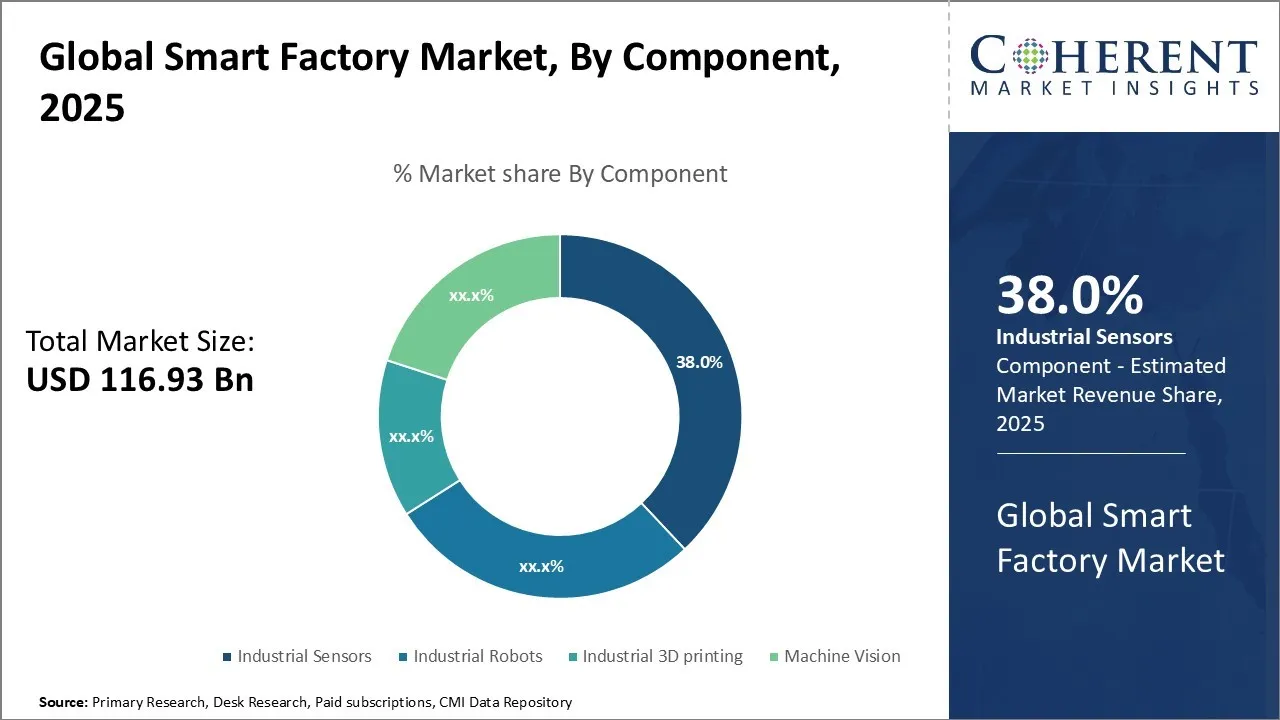
Smart Factory Market Insights, By Component - Industrial Sensors Acquires the largest share as it Provides Real-time Data Collection
In terms of component, the industrial sensors segment is expected to hold largest share of the global smart factory market in 2026, as they provide real-time data collection, monitoring, and automation critical pillars of Industry 4.0. Smart factories rely on continuous data streams from sensors to monitor parameters such as temperature, pressure, motion, humidity, vibration, and proximity. This enables instant decision-making, predictive maintenance, and automated responses to system variations. Sensors detect anomalies in machine behavior like overheating or unusual vibration which helps prevent equipment failure. This reduces downtime and maintenance costs by shifting from reactive to predictive maintenance models. Smart sensors help track energy consumption across machines and processes. This allows for optimization of operations and supports sustainability goals by identifying energy-wasting components.
In March 2025, Teledyne Technologies launched three new industrial CMOS image sensors, ranging from 1.3 MP to 67 MP, upscreened for space via delta qualification and radiation testing. These sensors are delivered as flight‑model USVs with full screening and certificates under U1 and U3 standards.
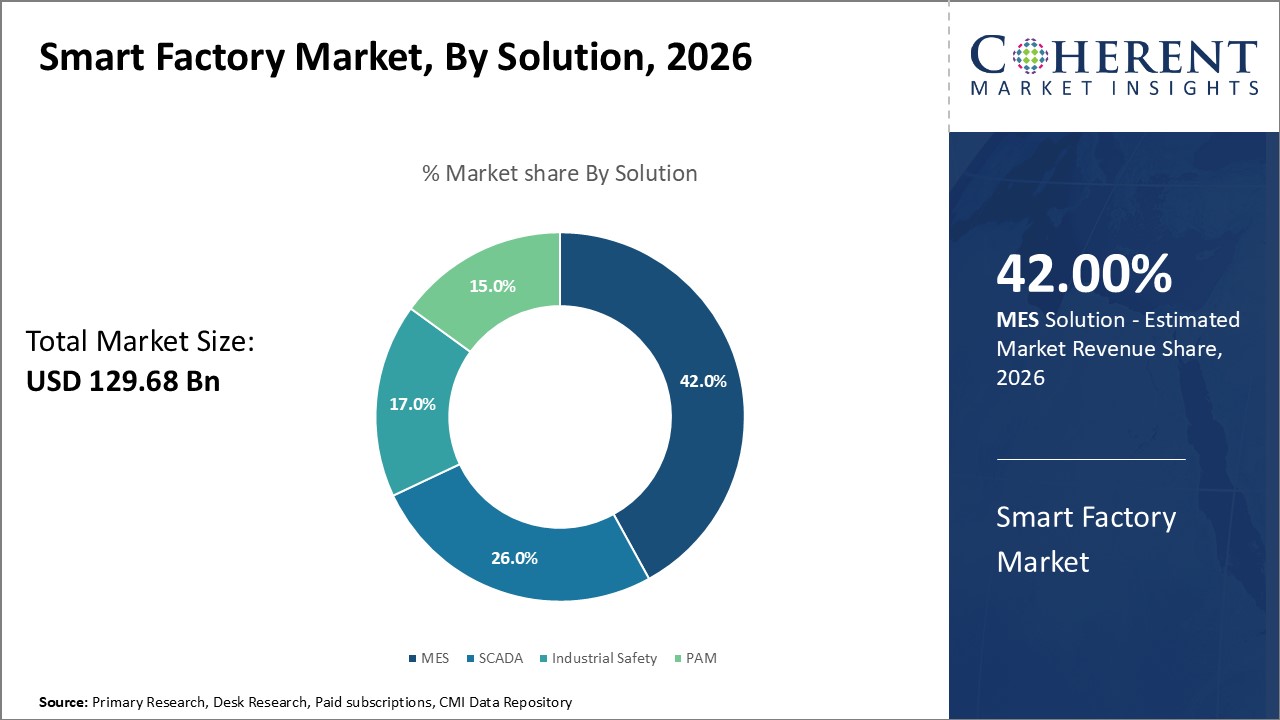
Smart Factory Market Insights, By Solution - MES Dominates the market Driven by Real-Time Production Monitoring
In terms of solution, the MES segment is projected to hold the highest share of the market in 2026. Manufacturing Execution Systems (MES) are in high demand within smart factories due to their central role in real-time production monitoring, operational efficiency, and integration across the digital manufacturing ecosystem.
MES provides live tracking of production processes, machine statuses, and material flows. This enables smart factories to respond instantly to disruptions or inefficiencies, improving uptime and throughput. MES acts as the digital bridge between shop floor equipment (via IoT/PLC systems) and enterprise-level software (ERP).
In February 2023, AVEVA launched its latest manufacturing execution system 2023, designed to significantly reduce the costs and complexities of multi‑site MES deployments. The new solution enables centralized deployment in corporate data centers while connecting automated processes and IIoT devices at each plant via lightweight edge computing.
Smart Factory Market Insights, By Manufacturing Verticals - Automation & transportation Dominates the market owing to growing Need for Automation and Operational Efficiency
In terms of manufacturing verticals, the automation and transportation segment are projected to account of the greatest market share in 2026, due to the need for automation, precision, and operational efficiency. As automotive manufacturers face increasing pressure to reduce production costs, shorten time-to-market, and improve product quality, especially with the rise of electric and autonomous vehicles, smart factory technologies offer a scalable solution.
In April 2026, Hyundai unveiled Metaplant America, a $7.6 billion electric and hybrid vehicle facility in Georgia, dubbed “America’s smartest factory,”. The sprawling 2,900‑acre site integrates cutting‑edge Industry 4.0 technologies, AI‑powered vision systems, autonomous robots, drones, and automated guided vehicles, operating over a dedicated private 5G network. The plant marks a milestone in combining advanced automation, private networking, and sustainable manufacturing.
Regional Insights
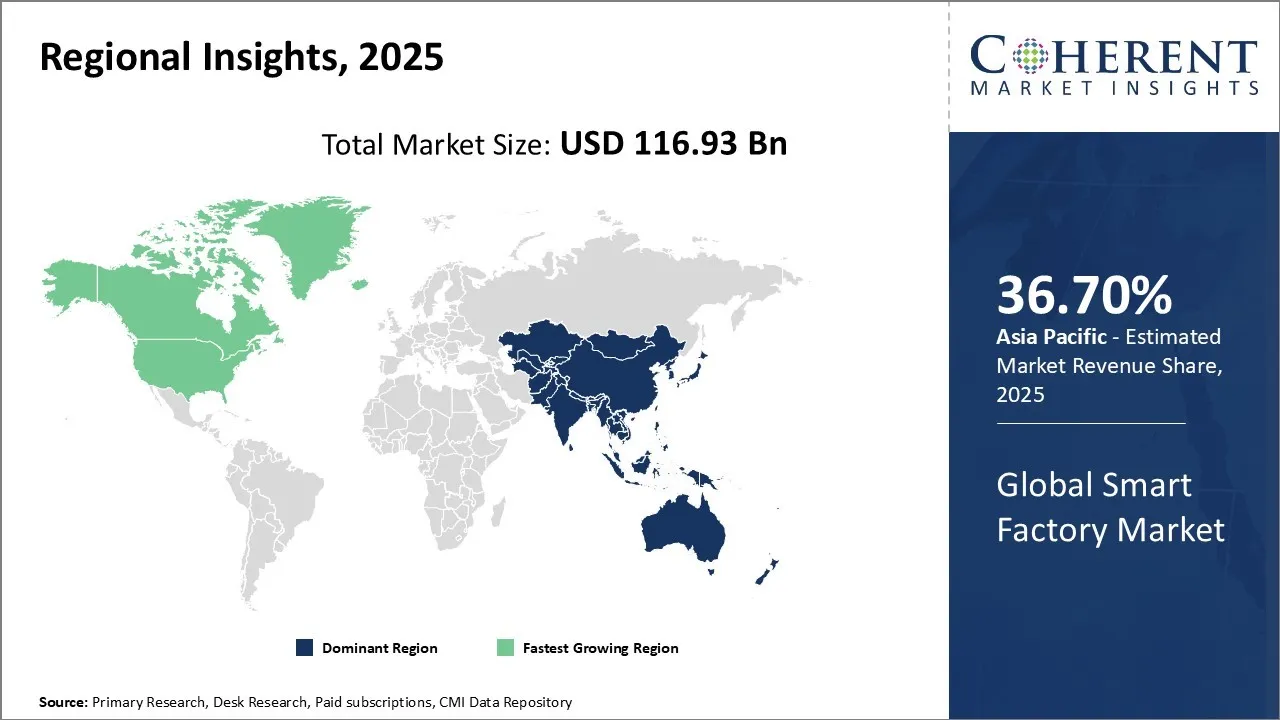
Asia Pacific Smart Factory Market Analysis & Trends
The Asia Pacific region is projected to lead the market with a 36.70% share in 2026, driven by its strong industrial foundation and proactive digital transformation strategies. Countries such as China, Japan, South Korea, and India are leading this growth, driven by national initiatives like “Made in China 2026” and “Digital India,” which promote automation and advanced manufacturing technologies. As labor costs rise, especially in China and South Korea, manufacturers are increasingly investing in smart solutions to remain competitive. The region's dominance in industries like automotive, electronics, and semiconductors further accelerates the adoption of intelligent production systems. Additionally, foreign direct investments and growing digitization among small and medium enterprises are fueling the shift toward connected, data-driven manufacturing. Collectively, these factors are positioning Asia Pacific as a global hub for smart factory innovation and implementation.
For instance, in June 2026, Chinese beauty brand Florasis opened a cutting-edge smart factory in Hangzhou, leveraging advanced automation and real-time data analytics to digitalize its entire production from raw material sourcing to packaging. The 6,480 m² facility integrates a proprietary “smart brain” system that employs AI-powered defect detection, robotic assembly, and continuous monitoring to enhance operational efficiency and product quality.
North America Smart Factory Market Analysis & Trends
North America region is expected to exhibit the fastest growth in the market during the forecast period. The region expansion is observed due to the region's early adoption of advanced manufacturing technologies, digital transformation strategies, and focus on improving industrial productivity. The U.S. and Canada are actively modernizing their manufacturing sectors with Industrial IoT, AI, robotics, and cloud-based platforms to stay globally competitive. Government initiatives such as “Made in America” and smart infrastructure investments are further incentivizing automation and factory modernization. Additionally, sectors like automotive, aerospace, and electronics in North America require high operational efficiency and precision, making smart factory solutions essential for scaling and reducing downtime. Rising labor costs and the need for energy-efficient operations are also pushing manufacturers toward automation and predictive maintenance tools.
For instance, at GM’s Factory Zero in Detroit, artificial intelligence and machine learning are used in real-time to optimize vehicle production, automate quality control, and minimize unplanned downtime by enabling predictive maintenance. This example illustrates how AI-driven smart factory technologies are transforming traditional automotive manufacturing into highly connected and adaptive systems.
Smart Factory Market Outlook Country-Wise
The U.S. Smart Factory Market Trends
The United States leads in smart factory adoption due to strong Industry 4.0 initiatives, reshoring efforts, and a skilled tech workforce. Key sectors like automotive (GM, Tesla), aerospace (Boeing), and electronics are investing heavily in automation, AI, and IoT to boost efficiency and resilience. Government incentives, such as the CHIPS and Science Act, further accelerate adoption, positioning the U.S. as a global leader in advanced manufacturing.
Germany Smart Factory Market Trends
Germany is a key driver of the smart factory market, being the originator of the industry 4.0 concept. Strong government backing and a tech-savvy manufacturing base have led to rapid adoption of IoT, automation, and AI across sectors. Leading automakers like Volkswagen and BMW, along with firms in industrial machinery and chemical processing (e.g., BASF, Bayer), are heavily investing in smart technologies to boost efficiency, flexibility, and sustainability. Germany’s advanced infrastructure and skilled workforce make it a major hub for smart factory innovation.
China Smart Factory Market Trends
China is a major driver of smart factory market demand due to government policies like "Made in China 2026", rising labor costs, and strong domestic robotics and AI capabilities. Key industries such as electronics, automotive, textiles, and consumer goods are rapidly adopting automation, IoT, and AI to enhance productivity and reduce costs. Cities like Shenzhen and Suzhou are emerging as smart manufacturing hubs. With strong government backing and a growing tech ecosystem, China is accelerating its shift toward intelligent, efficient manufacturing.
Market Report Scope
Smart Factory Market Report Coverage
| Report Coverage | Details | ||
|---|---|---|---|
| Base Year: | 2025 | Market Size in 2026: | USD 129.68 Bn |
| Historical Data for: | 2020 To 2024 | Forecast Period: | 2026 To 2033 |
| Forecast Period 2026 to 2033 CAGR: | 10.9% | 2033 Value Projection: | USD 267.53 Bn |
| Geographies covered: |
| ||
| Segments covered: |
| ||
| Companies covered: | Oracle Corporation, ABB Group, Atos SE, Rockwell Automation, Inc., Accenture PLC, General Electric Co., PTC Inc., Siemens AG, SAP SE, and IBM Corporation. | ||
| Growth Drivers: |
| ||
| Restraints & Challenges: |
| ||
Global Smart Factory Market Drivers
- Increased Efficiency and Productivity
Smart factories leverage automation, data analytics, and AI to optimize manufacturing processes, leading to increased efficiency and productivity. Automation reduces manual intervention, streamlines workflows, and minimizes production errors, resulting in higher output and improved overall performance. For instance, Siemens, a German multinational, which has pioneered smart factory implementations within its own operations and for clients across sectors. The integration of digital technologies in factories is a key driver of smart factory market growth, enabling real-time decision-making, predictive maintenance, and flexible production lines to meet dynamic market demands.
- Cost Reduction
Smart factories offer cost-saving benefits through various means, such as energy efficiency, predictive maintenance, and reduced labor costs. By implementing automation and advanced technologies, manufacturers can optimize resource utilization and minimize waste, leading to significant cost savings over time. Fanuc Corporation, one instance of Fanuc's success in achieving cost reduction through smart factory technologies can be seen in the automotive sector. Many automotive manufacturers have integrated Fanuc's robotic automation systems into their production lines to streamline operations and improve efficiency. These developments reflect growing sensitivity toward smart factory market price dynamics, as companies increasingly prioritize return on investment from intelligent automation.
Global Smart Factory Market Opportunities
- Adoption of Collaborative Robots (Cobots)
Collaborative robots, or cobots, are gaining significant traction in the smart factory market forecast due to their ability to work safely and efficiently alongside human workers. These robots offer increased safety, flexibility, and efficiency in manufacturing operations. The opportunity lies in the widespread adoption of cobots across industries, especially in smaller enterprises that can benefit from automation without significant infrastructure modifications. Universal Robots, a Danish robotics company, is a leading manufacturer of collaborative robotic arms. They specialize in producing cobots designed to work safely alongside human workers in various industries. Apart from this, in February 2025, Delta, a introduced D-Bot series Collaborative Robots (Cobots) in India. These 6-axis cobots, with payloads up to 30 kg and speeds of 200°/s, are designed to enhance efficiency in applications like electronics assembly, packaging, material handling, and welding.
Global Smart Factory Market Trends
- Connectivity and 5G Integration
The rise of 5G technology and its integration into industrial applications has been a major trend. The implementation of 5G connectivity enables real-time data exchange, low-latency communication, and seamless integration of IoT devices, supporting the development of more connected and intelligent smart factories. An example of 5G technology integration into industrial applications is the partnership between Ericsson and ABB. Ericsson, a leading telecommunications and networking company, collaborated with ABB, a multinational corporation specializing in industrial automation and robotics, to develop a smart factory solution that leverages 5G connectivity.
- Edge Computing for Real-Time Processing
Edge computing is gaining popularity in smart factories as it enables data processing and analysis closer to the data source, reducing latency and bandwidth requirements. By processing data at the edge of the network, smart factories can achieve faster decision-making, critical for real-time optimization and control of manufacturing processes. ABB Group is a global leader in industrial automation, robotics, and smart factory solutions. ABB's Ability Edge software suite is an example of how edge computing is used in smart factories. The Ability Edge suite is designed to process data at the edge of the network, closer to the data source, instead of sending all the data to a centralized cloud server for processing. This approach reduces latency and enables faster decision-making for real-time optimization and control of manufacturing processes.
Analyst Opinion (Expert Opinion)
The smart factory market value is no longer a speculative ambition; it is the operational benchmark toward which advanced manufacturing is converging.
A critical catalyst in this momentum is the convergence of AI/ML, edge computing, and digital twin architectures. Unlike isolated automation efforts of the past, smart factories now embody closed-loop, self-optimizing systems. For instance, Siemens’ Amberg facility in Germany, a benchmark for smart manufacturing reports a manufacturing defect rate of less than 0.001%, achieved through real-time data exchange across 50 million daily transactions between machines and systems.
However, the market is bifurcating. On one end, Tier 1 manufacturers (particularly in automotive, aerospace, and electronics) are moving aggressively toward autonomous operations. BMW’s Regensburg plant, equipped with AI-based quality control and flexible logistics robotics, showcases this shift with up to 30% faster throughput. On the other end, small-to-mid-size enterprises (SMEs), especially in emerging economies, are constrained by integration complexity and legacy infrastructure.
One overlooked trend that warrants strategic attention is the rise of plug-and-play interoperability. The OPC UA standard, for example, is becoming the de facto backbone for harmonizing industrial protocols, enabling real-time connectivity across heterogenous assets. Companies that still rely on vendor-locked or siloed systems will increasingly find themselves at a competitive disadvantage.
Cybersecurity is also not merely a support function, it’s a core enabler of the smart factory. With edge devices transmitting gigabytes of telemetry per hour, a single unsecured endpoint can paralyze operations. Recent attacks on JBS and Norsk Hydro illustrate that digital trust is now an operational imperative.
Speak to the analyst
Want personalized insights?
Take the findings above to one of our principal consultants, or have the report rebuilt around the segments, geographies and competitors you actually track.
Global Smart Factory Market Key Developments
- In April 2025, Atlas Copco Tools and Assembly Systems unveiled its inaugural Smart Factory Innovation Centre in India, located in Pune. The state-of-the-art hub showcases advanced Industry 4.0 solutions such as automated tightening and dispensing technologies, error-proofing systems, and software-driven smart integrated assembly is designed to deliver zero‑defect production and sustainable operations.
- In September 2024, Panasonic Smart Factory Solutions India (PSFSIN), a division of Panasonic Life Solutions India, unveiled its next-gen smart factory lineup at Productronica India. The showcase featured a fully operational mini production line with advanced SMT machines, the NPM‑GH, NPM‑GP/L, NPM‑D3A, NPM‑TT2, alongside inspection systems, PanaCIM MES, and semiconductor assembly tooling.
- In May 2024, Schneider Electric inaugurated a state‑of‑the‑art “smart factory” in Dunavecse, Hungary. Spanning 28,000 m² and employing around 500 staff, the plant Schneider’s 36th smart factory globally and Europe’s largest engineering‑to‑order (ETO) facility will produce medium‑ and low‑voltage switchgear tailored to customer specifications.
- In December 2023, Mitsubishi Electric India inaugurated a new ₹2,200 crore smart manufacturing plant in the Talegaon industrial area near Pune, Maharashtra. The state‑of‑the‑art facility spans 40,000 m² (with 15,400 m² initially built) and is dedicated to producing cutting‑edge factory automation systems including inverters and robotics for sectors such as automotive, textiles, and food & beverage.
Market Segmentation
- Global Smart Factory Market, By Component (Revenue, USD Bn, 2021 - 2033)
- Industrial Sensors
- Industrial Robots
- Industrial 3D Printing
- Machine Vision
- Global Smart Factory Market, By Solution (Revenue, USD Bn, 2021 - 2033)
- SCADA
- MES
- Industrial Safety
- PAM
- Global Smart Factory Market, By Manufacturing Verticals (Revenue, USD Bn, 2021 - 2033)
- Automobile & Transportation
- Food & Beverages
- Electrical & Electronics
- Aerospace & Defense
- Oil & Gas
- Garment & Textile
- Chemical & Material
- Others (healthcare & pharmaceuticals)
- Global Smart Factory Market, By Region (Revenue, USD Bn, 2021 - 2033)
- North America
- U.S.
- Canada
- Latin America
- Brazil
- Argentina
- Mexico
- Rest of Latin America
- Europe
- Germany
- U.K.
- Spain
- France
- Italy
- Russia
- Rest of Europe
- Asia Pacific
- China
- India
- Japan
- Australia
- South Korea
- ASEAN
- Rest of Asia Pacific
- Middle East
- GCC Countries
- Israel
- Rest of Middle East
- Africa
- South Africa
- North Africa
- Central Africa
- North America
- Global Smart Factory Market Key Companies Insights (Revenue, USD Bn, 2021 - 2033)
- Oracle Corporation
- ABB Group
- Atos SE
- Rockwell Automation, Inc.
- Accenture PLC
- General Electric Co.
- PTC Inc.
- Siemens AG
- SAP SE
- IBM Corporation
Sources
Primary Research Interviews from the following stakeholders
Stakeholders
- Interviews with plant automation heads, industrial IoT engineers, factory IT managers, production line supervisors, operations analysts, and manufacturing innovation heads across key global manufacturing sectors.
Specific Stakeholders
- Smart manufacturing leads at automotive OEMs
- Factory IT infrastructure managers at electronics manufacturers
- Process automation engineers in chemical and pharmaceutical firms
- Industry 4.0 integration managers in F&B companies
- MES (Manufacturing Execution Systems) and SCADA solution owners in heavy industry plants
- Heads of smart factory labs at academic or innovation centers
- Factory digitalization consultants embedded within large OEM environments
- Industrial cybersecurity leads responsible for CPS and IoT device protection
Databases
- UNIDO Industrial Statistics Database
- OECD Structural and Demographic Business Statistics (SDBS)
- World Bank Manufacturing Value Added Statistics
- EUROSTAT – High-tech Industry and Knowledge-intensive Services
- U.S. Bureau of Labor Statistics (BLS) – Manufacturing Productivity Data
- China National Bureau of Statistics – Smart Manufacturing Indicators
- Japan METI – Industrial Technology Survey
- Korea Industrial Complex Corporation – Smart Factory Promotion Data
- German Federal Statistical Office – Industrial Innovation Reports
Magazines
- Industry Week
- Automation World
- Control Engineering
- Manufacturing Global
- Plant Services
- Smart Industry Magazine
- Design World – Industrial Automation section
- Future Factory Digest
Journals
- Journal of Manufacturing Systems (Elsevier)
- IEEE Transactions on Industrial Informatics
- CIRP Annals – Manufacturing Technology
- Robotics and Computer-Integrated Manufacturing
- Journal of Intelligent Manufacturing
- International Journal of Production Research
- Procedia CIRP – Smart Factory Papers
- IFAC-PapersOnLine (Smart Manufacturing and Control Systems)
Newspapers
- The Wall Street Journal – Industry & Technology
- Financial Times – Advanced Manufacturing Insights
- The Hindu Business Line – Automation & Industry 4.0
- Nikkei Asia – Smart Manufacturing and Robotics
- South China Morning Post – Manufacturing & Industrial IoT
- Economic Times – Smart Industry Reports
- Business Standard – Manufacturing Policy Coverage
Associations
- Industrial Internet Consortium (IIC)
- International Society of Automation (ISA)
- OPC Foundation
- European Factories of the Future Research Association (EFFRA)
- Manufacturing Enterprise Solutions Association (MESA International)
- IEEE Industrial Electronics Society
- Japan Smart Factory Association (JSFA)
- Smart Factory Standards Committee (ISO/IEC JTC 1)
- Confederation of Indian Industry (CII) – Manufacturing Excellence Panel
Public Domain Sources
- U.S. National Institute of Standards and Technology (NIST) – Cyber-Physical Systems Program
- European Commission – Smart Specialisation Platform (S3 Industrial Modernisation)
- Ministry of Industry and Information Technology (MIIT), China
- Germany’s Federal Ministry for Economic Affairs and Climate Action – Industrie 4.0 initiatives
- India’s Department for Promotion of Industry and Internal Trade (DPIIT)
- Japan’s Ministry of Economy, Trade and Industry (METI)
- India Smart Factory Portal – Ministry of Heavy Industries
- Reserve Bank of India (RBI) – Technology Investment Reports
- U.S. Department of Commerce – Manufacturing USA network initiatives
Proprietary Elements
- CMI Data Analytics Tool, Proprietary CMI Existing Repository of information for last 8 years
*Definition: The Global Smart Factory Market refers to the market segment focused on the integration of advanced technologies, automation, data exchange, and artificial intelligence (AI) in manufacturing processes. Smart factories, also known as Industry 4.0 or digital factories, are characterized by their ability to leverage cutting-edge technologies to optimize production, improve efficiency, and enhance overall manufacturing operations.
Get access to 250+ pages report
Every segment, forecast, competitor profile and data table behind the analysis above — available for instant download.
- ESOMAR Member
- ISO 9001:2015 Certified
- D-U-N-S Registered
- GDPR & CCPA Compliant
Missing comfort of reading report in your local language? Find your preferred language:
Transform your Strategy with Exclusive Trending Reports
Frequently Asked Questions
The Smart Factory Market is estimated to be valued at USD 129.68 Bn in 2026, and is expected to reach USD 267.53 Bn by 2033.
The CAGR of the Smart Factory Market is projected to be 10.9% from 2026 to 2033.
Increased Efficiency and Productivity and Cost Reduction are the key factors driving growth of the market.
High Initial Investment Costs and Data Privacy and Cyber security Concerns are the major factors restraining growth of the market.
Key players operating in the market are Oracle Corporation, ABB Group, Atos SE, Rockwell Automation, Inc., Accenture PLC, General Electric Co., PTC Inc., Siemens AG, SAP SE, and IBM Corporation.
Typically takes 2–5 years, depending on existing infrastructure, digital maturity, workforce training, and technology investment levels.
Machine Learning algorithms optimize production, predict failures, improve quality, and enable adaptive control across connected factory systems.