

Digital Commerce Platform Market Analysis & Forecast: 2026-2033
Digital Commerce Platform Market size is estimated to be valued at USD 13.20 Bn in 2026 and is expected to reach USD 26.56 Bn in 2033, exhibiting a compound annual growth rate (CAGR) of 10.5% from 2026 to 2033.
Key Takeaways
- By Deployment Model, Cloud-based platforms are expected to hold over 65% market share by 2026, owing to scalability, cost-efficiency, and ease of integration.
- By Geography, North America is projected to lead the digital commerce platform market forecast with a 38% share in 2026, driven by its advanced digital infrastructure and early adoption of emerging technologies.
Market Overview
The digital commerce platform market demand is rapidly expanding, driven by increasing online shopping, mobile commerce, and the shift towards omnichannel retailing. Cloud-based solutions dominate due to their scalability and cost efficiency, while B2C remains the largest business model segment. Key verticals like retail, healthcare, and BFSI are adopting these platforms to enhance customer engagement and streamline operations. North America leads the market, followed by strong growth in Asia Pacific and Europe. Emerging regions such as the Middle East & Africa and Latin America are showing steady adoption fueled by rising internet penetration and digital payment infrastructure improvements.
Current Events and Its Impact on the Digital Commerce Platform Market
Event | Description and Impact |
Global AI Revolution and Platform Integration |
|
Economic Uncertainty and Consumer Behavior Shifts |
|
Regulatory Transformation and Data Privacy Revolution |
|
Pricing Analysis: Digital Commerce Platform Market
The pricing landscape for digital commerce platforms varies depending on deployment model, enterprise size, and feature set. In 2022, initial license or subscription fees for on-premise enterprise-grade Digital Commerce Platforms typically started at US $15,550/year, while full cloud-based or SaaS solutions ranged from US $29–299/month for SMB plans to over US $2,300/month for enterprise-grade services like Shopify Plus.
In 2023, mid-tier SaaS plans (e.g., Adobe Commerce, BigCommerce) were priced around US $79–$150/month, with custom enterprise and managed solutions averaging US $1,500–$3,000/month, driven by advanced integrations and AI capabilities.
By early 2025, the mainstream commercial subscription tiers stabilized at around US $99/month in North America, ~US $70–90/month in Europe, and ~US $60/month in Asia Pacific. However, the digital commerce platform market for CRM integration continues to see high demand for custom on-premise and fully-managed solutions, which often command a premium of US $20,000–50,000/year, especially in large-scale enterprise deployments.
- Current Industry Events of 2026
- Market Size Estimation
- Regional Breakdown
- Competitive Landscape
- Customer Intelligence
- Segmental Analysis
- Pricing Analysis
- Key Market Drivers, Challenges & Future Trends
- Customized Insights Section
Role of Artificial Intelligence (AI) and Automation in the Digital Commerce Platform Market
AI and automation are transforming digital commerce by boosting personalization, efficiency, and operational agility. Generative AI models now auto-generate product descriptions, email content, and chat responses—e.g., Shopify’s “Magic” tools rolled out in early 2025 to automate merchandising and customer service.
Predictive analytics enhance inventory optimization and dynamic pricing: platforms integrating Microsoft Fabric and Sitecore OrderCloud saw forecasting accuracy improve by ~95% and pricing conversions by ~10% through AI-powered adjustments. Computer vision and NLP-powered chatbots are driving customer engagement at scale—Mastercard’s AI-driven fraud detection flagged 300% more anomalies, and retailers like Amazon deployed NLP chatbots in mid-2023 to streamline service.
Across supply chains, AI supports digital-twin modeling and real-time logistics—Spryker-led initiatives use AI-assisted forecasting and supply chain management to reduce stockouts by 28%.
Segmental Insights
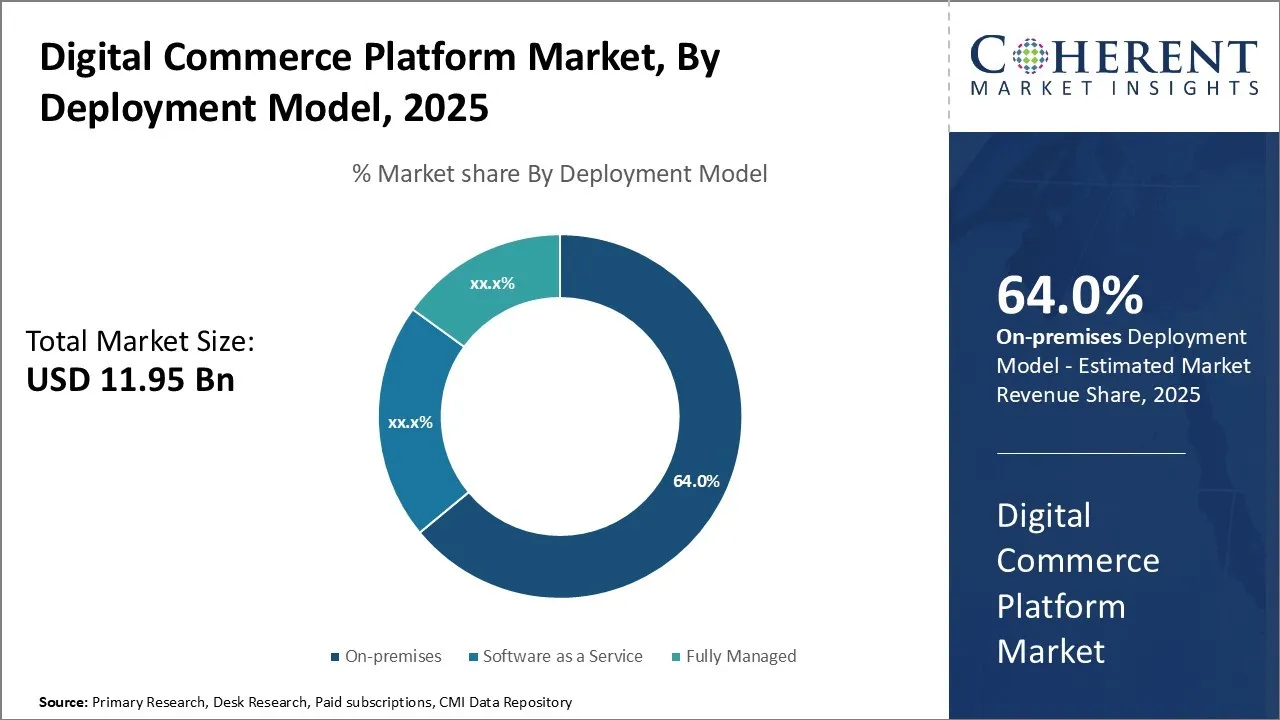
Global Digital Commerce Platform Market Insights, By Deployment Type
Based on the deployment type, the cloud based segment in the global digital commerce platform market held a dominant position in 2022. The on-premises digital commerce platform refers to the solutions that are installed locally on the company’s hardware systems and supported by the IT infrastructure of the company.
This segment typically involves huge upfront investments to purchase the infrastructure including the servers and related facilities that are essential to maintain the digital platform. Due, to the increasing inclination of organizations to offer digital commerce services to stay updated with the changing market trends and boost the revenue, the segment is expected to hold a dominant position as compared to other deployment types.
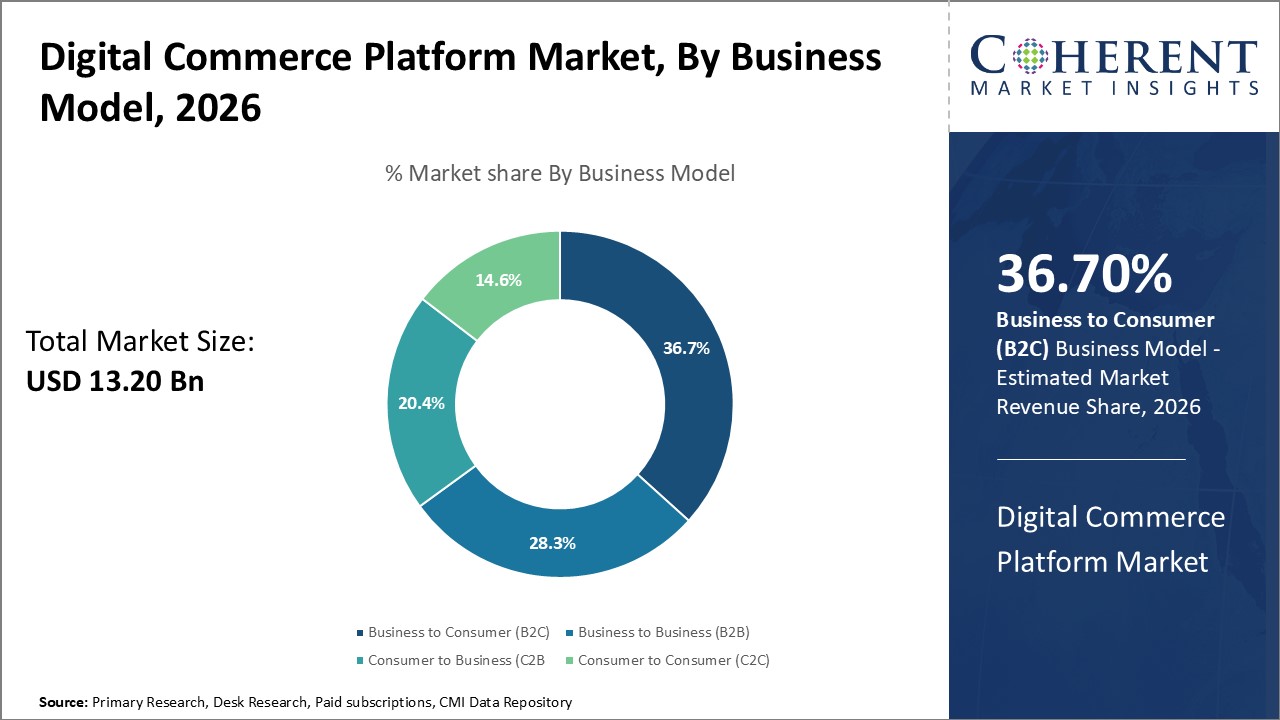
Global Digital Commerce Platform Market Insights, By Business Model
Based on business model, the Business to Consumer (B2C) segment in the global digital commerce platform market held the dominant position in 2026. The B2C segment is characterized with a rapid increase in the customer base. The number of digital commerce transactions in the B2C segment has witnessed an astounding growth in the past few decades.
Individual customers are showing increasing inclination towards the adoption of e-commerce platforms as the service is evolving and incorporating aspects that provide greater convenience to the users in terms of cash on delivery, online payment models, discounts and offers, and better customer service policies. Due to these factors, the B2C segment is expected to retain its dominant position in the global digital commerce platform market during the forecast period.
Regional Insights
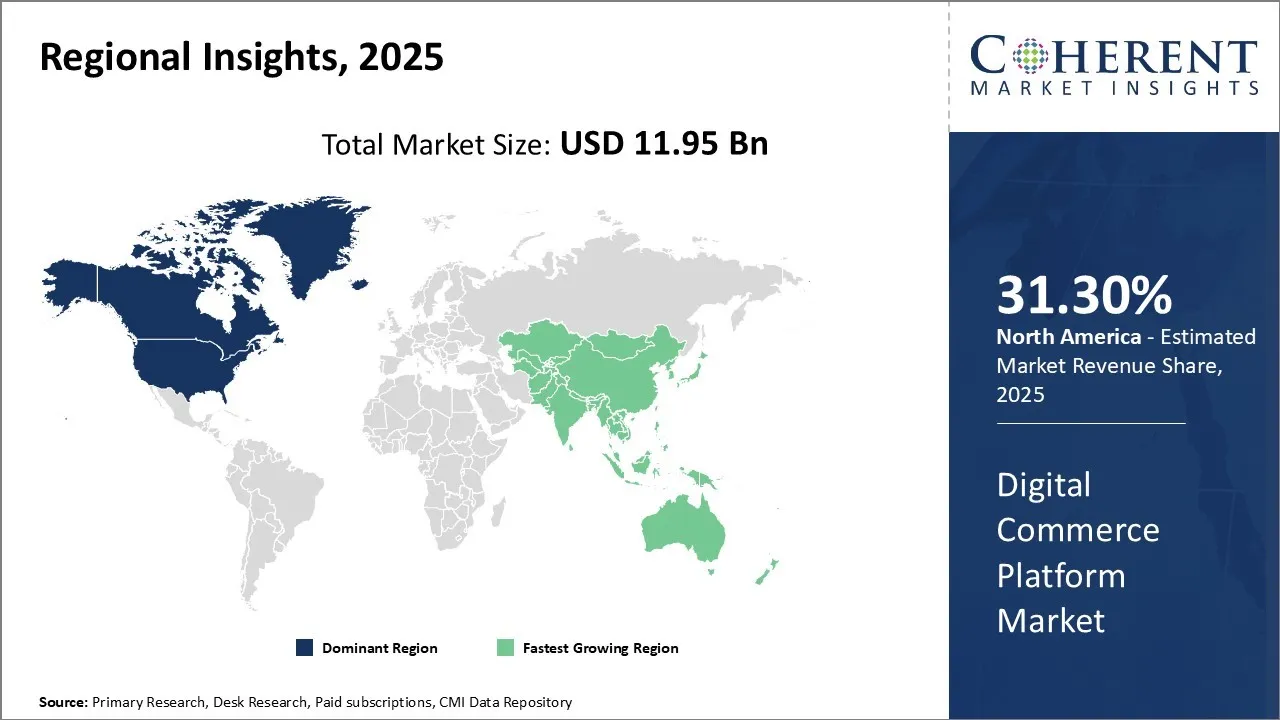
North America Digital Commerce Platform Market Analysis and Trends
North America held a dominant position in the global digital commerce platform market in 2026, owing to factors like robust internet infrastructure, high number of smartphone users, and high per capita income in the region, thus driving the growth of the North America digital commerce platform market. The population in countries like the U.S. and Canada have shown a high degree of adoption of digital commerce platforms.
The region has a presence of huge global corporations operating in the digital commerce platform market as well as domestic merchants make use of the technology on the regional level by selling goods online in the specific geographic region they operate in. These factors have significantly shaped the digital commerce platform market outlook, reinforcing North America's dominant position in the global landscape.
Asia Pacific Digital Commerce Platform Market Analysis and Trends
Asia Pacific is the most rapidly growing market in the global digital commerce platform market. The factors including high population in countries like India and China, the rapidly expanding technological infrastructure, and growing internet penetration are expanding the digital commerce platform market value.
The rise of digital payments infrastructure has provided an easy and efficient option for carrying out digital commerce transactions, which has further resulted in the increased adoption of these services in the Asia Pacific region. These factors are expected to boost the growth of the global digital commerce platform market in the Asia Pacific region during the forecast period.
Dominating Countries
- United States is expected to dominate the North American segment with a 65.6% market share in 2026, driven by mature infrastructure, widespread AI-enabled personalization, omnichannel strategies, and subscription-based commerce models.
- India is projected to witness robust growth, with a CAGR of 20.8% from 2026 to 2035, spearheaded by mobile-first platforms, government-backed digital initiatives (such as Digital India and UPI), and a boom in social and live-commerce channels.
Global Digital Commerce Platform Market Drivers
- Growing adoption of digital commerce platforms by commercial users
Enterprises are investing in innovative digital business models as a result of the growing demand for digital commerce, which will improve consumer experience. Companies are taking advantage of social media platforms to learn more about their customers and better serve them by identifying their customers' satisfaction and dissatisfaction levels. The accessibility and visibility of the consumer experience has changed due to digital commerce.
For instance, according to data from IBEF, a trust established by the Department of Commerce, Government of India, on July 4, 2023, India Post and Canada Post, the government operated postal service companies in India and Canada respectively, have partnered together to develop an online portal for the e-commerce companies to effective track the packages.
This shows that the adoption of various services related to e-commerce is increasing among public corporations as well as private companies. This is expected to boost the market growth of the global digital commerce platform market during the forecast period.
- Increasing demand for cloud services
Cloud service has greatly developed over the years, and as a result, it currently offers significant savings to its users by reducing the overall cost incurred by the organizations due to improved efficiency. As a result, numerous suppliers have begun to provide cloud services to clients. Large organizations are gaining from this trend, thus in recent years, sectors like e-mail marketing service providers (iContact, Mailchimp), CRM (salesforce.com), support (Zendesk), and customer engagement (Hybris, Marketo) have almost entirely shifted to the cloud.
Furthermore, the emergence of hybrid clouds has elevated cloud services to the status of a cutting-edge technology. A cloud computing infrastructure known as a hybrid cloud combines private cloud, on-premises cloud, and public cloud services.
For instance, according a blog published on January 31, 2023 by Appinventiv, a global software development company, the adoption of cloud services in the e-commerce industry has a shown a significant growing trend pertaining to benefits like scalability, increased speed of activities, and cost optimization. This is expected to expand the global digital commerce platform market during the forecast period.
Global Digital Commerce Platform Market Opportunity
- Growing demand for universal purchasing platform to present lucrative growth opportunities
Digital commerce platforms provide users the access to virtual marketplace. This virtual market place is an abstract phenomenon referring to the market place over the internet. This virtual marketplace is away from the limitations of the traditional marketplace with respect to limited space and offerings. The concept of universal purchasing refers to the platform where a variety of commodities are available for buying and selling online. This concept allows users to satisfy their varied demands with one solution.
For instance, according to a research report published on European Payment Institutions Federation, an international non-profit association established to monitor the adoption of Payment Service Directive (PSD), points out the factors that are leading to the growing demand for universal e-commerce platforms which include virtual wallet and universal account management. This increased demand for universal purchasing platform would provide an opportunity for the global digital commerce platform to grow during the forecast period.
Global Digital Commerce Platform Market Trends
- Digital commerce personalization tool
Currently, the majority of businesses place a strong priority on client happiness, which involves offering fresh, unique experiences. The self-service, co-creation, and personalization important strategic developments all describe the present digital customer. In light of these trends, Infosys digital commerce delivers end-to-end capabilities that eliminate the need for middlemen in transaction processing, warehousing, inventory management, and channels.
A complete set of digital commerce personalization solutions, including automatic behavioral warnings, product recommendations for email and the web, behavioral ranking, and actions that boost conversions and average order value, are also available through Episerver's intelligent personalization platform.
For instance, In July 2023, E-bay, a global e-commerce company, announced the integration of new AI tools on its platform to provide personalized suggestions to the users based on the data related to the in-app activity. This would provide a better way for the digital commerce platform companies to target their users in an efficient manner.
- Integration of digital commerce platform with other technologies
An integrated digital platform interacts with other related systems such as enterprise resource planning (ERP), logistics and order fulfillment systems. This platform was created to cater to all the requirements in one platform. Furthermore, functionalities such as newsletters and marketing strategies were considered to be outside the purview of the platform.
However, integrating it with other technologies has incorporated these systems into the digital commerce platforms. For instance, Elastic Path’s digital commerce platforms are often used for enterprise-wide capabilities and provide various fulfillment, licensing inventory, and post-transaction support. Elastic Path commerce integration platforms are also used to generate unified business APIs that power these applications in real-time.
For instance, on July 25, 2023, QAD, an India based provider of cloud-based enterprise resource software, announced the launch of its new solution for e-commerce industry named ‘ QAD Digital Commerce’. The new software is an ERP (Enterprise Resource Planning) solution for the companies providing digital commerce services to manage all the resources of an organization effectively.
Market Report Scope
Digital Commerce Platform Market Report Coverage
| Report Coverage | Details | ||
|---|---|---|---|
| Base Year: | 2025 | Market Size in 2026: | USD 13.20 Bn |
| Historical Data for: | 2020 To 2024 | Forecast Period: | 2026 To 2033 |
| Forecast Period 2026 to 2033 CAGR: | 10.5% | 2033 Value Projection: | 26.56% |
| Geographies covered: |
| ||
| Segments covered: |
| ||
| Companies covered: | Magento, Inc., Elastic Path Software Inc., IBM Corporation, NetSuite Inc., Oracle Corporation, Apttus Corporation, Adobe, Inc., Hybris AG, CloudCraze Software LLC, Demandware, Inc., Salesforce.com, Inc., and Digital River, Inc. | ||
| Growth Drivers: |
| ||
| Restraints & Challenges: |
| ||
Global Digital Commerce Platform Market- Recent Developments
- On May 3, 2023, Oracle, a global technology corporation, announced a collaboration with Steeda Autosports, a partner of Ford Motor Company, a global automobile manufacturer. The new digital commerce platform designed by Oracle NetSuite, Steeda will be able to have access to the real-time, consolidated view across inventory, order management, point-of-sale, and e-commerce processes.
- On June 29, 2023, Salesforce, a U.S.-based software company, announced a partnership with Deloitte, a U.K.-based multinational professional service provider, to deploy trusted Artificial Intelligence (AI) program for Customer Relationship Management (CRM)-related activities in serving the customers using their digital commerce platform.
- On May 11, 2023, Indian Government, announced the expansion of ONDC, a private non-profit digital commerce services providing company, to serve 236 new cities in India. This expansion would lead to the addition of 36,000 new merchants on the platform.
- On July 1, 2023, The Indian Government announced the collaboration with Google LLC, a global technology company, to develop google cloud powered digital commerce app for the co-operative organizations. The application was launched at the 17th Indian Co-operative Congress (ICC) in New Delhi.
Analyst Viewpoint
- The global digital commerce platform market is experiencing robust growth, driven by the rapid expansion of online retail, increasing mobile commerce penetration, and rising demand for personalized shopping experiences. Key players are leveraging AI, cloud infrastructure, and data analytics to deliver more agile and scalable e-commerce solutions.
- Opportunities are emerging in cloud-based deployment models, particularly among small and mid-sized businesses seeking cost-effective, low-maintenance platforms. The integration of omnichannel retail capabilities and real-time customer insights is further accelerating adoption across sectors such as retail, BFSI, and healthcare.
- However, the market faces challenges including cybersecurity risks, data privacy regulations, and the complexity of integrating new platforms with legacy enterprise systems. Additionally, digital infrastructure gaps in certain developing regions may limit adoption among small retailers.
- North America is expected to maintain its lead, supported by high digital maturity, advanced payment infrastructure, and early AI adoption. Meanwhile, Asia Pacific is anticipated to witness the fastest growth due to surging internet access, growing consumer e-commerce activity, and supportive government digitalization initiatives.
Market Segmentation
- Global Digital Commerce Platform Market, By Business Model (Revenue, USD Bn, 2021 - 2033)
- Business to Consumer (B2C)
- Business to Business (B2B)
- Consumer to Business (C2B)
- Consumer to Consumer (C2C)
- Global Digital Commerce Platform Market, By Deployment Type (Revenue, USD Bn, 2021 - 2033)
- On-premise
- Software as a Service
- Fully Managed
- Global Digital Commerce Platform Market, By Verticals (Revenue, USD Bn, 2021 - 2033)
- BFSI
- Retail
- Communication
- Airline + Travel
- Others
- Global Digital Commerce Platform Market, By Region (Revenue, USD Bn, 2021 - 2033)
- North America
- U.S.
- Canada
- Europe
- Germany
- U.K.
- France
- Italy
- Spain
- Russia
- Rest of Europe
- Asia Pacific
- China
- India
- Japan
- Australia
- South Korea
- ASEAN
- Rest of Asia Pacific
- Latin America
- Brazil
- Mexico
- Rest of Latin America
- Middle East & Africa
- GCC Countries
- South Africa
- Rest of Middle East & Africa
- North America
- Company Profiles
- Magento, Inc.
- Elastic Path Software Inc.
- IBM Corporation
- NetSuite Inc.
- Oracle Corporation
- Apttus Corporation
- Adobe, Inc.
- Hybris AG
- Cloud Craze Software LLC
- Demandware, Inc.
- Salesforce.com
- Digital River, Inc.
Source
Primary Research Interviews
- E-commerce Platform Executives
- Digital Commerce Solution Providers
- Enterprise IT Decision Makers
- Online Retail Business Owners
- Others
Databases
- Euromonitor International
- IBISWorld
- Bloomberg Terminal
- Others
Magazines
- Digital Commerce 360
- Internet Retailer Magazine
- E-commerce Times
- Retail TouchPoints
- Others
Journals
- Journal of Electronic Commerce Research
- International Journal of Electronic Commerce
- Electronic Commerce Research and Applications
- Others
Newspapers
- The Wall Street Journal
- Financial Times
- TechCrunch
- Reuters
- Others
Associations
- Digital Commerce Federation
- National Retail Federation (NRF)
- E-commerce Europe
- Internet Retailer Conference & Exhibition (IRCE)
- Others
Public Domain Sources
- U.S. Census Bureau E-commerce Statistics
- European Commission Digital Economy Reports
- World Trade Organization E-commerce Statistics
- OECD Digital Economy Outlook
- Others
Proprietary Elements
- CMI Data Analytics Tool
- Proprietary CMI Existing Repository of information for last 8 years
*Definition: Digital commerce platform refers to the buying and selling of goods or transmission of funds or data over the internet. These transactions are classified on the basis of the parties involved in the transaction such as, Business to Business (B2B), Business to Consumer (B2C), and Consumer to Business (C2B). Digital commerce provides a virtual marketplace for the customers to browse through vast inventories of goods and carry out the purchasing activities without visiting the physical market.
Get access to 250+ pages report
Every segment, forecast, competitor profile and data table behind the analysis above — available for instant download.
- ESOMAR Member
- ISO 9001:2015 Certified
- D-U-N-S Registered
- GDPR & CCPA Compliant
Missing comfort of reading report in your local language? Find your preferred language:
Transform your Strategy with Exclusive Trending Reports
Frequently Asked Questions
The Digital Commerce Platform Market size is estimated to be valued at USD 13.20 Bn in 2026, and is expected to reach USD 26.56 Bn by 2033.
The Global market is estimated to surpass USD 26.56 Bn by 2033.
The B2C segment held the dominant position in the market in 2026 and is expected to retain its dominance throughout the forecast period.
Growing adoption of digital commerce platforms by the commercial users such as traders and merchants.
The CAGR of the Digital Commerce Platform Market is projected to be 10.5% from 2026 to 2033.
Essential features for a seamless checkout experience include a fast, mobile-friendly interface, multiple secure payment options, guest checkout, auto-filled forms, and clear progress indicators.