

Global Home Shopping Market Size and Share Analysis: (2026 - 2033)
The Home-Shopping Market is anticipated to grow at a CAGR of 17.5% with USD 7,686.0 Bn share in 2026 and is expected to reach USD 22,957.49 Bn in 2033. The home shopping market is shifting from TV-led ordering to omnichannel digital purchasing, supported by stronger e-commerce penetration, mobile access, and consumer spending resilience. For instance, in March 2026, the U.S. Census Bureau’s Quarterly Retail E-Commerce Sales Report, stated that e-commerce represented 16.4% of total U.S. retail sales in 2025. The U.K. ONS, published in April 2026, reported internet sales at 27.9% of total retail sales in March 2026. Eurostat’s Digitalisation in Europe report, published in 2026, stated that 78% of EU people bought or ordered online in 2025, reinforcing cross-border, home-based retail adoption across mature and emerging digital retail channels.
Source: U.S. Department of Commerce; ons.gov.uk
Key Takeaways
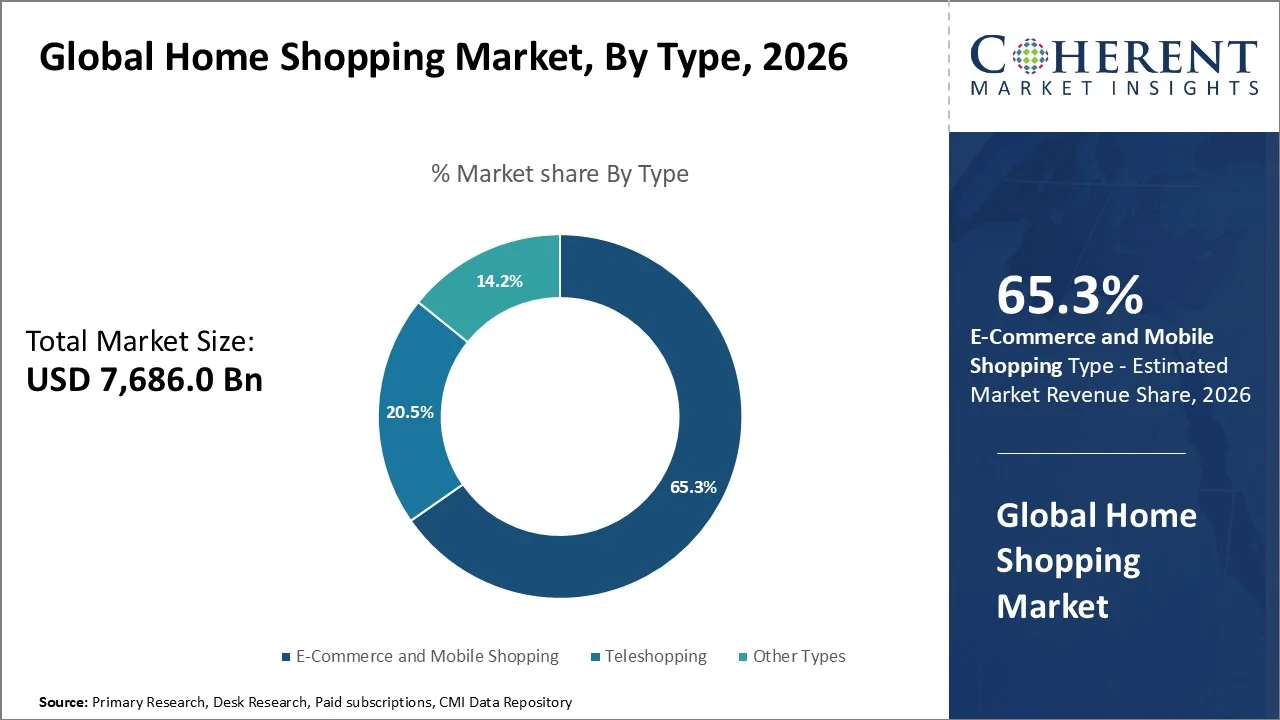
- E-Commerce and Mobile Shopping is expected to account the largest share of 65.3% in 2026, driven by widespread smartphone adoption, faster internet, and convenience of anytime, anywhere purchases. The U.S. Census Bureau’s Quarterly Retail E-Commerce Sales Report, published in March 2026, highlighted that mobile devices accounted for over 45% of online retail orders in 2025. Similarly, the GSMA Mobile Economy Report 2026 noted that 82% of global internet users accessed retail platforms via mobile devices, reinforcing digital-first consumer behavior and driving the shift from traditional TV-based home shopping channels.
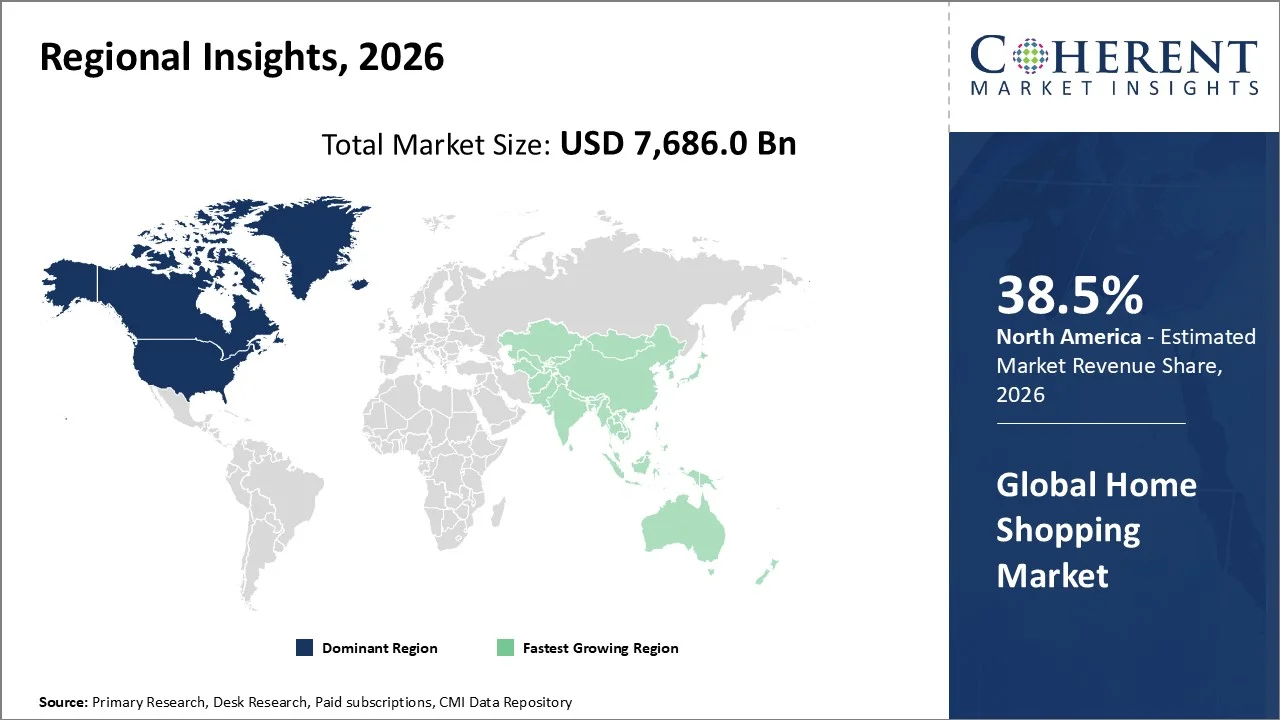
- North America is expected to acquire the dominant share of 38.5% in 2026, due to advanced digital infrastructure, high smartphone penetration, and strong consumer spending habits. For instance, in March 2026, the U.S. Census Bureau’s Quarterly Retail E-Commerce Sales Report, indicated that U.S. e-commerce accounted for 16.4% of total retail sales in 2025. Additionally, the Federal Reserve FRED data, updated in January 2026, highlighted robust personal consumption expenditures on online and mobile retail, reinforcing North America’s dominance in digital home shopping adoption.
Segmental Insights
Why is E-Commerce and Mobile Shopping Acquiring the Largest Market Share?
E-Commerce and Mobile Shopping is projected to account for the largest share of cognitive systems spending in 2026, representing approximately 65.3% of the total volume. The e-commerce and mobile shopping segment have emerged as the dominant force in the home shopping market due to widespread smartphone adoption, high-speed internet penetration, and the convenience of anytime, anywhere purchasing. For instance, in March 2026, the U.S. Census Bureau’s Quarterly Retail E-Commerce Sales Report, noted that mobile devices accounted for over 45% of U.S. online retail orders in 2025, reflecting the shift toward mobile-first shopping behavior. Globally, the GSMA Mobile Economy Report 2026 highlighted that 82% of internet users accessed retail platforms via mobile devices, driving higher engagement and purchase frequency. Additionally, robust digital infrastructure and secure payment systems promoted by governments and private platforms, as reported in the European Commission’s Digital Economy and Society policy documents (2026), increased consumer trust in e-commerce. Companies like Amazon and Walmart have leveraged AI-driven recommendations and app-based experiences to enhance personalization and streamline transactions, solidifying the e-commerce and mobile segment as the primary channel in home shopping.
Source: Census.gov; gsma.com; European Commission
- Current Industry Events of 2026
- Market Size Estimation
- Regional Breakdown
- Competitive Landscape
- Customer Intelligence
- Segmental Analysis
- Pricing Analysis
- Key Market Drivers, Challenges & Future Trends
- Customized Insights Section
Increasing penetration of internet
Increasing penetration of internet has created significant opportunities for the global home shopping market expansion over the forecast period. Increasing internet penetration expands access to online shopping platforms, making home shopping more convenient and accessible. For instance, according to Eurostat’s 2026 report on Digitalisation in Europe, 89% of EU households had internet access in 2025, enabling wider adoption of e-commerce. Similarly, the U.S. Census Bureau’s Quarterly Retail E-Commerce Sales Report, published in March 2026, noted that enhanced broadband availability supported rising online order volumes, driving growth in digital and mobile home shopping channels.
Source: U.S. Department of Commerce
Growing government initiatives to promote e-commerce sector
Growing government initiatives to promote the e-commerce sector are significantly driving the expansion of the home shopping market by improving regulatory frameworks, digital infrastructure, and consumer trust in online transactions. For instance, in March 2026, in the U.S., the Department of Commerce and the U.S. Census Bureau’s Quarterly Retail E-Commerce Sales Report, highlighted federal support for small and medium enterprises to adopt online retail technologies, boosting participation in digital home shopping. In India, the Department for Promotion of Industry and Internal Trade’s e-commerce policy updates, released in 2026, emphasized streamlined cross-border trade, secure payment systems, and tax simplification, encouraging domestic and foreign e-retailers to expand online home shopping offerings. Similarly, the European Commission’s Digital Economy and Society policy documents, published in 2026, focused on harmonizing digital regulations and improving consumer data protection, thereby enhancing user confidence and adoption of online platforms. These initiatives collectively stimulate market penetration, technological integration, and convenience-driven consumer behavior in the home shopping sector.
AI-Driven Personalization and Smart Automation Are Revolutionizing the Home-Shopping
AI-driven personalization and smart automation are transforming the home-shopping experience, significantly driving market growth by enhancing convenience, efficiency, and customer engagement. Retailers increasingly leverage AI algorithms to analyze consumer behavior, browsing patterns, and purchase history, enabling highly personalized product recommendations and dynamic pricing strategies. For instance, in March 2026, according to the U.S. Census Bureau’s Quarterly Retail E-Commerce Sales Report, platforms employing AI-driven recommendations saw higher conversion rates and repeat purchases in 2025. Similarly, Amazon’s 2026 annual report highlighted the deployment of AI chatbots and predictive analytics to streamline order fulfillment and provide real-time product suggestions, improving overall user experience. In Europe, the European Commission’s Digital Economy and Society policy documents, published in 2026, emphasized supporting AI adoption in digital commerce to boost efficiency, reduce operational bottlenecks, and increase consumer trust. Collectively, these innovations enable seamless, customized, and automated shopping journeys, fueling adoption of home-shopping platforms across demographics.
Source: Census.gov; European Commission; Amazon.com, Inc.
Current Events and Their Impact on the Home-Shopping Market
Current Event | Description and its Impact |
Increasing technology advancement and AI integration |
|
U.S. Federal Funding for E‑Commerce Infrastructure and Digital Retail Innovation |
|
European Union Digital Market Regulations Supporting Safe EU E‑Commerce (2026) |
|
UNCTAD’s Global E‑Commerce Policy Support and Technical Assistance (2026) |
|
Home-Shopping Market Trends
AI ‑ Driven Shopping Experiences Are Becoming the Norm
AI is no longer an add‑on it’s central to how consumers discover and buy products online. In 2026, retailers are integrating AI into search, recommendations, and virtual assistants to improve relevance and conversion. For example, Amazon’s Alexa for Shopping enables conversational product discovery and personalized suggestions across its app, web, and smart devices, transforming browsing into intuitive interaction. According to industry observers, AI tools are reshaping discovery from simple search to intelligent, context‑aware guidance, making it easier for users to find products that match their needs. This shift is also reflected in broader ecommerce trends, where AI led customer interactions are increasingly treated as revenue drivers rather than just support functions. AI implementation is improving UX, increasing assisted conversions, and differentiating home shopping platforms in a crowded market.
Source: Amazon Inc.
Video ‑ First and Conversational Commerce Reshaping Purchase Journeys
The traditional search and–buy model is giving way to scroll‑to‑cart and chat‑to‑buy experiences powered by AI, video commerce, and messaging platforms. In India, 2026 saw a notable shift where AI‑enabled product discovery happens via short‑form video (Reels) and WhatsApp conversations, blurring the line between entertainment and purchase. Retailers are reporting that over two‑thirds of product discovery now happens through social–video interfaces and messaging, with AI tools improving personalization and conversion. These formats make shopping more instinctive and engaging, especially across tier‑2 and tier‑3 cities where mobile usage is high. As a result, brands are investing in creator‑led campaigns, shoppable video content, and conversational bots to capture purchase intent at the moment of inspiration rather than relying on traditional search.
Quick Commerce and Delivery Expectations Are Redefining Convenience
Customer expectations for speed continue to reshape the market. Research indicates that quick commerce ultra‑fast delivery services in 30 minutes or less have fundamentally altered consumer behavior. Even standard ecommerce platforms are under pressure to improve fulfillment speed and reliability as shoppers increasingly expect fast delivery for everyday essentials. This trend is influencing logistics strategies, inventory placement (dark stores), and partnerships with last‑mile providers. The shift underscores that home shopping is no longer just about digital discovery it’s also about fulfillment efficiency and real‑time satisfaction, which directly impacts repeat purchase rates and customer loyalty.
Regional Insights
North America dominates owing to Robust Digital Infrastructure
North America account 38.5% market share in 2026, due to advanced digital infrastructure, high smartphone penetration, and strong consumer spending habits that favor online retail. For instance, in March 2026, the U.S. Census Bureau’s Quarterly Retail E-Commerce Sales Report, indicated that e-commerce accounted for 16.4% of total U.S. retail sales in 2025, highlighting the region’s digital adoption. Furthermore, in January 2026, the Federal Reserve Bank of St. Louis FRED data, showed robust personal consumption expenditures on online and mobile retail channels, reflecting strong consumer confidence and disposable income. Additionally, widespread broadband access, secure payment systems, and regulatory support for digital commerce, as noted in the U.S. Bureau of Economic Analysis reports (2026), further encourage adoption of home-shopping platforms. Major players such as Amazon, Walmart, and Qurate Retail Group have expanded omnichannel strategies and mobile-first platforms, enhancing convenience and driving sustained growth, positioning North America as the leading region globally in home shopping.
Source: Census.gov; Federal Reserve Bank of ST.Louis
Asia Pacific Home-Shopping Market Trends
The Asia-Pacific region is poised to be as the fastest-growing region through 2026-2033, due to rising internet penetration, rapid smartphone adoption, and a growing middle-class population with increasing disposable income. The Internet and Mobile Association of India’s 2026 E-Commerce Report highlighted that over 78% of Indian internet users shopped online in 2025, reflecting the surge in mobile and digital retail engagement. Similarly, UNCTAD’s E-Commerce and Digital Economy Report 2026 noted that Southeast Asia experienced a 25% year-on-year growth in online retail transactions in 2025, driven by government initiatives promoting digital payments, secure online platforms, and cross-border e-commerce. Enhanced logistics networks, expanding broadband access, and supportive policies from governments across China, India, and ASEAN nations have lowered barriers to entry for home-shopping platforms. Major players such as JD.com, Alibaba, and Flipkart leveraged AI-driven recommendations and app-based platforms to provide personalized shopping experiences, increasing user adoption and retention, positioning Asia Pacific as the fastest-growing home-shopping market globally.
Source: Internet And Mobile Association Of India; UNCTAD
Strong Consumer Purchasing Power is Accelerating the Home-Shopping Market Demand in United States
The U.S. is the dominant country in the North American home shopping market due to its advanced digital infrastructure, high internet penetration, and strong consumer purchasing power. For instance, in March 2026, the U.S. Census Bureau’s Quarterly Retail E-Commerce Sales Report, indicated that e-commerce accounted for 16.4% of total U.S. retail sales in 2025, reflecting a robust digital retail ecosystem. Furthermore, in January 2026, Federal Reserve FRED data, highlighted substantial personal consumption expenditures directed toward online and mobile retail platforms, signaling strong consumer adoption and confidence. Additionally, government support for secure online payments, data privacy, and small-business digital integration, as noted in the U.S. Bureau of Economic Analysis reports (2026), has strengthened the home-shopping infrastructure. Major home-shopping and e-commerce companies, including Amazon, Walmart, QVC, and HSN, have leveraged AI-driven personalization, app-based interfaces, and omnichannel strategies to enhance customer convenience and engagement. These factors collectively position the U.S. as the leading country in North America’s home shopping market.
China Home-Shopping Market Trends
China has become the biggest player in the Asia Pacific home-shopping market in 2026. China dominates the Asia Pacific home shopping market due to its extensive digital infrastructure, high smartphone penetration, and rapid adoption of mobile and online commerce. For instance, in 2026, according to UNCTAD’s E-Commerce and Digital Economy Report, China accounted for over 60% of total e-commerce transactions in Asia Pacific in 2025, driven by a tech-savvy population and widespread mobile payment adoption. JD.com and Alibaba, as reported in their 2026 annual reports, leveraged AI-driven product recommendations, livestreaming sales, and app-based interfaces to enhance personalized shopping experiences. Government initiatives, including policies supporting secure digital payments, cross-border e-commerce, and logistics network expansion, further enabled seamless home-shopping operations. Enhanced broadband access and urbanization have also contributed to higher consumer engagement. Combined with active digital marketing and loyalty programs, these factors have made China the primary driver of Asia Pacific’s home shopping growth, setting benchmarks in mobile-first retail innovation and large-scale consumer adoption.
Who are the Major Companies in Home-Shopping Market
Some of the major key players in Global Home Shopping Market are Amazon Inc., VGL Group of Companies, Quarte Retail Inc., Ebay Inc., Sears Brand LLC, Garbarino S.A.I.C.e.I., Alibaba Group, Walmart, Majid al Futtaim (Carrefour), Jewlry Television, Desertcart, and uBuy
Key News
- In March 2026, Walmart enhanced its e-commerce mobile app by adding voice-assisted shopping and instant order tracking, improving accessibility and convenience for consumers while integrating loyalty rewards for repeat buyers.
- In May 2026, Amazon Inc. launched “Alexa for Shopping,” a personalized AI shopping assistant powered by Alexa+, replacing its previous generative AI assistant Rufus across mobile, desktop, and Echo Show platforms. The new tool offers conversational product recommendations, comparisons, price tracking, and cross‑retailer “Buy for Me” The initiative consolidates Amazon’s AI capabilities to enhance the shopping experience with more intuitive voice and touch interactions.
Market Report Scope
Home Shopping Market Report Coverage
| Report Coverage | Details | ||
|---|---|---|---|
| Base Year: | 2025 | Market Size in 2026: | USD 7,686.0 Bn |
| Historical Data for: | 2020 To 2024 | Forecast Period: | 2026 To 2033 |
| Forecast Period 2026 to 2033 CAGR: | 17.5% | 2033 Value Projection: | USD 22,957.49 Bn |
| Geographies covered: |
| ||
| Segments covered: |
| ||
| Companies covered: | Amazon Inc., VGL Group of Companies, Quarte Retail Inc., Ebay Inc., Sears Brand LLC, Garbarino S.A.I.C.e.I., Alibaba Group, Walmart, Majid al Futtaim (Carrefour), Jewlry Television, Desertcart, and uBuy | ||
Analyst Opinion
- The home shopping market is moving from a traditional TV-shopping model to a digital-first retail model, where e-commerce, apps, and non-store channels are becoming core purchase points. The U.S. Census Bureau’s Quarterly Retail E-Commerce Sales Report, published in March 2026, stated that e-commerce represented 16.4% of total U.S. retail sales in 2025. Its Monthly Retail Trade report, released in May 2026, also showed that nonstore retailers grew 11.1% year-on-year in April 2026, indicating stronger demand for online and home-based shopping channels.
- Analyst opinion is that AI-enabled product discovery will become a major growth lever for home shopping platforms because it reduces search time, improves personalization, and supports automated buying decisions. In May 2026, Amazon launched “Alexa for Shopping” across the Amazon Shopping app, website, and Echo Show devices. Amazon stated that Rufus helped over 300 million customers in 2025, and Alexa for Shopping now supports product comparisons, price-history checks, scheduled purchases, and AI-generated product summaries.
- Mobile-first and conversational shopping are expected to increase customer retention, as large retailers are integrating AI assistants directly into consumer shopping journeys. In January 2026, Walmart and Google announced a new shopping experience combining Google Gemini with Walmart and Sam’s Club’s assortment to make shopping more intuitive and reliable. This reflects a wider shift from simple product listings to intelligent shopping support, where platforms guide users through discovery, comparison, checkout, and repeat purchases.
- Europe also confirms that online buying has become a mass-consumer habit, supporting long-term demand for home shopping platforms. Eurostat’s e-commerce statistics, published in February 2026, reported that 95% of EU individuals aged 16–74 used the internet in 2025, while 78% of them bought or ordered goods or services online. The highest participation was among the 25–34 age group at 90%, showing that younger digital consumers will remain key users of mobile and app-based home shopping formats.
Speak to the analyst
Want personalized insights?
Take the findings above to one of our principal consultants, or have the report rebuilt around the segments, geographies and competitors you actually track.
Market Segmentation
- By Type (Revenue, USD Bn, 2021-2033)
- Teleshopping
- E-Commerce and Mobile Shopping
- Other Types
- By Region (Revenue, USD Bn, 2021-2033)
- North America
- U.S.
- Canada
- Latin America
- Brazil
- Mexico
- Argentina
- Rest of Latin America
- Europe
- Germany
- U.K.
- France
- Italy
- Spain
- Russia
- Rest of Europe
- Asia Pacific
- China
- India
- Japan
- Australia
- South Korea
- ASEAN
- Rest of Asia Pacific
- Middle East
- GCC
- Israel
- Rest of Middle East
- Africa
- South Africa
- Central Africa
- North Africa
- North America
- Competitive Landscape
- Amazon Inc.
- VGL Group of Companies
- Quarte Retail Inc.
- Ebay Inc.
- Sears Brand LLC
- Garbarino S.A.I.C.e.I.
- Alibaba Group
- Walmart
- Majid al Futtaim (Carrefour)
- Jewlry Television
- Desertcart
- uBuy
Sources
Primary Research Interviews
- Interviews with home shopping platform and TV channel managers to understand customer acquisition, product selection, pricing, and digital sales.
- Insights from app developers and AI teams on recommendation engines, voice shopping, live commerce, and engagement.
- Discussions with retail brands and suppliers on product demand, category performance, promotions, and partnerships.
- Conversations with logistics and fulfillment managers on delivery, returns, inventory, and supply chain challenges.
- Interviews with marketing and CX teams on TV ads, influencer selling, social commerce, loyalty, and retention.
- Discussions with consultants and analysts on market trends, competition, consumer behavior, and online/mobile adoption.
Databases
- U.S. Census Bureau – Quarterly Retail E-Commerce Sales
- U.S. Census Bureau – Annual Retail Trade Survey
- U.S. Bureau of Economic Analysis (BEA) – Personal Consumption Expenditures
- Eurostat – E-Commerce Statistics for Individuals and Enterprises
- UNCTAD – E-Commerce and Digital Economy Database
Magazines
- Digital Commerce 360 (Retail and E-Commerce Insights)
- Retail Dive (Home Shopping and E-Commerce Coverage)
- Chain Store Age (Retail Technology and Trends)
- Internet Retailer Magazine (E-Commerce and Omnichannel Strategies)
- Multichannel Merchant (Home Shopping and Direct-to-Consumer Focus)
Journals
- Journal of Retailing (Elsevier)
- International Journal of Electronic Commerce (Taylor & Francis)
- Journal of Interactive Marketing (Elsevier)
- Journal of Business Research (Retail & E-Commerce Section)
- Electronic Commerce Research and Applications (Elsevier)
Newspapers
- Financial Times (Retail & E-Commerce Section)
- The Wall Street Journal (Retail & Digital Commerce Section)
- The New York Times (Business & Technology Section)
- The Guardian (Retail and Online Shopping Section)
- Economic Times (Retail & E-Commerce Coverage – India)
Associations
- National Retail Federation (NRF)
- Electronic Retailing Association (ERA)
- Direct Selling Association (DSA)
- Retail Industry Leaders Association (RILA)
- Internet and Mobile Association of India (IAMAI)
Public Domain Sources
- U.S. Government Retail & E-Commerce Reports (census.gov)
- European Commission Digital Economy and E-Commerce Policy Documents
- UNCTAD E-Commerce and Digital Economy Reports
- OECD Digital Economy and Retail Trade Data
- Company Annual Reports and Investor Presentations from publicly listed home shopping and e-commerce firms (e.g., Qurate/QVC, Amazon, Walmart, Alibaba, JD.com
Proprietary Elements
- CMI Data Analytics Tool
- Proprietary CMI Existing Repository of information for last 10 years
Get access to 250+ pages report
Every segment, forecast, competitor profile and data table behind the analysis above — available for instant download.
- ESOMAR Member
- ISO 9001:2015 Certified
- D-U-N-S Registered
- GDPR & CCPA Compliant
Missing comfort of reading report in your local language? Find your preferred language:
Transform your Strategy with Exclusive Trending Reports
Frequently Asked Questions
The Home-Shopping Market is expected to reach USD 22,957.49 Bn in 2033.
Major players operating in the global Home-Shopping Market include Amazon Inc., VGL Group of Companies, Quarte Retail Inc., Ebay Inc., Sears Brand LLC, Garbarino S.A.I.C.e.I., Alibaba Group, Walmart, Majid al Futtaim (Carrefour), Jewlry Television, Desertcart, and uBuy.
Limited infrastructure in developing countries and increasing instances of frauds in online shopping are the major factors hampering the growth of the home-shopping market.
Increasing penetration of internet and growing government initiatives to promote e-commerce sector are the factors driving the growth of the global home-shopping market over the forecast period.
The Home-Shopping Market is anticipated to grow at a CAGR of 17.5% between 2026 and 2033.
Among regions, North America is expected to account for a largest market share in the global Home-Shopping Market over the forecast period.