

Global E-Commerce Packaging Market Size and Share Analysis – Growth Trends and Forecasts (2026-2033)
The Global E-Commerce Packaging Market is estimated to be valued at USD 128.63 Bn in 2026 and is expected to reach USD 397.74 Bn by 2033, exhibiting a compound annual growth rate (CAGR) of 17.5% from 2026 to 2033.
Key Takeaways
- In terms of Product Type, Protective Packaging Segment contributes the 39% share of the market. This is owing to the need for reliable protection of goods during transit.
- In terms of Material, Plastic Segment contributes the 39.3% share of the market. This is its durable and cost-effective properties.
- In terms of Application, Electronics segment contributes the 39.3% share of the market during the forecast period. This is owing to growing needs for eco-friendly solutions.
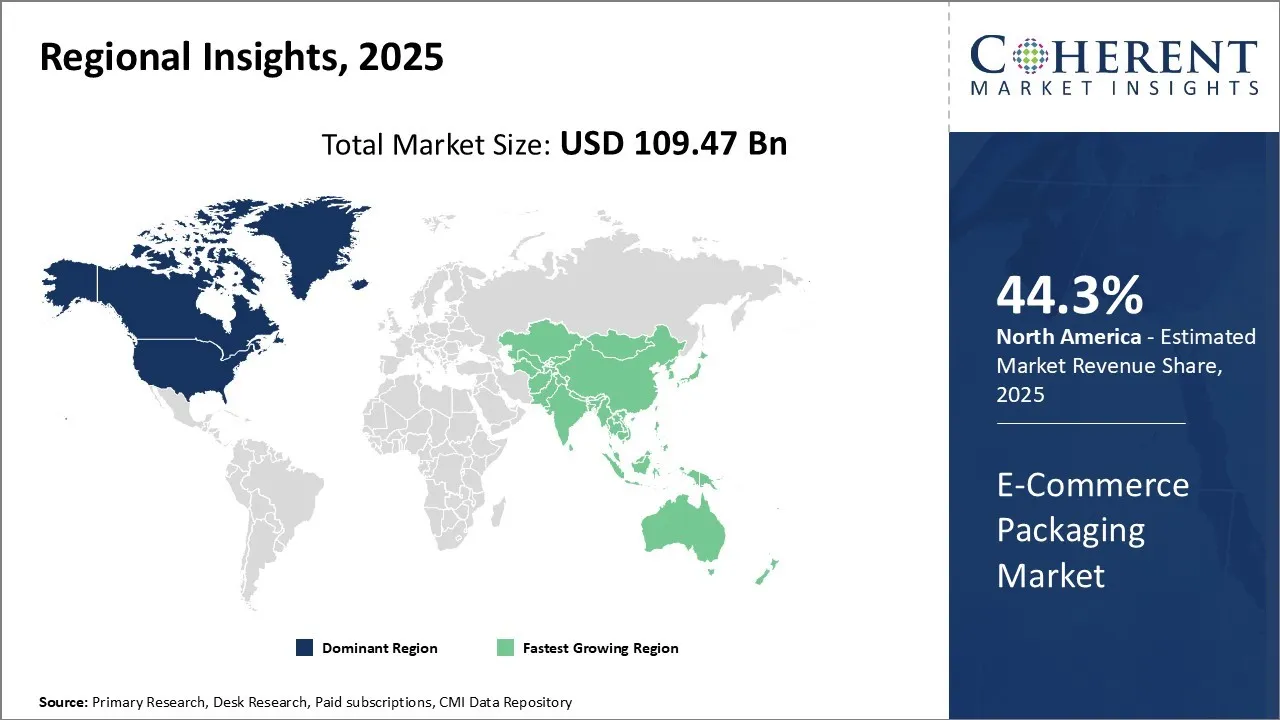
- North America holds dominant position in the global e-commerce packaging market with 44.3% share in 2026.
Market Overview
The global e-commerce packaging market is expected to see significant growth during the next few years, fueled by the fast growth of online shopping, consumer demand for convenience, and expanding environmental awareness. The expansion of internet penetration and smartphone adoption has greatly increased the volume of e-commerce transactions, generating a corresponding need for effective, robust, and eco-friendly packaging. Packaging is also significant in safeguarding products through transit and improving customer experience through branding and unboxing design.
Current Events and Its Impact
Current Events | Description and its impact |
Expansion of Automated E-Commerce Packaging Solutions
|
|
Amazon's Shift to Recycled Paper Fillers in North America
|
|
Role of emerging technologies
Emerging technologies are serving a revolutionary function in the development of the e-commerce packaging industry, improving efficiency, sustainability, and customer interaction. One key technology shift is the use of automation and robotics on packaging lines. These technologies improve packaging rate, lower labor, and enhance consistency, which is crucial for high-volume e-commerce businesses. Automated packing systems can also adjust box size according to product size, creating less waste and shipping expenses.
Next generation packaging is another area that is catching up. Technologies like QR codes, NFC tags, and RFID sensors are being used in packaging to provide real-time tracking, guarantee product authenticity, and give customers product information in detail. This enhances supply chain visibility and reinforces consumer trust.
Sustainable materials and computer-aided design software are also transforming the sector. New software now enables designers to produce environmentally efficient packaging designs that minimize material use while ensuring strength. Additionally, 3D printing facilitates quick prototyping and tailor-making, enabling brands to rapidly experiment with new pack formats at low cost.
Artificial intelligence (AI) and machine learning are being applied to predict demand, handle inventory, and streamline packaging material usage. AI-driven insights enable companies to anticipate seasonal surges and modulate packaging decisions accordingly.
- Current Industry Events of 2026
- Market Size Estimation
- Regional Breakdown
- Competitive Landscape
- Customer Intelligence
- Segmental Analysis
- Pricing Analysis
- Key Market Drivers, Challenges & Future Trends
- Customized Insights Section
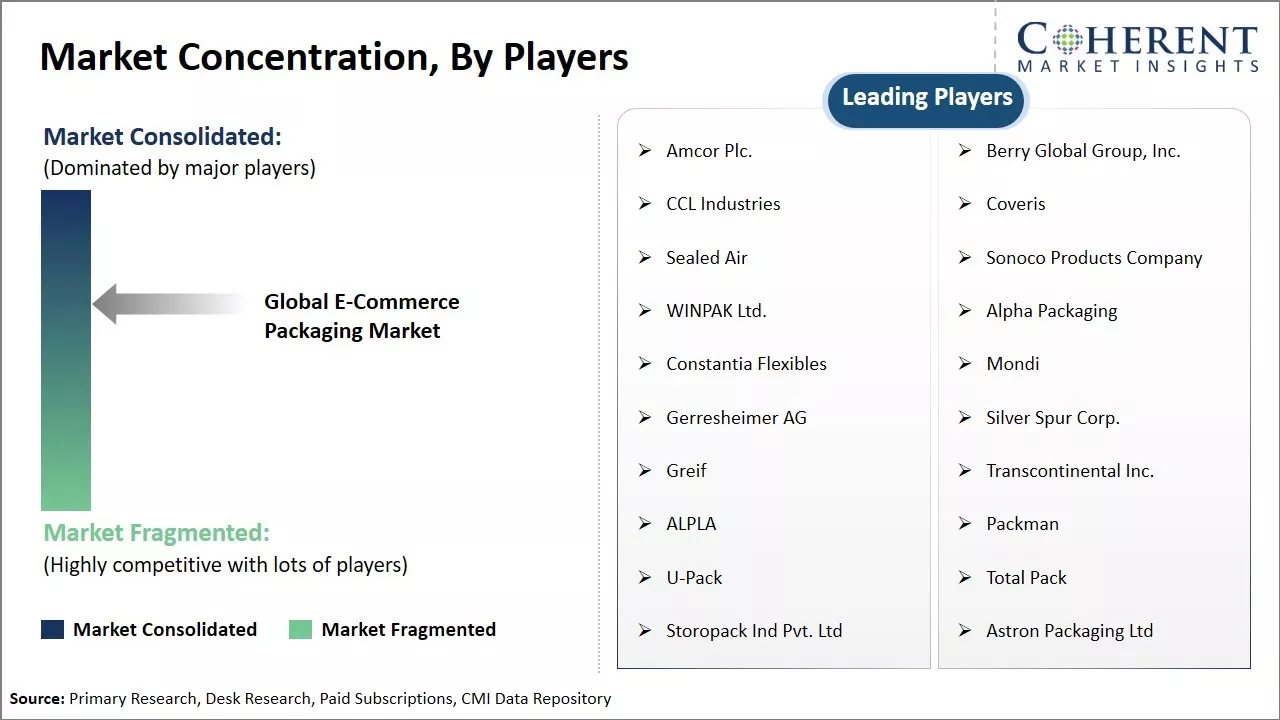
Market Concentration and Competitive Landscape
Market Drivers
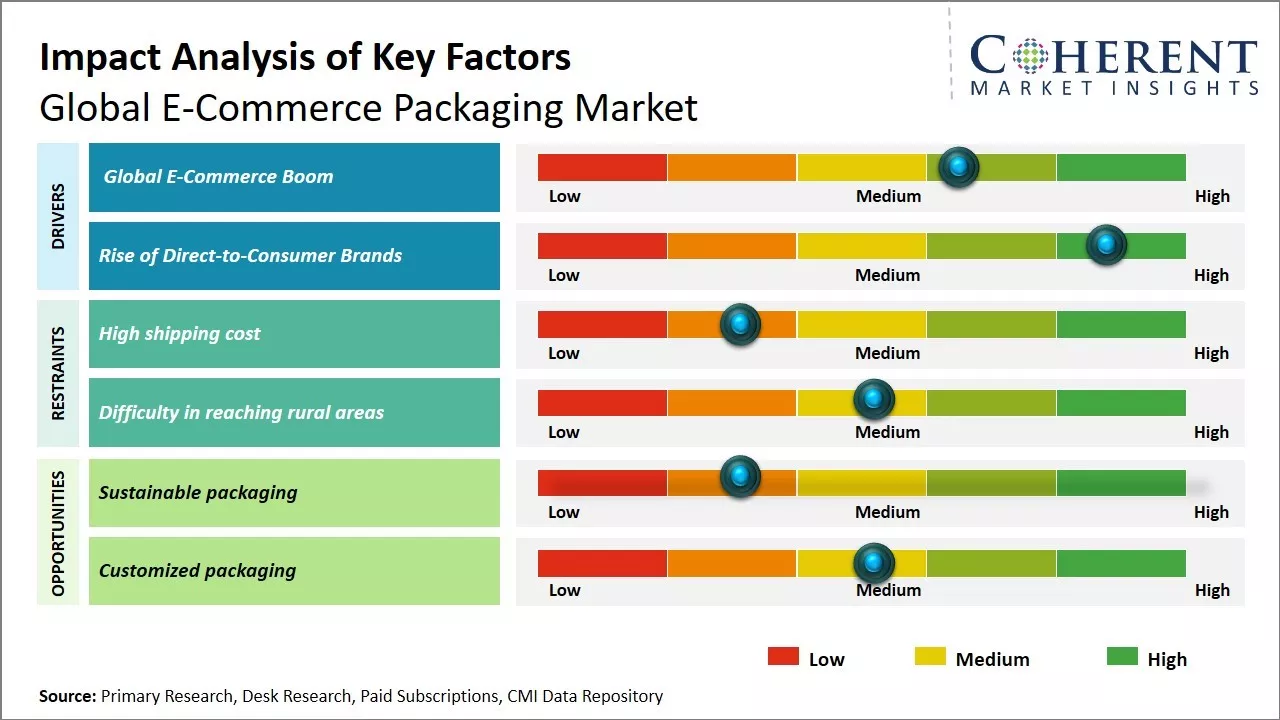
- Global E-Commerce Boom
With the internet revolutionizing business models across industries, e-commerce has seen unprecedented growth over the past decade. The comfort of online shopping from the convenience of one's home has won consumers worldwide. People no longer want to spend hours traversing busy markets or retail stores to find what they need - a few clicks is all it takes to get products delivered right at their doorsteps.
Especially after the disruptions of the pandemic, e-commerce has truly come into its own and established itself as a mainstay. Even those who were initially skeptical have embraced online shopping for everything from groceries to clothes to electronics. Online retailers massively boosted their investments to meet the massive surge in demand. Their warehouses and delivery fleets expanded exponentially to ensure shoppers remained loyal customers.
This boom has propelled the need for specialized packaging like never before. Online retailers require packaging that can protect products from damage during transport. Lightweight and affordable packages are essential to keep costs low and prices competitive. They must also provide enhanced brand visibility since customers don't get to see products before purchase.
- Rise of Direct-to-Consumer Brands
Enabled by strong social media platforms and direct access to customers, direct-to-consumer brands are disrupting many industries. These brands build their distinctive identities on the internet without involving wholesalers or retailers as intermediaries. They use their own websites and social pages to market innovative offerings to customers across the country or even worldwide.
By eliminating old distribution networks, direct brands have never-before-seen control over the customer experience from start to finish. They tailor every aspect, such as innovative packaging that makes first impressions better for online consumers. Unique boxes create each brand's personality and values, yet are functional in protection and convenience.
In 2024, Cabinet, a direct-to-consumer (DTC) brand specializing in prescription skincare, introduced innovative packaging that aligns with its sustainability ethos. The company ships prescriptions in home-compostable mailers and provides personalized, refillable glass bottles.
Opportunities: Sustainable packaging
Sustainable packaging could certainly provide a great opportunity for growth in the e-textiles market. With increasing awareness among consumers about reducing waste and carbon footprint, using environment-friendly and recyclable materials for packaging e-textile products can help capture this conscious segment of buyers. E-textiles being a technical category largely purchased online also produce significant packaging waste.
Adopting sustainable solutions here can thus appeal to growing ethical sensibilities. Brands can develop innovative designs utilizing recycled, biodegradable and reusable materials that are also robust for shipping e-textile products. For example, packaging made from wasted food or agricultural residues like straw and bamboo removes use of single-use plastics and paperboard.
In 2024, Lenovo expanded its use of bamboo fiber packaging across its ThinkPad series, marking a significant step towards sustainable packaging in the tech industry. This initiative is part of Lenovo's broader strategy to reduce plastic usage and enhance packaging sustainability. The company highlights bamboo's rapid growth cycle and composability as key benefits, aligning with its environmental goals and improving the customer experience with sleek, robust packaging.
Segmental Insights
E-Commerce Packaging market Insights, By Product Type
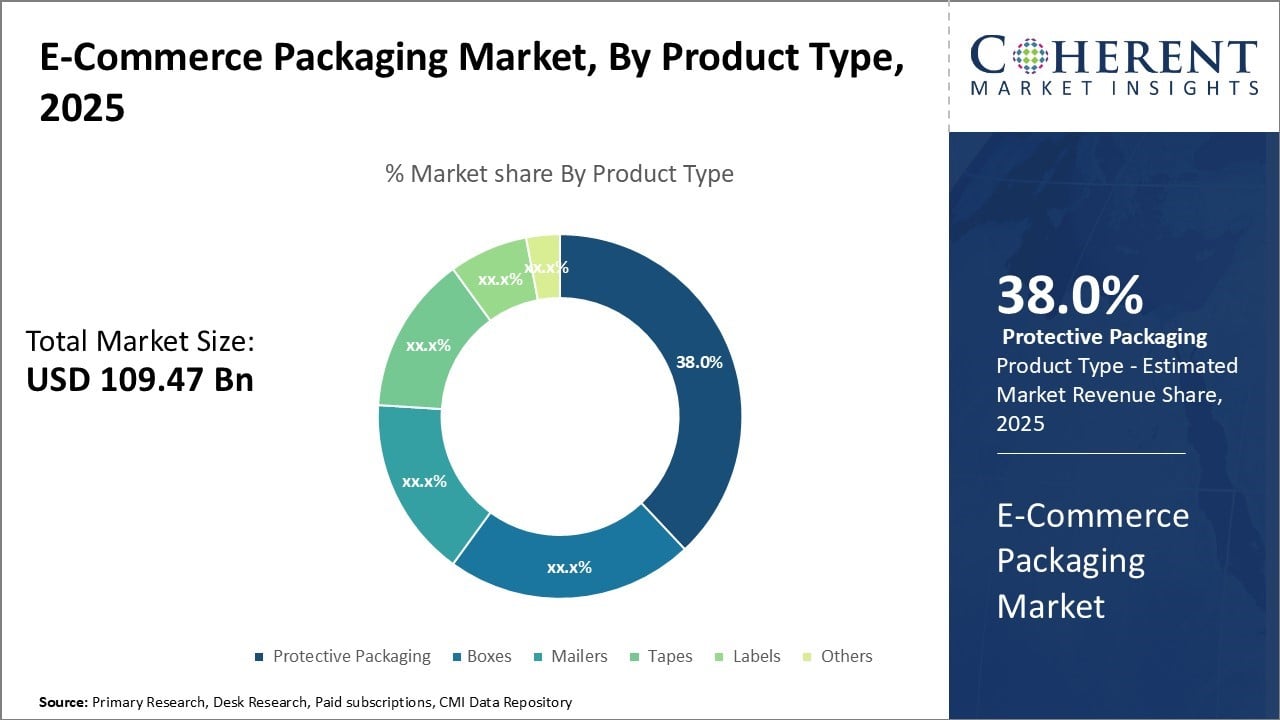
In terms of Product Type, Protective Packaging contributes the 39% share of the market owing to the need for reliable protection of goods during transit. Protective packaging such as boxes, air pillows, bubble wraps, and foam provide cushioning and act as a barrier against external factors that may damage products. They shield delicate items from shocks, dents, and punctures during handling and transportation. This is especially important for fragile electronic goods and other breakable items purchased online. The possibility of damage in transit could create dissatisfaction and return shipping costs for retailers.
Moreover, the unreliable delivery of broken items undermine trust in e-commerce. Hence, effective protective packaging builds credibility for online sellers and enhances customer satisfaction, encouraging repeat purchases. Unlike mailers and tapes alone, protective solutions offer comprehensive resilience, making them a vital part of the e-commerce packaging mix. Their demand continues growing in step with rising internet shopping.
E-Commerce Packaging market Insights, by Material
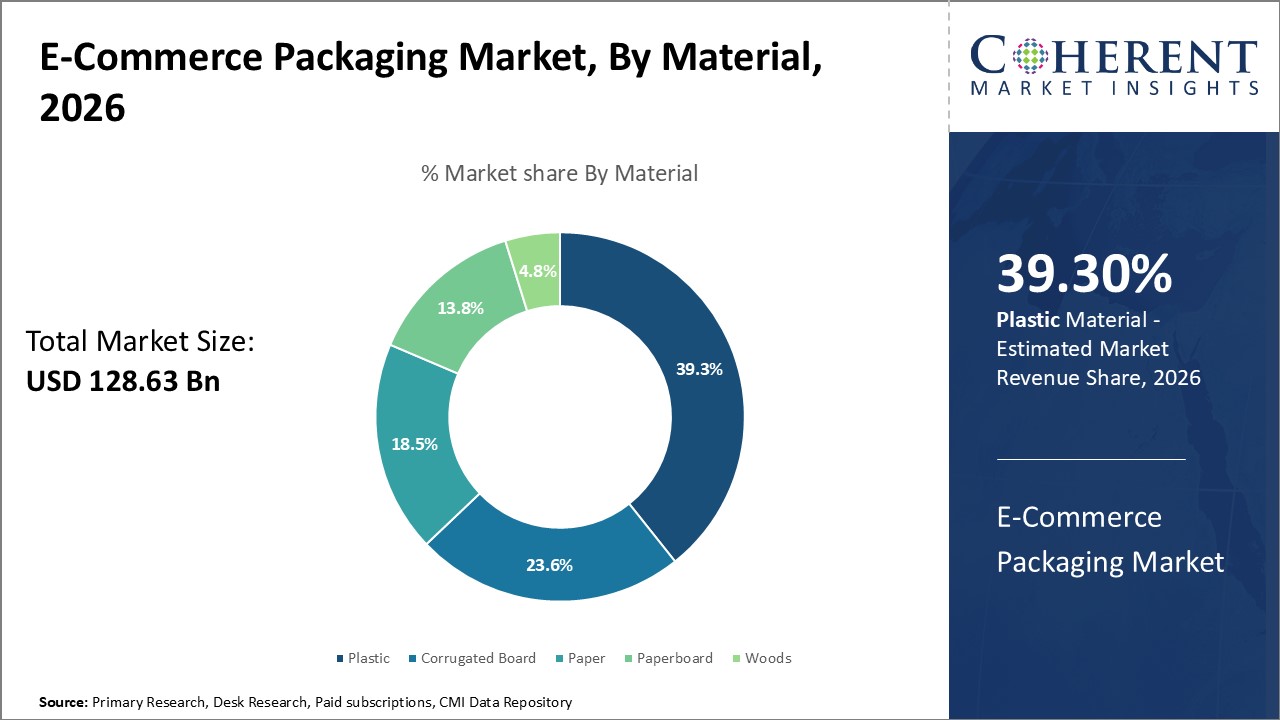
In terms of Material, Plastic contributes the 39.3% share of the market driven by its durable and cost-effective properties. Being lightweight yet sturdy, plastics withstand the rigors of logistics chains from warehouses to doorsteps. This maintains the structural integrity of packages even after multiple handling. Unlike paper prone to tearing and moisture damage, plastics do not deteriorate easily over the journey. Their impermeability to air and water also protects contents from external elements.
Additionally, plastics are inexpensive to produce through molding or forming complex shapes. This allows achieving optimized packaging designs ideal for different product dimensions. The reuse and recycling abilities of plastics further lower environmental impacts versus other materials. All such attributes encourage e-tailers to leverage plastics for a variety of packaging needs from mailers to protective films. Their versatility and affordability will enhance plastic usage in the dynamic e-commerce sector internationally.
E-Commerce Packaging market Insights, by Application
In terms of Application, Electronics contributes the 39.3% share of the market owing to growing needs for eco-friendly solutions. As a sector catalyzing e-commerce growth, electronics manufacturing and retailing place immense packaging waste. However, consumers increasingly prefer brands demonstrating environmental responsibility.
Younger buyers in particular appreciate sustainable initiatives and may switch to companies visibly reducing carbon footprints. This motivates electronics players to green their operations including packaging. Biodegradable mailers made from recycled paper cut reliance on plastics. Compact designs using minimum raw materials also aid sustainability while maintaining safety.
Reusability plays a key role too with packaging serving multiple product shipments. Constant innovations meeting the dual demands of protection and sustainability will expand opportunities in this high potential application segment.
Regional Insights
North America E-Commerce Packaging Market Analysis and Trends
North America continues to be the dominant region in the global e-commerce packaging market owing to several factors with 44.3% share. The large and developed e-commerce sector in countries like the U.S. and Canada generate strong demand for various packages across different product categories. Ease of purchasing goods online along with robust logistics infrastructure has ensured high adoption of e-commerce. This in turn is a major driver of packaging needs in the region.
Additionally, presence of major packaging manufacturers and suppliers in North America allow e-tailers to access a wide range of packaging solutions at competitive prices. Customizable packages tailored for fragile, heavy and oddly-sized goods are commonly available. The regional market is also characterized by continuous packaging innovations for features like tamper-proof seals, easy returns and recyclability. Sustainability remains an important focus for packaging in the region.
Asia Pacific E-Commerce Packaging Market Analysis and Trends
Asia Pacific has emerged as the fastest expanding regional market for e-commerce packaging globally. Rapid growth of the online retail industry coupled with rising incomes in developing nations is the primary factor here. China, India and other Southeast Asian countries have seen over 50.5% year-on-year increase in online shopping, outstripping mature markets. This upsurge directly impacts demand for an assortment of packaging formats.
Asia Pacific also offers packaging producers lucrative market opportunities due to increased localization of manufacturing. Large customer base and presence of leading online marketplaces are additional advantages. Furthermore, the availability of affordable raw materials and workforce has encouraged global brand owners to set up facilities in the region. This along with the proliferation of local packaging solution providers has made Asia Pacific an attractive destination for future expansion in the fast-moving e-commerce packaging industry.
Market Report Scope
E-Commerce Packaging Market Report Coverage
| Report Coverage | Details | ||
|---|---|---|---|
| Base Year: | 2025 | Market Size in 2026: | USD 128.63 Bn |
| Historical Data for: | 2020 To 2024 | Forecast Period: | 2026 To 2033 |
| Forecast Period 2026 to 2033 CAGR: | 17.5% | 2033 Value Projection: | USD 397.74 Bn |
| Geographies covered: |
| ||
| Segments covered: |
| ||
| Companies covered: | Amcor Plc., Berry Global Group, Inc., CCL Industries, Coveris, Sealed Air, Sonoco Products Company, WINPAK Ltd., Alpha Packaging, Constantia Flexibles, Mondi, Gerresheimer AG, Silver Spur Corp., Greif, Transcontinental Inc., ALPLA, Packman , U-Pack, Total Pack, Storopack Ind Pvt. Ltd, Astron Packaging Ltd | ||
| Growth Drivers: |
| ||
| Restraints & Challenges: |
| ||
E-Commerce Packaging Industry News
- In February 2024, Slovak Telecom, in collaboration with partners, introduced reusable e-commerce packaging for mobile phones. The initiative aims to reduce single-use packaging waste in the telecom sector. These durable packages can be returned and reused multiple times, promoting circular economy practices.
- In October 2024, Amazon announced the elimination of plastic air pillows from its global fulfillment centers. This move is part of Amazon's ongoing efforts to reduce single-use plastics in its packaging, responding to pressure from environmental groups to combat plastic pollution in oceans.
Analyst View
- The e-commerce packaging market is experiencing a revolutionary phase influenced by changing consumer expectations, regulatory forces, and technological innovation. The industry, though, is under increasing pressure regarding its environmental footprint, and brands are compelled to embrace sustainable materials such as compostable mailers and paper-based packaging.
- Though this change is in accordance with international sustainability objectives, it presents problems in terms of increased material expenses and supply chain issues, especially for small businesses without economies of scale. The market is currently led by Asia-Pacific due to the quickening pace of adoption of e-commerce in India and China, as well as manufacturing innovations to avoid logistical waste. Europe, on the other hand, is a leader in circular economy policies, propelled by tight EU regulations requiring recyclable packaging and waste reduction measures. Also gaining momentum are smart packaging technologies like tamper-evident seals and IoT-based tracking to improve security and transparency. Return-friendly packaging also offers a strategic path to make reverse logistics more efficient, solving one of e-commerce's most fundamental pain point.
- Brands that can implement eco-innovation successfully together with consumer-focused design are positioned to differentiate themselves, rendering packaging a cost driver rather than a cost center in the saturated digital market.
Market Segmentation
- By Product Type (Revenue, USD Bn, 2021 - 2033)
- Boxes
- Protective Packaging
- Mailers
- Tapes
- Labels
- Others
- By Material (Revenue, USD Bn, 2021 - 2033)
- Plastic
- Corrugated Board
- Paper And Paperboard
- Woods
- By Application (Revenue, USD Bn, 2021 - 2033)
- Electronics
- Food & Beverages
- Cosmetics
- Fashion
- Furniture
- Others
- By Region (Revenue, USD Bn, 2021 - 2033)
- North America
- U.S.
- Canada
- Latin America
- Brazil
- Argentina
- Mexico
- Rest of Latin America
- Europe
- Germany
- U.K.
- Spain
- France
- Italy
- Russia
- Rest of Europe
- Asia Pacific
- China
- India
- Japan
- Australia
- South Korea
- ASEAN
- Rest of Asia Pacific
- Middle East
- GCC Countries
- Israel
- Rest of Middle East
- Africa
- South Africa
- North Africa
- Central Africa
- North America
- Company Profiles
- Amcor Plc.
- Berry Global Group, Inc.
- CCL Industries
- Coveris
- Sealed Air
- Sonoco Products Company
- WINPAK Ltd.
- Alpha Packaging
- Constantia Flexibles
- Mondi
- Gerresheimer AG
- Silver Spur Corp.
- Greif
- Transcontinental Inc.
- ALPLA
- Packman
- U-Pack
- Total Pack
- Storopack Ind Pvt. Ltd
- Astron Packaging Ltd
Sources
Primary Research interviews
- Senior Packaging Designers at Amazon Sustainability Division
- Supply Chain Managers at UPS/FedEx E-Commerce Logistics Teams
- Product Development Heads at DS Smith/Sealed Air Corporation
- Executives from Reusable Packaging Startups (e.g., LimeLoop, Returnity)
- Others
Databases
- Euromonitor International’s E-Commerce Trends Database
- Smithers Pira Packaging Market Intelligence
- Bloomberg Green Packaging Analytics
- Others
Magazines
- Packaging World (E-Commerce Special Editions)
- Packaging Digest (Digital-Forward Solutions Section)
- Sustainable Brands (Circular Packaging Series)
- Others
Journals
- Journal of Cleaner Production (Packaging Sustainability Studies)
- International Journal of Retail & Distribution Management
- Packaging Technology and Science
- Others
Newspapers
- Financial Times (Supply Chain & E-Commerce Sections)
- The Wall Street Journal (Retail Innovation Columns)
- The Guardian (Sustainable Business Reports)
- Others
Associations
- Sustainable Packaging Coalition (SPC)
- Flexible Packaging Association (FPA)
- European Organization for Packaging and the Environment (EUROPEN)
- Others
Public Domain sources
- U.S. Environmental Protection Agency (EPA) Packaging Waste Guidelines
- European Commission’s Circular Economy Action Plan Reports
- World Economic Forum White Papers on E-Commerce Growth
- Others
Proprietary Elements
- CMI Data Analytics Tool
- Proprietary CMI Existing Repository of Information for Last 8 Years
*Definition: The Global E-Commerce Packaging Market refers to the market for various types of packaging solutions and materials that are used for protecting, containment, identification, and transportation of various products and goods that are ordered online through e-commerce platforms and websites. It includes various types of boxes, mailers, envelopes, labels, seals, tapes and other protective packaging products that are specifically designed for safe and secure delivery of online orders to customers globally.
Get access to 250+ pages report
Every segment, forecast, competitor profile and data table behind the analysis above — available for instant download.
- ESOMAR Member
- ISO 9001:2015 Certified
- D-U-N-S Registered
- GDPR & CCPA Compliant
Missing comfort of reading report in your local language? Find your preferred language:
Transform your Strategy with Exclusive Trending Reports
Frequently Asked Questions
The E-Commerce Packaging Market size is estimated to be valued at USD 128.63 Bn in 2026, and is expected to reach USD 397.74 Bn by 2033.
The CAGR of the global Market is projected to be 17.5% from 2026 to 2033.
Global E-Commerce Boom and Rise of Direct-to-Consumer Brands are the major factor driving the growth of Global E-Commerce Packaging industry.
High shipping cost and Difficulty in reaching rural areas are the major factor hampering the growth of Global Market.
In terms of Product Type, Protective Packaging, estimated to dominate the market revenue share 2026.
Amcor Plc., Berry Global Group, Inc., CCL Industries, Coveris, Sealed Air, Sonoco Products Company, WINPAK Ltd., Alpha Packaging, Constantia Flexibles, Mondi, Gerresheimer AG, Silver Spur Corp., Greif, Transcontinental Inc., ALPLA, Packman , U-Pack, Total Pack, Storopack Ind Pvt. Ltd, Astron Packaging Ltd are the major players.
North America is expected to lead the Global E-Commerce Packaging Industry.