

Biodegradable Packaging Market Size and Forecast – 2026 to 2033
The biodegradable packaging market is estimated to be valued at USD 126.06 Bn in 2026 and is expected to reach USD 194.62 Bn by 2033, growing at a compound annual growth rate (CAGR) of 6.4% from 2026 to 2033.
Key Takeaways
- By Type, Plastic holds the largest market share of 63.1% in 2026 owing to the environmental awareness.
- By End Use Industry, Food expected to hold largest market share of 43.1% in 2026 owing to its consumer demand for sustainability.
- By Region, North America dominates the overall market with an estimated share of 36.0% in 2026 owing to the rising consumer demand for eco-friendly products.
Market Overview
The biodegradable packaging market demand is expanding quickly as consumers demand sustainable solutions and environmental concerns rise. Governments are enforcing stricter regulations on plastic use, while companies actively commit to eco-friendly practices, driving widespread adoption. Innovations in bioplastic materials improve product performance, positioning biodegradable packaging as a practical alternative to traditional plastics. Increasing awareness about plastic waste reduction and the push for responsible packaging solutions are accelerating market growth worldwide, especially in regions that prioritize sustainability and green initiatives.
Current Events and their Impact on the Biodegradable Packaging Market
Current Events | Description and its impact |
Regulatory and Policy Developments |
|
Geopolitical and Trade Dynamics |
|
Economic Factors and Funding Landscape |
|
End-user Feedback and Unmet Needs in the Biodegradable Packaging Market
- Durability Concerns: End-users often report that biodegradable packaging lacks the strength and resilience of conventional plastics, especially under moisture or heavy load conditions. This limits their application in industries requiring robust packaging, highlighting a need for improved material formulations that balance biodegradability with enhanced durability.
- Limited Shelf Life: Many consumers find biodegradable packaging less effective for long-term storage, as it can degrade prematurely or lose integrity over time. This creates challenges in sectors like food and pharmaceuticals, where maintaining freshness and protection is critical, signaling a gap in material stability without compromising eco-friendliness.
- Cost Sensitivity: Feedback frequently points to higher costs of biodegradable packaging compared to traditional options, deterring widespread adoption by price-conscious buyers. End-users desire more affordable solutions without sacrificing environmental benefits, underscoring the market need for scalable, cost-efficient production technologies.
- Current Industry Events of 2026
- Market Size Estimation
- Regional Breakdown
- Competitive Landscape
- Customer Intelligence
- Segmental Analysis
- Pricing Analysis
- Key Market Drivers, Challenges & Future Trends
- Customized Insights Section
Segmental Insights
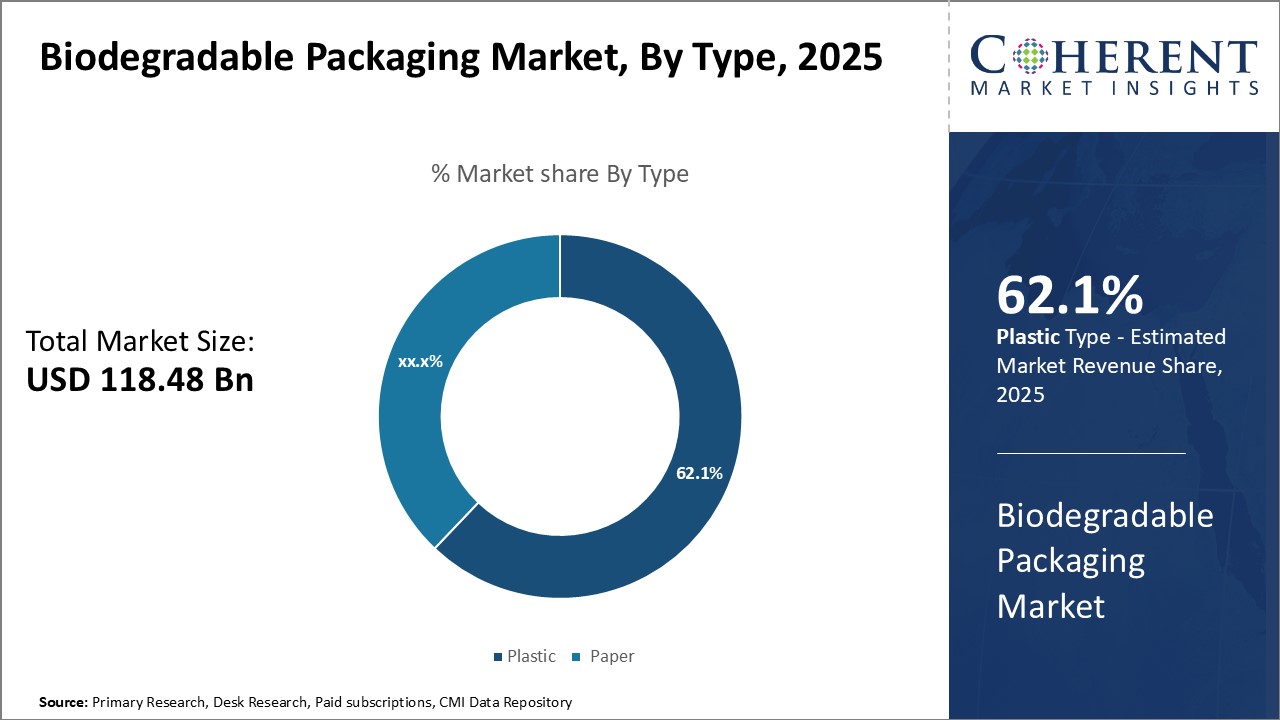
Biodegradable Packaging Market Insights, by Type: Plastic contributes the highest share of the market owing to its innovation in materials.
Plastic holds the largest market share of 63.1% in 2026. Growing environmental concerns and the need to reduce plastic pollution are driving demand for plastic alternatives in the biodegradable packaging market. Governments enforce strict regulations on single-use packaging, motivating manufacturers to adopt sustainable options. Consumers increasingly prefer eco-friendly packaging, which pushes brands to develop innovative biodegradable materials. Technological advancements enhance the quality and affordability of bioplastics, boosting their appeal. These combined factors actively drive the market to replace conventional plastics with biodegradable solutions.
For instance, in July 2025, Karnataka Milk Federation (KMF) introduced eco-friendly, biodegradable sachets for its Nandini milk brand in Bengaluru. These new packs resemble traditional plastic but are much more environmentally friendly.
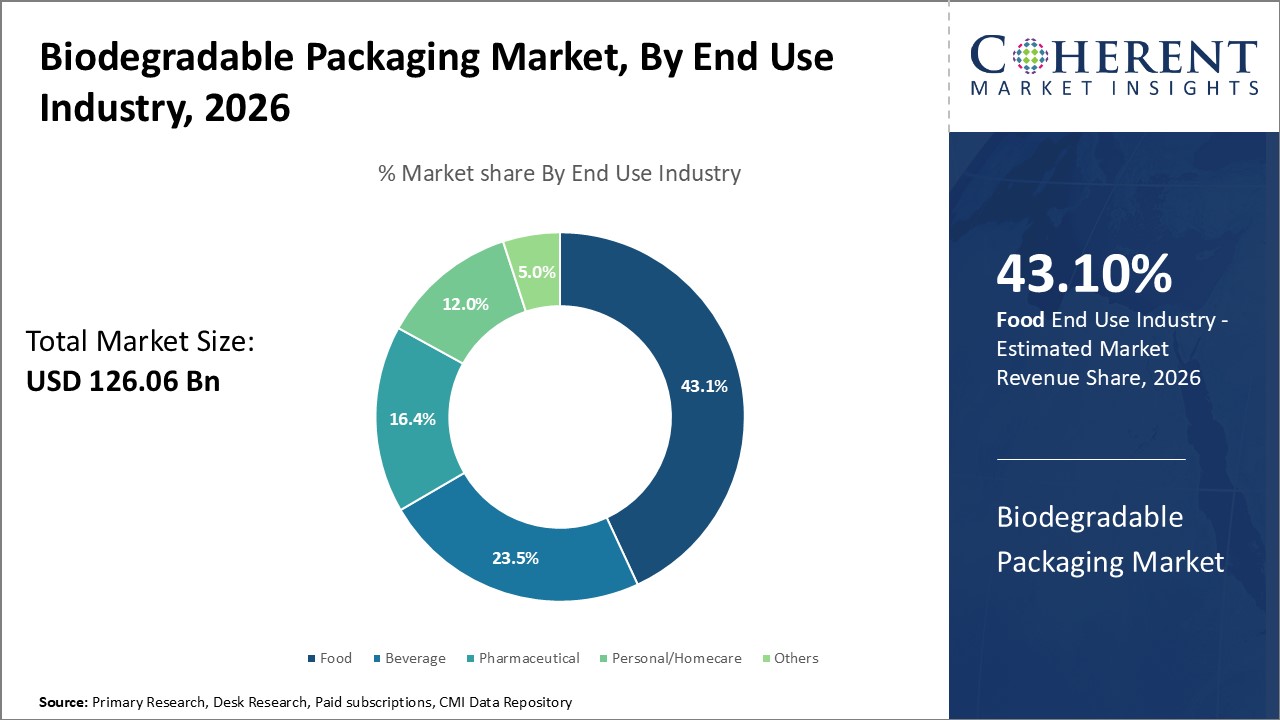
Biodegradable Packaging Market Insights, by End Use Industry: Food contributes the highest share of the market owing to its corporate social responsibility (CSR) and brand image.
Food expected to hold largest market share of 43.1% in 2026. The food sector actively drives the biodegradable packaging market as companies respond to growing consumer demand for eco-friendly options. Food producers address health and safety concerns by adopting packaging that maintains freshness while protecting the environment. Regulatory pressures motivate the shift toward sustainable materials. Innovations improve the durability and functionality of biodegradable packaging, making it suitable for various food products. These factors collectively accelerate the transition from traditional packaging to environmentally conscious alternatives within the food industry.
In July 2025, Preferred Packaging launched GreenStream multi-compartment fibre trays for packaged meals. Designed for microwave, freezer, and oven use, the trays feature a peelable liner that makes composting or recycling easier by minimizing food residue.
Regional Insights
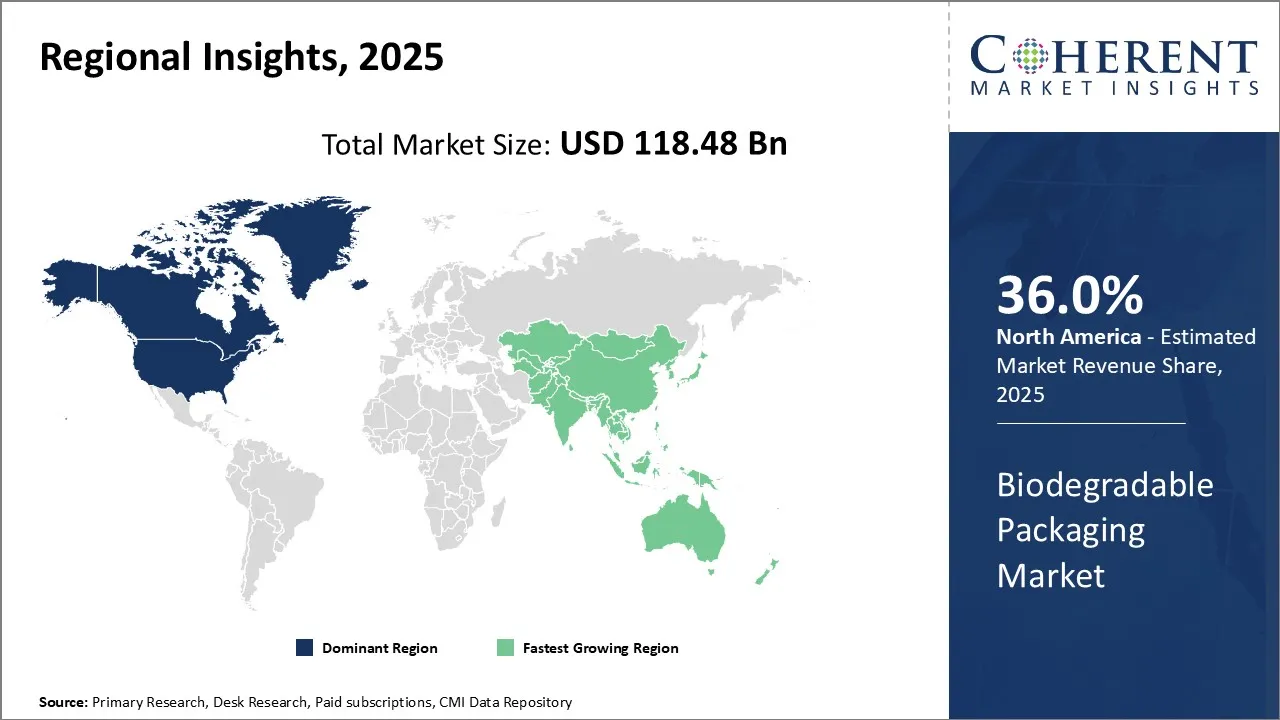
North America Biodegradable Packaging Market Trends
North America dominates the overall market with an estimated share of 36.0% in 2026. Increasing environmental regulations and strong consumer demand for sustainable products are shaping North America’s biodegradable packaging market. Companies in the region prioritize eco-friendly packaging to comply with regulations and meet changing market needs. Technological advancements improve the performance and cost-effectiveness of biodegradable materials, promoting broader adoption. Industry players actively collaborate with government initiatives to support innovation and certification. Together, these trends drive the growth and evolution of the biodegradable packaging industry throughout North America. For instance, in December 2024, Earthrings launched in Elgin, Illinois, aiming to revolutionize beverage packaging with a sustainable alternative to traditional plastic. The company is now actively shipping its product to breweries across the US, Canada, and the Caribbean.
Asia Pacific Biodegradable Packaging Market Trends
Increasing environmental awareness and government initiatives promoting sustainability are driving rapid growth in the Asia Pacific biodegradable packaging market. Rising urbanization and the expansion of food and beverage industries boost demand for eco-friendly packaging solutions. Manufacturers actively invest in advanced biodegradable materials to improve product quality and comply with regulations. Consumers’ growing preference for green products motivates companies to adopt biodegradable packaging. Together, these factors are actively transforming the packaging industry throughout the Asia Pacific region.
United States Biodegradable Packaging Market Trends
Heightened environmental concerns and strict regulations aimed at reducing plastic waste are driving growth in the United States biodegradable packaging market. Businesses are actively adopting sustainable packaging to satisfy consumer demands and adhere to government policies. Innovations in biodegradable materials enhance packaging durability and functionality, positioning them as effective alternatives to conventional plastics. Additionally, increasing awareness of corporate responsibility motivates companies to implement eco-friendly solutions. Together, these factors actively accelerate the transition to biodegradable packaging across the U.S. market. For instance, in February 2024, US packaging provider SEE (formerly Sealed Air) has launched a compostable protein packaging tray, marking a major shift in fresh meat packaging. The company unveiled the tray last month at the IPPE event in Atlanta as manufacturers seek alternatives to Expanded Polystyrene (EPS).
India Biodegradable Packaging Market Trends
Government policies and environmental initiatives actively push India’s biodegradable packaging market share to evolve by reducing plastic usage. Consumers increasingly demand eco-friendly packaging across sectors like food and retail due to rising sustainability awareness. Local manufacturers develop cost-effective biodegradable materials that meet quality standards. Businesses collaborate with regulatory bodies to promote innovation and support green packaging solutions. Together, these trends drive the growth and wider adoption of biodegradable packaging throughout India. For instance, Global beer brand Corona has launched a 100% biodegradable and compostable six-pack made entirely from barley straw in India. This new circular packaging supports Corona’s commitment to protecting and preserving nature.
Biodegradable Packaging Market Trend
Rise of Plant-Based Polymers
The market is increasingly shifting towards plant-derived polymers such as PLA and starch blends. These materials offer renewable alternatives to petrochemical plastics and appeal to eco-conscious consumers. Innovations focus on enhancing their mechanical properties and biodegradation speed, making them suitable for diverse packaging needs while aligning with sustainability goals.
Integration of Smart Packaging Features
Biodegradable packaging is evolving beyond basic containment to include smart functionalities like freshness indicators and antimicrobial coatings. This trend addresses consumer demand for safer, longer-lasting products while maintaining eco-friendly credentials. The convergence of biodegradability with intelligent features is opening new avenues for product differentiation.
Biodegradable Packaging Market Opportunity
Biodegradable Packaging in Healthcare
The healthcare sector offers significant potential for biodegradable packaging, particularly for single-use medical devices and pharmaceutical products. There is a growing need for sterile, eco-friendly materials that reduce medical waste without compromising safety or functionality. Innovating in this space addresses both environmental concerns and stringent regulatory requirements, paving the way for sustainable healthcare packaging solutions.
Market Report Scope
Biodegradable Packaging Market Report Coverage
| Report Coverage | Details | ||
|---|---|---|---|
| Base Year: | 2025 | Market Size in 2026: | USD 126.06 Bn |
| Historical Data for: | 2020 To 2024 | Forecast Period: | 2026 To 2033 |
| Forecast Period 2026 to 2033 CAGR: | 6.4% | 2033 Value Projection: | USD 194.62 Bn |
| Geographies covered: |
| ||
| Segments covered: |
| ||
| Companies covered: | BASF SE, Smurfit Kappa Group, Mondi Group, Rocktenn, Stora Enso, Clearwater Paper Corporation, Amcor, Novamont S.P.A., Kruger Inc., Reynolds Group Holding Limited, International Corp., Solenis, DuPont, Ball Corp, Novamont, Tetra Pak International SA, Biopak PTY, Imex Packaging, and Elevate Packaging Inc | ||
| Growth Drivers: |
| ||
| Restraints & Challenges: |
| ||
Biodegradable Packaging Market News
- In May 2025, India has launched the National Packaging Innovation Challenge through the Indian Institute of Packaging (IIP) to encourage startups and students to develop scalable, eco-friendly packaging solutions for domestic and export markets.
- In May 2025, Futamura, Repaq, and GK Sondermaschinenbau have teamed up to create a compostable laminate for liquid sachets using NatureFlex technology, suitable for packaging products like ketchup, sauces, and hand cream.
- In January 2025, Fresh-Lock® closures and TIPA Compostable Packaging have developed a fully home compostable pouch for True. ApS’ True Dates, supporting the snack brand’s commitment to reducing environmental impact.
Analyst Opinion (Expert Opinion)
- The biodegradable packaging market is at a critical inflection point where technological innovation must urgently address persistent functional shortcomings to drive broader adoption. Despite the laudable environmental narrative, the current generation of biodegradable materials often fails to meet the rigorous durability and barrier requirements demanded by sectors like food and pharmaceuticals. For example, a 2024 study by GreenTech Materials revealed that nearly 40% of end-users in the fresh produce segment experienced premature degradation or loss of product integrity when using PLA-based packaging.
- This reveals a glaring disconnect: sustainability alone no longer suffices as a purchase driver when it compromises core packaging performance. Industry leaders must prioritize R&D investments that enhance moisture resistance and mechanical strength without sacrificing biodegradability. Companies like Danimer Scientific are making strides by developing PHA-based alternatives that offer superior performance, but these innovations remain nascent and expensive, limiting their scalability.
- Moreover, the inconsistent compatibility of biodegradable packaging with existing waste management infrastructure undermines the sustainability promise. In Europe, where composting facilities are more established, a Waste Management Europe report shows less than 30% of biodegradable packaging waste is properly composted due to consumer confusion and inadequate labeling. This operational gap signals the urgent need for standardized certification and consumer education to avoid biodegradability becoming a marketing gimmick.
Speak to the analyst
Want personalized insights?
Take the findings above to one of our principal consultants, or have the report rebuilt around the segments, geographies and competitors you actually track.
Market Segmentation
- Type Insights (Revenue, USD Bn & KT, 2021 - 2033)
- Plastic
- Paper
- End-use Industry Insights (Revenue, USD Bn & KT, 2021 - 2033)
- Food
- Beverage
- Pharmaceutical
- Personal/Homecare
- Others
- Regional Insights (Revenue, USD Bn & KT, 2021 - 2033)
- North America
- U.S.
- Canada
- Latin America
- Brazil
- Argentina
- Mexico
- Rest of Latin America
- Europe
- Germany
- U.K.
- Spain
- France
- Italy
- Russia
- Rest of Europe
- Asia Pacific
- China
- India
- Japan
- Australia
- South Korea
- ASEAN
- Rest of Asia Pacific
- Middle East & Africa
- GCC Countries
- Israel
- Rest of Middle East & Africa
- Key Players Insights
- BASF SE
- Smurfit Kappa Group
- Mondi Group
- Rocktenn
- Stora Enso
- Clearwater Paper Corporation
- Amcor
- Novamont S.P.A.
- Kruger Inc.
- Reynolds Group Holding Limited
- International Corp.
- Solenis
- DuPont
- Ball Corp
- Novamont
- Tetra Pak International SA
- Biopak PTY
- Imex Packaging
- Elevate Packaging Inc
- Elevate Packaging
Sources
Primary Research interviews
- Packaging industry experts
- Biodegradable materials manufacturers
- Sustainability officers in FMCG companies
- Environmental policy makers
- Waste management facility operators
Databases
- United Nations Environment Programme (UNEP) databases
- Food and Agriculture Organization (FAO) statistical data
- Eurostat environmental statistics
- U.S. Environmental Protection Agency (EPA) data portal
Magazines
- Packaging World
- BioCycle Magazine
- Plastics Today
- Sustainable Packaging News
Journals’
- Journal of Cleaner Production
- Waste Management
- Environmental Science & Technology
- Packaging Technology and Science
Newspapers
- The Guardian (Environment Section)
- The New York Times (Sustainability Coverage)
- Financial Times (Green Economy)
- Reuters News (Environmental Focus)
Associations
- The Sustainable Packaging Coalition (SPC)
- European Bioplastics Association
- Biodegradable Products Institute (BPI)
- Plastics Industry Association
Public Domain sources
- World Bank Open Data
- National Institute of Standards and Technology (NIST)
- Government environmental and agriculture ministry reports
- Patent databases (e.g., Google Patents)
Proprietary Elements
- CMI Data Analytics Tool
- Proprietary CMI Existing Repository of information for last 8 years
Get access to 250+ pages report
Every segment, forecast, competitor profile and data table behind the analysis above — available for instant download.
- ESOMAR Member
- ISO 9001:2015 Certified
- D-U-N-S Registered
- GDPR & CCPA Compliant
Missing comfort of reading report in your local language? Find your preferred language:
Transform your Strategy with Exclusive Trending Reports
Frequently Asked Questions
The Biodegradable Packaging Market is estimated to be valued at USD 126.06 Bn in 2026, and is expected to reach USD 194.62 Bn by 2033.
The CAGR of the Biodegradable Packaging Market is projected to be 6.4% from 2026 to 2033.
Rising concerns about plastic pollution and increased adoption in food packaging and food service industries are the major factors driving the growth of the biodegradable packaging market.
Higher costs & quality issues and lack of global standards and certification are the major factors hampering the growth of the biodegradable packaging market.
In terms of type, paper is estimated to dominate the market revenue share in 2026.
BASF SE, Smurfit Kappa Group, Mondi Group, Rocktenn, Stora Enso, Clearwater Paper Corporation, Amcor, Novamont S.P.A., Kruger Inc., Reynolds Group Holding Limited, International Corp., Solenis, DuPont, Ball Corp, Novamont, Tetra Pak International SA, Biopak PTY, Imex Packaging, Elevate Packaging Inc, and Elevate Packaging are the major players operating in the market.
North America is expected to lead the biodegradable packaging market.