

Digital Signature Software Market Analysis & Forecast: 2026-2033
Digital Signature Software Market is estimated to be valued at USD 13.01 Bn in 2026 and is expected to reach USD 99.35 Bn in 2033, exhibiting a compound annual growth rate (CAGR) of 33.7% from 2026 to 2033.
Key Takeaways
- By component, the software segment is projected to hold the 61% share of the global digital signature software market in 2026, driven by growing demand for secure, efficient, and compliant digital transaction management platforms.
- By end-user, the enterprise segment dominates the global digital signature software market, driven by large-scale digitization initiatives and stringent compliance requirements in sectors such as BFSI, healthcare, and government.
- By industry, BFSI, healthcare, and IT & telecom represent the leading adopters of digital signature software, due to their stringent regulatory requirements, high transaction volumes, and need for secure, efficient, and paperless processes.
- By Region, Asia Pacific is the dominating region with 38.8% share in 2026 for digital signatures, fueled by digitalization, e-commerce, and smartphone penetration. China, India, Japan, and South Korea drive expansion.
Market Overview
A technique known as a digital signature ensures that the message's contents are not been altered during transmission (exchange of digital data and documents between different entities or parties through electronic means). A digital signature verifies a message, digital content, or piece of software's authenticity. Digital signatures are commonly employed as a security measure or authentication method to ensure the safety and integrity of records, confidential data, information, and documents when they are exchanged between different entities or parties. This cryptographic technique provides a means of encryption and acts as a virtual "seal" to verify the origin and unchanged state of the transmitted content.
Current Events and Its Impact
Event | Description and Impact |
EU Digital Governance and Regulatory Transformation |
|
US-China Technology Decoupling and Trade Relations |
|
Digital Transformation Acceleration |
|
Role of AI (Artificial Intlligence) in the Global Digital Signature Software Market
AI is transforming digital signature software by enhancing security, automating workflows, and improving user experience. DocuSign uses AI to analyze signing patterns and detect fraud in real-time, reducing fraudulent attempts by over 40%. Adobe Sign leverages machine learning for intelligent document processing and workflow automation, while SignNow’s AI-powered Smart Fill predicts signature fields, cutting document prep time by 60% and errors by 35%. Across the market, AI enables smart form completion, predictive analytics, and advanced authentication, streamlining digital transactions and setting new industry standards for efficiency and security.
- Current Industry Events of 2026
- Market Size Estimation
- Regional Breakdown
- Competitive Landscape
- Customer Intelligence
- Segmental Analysis
- Pricing Analysis
- Key Market Drivers, Challenges & Future Trends
- Customized Insights Section
Segmental Insights
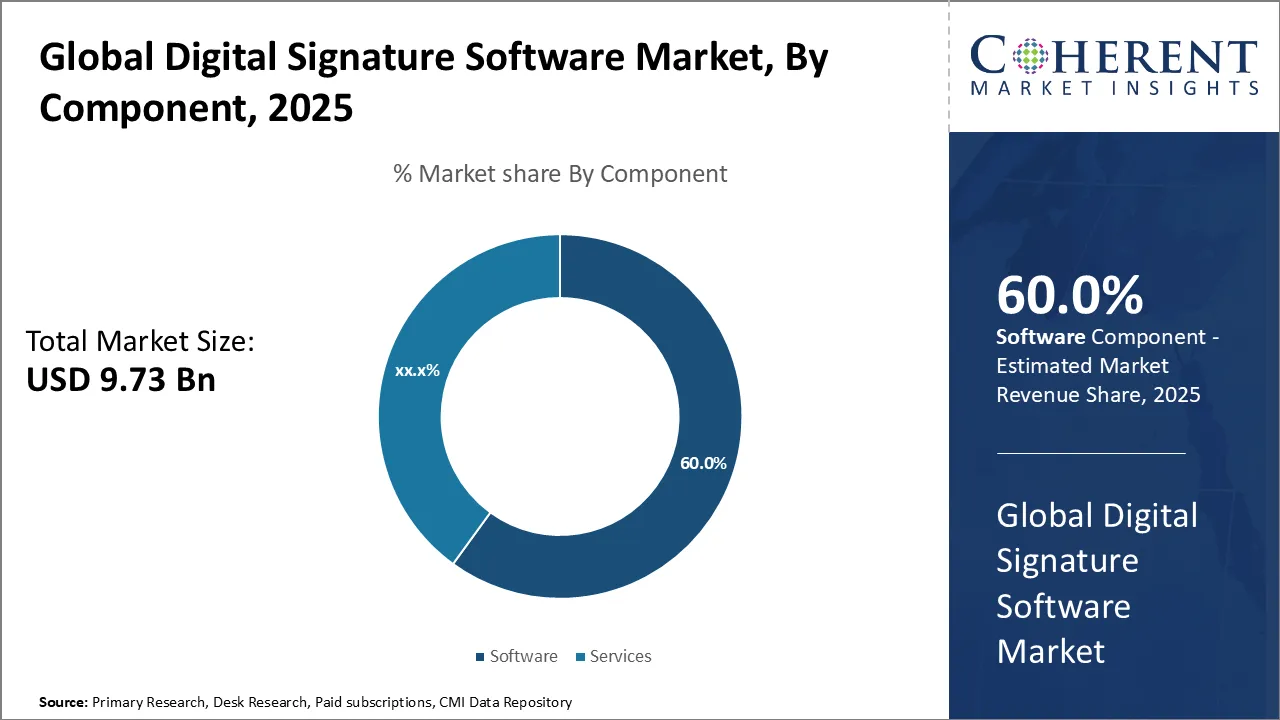
Global Digital Signature Software Market Insights, By Component - Software Segment Dominates Market Share
By component, the software segment is projected to hold 61% share of the global digital signature software market during the forecast period, supported by growing demand for secure, efficient, and compliant digital transaction management platforms. Organizations across industries are increasingly adopting digital signature software to eliminate paperwork, reduce operational costs, and streamline workflows. Advancements in encryption, cloud-based deployment, and AI integration further strengthen the adoption of software solutions. The services segment, including consulting, integration, and managed services, is also expanding as enterprises seek expert support to ensure seamless implementation and regulatory compliance.
For instance, Autenti is highlighted as a leading digital signature software platform that supports Simple Electronic Signatures (SES), Advanced Electronic Signatures (AES), and Qualified Electronic Signatures (QES) with over 170 QES suppliers across the EU. It offers features such as signature validation, online counterparty identity verification via the BROKER ID tool, and mobile document signing, making the transition from paper-based workflows to digital solutions seamless.
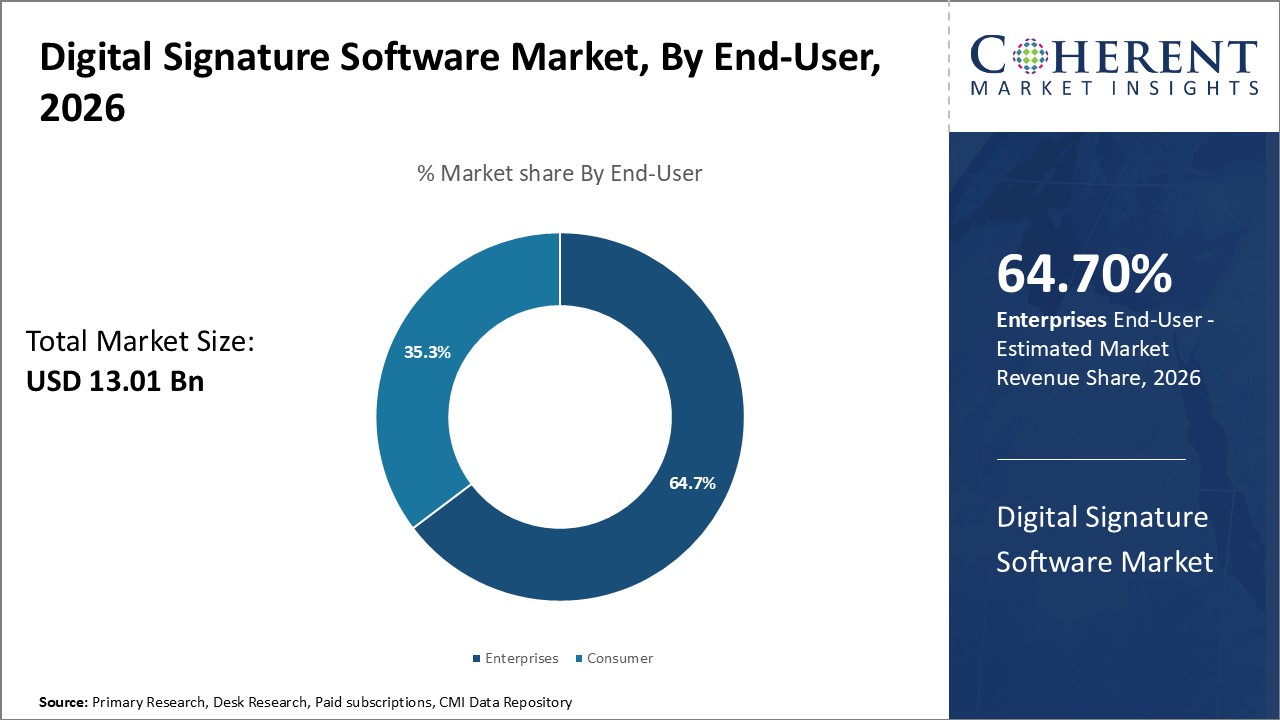
Global Digital Signature Software Market Insights, By End-user - Enterprise Segment Leads Adoption
By end-user, the enterprise segment dominates the global digital signature software market, driven by large-scale digitization initiatives and stringent compliance requirements in sectors such as BFSI, healthcare, and government. Enterprises are leveraging digital signature software to secure transactions, enhance operational efficiency, and strengthen customer trust. Meanwhile, the consumer segment is growing steadily as individuals adopt digital signatures for personal use in areas such as online banking, e-commerce, and remote contracts, reflecting increasing digital literacy and demand for convenience.
Global Digital Signature Software Market Insights, By Industry - BFSI, Healthcare, and IT & Telecom Drive Market Growth
By industry, BFSI, healthcare, and IT & telecom represent the leading adopters of digital software. The BFSI sector is heavily investing in secure digital signature platforms to meet regulatory standards and combat fraud in online transactions. Healthcare organizations are deploying digital signatures for electronic health records, telemedicine approvals, and patient data security. The IT & telecom sector is also a major contributor, driven by the need to secure customer onboarding and digital service contracts. Other key verticals such as defense, government, retail & consumer goods, and education are rapidly adopting digital signature solutions to modernize operations, ensure compliance, and deliver faster, paperless services. The “others” category encompasses emerging industries embracing digital transformation to improve efficiency and trust in digital transactions.
Regional Insights
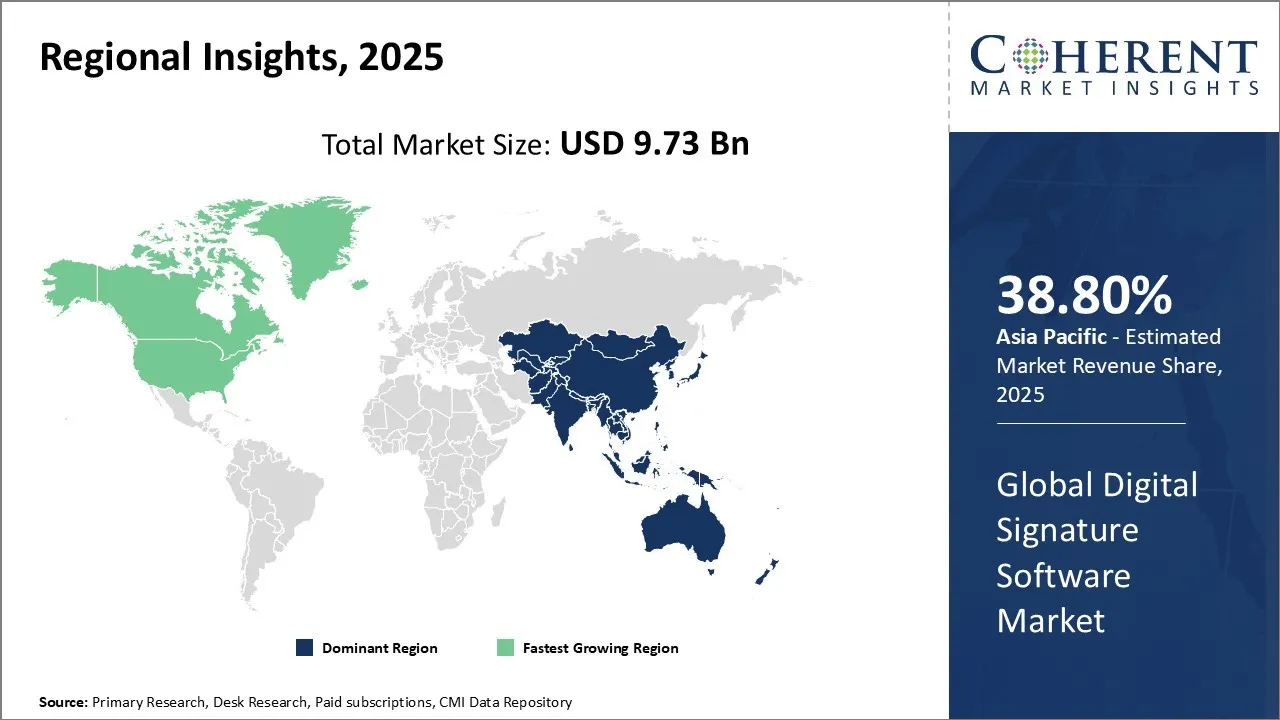
Asia Pacific Digital Signature Software Market Trends
Asia Pacific is the dominating region with 38.8% share in 2026 for digital signatures, fueled by digitalization, e-commerce, and smartphone penetration. China, India, Japan, and South Korea drive expansion. For instance, in June 2026, Infosys inaugurated a ₹32 crore development centre at GIFT City, Gandhinagar, focused on fintech-driven digital solutions. The facility, designed to employ over 1,000 professionals, will develop AI-powered tools for global financial institutions, including digital payments, smart contracts, and asset tokenisation. According to the Gujarat government, the centre will strengthen digital infrastructure and accelerate secure, paperless transactions in BFSI workflows. Such initiatives are boosting the adoption of digital signature.
North America Digital Signature Software Market Trends
North America represents a mature digital signature market, driven by advanced IT infrastructure and strong awareness of security and efficiency benefits. The U.S. leads growth, supported by major vendors and regulatory emphasis on data security and compliance. For instance, DocuSign reported a 15% increase in enterprise adoption in early 2026, exemplifying the region’s leadership in deploying secure digital signature solutions across industries.
Europe Digital Signature Software Market Trends
Europe is a leading adopter of digital signature technology, supported by regulations like eIDAS and robust legal frameworks. Countries such as Germany, France, and the Nordics have extensive usage across public and private sectors. For example,
Digital Signature Software Market Outlook: Country-Wise
United States Digital Signature Software Market Outlook
The U.S. is the key contributor to North America’s digital signature market share, driven by enterprise adoption and stringent compliance standards. Leading global providers like DocuSign, Adobe Sign, and OneSpan continue expanding services and integrations.
For instance, in February 2026, USDM Life Sciences launched its Veeva–DocuSign Integration Accelerator to streamline electronic signatures in highly regulated industries. The solution enables seamless connectivity between Veeva Vault and DocuSign, eliminating manual handoffs while ensuring full compliance with FDA 21 CFR Part 11 and EU Annex 11 regulations. By automating document routing, enabling real-time signature tracking, and maintaining audit-ready trails, the accelerator strengthens digital compliance infrastructure and accelerates secure, paperless workflows across the U.S. life sciences sector.
Canada Digital Signature Software Market Outlook
Canada shows steady adoption in government and corporate sectors, supported by regulations emphasizing electronic consent and cybersecurity. For instance, in March 2026, the Government of Ontario advanced its Digital and Data Strategy by rolling out province-wide digital identity and secure electronic signature capabilities to modernize public service delivery. The initiative integrates digital signature solutions into high-volume applications such as driver’s licence renewals, health card services, and business permits, reducing reliance on paper-based transactions. According to Ontario’s Treasury Board Secretariat, the program strengthens online privacy, enhances compliance with cybersecurity standards, and accelerates the province’s goal of becoming a world-leading digital jurisdiction. Such initiatives are accelerating the digital signature market revenue.
China Digital Signature Software Market Outlook
China leads adoption with government, banking, and enterprise digitalization initiatives. In March 2026, Alibaba integrated digital signature solutions for its B2B cloud services, enhancing contract security and efficiency.
Market Report Scope
Digital Signature Software Market Report Coverage
| Report Coverage | Details | ||
|---|---|---|---|
| Base Year: | 2025 | Market Size in 2026: | USD 13.01 Bn |
| Historical Data for: | 2020 To 2024 | Forecast Period: | 2026 To 2033 |
| Forecast Period 2026 to 2033 CAGR: | 33.7% | 2033 Value Projection: | USD 99.35 Bn |
| Geographies covered: |
| ||
| Segments covered: |
| ||
| Companies covered: | Cryptolog SAS, Vasco Data Security International, Inc., Integrated Media Management LLC, RightSignature LLC, Secured Signing Limited, Sertifi Inc., Comsigntrust Ltd., Identrust Inc., Ascertia Ltd., and Entrust Datacard Corporation. | ||
| Growth Drivers: |
| ||
| Restraints & Challenges: |
| ||
Market Dynamics
Global Digital Signature Software Market: Drivers
Increasing Need for Secure and Efficient Transactions
Increasing shift to digital processes, owing to demand for secure and efficient transactions is expected to drive the market growth. Digital signature software plays a crucial role in ensuring the integrity and authenticity of digital documents exchanged during these transactions. In the banking industry, digital signatures are used to validate and authenticate loan agreements, account opening documents, and financial transactions. Instead of relying on physical signatures that can be prone to forgery or tampering, digital signatures provides a secure and legally binding method to verify the identity of parties involved and ensure the integrity of the documents. This helps banks to streamline their operations, reduce paperwork, and enhance the overall security of their transactions.
Global Digital Signature Software Market: Opportunities
Increasing Adoption of Cloud-Based Solutions
The adoption of cloud-based solutions is witnessing significant growth in various industries. Cloud computing offers scalability, and thus, enables businesses to easily expand their operations and resources as needed. Due to its scalability, accessibility, and cost-effectiveness, cloud computing is increasingly being adopted across different industries. This opportunity has created huge demand for cloud-based digital signature software that provides businesses with the flexibility to securely access and manage documents from any location and device. As a result, software providers have an opportunity to meet this demand by offering reliable and feature-rich digital signature solutions that seamlessly integrate into existing workflows.
Expansion of E-commerce and Remote Workforce
The expansion of e-commerce and increasing prevalence of remote work have a profound impact on the need for digital signatures. As online transactions, contracts, and agreements are becoming popular in the digital economy, the importance of secure and legally binding signatures has heightened. The rapid expansion of e-commerce and rising remote work led to huge demand for digital signatures. Secure and legally binding signatures are essential for online transactions, contracts, and agreements, regardless of geographical constraints. To capitalize on these opportunities, digital signature software providers can develop user-friendly and effective solutions tailored to the specific requirements of e-commerce businesses and remote workers.
Analyst Viewpoint
- The global digital signature software market is witnessing strong growth, fueled by accelerating digital transformation initiatives and increasingly stringent regulatory compliance requirements. Organizations are prioritizing paperless operations to improve efficiency and reduce costs, driving robust demand for secure electronic signature solutions. The rise of remote work has further heightened the need for reliable digital authentication tools that facilitate seamless document processing across distributed locations.
- Key growth drivers include rising cybersecurity concerns, growing adoption of cloud-based solutions, and the demand for faster transaction processing across industries such as banking, healthcare, and legal services. Government programs promoting digital governance and the expansion of e-commerce are additional catalysts supporting market growth. Challenges remain, including data privacy concerns, complexities in integrating with legacy systems, and divergent regulatory frameworks across regions, which can complicate adoption for multinational organizations.
- North America is emerging as the fastest-growing market, backed by advanced technological infrastructure, early adoption of digital solutions, and stringent compliance standards. Meanwhile, the Asia-Pacific region currently leads the market, propelled by rapid digitalization, expanding e-commerce ecosystems, and increasing government support in countries like India, China, and Southeast Asian nations.
- Emerging markets present significant opportunities as digital literacy improves and regulatory frameworks evolve to facilitate electronic transactions. Additionally, the integration of artificial intelligence and blockchain technologies offers promising growth avenues, enabling enhanced security, automated workflows, and next-generation digital signature capabilities poised to reshape the market landscape.
Speak to the analyst
Want personalized insights?
Take the findings above to one of our principal consultants, or have the report rebuilt around the segments, geographies and competitors you actually track.
Global Digital Signature Software Market: Key Developments
- In August 2025, Quantum Software Solutions, a Qatari tech research lab under MBK Holding, launched a post-quantum security add-on to protect digitally signed documents from quantum threats. The solution integrates with e-signature platforms, using NIST-recommended post-quantum algorithms and QANplatform’s quantum-resistant blockchain.
- In February 2025, Sumsub, a provider of verification and client onboarding solutions launched its Qualified Electronic Signature (QES) Verification product. This new solution enhances security, compliance, and efficiency in remote user onboarding across the EU and Norway, fully aligning with national laws and the eIDAS framework.
Market Segmentation
- Global Digital Signature Software Market, By Component (Revenue, USD Bn, 2021 - 2033)
- Software
- Services
- Global Digital Signature Software Market, By End-user (Revenue, USD Bn, 2021 - 2033)
- Consumer
- Enterprises
- Global Digital Signature Software Market, By Industry (Revenue, USD Bn, 2021 - 2033)
- BFSI
- Defense
- Government
- Retail & Consumer Goods
- Healthcare
- Education
- IT & Telecom
- Others
- Global Digital Signature Software Market, By Region (Revenue, USD Bn, 2021 - 2033)
- North America
- U.S.
- Canada
- Latin America
- Brazil
- Argentina
- Mexico
- Rest of Latin America
- Europe
- Germany
- U.K.
- Spain
- France
- Italy
- Russia
- Rest of Europe
- Asia Pacific
- China
- India
- Japan
- Australia
- South Korea
- ASEAN
- Rest of Asia Pacific
- Middle East
- GCC Countries
- Israel
- Rest of Middle East
- Africa
- South Africa
- North Africa
- Central Africa
- North America
- Company Profile
- Cryptolog SAS
- Vasco Data Security International, Inc.
- Integrated Media Management LLC
- RightSignature LLC
- Secured Signing Limited
- Sertifi Inc.
- Comsigntrust Ltd.
- Identrust Inc.
- Ascertia Ltd.
- Entrust Datacard Corporation
Sources
Primary Research Interviews
- Digital signature software vendors and solution providers
- IT security managers and chief information officers
- Enterprise software procurement specialists
- Government regulatory compliance officers
- Others
Databases
- Bloomberg Terminal
- Thomson Reuters Eikon
- IDC Worldwide Software Tracker
- Others
Magazines
- CIO Magazine
- Information Security Magazine
- Enterprise Security Magazine
- Digital Transformation Magazine
- Others
Journals
- Journal of Information Security and Applications
- International Journal of Digital Crime and Forensics
- IEEE Security & Privacy Magazine
- Others
Newspapers
- The Wall Street Journal (Technology Section)
- Financial Times (Digital Business)
- Reuters Technology News
- Forbes Technology Council
- Others
Associations
- Electronic Signature and Records Association (ESRA)
- Cloud Security Alliance (CSA)
- Information Systems Security Association (ISSA)
- International Association of Privacy Professionals (IAPP)
- Others
Public Domain Sources
- U.S. Securities and Exchange Commission (SEC) filings
- European Union eIDAS Regulation documentation
- National Institute of Standards and Technology (NIST) publications
- Government procurement databases
- Others
Proprietary Elements
- CMI Data Analytics Tool
- Proprietary CMI Existing Repository of information for last 8 years
Get access to 250+ pages report
Every segment, forecast, competitor profile and data table behind the analysis above — available for instant download.
- ESOMAR Member
- ISO 9001:2015 Certified
- D-U-N-S Registered
- GDPR & CCPA Compliant
Missing comfort of reading report in your local language? Find your preferred language:
Transform your Strategy with Exclusive Trending Reports
Frequently Asked Questions
The Digital Signature Software Market is estimated to be valued at USD 13.01 Bn in 2026, and is expected to reach USD 99.35 Bn by 2033.
The CAGR of the Digital Signature Software Market is projected to be 33.7% from 2026 to 2033.
Increasing need for secure and efficient transactions and regulatory compliance and legal acceptance are the key factors driving growth of the market.
Limited awareness and understanding cost considerations are the major factors restraining growth of the market.
Key companies operating in the market are Cryptolog SAS, Vasco Data Security International, Inc., Integrated Media Management LLC, RightSignature LLC, Secured Signing Limited, Sertifi Inc., Comsigntrust Ltd., Identrust Inc., Ascertia Ltd., and Entrust Datacard Corporation.