

Voice Biometric Market Size and Trends
Global voice biometric market is estimated to be valued at USD 2.79 Bn in 2026 and is expected to reach USD 8.28 Bn by 2033, exhibiting a compound annual growth rate (CAGR) of 16.8% from 2026 to 2033.
Key Takeaways
- Based on Type, the Active Biometrics segment is projected to account for 55.6% share of the global voice biometric market in 2026, owing to its more accurate verification capabilities as compared to passive biometrics.
- Based on Deployment, the Cloud-Based segment is expected to capture 52.9% share of the global voice biometrics market in 2026, owing to advantages like ubiquitous access, scalability, and low upfront costs.
- Based on Vertical, Healthcare And Life Sciences segment lead the market holding an estimated share of 40.7% in 2026, owing to growing need of streamlining identity verification while securing sensitive patient data.
- Based on Region, North America is estimated to lead the market with a share of 36.8 % in 2026. While Asia Pacific is projected to be the fastest growing region during forecast period in the voice biometric market.
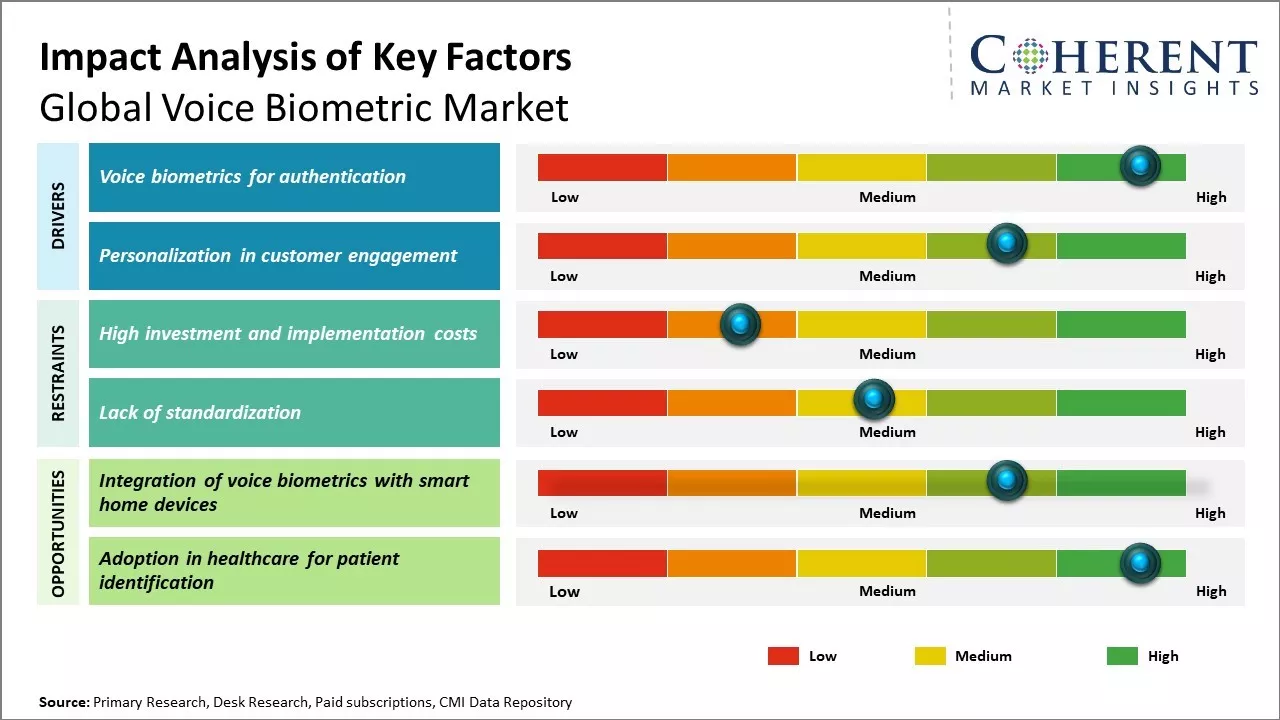
Market Overview
Global voice biometric market is expected to witness significant growth during the forecast period due to factors such as increasing demand for fraud detection and prevention, coupled with rising need for monitoring and access management. With technological advancements in voice recognition capabilities, voice biometric market demand is increasingly being adopted across several applications such as secure access, payments, forensic voice analysis, healthcare record access. Furthermore, integration of voice biometric solutions with other biometric modalities such as face, signature, fingerprints and others can offer opportunities for vendors.
Current Events and their impact on the Voice Biometric Market
Current Event | Description and its Impact |
Regulatory and Privacy Enforcement |
|
Regional Market Expansion and Digital Inclusion |
|
Strategic Partnerships and Corporate Moves |
|
Role of Artificial Intelligence (AI) in Voice Biometric Market
Integration of Artificial Intelligence significantly enhances the accuracy, security, and adaptability of voice biometric systems. AI-powered deep learning models analyze voice traits such as pitch, tone, and accent to enable precise user authentication, even in noisy environments or with natural voice changes.
In active voice biometrics, AI verifies users via spoken passphrases, while in passive systems, it authenticates users during natural conversations without prompts. AI also strengthens liveness detection to prevent spoofing and enables integration with other biometrics like facial or fingerprint recognition.
Overall, AI makes voice biometrics smarter, more secure, and scalable for industries like banking, telecom, and healthcare.
In March 2023, Cerence Inc. launched its enhanced, AI‑powered Voice Biometrics engine, now embedded within Cerence Assistant, designed to deliver deeper personalization and heightened security for in‑car user experiences. The system enables more accurate driver profiling and voice identification across multiple languages, operating entirely in‑vehicle for a frictionless and private setup. Multimodal biometric support extends beyond voice to include cabin-wide identification and authorization use cases, such as touchless authentication for payments, language switching, exterior vehicle access, parental controls, and secure log‑ins and all with minimal footprint and maximum accuracy.
- Current Industry Events of 2026
- Market Size Estimation
- Regional Breakdown
- Competitive Landscape
- Customer Intelligence
- Segmental Analysis
- Pricing Analysis
- Key Market Drivers, Challenges & Future Trends
- Customized Insights Section
Segmental Insights
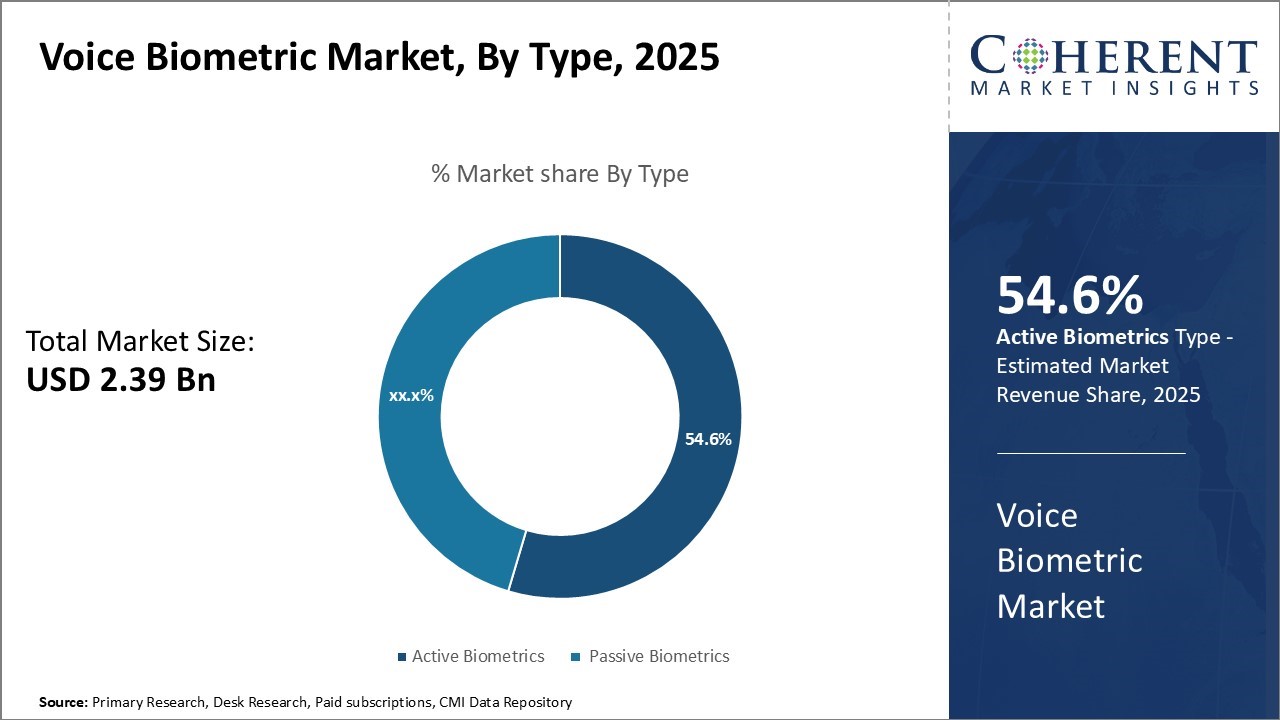
Voice Biometric Market Insights, By Type: Reliability and Security Boosts Adoption of Active Biometrics
In terms of type, active biometrics segment is estimated to contribute the highest market share of 55.6% in 2026, owing to its more accurate verification capabilities as compared to passive biometrics. Active biometric systems require user consent and participation to capture and verify voice samples. This allows the systems to collect more data points for analysis, leading to higher success rates in authentication. The active process also eliminates chances of unauthorized access through unattended devices. As voice is uniquely tied to an individual's physiology, it provides a very reliable method of verification. Active systems can analyze multiple parameters such as tone, pitch, cadence and accent to reduce false acceptance and rejection rates. This high level of precision assures users of security.
In May 2025, ICICI Bank, one of India’s leading private sector banks, introduced a voice recognition system for biometric authentication in phone banking. This innovative feature enables customers to authenticate their identity using their unique voice pattern, eliminating the need for passwords or security questions. The system analyzes over 100 voice characteristics, including speed, accent, and modulation, ensuring a quick, secure, and seamless experience. Such innovations are proliferating the voice biometric market revenue.
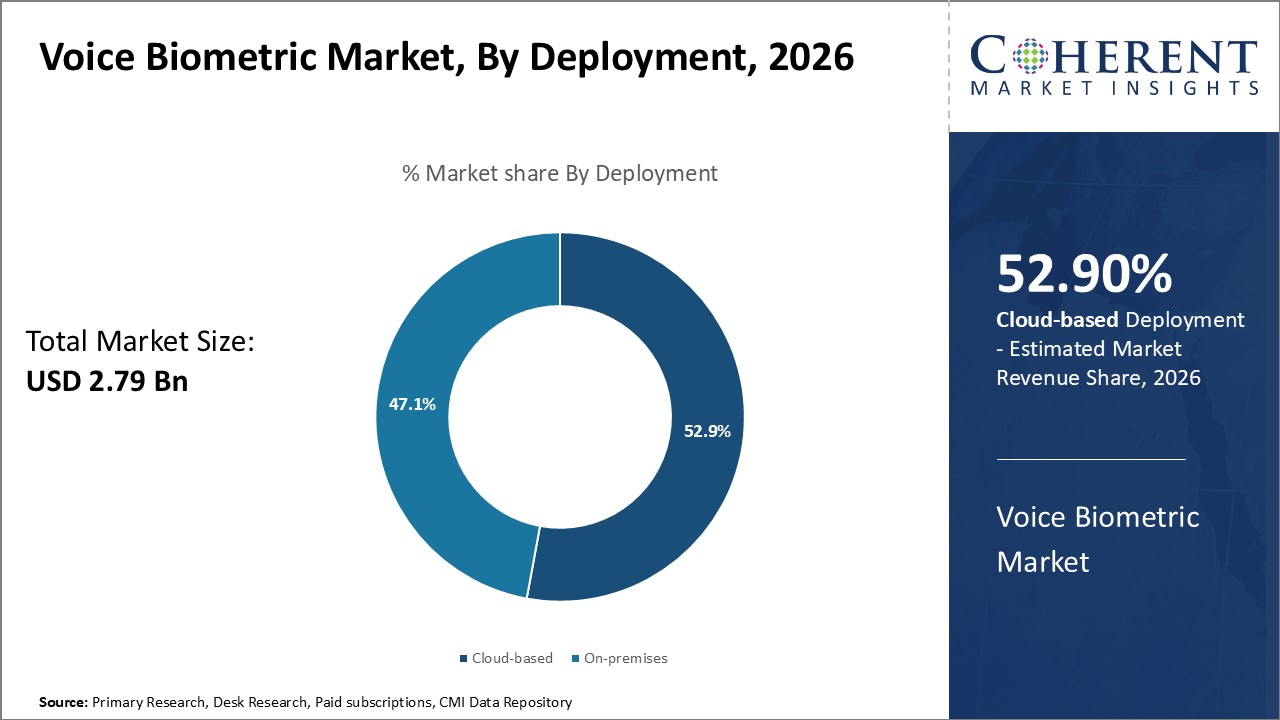
Voice Biometric Market Insights, By Deployment: Ubiquity and Scalability Boosts Adoption of Cloud-based Voice Biometric
In terms of deployment, cloud-based segment is estimated to contribute the highest market share of 52.9% in 2026, owing to advantages like ubiquitous access, scalability, and low upfront costs. Cloud platforms allow voice biometric solutions to be deployed flexibly across diverse environments. As the systems operate via the internet, users can access services and complete verifications from any place at any time. This flexibility makes cloud-based biometric ideal for businesses dealing with remote or mobile workforces. The on-demand nature of cloud also solves issues of over or under-provisioning of infrastructure. Cloud providers seamlessly scale systems up or down to match authentication loads, eliminating costs associated with over-provisioning of on-premise servers.
In March 2025, Advanced Media Inc. launched a next‑generation voice recognition engine powered by end‑to‑end technology on its AmiVoice API, delivered through the AmiVoice Cloud Platform in Japan. the upgrade significantly improves recognition accuracy and now supports three general‑purpose engines: Japanese, Chinese, and a multilingual engine covering Japanese, English, and Chinese usable in both real‑time and batch transcription workflows. Such innovations are accelerating the voice biometric market demand.
Voice Biometric Market Insights, By Vertical: Healthcare Drive Adoption in Biometrics for Health Sector
In terms of vertical, healthcare and life sciences segment is estimated to contribute the highest market share of 40.7% in 2026, owing to growing need of streamlining identity verification while securing sensitive patient data. Voice biometrics are used in healthcare to authenticate providers, nurses and other staff accessing electronic health record systems and restricted areas. This ensures that the right individuals handle crucial patient information and medical equipment. Voice patterns provide a reliable control over privileged access to clinical and billing systems. Healthcare organizations also use biometric to identify patients remotely and verify insurance eligibility electronically. This maintains privacy and convenience during appointments. Furthermore, voice biometrics help reduce medical errors. Hospital readmissions and operations on wrong persons can occur when identities are mistaken. Verifying identities with biometrics mitigates such risks.
In February 2024, VerifiNow launched PatientVerifi, a biometric identity verification platform tailored for telehealth providers. The system integrates voice biometrics, facial recognition, and liveness detection to ensure secure and accurate patient authentication during virtual care sessions. Voice biometrics enables real-time matching of a patient’s spoken voice to a verified profile, preventing impersonation and boosting fraud resilience. Such innovations are proliferating the voice biometric market share.
Regional Insights
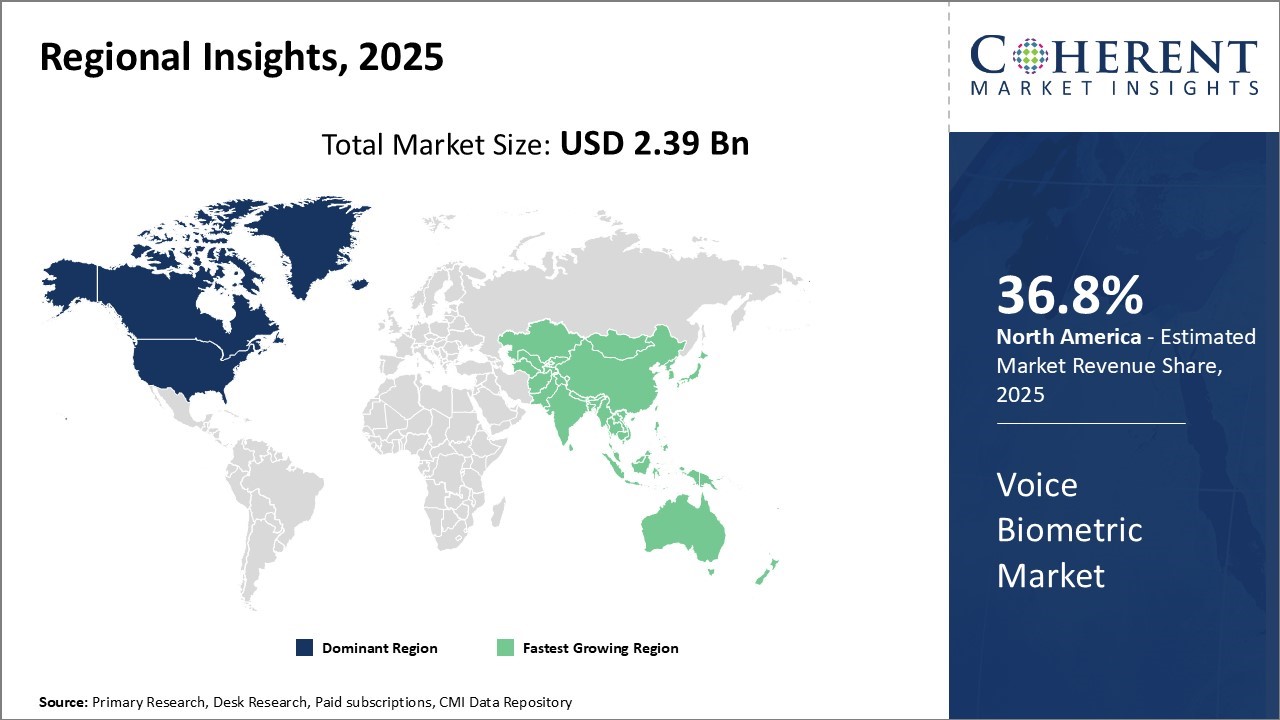
North America Voice Biometric Market Analysis & Trends
North America dominates the global voice biometric market with an estimated market share of 36.8% in 2026. The strong presence of technology leaders and large enterprises from sectors like banking, healthcare and government have boosted adoption of voice biometrics in the region. Voice recognition solutions are increasingly being used for user authentication in mobile apps, call centres, and other customer-facing applications. With strict data privacy regulations and focus on digital transformation, voice biometrics is viewed as a more user-friendly and secure alternative to passwords in the U.S. and Canada.
In August 2024, Veridas, a global leader in AI-based identity verification, intensified its presence in the U.S. with expanded partnerships and advanced voice biometrics technology. Its flagship solution, VoiceShield, now integrates with major platforms like Twilio, Genesys, and Amazon Connect, enabling fraud detection without user enrollment. As cybersecurity concerns rise, the company reports 95% faster customer verification and successful deployments in under four weeks.
Asia Pacific Voice Biometric Market Analysis & Trends
Asia Pacific has emerged as the fastest growing regional for voice biometric market. Massive growth of e-commerce and digital payments in countries like India, China, and Indonesia is propelling voice biometrics deployment. Customers in Asia are more comfortable using voice rather than passwords or fingerprints for verifying transactions on mobile devices due to cultural preferences. This makes Asia an attractive development and deployment region for voice biometric vendors. Rapid expansion of digital services by regional tech giants drives intensive R&D investments to indigenize voice biometric solutions.
In November 2024, Auraya launched ArmorVox™ 18, a transformative upgrade in voice biometrics, designed for faster, smarter, and more secure identity verification. With enhanced onboarding, streamlined voiceprint calibration, advanced cybersecurity, and an intuitive management console, ArmorVox 18 enables effortless migration from legacy Nuance systems without requiring re‑enrolment.
Voice Biometric Market Outlook Country-Wise
The U.S. Voice Biometric Market Trends
The U.S. leads in voice biometric adoption, driven by its strong presence in BFSI, government, and healthcare. Rising identity fraud and the need for secure, frictionless authentication are major growth drivers. Voice biometrics are widely used for contact center authentication and fraud prevention, supported by strict data privacy laws like CCPA and HIPAA.
In May 2023, Xembly launched VoicePrint, a new AI-powered feature that tags meeting participants automatically whether they’re remote or in‑room to enable precise, automated note‑taking, action‑item capture, and task assignment. Building on Xembly’s existing capabilities to detect conversational intent and speaker identity, VoicePrint uses proprietary speaker segmentation and layered voice‑fingerprinting to recognize all participants in a single audio channel.
China Voice Biometric Market Trends
China is rapidly adopting voice biometrics, fueled by strong government investment in AI, surveillance, and smart city programs. National biometric databases are being developed to support identity verification in telecom, banking, and public security. Voiceprint recognition is widely used by telecom providers like China Mobile for authentication and fraud prevention.
Smart city projects integrate voice biometrics with other AI tools for seamless access control and surveillance. The technology also aids law enforcement in criminal investigations. With a centralized push for AI and digital identity, China remains a leading market for voice biometric adoption.
For instance, Ant International’s Alipay+ and electronics firm Meizu achieved the world’s first real‑world e‑wallet transaction via AR smart glasses in Hong Kong, using Meizu’s StarV Snap eyewear with AlipayHK. Users initiated payment hands‑free through QR scanning or voice commands, secured by Alipay+’s AI‑powered voice interface, intent recognition, and voiceprint authentication.
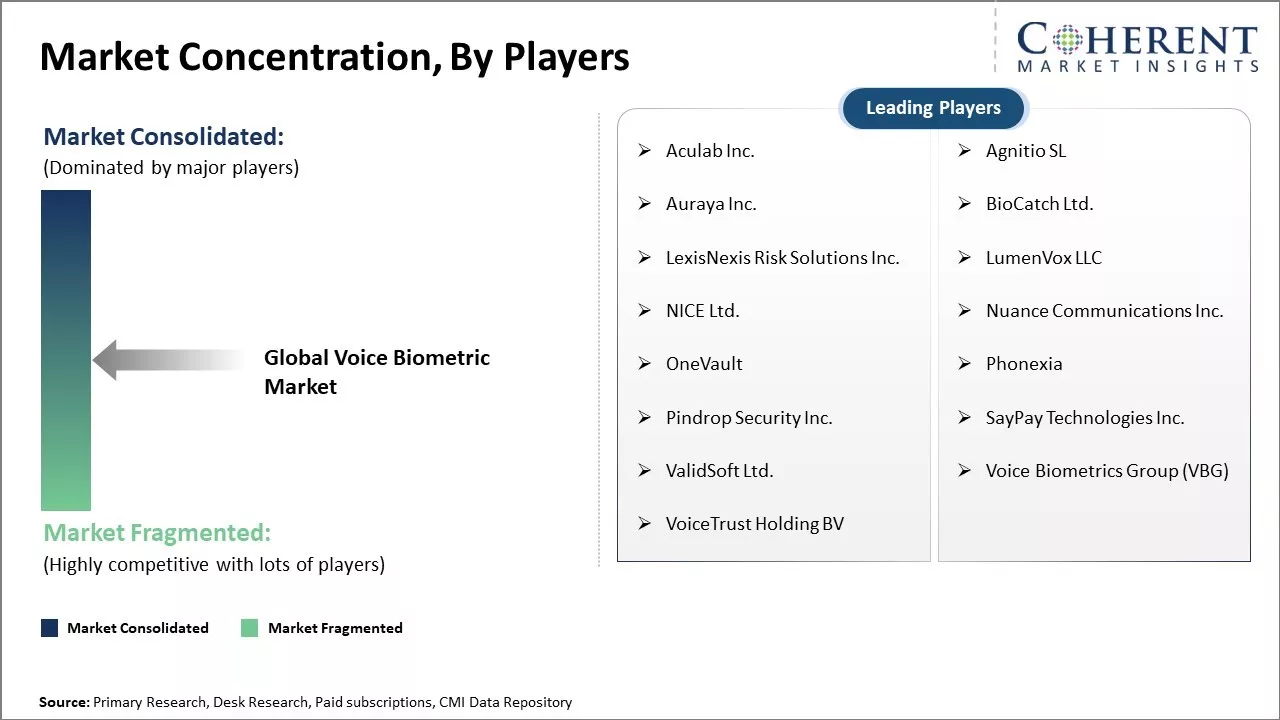
Market Concentration and Competitive Landscape
Voice Biometric Industry News
- In March 2025, Australia and New Zealand Banking Group (ANZ) became the first major Australian bank to roll out voice biometric authentication for large mobile payment transactions in 2025. Customers making payments over AUD 1,000 via the ANZ mobile app will be able to verify their identity simply by speaking a phrase, eliminating the need for PINs or passwords. Developed in partnership with voice‑biometrics provider Nuance, this enhancement aims to increase both the convenience and security of high‑value payments.
- In March 2025, UIDAI and Sarvam AI introduced a groundbreaking voice‑based Aadhaar service, now live with AI‑powered fraud detection and multilingual support. The system enables Aadhaar holders to access key services via voice interaction in up to 10 Indian languages, including Hindi and English.
Market Report Scope
Voice Biometric Market Report Coverage
| Report Coverage | Details | ||
|---|---|---|---|
| Base Year: | 2025 | Market Size in 2026: | USD 2.79 Bn |
| Historical Data for: | 2020 To 2024 | Forecast Period: | 2026 To 2033 |
| Forecast Period 2026 to 2033 CAGR: | 16.8% | 2033 Value Projection: | USD 8.28 Bn |
| Geographies covered: |
| ||
| Segments covered: |
| ||
| Companies covered: | Aculab Inc., Agnitio SL, Auraya Inc., BioCatch Ltd., LexisNexis Risk Solutions Inc., LumenVox LLC, NICE Ltd., Nuance Communications Inc., OneVault, Phonexia, Pindrop Security Inc., SayPay Technologies Inc., ValidSoft Ltd., Voice Biometrics Group (VBG), VoiceTrust Holding BV | ||
| Growth Drivers: |
| ||
| Restraints & Challenges: |
| ||
Voice Biometric Market Driver
- Voice biometrics for authentication
Increasing digitization across various industries and ever-rising threat of cybercrimes boosts the need for enhanced authentication solutions. For instance, according to Daon, 92%of consumers surveyed expect cybersecurity threats to outpace cybersecurity protection technology, so 81% are willing to take extra security measures, such as using voice biometrics to protect their information and accounts. Traditional methods of password and PIN based verification are no longer considered robust enough to prevent illegitimate access.
Voice biometrics is emerging as a more seamless and secure alternative to establish identities without additional hardware tokens or memorization of complex credentials. By leveraging the unique acoustic properties and patterns in a person's voice, this technology ensures that only the authorized user can gain access to sensitive data and platforms. Advanced deep learning algorithms are able to analyze countless vocal features and behaviors to match voiceprints with extremely high accuracy rates.
Voice biometrics allows convenient login from any device without requiring additional memory space for storing passwords. The machine learning models continue enhancing over time to detect spoofing attempts or voice disguises with unparalleled precision. This not only boosts security but also delivers an effortless authentication flow integrated within conversations with voice assistants and call center interactions. More organizations are realizing the potential of voice biometrics technology to balance both protection needs and optimal user experience demands, especially in a work from anywhere culture with diverse access points.
- Personalization in customer engagement
Along with risk mitigation, voice biometrics also enables hyper-personalization of customer journeys. Advanced conversational AI solutions powered by voice recognition capabilities are facilitating highly tailored interactions based on speech patterns, vocabulary usage and customer histories. This level of personalization allows addressing customers by name, recalling past discussions and preferences, as well as recommending most relevant products and offers. As voice interfaces become a primary mode of communication, retaining customer attention and ensuring preference-driven engagements will be crucial for competitive differentiation. As voice interfaces grow in adoption, they are helping enterprises capture greater voice biometric market share by differentiating on user experience.
Voice biometrics collects a wealth of behavioral data during natural conversations to develop rich user profiles. Machine learning algorithms can then match conversation style and context to offer superior personalization at scale. This drives higher response rates to campaigns, cross-sell and up-sell opportunities through 1:1 targeting. Sentiment analysis on tonal variations and emotional signatures further improve understanding diverse personalities and feedback. For instance, Nuance Communications, a Microsoft company, has helped major U.S. banks deploy voice biometrics to personalize customer service while preventing fraud and boosting both engagement and trust.
Voice Biometric Market Opportunities
- Integration of voice biometrics with smart home devices
The integration of voice biometrics with smart home devices presents a great opportunity for global voice biometric market forecast growth. As voice assistants like Alexa, Google Assistant and Siri continue to gain widespread adoption in homes around the world, incorporating biometric authentication could take their capabilities to the next level.
With voice biometrics, smart home devices would be able to reliably recognize individual members of households based on the unique characteristics of their voices. For one, it would allow personalizing the experience for each user. The lights, thermostat and other devices could be customized based on personalized preferences for different family members. Biometric recognition also enhances security and privacy. Access to features or apps could be granted based on voice ID rather than needing to remember passwords. Personal information, messages or finance details would stay private to just that individual.
For instance, in March 2025, Amazon updated its Alexa Skills Kit to simplify testing for Skills Personalization. Developers can now create and manage user voice profiles within the Developer Console, toggling consent settings to simulate different permission configurations. The simulator supports text‑based utterance testing for recognized speakers, even for those with personalization disabled, enabling thorough end‑to‑end testing across scenarios.
Analyst Opinion (Expert Opinion)
The voice biometric market value stands at a pivotal juncture, not because of increasing adoption, but because of how it is being adopted and where.
From a technical standpoint, what separates voice biometrics from other modalities is not merely its convenience, but its capacity for continuous and passive authentication. Unlike fingerprints or OTPs that require active input, voiceprints can be authenticated dynamically during a conversation—an attribute increasingly embedded in call centers and voice agents. HSBC’s deployment of voice biometrics has already enrolled over 15 million customers globally, reducing fraud attempts by over 50%, as per 2024 internal security audits. This shift signals a larger industry trend: authentication is no longer a checkpoint, it’s becoming a background function.
Critically, we’re seeing regional variation in maturity. While North America and Western Europe remain focused on compliance and fraud reduction, markets such as India and the UAE are leapfrogging with more integrated use cases. For example, Aadhaar-linked voice verification trials for pension disbursement in India are already being piloted with state governments, pointing toward public-sector scale deployment.
Another force reshaping the market is on-device processing. Apple's neural engine and Qualcomm’s Snapdragon platforms are now enabling low-latency, offline voiceprint verification without reliance on cloud architecture. This is a gamechanger for sectors like defence and aviation, where data residency and latency are non-negotiable. What we’re witnessing is a decentralization of biometric intelligence—voice recognition is no longer a central server decision; it’s moving to the edge.
Speak to the analyst
Want personalized insights?
Take the findings above to one of our principal consultants, or have the report rebuilt around the segments, geographies and competitors you actually track.
Market Segmentation
- Type Insights (Revenue, USD Bn, 2026 - 2033)
- Active Biometrics
- Passive Biometrics
- Deployment Insights (Revenue, USD Bn, 2026 - 2033)
- Cloud-based
- On-premises
- Vertical Insights (Revenue, USD Bn, 2026 - 2033)
- BFSI
- Retail and Ecommerce
- Government and Defense
- IT and Telecom
- Healthcare and Life Sciences
- Transportation and Logistics
- Travel and Hospitality
- Energy and Utilities
- Others
- Regional Insights (Revenue, USD Bn, 2026 - 2033)
- North America
- U.S.
- Canada
- Latin America
- Brazil
- Argentina
- Mexico
- Rest of Latin America
- Europe
- Germany
- U.K.
- Spain
- France
- Italy
- Russia
- Rest of Europe
- Asia Pacific
- China
- India
- Japan
- Australia
- South Korea
- ASEAN
- Rest of Asia Pacific
- Middle East & Africa
- GCC Countries
- Israel
- South Africa
- Rest of Middle East & Africa
- Key Players Insights (Revenue, USD Bn, 2021 - 2033)
- Aculab Inc.
- Agnitio SL
- Auraya Inc.
- BioCatch Ltd.
- LexisNexis Risk Solutions Inc.
- LumenVox LLC
- NICE Ltd.
- Nuance Communications Inc.
- OneVault
- Phonexia
- Pindrop Security Inc.
- SayPay Technologies Inc.
- ValidSoft Ltd.
- Voice Biometrics Group (VBG)
- VoiceTrust Holding BV
Sources
Primary Research Interviews from the following stakeholders
Stakeholders
- Interviews with cybersecurity officers, voice biometric technology vendors, telecom operators, BFSI security heads, compliance officers, call center infrastructure managers, and authentication solution integrators across global markets.
Specific Stakeholders
- CISOs and digital identity heads at banks and financial institutions
- Customer authentication leads at telecom firms
- Contact center infrastructure managers at BPOs and customer service hubs
- Digital onboarding product owners in fintech firms and neobanks
- IT heads of healthcare systems implementing secure patient access
- Privacy and compliance officers in public sector e-governance programs
- Voice AI and biometrics product managers at OEMs and solution providers
Databases
- World Bank – Digital ID and Cybersecurity datasets
- UN Comtrade Database – Voice and speech processing equipment
- Ministry of Electronics and IT (MeitY), India
- U.S. Department of Homeland Security – Biometric standards and adoption reports
- Eurostat – ICT and Security Usage by Enterprises
- Japan Ministry of Internal Affairs and Communications
- China Biometric Data Infrastructure Statistics
- South Korea – National IT Industry Promotion Agency (NIPA)
Magazines
- Biometric Update
- Security Today
- Cybersecurity Insiders
- Biometric Technology Today
- IT Security Guru
- Enterprise Security Magazine
- CSO Online
- FindBiometrics
Journals
- IEEE Transactions on Biometrics, Behavior, and Identity Science
- Pattern Recognition (Elsevier)
- Journal of Information Security and Applications
- International Journal of Speech Technology
- Computers & Security
- ACM Transactions on Privacy and Security
Newspapers
- The Wall Street Journal – Cybersecurity and Identity
- The Economic Times – Digital Transformation & Fintech
- The Hindu Business Line – Technology & AI
- Financial Times – Biometrics and Digital Security Reports
- Nikkei Asia – Identity and Voice Technology in APAC
- South China Morning Post – AI and Authentication Trends
Associations
- FIDO Alliance (Fast Identity Online)
- Biometric Institute (Australia)
- International Biometrics + Identity Association (IBIA)
- Voice Biometrics Group
- National Cybersecurity Alliance
- GlobalPlatform – Trusted Identity Standards
- Data Security Council of India (DSCI)
- European Union Agency for Cybersecurity (ENISA)
Public Domain Sources
- National Institute of Standards and Technology (NIST), U.S. – Speaker recognition evaluations
- UIDAI (Unique Identification Authority of India) – Aadhaar authentication reports
- U.S. Federal Trade Commission – Identity Theft Reports
- UK Information Commissioner's Office – Biometric data handling regulations
- CERT-In (India) – Voice data breach incident logs
- European Commission – Biometric and identity-related whitepapers
- Ministry of Home Affairs, India – Digital authentication infrastructure reports
- NITI Aayog – Digital Public Infrastructure updates
Proprietary Elements
- CMI Data Analytics Tool, and Proprietary CMI Existing Repository of information for last 8 years
*Definition: Global Voice Biometric Market refers to the market for technology that can identify and verify individuals based on the unique acoustic characteristics of their voices. Voice biometrics analyzes vocal parameters such as pitch, cadence, tone and timbre to authenticate user identities. It enables contact centers, financial institutions and other businesses to securely and conveniently verify callers using voice samples alone.
Get access to 250+ pages report
Every segment, forecast, competitor profile and data table behind the analysis above — available for instant download.
- ESOMAR Member
- ISO 9001:2015 Certified
- D-U-N-S Registered
- GDPR & CCPA Compliant
Missing comfort of reading report in your local language? Find your preferred language:
Transform your Strategy with Exclusive Trending Reports
Frequently Asked Questions
The Voice Biometric Market is estimated to be valued at USD 2.79 Bn in 2026, and is expected to reach USD 8.28 Bn by 2033.
The CAGR of the Voice Biometric Market is projected to be 16.8% from 2026 to 2033.
Voice biometrics for authentication and personalization in customer engagement are the major factors driving the growth of global voice biometric market.
High investment and implementation costs and lack of standardization are the major factors hampering the growth of global voice biometric market.
In terms of type, active biometrics segment is estimated to dominate the market in 2026.
Aculab Inc., Agnitio SL, Auraya Inc., BioCatch Ltd., LexisNexis Risk Solutions Inc., LumenVox LLC, NICE Ltd., Nuance Communications Inc., OneVault, Phonexia, Pindrop Security Inc., SayPay Technologies Inc., ValidSoft Ltd., Voice Biometrics Group (VBG), VoiceTrust Holding BV are the major players.
North America is expected to lead the global voice biometric market in 2026.