

Intelligent Virtual Assistant Market Size and Share Analysis: (2026 - 2033)
The intelligent virtual assistant market was valued at USD 34.45 Bn in 2026 and is forecast to reach a value of USD 283.1 Bn by 2033 at a CAGR of 33% between 2026 and 2033.
Key Takeaways
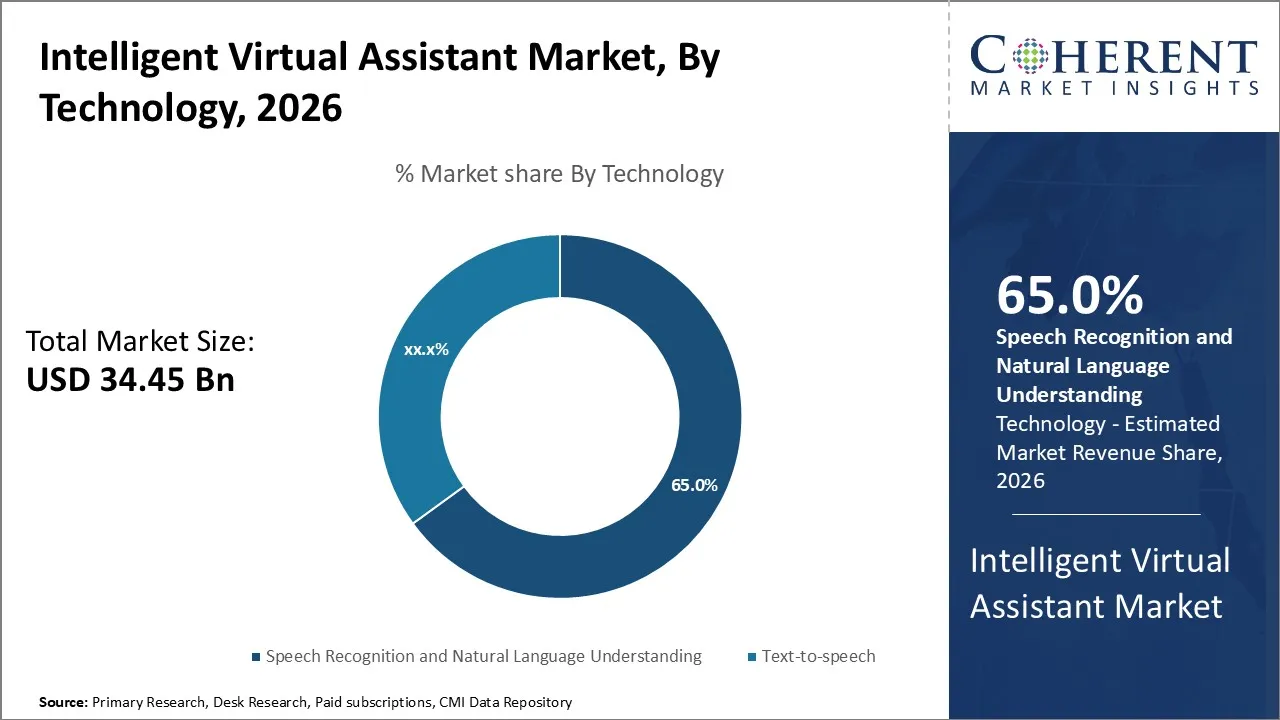
- Based on technology, the speech recognition and natural language understanding segment is expected to hold 65% share of the market in 2026.
- Based on end user, the large enterprises segment is projected to account for 55% share of the market in 2026.
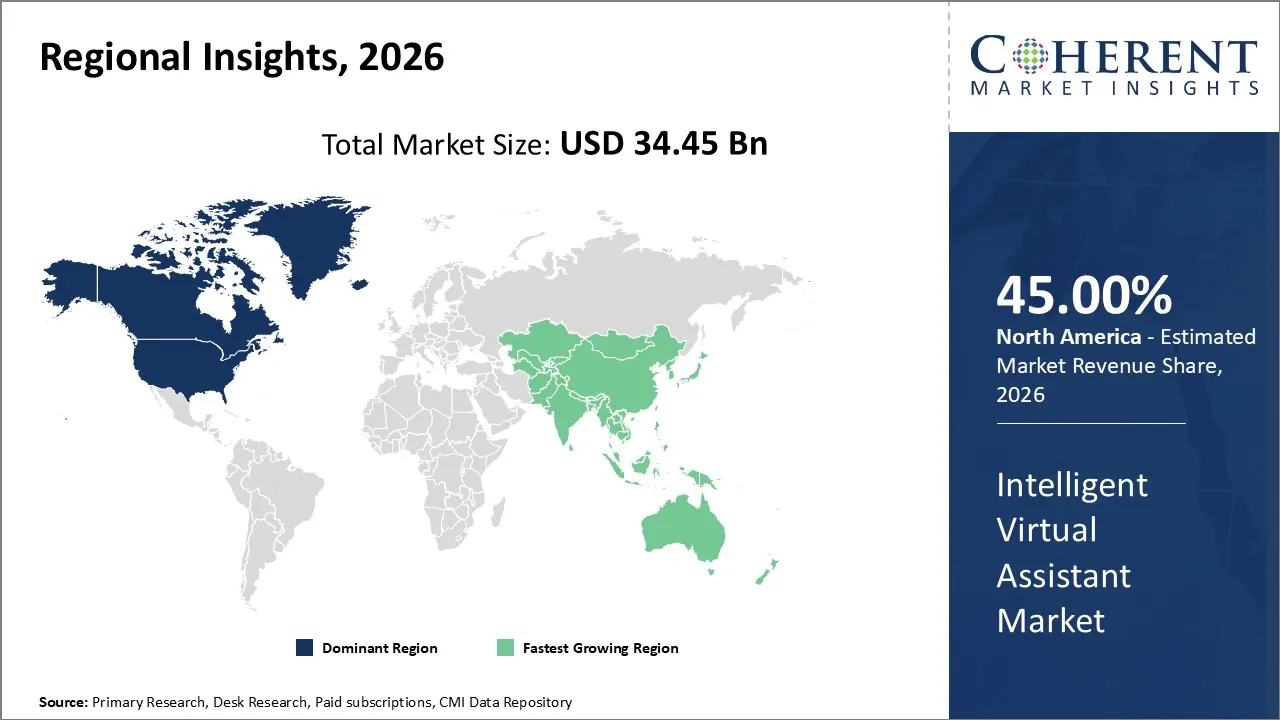
- Based on Region, North America is set to lead the intelligent virtual assistant market with 45% share in 2026. While, Asia Pacific is anticipated to be the fastest growing region.
Market Overview
A virtual assistant is an intelligent system that supports users whenever users seek information. Virtual assistants act as a real system, in order to avoid users waiting for a long time in getting the information they need. An intelligent virtual assistant not only aims to answer user queries but also offers recommendations in order to keep the user communication going. A virtual assistant helps to establish brand loyalty through a persona. A virtual assistant solves customer queries as well as help to advertise products. Furthermore, the virtual assistant has become popular due to its ability to personalize customer service experience. Growing demand for automation in customer service and business operations is encouraging organizations to adopt IVAs to reduce costs and improve productivity. The increasing use of smartphones, smart devices, and IoT technologies is also boosting accessibility and integration.
Current Events and their Impacts on the Intelligent Virtual Assistant Market
Current Event | Description and its Impact |
Expansion of Healthcare AI Assistants |
|
Enterprise as well as Consumer Adoption of IVA Platforms |
|
Segmental Insights
- Current Industry Events of 2026
- Market Size Estimation
- Regional Breakdown
- Competitive Landscape
- Customer Intelligence
- Segmental Analysis
- Pricing Analysis
- Key Market Drivers, Challenges & Future Trends
- Customized Insights Section
Intelligent Virtual Assistant Market Insights, By Technology - Speech recognition and natural language understanding represent the largest share
In terms of technology, the speech recognition and natural language understanding segment is expected to lead the market with 65% share in 2026, this dominance is primarily attributable to the critical role these technologies play in enabling IVAs to interpret, process, and respond to complex human language inputs effectively. Speech recognition enables the system to convert spoken language into machine-readable text, while NLU makes the assistant to comprehend the intent behind the user’s speech, facilitating responses that are contextually relevant as well as meaningful.
One of the major reasons behind the dominance of the Speech Recognition and NLU segment is the high adoption of voice-enabled applications across diverse industries, from customer service as well as healthcare to automotive and financial services. Governments and international organizations are promoting AI-driven automation as a means to enhance service delivery and efficiency.
Intelligent Virtual Assistant Market Insights, By End Users - Large enterprise dominates the market
In terms of end user, the large enterprise segment is expected to hold 55% share of the market in 2026. Primarily attributable to their substantial operational scale, extensive customer base, as well as major investment capacity in advanced digital technologies. Large enterprises are leveraging Intelligent Virtual Assistants comprehensively across various functions such as customer service, human resources, and internal operations, which makes their share particularly prominent.
For instance, multinational companies like IBM have connected AI-powered virtual assistants across their service desks and internal help systems, drastically improving response times and operational efficiency. These organizations tend to adopt IVAs to automate routine interactions, streamline workflows, as well as provide personalized experiences to a broad user base, thus lowering operational costs as well as enhancing overall productivity.
Regional Insights
North America Intelligent Virtual Assistant Market Analysis & Trends
North America is expected to dominate the Intelligent Virtual Assistant market with 45% share in 2026, owing to its highly advanced technological infrastructure, mature digital economy, and widespread adoption of AI-driven customer engagement tools. For example, recent initiatives by U.S. federal and state governments authorities have aimed at promoting artificial intelligence integration in both public and private sectors have created fertile ground for IVA deployment. The adoption of intelligent virtual assistants in healthcare, finance, as well as retail sectors across North America is particularly notable.
For instance, in December 2025, Elevance Health has made it’s Virtual Assistant easier to use. This digital helper lets members quickly get information, understand their benefits, and find healthcare services. It works through the Sydney Health app and Elevance Health websites. The Virtual Assistant uses conversation-style technology to make healthcare simpler and help members connect better with their health plans.
Asia Pacific Intelligent Virtual Assistant Market Analysis & Trends
Asia Pacific is expected to exhibit the fastest growth, fueled by high digitalization, increasing smartphone penetration, as well as rising consumer demand for automation in services across emerging economies. Countries like India, China, Japan, and South Korea are experiencing a major surge in IVA adoption across sectors such as banking, telecommunications, healthcare, and e-commerce.
For instance, in 2025, in China, a project that created a self-running virtual hospital became public, showing how quickly the country is using AI in healthcare.
Intelligent Virtual Assistant Market Outlook Country-Wise
The U.S. Intelligent Virtual Assistant Market Trends
The U.S. contributes the highest share in the Intelligent Virtual Assistant (IVA) market in the region due to its mature technological infrastructure, extensive adoption across diverse industries, as well as significant investment in artificial intelligence research and development. Places like Silicon Valley, Seattle, and Boston are tech centers that create new ideas. They help put smart virtual assistants into products for consumers, businesses, and healthcare.
For instance, in March 2025, AvaSure, a top company in virtual healthcare, released its new Virtual Care Assistant. It uses advanced technology from Oracle and NVIDIA to aid hospitals take better care of patients, make doctors’ work easier, and run the hospital more efficiently.
China Intelligent Virtual Assistant Market Trends
China contributes the highest share in the Intelligent Virtual Assistant (IVA) market in the region owing to its unparalleled advancements in artificial intelligence technologies, high digital transformation initiatives, as well as substantial government backing aimed at fostering smart city projects and digital economies. The Chinese government's "AI Development Plan" emphasizes the integration of virtual assistants across multiple sectors such as retail, banking, healthcare, etc., which has spurred accelerated adoption of these technologies.
For instance, big Chinese tech companies like Baidu, Alibaba, and Tencent have spent a lot on smart virtual assistants. These systems can understand Mandarin and other Chinese dialects, helping them work well with the country's different languages.
Market Report Scope
Intelligent Virtual Assistant Market Report Coverage
| Report Coverage | Details | ||
|---|---|---|---|
| Base Year: | 2025 | Market Size in 2026: | USD 34.45 Bn |
| Historical Data for: | 2020 To 2024 | Forecast Period: | 2026 To 2033 |
| Forecast Period 2026 to 2033 CAGR: | 33% | 2033 Value Projection: | USD 283.1 Bn |
| Geographies covered: |
| ||
| Segments covered: |
| ||
| Companies covered: | NextIT Corp., eGain Communications Corp., Creative Virtual Ltd., Artificial Solutions Ltd., Creative Virtual Ltd., SpeakToit Inc., Anboto Group., IntelliResponse Systems Inc., Nuance Communications Inc, Five9 Inc., and CodeBaby Corp | ||
| Growth Drivers: |
| ||
| Restraints & Challenges: |
| ||
Intelligent Virtual Assistant Market Driver
Growing adoption of AI and machine learning technologies
The accelerating integration of artificial intelligence and machine learning technologies represents a fundamental catalyst transforming the intelligent virtual assistant landscape across multiple sectors. Organizations worldwide are increasingly recognizing the strategic value of AI-powered conversational interfaces that can process natural language, learn from user interactions, and deliver personalized experiences at scale. This technological evolution has moved beyond simple command-response mechanisms to sophisticated systems capable of contextual understanding, emotional intelligence, and predictive analytics.
Increasing demand for automation and operational efficiency
The relentless pursuit of automation and operational efficiency across industries has emerged as a primary catalyst propelling the Intelligent Virtual Assistant (IVA) market forward. Organizations worldwide are increasingly recognizing that traditional customer service models and internal operational processes are insufficient to meet the demands of today's fast-paced, always-connected business environment. According to the Organization for Economic Co-operation and Development (OECD), digital transformation initiatives accelerated significantly during the pandemic, with over 70% of surveyed enterprises reporting increased investment in automation technologies between 2020-2022.
Intelligent Virtual Assistant Market Opportunity
Integration with emerging technologies like AR/VR and blockchain
The integration of emerging technologies such as Augmented Reality (AR), Virtual Reality (VR), and blockchain with Intelligent Virtual Assistants (IVAs) represents a transformative opportunity that could significantly elevate the functionality, security, and user engagement within this market. AR and VR technologies enhance the immersive capabilities of IVAs by providing users with interactive, three-dimensional environments where virtual assistants can operate more naturally and contextually.
Analyst Opinion (Expert Opinion)
- The Intelligent Virtual Assistant (IVA) market is poised for significant transformation driven by rapid advancements in artificial intelligence, natural language processing, and machine learning technologies.
- High demand for enhanced customer experience across industries such as healthcare, retail, banking, telecommunications, etc., is a primary driver propelling adoption of IVAs. Organizations are adopting these assistants to streamline customer interactions, lower operational costs, as well as improve service efficiency.
- However, challenges related to data privacy concerns, integration complexity with legacy systems, as well as occasional limitations in understanding nuanced human language could restrain market potential to some extent.
- Opportunities abound as the proliferation of smart devices as well as growing acceptance of voice-activated technologies create new avenues for IVA applications. Additionally, the integration of sentiment analysis as well as emotional AI capabilities is expected to make virtual assistants more intuitive as well as personalized, expanding their usability.
- North America leads the market now because of strong technology, lots of AI use, and major companies being there. At the same time, Asia-Pacific is growing fastest, helped by more digital technology, more smartphones, and government support for AI.
Speak to the analyst
Want personalized insights?
Take the findings above to one of our principal consultants, or have the report rebuilt around the segments, geographies and competitors you actually track.
Global Intelligent Virtual Assistant Market: Key Developments
In March 2026, Baidu announced that its health platform will launch an AI assistant to help doctors. The assistant will organize research, track papers, set reminders, and follow new publications
Market Segmentation
- By Technology
- Text-to-speech
- Speech recognition and natural language understanding
- By End users
- Individual users
- Small and medium enterprise
- Large enterprise
- By Region
- North America
- U.S.
- Canada
- Latin America
- Brazil
- Argentina
- Mexico
- Rest of Latin America
- Europe
- Germany
- U.K.
- Spain
- France
- Italy
- Russia
- Rest of Europe
- Asia Pacific
- China
- India
- Japan
- Australia
- South Korea
- ASEAN
- Rest of Asia Pacific
- Middle East & Africa
- GCC Countries
- Israel
- Rest of Middle East & Africa
- North America
- Key Players
- NextIT Corp
- eGain Communications Corp
- Creative Virtual Ltd
- Artificial Solutions Ltd
- Creative Virtual Ltd
- SpeakToit Inc
- Anboto Group
- IntelliResponse Systems Inc
- Nuance Communications Inc
- Five9 Inc
- CodeBaby Corp
Sources
Primary Research Interviews
- Technology executives from major IVA platform providers
- IT decision-makers from enterprise organizations implementing IVA solutions
- Product managers from cloud service providers offering IVA services
- AI/ML researchers and developers specializing in conversational AI
- Others
Databases
- Gartner IT Market Data
- IDC Worldwide Software Tracker
- Others
Magazines
- AI Magazine
- Enterprise AI Magazine
- VentureBeat AI & Machine Learning
- MIT Technology Review
- Others
Journals
- Journal of Artificial Intelligence Research
- IEEE Transactions on Neural Networks and Learning Systems
- International Journal of Human-Computer Studies
- Others
Newspapers
- The Wall Street Journal (Technology Section)
- Financial Times (Digital Business)
- TechCrunch
- Forbes Technology Council
- Others
Associations
- Association for the Advancement of Artificial Intelligence (AAAI)
- IEEE Computer Society
- International Association of Computer Science and Information Technology
- Partnership on AI
- Others
Public Domain Sources
- U.S. Patent and Trademark Office (USPTO) AI patent filings
- SEC filings from major technology companies
- Government AI strategy documents and white papers
- Open-source AI research repositories (GitHub, arXiv)
- Others
Proprietary Elements
- CMI Data Analytics Tool
- Proprietary CMI Existing Repository of Information for the Last 8 Years
Get access to 250+ pages report
Every segment, forecast, competitor profile and data table behind the analysis above — available for instant download.
- ESOMAR Member
- ISO 9001:2015 Certified
- D-U-N-S Registered
- GDPR & CCPA Compliant
Missing comfort of reading report in your local language? Find your preferred language:
Transform your Strategy with Exclusive Trending Reports
Frequently Asked Questions
The global intelligent virtual assistant market size was valued at USD 34.45 Bn in 2026 and is expected to reach USD 283.1 Bn in 2033.
Major players operating in the market include NextIT Corp., eGain Communications Corp., Creative Virtual Ltd., Artificial Solutions Ltd., Creative Virtual Ltd., SpeakToit Inc., Anboto Group., IntelliResponse Systems Inc., Nuance Communications Inc., Five9 Inc., and CodeBaby Corp.
Among technology, the speech recognition and natural language understanding segment estimated significant revenue in 2026.
Major factor driving the growth of global intelligent virtual assistant market during the forecast period is growing emphasis on improving alignment between customers
The market is estimated to exhibit a CAGR of 33% till 2033.
Among region, North America is expected to witness significant growth over the forecast period.