

Ambient Intelligence Market Size and Forecast — 2026-2033
The Ambient Intelligence Market size is estimated to be valued at USD 9.73 billion in 2026 and is expected to reach USD 25.11 billion by 2033, exhibiting a compound annual growth rate (CAGR) of 14.5% from 2026 to 2033.
Overview
Ambient Intelligence is a part of pervasive computing environment that aids in interacting with and respond to humans in that environment. Moreover, its features include activity recognition, reasoning, and decision making. For instance, sensor networks are utilized for data collection; and human computer interaction enables natural interfaces.
Ambient intelligence is a Component helps in gathering digital information to make interactions between human and computer, easy by expanding the interface media and making it available for smartphone devices and other modes of portable communication. Furthermore, it enables computers to adapt to their user preferences.
The innovative interface paradigms of ambient intelligence Component can be used for Technology in the healthcare sector to improve various real time solutions, including continuous monitoring health systems and providing diagnosis on various health conditions. For example, in September 2017, Nuance launched artificial intelligence (AI)-powered virtual assistant solution designed specifically for healthcare providers, which is expected to improve patient experience and reduce physician burnout. In April 2017, Ambient Clinical Analytics received US$ 5.4 Mn in funding for its enhancing its Clinical Decision Support and Control Tower Software Platform.
Key Takeaways
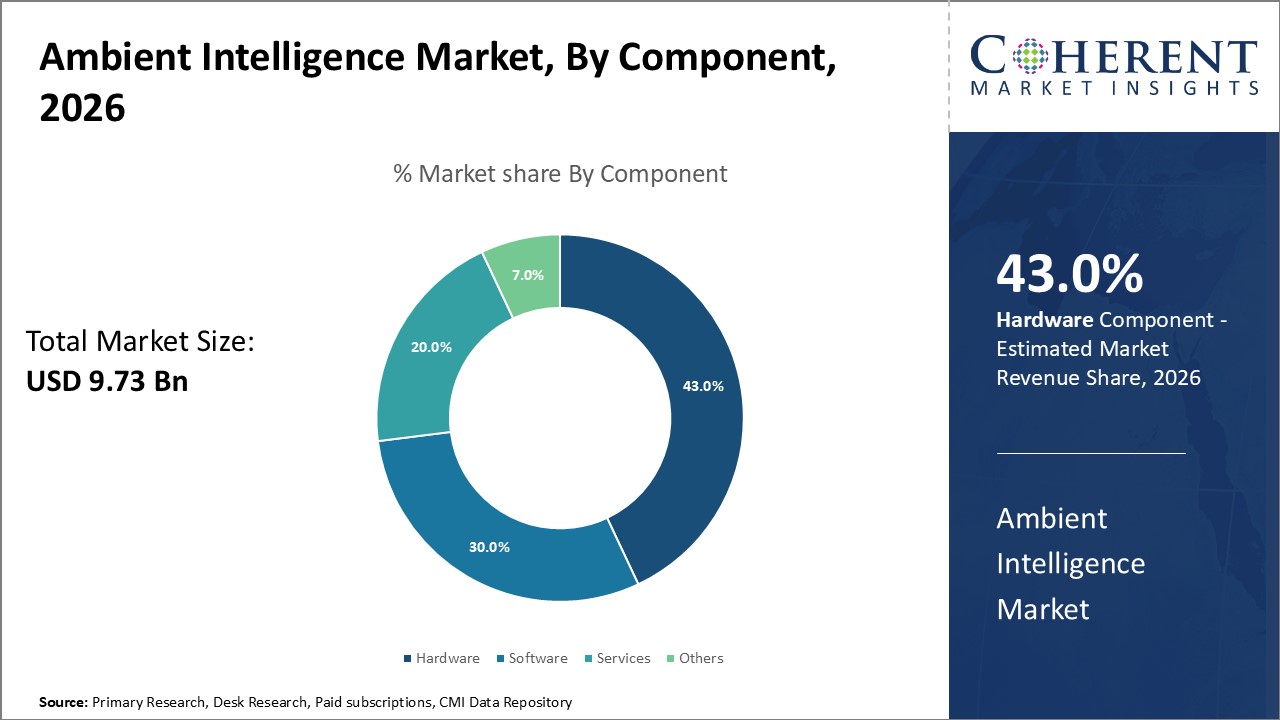
Based on component, the Hardware component dominates with a 43% industry share, driven primarily by demand in smart home devices. Software solutions, although smaller, are the fastest growing due to AI advancements.
Application-wise, smart homes represent the largest market size, accounting for 39% of market revenue in 2026, with healthcare showing rapid adoption enabled by predictive analytics.
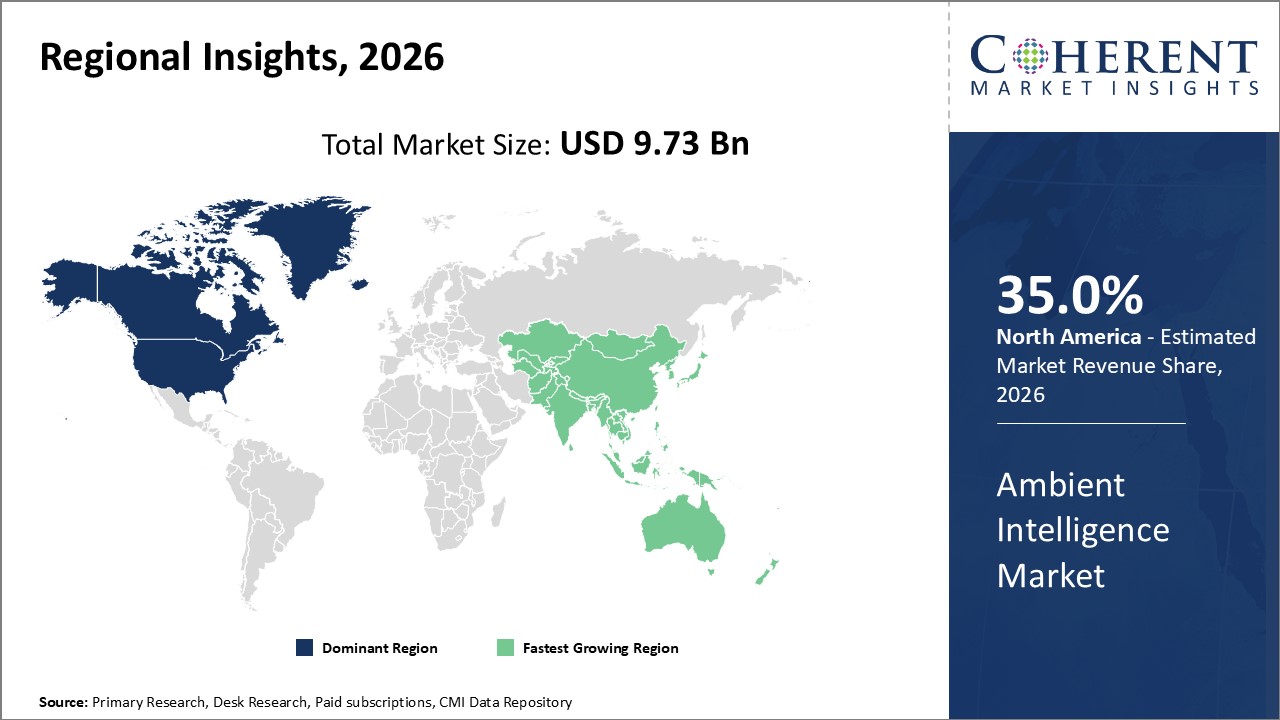
Regionally, North America commands the largest market share, exceeding 35%, attributable to its mature IoT infrastructure and early adoption of smart technologies. Meanwhile, the Asia Pacific region demonstrates the fastest CAGR, fueled by government support and expanding industrial IoT ecosystems.
The automotive sector across Europe is leveraging ambient intelligence to improve driver safety and in-vehicle experiences, signaling diversifying industry trends shaping the market forecast.
Ambient Intelligence Market – Segmentation Analysis
Ambient Intelligence Market Insights, By Component
In terms of Components, Hardware dominates the market share with 43%. Hardware, including sensors, edge devices, and processors, underpins the entire ambient intelligence ecosystem by providing the physical layer for environment sensing and data gathering. The steady decline in hardware costs coupled with improvements in sensor accuracy continues to drive demand across applications like smart homes and healthcare.
Ambient Intelligence Market Insights, By Technology
In terms of Technology, Machine Learning & AI accounting for a commanding 39% market share. This segment’s dominance is attributed to its capability to analyze vast data sets and enable intelligent responses within ambient environments, a foundational enabler for most use cases including healthcare and smart buildings.
Ambient Intelligence Market Insights, By Application
In terms of Application, Smart Homes dominate with a 38% market share. Smart homes leverage ambient intelligence to automate lighting, security, and energy management, driven by consumer demand for comfort and efficiency.
Ambient Intelligence Market Trends
The ambient intelligence market is witnessing significant shifts towards decentralized AI models that process data locally on edge devices, enhancing privacy and reducing latency. For example, in 2026, over 45% of ambient intelligence deployments used decentralized frameworks, underscoring a growing trend away from centralized cloud dependency.
Additionally, integration with 5G networks is accelerating data throughput and enabling real-time ambient scenarios in smart cities and autonomous driving. The rise of context-aware AI chatbots and voice assistants with natural language understanding further exemplifies the trend of intuitive human-machine interaction. The retail industry has notably adopted ambient intelligence for personalized shopping experiences, reflecting a market trajectory towards hyper-personalization.
Ambient Intelligence Market Insights, By Geography
North America Ambient Intelligence Market Analysis and Trends
High technological preparedness, a strong IoT infrastructure, and large R&D expenditures by leading market players like IBM and Honeywell are the main drivers of North America's dominance in the ambient intelligence market share, which stands at over 35%. Due to federal and state government activities supporting smart city frameworks and healthcare technology upgrades, the United States in particular commands a significant proportion.
Asia Pacific Ambient Intelligence Market Analysis and Trends
As a result of growing digital transformation in emerging economies like China, the Asia Pacific area is growing at the quickest rate, with a compound annual growth rate (CAGR) of over sixteen percent. Ambient intelligence market expansion is accelerated by governments' emphasis on smart manufacturing and linked urban environments, as well as a rise in regional market leaders like Huawei.
Ambient Intelligence Market Outlook for Key Countries
United States Ambient Intelligence Market Analysis and Trends
The USA’s ambient intelligence market is bolstered by strong demand from smart home adopters and industrial automation sectors.
In 2025, government grants and private investments exceeded USD 1 billion for AI-enabled ambient solutions, fostering innovation among market companies like Microsoft and Intel. The country is also home to numerous start-ups pioneering AI-contextual computing innovations, consolidating the USA’s leadership in technology deployment.
China Ambient Intelligence Market Analysis and Trends
China’s market is propelled by expansive smart city projects and manufacturing digitization. With initiatives like the ‘New Infrastructure’ policy emphasizing 5G and IoT ecosystems, ambient intelligence has become integral to urban planning and industrial automation. Huawei’s active role in developing AI-powered ambient environments has significantly contributed to market penetration, making China a vital contributor to regional market growth and a hub for emerging business growth in ambient intelligence technologies.
Analyst Opinion
The rapid proliferation of edge devices with enhanced processing capabilities is a critical supply-side indicator bolstering the Ambient Intelligence Market share. In 2025, over 61% of deployed ambient intelligence devices incorporated edge computing modules, enhancing latency-sensitive applications especially in healthcare and smart transportation.
Demand-side momentum is significantly shaped by rising adoption in smart homes and enterprise automation. For instance, in 2026, smart home implementations accounted for around 39% of the ambient intelligence system revenues, reflecting increasing consumer inclination for context-aware automation.
Pricing dynamics indicate a gradual downward trend due to technological advancements and economies of scale, facilitating broader market penetration. Industry data from 2025 show a 13% average reduction in ambient intelligence hardware costs compared to 2022, making market growth more accessible for mid-sized enterprises.
Vertical-specific use cases, notably in healthcare monitoring and predictive maintenance for manufacturing plants, remain dominant micro-indicators. Examples include a 26% increase in implementation of ambient intelligence for patient monitoring systems between 2023 and 2026, signaling strong sector-specific market growth drivers.
- Current Industry Events of 2026
- Market Size Estimation
- Regional Breakdown
- Competitive Landscape
- Customer Intelligence
- Segmental Analysis
- Pricing Analysis
- Key Market Drivers, Challenges & Future Trends
- Customized Insights Section
Market Scope
| Report Coverage | Details | ||
|---|---|---|---|
| Base Year: | 2025 | Market Size in 2026: | USD 9.73 billion |
| Historical Data for: | 2020 To 2024 | Forecast Period: | 2026 To 2033 |
| Forecast Period 2026 to 2033 CAGR: | 14.5% | 2033 Value Projection: | USD 25.11 billion |
| Geographies covered: |
| ||
| Segments covered: |
| ||
| Companies covered: | Toshiba Corporation, Siemens AG, Honeywell International Inc., Bosch Software Innovations, IBM Corporation, Hitachi Ltd., Panasonic Corporation, Cisco Systems Inc., Intel Corporation, Google LLC | ||
| Growth Drivers: |
| ||
Ambient Intelligence Market Growth factors
The ambient intelligence market growth is propelled mainly by the rise in smart city initiatives and digital transformation efforts globally, which demand context-aware and automated infrastructures. Increasing consumer preference for smart home technologies also catalyzes market revenue, with smart home applications contributing nearly 41% of total market share in 2026.
Furthermore, advancements in machine learning algorithms enhance system accuracy and responsiveness, expanding ambient intelligence adoption in healthcare and industrial sectors. The regulatory push towards energy-efficient and secure smart environments is another catalyst encouraging market companies to innovate aggressively, evidenced by a 15% rise in government-funded projects integrating ambient intelligence in 2025.
Ambient Intelligence Market Development
In June 2026, Mayo Clinic in Florida is exploring the potential for ambient clinical intelligence to enable a more proactive approach to care delivery, and potentially reduce hospitalizations and severity of illness and improve patient quality of life.
In February 2026, Intel Corp. and Qualcomm Inc. are among the first members of the Ambient IoT collaboration, a new collaboration aimed at creating and advancing a global internet of things ecosystem. The organization was inaugurated. The goal of AIoTA, a cross-industry alliance aimed at advancing and scaling the future ambient IoT ecosystem, is to encourage and facilitate the growth of an open, standardized, and aligned multi-standard ecosystem.
Key Players
Toshiba Corporation
Siemens AG
Honeywell International Inc.
IBM Corporation
Hitachi Ltd.
Panasonic Corporation
Cisco Systems Inc.
Intel Corporation
Google LLC
Competitive strategies predominantly revolve around intensive R&D for AI and sensor fusion, strategic partnerships to expand IoT ecosystems, and aggressive acquisitions of AI startups to consolidate technology portfolios. For instance, IBM’s strategic collaboration with healthcare firms led to a 21% market revenue uplift in ambient intelligence-powered patient care solutions in 2025.
Ambient Intelligence Market Future Outlook
The market for ambient intelligence will increase rapidly in the coming years due to developments in edge computing, sensor technologies, artificial intelligence, and the Internet of Things. It will place a greater emphasis on cross-industry partnerships, blockchain integration, health and wellness applications, and human-centric design. Ambient intelligence technologies will become more widely used as a result of global smart city projects and growing urbanization, which will be encouraged by government laws. The use of ultra-low-power semiconductors and energy-efficient, privacy-preserving edge AI will be essential to lowering latency and dependency on cloud computing.
Smart homes, autonomous cars, healthcare, and sustainable urban infrastructure will represent important commercial opportunities. Businesses will continue innovating through collaborations, product development, and regional growth, while user experiences will be enhanced by the widespread usage of wearable technology, voice-activated assistants, and augmented reality integration. With the help of significant investments and trial projects, the Asia-Pacific region will spearhead worldwide adoption. Ultimately, over the next ten years, ambient intelligence will shape smart living and working spaces by enabling more seamless, context-aware settings that will enhance convenience, security, and energy efficiency.
Market Evolution
Historically, the Ambient Intelligence Market evolved from early concepts of context-aware computing and pervasive sensor networks into a dynamic global sector characterized by fast-paced technological integration and adoption. Initially, growth was driven by smart home and smart city initiatives, with North America and Europe led due to investments in infrastructure and vendor innovation. The market’s foundation was built on embedded, adaptive systems enhanced by artificial intelligence, IoT, and machine learning, enabling responsive and intuitive user environments. Over the years, key players such as Johnson Controls, Siemens, and Honeywell International increased market penetration through developments in energy management, security, and healthcare applications.
From 2017 to 2022, Ambient Intelligence witnessed accelerated adoption, especially as industries recognized its value for personalized experiences, operational efficiency, and real-time data insights.
Sources
Primary Research interviews:
Healthcare technology providers
Smart city project managers
Consumer electronics retailers
Databases:
Web of Science
ScienceDirect
Magazines:
IEEE Spectrum
Fast Company (Technology section)
Technology Review Asia
Journals:
Pervasive and Mobile Computing
Future Generation Computer Systems
ACM Transactions on Computer-Human Interaction (TOCHI)
Newspapers:
Financial Times (Technology)
The Economic Times (Tech)
The Wall Street Journal (Tech)
Associations:
Ambient Intelligence Research Lab (various universities)
Smart Cities Council
Consumer Technology Association (CTA)
Get access to 250+ pages report
Every segment, forecast, competitor profile and data table behind the analysis above — available for instant download.
- ESOMAR Member
- ISO 9001:2015 Certified
- D-U-N-S Registered
- GDPR & CCPA Compliant
Missing comfort of reading report in your local language? Find your preferred language:
Transform your Strategy with Exclusive Trending Reports
Frequently Asked Questions
Dominant players include Toshiba Corporation, Siemens AG, Honeywell International Inc., IBM Corporation, and Bosch Software Innovations, leading market revenue through continuous innovation and strategic expansions.
The market size is projected to grow from USD 9.73 billion in 2026 to USD 25.11 billion by 2033, reflecting a CAGR of 14.5%, driven by technological advancements and widespread adoption across sectors.
Smart homes continue to hold the largest growth opportunity with a 38% market share, while healthcare adoption is rapidly increasing due to demand for real-time patient monitoring solutions.
Market trends indicate shifts towards decentralized edge AI, integration with 5G networks, and enhanced context-aware computing, enabling new use cases in smart cities, retail, and automotive industries.
The competitive landscape is marked by innovation-driven competition with emphasis on AI capabilities, sensor integration, and partnerships. Challenges include data privacy concerns and interoperability among diverse devices.
Leading companies adopt strategies such as strategic partnerships, acquisitions of AI startups, and investment in R&D to develop scalable, cost-effective solutions addressing varied industry needs.