

Power Management System Market Size and Share Analysis- 2026 To 2033
The Power Management System Market size is anticipated to grow at a CAGR of 6.9% with USD 7.56 Bn in 2026 and is expected to reach USD 12.04 Bn in 2033. The primary drivers are defined by rising electricity consumption, growing industrial automation, increasing integration of renewable energy, and stronger requirements for reliable and energy-efficient operations. According to the International Energy Agency, global electricity demand increased by 4.3% in 2024. This is strengthening demand for power monitoring and control hardware, load-shedding modules, generator controls, energy-cost accounting, data historian software, and predictive analytics. The integrated power-management solutions are adopted across manufacturing, oil and gas, utilities, marine, mining, pharmaceutical, and other energy-intensive industries in developed and emerging markets worldwide.
Key Takeaways
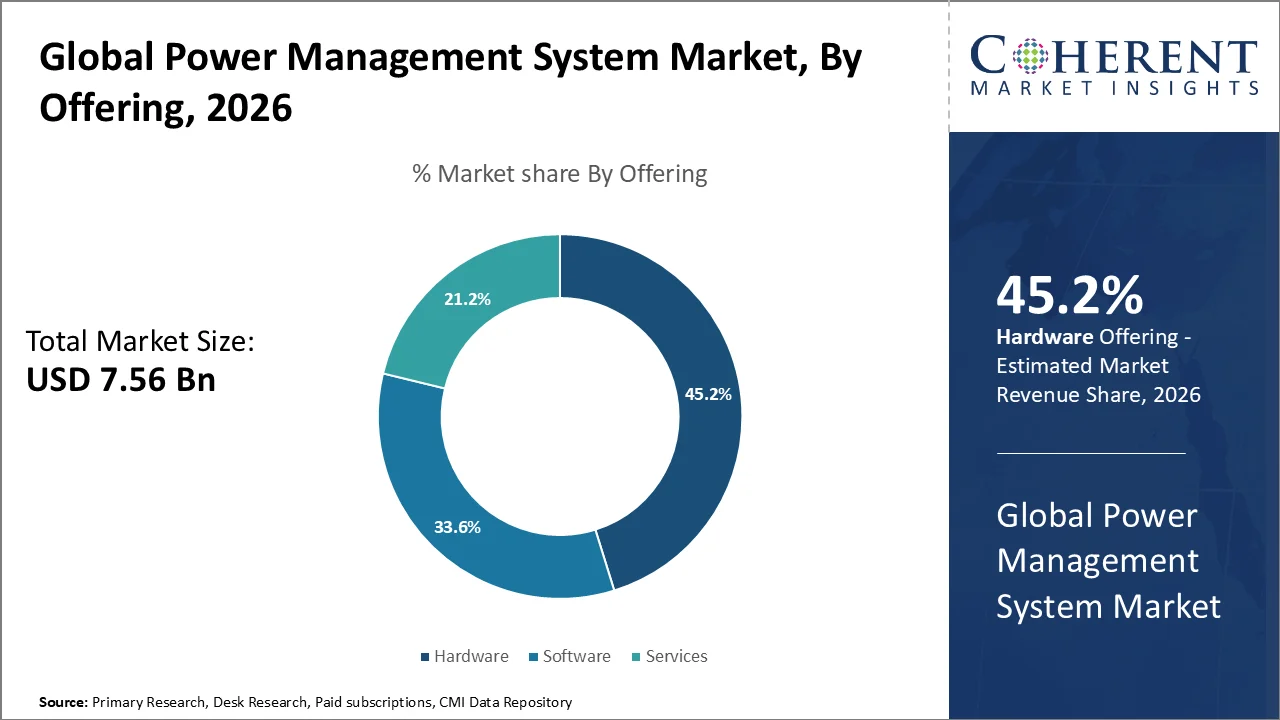
- The hardware segment is likely to dominate the market with 45.2% in 2026. The segment’s growth is owing to the rising deployment of intelligent meters, controllers, protection devices, sensors, and communication equipment.
- The power monitoring & control segment is set to lead with 31.8% in 2026. The segment’s growth is owing to the growing requirements for continuous equipment monitoring, energy optimization, demand control, and early fault detection.
- The oil & gas companies are expected to dominate the market with a share of 28.4% in 2026. The segment’s growth is owing to the energy-intensive operations and need for uninterrupted electricity across refineries, pipelines, offshore platforms, and processing facilities.
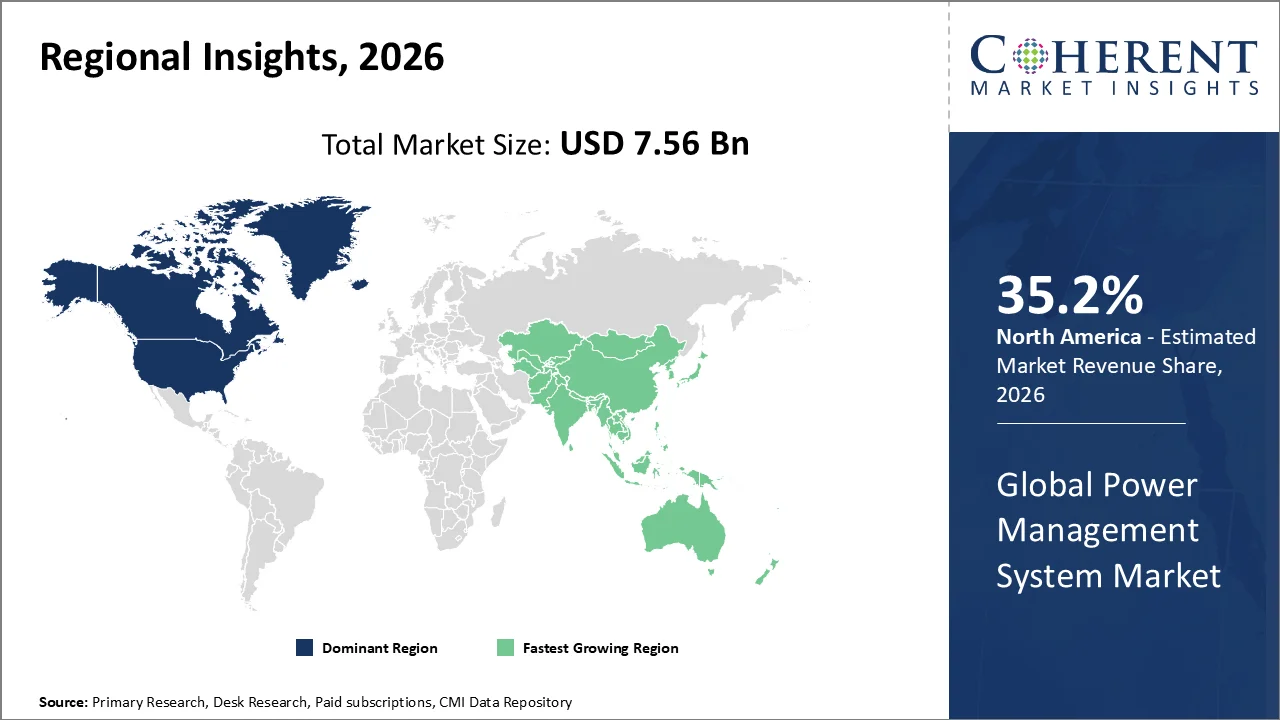
- North America is expected to acquire the prominent share of 35.2% in 2026. The region’s growth is owing to the established industrial infrastructure, increasing grid modernization investments, strict energy-efficiency requirements, and early adoption of digital power management and industrial automation solutions.
Segmental Insights
Why is Hardware Segment Acquiring the Largest Share?
On the basis of offering, the hardware segment is projected to account for the largest Power Management System Market share of 45.2% in 2026. The segment’s growth is owing to essential role of physical devices in measuring, controlling, isolating, communicating, and protecting electrical systems. Hardware includes intelligent meters, power-quality analyzers, protection relays, circuit breakers, programmable controllers, sensors, generator controllers, communication gateways, human-machine interfaces, and data-acquisition equipment.
The International Energy Agency forecasts global electricity demand to increase from approximately 28,200 TWh in 2025 to 33,600 TWh by 2030. Increasing electrical demand will require new distribution equipment, sensors, controllers, protection systems, and communication devices.
In December 2025, Siemens announced that Swiss utility IBC Energie Wasser Chur would equip 200 transformer stations as well as 290 distribution cabinets with smart bidirectional fuses, grid sensors, and the Electrification X platform. The system provides continual data access, key performance analysis, and automated alarm messages, improving fault detection and grid visibility.
- Current Industry Events of 2026
- Market Size Estimation
- Regional Breakdown
- Competitive Landscape
- Customer Intelligence
- Segmental Analysis
- Pricing Analysis
- Key Market Drivers, Challenges & Future Trends
- Customized Insights Section
Oil & Gas Companies hold the Largest Market Share
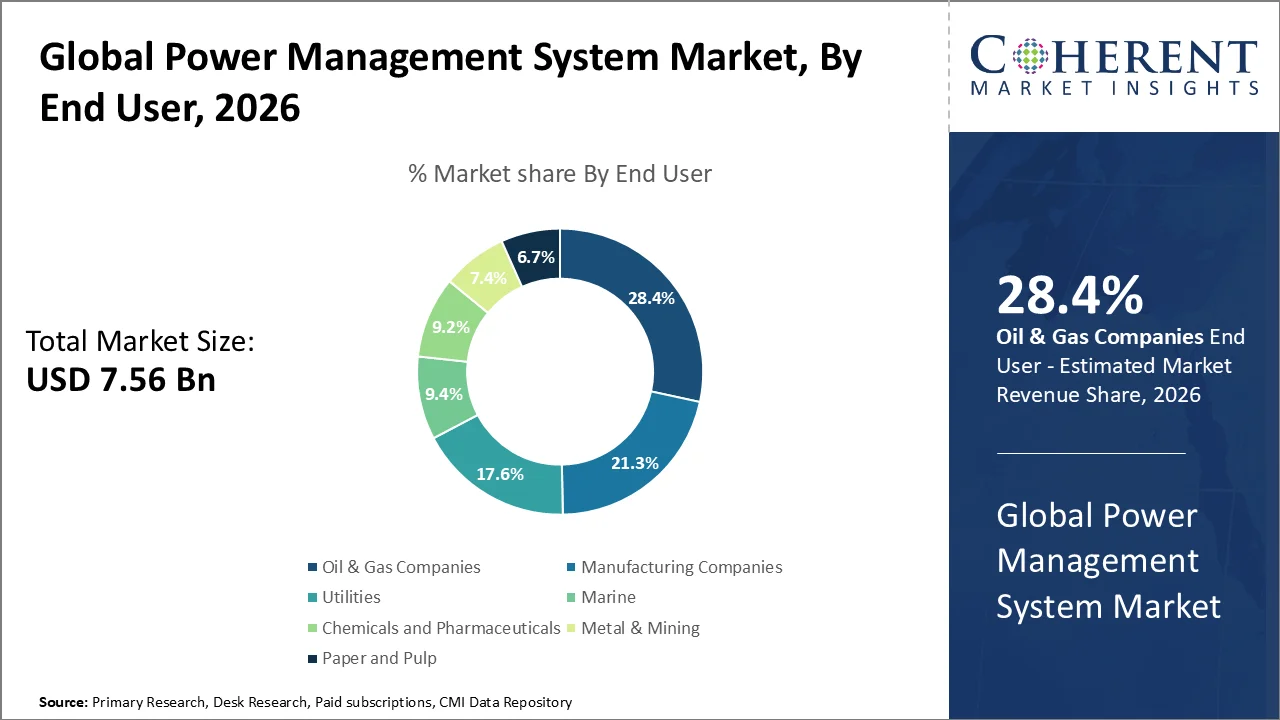
On the basis of end user, the oil & gas companies segment lead with a major 28.4% share in 2026. The growth is owing to the size, complexity, and criticality of electrical infrastructure used across exploration, production, processing, transportation, refining, storage, and petrochemical operations.
The U.S. produced a record 13.6 million barrels of crude oil per day in 2025, thus representing an increase of approximately 3% from 2024. The country is still the world’s largest crude oil producer during the year.
As of January 1, 2026, the U.S. had 130 operable petroleum refineries and approximately 18.2 million barrels per calendar day of operable atmospheric crude-oil-distillation capacity. These large and geographically distributed facilities require monitoring, generator management, electrical protection, power-quality analysis, and automated control.
Market Drivers
Rising Innovations in Intelligent Electrical Infrastructure are Transforming the Power Management System Market in the U.S.
The U.S. is witnessing rapid innovation in power management owing to the data-center expansion, domestic manufacturing investment, transportation electrification, distributed generation, and aging electricity infrastructure. The organizations are moving from isolated meters and manually operated equipment toward connected electrical architectures that integrate intelligent switchgear, sensors, cloud platforms, digital twins, artificial intelligence, and predictive analytics.
The data centers represent a particularly important source of demand. The U.S. Department of Energy reported that electricity consumption by data centers increased from 58 TWh in 2014 to 176 TWh in 2023. The consumption could reach between 325 TWh and 580 TWh by 2028. These facilities require continuous power-quality supervision, redundant electrical distribution, generator coordination, automated transfer, capacity planning, as well as real-time load management.
In November 2025, Schneider Electric announced EcoStruxure Foresight Operation in Las Vegas, an artificial-intelligence-powered platform that unifies energy, power, and building systems. The firm stated that the platform could reduce engineering workflow time by up to 40%, improve operational efficiency by up to 50%, and resolve interconnected electrical and mechanical issues substantially faster.
AI-Based Power Optimization: A Major Breakthrough in the Power Management System Market
Artificial intelligence is emerging as a major breakthrough in power management. Conventional systems mainly collect electrical data, generate alarms, and display historical consumption. AI-enabled systems extend these capabilities by forecasting loads, recognizing abnormal operating patterns, predicting equipment failures, optimizing energy-resource dispatch, as well as recommending corrective actions.
In March 2026, ABB announced the integration of automated machine learning with ABB Ability OPTIMAX, its model-based energy-management and optimization system. The technology uses available plant data to develop multivariable forecasting models without requiring users to create complete machine-learning pipelines manually. ABB indicated that the system can operate on-premises, in data centers, in the cloud, or through hybrid deployment. It supports monitoring, reporting, forecasting, predictive optimization, real-time control, load management, and predictive maintenance. The technology was being evaluated under real-world operating conditions at a chemical park in Hesse, Germany.
Current Events and Their Impact on the Power Management System Market
Current Event | Description and its Impact |
EU Energy Efficiency Directive Implementation and Mandatory Energy Audits
|
|
2026 U.S. Grid Cybersecurity and Virtualization Standards |
|
Power Management System Market Trends
- Rising adoption of AI-based analytics and predictive maintenance improves equipment monitoring, fault detection, load forecasting, operational reliability, and real-time optimization across industrial power networks.
- Integration of renewable generation, battery storage, microgrids, and distributed energy resources increases demand for advanced platforms that coordinate power generation, consumption, switching, and grid-connected assets.
- Stricter energy-efficiency regulations encourage the deployment of power monitoring and energy-cost accounting systems. The revised EU framework establishes a 1.9% annual energy-consumption reduction target for the public sector and extends the 3% annual building-renovation obligation across public administrations.
- Expanding data centres and industrial electrification are increasing requirements for reliable power management systems. S. electricity consumption is projected to rise by more than 420 TWh through 2030, with data centres contributing approximately 50% of this demand growth.
- Growing digital workloads strengthen demand for load balancing, backup power, and energy optimization solutions. Global data-centre electricity consumption is projected to reach approximately 945 TWh by 2030, growing at around 15% annually between 2024 and 2030.
Regional Insights
North America Dominates Owing to the Grid Modernization and Rising Electricity Demand
The North America region accounts for 35.2% of the market share in 2026. The region’s growth is owing to the grid modernization, expanding data-center loads, industrial electrification, and stringent reliability requirements.
The U.S. Energy Information Administration reported that national electricity demand increased by an average 2.1% annually during the five years through 2025, creating stronger requirements for real-time monitoring, load forecasting, automated controls, and power-quality management. EIA also estimated that servers represented 7% of U.S. commercial-sector electricity consumption in 2025, highlighting the need for intelligent load balancing and energy optimization in data centers.
In a recent development, Natural Resources Canada announced that its Energy Innovation Program will launch a smart-grid call for proposals in fall 2026, supporting demonstration and capacity-building projects for advanced grid technologies.
Asia Pacific Power Management System Market Trends
Asia Pacific is expected to witness strong growth in market over the forecast period. The region’s growth is owing to the renewable integration, industrial electrification, rising electricity demand, and requirements for real-time monitoring, load balancing, and power-quality control.
India’s Central Electricity Authority reported that renewable-energy capacity exceeded 260 GW by January 2026, increasing the need for systems that coordinate variable generation, storage, generators, and critical loads. Australia’s Department of Climate Change, Energy, the Environment and Water stated that renewables supplied 39.5% of national electricity generation in 2025, including 19.6% from solar and 14.0% from wind. This changing generation mix supports the demand for forecasting, demand-response, energy accounting, and automated switching platforms.
In August 2025, ABB launched Lite Panel Pro in Vietnam, an intelligent energy-monitoring solution designed to improve visibility and management of electrical consumption.
Rising Data-Center Demand is Accelerating the Power Management System Market in United States
The U.S. is the largest individual market for Power Management Systems. This is owing to the expanding data centers, advanced manufacturing, and electrified infrastructure require continuous monitoring, load balancing, fault detection, and energy optimization. The U.S. Department of Energy reported that data centers consumed 176 TWh of electricity in 2023, thereby intensifying demand for intelligent control platforms and real-time power-quality management.
In March 2026, the Department announced an approximately USD 1.9 billion SPARK funding opportunity for critical grid upgrades. The program supports higher-capacity transmission technologies, operational efficiency, reliability, and security, strengthening demand for integrated hardware, software, automation, and analytics across utilities and industrial facility operations nationwide.
China Power Management System Market Trends
China is emerging as an important Asia Pacific market owing to rapid renewable-energy integration, industrial electrification, expanding data centers, and modernization of transmission and distribution networks. The National Energy Administration data showed that China added more than 430 million kilowatts of wind and solar capacity in 2025, thereby increasing the need for real-time monitoring, load forecasting, automated dispatch, protection, as well as energy optimization.
In January 2026, China Southern Power Grid announced the plans to develop eight pumped-storage stations, thereby supporting grid flexibility and renewable balancing. These developments are encouraging utilities, manufacturers, and infrastructure operators to deploy integrated power management hardware, software, controls, and analytics nationwide.
Who are the Major Companies in Power Management System Industry
Some of the major key players in Power Management System Market are ABB, Rockwell Automation, Mitsubishi Electric, Etap, Omron Corporation, General Electric, L&T limited, Cpower Inc., Emerson Electric Corporation, Fluke Corporation, Fuji Electric Corporation Ltd, Eaton Corporation, Yokogawa Electric Corporation, Littelfuse Inc., and Schneider Electric S.E.
Key News
- In July 2026, Emerson delivered first-of-its-kind synchronization software for power and water control systems by launching the Ovation Curation Tool. The solution automates change tracking and synchronization between production systems and digital twins, improving accuracy, governance, troubleshooting, and engineering efficiency.
- In September 2025, Eaton introduced an industry-first edge-based solution for detecting AI power bursts and subsynchronous oscillations in data centers. The Power Xpert PXQ firmware upgrade helps operators prevent equipment damage, avoid outages, and improve data center and grid resiliency.
Market Report Scope
Power Management System Market Report Coverage
| Report Coverage | Details | ||
|---|---|---|---|
| Base Year: | 2025 | Market Size in 2026: | USD 7.56 Bn |
| Historical Data for: | 2020 To 2024 | Forecast Period: | 2026 To 2033 |
| Forecast Period 2026 to 2033 CAGR: | 6.9% | 2033 Value Projection: | USD 12.04 Bn |
| Geographies covered: |
| ||
| Segments covered: |
| ||
| Companies covered: | ABB, Rockwell Automation, Mitsubishi Electric, Etap, Omron Corporation, General Electric, L&T limited, Cpower Inc., Emerson Electric Corporation, Fluke Corporation, Fuji Electric Corporation Ltd, Eaton Corporation, Yokogawa Electric Corporation, Littelfuse Inc., and Schneider Electric S.E. | ||
| Growth Drivers: |
| ||
| Restraints & Challenges: |
| ||
Analyst Opinion
- The Power Management System Market growth is supported by the rising electricity consumption and the need for dependable operations. The IEA expects global electricity demand to grow by 3.6% annually during 2026–2030. This is strengthening the demand for real-time monitoring, load control, energy optimization, and fault prevention.
- Data centers represent a power-management opportunity. Their electricity consumption is projected to double to around 945 TWh by 2030, thereby increasing requirements for load balancing, uptime assurance, and energy-cost control.
- Digital power management is gaining substantial traction, as connected sensors, automation, analytics, and intelligent control platforms help industries monitor consumption, manage peak loads, detect equipment abnormalities, and integrate renewable energy. These capabilities improve reliability, resilience, and operating efficiency, thereby encouraging wider adoption across manufacturing, oil and gas, utilities, marine, mining, chemicals, pharmaceuticals, and other power-intensive sectors in both established as well as emerging markets worldwide during the forecast period.
Speak to the analyst
Want personalized insights?
Take the findings above to one of our principal consultants, or have the report rebuilt around the segments, geographies and competitors you actually track.
Market Segmentation
- By Offering (Revenue, USD Bn, 2021-2033)
- Software
- Hardware
- Services
- By Module (Revenue, USD Bn, 2021-2033)
- Power Monitoring & Control
- Data Historian
- Switching & Safety Management
- Load Shedding & Management
- Energy Cost Accounting
- Power Simulator
- Generator Controls
- By End User (Revenue, USD Bn, 2021-2033)
- Manufacturing Companies
- Oil & Gas Companies
- Utilities
- Marine
- Paper and Pulp
- Chemicals and Pharmaceuticals
- Metal & Mining
- By Region (Revenue, USD Bn, 2021-2033)
- North America
- U.S.
- Canada
- Latin America
- Brazil
- Mexico
- Argentina
- Rest of Latin America
- Europe
- Germany
- U.K.
- France
- Italy
- Spain
- Russia
- Rest of Europe
- Asia Pacific
- China
- India
- Japan
- Australia
- South Korea
- ASEAN
- Rest of Asia Pacific
- Middle East
- GCC
- Israel
- Rest of Middle East
- Africa
- South Africa
- Central Africa
- North Africa
- North America
Sources
Primary Research Interviews
- Power system engineers
- Electrical and automation engineers
- Plant operations managers
- Energy and utility managers
- Facility managers
- Industrial power management system integrators
- Engineering, procurement, and construction (EPC) contractors
- Power equipment manufacturers
- Utility company representatives
- Software and control-system providers
- Data center infrastructure managers
- Marine electrical system operators
- Key opinion leaders (KOLs) in power automation and energy management
Databases
- International Energy Agency (IEA)
- U.S. Energy Information Administration (EIA)
- World Bank
- Organisation for Economic Co-operation and Development (OECD)
- Eurostat
- United Nations Industrial Development Organization (UNIDO)
- International Renewable Energy Agency (IRENA)
- IEEE Xplore Digital Library
Magazines
- Power Engineering
- POWER Magazine
- Electrical Review
- Control Engineering
- Plant Engineering
- Electrical Business
- Energy Digital
Journals
- IEEE Transactions on Power Systems
- IEEE Transactions on Industry Applications
- IEEE Transactions on Smart Grid
- Electric Power Systems Research
- International Journal of Electrical Power & Energy Systems
- Applied Energy
- Energy
- Journal of Modern Power Systems and Clean Energy
Newspapers
- The New York Times
- The Guardian
- The Wall Street Journal
- Financial Times
- Reuters
- Bloomberg
Associations
- IEEE Power & Energy Society
- International Council on Large Electric Systems (CIGRE)
- National Electrical Manufacturers Association (NEMA)
- International Electrotechnical Commission (IEC)
- European Association of Electrical Contractors
- Electrical and Electronic Manufacturers’ Association
- Association of Energy Engineers
- International Association for Energy Economics
Public Domain Sources
- Company Annual Reports and Investor Presentations
- Government Energy Ministry Publications
- Electricity Regulatory Authority Publications
- National Grid and Utility Company Reports
- Power Generation and Transmission Statistics
- Public Procurement and Tender Databases
- Grid Codes and Electrical Safety Standards
- Patent Databases and Technology Registries
- Power Plant and Industrial Infrastructure Project Databases
- Government Policies on Energy Efficiency, Electrification, and Grid Modernization
Proprietary Elements
- CMI Data Analytics Tool
- Proprietary CMI Existing Repository of Information for Last 10 Years
Get access to 250+ pages report
Every segment, forecast, competitor profile and data table behind the analysis above — available for instant download.
- ESOMAR Member
- ISO 9001:2015 Certified
- D-U-N-S Registered
- GDPR & CCPA Compliant
Missing comfort of reading report in your local language? Find your preferred language:
Transform your Strategy with Exclusive Trending Reports
Frequently Asked Questions
The Power Management System Market is expected to reach USD 12.04 Bn in 2033.
Major players operating in the global Power Management System Market include ABB, Rockwell Automation, Mitsubishi Electric, Etap, Omron Corporation, General Electric, L&T limited, Cpower Inc., Emerson Electric Corporation, Fluke Corporation, Fuji Electric Corporation Ltd, Eaton Corporation, Yokogawa Electric Corporation, Littelfuse Inc., and Schneider Electric S.E.
The integration complexity with legacy networks, high initial deployment costs, and rising cybersecurity vulnerabilities the key factors hampering growth of the market.
The increasing demand for energy efficiency, the rapid integration of renewable energy sources, and the exponential expansion of data centers is boosting the demand for Power Management System.
The Power Management System Market is anticipated to grow at a CAGR of 6.9% between 2026 and 2033.
Among regions, North America is expected to account for a largest market share in the global Power Management System Market over the forecast period.
The global Power Management System Market is on a steady upward trajectory owing to the renewable energy integration, industrial automation, and AI data center demands.