

Human Machine Interface Market Analysis & Forecast: 2026-2033
Human Machine Interface Market is estimated to be valued at USD 7,288.2 Mn in 2026 and is expected to reach USD 14,753.9 Mn in 2033, exhibiting a compound annual growth rate (CAGR) of 10.6% from 2026 to 2033.
Key Takeaways
- Based on Product, the display terminals segment is expected to lead the market with 43% share in 2026, by enabling intuitive control and real-time system monitoring.
- Based on Application, the automotive segment is projected to account for the largest share of the market in 2026, driven by rising demand for smart vehicle interfaces and ADAS integration.
- Based on Region, Asia Pacific region is leading the human machine interface market with 32.20% share in 2026. While, North America is expected to be the fastest growing region.
Market overview
The human machine interface market is experiencing robust growth driven by rising automation across industries. The increasing integration of advanced technologies such as AI, machine learning, and IoT into industrial systems is fueling human machine interface market demand. These interfaces enhance operational efficiency, safety, and user experience in sectors like automotive, healthcare, and manufacturing. Touchscreen panels, gesture control systems, and voice recognition tools are becoming standard in modern control environments. As digital transformation accelerates, the need for intuitive and responsive HMI solutions continues to expand, making them a cornerstone of smart industrial ecosystems.
Current Events and their Impacts on the Human Machine Interface Market
Current Event | Description and its Impact |
AI Revolution and Generative AI Integration |
|
Automotive Industry Electric Vehicle Transition |
|
End User Feedback and Unmet Needs on Human Machine Interface Market
End User Feedback
- Ease of Use: Users consistently emphasize the need for intuitive interfaces that reduce training time and operator errors. Complex or cluttered HMIs hinder productivity, especially in industrial settings.
- Customization: Many industries require tailored HMI solutions to match specific workflows. Off-the-shelf systems often lack flexibility, prompting demand for modular and configurable platforms.
- Responsiveness: Real-time feedback is critical, especially in manufacturing and healthcare. Users report lag or delays in data visualization and control execution as a major pain point.
- Security Concerns: With increasing connectivity, users are concerned about cybersecurity risks in HMI systems. Secure boot, encrypted communication, and compliance with standards like ISO26262 are increasingly expected.
- Cross-Platform Compatibility: Users want HMIs that work seamlessly across devices, touchscreens, mobile apps, and desktops, but many solutions lack consistent performance across platforms.
Unmet Needs in the HMI Market
- Integration with Legacy Systems: Many industries still rely on older machinery. Users struggle to integrate modern HMI solutions with legacy equipment, creating operational silos.
- Scalability: Small and mid-sized enterprises need scalable HMI platforms that grow with their operations. Current offerings often cater to large enterprises, leaving smaller players underserved.
- AI and Predictive Analytics: While AI integration is growing, users want more intelligent HMIs that can predict failures, optimize workflows, and adapt to user behavior, features still in early stages.
- Localization and Language Support: In emerging markets, lack of multi-language support and region-specific customization limits adoption and usability.
- Affordability: High-end HMI systems are often cost-prohibitive for smaller firms. Users seek cost-effective solutions without compromising on performance or security.
- Current Industry Events of 2026
- Market Size Estimation
- Regional Breakdown
- Competitive Landscape
- Customer Intelligence
- Segmental Analysis
- Pricing Analysis
- Key Market Drivers, Challenges & Future Trends
- Customized Insights Section
Segmental Insights
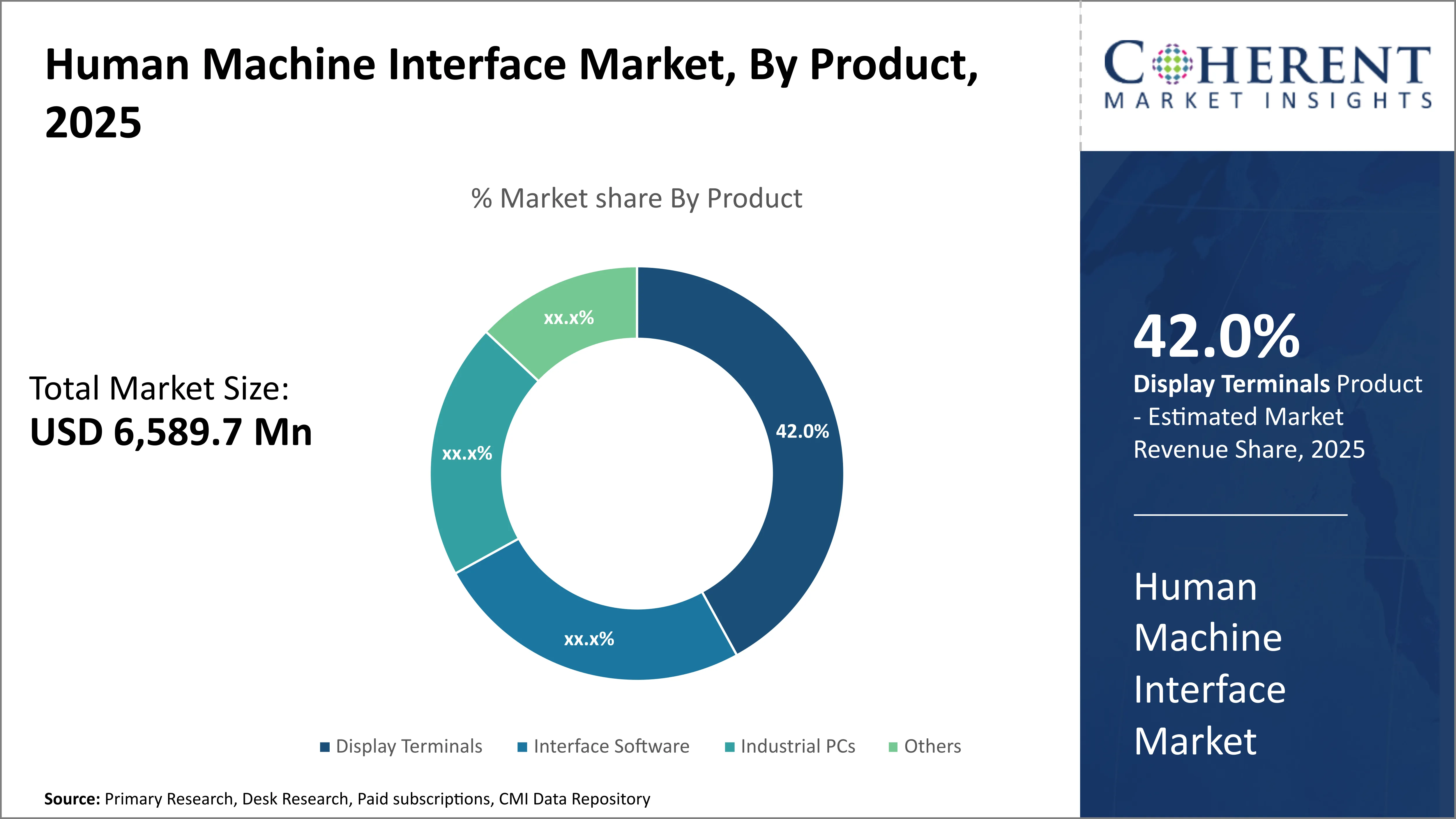
Human Machine Interface Market Insights, By Product: Display Terminals Lead by Enabling Intuitive Control and Real-Time System Monitoring
In terms of product, the display terminals segment is expected to hold the 43% share in 2026. Their widespread adoption is fueled by the growing need for intuitive, real-time interaction between humans and machines across industrial environments. These terminals play a critical role in smart manufacturing and automation, offering user-friendly interfaces that enhance operational efficiency and safety. From touchscreen panels to advanced graphical displays, they enable seamless monitoring and control of complex systems, particularly in high-speed production lines where precision and responsiveness are paramount.
For instance, in July 2025, Renesas launched its 64-bit RZ/G3S and RZ/G3M MPUs, designed for high-performance human-machine interface (HMI) systems. Featuring Arm Cortex-A55 cores, 2D graphics engines, and AI acceleration, these MPUs support advanced display terminals and edge computing. Ideal for industrial and smart applications, they offer robust graphics and connectivity for next-gen user interfaces.
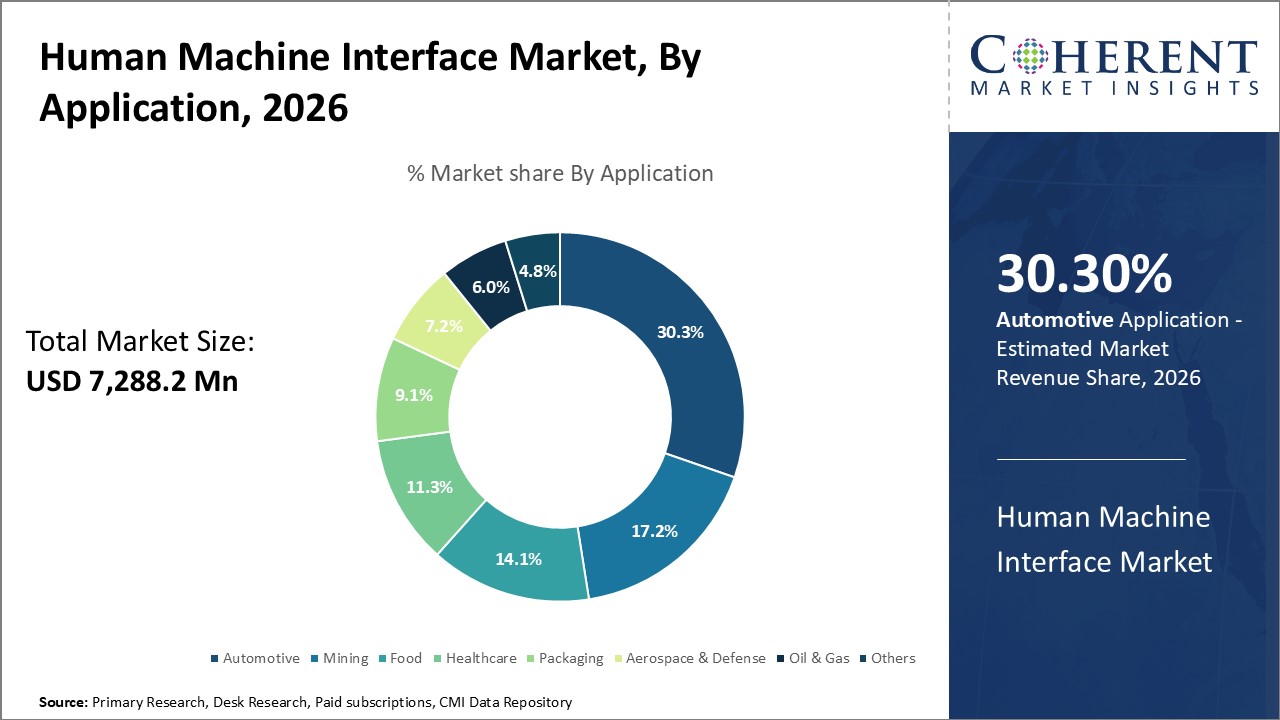
Human Machine Interface Market Insights, By Application: Automotive Dominance Is Driven by Rising Demand for Smart Vehicle Interfaces and ADAS Integration
In terms of application, the automotive segment is projected to account for the largest share of the market in 2026, driven by the rapid integration of advanced HMI technologies in modern vehicles. As the industry shifts toward electric and autonomous vehicles, the demand for sophisticated interfaces, such as digital dashboards, infotainment systems, and voice-controlled navigation, continues to rise. These solutions not only improve driver experience and safety but also support the growing ecosystem of connected car technologies. The evolution of ADAS (Advanced Driver Assistance Systems) further amplifies the need for responsive and intelligent HMI platforms, positioning automotive as a key growth driver in the market.
For instance, in February 2025, VI-grade unveiled a compact HMI simulator tailored for automotive applications, enabling OEMs and suppliers to test and refine human-machine interfaces. Featuring realistic driving controls and display systems, the simulator supports rapid prototyping and user experience evaluation. It complements VI-grade’s Driver-in-the-Loop ecosystem, advancing intuitive and safe vehicle interaction design.
Regional Insights
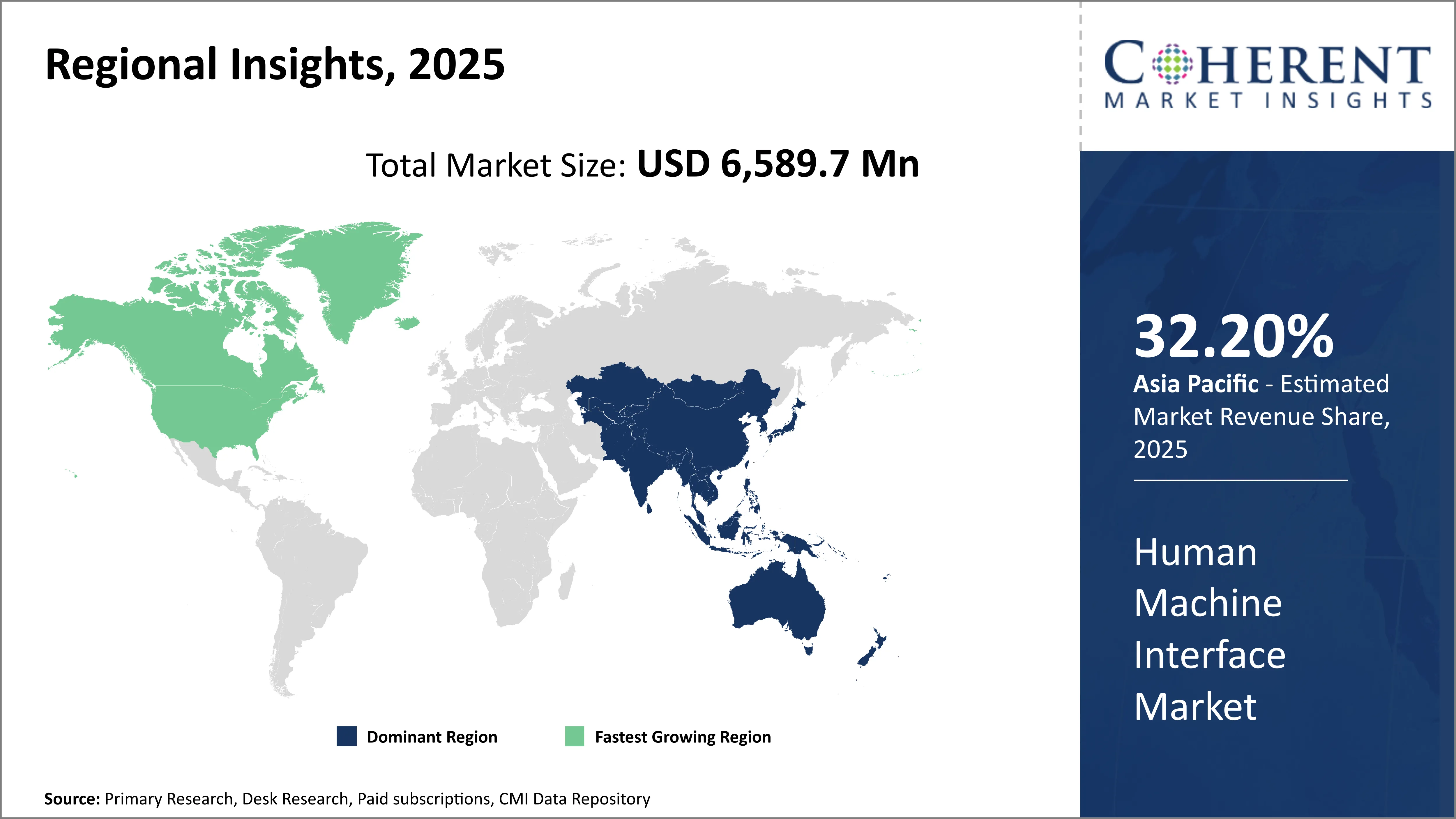
Asia Pacific Human Machine Interface Market Analysis & Trends
Asia Pacific, holing 32.20% share in 2026, is projected to dominate the human machine interface market, due to rapid industrialization, expanding manufacturing sectors, and increasing adoption of automation technologies. Government initiatives supporting smart factories and Industry 4.0, especially in countries like China, Japan, and India, are accelerating HMI deployment across industries, enhancing productivity, safety, and operational efficiency.
For instance, in August 2026, Mitsubishi Electric launched the next-generation GOT3000 HMI, designed to accelerate digital transformation in manufacturing. Featuring high-definition multi-touch displays, enhanced connectivity including OPC UA and USB-C, and robust security with VPN and encryption, the GOT3000 enables seamless integration with factory systems and cloud platforms, supporting smarter and more secure industrial automation.
North America Human Machine Interface Market Analysis & Trends
North America is anticipated to be the fastest growing region, due to advanced industrial infrastructure, high adoption of automation, and strong presence of leading tech companies. Demand is further driven by innovations in automotive, aerospace, and healthcare sectors, along with increasing focus on user-centric design and safety. Regulatory support for smart manufacturing also boosts market growth.
For instance, in October 2026, NTX Embedded introduced the Octolux Industrial HMI Platform, designed to streamline development of industrial and medical products. Featuring integrated high-resolution displays and control boards, Octolux enables rapid prototyping and full lifecycle support. Its flexible, eco-friendly architecture targets sectors like automation, energy, transportation, and IoT, accelerating time-to-market for advanced human-machine interfaces.
Human Machine Interface Market Outlook Country-Wise
China Human Machine Interface Market Trends
China's Human-Machine Interface (HMI) market is booming due to rapid industrial automation, smart manufacturing initiatives, and strong government support for digital transformation. High demand in automotive, electronics, and consumer goods sectors fuels growth. Additionally, China's large manufacturing base and investment in AI and IoT technologies drive widespread adoption of advanced HMI solutions.
For instance, in October 2026, China launched the world’s first magnetic resonance platform for brain-computer interface (BCI) applications, marking a major advancement in human-machine interaction. Developed by the China Electronics Technology Group Corporation, the platform enables non-invasive brain signal acquisition, enhancing research in neuroscience, cognitive science, and AI, and paving the way for next-generation BCI technologies.
The U.S. Human Machine Interface Market Trends
The U.S. Human-Machine Interface (HMI) market is thriving due to strong demand in automotive, aerospace, healthcare, and industrial automation. Advanced technologies like AI, IoT, and smart manufacturing drive adoption of intuitive, secure interfaces. High consumer expectations for usability and innovation, along with a robust tech ecosystem, further fuel HMI development and deployment.
For instance, in November 2026, Ezurio launched the Nitrogen HMI, a U.S.-built, pre-certified human-machine interface platform for industrial, commercial, and medical applications. Featuring integrated display, touch, and processing capabilities, it supports Wi-Fi, Bluetooth, and Ethernet. With global certifications and robust security, Nitrogen HMI accelerates development and deployment of reliable, connected interface solutions across mission-critical environments.
Market Report Scope
Human Machine Interface Market Report Coverage
| Report Coverage | Details | ||
|---|---|---|---|
| Base Year: | 2025 | Market Size in 2026: | USD 7,288.2 Mn |
| Historical Data for: | 2020 To 2024 | Forecast Period: | 2026 To 2033 |
| Forecast Period 2026 to 2033 CAGR: | 10.6% | 2033 Value Projection: | USD 14,753.9 Mn |
| Geographies covered: |
| ||
| Segments covered: |
| ||
| Companies covered: | ABB Ltd., General Electric Company, Advantech Co., Ltd., Emerson Electric Corporation, Atmel Corporation, Eaton Corporation, American Industrial Systems, Inc., BARTEC Top Holding GmbH, and Beijer Electronics, Inc | ||
| Growth Drivers: |
| ||
| Restraints & Challenges: |
| ||
Global Human Machine Interface Market Drivers
High growth of industrial automation
Industrial automation refers to practices of software and control systems to monitor and operate independently as mechanized system solutions of manufacturing processes. Industrial factory and control automation devices are executed for reducing the human interaction in the development of products and services. This, in turn, reduces labor and production costs thereby helping to increase the production output. Human machine interface (HMI) plays a vital part in industrial automation to improve industrial controls. For instance, in February 2023, Exor, a provider of human-machine interface (HMI) solutions, had launched eX707M a Web industrial HMI. Designed for industrial automation applications, this advanced HMI offers an integrated web server, making it ideal for use in modern factory automation systems. Over the years, many industries such as packaging, pharmaceutical, energy, mining, automobile, petrochemical, and oil & gas has witnessed automation in the recent past. Since HMI provides realistic views of plant, industries are replacing conventional control process with advanced methods. Thus, these factors are expected to drive growth of the global human machine interface market during the forecast period. Growing demand for mobility and efficiency.
Growing demand for mobility and efficiency
Manufacturing industries are struggling with reliable and instant monitoring and controlling of data from different remote locations. Furthermore, global manufacturers are seeking for solutions that can enable the remote monitoring, maintenance, and controlling of equipment. Furthermore, remote maintenance helps to decrease costs and enhance efficiency compared to local maintenance procedures. Remote monitoring and controlling of volume data will offer mobility to manufacturing industries and other sectors. This, in turn, is increasing the demand for HMI with communication devices for allowing information access on their personal communication devices. Hence, these factors are expected to propel the market growth over the forecast period.
Global Human Machine Interface Market Opportunities
Manufacturing opportunities in emerging economies
Emerging economies present significant manufacturing opportunities that are fueling the growth of the Human Machine Interface (HMI) market. As countries like India, Vietnam, Brazil, and Indonesia invest in industrial automation, smart factories, and digital infrastructure, demand for intuitive and efficient HMI systems is rising. These regions offer cost-effective labor, expanding industrial bases, and favorable government policies, attracting global manufacturers. The integration of IoT, AI, and real-time monitoring in production lines further accelerates HMI adoption. According to the human machine interface market forecast, emerging markets are expected to contribute substantially to global growth, driving innovation and localized solutions in industrial and commercial sectors.
Research and development activities among market players
Research and development activities among market players are significantly boosting the human machine interface market size. Leading companies are investing in advanced technologies such as AI-driven interfaces, gesture recognition, voice control, and augmented reality to enhance user experience and system efficiency. These innovations are driving demand across industries like automotive, healthcare, and industrial automation. R&D efforts also focus on improving security, connectivity, and customization, enabling smarter and more intuitive HMI solutions. As competition intensifies, continuous innovation is essential for differentiation and market expansion, contributing to the steady growth of the global Human Machine Interface Market size through cutting-edge product offerings
Global Human Machine Interface Market Trends
Advantage to the entire operation by limiting the number of alarm systems
Limiting the number of alarm systems in industrial operations enhances efficiency and reduces cognitive overload for operators, directly benefiting the Human Machine Interface (HMI) market. Streamlined alarm management allows HMIs to present only critical alerts, improving decision-making and response times. This leads to safer, more productive environments and lowers maintenance costs. Advanced HMI platforms now integrate intelligent filtering and prioritization features, aligning with industry demands for smarter control systems. As a result, manufacturers increasingly adopt sophisticated HMI solutions, contributing to the rising human machine interface market share across sectors like energy, manufacturing, and healthcare, where operational clarity and reliability are paramount.
Rapid Evolution to process and access information at shop floor and other multiple locations
Many manufacturing industries worldwide are facing challenges regarding managing and accessing of vast volumes of operational information. HMI software solutions are evolving rapidly in order to process and access information at shop floor, and other multiple locations. Manufacturers seek for advanced HMI solutions that support multi-node, multi-process applications with intuitive graphic interface for complex manufacturing and processing applications. End user industries such as automotive, aerospace & defense and others prefer intelligence panels over traditional HMI systems due to rising need to process information at multiple locations in the manufacturing plant.
Analyst Opinion (Expert Opinion)
The Human Machine Interface market value is rapidly evolving from hardware-centric displays to software-driven, data-integrated platforms. The competitive edge now lies in UX design, cybersecurity, and seamless data orchestration rather than in panel performance. Vendors such as Siemens and Schneider Electric have redefined HMI architecture through web-native frameworks and augmented reality (AR) integration. For instance, Schneider’s EcoStruxure Augmented Operator Advisor has demonstrated up to a 20% reduction in mean time to repair by embedding contextual AR data directly into maintenance workflows.
Cybersecurity has become a decisive differentiator as approximately one-third of industrial control system (ICS) vulnerabilities remain unpatched, prompting buyers to prioritize “secure-by-design” HMI solutions with verifiable update mechanisms. Similarly, edge-enabled and PLC-hosted visualization tools are gaining traction, minimizing latency and enhancing remote operability.
Human-factor metrics, such as reduced downtime and faster troubleshooting are now measurable ROI benchmarks for procurement teams. Vendors integrating predictive analytics, mobile clients, and secure web runtimes are expected to dominate. In essence, HMI has transitioned from being a visual interface to a strategic layer in industrial intelligence. Future success will hinge on secure architectures, intuitive UX, and evidence-based productivity improvements rather than incremental hardware upgrades.
Speak to the analyst
Want personalized insights?
Take the findings above to one of our principal consultants, or have the report rebuilt around the segments, geographies and competitors you actually track.
Global Human Machine Interface Market: Key Developments
- In November 2025, Capgemini and Orano deployed the first intelligent
- In June 2025, Nuvoton Technology Corporation Japan unveiled its 4th-generation Gerda HMI display ICs, Gerda-4M, Gerda-4L, and Gerda-4C, designed for advanced automotive applications. These chips support AR head-up displays, electronic mirrors, and cluster meters, offering high-resolution output, image processing, and enhanced safety features. The launch strengthens Nuvoton’s position in the evolving human-machine interface (HMI) market.
- In February 2025, Toyota Motor Corporation selected Unity to develop its next-generation human-machine interface (HMI) for vehicles. Leveraging Unity’s real-time 3D platform, the new HMI aims to deliver immersive, interactive in-car experiences. This collaboration marks a significant step in enhancing automotive user interfaces, blending advanced visualization with intuitive design for future mobility solutions.
- In January 2025, DXC Technology partnered with Ferrari to develop the driver human-machine interface (HMI) for next-generation vehicles. The collaboration aims to enhance in-car experiences through advanced digital engineering and real-time data integration. This strategic move supports Ferrari’s vision for software-defined vehicles, delivering intuitive, high-performance HMI systems tailored for future mobility.
Market Segmentation
- By Product (Revenue, USD Mn, 2021 - 2033)
- Display terminals
- Interface Software
- Industrial PCs
- Others
- By Application (Revenue, USD Mn, 2021 - 2033)
- Automotive
- Mining
- Food
- Healthcare
- Packaging
- Aerospace & Defense
- Oil & Gas
- Others
- By Region (Revenue, USD Mn, 2021 - 2033)
- North America
- U.S.
- Canada
- Latin America
- Brazil
- Argentina
- Mexico
- Rest of Latin America
- Europe
- Germany
- U.K.
- Spain
- France
- Italy
- Russia
- Rest of Europe
- Asia Pacific
- China
- India
- Japan
- Australia
- South Korea
- ASEAN
- Rest of Asia Pacific
- Middle East
- GCC Countries
- Israel
- Rest of Middle East
- Africa
- South Africa
- North Africa
- Central Africa
- North America
- Global Human Machine Interface Market: Key Companies Insights (Revenue, USD Mn, 2021 - 2033)
- ABB Ltd.
- General Electric Company
- Advantech Co., Ltd.
- Emerson Electric Corporation
- Atmel Corporation
- Eaton Corporation
- American Industrial Systems, Inc.
- BARTEC Top Holding GmbH
- Beijer Electronics, Inc
Sources
Primary research — Interviews
Stakeholders
- Commercial display manufacturers
- AV integrators and systems integrators
- Signage installers and integrators
- Facility managers (retail, transport, corporate)
- Digital content managers / DOOH operators
- Procurement heads (retail, hospitality, transport, corporate IT)
Specific Stakeholder Interview Targets
- Digital transformation leads at retail chains — e.g., Reliance Retail; Carrefour; Best Buy
- Facility & operations managers at transport hubs — e.g., Heathrow Airport; Chhatrapati Shivaji Maharaj International Airport (Mumbai); JFK Airport
- IT infrastructure / technology heads at hospitality groups — e.g., Marriott International; Taj Hotels; Accor
- Advertising & media managers at DOOH agencies and mall operators — national/regional DOOH agencies and large mall asset owners
- AV consultants and integrators serving corporate and education sectors — (system design & deployment leads)
- Product managers / engineering leads at display OEMs and component suppliers — (panel makers, touch-module vendors, controller/SoC suppliers)
Databases
- World Trade Organization (WTO) — Trade Statistics
- UN Comtrade Database
- Ministry of Electronics and Information Technology (MeitY), India — trade & electronics policy datasets
- Bureau of Economic Analysis (U.S.) — industry and trade data
- Eurostat — trade and industry statistics
- China Customs Statistics (General Administration of Customs)
- Korea Customs Service Data Portal
- Japan External Trade Organization (JETRO) — trade & investment data
- Directorate General of Commercial Intelligence and Statistics (DGCIS), India
Industry Magazines & Trade Press
- AV Magazine
- Installation International
- Digital Signage Today
- InAVate
- Systems Contractor News (SCN)
- Display Daily
- TechRadar Pro — Commercial Display / Business tech sections
- Future Store Guide
Academic & Technical Journals
- Journal of Display Technology (IEEE/industry)
- IEEE Transactions on Consumer Electronics
- Displays (Elsevier)
- Journal of Visual Communication and Image Representation
- Journal of Retailing and Consumer Services (for user-experience / retail HMI studies)
Newspapers & Mainstream Business Press
- The Wall Street Journal — Tech & Media coverage
- The Economic Times — Technology & Industry (India)
- The Hindu Business Line — Consumer Tech & Retail
- Financial Times — technology / supply-chain and AV industry reporting
- Nikkei Asia — electronics manufacturing & supply chain coverage
- South China Morning Post — tech & industry reporting in Greater China region
Associations & Industry Bodies
- Society for Information Display (SID)
- International Sign Association (ISA)
- AVIXA (Audiovisual and Integrated Experience Association)
- Digital Signage Federation (DSF)
- Consumer Technology Association (CTA)
- Confederation of Indian Industry (CII) — Electronics & Display Forum (where applicable)
- Display Industry Council (Japan) / relevant national display associations
Public-Domain Government & Standards Sources
- Ministry of Electronics & Information Technology (Government of India) — policy, production incentive schemes
- National Institute of Standards and Technology (NIST), U.S. — standards, cybersecurity guidance for IoT/HMI systems
- Ministry of Economy, Trade and Industry (METI), Japan — electronics & manufacturing reports
- U.S. International Trade Commission (USITC) — trade remedies, tariff data
- NITI Aayog (India) — technology / digital infrastructure strategy papers
- India Investment Grid — electronics sector project listings
- EU Single Market Observatory — digital media and signage reports
- Reserve Bank of India (RBI) — sectoral reports touching retail/consumer electronics where relevant
Proprietary elements
- CMI Data Analytics Tool
- Proprietary CMI Existing Repository of information for last 8 years
Definition: Human Machine interface is a component of a machine that controls and monitors human machine interaction. It comprises of group of screens, graphic displays, membrane switches, screens, keyboards, and other technology systems that are used by the machine operator to control, monitor, and interact with machine.
Get access to 250+ pages report
Every segment, forecast, competitor profile and data table behind the analysis above — available for instant download.
- ESOMAR Member
- ISO 9001:2015 Certified
- D-U-N-S Registered
- GDPR & CCPA Compliant
Missing comfort of reading report in your local language? Find your preferred language:
Transform your Strategy with Exclusive Trending Reports
Frequently Asked Questions
The Human Machine Interface Market is estimated to be valued at USD 7,288.2 Mn in 2026, and is expected to reach USD 14,753.9 Mn by 2033.
The CAGR of the Human Machine Interface Market is projected to be 10.6% from 2026 to 2033.
Major factor driving the market during the forecast period is growing demand for mobility and efficiency.
Major factors hampering the market during the forecast period is inadequate HMI design in the market.
Asia Pacific human machine interface market is expected to generate the highest revenue during the forecast period.