

North America Ignition Interlock Devices Market Analysis and Forecasts (2026-2033)
The North America ignition interlock devices market is anticipated to grow at a CAGR of 6% with USD 64.6 Mn in 2026 and is expected to reach USD 96.7 Mn in 2033. Expanding use in commercial fleets, growing incidents of driving under the influence and alcohol-impaired driving is influencing the North America ignition interlock devices market growth over the forecast period. For instance, according to the data published by the Centers for Disease Control and Prevention, it has been reported that on average in the U.S., 37 people die every day in crashes involving an alcohol‑impaired driver that’s one death every 39 minutes. (Source: CDC)
Key Takeaways
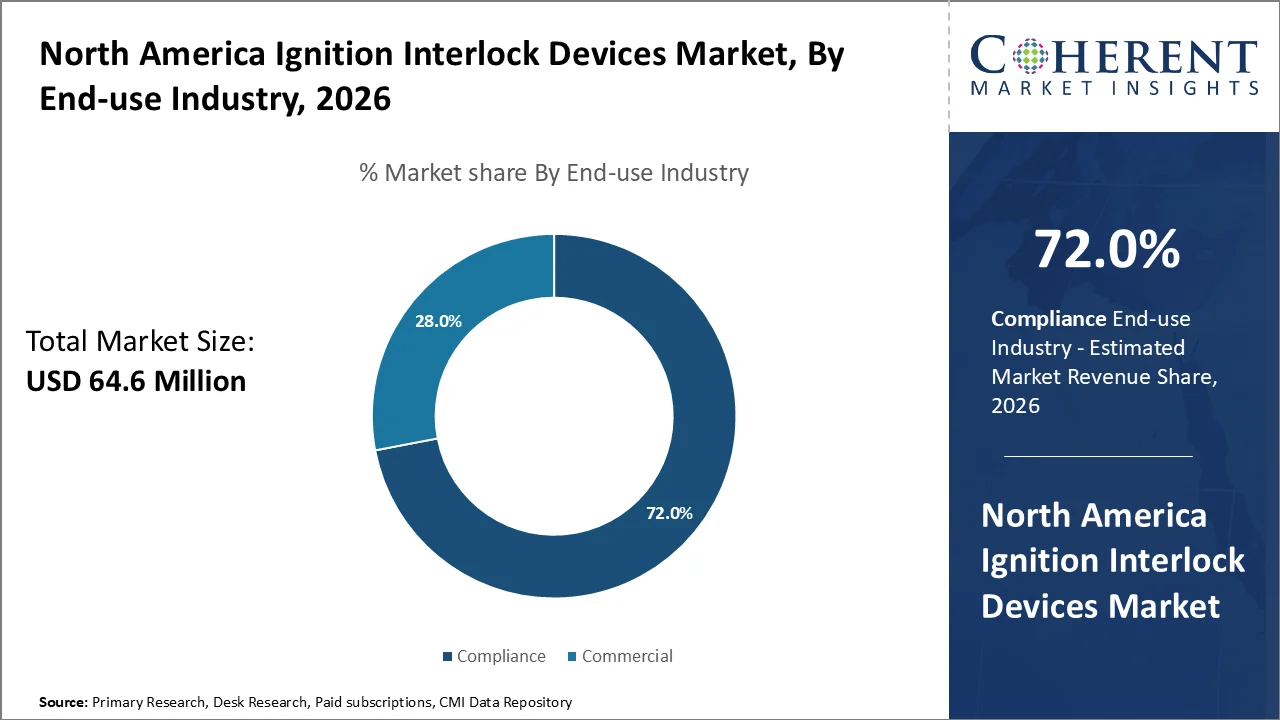
- Compliance is expected to account the largest share of 72.0% in 2026, driven by increasing safety regulations and fleet management practices that encourage the installation of ignition interlock devices in commercial vehicles. In 2024, National Highway Traffic Safety Administration states that ignition interlocks reduce recidivism in Driving Under the Influence offenders by 70%, reinforcing their effectiveness as part of DUI laws and regulations. (Source: NHTSA)
- Fuel cell technology will dominate with 81.0% in 2026, because it is extensively used in Ignition Interlock Devices as it offers high accuracy and reliable performance for detecting alcohol levels. Many U.S. state ignition interlock programs explicitly require fuel cell or other alcohol‑specific sensing technology in approved devices to ensure accurate and reliable BAC detection. For instance, the Arkansas ignition interlock regulations mandate that devices “use fuel cell technology or other alcohol‑specific sensing technology approved by the Office of Alcohol Testing” and must meet federal standards for accuracy and reliability in unsupervised environments.
- U.S. is expected to acquire the dominant share of 85.0% in 2026, attributed to the large number of Driving Under the Influence (DUI) convictions and strict enforcement of DUI laws across many states. Federal and state regulations mandate the use of ignition interlock devices for individuals convicted of driving under the influence of alcohol. According the data published by the Centers for Disease Control and Prevention, in the U.S., on average, one person is killed every ~42 minutes in crashes involving a drunk driver.
Segmental Insights
Why is Compliance Acquiring the Largest Market Share?
Compliance is projected to account for the largest share of North America ignition interlock devices in 2026, representing approximately 72.0% of the total volume. most installations are still tied directly to court orders, DMV reinstatement rules, and offender-monitoring requirements rather than voluntary consumer adoption. This remains highly regulation-led: California DMV states that repeat and injury-involved DUI offenders must install an IID for 1 to 4 years, and a law effective January 1, 2026 extended that statewide program through January 1, 2033. In Washington, a 2026 legislative audit reported that 65,782 drivers were required to install an ignition interlock device between January 2018 and June 2025. Regulatory tightening is widening the addressable compliance pool. Colorado’s HB26-1242 states that the waiting period to apply for an interlock-restricted license is eliminated and that certain first-time impaired-driving offenders must hold an interlock-restricted license for the revocation period, which directly supports compliance-led device demand. Moreover, compliance-based program design is increasing the importance of sustained device use, not just initial installation. Washington requires offenders to remain violation-free for the last 180 days before device removal, and NHTSA’s latest official reporting notes 12,429 alcohol-impaired-driving fatalities in the U.S. in 2023, equal to about 30% of all traffic fatalities, which keeps policymakers focused on offender-control measures such as interlocks.
Fo instance, on March 24, 2026, Smart Start launched Speed Aware in Ohio to expand court and supervision-focused driver monitoring. Furthermore, on January 1, 2026, California’s IID program was extended to January 1, 2033. Moreover, in April 2026, Washington JLARC reported only 41% of required drivers had installed or completed IID use, underscoring the scale of the compliance market.
(Source: State of California)
- Current Industry Events of 2026
- Market Size Estimation
- Regional Breakdown
- Competitive Landscape
- Customer Intelligence
- Segmental Analysis
- Pricing Analysis
- Key Market Drivers, Challenges & Future Trends
- Customized Insights Section
Fuel Cell Technology holds the Largest Market Share
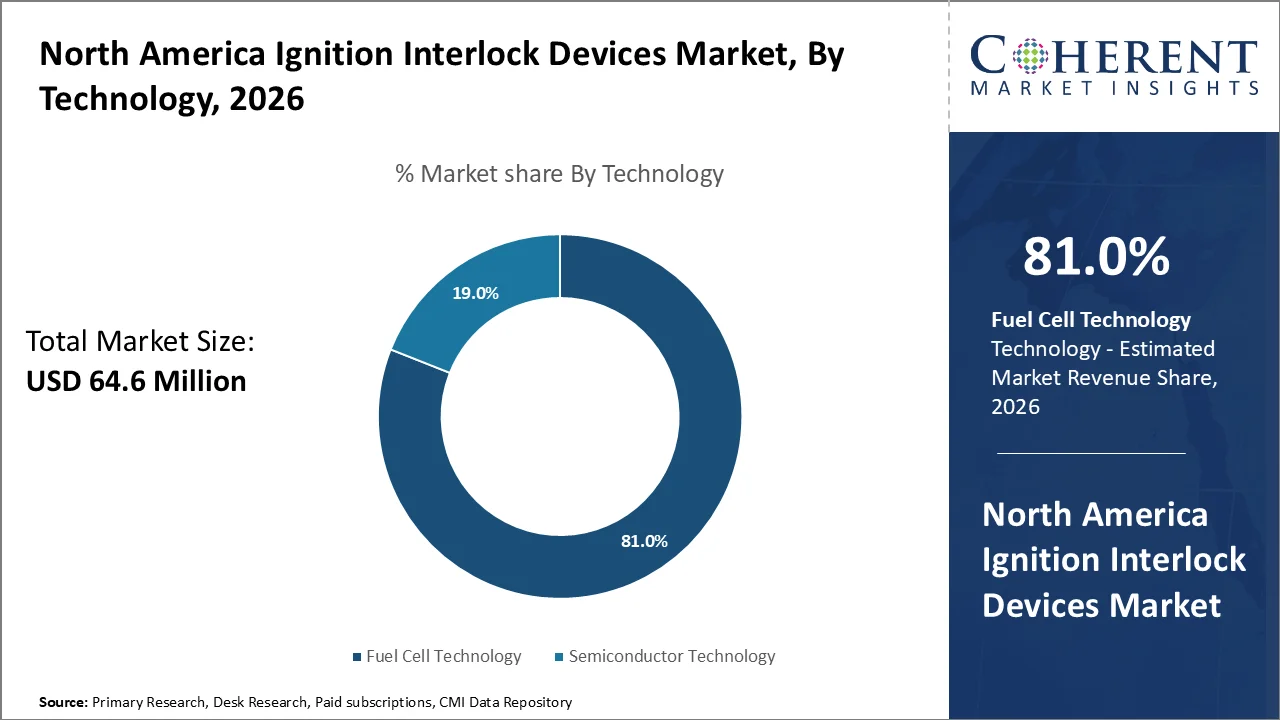
Based on Technology, Fuel Cell Technology dominate the market, accounting for a significant 81.0% share in 2026, owing to high accuracy in alcohol detection, superior reliability and consistency and better performance across environmental conditions. Manufacturers are continuously improving sensor sensitivity, response time, anti-tampering features and remote monitoring (GPS, mobile integration). This strengthens the position of fuel cell technology as the industry standard. Semiconductor-based devices are gradually being replaced due to higher false readings and lower accuracy. Fuel cell devices work effectively in extreme temperatures and varying climates and maintain accuracy in real-world driving conditions. This is important in North America where weather varies significantly. For instance, in 2026, Iowa Administrative Code continued to mandate that any ignition interlock device installed in a vehicle, including replacement units, must use fuel cell technology. The state’s 2026 rulemaking further permitted approved fuel cell devices to remain in service for longer calibration intervals after passing precision and functionality testing, reinforcing fuel cell technology’s position as the preferred compliance standard.
(Source:American Association of Motor Vehicle Administrators (AAMVA); https://www.legis.iowa.gov/docs/iac/agency/01-21-2026.661.pdf)
Rising Number of Driving Under the Influence (DUI) Offenses
The increase in alcohol-related driving incidents continues to drive demand for ignition interlock devices, especially as law enforcement steps up efforts to combat impaired driving. This growing concern around road safety strengthens the demand for interlock systems as a preventive tool.
For instance, in 2026, according to the data published by the Hawaiʻi Police Department, it has been estimated that during the first week of January 2026, law enforcement on Hawai‘i Island arrested 13 motorists for DUI in just four days (Jan 1–4), with several of those involved in traffic accidents illustrating that DUI enforcement remains active and frequent even in early 2026.
Government Initiatives and Funding
Increasing government funding and initiatives has estimated to drive the North America ignition interlock devices market growth over the forecast period. Government initiatives, including funding and grants for DUI (Driving Under the Influence) offenders to install ignition interlock devices, are creating an environment where adoption is economically supported. These programs have been instrumental in boosting the market penetration of ignition interlock devices across the U.S. and Canada.
For instance, in January 2026, according to the data published by the Government of Ontario, a new impaired driving law came into effect in parts of Canada that strengthens impaired driving countermeasures and increases accountability for offenders including provisions aimed at expanding use of ignition interlock devices as part of the enforcement framework. This legislative adjustment is designed to ensure that offenders face more stringent compliance requirements, which indirectly supports higher installation rates of ignition interlock devices.
This new law serves as part of a larger trend across North America, where government initiatives, such as funding and grants, play a pivotal role in supporting the installation of ignition interlock devices (ignition interlock devices) for DUI offenders, reducing the economic burden on individuals required to install the devices.
(Source: Government of Ontario)
Current Events and Their Impact
Current Event | Description and its Impact |
Growing Public Awareness and Advocacy |
|
Legal Mandates and Enforcement Policies |
|
North America Ignition Interlock Devices Market Trends
- Regulatory Expansion Across U.S. States -: Mandatory ignition interlock laws are expanding rapidly across North America, especially in the U.S., where 31 states plus the District of Columbia now require ignition interlock devices (IIDs) for all DWI offenders, including first-time offenders. This regulatory trend has been driven by evidence that IIDs reduce repeat impaired driving offenses by approximately 70%. In California, a statewide program extension, effective January 1, 2026, mandates that offenders must install IIDs for 1 to 4 years, further promoting growth in this market.
- Proven Safety Impact Fuels Policy Support -: The safety benefits of ignition interlocks continue to reinforce their role in reducing recidivism and traffic fatalities. According to Centers for Disease Control and Prevention data, interlocks reduce repeat offenses by about 70% when installed. Additionally, states with all-offender interlock laws report 15–26% fewer alcohol-involved fatal crashes compared to states without such laws. These numbers have bolstered policy efforts, with increasing state and local mandates making interlocks a cornerstone of DUI enforcement strategies.
- Market Growth Supported by More Widespread Use of Safety Technology -: Technological innovations, such as smart ignition interlocks with telematics and Bluetooth capabilities, are gaining traction in North America. These devices offer remote reporting, real-time data transmission, and automated violation detection, which enhance compliance monitoring.
- Compliance Barriers and Socio ‑ Economic Patterns -: As ignition interlock adoption increases, socio-economic factors are emerging as a barrier to compliance. A 2026 report from Washington State reveals that 50% of required IID users earned less than USD 28,000 annually, highlighting a significant financial hurdle. With the cost of IIDs and installation fees being a major concern for lower-income offenders, some states are exploring subsidized programs to increase participation. This trend points to a growing demand for affordable, government-supported programs to enhance compliance.
- Increasing Driving Under the Influence ‑ Related Traffic Fatalities Underscore Demand -: Alcohol-impaired driving is still a major problem despite improvements in vehicle safety. According to CDC data, 13,524 individuals died in alcohol-related crashes in 2022, accounting for 32% of all road fatalities in the United States. The ongoing high number of fatalities highlights the urgent need for ignition interlocks (IIDs) as a crucial safety measure to reduce drunk driving, encouraging both public policy and law enforcement organizations to embrace IIDs as a vital intervention tool.
Regional Insights
U.S. dominates the North America Ignition Interlock Devices Industry
U.S. account 85.0% market share in 2026, due to strict nationwide enforcement, high alcohol-impaired driving rates, and proven effectiveness of IID programs supported by federal agencies. According to the Centers for Disease Control and Prevention, ignition interlocks reduce repeat driving under influence offenses by about 70%, while states with comprehensive ignition interlock device laws experience 20–26% fewer alcohol-related fatal crashes. Recent data from the National Highway Traffic Safety Administration shows an estimated 27,365 traffic deaths in the first nine months of 2025, with alcohol-impaired driving still a major contributor, and 12,429 alcohol-related fatalities recorded in 2023. In addition, over 4.9 million drunk-driving attempts were prevented (2006–2023) due to IID usage, highlighting strong adoption. Intoxalock, Smart Start Inc., and LifeSafer further reinforce market leadership through nationwide coverage and integration with state driving under influence enforcement programs.
Canada Ignition Interlock Devices Market Trends
The Canada region is poised to be as the fastest-growing region through 2026-2033, owing to stricter provincial policies, rising impaired driving concerns, and strong public support for enforcement. Programs such as those implemented by the Government of British Columbia show that ignition interlocks can reduce repeat drunk-driving offenses by up to 90% while installed, encouraging wider adoption across provinces. In addition, impaired driving remains a growing issue about 9.2% of Canadian drivers admitted to driving over the legal alcohol limit in 2025, nearly doubling from 5.9% in 2024, while fatalities involving alcohol rose to 521 deaths, up 14% from 2021. Public awareness is also very high, with 93% of Canadians in 2026 considering impaired driving a serious public safety issue, driving policy expansion and compliance demand. These factors, combined with increasing provincial mandates and the presence of key players like Alcohol Countermeasure Systems Corp., position Canada as the fastest-growing IID market in North America.
(Source: Government of British Columbia; Traffic Injury Research Foundation)
Who are the Major Companies in North America Ignition Interlock Devices Market
Some of the major key players in North America Ignition Interlock Devices Market are SmartStart Inc., Guardian Interlock, LLC, Lifesafer Inc., Alcohol Detection Systems, Inc., Drägerwerk AG & Co. KgaA, Alco Alert Interlock, Inc., Directed Electronics Inc., Alcohol Countermeasure Systems, Andatech, Monitech, LLC, and Intoxalock.
Key News
- In January 2026, new proposals in Wisconsin aim to increase IID usage among first-time and high-BAC offenders and extend monitoring duration in cases of tampering. This reflects a broader North American trend of tightening IID regulations and enforcement frameworks to reduce impaired driving incidents.
- In 2026, the Dräger Safety, an international leader in the fields of medical and safety technology continued to highlight its Interlock 7000 ignition interlock device, a widely used alcohol ignition prevention system designed to block vehicle ignition if alcohol is detected in the driver’s breath. The device features rapid start-up, high measurement accuracy, and integrated data logging, and can also be equipped with optional camera, GPS, and mobile data transmission modules for enhanced monitoring and compliance enforcement. The system also uses advanced fuel-cell sensor technology to distinguish true breath alcohol from mouth alcohol, improving reliability in offender monitoring programs across North America.
Market Report Scope
North America Ignition Interlock Devices Market Report Coverage
| Report Coverage | Details | ||
|---|---|---|---|
| Base Year: | 2025 | Market Size in 2026: | USD 64.6 Mn |
| Historical Data for: | 2020 To 2024 | Forecast Period: | 2026 To 2033 |
| Forecast Period 2026 to 2033 CAGR: | 6% | 2033 Value Projection: | USD 96.7 Mn |
| Geographies covered: |
| ||
| Segments covered: |
| ||
| Companies covered: | SmartStart Inc., Guardian Interlock, LLC, Lifesafer Inc., Alcohol Detection Systems, Inc., Drägerwerk AG & Co. KgaA, Alco Alert Interlock, Inc., Directed Electronics Inc., Alcohol Countermeasure Systems, Andatech, Monitech, LLC, and Intoxalock among others. | ||
Analyst Opinion
- The North America ignition interlock devices market is increasingly embedded within a broader road safety enforcement and behavioral compliance ecosystem rather than functioning as a standalone breathalyzer device category. The CDC estimates that more than 13,000 deaths annually in the U.S. (latest consolidated 2022 data published 2024) are linked to alcohol-impaired driving incidents, underscoring persistent enforcement gaps despite stricter laws. This has driven regulators to strengthen compliance mechanisms beyond initial installation, including rolling retests, shorter lockout thresholds, stricter calibration schedules (typically every 30–90 days depending on state regulations), and mandatory data reporting to monitoring authorities. In my view, this regulatory tightening is transforming ignition interlocks from simple enforcement tools into continuous behavioral compliance systems, increasingly integrated with court monitoring workflows and state DMV enforcement databases.
- The North America ignition interlock devices market is structurally driven by mandatory legal enforcement rather than discretionary automotive demand, which creates a predictable, regulation-linked installation pipeline. According to the U.S. National Highway Traffic Safety Administration (NHTSA) Traffic Safety Facts (published May 2024, based on 2022 data), alcohol-impaired driving accounted for 13,524 deaths in the United States in 2022, representing about 31% of all traffic fatalities. This sustained fatality burden has reinforced the expansion of ignition interlock laws across all 50 U.S. states, where installation is required for at least certain DUI offenses and is commonly mandated as a condition for license reinstatement. A CDC-backed meta-analysis found that ignition interlocks reduce repeat DUI offenses by approximately 67% while installed. In my view, this creates a structurally resilient demand base where each DUI conviction directly translates into device installation and recurring monitoring revenue, making the category significantly less cyclical than typical automotive electronics markets.
- A key growth driver in the market is technology premiumization and anti-circumvention innovation, particularly among leading providers such as Draeger and Smart Start. Modern ignition interlock systems now increasingly include camera-based facial verification, GPS-enabled monitoring, engine-start blocking logs, and real-time data transmission to compliance authorities, reducing fraud risks such as “blower substitution” attempts. Industry enforcement data referenced by NHTSA program evaluations shows that earlier-generation devices were vulnerable to circumvention attempts in a minority of cases, which has driven upgrades toward multi-factor verification systems. For example, Smart Start’s newer SmartMobile and next-generation interlocks integrate photo capture and live reporting features, while Draeger’s systems emphasize tamper detection and automated calibration alerts. In my view, this shift is critical because it links device sophistication directly to legal enforceability, enabling higher service pricing, longer contract durations, and stronger institutional adoption.
- North America remains the dominant global demand center for ignition interlock devices due to its highly institutionalized DUI enforcement framework and mature service ecosystem. In the United States, ignition interlock laws are active in all 50 states (with varying severity), and several states including Arizona, New Mexico, and Louisiana have implemented mandatory all-offender ignition interlock requirements, significantly increasing installation penetration rates. In Canada, Transport Canada and provincial programs (e.g., Ontario’s IGNITION Interlock Program) mandate device installation for impaired driving offenders, typically ranging from 1–2 years for first offenses and longer durations for repeat offenses depending on jurisdiction. In 2023, a Transport Canada safety update highlights ignition interlocks as one of the most effective tools for preventing repeat impaired driving during license reinstatement periods. In my view, this combination of strict enforcement, long installation durations, and structured monitoring networks ensures North America will continue to anchor both global installation volumes and recurring calibration/service revenues.
Speak to the analyst
Want personalized insights?
Take the findings above to one of our principal consultants, or have the report rebuilt around the segments, geographies and competitors you actually track.
Market Segmentation
- By End-Use Industry
- Compliance
- Commercial
- By Technology
- Fuel Cell Technology
- Semiconductor Technology
- By Country
- North America
- U.S.
- Canada
- North America
- Company Profiles
- SmartStart Inc.
- Guardian Interlock, LLC
- Lifesafer Inc.
- Alcohol Detection Systems, Inc.
- Drägerwerk AG & Co. KgaA
- Alco Alert Interlock, Inc.
- Directed Electronics Inc.
- Alcohol Countermeasure Systems
- Andatech
- Monitech, LLC
- Intoxalock
Sources
Primary Research Interviews
- Interviews with DMV (Department of Motor Vehicles) officials and DUI (Driving Under the Influence) program managers on ignition interlock mandates, installation rules, and enforcement intensity across North America.
- Insights from IID (Ignition Interlock Device) service providers and installation operators on calibration cycles, servicing issues, and regional execution challenges.
- Discussions with OEM (Original Equipment Manufacturer) device makers and engineers on advances in fuel cell sensors, tamper detection, camera verification, and connected monitoring systems.
- Conversations with fleet safety and compliance consultants on data-driven enforcement, real-time reporting, and integration with court and DMV systems.
Databases
- Statista
- IBISWorld
- U.S. National Highway Traffic Safety Administration (NHTSA) Data
- Centers for Disease Control and Prevention (CDC) Injury Center Data
Magazines
- Automotive News
- Fleet Maintenance Magazine
- Automotive World
- Transport Topics
- FleetOwner
Journals
- Journal of Transportation Safety & Security
- Accident Analysis & Prevention
- Traffic Injury Prevention
- Journal of Safety Research
- IEEE Transactions on Intelligent Transportation Systems
Newspapers
- USA Today
- Financial Times
- The Washington Post
- The Wall Street Journal
- The New York Times
Associations
- Governors Highway Safety Association (GHSA)
- Society of Automotive Engineers (SAE)
- Mothers Against Drunk Driving (MADD)
- National Highway Traffic Safety Administration (NHTSA) Advisory Bodies
- Transport Canada Safety Council
Public Domain Sources
- State DMV (Department of Motor Vehicles) DUI Program Guidelines
- U.S. Department of Transportation (USDOT) Publications
- U.S. National Highway Traffic Safety Administration (NHTSA) Reports
- Centers for Disease Control and Prevention (CDC) Impaired Driving Data
- Transport Canada Road Safety Reports
Proprietary Elements
- CMI Data Analytics Tool, Proprietary CMI Existing Repository of information for last 10 years
Get access to 250+ pages report
Every segment, forecast, competitor profile and data table behind the analysis above — available for instant download.
- ESOMAR Member
- ISO 9001:2015 Certified
- D-U-N-S Registered
- GDPR & CCPA Compliant
Missing comfort of reading report in your local language? Find your preferred language:
Transform your Strategy with Exclusive Trending Reports
Frequently Asked Questions
The North America Ignition Interlock Devices Market is expected to reach USD 96.7 Million in 2033.
Tampering and circumvention attempts and technical limitations & device reliability issues are the major factors hampering the growth of the North America ignition interlock devices market.
Rising number of driving under the influence (DUI) offenses and government initiatives and funding are the two major factors driving the growth of the global North America ignition interlock devices market.
The North America Ignition Interlock Devices Market is anticipated to grow at a CAGR of 6% between 2026 and 2033.
Among regions, U.S. is expected to account for a largest market share in the global North America Ignition Interlock Devices Market over the forecast period.
An ignition interlock device is a vehicle-integrated breathalyzer that prevents the engine from starting if alcohol is detected above a set threshold. It works by interrupting the ignition circuit until a valid breath sample is provided.
The system uses an electrochemical fuel cell sensor that reacts with ethanol in breath to generate an electrical signal. This signal is converted into a measurable BrAC value used to determine if the vehicle can start.