

Smart Camera Market Size and Share Analysis- Growth Trends and Forecasts (2026-2033)
The Smart Camera Market size is anticipated to grow at a CAGR of 11% with USD 7.4 Bn in 2026 and is expected to reach USD 15.3 Bn in 2033. The primary drivers are defined by the rising demand for intelligent surveillance, increasing adoption of edge AI, expanding smart city deployments, and wider access to high-speed connectivity. According to IoT Analytics, connected thereby supporting the sustained demand for networked imaging systems. This is also strengthening the demand for AI-enabled cameras, real-time video analytics, cloud-based monitoring, automated threat detection, and smart vision solutions across various applications. These include commercial, residential, transportation, industrial, and public infrastructure applications.
Key Takeaways
- The image sensor segment is likely to dominate the market with 34.5% in 2026. The segment’s growth is owing to the demand for higher-resolution imaging, low-light performance, faster processing, and embedded analytics. Sony reported that image sensors support security cameras and other smart applications, while its global image-sensor revenue share reached 53% in 2024.
- The commercial area segment is set to lead with 32.8% in 2026. The segment’s growth is owing to the rising deployment across retail stores, offices, warehouses, hospitality facilities, and public venues. According to the latest U.S. Bureau of Labor Statistics data, the United States had 1,066,174 private retail establishments as of Q4 2025.
- North America is expected to acquire the prominent share of 36.7% in 2026. The region’s growth is owing to the advanced surveillance infrastructure, strong adoption of AI-enabled cameras, and high enterprise security spending. The U.S. had an estimated 100 million installed cameras in 2025, with approximately 10 million additional units deployed annually.
Segmental Insights
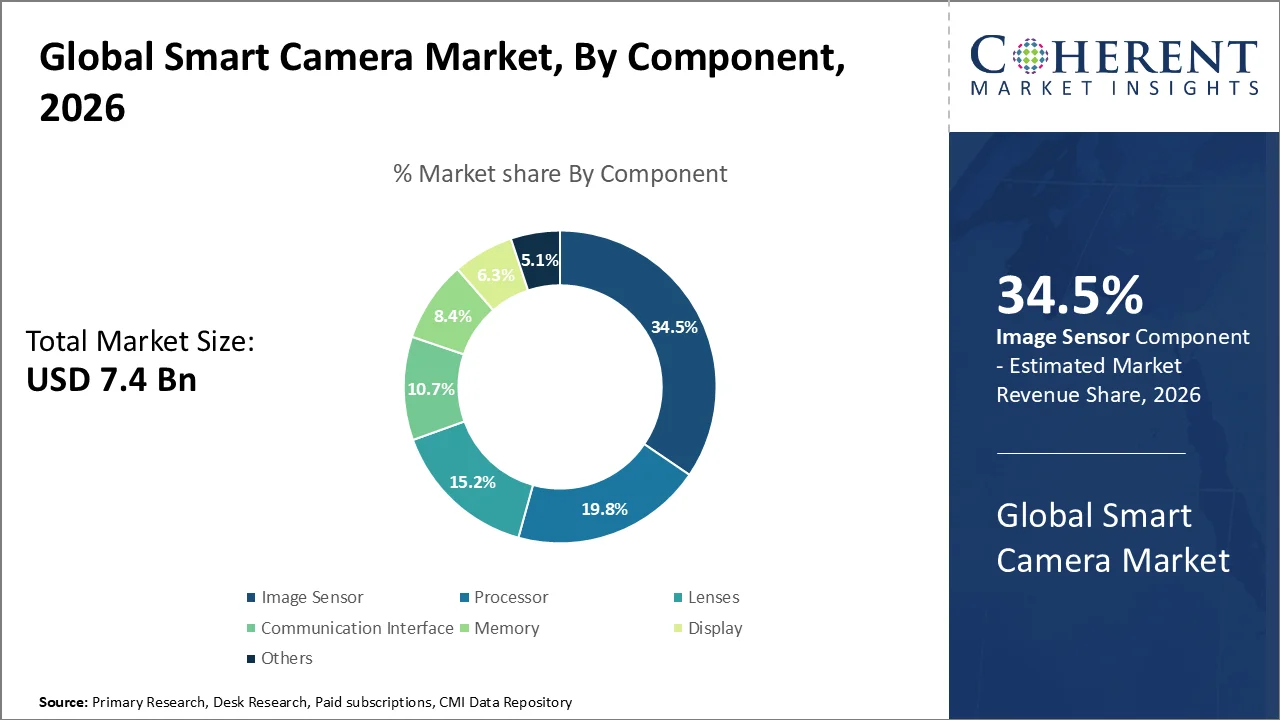
Why is Image Sensor Segment Acquiring the Largest Share?
On the basis of component, the image sensor segment is projected to account for the largest Smart Camera Market share of 34.5% in 2026. The segment’s growth is owing to their ability to determine resolution, low-light performance, dynamic range, frame rate, and the accuracy of embedded artificial intelligence analytics. The demand is strengthening across automotive vision, industrial inspection, traffic monitoring, retail analytics, and security applications.
In the U.S., NHTSA’s FMVSS No. 127 requires automatic emergency braking on passenger cars and light trucks by September 2029. NHTSA estimates the rule could save 360 lives annually and prevent 24,000 injuries each year, supporting deployment of camera-based sensing systems.
In May 2026, Sony Semiconductor Solutions and TSMC signed a memorandum of understanding to establish a strategic partnership for developing and manufacturing next-generation image sensors, including potential production lines in Kumamoto, Japan.
- Current Industry Events of 2026
- Market Size Estimation
- Regional Breakdown
- Competitive Landscape
- Customer Intelligence
- Segmental Analysis
- Pricing Analysis
- Key Market Drivers, Challenges & Future Trends
- Customized Insights Section
Commercial Area hold the Largest Market Share
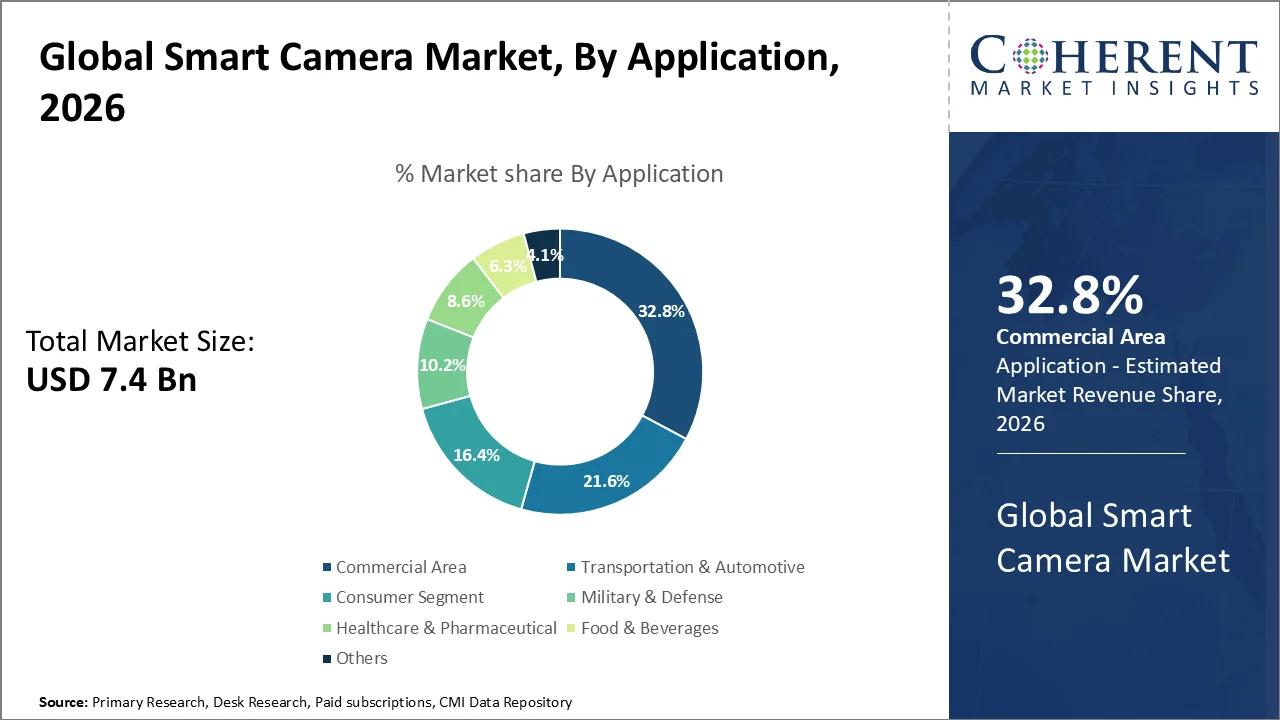
On the basis of application, the commercial area segment lead with a major 32.8% share in 2026. The growth is owing to the expanding deployment across retail stores, offices, hotels, warehouses, shopping centers, and other commercial facilities requiring real-time security, occupancy monitoring, customer-flow analysis, and loss prevention.
According to the U.S. Energy Information Administration’s Commercial Buildings Energy Consumption Survey, the United States had 5.9 million commercial buildings. These properties represented about 96.4 billion square feet of floorspace, indicating an addressable base for connected surveillance and analytics systems.
In March 2026, Axis Communications announced six AI-powered fisheye cameras designed to provide 360-degree coverage, reduce blind spots, and support advanced onboard analytics.
Market Drivers
Rising Innovations in Edge-Based Traffic Monitoring are Transforming the Smart Camera Market in the U.S.
The U.S. is emerging as an important innovation center for smart cameras that perform analytics at the device level. Municipalities, transportation authorities, retailers, logistics operators, manufacturers, and commercial property owners are evaluating edge-based systems which can interpret video without continuously transmitting complete footage to a centralized cloud platform.
The country’s large commercial and digital infrastructure base supports the technology adoption. The U.S. Census Bureau reported approximately 8.36 million business establishments in 2023. Its 2020–2024 QuickFacts data indicates that 91.0% of households maintained broadband subscriptions. The available data indicates that this combination of enterprise density and connectivity is creating favorable conditions for camera-as-a-sensor applications covering security, customer-flow analysis, workplace safety, automated checkout, logistics visibility, and building management.
In August 2025, Sony Semiconductor Solutions announced that its intelligent vision sensors and edge-AI technology were supporting traffic-safety initiatives in Lakewood, Colorado, and San José, California. The deployments were designed to detect vehicles and pedestrians in real time under challenging lighting and weather conditions. This allows the transportation stakeholders to evaluate road-user behavior and potential safety risks without depending solely on conventional video review.
Edge AI Intelligent Vision Sensors: A Major Breakthrough in the Smart Camera Market
Edge AI intelligent vision sensors combine image capture, signal processing, and artificial intelligence inference within the camera or imaging component. Conventional network cameras generally capture video and transmit footage to a server or cloud platform for analysis. Edge-enabled cameras can instead classify objects, detect movement patterns, recognize anomalies, count people, identify vehicles, or initiate alerts locally.
Sony’s IMX500 intelligent vision sensor integrates image sensing and AI processing capabilities on a single chip. According to Sony, the design can reduce dependence on high-performance external processors and continuous cloud transmission, thereby lowering infrastructure requirements while supporting privacy-conscious visual analytics.
In October 2025, Sony Semiconductor Solutions announced the IMX775, an RGB-IR image sensor developed for automotive in-cabin monitoring. The sensor offers approximately 5 effective megapixels, a 2.1-micrometer pixel size, and simultaneous visible and near-infrared imaging capability, with mass production scheduled for spring 2026.
Current Events and Their Impact
Current Event | Description and its Impact |
EU AI Act Restrictions on Biometric Surveillance and Facial Recognition
|
|
U.S. Cyber Trust Mark for Connected Security Cameras |
|
Smart Camera Market Trends
- The rising adoption of edge AI is allowing for real-time object detection, facial recognition, and behavioral analytics with lower latency.
- The integration with IoT platforms is assisting in improving the remote monitoring, automated alerts, as well as connected security management.
- The growing demand for intelligent video surveillance is strengthening the smart camera deployment in retail, transportation, manufacturing, smart homes, and public safety. Interoperability is improving, with the ONVIF ecosystem exceeding 35,000 conformant products in January 2026, thereby supporting the integration across cameras, software, and security platforms.
- Stronger cybersecurity and privacy regulations is encouraging the manufacturers to develop secure and compliant smart camera systems. The U.S. Cyber Trust Mark applies to eligible wireless consumer IoT devices including internet-connected home security cameras. In Europe, the EU AI Act becomes broadly applicable on August 2, 2026, introducing stricter requirements for high-risk AI systems and limiting biometric surveillance practices. This is increasing the compliance costs while strengthening customer trust and responsible adoption.
Regional Insights
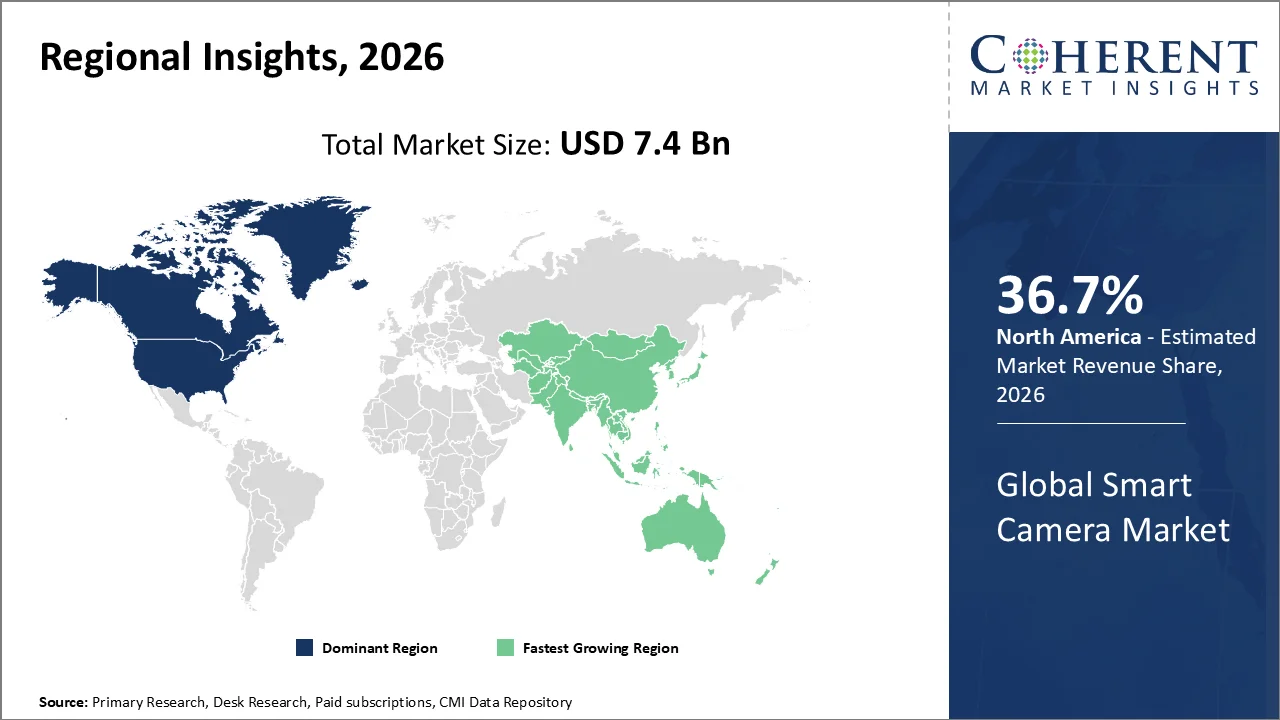
North America Dominates Owing to the Widespread Deployment
The North America region accounts for 36.7% of the market share in 2026. The region’s growth is owing to the widespread deployment across schools, transportation networks, commercial facilities, and public safety systems.
The U.S. National Center for Education Statistics reported that nearly 92.6% of public schools used security cameras during the 2021–22 school year, thereby highlighting the established demand base for intelligent video monitoring. The NHTSA also reported 39,254 U.S. Road fatalities in 2024, thus sustaining government and municipal interest in AI-enabled traffic monitoring, incident detection, as well as automated enforcement cameras.
In May 2026, Cognex launched the In-Sight 3900, an embedded AI vision system powered by Qualcomm Dragonwing technology. Offering up to 25 MP resolution and four-times-faster processing, it enables PC-free, real-time inspection for high-speed manufacturing applications across multiple industries worldwide.
Asia Pacific Smart Camera Market Trends
Asia Pacificis expected to witness strong growth in market over the forecast period. The region’s growth is owing to the expanding smart-city surveillance, traffic management, and public-security infrastructure.
India’s Ministry of Housing and Urban Affairs reported that more than 84,000 CCTV cameras had been installed across 100 Smart Cities by June 2025, alongside number-plate recognition and red-light enforcement systems. Singapore’s Land Transport Authority states that its Traffic Monitoring Camera System operates around 1,100 cameras at junctions and arterial roads, thereby providing real-time footage for incident verification as well as traffic management.
In June 2025, Honeywell launched its Made-in-India CCTV camera range, featuring AI analytics, 2MP-to-8MP imaging, night vision, edge storage, and IP67- and IK10-rated models. The locally manufactured portfolio targets homes, businesses, government facilities, smart cities, transport hubs, and critical infrastructure in India.
Demand for Automated Inspection is Accelerating the Smart Camera Market in United States
In the United States, the Smart Camera Market is influenced by the expanding AI-based traffic monitoring, infrastructure modernization, and demand for automated inspection. A June 2026 U.S. Department of Transportation implementation report stated that the Tahoe Transportation District plans to expand coverage to 21 AI video data stations, alongside 10 AI-enabled pedestrian crossings.
In June 2026, UnitX launched DeteX, an edge-AI smart camera designed for one-minute deployment in manufacturing inspection. The system combines AI segmentation, classification, OCR, counting, and 0.1 mm dimensional measurement to detect defects directly on production lines across global factories.
China Smart Camera Market Trends
China’s smart camera market is expanding as households, enterprises, transport operators, and public facilities adopt connected video systems with embedded artificial intelligence. The China Internet Network Information Center reported that about 22.6% of Chinese internet users accessed the internet through smart-home devices by December 2024, thereby indicating a sizeable installed base for app-connected cameras as well as related monitoring products.
In July 2025, Hangzhou-based Hikvision launched its DeepinViewX bullet cameras, integrating large-scale AI models to improve object classification, scene understanding, and alarm accuracy.
Who are the Major Companies in Smart Camera Industry
Some of the major key players in Smart Camera Market are XIMEA GmbH, Fujifilm Corporation, Samsung Electronics Co., Ltd., Matrox Imaging, Canon Inc., Vision Components GmbH, Nikon Corporation, Microscan Systems, Inc., Sony Corporation, Hero Electronix Polaroid Corporation, Panasonic Corporation, and Olympus Corporation.
Key News
- In May 2026, Hanwha Vision launched its second-generation X Series AI compact cameras, combining a slim 120 mm design with advanced dual-NPU analytics and real-time privacy masking. Models offer 2MP, 5MP, and 8MP resolution, infrared, IP66 protection, and IK10 durability.
- In August 2025, Arlo Technologies launched a new AI-powered smart home security lineup including indoor and outdoor Pan Tilt cameras with 360-degree coverage. The range also introduced upgraded Essential, Pro, as well as Ultra models featuring up to 4K HDR resolution capabilities.
- In June 2025, Meta partnered with Oakley to launch Oakley Meta HSTN AI-powered smart glasses featuring a hands-free high-resolution camera, open-ear speakers, water resistance, and Meta AI.
Market Report Scope
Smart Camera Market Report Coverage
| Report Coverage | Details | ||
|---|---|---|---|
| Base Year: | 2025 | Market Size in 2026: | USD 7.4 Bn |
| Historical Data for: | 2020 To 2024 | Forecast Period: | 2026 To 2033 |
| Forecast Period 2026 to 2033 CAGR: | 11% | 2033 Value Projection: | USD 15.3 Bn |
| Geographies covered: |
| ||
| Segments covered: |
| ||
| Companies covered: | XIMEA GmbH, Fujifilm Corporation, Samsung Electronics Co., Ltd., Matrox Imaging, Canon Inc., Vision Components GmbH, Nikon Corporation, Microscan Systems, Inc., Sony Corporation, Hero Electronix Polaroid Corporation, Panasonic Corporation, and Olympus Corporation. | ||
| Growth Drivers: |
| ||
| Restraints & Challenges: |
| ||
Analyst Opinion
- Smart camera growth is tied to industrial automation. In 2024, factories installed 542,000 industrial robots, while the operational stock reached 4.66 million units. Machine vision cameras are therefore becoming essential for robotic guidance, defect inspection, worker safety, and production monitoring across automated facilities.
- Enterprise AI adoption is broadening the addressable customer base. In 2025, nearly 20.0% of EU enterprises used AI technologies, thus rising from 13.5% in 2024. Also, the adoption among large enterprises reached 55.0%. This indicates stronger readiness to deploy AI-enabled cameras for security, analytics, quality control, as well as customer intelligence.
- Connectivity and edge-computing advances will speed up the adoption. The global 5G subscriptions surpassed 3 billion during the first quarter of 2026, thereby supporting faster video transmission and remote monitoring. Meanwhile, the edge platforms delivering up to 275 TOPS allow smart cameras to process analytics locally, reducing cloud dependence, bandwidth consumption, and response time.
Speak to the analyst
Want personalized insights?
Take the findings above to one of our principal consultants, or have the report rebuilt around the segments, geographies and competitors you actually track.
Market Segmentation
- By Component (Revenue, USD Bn, 2021-2033)
- Image Sensor
- Memory
- Processor
- Communication Interface
- Lenses
- Display
- Others
- By Application (Revenue, USD Bn, 2021-2033)
- Transportation & Automotive
- Healthcare & Pharmaceutical
- Food & Beverages
- Military & Defense
- Commercial Area
- Consumer Segment
- Others
- Global Smart Camera Market, By Region (Revenue, USD Bn, 2021-2033)
- North America
- U.S.
- Canada
- Latin America
- Brazil
- Mexico
- Argentina
- Rest of Latin America
- Europe
- Germany
- U.K.
- France
- Italy
- Spain
- Russia
- Rest of Europe
- Asia Pacific
- China
- India
- Japan
- Australia
- South Korea
- ASEAN
- Rest of Asia Pacific
- Middle East
- GCC
- Israel
- Rest of Middle East
- Africa
- South Africa
- Central Africa
- North Africa
- North America
- Key Players
- XIMEA GmbH
- Fujifilm Corporation
- Samsung Electronics Co., Ltd.
- Matrox Imaging
- Canon Inc.,
- Vision Components GmbH
- Nikon Corporation
- Microscan Systems, Inc.
- Sony Corporation
- Hero Electronix
- Polaroid Corporation
- Panasonic Corporation
- Olympus Corporation
Sources
Primary Research Interviews
- Smart camera manufacturers and original equipment manufacturers (OEMs)
- Machine vision system integrators
- Artificial intelligence and computer vision software providers
- Image sensor and semiconductor suppliers
- Industrial automation and robotics companies
- Security and surveillance solution providers
- Smart camera distributors and channel partners
- Key opinion leaders (KOLs) in machine vision, embedded vision, and computer vision
Databases
- International Telecommunication Union (ITU)
- Organisation for Economic Co-operation and Development (OECD)
- World Bank
- United Nations Comtrade Database
- Eurostat
- U.S. Census Bureau
- National Institute of Standards and Technology (NIST)
- World Intellectual Property Organization (WIPO)
Magazines
- Vision Systems Design
- Security Today
- SDM Magazine
- SecurityInfoWatch
- Industrial Equipment News
- Electronic Design
- Control Engineering
Journals
- IEEE Transactions on Pattern Analysis and Machine Intelligence
- IEEE Transactions on Image Processing
- Machine Vision and Applications
- Journal of Electronic Imaging
- International Journal of Computer Vision
- Journal of Real-Time Image Processing
Newspapers
- The Wall Street Journal
- The New York Times
- Financial Times
- The Guardian
- Nikkei Asia
- South China Morning Post
Associations
- Association for Advancing Automation (A3)
- Automated Imaging Association (AIA)
- Edge AI and Vision Alliance
- Security Industry Association (SIA)
- International Association of Chiefs of Police (IACP)
- Institute of Electrical and Electronics Engineers (IEEE)
- European Machine Vision Association (EMVA)
Public Domain Sources
- Company annual reports and investor presentations
- Government industrial automation and electronics publications
- International trade and customs databases
- Patent databases such as WIPO PATENTSCOPE and Google Patents
- Government procurement and public surveillance project databases
- Product certification and regulatory authority publications
- Technical standards published by ISO, IEC, IEEE, and ONVIF
- Company product launches, press releases, and technical datasheets
Proprietary Elements
- CMI Data Analytics Tool
- Proprietary CMI Existing Repository of Information for Last 10 Years
Get access to 250+ pages report
Every segment, forecast, competitor profile and data table behind the analysis above — available for instant download.
- ESOMAR Member
- ISO 9001:2015 Certified
- D-U-N-S Registered
- GDPR & CCPA Compliant
Missing comfort of reading report in your local language? Find your preferred language:
Transform your Strategy with Exclusive Trending Reports
Frequently Asked Questions
The Smart Camera Market is expected to reach USD 15.3 Billion in 2033.
The privacy concerns, cybersecurity vulnerabilities, high upfront and maintenance costs, and technical interoperability issues are the key factors hampering growth of the market.
The integration of Edge AI, a booming smart home ecosystem, and the urgent need for robust surveillance is boosting the demand for Smart Camera.
The Smart Camera Market is anticipated to grow at a CAGR of 11% between 2026 and 2033.
The market outlook remains positive due to surge in AI-powered edge computing, rising global security and automation needs, and integration with 5G connectivity across residential, retail, and industrial sectors.
The Smart Camera Market covers imaging devices that combine camera hardware with processing, connectivity, software, or artificial intelligence capabilities. These cameras can capture and analyze visual information, communicate results, automate alerts, or support operational decisions across commercial, residential, industrial, automotive, public-infrastructure, and consumer applications.
Among regions, North America is expected to account for a largest market share in the global Smart Camera Market over the forecast period.