

Smart Irrigation Market Size and Forecast – 2026 to 2033
The Smart Irrigation Market is anticipated to grow at a CAGR of 14.2% with USD 3.4 Bn share in 2026 and is expected to reach USD 7.2 Bn in 2033. Water scarcity and the growing need for efficient water management are accelerating smart irrigation adoption. Approximately 4 Bn people, nearly two-thirds of the global population, experience severe water scarcity for at least one month each year.
Key Takeaways
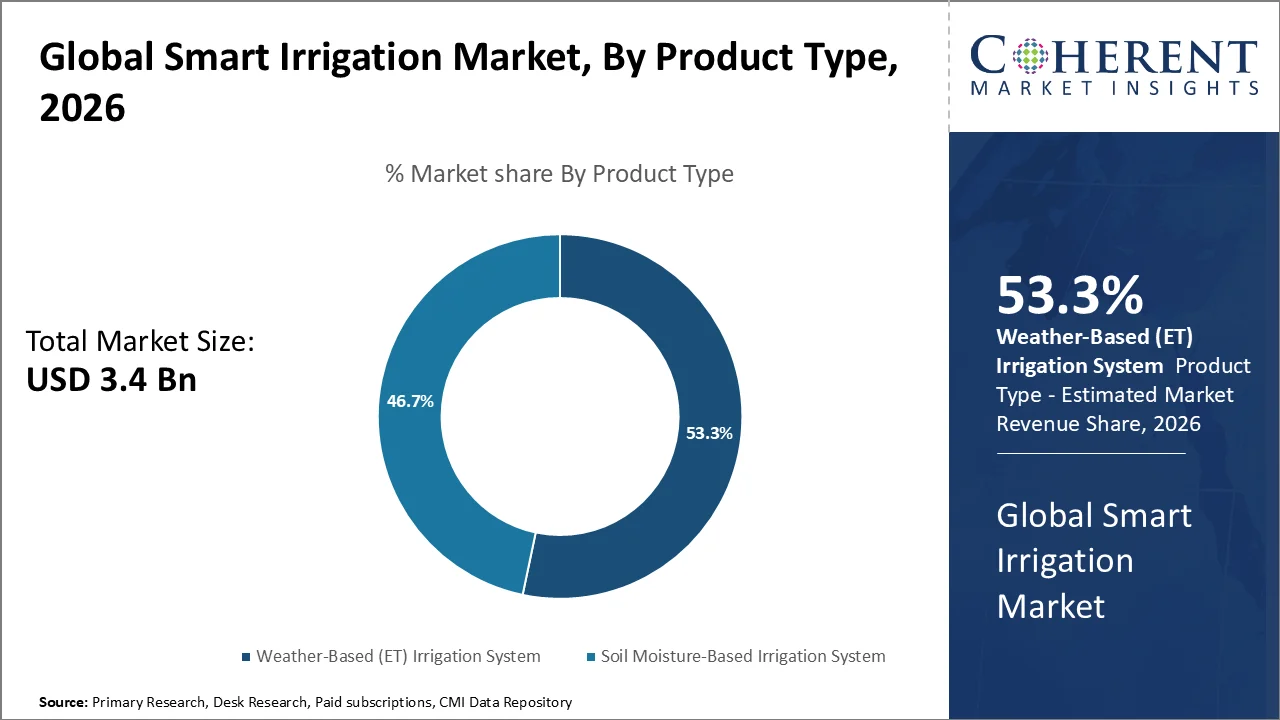
- Weather-Based (ET) Irrigation System hold the largest market share of 53.3% in 2026 owing to its growing water scarcity and pressure on freshwater resources. According to a 2025 World Vision article, women and girls collectively spend an estimated 250 million hours each day collecting water, walking an average of 6 kilometers (3.7 miles) while carrying approximately 44 pounds (20 kg) of water.
- Weather-Based Controllers expected to hold largest market share of 52.7% in 2026 owing to the rising adoption of smart irrigation.
- Hardware Components acquired the prominent market share of 37.5% in 2026 owing to its rapid IoT adoption.
- Agricultural captures the largest market share of 54.7% in 2026 owing to the climate change and rainfall variability. Rainfall conditions varied considerably from year to year between 2003 and 2024. Of the 22 years analyzed, 12 years (54.55%) recorded dry conditions (SPI < 0), while 10 years (45.45%) were classified as wet (SPI > 0). Moderate drought occurred in 2 years (9.09%), with no severe drought events recorded during the study period.
- Asia Pacific is expected to acquire the dominant share of 42.7% in 2026 owing to the large agricultural base. India is the world’s second-largest agricultural producer, with agriculture employing approximately 42% of the workforce and contributing around 17–18% of the country’s GDP.
Current Events and Their Impact on the Smart Irrigation Market
Current Event | Description and its Impact |
India Sets Target to Bring 100 Lakh Hectares Under Micro-Irrigation by 2029–30 |
|
EU 2025 Water Resilience Strategy Places Greater Emphasis on Water Efficiency |
|
Segmental Insights
- Current Industry Events of 2026
- Market Size Estimation
- Regional Breakdown
- Competitive Landscape
- Customer Intelligence
- Segmental Analysis
- Pricing Analysis
- Key Market Drivers, Challenges & Future Trends
- Customized Insights Section
Why is Weather-Based (ET) Irrigation System Acquiring the Largest Market Share?
Weather-Based (ET) Irrigation System hold the largest market share of 53.3% in 2026. Weather-based (ET) irrigation systems gain momentum as users seek water conservation, efficient irrigation, and automated water management. These systems analyze weather data and evapotranspiration conditions to adjust irrigation schedules according to actual water requirements, helping users minimize overwatering and runoff. Climate variability, drought, rising water costs, and the growing adoption of smart agriculture and IoT technologies further increase demand. By integrating weather sensors, remote connectivity, and automated controllers, these systems improve irrigation precision and convenience, supporting their adoption across agricultural, residential, and commercial applications. For instance, The IMD launched two new services, including an AI-powered monsoon forecasting system that provides rainfall updates and localised weather information up to four weeks ahead for farmers in 16 states and over 3,000 sub-districts.
Weather-Based Controllers expected to hold largest market share
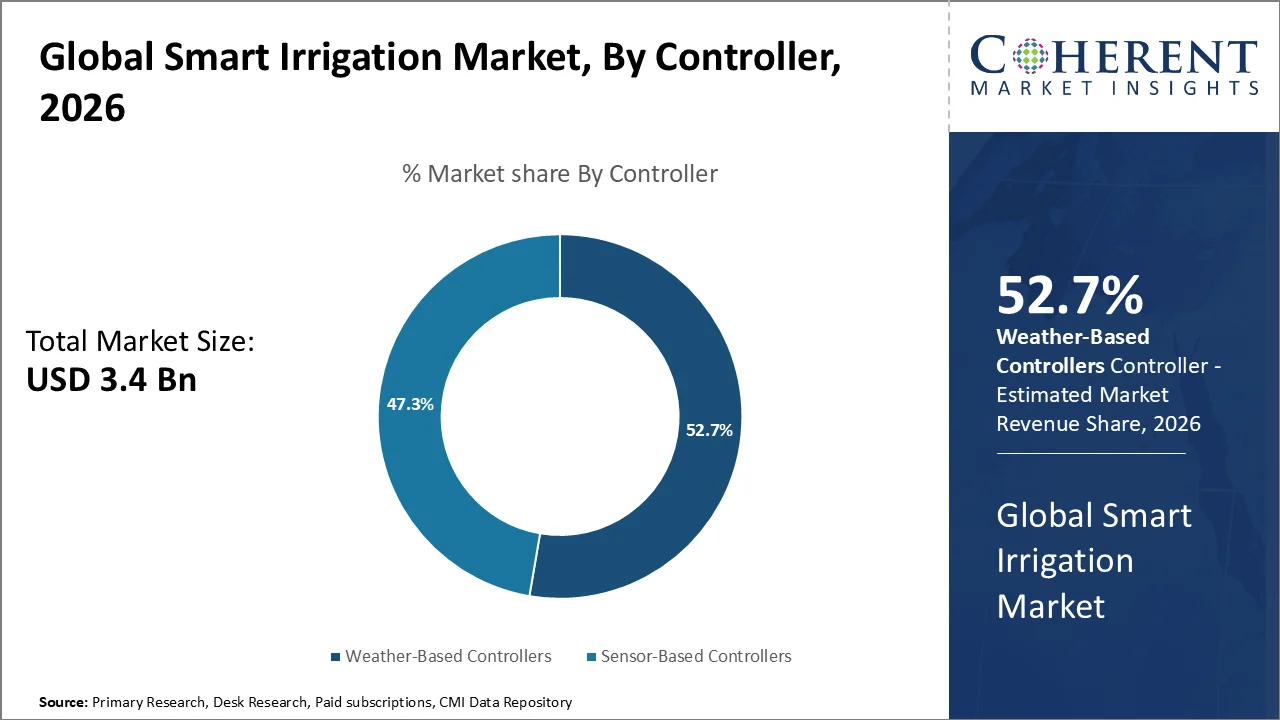
Weather-Based Controllers expected to hold largest market share of 52.7% in 2026 owing to the increasing demand for automation. Weather-based controllers gain traction as users seek water conservation, efficient irrigation, and automated scheduling. These controllers monitor local weather and landscape conditions to adjust irrigation timing, frequency, and duration, enabling users to reduce overwatering and water waste. Climate variability, drought, rising water costs, and growing adoption of smart irrigation technologies further increase demand. According to the U.S. Environmental Protection Agency (EPA), weather-based irrigation controllers (WBICs) improve irrigation efficiency by adjusting watering schedules based on local weather conditions.
Hardware Components acquired the prominent market share
Hardware Components acquired the prominent market share of 37.5% in 2026 owing to its expansion of wireless connectivity. Hardware components in the smart irrigation market gain demand as users prioritize water conservation, precise irrigation, and automated water management. IoT-enabled sensors, smart controllers, flow meters, valves, and communication devices provide real-time monitoring and optimize water delivery. Farmers and property managers increasingly adopt automation and precision farming to address water scarcity and climate variability. Technological advancements improve sensor accuracy and wireless connectivity, while lower equipment costs make smart irrigation hardware more accessible across agricultural, residential, and commercial applications.
Which Applications segment dominates the market?
Agricultural captures the largest market share of 54.7% in 2026. Agriculture drives the smart irrigation market as farmers seek greater water efficiency, higher crop productivity, and sustainable farming practices. Water scarcity, climate variability, and growing food demand encourage farmers to adopt precision irrigation technologies that optimize water use based on soil, crop, and weather conditions. IoT-enabled sensors, automated controllers, and data-driven systems help farmers manage resources efficiently and minimize water losses. Farmers also increasingly adopt precision agriculture, automation, and modern irrigation techniques, further accelerating smart irrigation deployment across agricultural applications.
Smart Irrigation Market Trends
- Integration of soil-moisture, weather, and evapotranspiration (ET) sensors enables more precise irrigation decisions based on field and environmental conditions, helping reduce unnecessary watering. The U.S. EPA recognizes weather-based and soil-moisture-based irrigation controllers under its WaterSense program. EPA estimates that replacing a standard clock-based controller with a WaterSense-labeled controller can save an average home up to 15,000 gallons of water annually.
- Increasing water scarcity and climate variability accelerate demand for smart irrigation solutions as farmers, municipalities, and property owners seek to optimize water consumption. FAO reported in December 2025 that renewable water availability per person had declined by 7% over the previous decade, indicating increasing pressure on freshwater resources.
- Integration of smart irrigation with drip and micro-irrigation systems improves water-delivery precision and supports efficient irrigation practices, particularly in water-stressed agricultural regions. The EEA reports that replacing surface irrigation with drip irrigation can save approximately 10–40% of the water currently used, depending on the circumstances.
Regional Insights
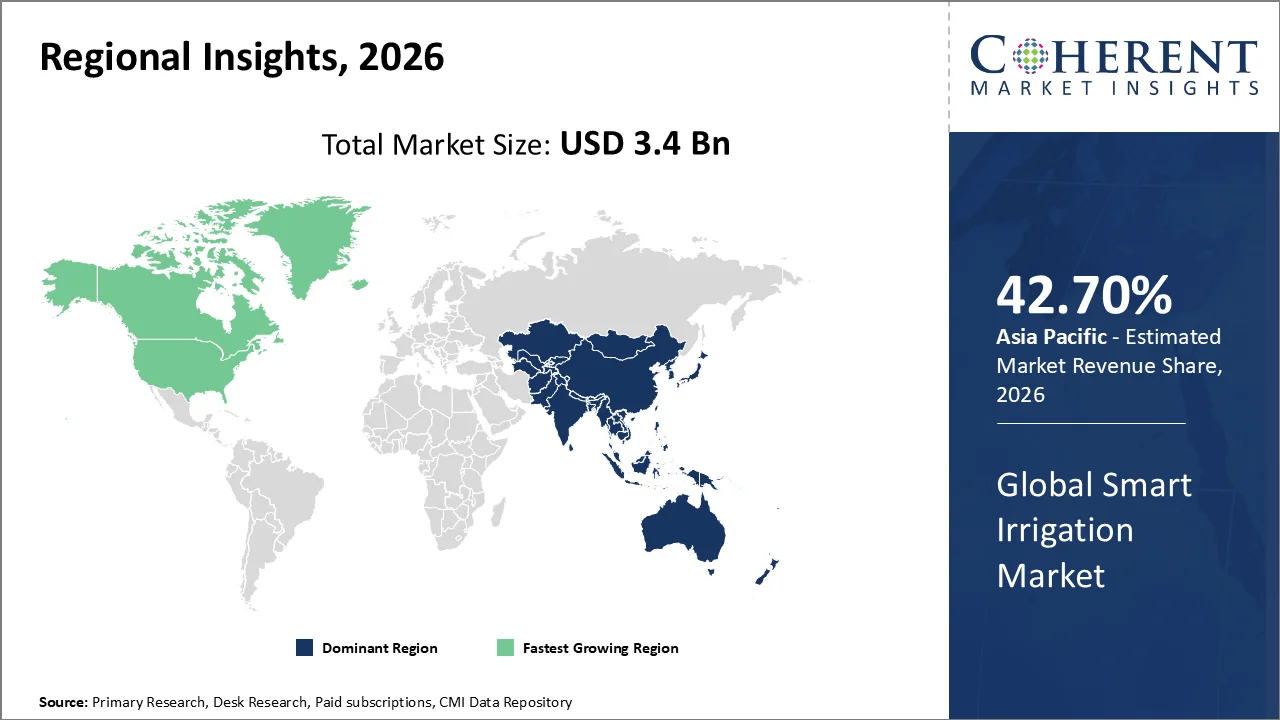
Asia Pacific dominates owing to increasing water scarcity and climate stress
Asia Pacific is expected to acquire the dominant share of 42.70% in 2026. Rising water scarcity, climate change, and the need to manage agricultural water efficiently drive the Asia-Pacific smart irrigation market. Increasing food demand and the need to boost crop productivity encourage farmers to adopt precision irrigation technologies. Governments support market growth through subsidies, water-conservation initiatives, and investments in digital agriculture across countries such as India, China, and Vietnam. Meanwhile, lower sensor costs, wider IoT connectivity, and advances in AI and automation help farmers monitor irrigation in real time, optimize water use, and improve overall farm management. RM Drip and Sprinklers Systems Limited has entered the IoT-based smart irrigation and digital agriculture automation sector through a strategic technology partnership.
North America Smart Irrigation Market Trends
North America’s smart irrigation market is gaining momentum as water scarcity increases, organizations prioritize efficient water management, and farmers adopt precision agriculture. Governments and states promote water-efficient technologies through conservation initiatives, while IoT-enabled controllers, soil-moisture sensors, weather-based systems, and cloud platforms help users automate irrigation and make data-driven decisions. Investments in sustainable agriculture, drought-resilient infrastructure, and smart landscaping further accelerate adoption. Demand from farms, golf courses, commercial landscapes, public parks, and residential properties also continues to drive the market’s growth across the region. FarmHQ, a Washington-based agtech startup, raised USD 500,000 to expand its irrigation technology business, bringing total funding to nearly USD 5 million. The company now serves over 200 customers across four countries and has more than doubled its revenue year over year.
India Smart Irrigation Market Trends
India’s smart irrigation market is expanding as farmers address water scarcity, groundwater depletion, and the need for efficient water management. Government initiatives such as PMKSY and Per Drop More Crop promote adoption by providing financial support and encouraging water conservation. Farmers increasingly use IoT, sensors, automation, and AI to improve irrigation precision and monitor fields remotely. The growing adoption of precision farming, high-value horticulture, and resource-efficient practices, along with labor shortages, rising energy costs, climate variability, and greater awareness of productivity gains, continues to drive market growth. Netafim India has launched its Flexi Sprinkler Kit for field-crop irrigation, aiming to reach 15,000 farmers and cover 15,000 hectares across India.
United States Smart Irrigation Market Trends
The United States smart irrigation market is expanding as water scarcity, recurring droughts, and the need for efficient water management increase across agriculture and landscaping. Government conservation programs and regulations encourage users to adopt advanced irrigation solutions. In March 2024, the Biden administration announced a Colorado River Basin conservation plan targeting at least 3 million acre-feet of water savings through the end of 2026, supported by investments under the Inflation Reduction Act and Bipartisan Infrastructure Law. Farmers and property managers increasingly use IoT devices, soil-moisture sensors, weather-based controllers, AI, and cloud platforms to automate watering and monitor systems remotely.
Who are the Major Companies in Smart Irrigation Industry
Some of the major key players in Smart Irrigation are Hydropoint Data System, Rain Bird Corporation, Hunter Industries , Galcon, Weathermatic, Rachio, the Toro Company, Calsense, Netafim, Baseline Inc., Aqua Spy, Libelium, and Aquacell Systems.
Key News
- In August 2026, Netafim has launched GrowSphere FLEX, a smart irrigation and fertigation controller designed to provide digital farming tools to small and mid-sized farmers.
Market Report Scope
Smart Irrigation Market Report Coverage
| Report Coverage | Details | ||
|---|---|---|---|
| Base Year: | 2025 | Market Size in 2026: | USD 3.4 Bn |
| Historical Data for: | 2020 To 2024 | Forecast Period: | 2026 To 2033 |
| Forecast Period 2026 to 2033 CAGR: | 14.2% | 2033 Value Projection: | USD 7.2 Bn |
| Geographies covered: |
| ||
| Segments covered: |
| ||
| Companies covered: | Hydropoint Data System, Rain Bird Corporation, Hunter Industries , Galcon, Weathermatic, Rachio, the Toro Company, Calsense, Netafim, Baseline Inc., Aqua Spy, Libelium, and Aquacell Systems. | ||
Analyst Opinion
- Smart irrigation is becoming a necessity rather than a technology upgrade. In the United States, more than 28 million homes have in-ground sprinkler systems, while inefficient outdoor irrigation can waste up to 50% of water. This creates a substantial replacement opportunity because traditional clock-based controllers remain widely deployed. EPA estimates that replacing these systems with WaterSense-labeled smart controllers can save an average home up to 15,000 gallons of water annually, making water savings a direct economic justification for adoption.
- The strongest growth opportunity lies in converting legacy irrigation infrastructure into intelligent systems. EPA estimates that roughly 90% of the 28.8 million U.S. irrigation systems were controlled by standard clock timers and could be candidates for smart irrigation technologies. This tells me the market is still largely an upgrade story rather than a saturated replacement cycle. The commercial case is equally compelling: a 372,000-square-foot office complex in Dallas saved 12.5 million gallons of water and USD 47,000 in its first year after deploying a weather-based irrigation controller.
- Agriculture will increasingly push smart irrigation toward precision-based water management. The United States had 54.9 million acres of irrigated agricultural land in 2022, making irrigation efficiency strategically important as water constraints intensify. USDA data show that water use per irrigated acre fell from more than 2 acre-feet in 1969 to 1.52 acre-feet in 2023, with pressurized irrigation and improved application technologies contributing to the decline. I believe the next competitive advantage will come from combining sensors, automation, weather intelligence, and data analytics to optimize when and where water is applied.
Speak to the analyst
Want personalized insights?
Take the findings above to one of our principal consultants, or have the report rebuilt around the segments, geographies and competitors you actually track.
Market Segmentation
- By Product Type (Revenue, USD Bn, 2021-2033)
- Weather-Based (ET) Irrigation System
- Soil Moisture-Based Irrigation System
- By Controller (Revenue, USD Bn, 2021-2033)
- Sensor-Based Controllers
- Weather-Based Controllers
- By Component (Revenue, USD Bn, 2021-2033)
- Hardware Components
- Software Components
- Smart Detection System
- Water/Flow Meter
- Sensor
- By Applications (Revenue, USD Bn, 2021-2033)
- Agricultural
- non-agricultural
- By Region (Revenue, USD Bn, 2021-203)
- North America
- U.S.
- Canada
- Latin America
- Brazil
- Mexico
- Argentina
- Rest of Latin America
- Europe
- Germany
- U.K.
- France
- Italy
- Spain
- Russia
- Rest of Europe
- Asia Pacific
- China
- India
- Japan
- Australia
- South Korea
- ASEAN
- Rest of Asia Pacific
- Middle East
- GCC
- Israel
- Rest of Middle East
- Africa
- South Africa
- Central Africa
- North Africa
- North America
Sources
Primary Research interviews
- Interviews with irrigation system manufacturers and solution providers
- Interviews with smart irrigation technology providers and IoT solution companies
- Interviews with drip and sprinkler irrigation equipment manufacturers
- Interviews with agricultural technology and precision-agriculture solution providers
- Interviews with farmers, farm operators, greenhouse operators, and agricultural cooperatives
- Interviews with irrigation consultants, agronomists, agricultural engineers, and water-management specialists
- Interviews with distributors, dealers, system integrators, and channel partners
- Interviews with government officials and representatives involved in agriculture, irrigation, and water-resource management
- Interviews with technology specialists covering IoT, sensors, automation, connectivity, AI, and remote monitoring
Databases
- FAO AQUASTAT – global database covering water resources, water use, irrigation, drainage, and agricultural water management.
- FAOSTAT – agricultural production, land use, irrigation-related and socioeconomic agricultural statistics
- World Bank DataBank – agriculture, water resources, infrastructure, GDP, population, and development indicators
- United Nations Data – population, agriculture, water, climate, and socioeconomic indicators
- USDA National Agricultural Statistics Service (NASS) – agricultural production, farm characteristics, irrigation, and water-use statistics
- USDA Economic Research Service (ERS) – agricultural economics, farm-sector data, water and resource-use information
- U.S. Geological Survey (USGS) – water-use, groundwater, surface-water, and irrigation datasets
- India Ministry of Agriculture & Farmers Welfare databases and agricultural statistics
- India Ministry of Jal Shakti – water-resource and irrigation-related statistics
- International Water Management Institute (IWMI) databases and water-management resources
- World Resources Institute (WRI) – water-stress and water-resource datasets
- International Energy Agency (IEA) – energy and electricity data relevant to irrigation pumping and agricultural energy consumption
- Scopus, Web of Science, IEEE Xplore, and ScienceDirect for academic publication and technology-trend analysis
Magazines
- Irrigation & Green Industry
- Irrigation Association publications
- Irrigation Today
- AgWeb
- Successful Farming
- Farm Journal
- Modern Farmer
- Agriculture Technology Magazine
- PrecisionAg
- Future Farming
- The Grower
- Agricultural industry trade publications covering irrigation, precision agriculture, IoT, sensors, automation, and farm technology
Journals
- Agricultural Water Management
- Irrigation and Drainage
- Irrigation Science
- Journal of Irrigation and Drainage Engineering
- Computers and Electronics in Agriculture
- Precision Agriculture
- Biosystems Engineering
- Agricultural Engineering International: CIGR Journal
- Sensors
- IEEE Internet of Things Journal
- IEEE Access
- Sustainability
- Journal of Cleaner Production
- Water
- Remote Sensing
- Discover Internet of Things
Newspapers
- The Economic Times
- Business Standard
- The Hindu
- The Indian Express
- Financial Times
- The Wall Street Journal
- Reuters
- Bloomberg
- Associated Press
- The Times of India
- Agriculture-focused national and regional newspapers
- Local publications covering agricultural policy, drought, water availability, irrigation infrastructure, and technology adoption
Associations
- Irrigation Association (IA)
- American Society of Agricultural and Biological Engineers (ASABE)
- International Commission on Irrigation and Drainage (ICID)
- International Water Management Institute (IWMI)
- International Society for Precision Agriculture (ISPA)
- IEEE
- International Society for Horticultural Science (ISHS)
- National Association of State Departments of Agriculture (NASDA)
- Agricultural and Processed Food Products Export Development Authority (APEDA)
- Federation of Indian Chambers of Commerce & Industry (FICCI) – agriculture and water-related industry resources
- Confederation of Indian Industry (CII) – agriculture, water, and technology resources
Public Domain sources
- Food and Agriculture Organization of the United Nations (FAO) – AQUASTAT and agricultural statistics.
- World Bank – agriculture, water, infrastructure, population, and economic indicators
- United Nations – demographic, climate, Sustainable Development Goal, and socioeconomic datasets
- United States Department of Agriculture (USDA)
- U.S. Geological Survey (USGS)
- U.S. Environmental Protection Agency (EPA)
- National Oceanic and Atmospheric Administration (NOAA)
- India Ministry of Agriculture & Farmers Welfare
- India Ministry of Jal Shakti
- Government of India – Department of Agriculture & Farmers Welfare
- Government of India – Department of Water Resources, River Development & Ganga Rejuvenation
- Indian Council of Agricultural Research (ICAR)
- National Statistical Office (NSO), India
- NITI Aayog
- Central Water Commission (CWC), India
- Central Ground Water Board (CGWB), India
- International Water Management Institute (IWMI)
- World Resources Institute (WRI)
- Open government datasets and publicly available regulatory, agricultural, irrigation, water-resource, climate, and trade statistics
Proprietary Elements
- CMI Data Analytics Tool
- Proprietary CMI Existing Repository of information for last 10 years
Get access to 250+ pages report
Every segment, forecast, competitor profile and data table behind the analysis above — available for instant download.
- ESOMAR Member
- ISO 9001:2015 Certified
- D-U-N-S Registered
- GDPR & CCPA Compliant
Missing comfort of reading report in your local language? Find your preferred language:
Transform your Strategy with Exclusive Trending Reports
Frequently Asked Questions
The Smart Irrigation Market is anticipated to grow at a CAGR of 14.2% with USD 3.4 Bn share in 2026 and is expected to reach USD 7.2 Bn in 2033.
Smart irrigation uses technologies such as soil-moisture sensors, and automated valves to determine when and how much water an irrigation system should apply.
Key drivers include water scarcity, rising irrigation costs, pressure to improve water-use efficiency, increasing adoption of IoT and precision agriculture, and government-led water conservation initiatives.
EPA estimates that replacing conventional controllers with WaterSense-labeled soil-moisture controllers can save an average home more than 15,000 gallons of water annually, while weather-based controllers can save nearly 7,600 gallons annually.
Soil-moisture sensing and weather-based irrigation controllers remain important technologies, while IoT connectivity, cloud platforms, artificial intelligence, and predictive analytics are expanding system capabilities.
Agriculture represents a major opportunity because smart irrigation can help growers optimize water application while maintaining crop productivity.